Here we are at the end of 2025, so it’s time for quick wrap-up of the most important things that happened this year for urbanism and transport in our city.
A huge thank you to everyone who has visited the blog, shared our work, and supported us in our mission to make a greater Tāmaki Makaurau. We couldn’t do it without you!
A reminder: Greater Auckland’s work is delivered largely pro-bono, and made possible by generous donations from our readers and fans.
We’re now a registered charity, so your donations are tax-deductible. If you’d like to support our work – and, what better time of year to make a gift for a better world? – you can join our circle of supporters here, or support us on Substack.
You can also follow us on pretty much every social channel.
Politics
Local Body Elections
Auckland’s local body elections delivered the least competitive mayoral election we’ve seen, resulting in Mayor Wayne Brown being re-elected with over 50% of the vote. That said, this election saw the lowest turnout so far, with fewer than 29% of eligible people voting. (See full results here).
There was a bit more competition at the councillor level, with four old hands stepping down – Angela Dalton, Chris Darby and Sharon Stewart, while Kerrin Leoni stood for Mayor instead. And Wayne Walker, who has been around the council table since the inaugural election in 2010, lost his seat.
The five new faces at the table are John Gillon (North Shore), Matt Winiata (Manurewa-Papakura), Bo Burns (Howick), Sarah Paterson-Hamlin (Whau), and Victoria Short (Albany).
It remains to be seen just how this new line-up will tackle the many major issues council will face this term, which include:
- the latest plans to enable more housing, via Plan Change 120, which we’ll be following closely in the New Year along with our friends at Coalition For More Homes homies, and
- the changes to Auckland Transport governance, which will put more responsibility in the hands of council (overseen by a regional board, with government hand-picking key members).
Local boards are also set to have somewhat more say over local streets, albeit not necessarily the budget to support their visions. This will be interesting to watch, as local support for street improvements is often stronger than headlines would have us believe. For example, two local board areas that saw a number of supposedly “controversial” improvements were strongly regained by the safe-streets-forward City Vision ticket: Albert-Eden, and the central city rohe of Waitematā.
Meanwhile, out south, Papatoetoe-Ōtara saw some highly unusual numbers, leading to a court case that voided the result. A new by-election will be held in early 2026 – and the whole thing has re-ignited interest in better ways to run local elections.
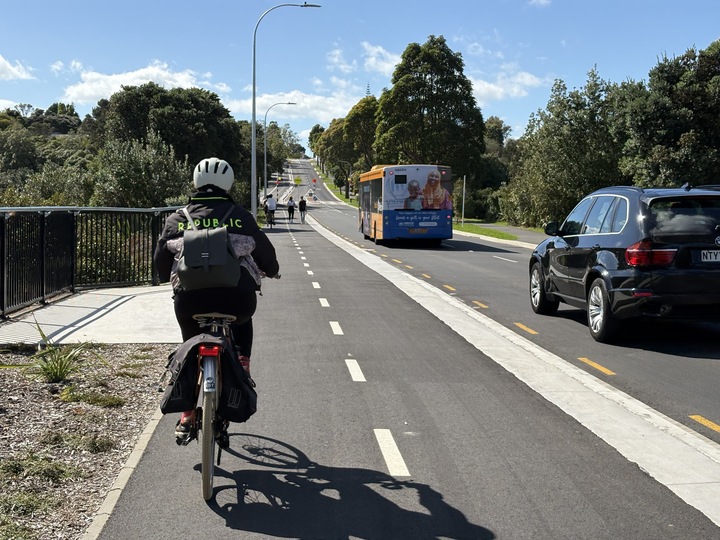
The rebuilt Meola Road – a winning outcome? Image: Jolisa Gracewood
A New Minister of Transport
One of the first of the big things that happened in early 2025 was a cabinet reshuffle by Prime Minister Christopher Luxon which saw probably the most fanatically ideological transport minister New Zealand has ever seen – Simeon Brown – replaced with the government’s most urbanist minister, Chris Bishop.
This hasn’t resulted in any significant change to transport policy, however. Notably Bishop did not intervene in the mass reversal of evidence-based safe speeds across Auckland and elsewhere, despite strong representations from the community.
Auckland Transport Governance Changes
Late in 2024, Mayor Wayne Brown and then-Minister of Transport (and still Minister for Auckland) Simeon Brown announced a shake up of Auckland Transport that would, among other things, see the policy and planning functions of Auckland Transport shifted back to the council.
The council would become the local Road-Controlling Authority (RCA), while AT would continue to exist as a council-controlled organisation focused on delivering transport projects and services.
In September, it was announced the changes would be stepped up a notch, with the delivery of projects and maintenance also now shifting back to the council – leaving AT solely focused on the delivery of public transport.
Lots of questions remain about how this will function in practice, including how best to prioritise arterials for public transport efficiency, how local streets will be treated, and who’s in charge of coordinating safety and access for people walking and cycling.
Public Transport
Pukekohe
In February, electric trains finally rolled into Pukekohe following a two-year closure to electrify the line and upgrade the station.
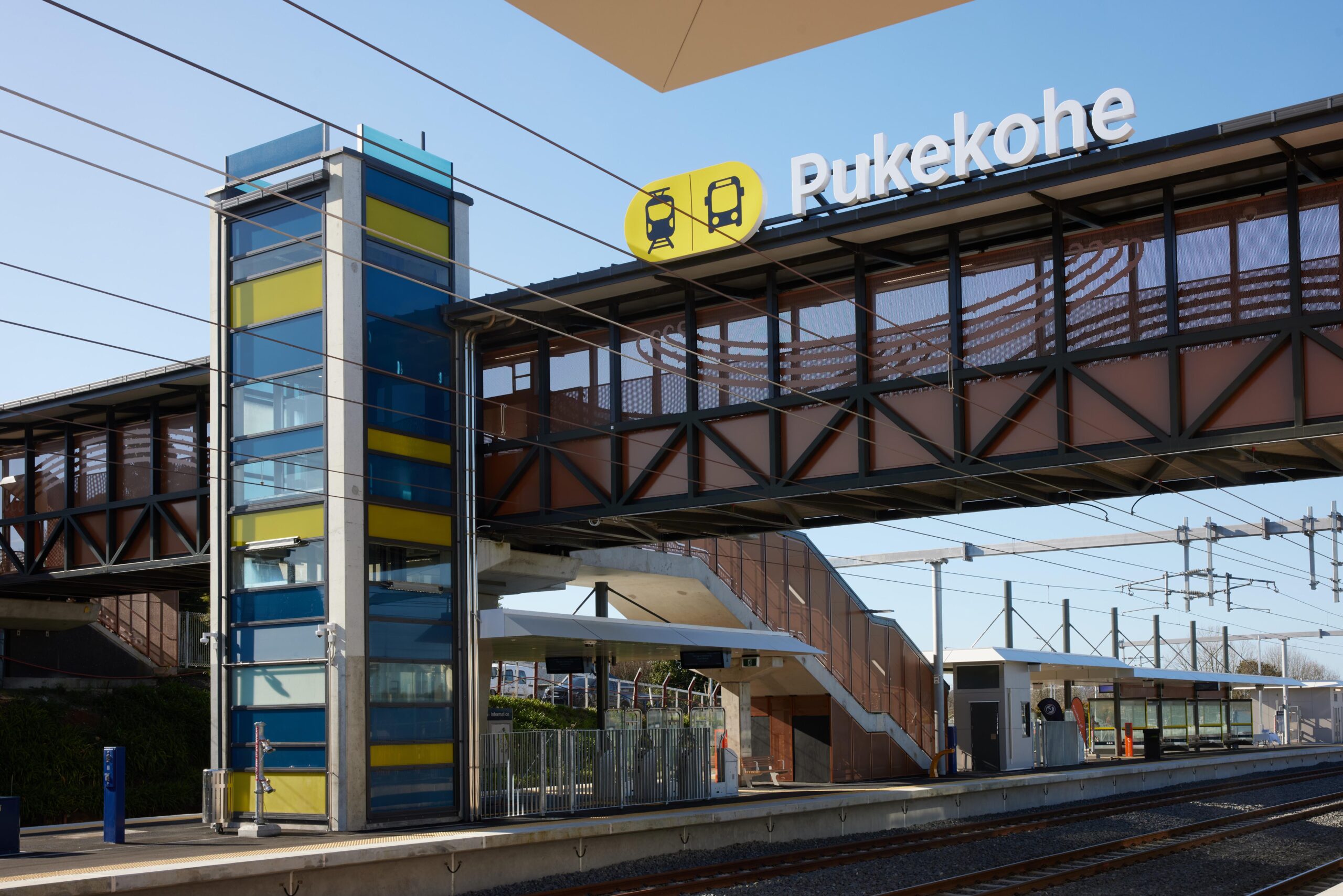
The completed Pukekohe Station. Image credit: KiwiRail
Next year two of the three new stations along the line – Drury and Paerātā – will open. The final new station, Ngākōroa, will open in 2027.
City Rail Link Progress
It’s been another year of progress towards the CRL with some really visible signs we’re getting close to the finish line, like the reopening of Beresford Square and Albert St. There’s also been a lot of less visible progress too, with testing ramping up significantly. The first trains finally rolled through the tunnels in February and by the end of the year had clocked up over 16,000km through them.
Auckland Transport also released their first official map for once the CRL is open, and we certainly had some thoughts about it.
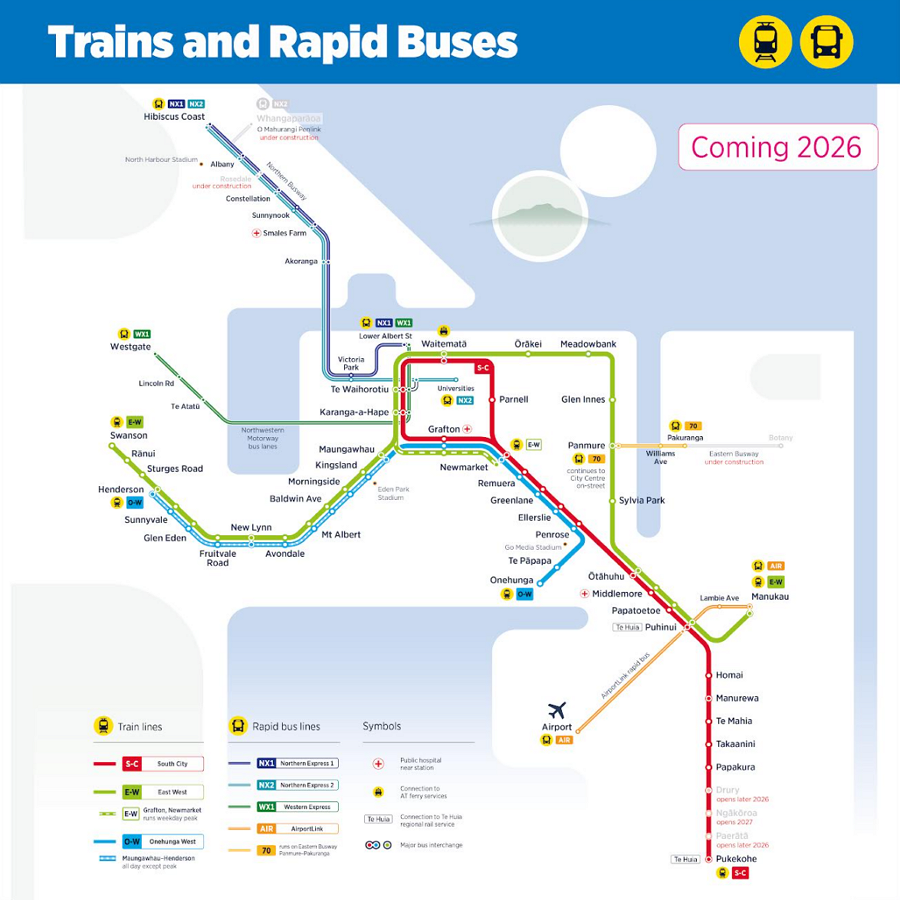
SC, EW, OW: the names for the major lines could do with some workshopping…
Speaking of things opening, at the start of December, we sadly learnt that it won’t be till the second half of 2026 that we can finally catch a train through the tunnels.
Northwestern Busway
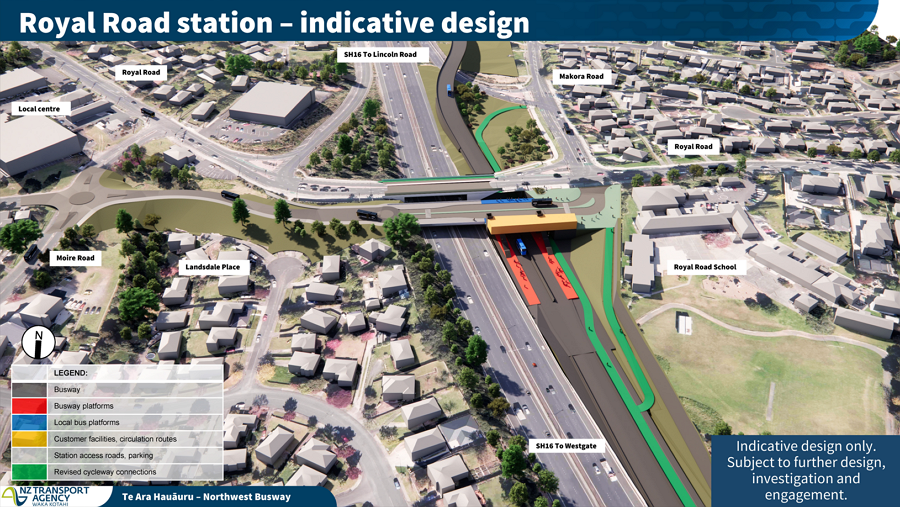
The Northwestern Busway is the only major new public transport project being progressed under this government and by the end of the year the design had begun to shape up, with indicative designs for the busway and stations being released.
This project – which has been urgently needed for ages, and bizarrely went unbuilt during the widening of SH16 last decade – won’t come cheap, especially with the massive cost escalation that has occurred on transport projects all around the country. It is now expected to cost up to $5 billion to deliver the entire extent.
Ridership
At the end of 2024, we noted that ridership recovery following the early pandemic years was starting to stall. In 2025, that has absolutely become a reality, with ridership even declining a little since the end of last year. This is likely due to a combination of factors – chiefly fare rises, ongoing rail disruption, and the wider economic challenges we are all currently facing.
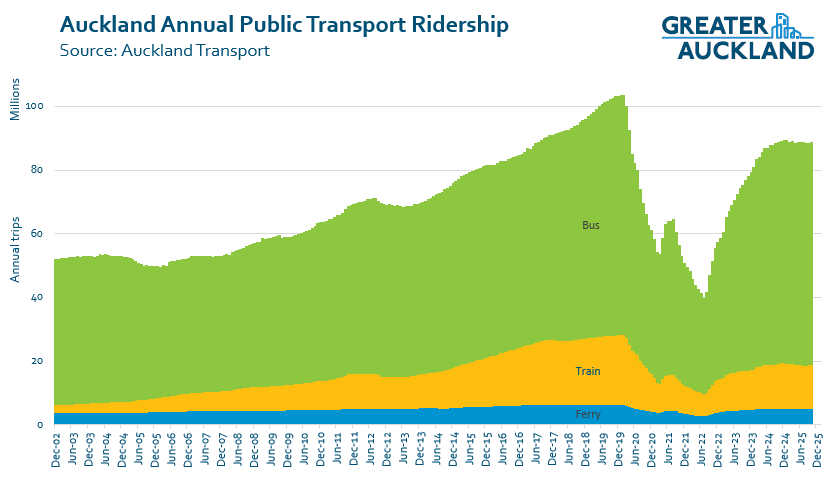
If you’re keen for a more in-depth look at specific changes to public transport services, Darren Davis has catalogued the year in public transport from all around the country.
Active Modes, aka walking and cycling and scooting
There’s been a surprising amount of progress on delivering walking and cycling projects this year, as many of them were funded from the council’s Climate Action Targeted Rate – enabling completion of things that have been in the design/build progress for many years.
One of the big ones is Great North Rd, which is very near completion after a decade of delay from Auckland Transport and last-minute attempts by the Mayor and local Councillor to ditch it. It’s looking great, does a better job of serving the growing residential boulevard, and fills a crucial gap in the network.
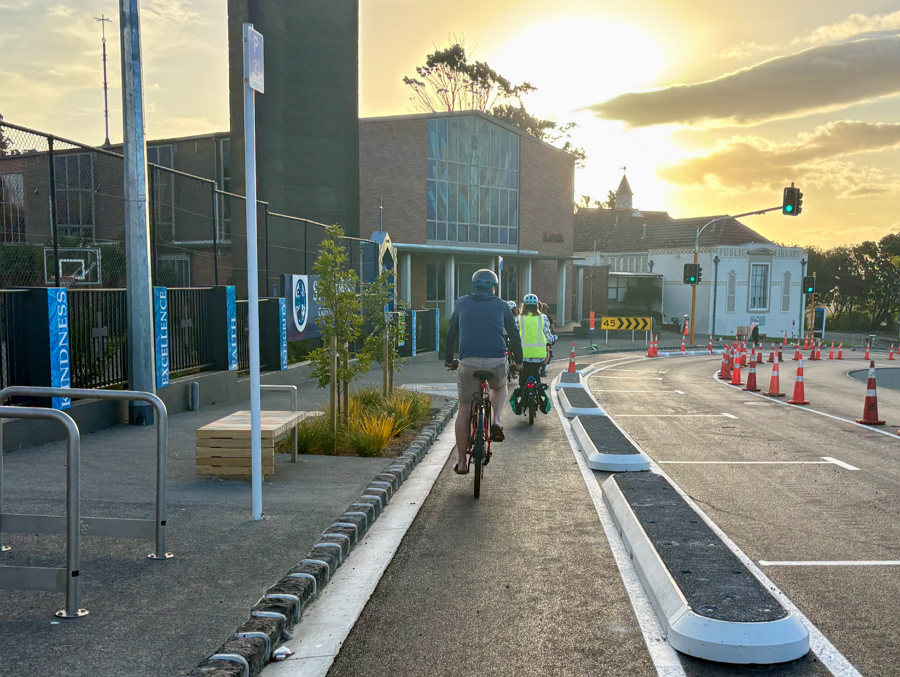
Great North Road mid-December 2025, with the final seal going down, and tim-tams installed. Still to come, some road markings and greening for where the bike lanes cross side streets and go around bus stops. (And yes, this is the exact location where the Mayor was photographed riding on the footpath – insisting that protected bike lanes weren’t needed – and just a week later an errant car wiped out a tree, a bus shelter, and a chunk of that school fence.)
The Meola Rd total rebuild and Pt Chevalier to Westmere improvements were also formally completed this year – although the work was largely done by this time last year.
Some of the other additions to the bike network include:
- Vincent St
- More sections of Te Hā Noa along Victoria St
- The Strand
- More bike connections around Glen Innes
- Work commencing on the final chunk of GI2TD/ Te Ara ki Uta ki Tai
- And a whole bunch of safe cycleways and links through Māngere West and Māngere Bridge
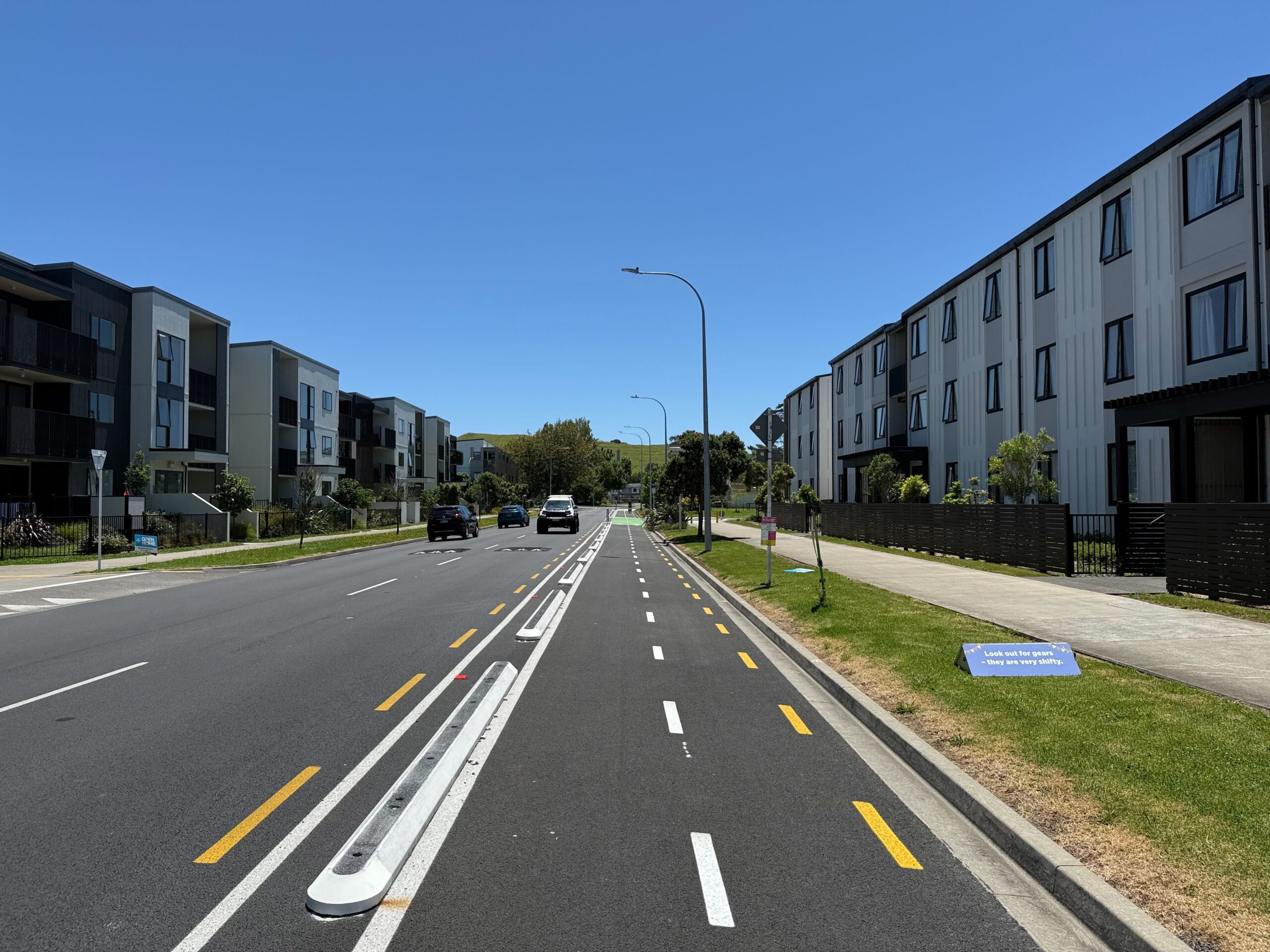
Māngere West. Photo supplied.
There are a few other big projects underway, such as Te Whau Pathway (linking Te Atatū to New Lynn), where the first section is nearing completion. And there’s a bit more in the pipeline, with improvements to Hobsonville Rd starting in January.
However, the concern is what happens when the current pipeline runs out, especially given the current government policy which is weirdly hostile to these kinds of basic improvements for safety and freedom of transport choice.
Council continuing to provide targeted funding will certainly help – as would a citywide “complete streets” policy to leverage the huge maintenance and renewals budget to dig once and build back better.
Project K
Is gonna be OK! Back at the start of the year, Auckland Transport put forward some really weird and unwelcome last minute design changes to Project K. Thankfully, a concerted effort from a whole lot of people speaking up (kicked off by Connor on this very blog) put the project back on track. It’s almost done, and looking great!
Upgrades are now complete on Pitt Street, including new cycleways that link to Nelson St and the new bidirectional lanes on Vincent St. Meanwhile, Mercury Lane appears to just need a few finishing touches, with the new cycleway infrastructure on Canada Street and East Street pretty much up and running.
We are still waiting for the changes to Cross Street – this seems to have been spun off into a separate workstream, but we are very confident and optimistic for a good outcome there.
Check out the area if you haven’t already!
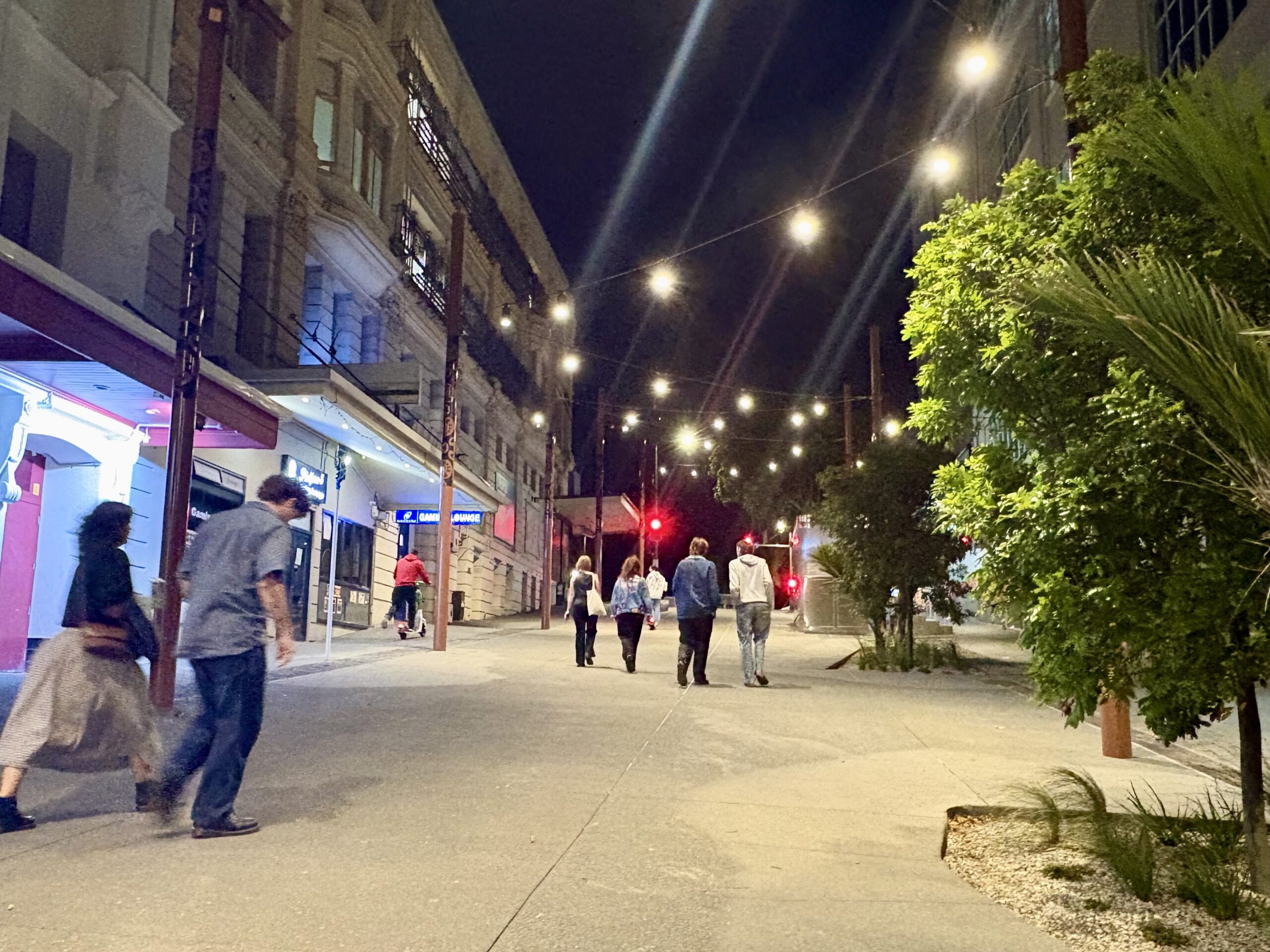
Mercury Lane at night, shortly before Christmas. Not quite formally finished but already a place for people.
Roads
Roads of National Significance
The government’s mega-roads programme rolls on. October 2025 saw the release of the latest thinking about many of the projects, including their absolutely astonishing costs. All up, the RoNS programme is now expected to cost up to $56 billion.
That’s simply not possible to fund out of existing transport budgets. The Minister later noted it would require a one-off 70% increase to petrol tax and road user charges, which still wouldn’t be enough to provide funding for any other major transport projects. A re-reckoning is surely due.
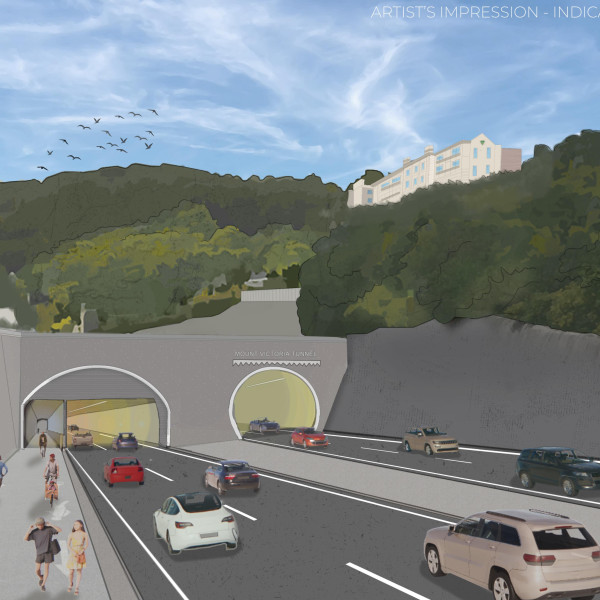
A render of the proposed new Mt Victoria tunnels, which would be one of the costliest low-BCR projects in our nation’s history. Not shown: knock-on impacts on the city’s streets, opportunity cost of not being able to afford more productive and necessary infrastructure.
Road Pricing
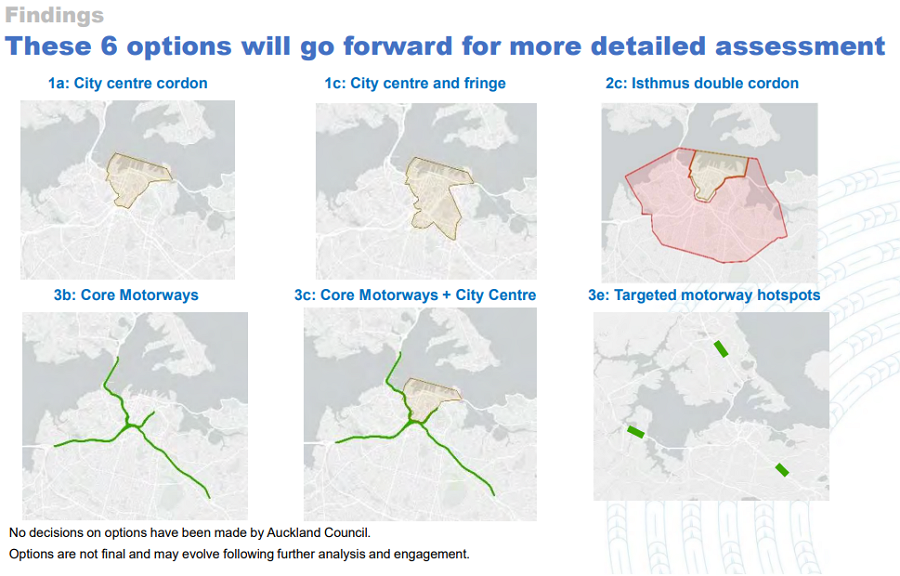
In November, parliament unanimously passed legislation allowing for road pricing, aka (de)congestion charging. Auckland will be the first city to implement this, and while the legislation worked through parliament, Auckland Transport continued to progress their work on what the scheme may look like, and what impacts that would have. At last count, they;d narrowed their thinking down to six options.
Safe Speed Limits
Despite community dismay at the widespread impacts, Auckland Transport rushed ahead and implemented Simeon Brown’s deadly Speed Rule – taking an uniquely strict interpretation of the rule changes to raise speed limits on over a thousand roads across the city.
These changes run completely counter to all logic, research, and evidence-based road safety practice. Worse, due to some cunningly specific wording in Brown’s Rule, most speed limit increases (especially in Auckland, but also elsewhere) occurred where schools had been cited as one of many reasons for prior speed reductions.
Bare-minimum carve-outs at the beginning and end of school days only are a poor sop by way of compensation, and the blow to children’s freedom to walk and bike in their neighbourhoods is one of the saddest outcomes. Likewise, the petty removal of 30kmh from the toolbox of cities and towns – the evidence-based sweet spot for urban streets – underscores that this move was entirely ideological.
In our view, the speed changes are a shocking failure of responsibility by the many politicians and the transport agencies involved. When the road toll begins to creep back up in the next few years, it will be because of their actions.
That said, shout-out to the communities who managed to retain their safe speeds, and those who’ve successfully fought to regain them in recent months. This is not over.
Level Crossing Removal
As the opening of the CRL gets closer the impetus to remove level crossings has stepped up and in February the government announced it would allocate up to $200 million towards the level crossings in Takanini.

Auckland Transport are also focused on replacing the last remaining pedestrian level-crossings on the Southern and Eastern lines, and have started construction on pedestrian bridges at Glen Innes, Te Mahia and Takaanini stations.
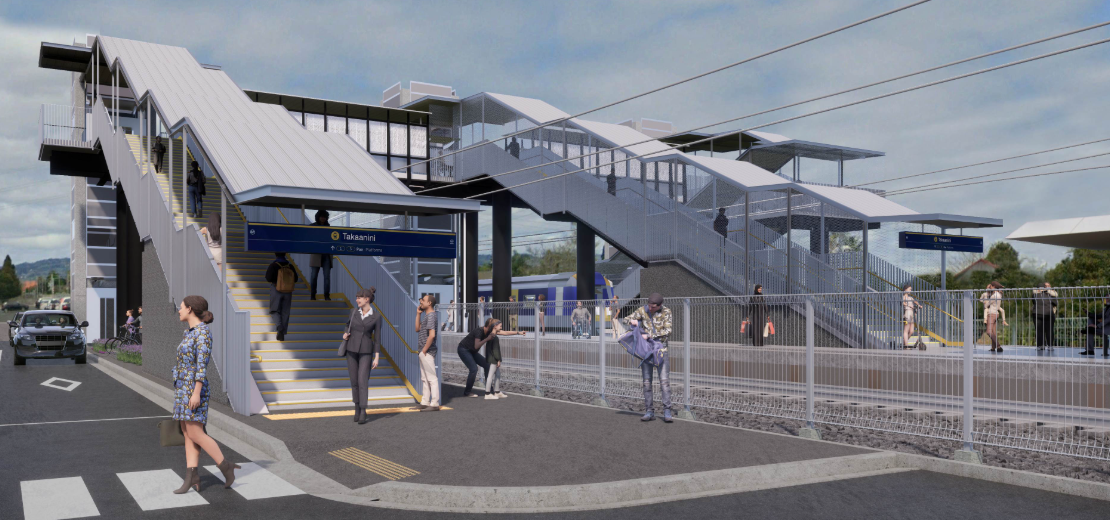
Render of Takaanini Station new bridge. Image credit: Auckland Transport
Housing and Development
Plan Change 120
Following the government’s policy to let councils withdraw from the requirements of the Medium Density Residential Standards (MDRS), Auckland Council had been pushing to withdraw its Plan Change 78 (PC78), arguing that it needed to change zoning, particularly around flood-prone areas.
Housing Minister Chris Bishop eventually agreed, on the condition that there be even greater density around some of the inner-west train stations, and that the total housing capacity of the new plan matched what was enabled in PC78.
The new plan is known as Plan Change 120 (PC120) and will see much more housing enabled, especially in some parts of the central isthmus which have the best public transport connectivity.
Submissions on the plan have only recently closed, and next year there’ll be a lot happening as it works its way through the hearing process, which won’t conclude till 2027.

PC120’s plan for the isthmus.
Building Consents
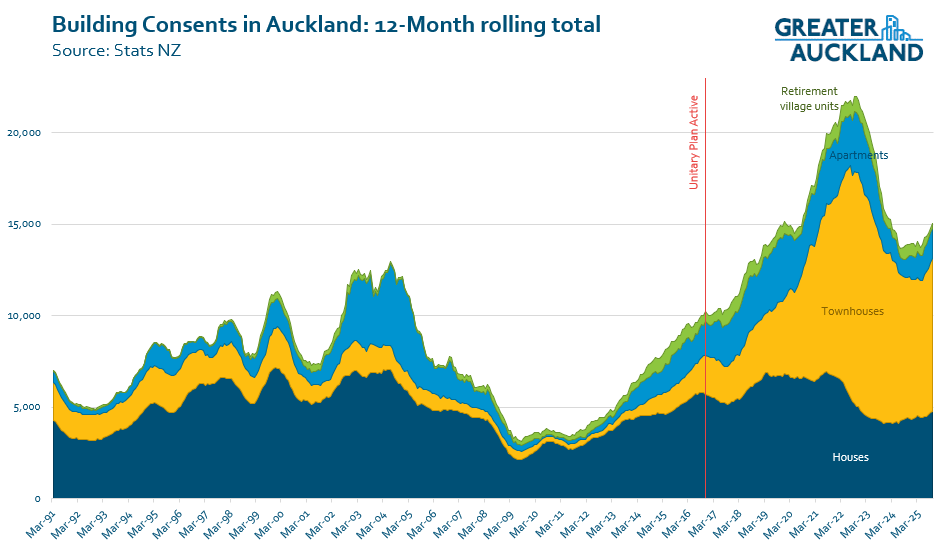
One trend that will be important to follow in the coming year is the number of building consents. They fell significantly from a late 2022 peak of 22,000 to a low of 13.7k in 2024 and 2025.
However, by the end of the year they’ve started to bounce back up again – something the government will certainly be hoping continues.
Notably, even that low was still higher than any time prior to the implementation of the Unitary Plan, and a good delivery of PC120 should help boost numbers even further.
Downtown West
Just a few weeks ago, the sale of the Downtown carpark was finally completed. Earlier in the year we got a look at what Precinct Properties has planned for this space: the stunning Pūmanawa Downtown West development.
There’s also been some information on how the transport system will adapt in the area – plans include removing the Lower Hobson St flyover, but recent noises from the Mayor suggest this is not yet a settled plan. The sooner it’s sorted the better, in our opinion – this area deserves to thrive.
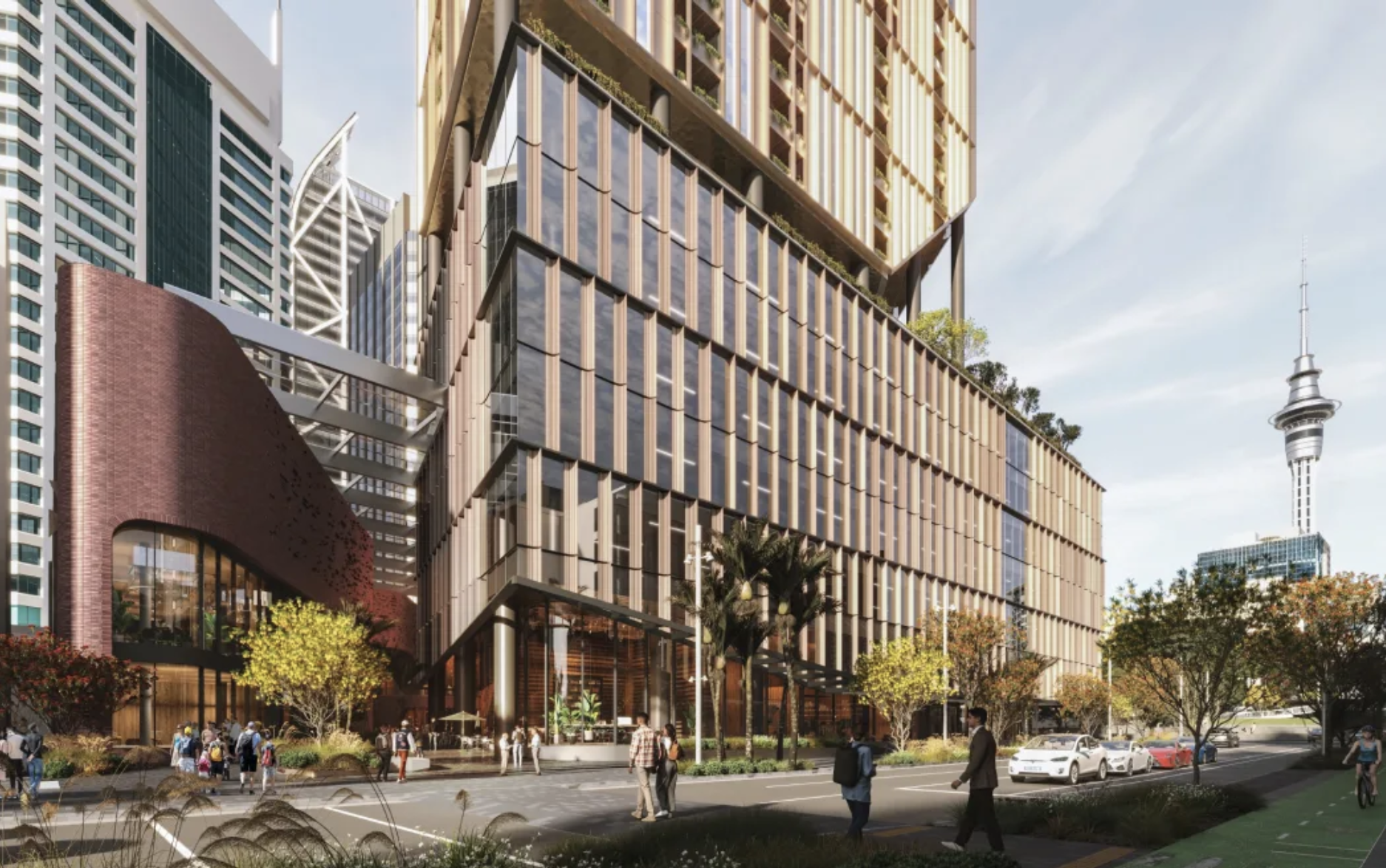
A render of the proposed Pūmanawa development to replace the Downtown Car Park. Image: Precinct Properties
Our most-read posts, and our biggest wins
It’s been a busy year on the blog, with almost 200 posts published thanks to a growing range of contributors. These were our top 10 most viewed posts for the year:
- Auckland Transport No More
- Te Huia to Tauranga?
- National’s proposed changes to transport rules
- Hamilton Central Station: Britomart 2.0
- The City Rail Link is a bargain…
- Should Auckland demolish Spaghetti Junction?
- Electrifying the North Island Rail Network
- Level Crossing Removal Starts
- Mercury Lane, and Auckland Transport’s habitual failure
- Government’s Road Announcement Week
Speaking of good reads, and reaching our audiences: this year we started sharing our work via Substack, and we’ll be looking at other ways to spread the good news in the New Year.
Also, alongside my regular media commentary on stories of the day, you might have also spotted some Greater Auckland op-eds in The Post and the NZ Herald, the work of Connor with support from Jolisa. (See for example here, here, here and the most recent one here.)
Plus, with some skilled volunteer support, we ventured into video (see below, starring Patrick – and stay tuned for more!).
And event-wise, we also dipped our toes back into IRL gatherings, starting with a great evening (and some local explorations) with CityNerd Ray Delahunty:
We’re super grateful for these fresh opportunities to tell the story of how great Auckland can be, and we’re looking forward to doing more of this sort of thing in 2026. As always, we’re open to your thoughts, suggestions, and offers of help in getting the message to a wider audience.
As for tangible wins, probably our biggest success this year was Project K. We sounded the alarm about a potential last minute rat-running redesign of the people-friendly precinct around what’ll be one of the city’s busiest train stations. You joined Connor’s call – and thankfully, AT stayed the course.
(By the way, we’re hoping for similar success with keeping Queen St as people-friendly as it should be – you can read more about that one here.)
Likewise, kudos to Connor’s tenacious work this year in getting isthmus light rail back on the infrastructure priority agenda – and shining a light on the hidden costs of some of the most critical transport planning.
We see these wins – along with others over the years, like the Congestion Free Network campaign – as solid proof of the value of our work: keeping watch, keeping receipts, and keeping you informed about what’s happening and about what’s possible.
Together, we can hold our elected leaders and public agencies to their promises and strategies, to make our city be as good as it can be. So stay tuned for even more proactive work along these lines in 2026!
There’s so much more we could have included here. What were your local highlights of 2025?
This is our last post for the year. Once again thanks for reading and supporting us. Have a happy and safe break, and best wishes for the New Year!

 Processing...
Been a great year of posts thank you. Here’s to the next year & the year the long awaited CRL opens!
I do wonder if removing the downtown car park will have negative effects. My family tend to use PT where possible, but sometimes it’s just a lot easier to drive, and we typically park there. Without it we would probably go to the city far less often.
Other than the downtown carpark, there are another 23,000 public offstreet carparks across two dozen parking buildings in the city centre. Are none of those any good to you? You’d probably drive past a couple on your way to downtown.
I’m in the same position as you – while I used public transport most of the time, if I’m coming in very early or at night I tend to park there. Other carparks in the area are significantly more expensive, plus I don’t want to be walking too far later at night as not safe.
Leaving supply, time-structure and pricing for off-street parking in private sector hands weakens planned management and plays to near-monopoly interests. Enabling a free market but with inclusive access support may be necessary if difficult. Parking demand will change as mobility options change in the future. Managing change for residential off -street parking will become an increasing part of that.
There’s tons of parking structures around the CBD you could use instead. One of the first things I noticed when I arrived in Auckland.
If you check Google and “CBD carparking” you’ll see there is very little of that area that isn’t serviced by a parking building at most a block away. A stones throw from the Downtown one is the Viaduct and Princes Wharf, as an example.
Depending on when you use them they’re typically about twice the price of Downtown. It will be interesting to see the impact on Commercial Bay and the Viaduct area. As I mention above I normally use public transport, but it isn’t always an option. Instead I would avoid these areas in the evening when I don’t feel safe on public transport.
Its cheaper because its subsidised, the charges being lower than the market rate, as you point out. At a time when people are asking Councils to stick to their knitting and to find new revenue sources, tying up Council time and money in car-parking but doing it at less than what you should be making just seems crazy.
“Save the Downtown Carpark” tells us that 950 businesses signed a petition to keep it, so maybe they should chip in and pick up the council tab if its integral to their businesses. I bet they won’t.
I think they had to drop the prices further a few years back because it was barely 50% full each day. Many of those would have been workers who will have to find somewhere else, so my guess is the impact on the surrounding businesses will be negligible in the short term and forgotten about after that. But Sue, I do wish you well in finding a solution that works for you.
That RTN is starting to take shape. Completion of A2B would just leave a gap through the isthmus and on to the Airport.
Is the plan for NX1 or NX2 to veer off over Penlink? Or would there be a new service (NX3?) servicing Whangaparaoa?
Last I checked, they planned to route the NX2 over Penlink, with NX1 going to Hibiscus Coast Station.
But that plan included getting rid of the gulf harbour ferry, which pissed off some NIMBY’s up there.
Not 100% if that NX2 will happen or not
Yeah pretty sure going ahead, they are building a station for it and everything.
Wouldn’t be the first time they built the infrastructure then didn’t run any services on it. Still waiting for my bus to Rosedale.
The funny thing is that a RTN through the isthmus is the easiest of all of them. Make Dominion Road 24×7 bus lanes (maybe by creating more parking in side streets), and run a new direct bus via Ian McKinnon Drive with limited stops. Surprised National haven’t done it to kill off LRT for good.
Good overview, thanks Greater Auckland. It has been brilliant seeing a number of cycling projects be completed last year and the progress around the CRL. The Waitemata Local Board advocated for the Cross St upgrades to be developed and fought to keep them and have been advocating for more effort around Maungawhau too and it looks like we’re getting there. Fighting for access for all in midtown and the city centre masterplan is emerging as another battleground though. Bring on 2026!
Does someone want to look into A4E and how the principle can be turned into detailed ‘Quarter’ plans that can be made to work? Too much piecemeal investigation for service & delivery, coach traffic, parking and accessibility may weaken public understanding and support for the transformation.
A4E already includes detailed service-delivery-loading, parking, public transport and disability access plans. The principles were worked through years ago already.
The principles are fine. The details of limited access, direction, modal filters are critical to achieving the principles. Some people are going to be significantly affected and engaging with them, dealing with real issues for them and gaining full support are where it becomes difficult. Planning the sequence of changes then needs to take account of temporary traffic management for the significant infrastructure projects for utilities and developers, including the demolition and construction works at the Downtown car park and the Hobson St viaduct. All this is needed without triggering people to oppose the principles of A4E, remembering that the name is Access for Everyone – an ambitious target.
The plans are all done already. People are going to oppose it regardless of how well they have their hand held along the way because they oppose anyway. Like the the people on mercury lane claiming they’ll be hostages in their own home if the can’t drive down the top of mercury lane to get to cross street.
Delaying A4E in the name of detailing all the very complex issues again over and over is the same delay tactic. The downtown flyover removal was likewise planned and staged out years ago, don’t need to start a business case for consultation engagement to redo it again over the next half decade.
“and gaining full support are where it becomes difficult”
Impossible.
A very big shoutout to this team for the rescue of Mercury Lane.
I was really skeptical and said so given the volume of public capital already gone in to CRL.
But I am also very happy to see advocacy win, and particularly when it comes from knowledgeable and passionate citizens like Conor and the other key authors on this site. Just occasionally in life you get to be delighted at being wrong.
It’s always hard fought – particularly when the leadership at the top of Council and government is so poor – and such fights make the successes to be long savoured.
Thanks for always being an intelligent site to come back to.