Patrick Reynolds is deputy chair of the City Centre Advisory Panel and is running for council in the Waitematā & Gulf ward in this years local elections.
As the City Rail Link (CRL) nears completion amid talk of city deals and rates caps, I thought it worth looking at what that project can tell us about the nation-city relationship.
Cost and Value
It goes without saying that the CRL at $5.5b, is not cheap. The cost per kilometre of the new section is very high in global terms. Outside of specific causes of this, like Covid impacts and scope changes, it would be very interesting to add all recent fixes and upgrades on the entire Metro network and cost that by the full length of the essentially new system we are getting (writing posts always leads to ideas for more posts!).
This is also because all infrastructure is expensive in New Zealand, compared to places that build more of it, have more mature supply chains, possess a much higher state capacity and capabilities, and scale that enables deeper private sector competition.
This high cost of doing things makes it even more imperative that we are smart about what we choose to build.
Therefore, the most important question for large infrastructure projects is always about their value.
This is an area in which I think we as a nation do not enough work, so it is good to see that for CRL there is a programme aimed at doing just that: understanding the transport and wider economic benefits.
Personally, I have always been confident about the value of CRL: it is in a rare category of projects that are especially valuable because they are transformational.
Truly transformational projects profoundly change their context, rather than just adding more of what’s already there. These kinds of projects are rarer than we may think. Previous examples of transformational projects include the Auckland Harbour Bridge, the Kaimai Tunnel (without which the port of Tauranga could not have scaled up), and last century’s hydro schemes and transmission network. And, going back earlier in time, nation-building examples like the North Island Main Trunk Railway.
The challenge is that truly transformational projects tend to be misunderstood until they are complete. Because they re-shape their worlds, they’re hard to understand in advance – and yet afterwards, they look so obvious. Which in turn leads to previous critics re-framing their earlier positions.
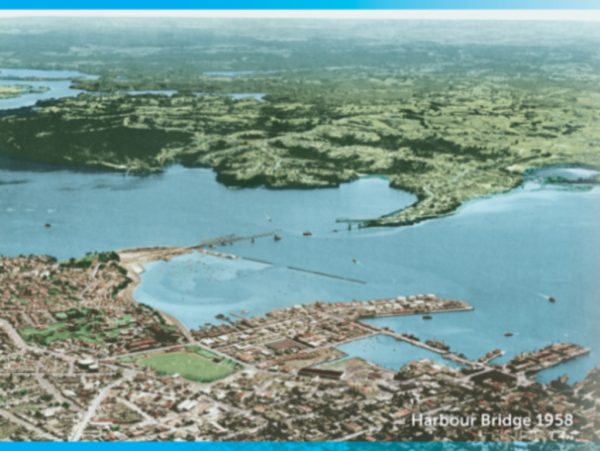
Clearly shown here: the Auckland Harbour Bridge transformed the North Shore – it is as if it fished up new city-proximate land, Maui-like, from the sea.
This image perfectly illustrates the impact of the Auckland Harbour Bridge on land value on the North Shore, transforming it from rural to urban, and opening up new land in close proximity to the city.
This is also what the CRL will do: it doubles the number of people who live within half an hour of the highest concentration of jobs and educational opportunities in the nation.
The CRL is transformational because it redefines Auckland: from an almost entirely suburban and auto-dependent place, to a more urban and metro-served city. In effect, Auckland is getting a new logic board (there is much more to say here about systemic change, eg the last huge one – trams to motorways, but that’s for another post).
And this is so important, because Auckland’s vapid form and inefficient, lopsided transport system, has been holding back the city – and therefore the nation, as the recent State of the City report laid out. As per this RNZ story):
“Auckland’s productivity sets the pace for the rest of the country, so it has an opportunity – and a responsibility – to be bolder in lifting it.”
The report recommends the central and local governments address land use, housing, transport and regulatory settings which hindered productivity.
It also recommended the council strengthen Auckland’s international brand, and “develop a compelling story about Auckland’s past, present, and future that communicates its values, culture, and ambitions to the world”.
Three reasons why the CRL is a bargain (for the government)
Basic tax math #1: Of subsets and super-cities
Government ministers of many stripes love to fly into Auckland and brag about how much they are spending of their money in our city. But they neglect to mention that Auckland represents around 38% of the nation’s economy, so any government spending anywhere is 38% sourced from Auckland.
This is generally a reasonable set-up, because of course the corollary is also the case: Auckland projects of national significance are 62% funded by the rest of the nation. So for example, Auckland may fund 38% of government projects in, say Tasman/Nelson, but Tasman/Nelson are funding 1.8% of all of ours too.
Except, that is, for the CRL, the biggest transport project in our nation’s history. It is unusual in being funded 50/50 between the government and the city. And this leads to some interesting sums.
The city pays 50%, The nation pays 50%, But Auckland is a subset of the nation, so 38% of the government’s 50% is sourced from Auckland… which is 19% of the whole. Therefore, the city is really funding 69% of the CRL project and the rest of the nation provides the other 31%.
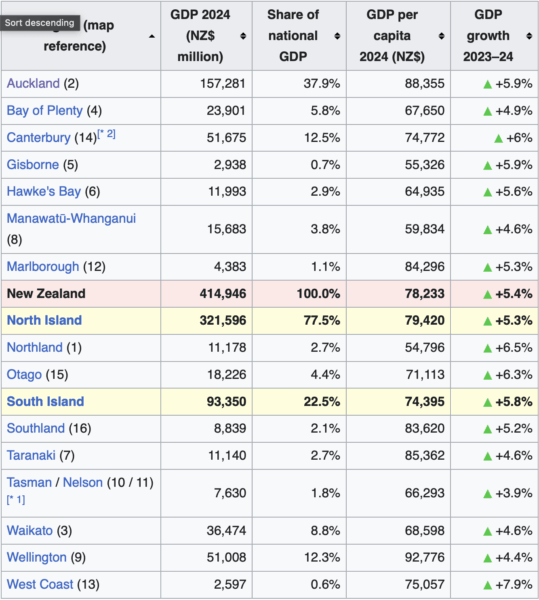
NZ Economy March 2025, via Wikipedia
Basic tax math #2: GST claw-back
All up, the CRL is costing $5.5b, shared 50/50 between the NZ Government and Auckland Council.
Government’s share, from nationwide general taxes is $2.75b (I know this isn’t strictly true, i.e. the government creates money by spending, and taxes actually come later, but this will do for here).
And Council’s share, from Auckland property rates is $2.75b.
However! As soon as the money is spent, the government immediately scrapes back 15% GST from the total: $5.5b x 15% = $875m.
So already, before CRL opens, the government share is reduced to $1.95b. $2.75b – 875m = $1.95b.
For comparative purposes: just Stage 1 alone of Mill Rd (a three-stage project) is projected to cost $2b, before any escalation. This is a state highway, so is 100% govt funded. Will the upgrade of this suburban arterial, if completed, end up costing more than the CRL – but be 100% funded by the nation?
More on this sort of comparison later. First, a bit more on the difference between Government and Council as funding source.
Basic tax math #3: these projects generate taxes
The government also receives benefits from the larger economy this sort of major project creates, in more taxes of each kind – including payroll taxes, etc, from everyone who’s working on the project. I’m not going to try to calculate these numbers. But we have all seen, for example, what happens when the government – the only investor of true scale in the country – stops investing in major capital works. It is devastating for wider economic activity.
By contrast, the Council has no mechanism to directly obtain a financial return on infrastructure projects. It must instead wait for an economic one. For this, it needs the thing to be complete and functioning, so it can deliver value to the wider Auckland economy, leading to growth and more rates.
Anyway, the point I am making is the government’s contribution to the CRL is even lower than it first appears: it is a bargain rather than a huge cost for the nation’s finances. Especially when compared to the huge rural Roads of National Significance 100% state funded, and serving small populations and low vehicle numbers, and therefore sure to be lower in value.
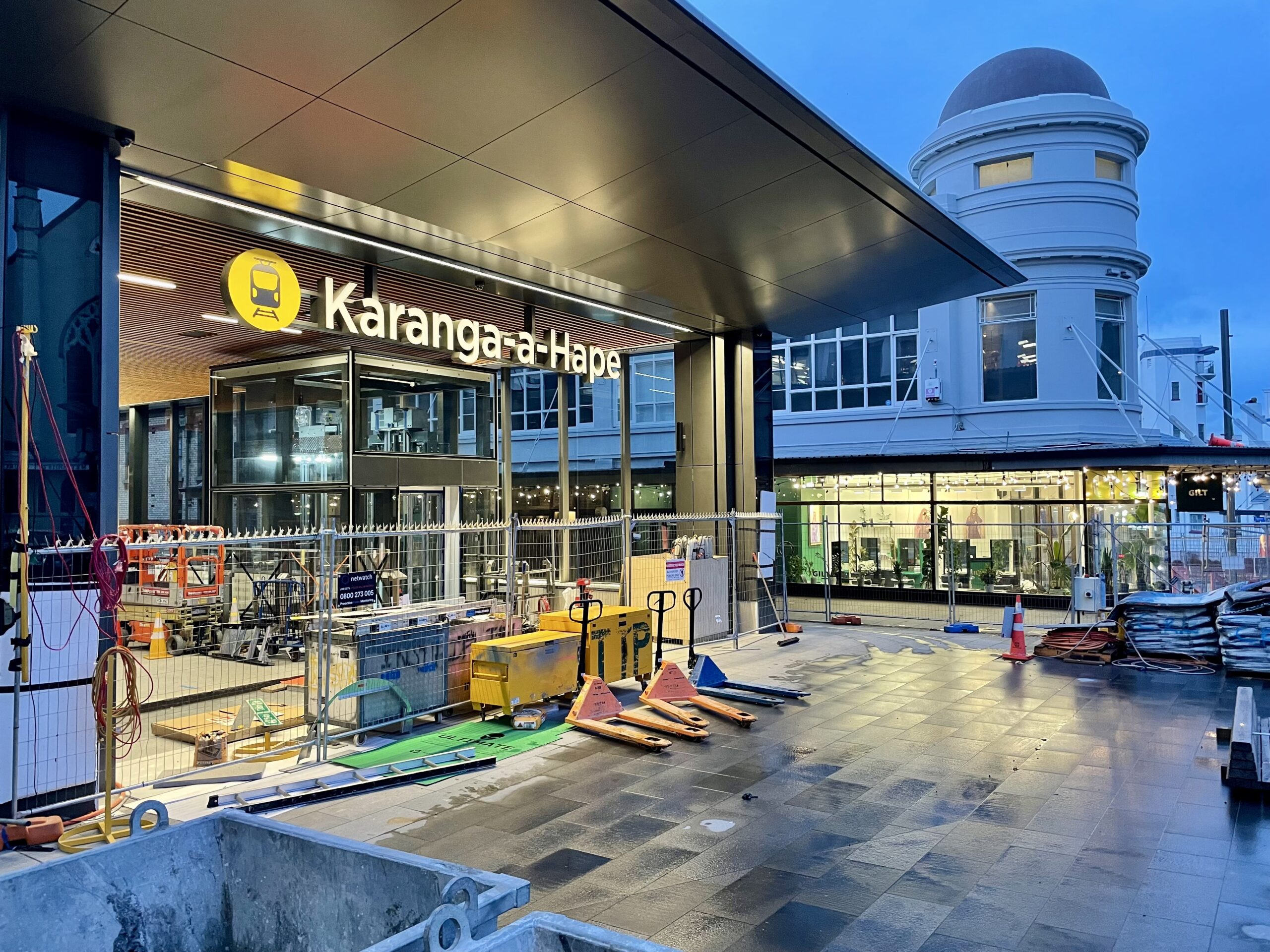
Transformational: once a traffic street, now a people-space and metro entrance.
Rail of National Significance
Of course the reason for CRL’s evenly-shared funding structure is because that was the only way the city could get the government to come to the party at all. The city, and its then-mayor Len Brown and deputy mayor Penny Hulse, were begging the government to approve and fund this project. It was very hard to even get the 50% commitment.
However. the current Prime Minister said at a recent CRL joy-ride by politicians and media, that the CRL is worth $12b to the economy (over some unspecified time period):
Luxon said the project was “a major, major feat” that would spur another $12 billion of investment in other economic activity in the city.
A figure curiously similar to the one in this graphic, although this appears to be about private-sector investment?
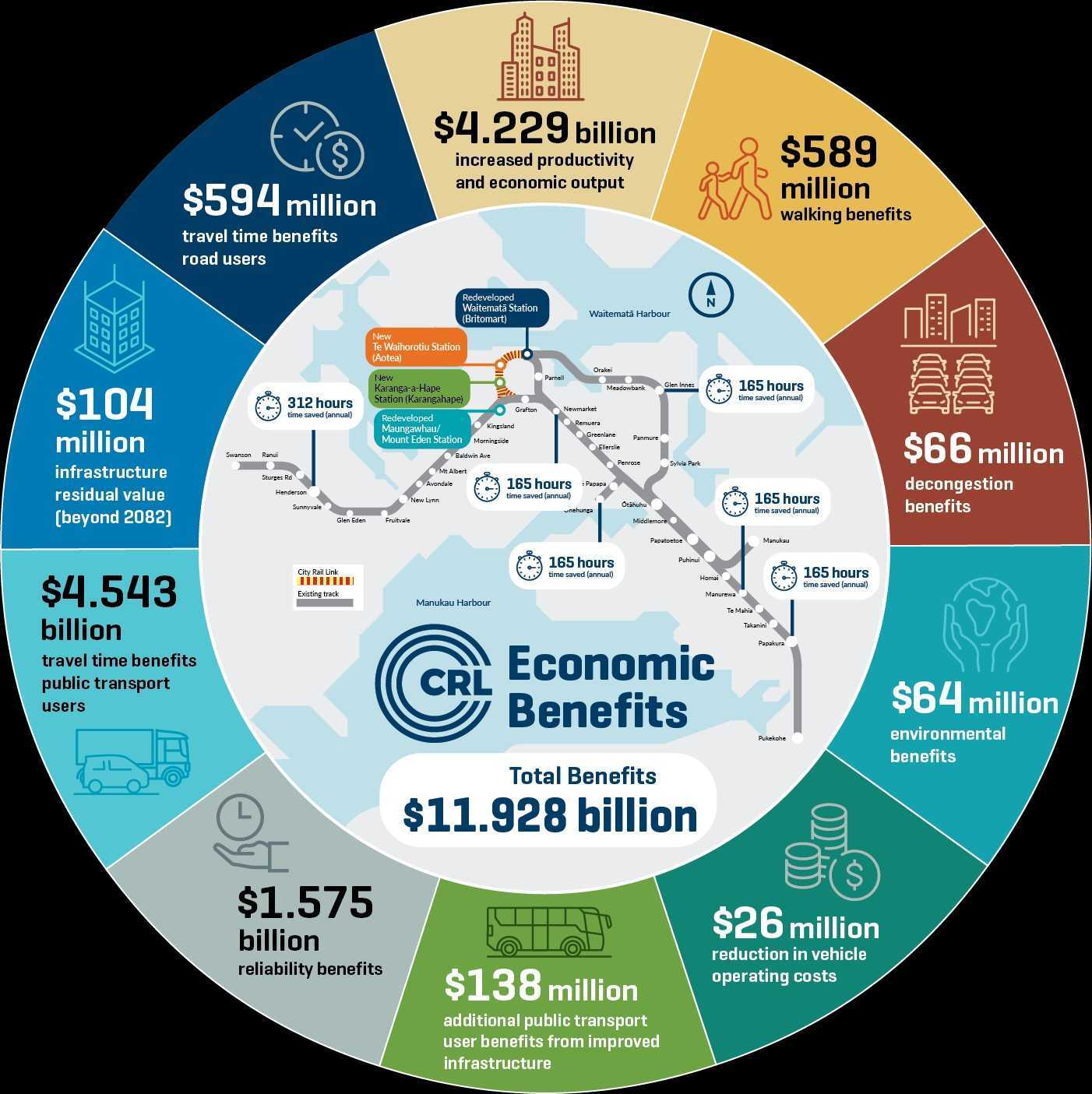
Either way, a $2b spend for $12b in benefits looks like a very wise investment for the whole country. In this context the funding arrangement is not just unequal, but punitive.
It really is beyond time that politicians understood that all infrastructure might or might not be “of national significance”. It is simply not the case that roads automatically are, and other types are not.
Indeed, there’s a case for a more accurate category of Infrastructure of National Significance, not solely Roads of National Significance. It even has a snappier acronym: IoNS.
CRL: City Deal avant la lettre
This also raises questions about the city-government relationship, particularly in light of the push for a “City Deal”. In a way. the CRL is a City Deal before the fact. But a very lopsided one.
I have long thought our cities might develop in much better ways if there was more local opportunity to influence which infrastructure projects are funded, and their design too (looking at you, next Waitematā Harbour crossing).
For that to really work, both parties need to have skin in the game. So instead of the government 100% funding motorways that it alone selects, and 50% funding local roads and public transport, with cities 100% funding water infrastructure – what if all major works were co-funded and agreed on?
That couldn’t work at the unfair 50/50 rate, so maybe more like government/city 75/25, or 70/30? A workable ratio needs more analysis.
It is pretty arbitrary that Mill Road or the East-West link are 100% government-funded, while the CRL and the Eastern Busway are shared. Especially as the share of the National Land Transport Fund that comes from road taxes is now down to about only 63%.
How would it go for the good people of Levin if they were expected to find 50% of the now $2b Otaki to North of Levin highway? Unrealistic, of course, by maybe if they were contributing even 20% they would have had a much more measured and reasoned response to the design options. Loud voices in the region were outraged at the $400m cheaper alternative with roundabout interchanges instead of fully grade separate ones. The ‘free’ funding of some types of projects reduces wise project selection and makes for an infrastructure politics detached from cost implications. We are all now funding an unnecessarilly ‘gold-plated’ highway there (Aucklanders 38%).
For a real partnership between our one city of scale and the nation as a whole, as represented by central government, to be enduring it will need to be fair.
Both the city and the nation would benefit from a real City Deal, but we have a very long way to go from the current set-up to get to that happy place.

A changing city is a thriving one. Who can remember the scale of this work downtown, now that it is complete? The same will soon be the case all along the CRL route.

 Processing...
Good point about the taxes! The government will barely spend a cent once you consider all the GST, PAYE, company tax, excise tax, etc that the project will generate.
We need to think beyond and different. The passengers numbers cannot be scaled down. People love driving cars, which they should give up.
Single person driving at peak hours should be restricted and discouraged.
Do what ever,which ever Aucklander should use the services.
I’m looking forward to the CRL opening (hopefully) next year too.
However people might be disappointed when Te Waihorotiu handles far fewer than 19,000 passengers per hour (scaled back from 54,000 per hour). Claims that it will be the country’s busiest station are also rather optimistic.
Do increased service frequencies depend on almost all level crossings being removed/closed? If so, we might be waiting some time.
Some people might expect cancellations to be a thing of the past once the CRL opens. Despite KiwiRail claiming that they now carry out preventative, rather than reactive, maintenance there will still be planned cancellations every year.
There are also hopes that Te Waihorotiu Station will help perk up Midtown. I hope it does too but it’s not realistic to expect it to by itself. Will the Symphony Centre go ahead?
In short, I hope the CRL opens next year without (m)any teething troubles and rail patronage reaches 2019 levels by the end of the decade but I don’t necessarily expect that.
The difference between those numbers come from various commentators (especially Heart of the City) misunderstanding the difference between capacity, and ultimate capacity at that, and projected ridership.
54k per hour is the longer term capacity dependent on future improvements to the network, especially signalling upgrades to ETCS 2. And, with that work is still available.
Anyway is an absolutely huge volume of people. Around 1 million per day! Not necessary on day one.
There are more relevant concerns that will impact actual ridership than capacity. Like service pattern design, bus and bike way connections to outlying stations, upzoning and good development around stations, grade separation of the wider network, and strategic additions of 3rd and 4th tracks. Oh and more rolling stock.
I have seen claims that the Auckland Harbour Bridge did not radically alter the distribution of Auckland’s population. Lots of people already used ferries and others had moved to the North Shore in anticipation of the bridge.
If they moved to the Shore in anticipation of the bridge, surely the bridge informed their choice and helped transforming the area?
Also, just looking at that photograph above shows you that there was not a lot of development prior to the bridge in Northcote Point, Northcote Birkenhead, Beach Haven, Chatswood and probably a whole lot of other suburbs. I don’t think it would be possible to have the current kind of developments without the bridge.
How much does Auckland traffic cost us per year? Some have calculated a billion or two. Per year!
The CRL will serve us for infinity (at least compared to my lifetime); should have been built more than fifty years ago, and has the potential to produce far more ecomonmic benefits.
If we can build fifteen and twenty storey apartment communities within a reasonable distance of train stations, we will reduce the need for private motor vehicles.
Less private motor vehicle use, less congestion, less billions being wasted in traffic.
I live in the city centre, and with this fortunate fact, can move about solely with public transport, and the odd (sometimes excessive) hikoi.
I move my kids exclusively though this method also (except in cases when their grandparents or mother is involved). I hope that by doing this they are learning how relaxing a life without driving can be, and that when they are old enough to legally drive, they will be able to vote, instead of learning to drive.
That sixteen year olds have no political agency, yet seventy nine year old white men can still be in charge of a city, is ageism. It is discriminating against Rangatahi, and has produced the fading democracy that we are experiencing.
We all have life experience, for some sixteen year olds they have lived though worse than some sixty year olds, so to claim that age has any relevance to experience is ridiculous.
We can all enjoy the CRL, but the older population can enjoy it for free, so they will not need to drive, which removes more private motor vehicles from our roads.
If we can begin to reduce the number of older people driving, in conjunction with the younger people who through excessive knowledge of the world, and the very real threat of climate or military devastation, already choose not to drive, then we may finally approach something that deserves to be called a CITY.
Until then we are just this rural / urban hybrid town, and for us who believe in CITIES, it is time my hometown grew up and became the city it is supposed to be. GROW UP, not out.
bah humbug
Matiu – Auckland is no longer a city, it is a ‘city’ region with one council and a central business district.
“yet seventy nine year old white men can still be in charge of a city, is ageism. ”
I really don’t think bringing ethnic background adds anything, would you be cool if the seventy nine year old man had a non-european ethnic background? Would that make his opinions any more valid?
Not really the forum but since you mention it, even at 18 most youth lack sufficient maturity and experience of life to make reasoned decisions.
Participation in democratic processes is one way to grow the maturity & life experience of all ages, especially 16 & 18 yr olds.
The same argument against 16 year olds applies to 76 year olds: Both groups contain those without full mental capabilities or relevant experiences.
The only difference is the length of time they have to live with the consequences of that vote.
Agree. I’d add the 76 year olds have already spent a life demonstrating whether they can collaborate and prioritise what matters… I’d trust the untested 16 year olds every time.
I fully agree with Andrew on this.
Plus three interrelated additional points too:
1. The earlier we get engagement from younger people in the process the more chance they’ll stay engaged, and nuance their views.
2. Having school kids facing the opportunity to participate at 16 also makes for really meaningful civics classes at high school – and shows that adults do really care about their views.
3. 16-18 year olds have to live with the outcomes of elections for much longer than 76 year olds. Young people literally have more skin in the game. While nostalgia may drive a number of older voters, we literally can only vote about what we do in the future.
Is it April 1st already? The rates bills are going up next year above inflation to cover the operating cost of CRL. The project that just keeps on taking. It makes Wellington’s sludge plant look like good value.
miffy’s about to announce the actual most revolutionary and cost effective transport project… the dirt track.
The Council now has to find an additional $235 million each year to run it. https://newsroom.co.nz/2025/06/27/brown-not-gloating-over-auckland-rates-rise-2026-looms-higher/
But just wait until you see how much they need to put aside for depreciation.
What is the depreciation timeframe for infrastructure like CRL?
Funding a replacement must be a long way out.
Come on Miffy that is a shocking piece of bullshit, even for you. Out by an order of magnitude.
That is an article about the Long Term Plan which is a 10 year budget.
So the actual number $23.5m per annum.
Cynicism is dark window that obscures an accurate view.
The mayor said in 2023 CRL would cost $220 million per year to run. https://www.stuff.co.nz/nz-news/350482649/auckland-mayor-wayne-brown-signals-rates-rises-as-annual-cost-of-city-rail-link-revealed
$235 million looks more like an annual cost than a 10 year cost.
Do you not fact check anything?
Think about it, how is a billion in opex every four years even slightly credible? No matter who repeats it.
Miffy, the mayor was talking about the cost to council, not the cost to run the CRL.
Almost all of that is debt repayment, paying for the infrastructure built. The operation cost is a minor fraction of that number.
Yes it’s a big number that the city has not pay for, but no it’s not opex and it’s not forever. Complaining about that is like complaining about a mortgage being a waste of money while living inside the house it pays for.
I am not claiming interest is part of OPEX, that term has a particular meaning. But it is complete BS to claim the ongoing cost of CRL is $23m per year when the sources suggest it is $230m. We are now looking at around 10% of our rates going to a project that allows well off people to have a nice ride to work. But while we are considering sunk costs perhaps we should add in the additional cost of electrification over a set of new diesel trains that was chosen on the basis it would allow CRL to occur. Then all the other projects they now tell us are required to get the benefits of CRL. Remember this is a project that didn’t even get a BCR of 1.0 until politicians put their foot on the scales.
miffy – the business case for electrification was reduced running costs covering the cost of eletrification over a 30 year period.
Continuing to run diesel trains an being dependent on an imported commodity would have been foolish.
You said operating costs Miffy, then the cost to run. It’s ok to admit you repeated Orsmans crappy reporting without any critical thinking.
The electrification project was cheaper than buying new diesel trains on its own right, because electric trains are cheaper to buy and cheaper to run. Nobody was funding the CRL when the electrification decision was made and they did that simply to save money. The ratepayers can thank them.
Yet if you actually read any of the electrification business cases you fairly soon realise it was a more expensive option justified for reasons other than running costs. Take a look at the Pukekohe electrification and you will see a huge part of the benefits claimed are the new stations and nothing to do with electric trains. Trains that we have since found out are no faster than the steam trains were. The real reason electric trains were chosen is because you couldn’t have CRL with diesel units.
Richardo I am not trying to mott and bailey this. My point was supposed to be that we now have this ongoing annual charge that for many of us will be forever on our rates. We have little hope of finding funding for projects that would probably be better value like a busway to the northwest or practically any of those bus lane projects the Supporting Growth have been designating because the money has been spent upgrading existing rail lines and building fancy stations. Basically now we are screwed. But despite the dire situation we find ourselves in a guy comes on here and tries to tell us it is a bargain. FFS. We don’t even know how much they have actually spent on this boondoggle yet.
miffy – I was talking about the initial Swanson to Papakura electrification business case. Yes, the Pukekohe business case was largely we need electric trains but there’s a really expensive bridge to rebuild so will make it all about the stations.
Even that was a jack-up. The goal was to make sure electrification was a sunk cost prior to CRL. There was never a comparison with buying a small number of diesel units and phasing them in over a period of years and getting rid of the worst DMUs just before they were stuffed. They didn’t assess that because the discount rate would have shown that to be best. They wanted electric so the business case was built to make sure it was an all this or all that. The result of the whole sorry saga is the money has been spent and now we have to pay for it all.
Seems reasonable to me to base a business case on retiring equipment after it’s 30 years old and there was nothing with an engine in it that was less than 30 years old on the Auckland network in 2015.
It is logical for all number of reasons to connect the Main Trunk electrification south of Hamilton to the compatible Auckland Metro electrification. So not a matter of if but when.
So given that the Papakura to Pukekohe passenger service needed replacement rolling stock, extending the electrification towards the eventual connection in Hamilton made sense.
Unless your business is selling cars, making and maintaining roads, or road haulage.
London Underground still has some 1972 and 73 trains. Age isn’t the issue, the issue is if the cost of keeping them justifies the cost of replacing them. Unless you are trying to spruik some other scheme, like they were here.
The goal was to make a large chunk of the total costs a sunk cost so it wouldn’t appear in the CRL business case- they knew that wasn’t strong enough if the total was included.
It’s really hard to overstate how much lockdowns and changes to work patterns have impacted train use in Auckland. It’s been knocked back by over a decade. The June 2025 train boardings are lower than the June 2014 ones. This is start of electrification numbers.
Buses are pretty much back to 2018 boardings, still much lower on a per capita basis though.
Success needs to be defined as much higher than 2019 numbers. 3,000,000 boarding a month should be the objective
I think you’re ignoring the biggest factor, which is unreliable KR/AOR/AT. If they hadn’t been focusing on large closures over long time frames rather than short sharp closures over small areas, they wouldn’t have pushed away as much ridership as they have.
I agree the closures have been the biggest driver of the patronage decline but I’m not sure they could have been done any other way.
The reality was there was a large amount of work that needed doing.
The closures generally seem a lot more to the extremities of the network. Also Sunday – Thurs late if they are so it’s improving the confidence of using it again I’m sure.
Less full line closures, and more smaller section closures where trains run at both ends of the closure, and buses cover only the gap rather than the whole route. Obviously we’re not at the point where the closure can only be a station or two (and generally networks are super easy to design to prevent full closures while properly maintaining, but nearly impossible to retrofit after they’re built, so it’s not reasonable to expect 0 closures).
Future lines (Avondale – Southdown, whatever light metro routes we get) can be designed to only need to shut down a single track at a time while allowing full service on the other, albeit not with 2 minute headways.
Not sure what that would achieve. If the 9 month Eastern line closure in 2023 had been broken into shorter sections it would still have resulted in not being able to get between Sylvia Park and Britomart without a double transfer for the best part of 7 months.
Yes you might have been able to get between Panmure and Sylvia Park for most of the time, but that’s not what was putting people off.
Patrick Reynolds demonstrates that he is captured by American interests by misspelling maths. Dead giveaway.
The big issue as far as I can see is that I don’t actually believe the CRL will galvanise rail transport, because it’s a “damaged brand”. You just have to read the online comments about it. People are overwhelmingly negative about the cost and the disruption (and of course have had an allergic reaction to the use of te reo); and they just assume “all those trains will be cancelled anyway” because AT/Kiwirail have thoroughly screwed the pooch. So, prepare to be disappointed about public reaction once it’s open.
I know, people keep claiming “online commentary isn’t representative”, but then people vote for Brexit and Trump, which you could have predicted if you’d read the comments
Always a ray of sunshine Daphne, ‘damaged brand’ is the weakest of your claims there.
Temporary disruption panic is the silliest of the issues, and has an obvious and immanent solution: its end.
Maybe understandably, but also somewhat extraordinarily, many in the media and outside it have obsessed on the only part of the project they can easily see, once everyone can actually see and use the whole thing that commentary will die.
I predict, as pretty clearly outlined in the post above, people will alter their view of the project through use.
With the one rather large caveat that this requires AT and KR to actually run it well, and consistently so. This is the part that requires optimism over realism.
The thing itself: brilliant, and its operation can always be fixed if falling short.
I get that your whole schtick is to always predict the worst and you’ll never be wholly wrong, easy told-ya-so available there. Mine is to be aware of that while working to achieve the best possible, in spite of that.
So it goes.
The ‘temporary’ disruption to Albert Street was enough to kill any chance of light rail on Dominion Road. No politician was going to be responsible for that effect on businesses again. The shame is it was all predicted at the hearing but ignored.
gee i wonder how the responsibility for crop failures induced by climate change is going to be handled. especially by “do-nothing”ers like you, miffy, cause the way you talk it seems like you’re absolutely fine with the pollution-addled crapfest that got us here.
Perhaps you should try and state your own position rather than trying to state mine and getting it so wrong.
This seems an inappropriately aggressive response to someone *on your side* who has concern, Patrick.
Apologies Daphne, was not my intention to use an aggressive tone, just to be accurate.
Soon the construction and destruction will be over anyone will have forgotten about it a year or two later.
Britomart was the definition of a damaged brand. But the users like myself who found it got trains close enough to my work to make them worthwhile couldn’t have cared less about that brand damage.
Everyone gripes and wails during construction of a project, and forgets everything the first day it opens. There’s no damaged brand. If there was the Britomart debacle would have been enough to damage the brand of rail, rather than growing ridership twenty times over what it was.
Most of the complaints are anti-PT (“no one will use it”) or anti-Maori names (“Its NZ not Aotearoa”).
On Facebook, at least, I have been surprised at how the positive comments now well outnumber the negative..
More simpler than that just negativity bias including in here backed up by nothing more than a predisposition towards the negative outcome of something
Auckland wasn’t always the economic powerhouse it is today. The Auckland Harbour Bridge used in this article was mainly funded by Gore Farmers, but we can’t really stand on ceremony here.
The point is that everyone gets the benefits of CRL, but most of those benefits will go to Auckland… and rightly so. But don’t start creating competition for money.
If you want to do this, lets look at projects that were canned by Governments. Light Rail… Mainly because Labour didn’t want to spend on the project it got caught up in Bullshit. With Winnie around, perhaps they may have been better looking at Heavy Rail alternatives to the Airport… which was really the achillies heel of the whole LRT concept.
Even better, lets look at the cost of cancelling iReX. The damage this government has done should not be forgiven so easily by its voting public.
light rail to the airport came around because the heavy rail designs were increasingly expensive and complex for less benefit. Winnie the Peters would have forced a useless Puhinui spur that provided no benefit to Mangere suburbs, hampers train frequencies, and duplicates an already-identified BRT corridor from the Airport to Manukau and Botany.
Extending the Onehunga branch would have entailed grade separation and duplication of the Penrose-Onehunga line; moving Onehunga station even further away from the main shopping street and the bus interchange; stations at Favona and Ascot with significant potential residential and industrial catchment would have not been able to be built due to gradient and curvature; tunnelling under the future second runway to the airport terminal would have been very expensive due to ground conditions. In todays money you’d probably be looking at a $7-10 billion pricetag for airport heavy rail from Onehunga.
I reckon, extending the eastern busway from panmure through to Penrose and then replacing the onehunga line could be a good investment, or even light rail preferably! I’m sad to see the onehunga line go to such a waste, especially since it’s my local station. But having a LRT line loop utilizing the eastern busway, onehunga line, A2B and going through mangere could work I think! Mangere doesn’t have a very reliable connection to the rail network right now and it’s a shame, since it’s one of the biggest suburbs in the whole country! Therefore this loop would interchange at Penrose, panmure and puninui! Connecting mangere, botany, onehunga and the airport with rapid transit.
I would have the A2B busway a through route at the airport up to Onehunga, for changes with the O’ Line. We can then decide on the next phase (Dom Rd, up SH20 to Avondale, or replace O’Line through Penrose) later. But I like the idea of replacing the O’Line and taking it up to through Panmure and on to the Eastern Busway.
Heavy rail from Onehunga looks easy on a map but as per Burrower’s comments it (from memory) cost twice as much for half the benefits (mainly its limited stations compared to LRT).
i think using the NZTA’s cost projections per km for heavy rai (from page 52 of this https://fyi.org.nz/request/18392/response/70939/attach/5/Auckland%20Rapid%20Transit%20Plan%20Stage%201%203%20Summary%20Report.pdf )l it would be:
– 3.6km from Penrose to Onehunga double-tracked and elevated or trenched at $400-900M per km: $1.4B to $3.3B
– 7.6km from Onehunga to The Landing (where it would need to tunnel under the second runway), elevated at $400M per km: $3.0B
– 2.0km from The Landing to the Airpor terminal station, tunnelled at $900M-$1B per km: $1.8B to $2B
all up cost of $6.2B to $8.3B, not including enhanced bus, BRT, or LRT for Dominion Rd which could add i assume an extra billion on top of that?
compared to the 2016 surface light rail plan
– from Wynyard Quarter to Hillsborough, 12km at-grade at $100M per km: $1.2B (though I think the IRL estimate was $1.8B?)
– from Hillsborough to Onehunga, 3km mix of elevated and surface, let’s go with the elevated cost per km of $200M: $0.6B
– from Onehunga to Mangere TC, 5km elevated at $200M per km: $1.0B
– from Mangere TC to the Airport, 5km at-grade at $100M per km: $0.5B
for a total of $3.3B to $3.9B
light metro on the same route as light rail, but entirely tunnelled from Wynyard Quarter to Onehunga (15km at $450-650M per km = $6.8B to $9.1B) then elevated to The Landing (7.6km at $300M per km = $2.3B) and trenched to the Airport terminal (2.0km at $450M per km = $0.9B) would come in at $10B to $12.3B
also just for interests sake, Avondale-Southdown. Assuming all 13km were at-grade ($250M per km) it would cost around $3.3 billion, but since the cited cost estimates were around double that — $6B — I assume they’re factoring in earthworks on the Hillsborough-Onehunga downhill, trenching and possible elevated sections (definitely cannot see the bit that runs through the north side of Onehunga being at-grade). In fact only the run from Avondale to Hayr Road seems like it would be just laying-tracks at-grade.
i’m sure anon’s going to be very mad disproven once again that their claim of “avondale to southdown is already paid for and construction will only cost a few hundred million” is easily debunked.
Imagine how cheaply and quickly we could put in a busway in comparison….
i mean… if we’re talking Eastern Busway style busway (7km for $1.6B, roughly $225M per km) or the Northwestern Busway (9km Brigham to Te Atatu for $4.6B, roughly $500M per km) i wouldn’t say the odds for Dominion Rd being cheaper aren’t that promising. if NZTA had a fair benchmark for BRT costs in that comparison of light rail, metro, and heavy rail costs they did, that would be helpful…
” moving Onehunga station even further away from the main shopping street.. ”
This kind of thinking is a big part of our problem in auckland.
I remember talking to a friend who worked for the shin-bundang line in Seoul, korea. A lot of it was built out from the city in the middle of nowhere but good development land. So the railway came first. Then the company made money on the development around the stations.
Much easier to build a reasonable cost effective railway then change the development plans/zones on top of it and around it, and then wait a bit, rather than spend megabucks on a difficult expensive rail line to get closer to a few cheap shops in onehunga mall.
The crl is another example of spending more to get closer to queen st, instead of a cheaper option.
Pulling the Auckland CBD away from where it currently is would also have likely meant pulling it away from the waterfront.
I think the overall cost of putting the CRL through the existing CBD would likely end up cheaper overall than any other options.
not to mention like we *tried* MRB’s strategy already, with the Beach Rd railway station. It didn’t work, the CBD didn’t shift eastwards.
Well it happened over there and was successful. The strand is not really a good example as the station was built but no development/city planned around it.
There was a large rail yard behind it with low rise semi industrial development in lower Parnell, then later became a motorway funnel, rather than being a station built in conjunction with the development.
It doesn’t cost much to change zoning. as long as the areas around the stations are planned in conjunction with the station. Eg. Running the eastern line up over beach rd up grafton gully with a station at Wellesley /symonds st could have been largely over ground. Then on to where the k road station is now and western line.
Plenty of money left over for capping some of the grafton gully motorway sewers and connecting the city with the domain with some nice public spaces/development and which the station would be in the middle of.
So to clarify there would still be an underground section from Wellersley/Symonds thru K Rd to Maungawhau?
So you might save $1-2 billion, which isn’t going to go far capping a motorway to the standard to build high rise buildings over the top of it.
On top of that there would be no connection between K Rd & Waitemata. It’s basically penny pinching to significantly reduce functionality.
so avoiding the centre city entirely, routing rail up a gully potentially too steep for heavy rail, which would still require complex grade separated flying junctions and tunnelling; sacrificing native planting in the gully for development that entirely banks on the complexity of building on top of active motorway – somehow costing less than $6 billion?
dream on mate. this is why we don’t take heavy rail dogmatists seriously, between you and that Anon fella.
“this is why we don’t take heavy rail dogmatists seriously, between you and that Anon fella.”
The conversation was how auckland seems to choose the gold plated/difficult/ unaffordable version rather than simpler things that we can afford and then working with developers to build things on top.
Using the crl as an example. Nothing about mode. People that are dogmatic tend to always bring those dogmas into conversations even when not prompted like you have just done…
How is your light rail plan to demolish dominion rd going?
” sacrificing native planting”. Yeah don’t know about that one. But yes roughly along where the bike path is. If it starts elevated well above beach road it would start quite high anyway.
How much? Wouldn’t have a clue. That’s not the point. The point was that we seem to spend extra money to retrofit expensive transit infrastructure near existing buildings. Rather than building it somewhere easier/cheaper and then working with developers to build transit developments on top as they do overseas.
Many of seouls stations and subway lines were built by conglomerates who simply built a transit line and station in the bottom of their new department store to bring in customers.
I’d like to see auckland work with developers more.
E.g. If they are going to build the asl then they should be talking to developers about what building the owairaka or Mt roskill rail station will sit below. If you have a plan to build on top of the station then the line can be anywhere really.
But auckland always seems to do expensive retrofitting of existing areas..
In reply to jezza.
Not sure how much tunneling would be required. As I said it would have to go up and over beach rd to start with anyway so would be quite high. Similar to the Parnell hill and rail bridge.
Elevated rail for quite a way basically along the bike path up the gully as far as it could and around when it hit spaghetti junction .
As for development over the grafton gully motorway, there are a few posts on this blog alone of all the development potential of grafton gully and motorway capping. I think they wanted to build a new stadium over the motorway at one stage.
A big new station and developments/shops/university buildings etc on top of this new Wellesley station that spanned across the motorway from the uni to the domain would have been awesome. Like an old London bridge. With some public spaces to link the city to the domain.
And also help fund the station itself.
The k rd station would be around the back somewhere like Canada Street and then created the development could span the motorway there with public space on top. It would still have entrances on mercury lane like now so would not be that much different in location to the k rd station we have built.
No idea on the cost or specifics.
It was just an example to make a point that sometimes building in a new easier place and working with developers/ council zoning plans to incorporate the station into a new building/development is better than expensively retrofitting old neighborhoods and relying on the public to foot the bill which auckland seems to have chosen.
I think the conversation started with onehunga, and again I would argue plenty of allowance there to put the rail line wherever it fits and rezone an old industrial block to something suiting the train station. Rather than spending more money to move it closer to onehunga malls few shops.
These train stations are massive assets and we should be selling them more.
so a ~70m height difference over 2.4km and an average gradient of 1 in 33, not accounting for levelling out for 200m long platforms or sudden elevation changes that would require steeper gradients. not to mention constructing, again, on top of active motorways (unless you’re committing to transit advocacy and planning to close the motorways? i’d respect you more if you were)
i fail to see how this is any more feasible. if anything this is just as bogus as the “elevated CRL” proposal that sent it, again, skirting the CBD limits but to the west.
ok fair, but also having 2 entirely disconnected transit interchanges a 5+ minutes walk from each other (the train station and the bus interchange), not to mention the third station way up near Grey St that the avondale-southdown line would add, is not conductive to transfers and the whole point of an interconnected hub-and-spoke transit network. Which one is the hub? A transfer from the Onehunga ASL station to a hypothetical airport-bound train at the southern Onehunga station would require a 10 minute walk or an extra transfer onto a bus, which is both things i thought the old greyhair ‘one-seat ride everywhere’ transit “advocates” hated.
also “cost effective” lmao you completely missed the point that heavy rail isn’t cost effective. you want cost effective? surface light rail to the airport via Dominion Rd, $3-5 billion, take it or leave it.
In my hopefully humble opinion, Light (or Heavy) Rail could begin in Mangere Bridge, and via Mangere and the airport return to Puhinui. Lower cost I guess as it would be built on Whenua, rather than crossing Moana.
We seem to obsess about bridge, tunnel and ferry crossings, which is natural given our position on the globe, but why does the North Shore have ferries and a heavy vehicle bridge, while South Shore, Onehunga, has a pedestrian/bike bridge, and a heavy vehicle bridge. Surely this is inequity to both Shores.
Dominion Road into Mount Roskill would be a separate line connecting back to Maungawhau.
As two separate rail projects, we could do one first, then the other. As the airport believes it needs to expand, despite climate evidence proving we should be reducing our air travel, it only makes sense to replace the senseless motorway experience with mass transit.
In the real cities of the world, transfers are natural on mass transit, and if we took the rain (which I assume has been falling for the past few hundred years) a little more seriously, we could be building transit stations that protected people while making their transfer (Puhinui, Otahuhu, New Lynn as examples).
Maangere and Mount Roskill are population intensive and have never had good public transport links. They deserve better as they are highly populated, and mass transit would reduce car related problems.
Maaori and Pasifika communities have other colonialism related problems to overcome, and not every body type is suited to a bike, as much as a bike is the superior wheeled option for personal travel.
Car reliance is a global problem, but it is more obvious in Auckland, with a relatively low population for its geographic enormity, and most would observe a majority of single occupancy motor vehicles, which is an horrific waste of space.
A rail line only needs a corridor, hopefully a four track corridor these days to ensure that passenger and freight trains are not impacting on each other.
But at my age I am accustomed to the “think big” act small syndrome of Aotearoa. I am looking forward to the CRL opening, and being able to take my kids on a real subway. They have been to Sydney and marvelled at the multilevel trains in that city, I want them to be impressed by their home city too!
bah humbug
Heavy rail extensions are cost effective. We already have all the infrastructure, vehicles and expertise.
And also a designation across a large swathe of auckland.
Just need to focus on smaller more achievable goals like extending the onehunga line over to magere bridge first perhaps. Or Avondale to mt roskill for a start. Smaller and more achievable may be better.
They’re only cheaper if you ignore the additional costs of providing extra capacity on existing parts of the network to handle the extra traffic.
It’s called heavy rail because it’s *heavy*. Highest axle loads require the most robust construction. Not even getting into the requirement for wide radii curves and gradients limited to half of what light rail and light metro are capable of.
In a fair comparison of cost projections the NZTA found that heavy rail, per km, costs between 2 and 2.5 times more than light rail depending on whether it’s at-grade, elevated, trenched, or tunnelled. (page 52 of the following report)
https://fyi.org.nz/request/18392/response/70939/attach/5/Auckland%20Rapid%20Transit%20Plan%20Stage%201%203%20Summary%20Report.pdf
“In a fair comparison of cost projections the NZTA found that heavy rail, per km, costs between 2 and 2.5 times more than light rail depending on whether it’s at-grade, elevated, trenched, or tunnelled”
Does that include the cost of rebuilding dominion rd from scratch to compensate for the light rail?.
“it’s called heavy rail because it’s *heavy*. Highest axle loads”
Yes, thanks for reminding me. It’s a good point that the heavy rail can also be used for freight and intercity services. I forgot to mention that.
Yes, it’s a per km rate. Dominion road is 6km long, so equal to the cost of 2.5km of heavy rail rebuild (eg the same cost as fixing up the Onehunga branch)
@MRB if you understood the importance of high frequency for convenience and attracting people out of cars, you’d understand that suburban trains sharing tracks with long distance passenger and freight is a disadvantage.
and you can’t triple- or quad-track every single bit of rail line in Auckland without significant property acquisition (surprise surprise, pushing up costs). go measure how wide the western line corridor is on google maps if you don’t believe me
again, yes, not impossible, but you heavy rail nuts are prancing around like it’s somehow magically the “cheapest or most feasible option”. no self-criticality at all, just vanity.
“Dominion road is 6km long, so equal to the cost of 2.5km of heavy rail rebuild”
My question whether that accounted for re-doing the road part of dominion road, redoing shops, footpath, intersections etc, or is that just the basic light rail itself.
For Burrower, I wouldn’t want to triple track.
The intercity trains can find paths in the auckland network as te huia and the northern explorer currently do.
The freights can be scheduled at off peak as they are currently anyway.
As for your accusations of mode bias. I have a bias toward better options. Light rail is best on dominion rd. But to the airport or to other places this blog pushes light rail for, it’s not really suited. The airport being one.
I don’t think the asl prohibits a dominion rd light rail by the way. Just connects at one of the stations.
Another light rail route may be manukau rd or mission bay. But I don’t agree that it works when it goes too far.
For the asl route and the airport loop heavy rail strategic connections are required. Once those are complete you can build light rail /busways to your hearts content.
Why is light rail not suited to the airport?
@MRB it is physically impossible to operate suburban trains at greater than 10 min frequencies whilst sharing trackage with long distance trains. And 10 minute frequencies is the bare minimum for turn-up-and-go service.
but i suppose since the heavy rail cult think a train every 15 minutes at peak is fine and dandy and we just need an unintelligible network of low frequency one-seat rides that use all 26 letters of the alphabet as designations, you don’t see anything wrong with that
Yes, the costs were taken from real projects and include cost of land (or not in this case) and rebuilding the street and intersections as well as just the tracks and stations. It doesn’t include redoing shops because you don’t need to redo shops.
Manukau Road would be an ok light rail route, but it gets difficult between Manukau and the city centre. It’s a long and convoluted path, unlike Dominion Road which runs straight ahead into Queen Street.
Mission Bay is a terrible alignment, long a winding with half the catchment taken up by water and the other half having a huge amount of reserves and parks.
Not sure why they think light rail isn’t suitable for the airport or whatever, I guess they think its like the wynyard tram or something. From the end of Dominion Road to the airport itself it would be a straight run alongside the motorway, so the same route and stations and speed as heavy rail or metro.
As others have said peak speed is almost irrelevant when the distance between stops is the desired, less then 1 k through intensively built up residential areas. So for such service heavy rail is over engineered.
Heavy passenger rail is heavy to provide additional protection at those higher peak running speeds desirable for longer journeys.
And also greater protection in the event of collisions with very heavy railway goods trains they share the tracks with.
Lighter vehicles require less materials to build, lower track bed strength, and lower operating fuel costs. So for a given sum of money you simply get more kilometres of service.
“@MRB it is physically impossible to operate suburban trains at greater than 10 min frequencies whilst sharing trackage with long distance trains.”
That’s not correct. Te huia can run into smaller gaps. Around 6-7 min. That’s how it is planned between wiri and westfield. Best check your info there.
” i suppose since the heavy rail cult think.. ”
Lol. You will find out when the great heavy rail savior descends from heaven and all light rail believers will be cast down into the pits of eternal suffering…..
(the heavy rail savior being winston)
MRB – Winston is no saviour of heavy rail in Auckland. He’s saved rail ferries and might get a line built to Marsden Point, but that’s it.
Also Westfield to Wiri is completely irrelevant as it will have 3-tracks.
In reply to KLK.
“Why is light rail not suited to the airport”
It’s been done a million times but essentially many have convinced themselves that light rail is a city wide strategic connection rather than just a local feeder. I’ve never been convinced by those arguments.
The light rail plan auck had was basically trying to be a combo of both.
Allied with opportunities with the heavy rail that dont exist with light rail, (Which others don’t agree with me on, ). I would say heavy rail to the airport with the full onehunga loop would be better in the long run for auck and nz.
For jezza.
The timings were for 2 tracks. Not including the 3rd main. It’s what has been running for a few years now due to suburban congestion in that area.
MRB.
The light rail line is a suburban commuter one that just happens to have a the airport at one end. One of the problems of the doomed LRT was too much emphasis was put on its stop over the other 17 stations it served.
Its was always perfectly suited to that route and it remains so.
The CRL is undoubtedly needed to more then double passenger capacity into, and through the CBD. Although incredibly expensive it will achieve getting these extra people to their desired destination cheaper then any road-based solutions.
But trams, or heavy rail for increasing movement capacity in the heavily built up suburbs?
Surface run trams are cheaper to buy and run then their heavy rail equivalents. But the cost, (and convenience) of heavy rail on new routes, is the need to either tunnel or elevated the lines.
The new CRL underground stations are impressive. But with elevators fire suppression systems and lighting they are incredibly expensive to build and operate. They would not any significantly less expensive if located on Dominion Road. My understanding is that expected boardings at Waihorotiu Station will be around 4million per annum.
By contrast the two tram stops, consisting of only two low platforms and basic shelters, adjacent to Flinders Street Raiway Station board over 9 million passengers each! per annum. Compared to underground stations their operating costs would be truely minimal.
https://danielbowen.com/2022/04/11/busiest-stations-and-stops/
And Onehunga costs twice as much and only gets you half the catchment, south of Onehunga. And terrible frequencies.
Its like this doesn’t seem to matter, as long as the solution is heavy rail
To don r
“. They would not any significantly less expensive if located on Dominion Road”
I don’t think anyone is talking about putting heavy rail underneath dominion road. The only place was the asl route which is already designated although some may have to be cut. The airport to puhunui is also at grade. The onehunga to airport is the difficult part depending on how they do it.
To KLK.
“And Onehunga costs twice as much and only gets you half the catchment, south of Onehunga. And terrible frequencies”
You’ll have be more specific on “onehunga costs twice as much” part. Was that the part where heavy rail was twice as expensive as light rail to get from onehunga to the airport but they conveniently left out the bit that they didn’t have any connection from onehunga to the city built as light rail and probably won’t for the next 30 years and so it was pointless anyway? They gave up on Dominion rd light rail for a reason and there is little point pushing light rail from the airport if you can’t get it further than onehunga. The only things that get to the city are heavy rail and bus lanes currently. So it will be one of those two as it stands or likely nothing I suppose.
For the catchment. Heavy rail to auck airport has a catchment of everyone in Hamilton and Tauranga and maybe Whangarei and also every international visitor transiting though the airport out of auckland.if the answer is just to transfer then I suppose everyone in mangere or the airport can just take a bus and transfer wherever and we shouldn’t bother with light or heavy rail at all.
“They gave up on Dominion rd light rail for a reason and there is little point pushing light rail from the airport if you can’t get it further than onehunga”
They gave up on Dom Rd LRT because they turned it into a subway project and cost went up 9x accordingly.
They didn’t even bother with HR because against every other RT option its business case was trash – cost, catchment and frequencies. You guys just won’t let it die.
To KLK.
“They gave up on Dom Rd LRT because they turned it into a subway project and cost went up 9x accordingly”
And why did they turn it into a subway?.
Because the surface option was too disruptive. It’s hard to destroy dominion road for 5 years or so.
And they needed more capacity and faster times if they wanted it to go all the way to mangere/ the airport.
If they wanted it to act as a local feeder on Dominion rd only to replace the buses and do what light rail does well, then the surface may have worked and I reckon it would have gone ahead.
However due to the pressure to get to mangere/airport, they decided to separate it from traffic and intersections to speed it up and increase capacity. So they wanted the light rail to run like a railway. Then all the problems arose.
it looks like you guys are the ones that won’t let it die. You are arguing for airport extensions from onehunga on a dominion rd light rail line that doesn’t exist.
I’m not pushing for light rail, although I still thinks it’s the best option. I’m not going to die in a ditch over it, though.
You are pushing for an extension with an inferior business case, to a line with 30mins frequencies that does not even go to the CBD.
MRB – the metro proposal wasn’t due to concerns around disruption, there was still plenty of that. It was more around avoiding significant change on Dominion Rd, which will be an issue with LR whether it goes to Mt Roskill or the Airport.
I think the airport is done for rail of either type for a long time now unfortunately.
To KLK.
If LR is politically, and locally unpalettable to go down dominion rd or any road on the surface then whatever LR proposal is offered will have to start at the 9 billion underground figure from Mt roskill to the city, then go from there. We can likely double it because these things are always wrong.
So HR doesn’t seem that bad in comparison.
Heavy rail on the asl looks to be the newest thing they are talking about.
I agree HR to the airport is unlikely but there may be some small achievable gains/ low hanging fruit we can get with the current HR system .
Doesn’t have to go all the way to the airport.
Genuine question but does anyone know the issues with building causeways over the shallows through the mangroves around the manukau harbour?. We did it over hobsons bay. Are we not allowed anymore.?. Seems to be plenty of shallows where rail lines can run over the mangroves without having to build elevated or tunnelled rail lines ?
*deep sigh*
it’s not the causeways, it’s the gradients and the buildings. i thought a HR enthusiast would know that the ASL route winds through the suburbs between Hillsborough and Southdown, crosses multiple streets and would even intersect the Church St/Victoria St roundabout, some of the land in its reservation has been built on with houses and apartments. and there is no clear path between Captain Springs Reserve where the visible path of scattered parks and empty land ends, and the Southdown rail freight terminal which the line would connect to.
unless you’re talking about crossing the Mangere inlet to get to Mangere and SH20, in which case why didn’t they build the motorway bridge as a causeway? not to mention that the issues south of Mangere are, again, that no adequate space was provided for an at-grade rapid transit corridor beside SH20, so heavy rail would need to be elevated most of the way (and thus couldn’t transition fast enough to accomodate stations at Walmsley Rd or Montgomerie Road)
but oh that’s right, you always assume the worst-case scenario of the modes you don’t like, but always assume your preferred mode is super cheap and easy.
if you want cheap rail, surface light rail is the solution. my sincerest condolences to the old codgers and whingers on Dominion Road, but you either get an expensive “disruptionless” option or an economical surface rail option with disruption.
there is no heavy rail extension that will undercut it in price, and if you’re going to waffle about how the last surface light rail costing was $9 billion (somehow) i think i’m also entitled to say that we can expect Avondale-Southdown to balloon past $6 billion in costs, maybe past $10 billion; if there isn’t radical change to the blasted economy.
To burrower.
“i thought a HR enthusiast”.
Must help with the headaches I guess to label people. Whatever you like.
The asl is designated all the way. So the part between captain springs rd and southdown has a designation, all the buildings on the designation are owned by kiwirail and are leased I believe.
My post was merely mentioning that there have been a few media articles and news bits on the asl and kiwirail are pushing for that one to be built.
In terms of the causeways. Yes, it was a general question about the mangere side and if we can build them anymore or do the environmental rules prohibit it now?.
In terms of running next to sh20. The eastern busway didn’t have allocated path at grade either so they demolished all the houses on one side of the road all the way from pakuranga to bunnings to make way for it. Strange they cant look at some cheap properties alongside sh20 for the same reason.
i’d have less headaches if you weren’t so doggedly stubborn about insisting that light rail is impossible to build instead of having a fair and reasonable discussion about the merits of each mode INCLUDING the ability to be self-critical.
It’s good to see you are giving up. That’s the first stage.
I’ll give you a book to read called ” How Heavy rail changed my life”.
We have a group and we meet on Sundays to talk about how heavy rail saved us. Then we try to spread the good word.
yeah yeah you keep on going to your alcoholics anonymous type group, mate, come and join the adults when you’re ready to discuss a fair comparison of costs per km, the merits of service frequencies better than every 10 minutes off-peak, and where the cost-capacity-speed tradeoffs actually need to be made
“the merits of service frequencies better than every 10 minutes off-peak,”
In Seoul, a city of around 20 million or so, the off peak for line 2 ( circle line and the busiest line) is 6 min. So if you think our little auckland needs more than 10 min frequencies off peak you’re dreaming.
” and where the cost-capacity-speed tradeoffs actually need to be made”
And reality. Because light rail doesn’t exist. If the only way light rail can get anywhere in the centre of auckland is by tunneling, then it’s not likely. Luckily heavy rail exists all around auckland already so let’s extend that. When the Avondale southdown line opens you can come to the ribbon cutting ceremony.
Irrespective of what frequency is required in Auckland, no one is building a new rapid transit line (HR, LR or bus) for frequencies lower than 12 per hour, the business case simply wouldn’t stack up.
I’m curious as to why you think LR needs to be tunnelled through the city, it’s one of it’s biggest advantages that it can be built on the surface.
The Avondale Southdown line isn’t going to be built. The only reason they are talking about it is because the designation is due to lapse and they want to retain it.
Ain’t nobody dropping six billion bucks to build a train line from Southdown to Avondale, not for two freight trains a day, and not for adding two or three stations in the suburbs. They’ll go through the motions, secure the designation again and forget about it.
“The Avondale Soutdown line isn’t going to be built”.
You had to wonder. As part of their 30yr plan released last year, Kiwirail didnt seem to care too much about this as it was the very last thing to be done under that plan; operational only in 2055. Plenty of online articles about the locals and their National MP lawyer-ing up to stop it carving a path through neighbourhoods, schools, reserves. The cost of tunnelling is unlikely to be palatable.
Put a Busway the NW equivalent and/or Western Line down SH20 to Onehunga. This will link with the New N Rd, Sandringham and Dominion Rd buses. Second phase can be Onehunga down to the airport and through to the Puhinui extension.
Should be planning it now as the Eastern Busway gets completed, the NW Busway (of sorts) commences and the A2B line gets signed off.
once again heavy rail cultists like MRB and Anon cannot seem to get it into their heads that capacity is not the only reason for frequency, CONVENIENCE is. turn up and go frequency means public transport becomes as easy to catch as it is to just get in the car and go somewhere on a whim.
“light rail doesn’t exist” well golly gee, i guess 400 cities around the world that operate tram and light rail systems are going to be very surprised to learn that!
To jezza. ..
’m curious as to why you think LR needs to be tunnelled through the city”
Because they tried it and decided to tunnel. It seems no-one wants to rip up dominion road and queen st for 5 years. Even a tunnel would be disruptive but that was the eventual plan for the light rail scheme to tunnel under dominion rd and queen st. Surface is OK for me as a local feeder but it seems no-one is keen now.
To jezza and Ricardo.
“Auckland, no one is building a new rapid transit line (HR, LR or bus) for frequencies lower than 12 per hour”
During peak?. Every 5 min is pretty wild for a city of 1.5 million. The only area that does that is Westfield to wiri where the two lines join and crl after it starts.
Nowhere in auckland has the density really for good rapid transit. And nobody seems to want to rip up existing places like dominion rd.
Which harks back to my original point in this long conversation. The way it’s done in the overseas example is to build rail to an almost greenfield zone that is flat or easier in some way for the rail regardless of what is there. Such as the asl, or grafton gully, or the mahunga drive side of mangere, wherever, Then rezone in that area for large 10/15 storey apartments and commercial etc. People walk out of a train station onto a public square near many apartment blocks with shops and think “wow, this was well planned”.
But in auckland the conversation always seems to be trying to retrofit rapid transit to get closer to a few two dollar shops and a bakery in onehunga or mangere township. If they have to redevelop anyway then why does it matter where it is? . Anything worthy of rapid transit would have to be heavily developed.
To jezza and Ricardo
Will the asl be built? We’ll it depends if they rezone on top of it. There is not much there now but could be. And also if Northport is connected and grows. But it’s a designated railway through centralish auckland. It is the most greenfield like route. So disregard what is there now as it doesn’t really matter. The train station is the attraction itself.
In regard to the busway idea. Where would it go?. It can’t go on the rail designation as that is owned by kiwirail.
For burrower.
“once again heavy rail cultists like MRB and Anon”
Come now my brother, we are all but travelers in time on the great heavy rail service to the sky. There is no need to be upset. For if we fall into sin, remember we will suffer in eternal pain on a light rail vehicle stuck waiting at traffic lights due to a fender bender for all eternity!!.
My PT brother right here!
ah, religion. not debunking what i said about the heavy rail cult being a cult at all.
i hope you two realise that your and your ilk’s blithering stubbornness for “only heavy rail anything else bad” is what’s set rapid transit development in auckland back, and i hope you feel guilty for it one day. it wasn’t light rail advocates who held up the process of starting a new rail rapid transit line out of petty mode spite. it was winnie the peters and his backwards insistence that a half-hourly puhinui-airport branch would be better than a line actually serving suburbs in mangere and the isthmus that needed transit improvements.
like all religious nutjobs you’ll be waiting for a rapture that will never come
I thought it was just cause light rail was a bad idea and that specific plan was unworkable in practice.
If you want to know more you should ask that Anon guy. He is quite knowledgeable and has good coomon sense takes on things.
MRB – that’s not correct, both the Northern and Eastern busway’s have frequencies of 12 per hour at peak.
Yes, it probably is a lot for a city of 1.5 million but if they are not expecting to run 12 tph in the next 30 years (when the population will be a lot more) it’s simply not going to get built.
MRB – no decision has been made on what form LR will follow if it is ever built in Auckland, what was proposed and abandoned by the last government is largely irrelevant.
@mrb okay now i know for sure you’re a troll. you and your anonymous friend keep taking drugs or whatever it is that has them deluded into thinking trains can go 110km/h between two stations 800 metres apart.
It seems as the Govt needs to keep spending because the economy goes into a trough just like now if they try to cut back. So it might as well be spent on rail rather than roads. However the real value of the project will be in how many passengers it can attract. Ok we have spent the money now and there’s is more to spend on running costs. I expect uptake will depend on how well the network operates. Too many breakdowns and cancellation and shutdowns will scare the patrons off. So this is the moment that staunch advocates like Patrick Reynolds need to take ownership. Because the numbers will tell the story. Any chance of further development of Auckland rail will depend on the success of this project. A period of consolidation is required before further development takes place anyway because the public will not tolerate a repeat of the disruption that this project has caused. I don’t suppose we have seen the end of rail buses but there use should not at the level it has being over the last few years.
When you consider the magnitude of local government revenue vs central government revenue, a fair ratio would be more like 90/10.
Obviously it as a bit more complex, but it puts into perspective how small the ability of local government to fund things is relative to central government’s ability.
Governments for decades have resisted giving Councils ways to generate income beyond rates. Huge constraint, and for what?
I like the optimism of this article and I hope the CRL is a success, however the CBD in not the central hub it once was. Suburban malls, on line shopping and working from home have reduced the need for the CBD. The post Covid years have also made the CBD less attractive with many social problems of empty shops, homelessness and crime blighting the inner city. Foot traffic has reduced considerably over the years, hence Smith and Caughtys closing. I have feeling it is a little too late for the CRL to give the CBD some CPR but I hope I am proved wrong.
What about the HUGE cost in closed businesses. Would be billions. Auckland is deserted. Before you say I can’t be. I live here. It wasn’t worth it.
“Would be billions” – that’s a big assumption, a billion dollars is a lot of money.
“Auckland is deserted” – mostly due to Covid (although it always looks busy when I go there). Most of the works are in areas that were never particularly popular anyway, unlikely they caused the whole city to be deserted. The reality is that without the CRL, midtown would still be deserted but also without any hope. The heart of the centre moved to downtown after Britomart opened.
Midtown will be unrecognisable.
Private investment: https://progressakl.co.nz/midtown/investing-in-midtown/
Public investment: https://ourauckland.aucklandcouncil.govt.nz/news/2024/09/midtown-programme-update/
Thanks Patrick – thats most educational.
I’ve been admiring Winstons economics of late, saving us $3B on the iRex ferries.
With the model now proven, we should do this twice a year going forward pumping huge cash into NZ’s finances, funding RoNS or IoNS or maybe even trainee nurses.
Now question is – ticket pricing for CRL and Aucklands PT. How much of a dent does Wellington really want to make in petrol and diesel use or future motorway widening projects.
This savings approach seems to resonate with NZ’s voting public, as NZ Firsts popularity is skyrocketing and definitely part of the Ferry, Road and Train choosers next election.
Winston is trying to salvage something out of the Irex cancellation disaster. Put the blame where,it lies, Willis, Luxon and co.
i hope on some level he and the railfans in NZF are regretting picking the anti-public transport coalition for the sake of their post-covid culture war-stoking nonsense
Some of the blame lies with Kiwirail. If Winston Peter’s can get the Marsden Point branch over the line as well then he will have done some good during the term of the coalition Govt.
I’m all for it. Modern transport for a modern city. Auckland in 100 years will have an underground that reaches far and beyond.. maybe. Then, with some of the money the rest of NZers have put toward, how about spreading the love to us, and develop the entire nation, not just a road.
Infrastructure projects of national significance nearly almost always get bogged in cost concerns and hurdles to get going. They can often be transformational and future generations wouldn’t be without them. So many examples here and around the world. Build it and they will come.
Yes, so true. It will be a great success.
I’m not convinced the author of this article understands how GST works.. wouldn’t the council claim back the gst spent towards this project from the government? Making the government contribution more not less. Am I missing something here?
Yes you are missing something. That something is that City Rail Link Ltd is the construction party not the Council.