The government’s mega-roads programme is now looking to cost an astonishing $40-50 billion, based on new documents released yesterday by the NZTA.
On Monday, Transport Minister Chris Bishop touted the fact that $1.2 billion would be spent towards funding for design, consenting and property acquisition for six of the projects.
At the same time, NZTA published some very high-level summaries (here) – which include some interesting details on the latest thinking about the Roads of National Significance (RoNS) programme.
“The NZ Transport Agency (NZTA) Board has now endorsed investment cases for all of the RoNS, with the most recent endorsements including Sections 2 and 3 of the Northland Expressway, the East West Link, Hamilton Southern Links, Petone to Grenada and Cross Valley Link, SH1 Wellington Improvements including a new Mt Victoria tunnel, and the Hope Bypass. These investment case summaries have now been published on NZTA’s website.
“The Board has also approved more than $675m in funding to progress consenting, design, route protection, site investigations, and some early works. In addition, more than $515m is expected to be used from approved RoNS property funding to enable local property acquisition to get underway on these projects.
“The NZTA Board’s endorsement of these investment cases, and approval of funding for next steps, ensures progress on these projects can continue at pace.
A striking thing about the RoNS investment cases is that all six of the projects now have Benefit Cost Ratios greater than one. In other words, the assertion is that (at least in theory) every dollar they cost will generate slightly more than that in benefits.
But this is only due to a significant change in the way NZTA calculates the BCR. Most notably:
- these projects are now being assessed over a far longer period of time (up to 60 years instead of 30), and
- using a much lower discount rate (2% dropping down to 1.5% after 30 years, whereas it used to be 6%).
This means projects that previously barely qualified as economical now suddenly generate more benefits than costs – and all now magically clear the (very low) hurdle of a BCR of 1.0.
There was a time when a BCR of 3.0 was the minimum for spending public funds on this scale.
Which raises the question: what should the bar be for funding these mega-projects, given that even with some creative accounting, so many examples are still only just scraping over it?
What can New Zealand actually afford to build? And why is this Government so determined to push the envelope (and lower the bar)?
Recall that last year the Infrastructure Commission/ Te Waihanga sounded a warning about the costs of the RoNS programme, which noted that one RoNS alone (the Northern Expressway) was set to soak up fully 10% of the nation’s infrastructure budget for the next 25 years – not only for roading, but for all infrastructure, including schools, hospitals, justice, defence, administration and more.
So, let’s take a look at the six RoNS whose business cases were endorsed yesterday, as they help to illustrate the scale of the unaffordability crisis racing towards us. It’s hard to avoid the conclusion that the Government is not just kidding themselves, they’re trying to fool the public as well.
Northland Corridor
This was always going to to be the most expensive of the projects, with reporting last year that it could consume 10% of all government infrastructure spending over the next 25 years.
See our earlier post: The Government’s Northern Expressway Obsession.
Even so, the numbers are staggering. The section between Whangarei and Te Hana is expected to cost $15.3-18.3 billion, and this doesn’t include the cost of the Warkworth to Te Hana section which is expected to start construction next year and was most recently estimated to cost $2.9-3.8 billion.
Combined, that’s $18.2-22.1 billion – which is incredible for a road that for most of its length carries only 10-15,000 vehicles a day.
To put the cost a different way: if usage of the road more than doubled to 30k vehicles per day (which is more than most parts of the Waikato Expressway) over a 30 year span, that would still work out at nearly $70 per trip include the cost of operating and maintaining the road.
The investment case claims that it will be up to 38 minutes faster to drive between Te Hana and Whangarei, and that the road reduce deaths and serious injuries by 66%. As a result – and with the much easier economic assessment method – they claim the project now has a BCR of 1.4.
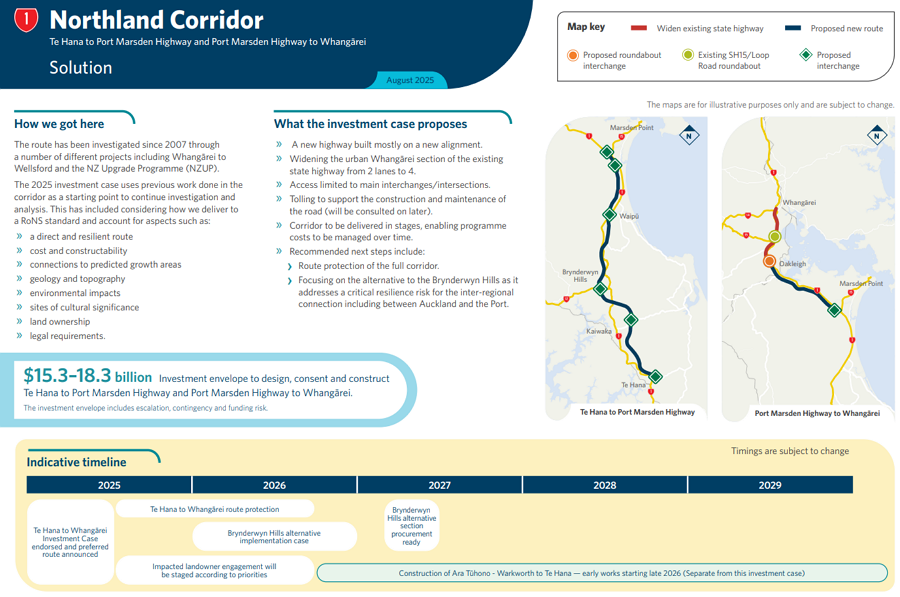 Yesterday’s announcement included this detail:
Funding of $187m to progress design, consenting, and route protection, with priority given for an alternative to the Brynderwyn Hills (section 2b)
East West Link
Just in time for Halloween, the zombie East West Link project is back from the dead – in a new slimmed down form, yet still significantly more expensive than it was nearly a decade ago.
A key change to the project is that it is no longer planned as a highway across the edge of the harbour. Rather, the proposal is now for some more sensible improvements to interchanges, and looking to make better use of Neilson St – which is something that should always have been part of the project.
One of the reasons noted below for the change is to reduce the environmental impact by avoiding the foreshore area.
Back in 2017, this project was expected to cost $1.8 billion – which at the time qualified it as the world’s most expensive road per kilometre. That’s now up to $3.7-4.1 billion.
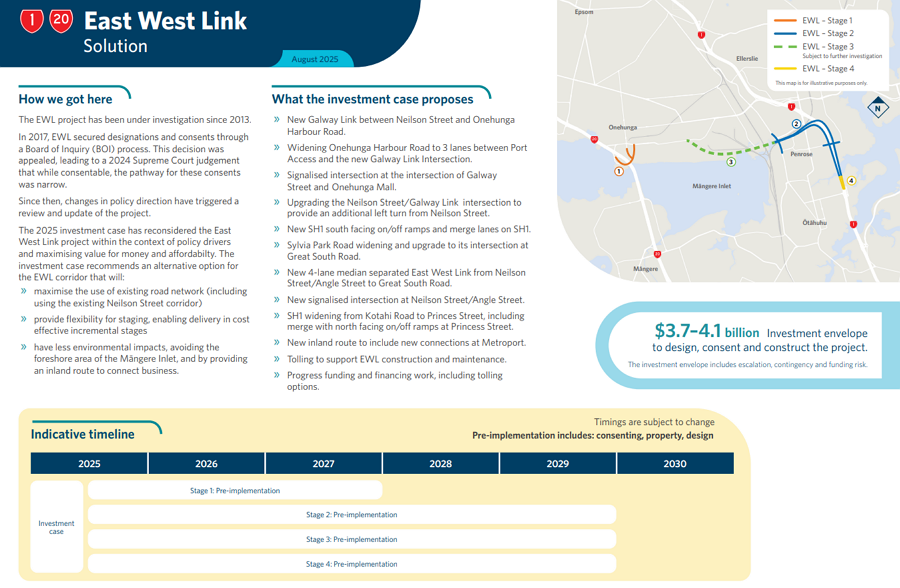
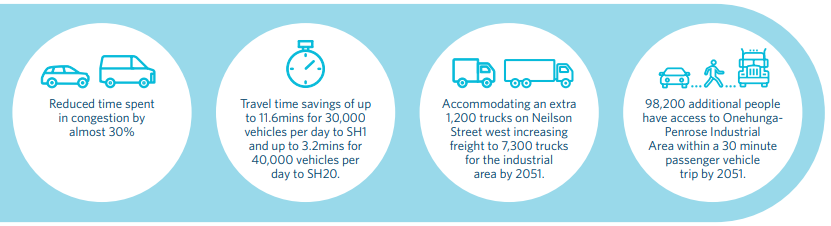
The new East West investment case claims it will boost GPD by $49.5 million a year, which doesn’t sound like all that much for up to $4 billion in investment. Nonetheless, it’s claimed to have a BCR of 3.2 if untolled, or 2.6 if tolled. The following benefits are also provided for the project:
 Based on the above map, it seems it might still include this part at the Onehunga end – but without the foreshore extension:
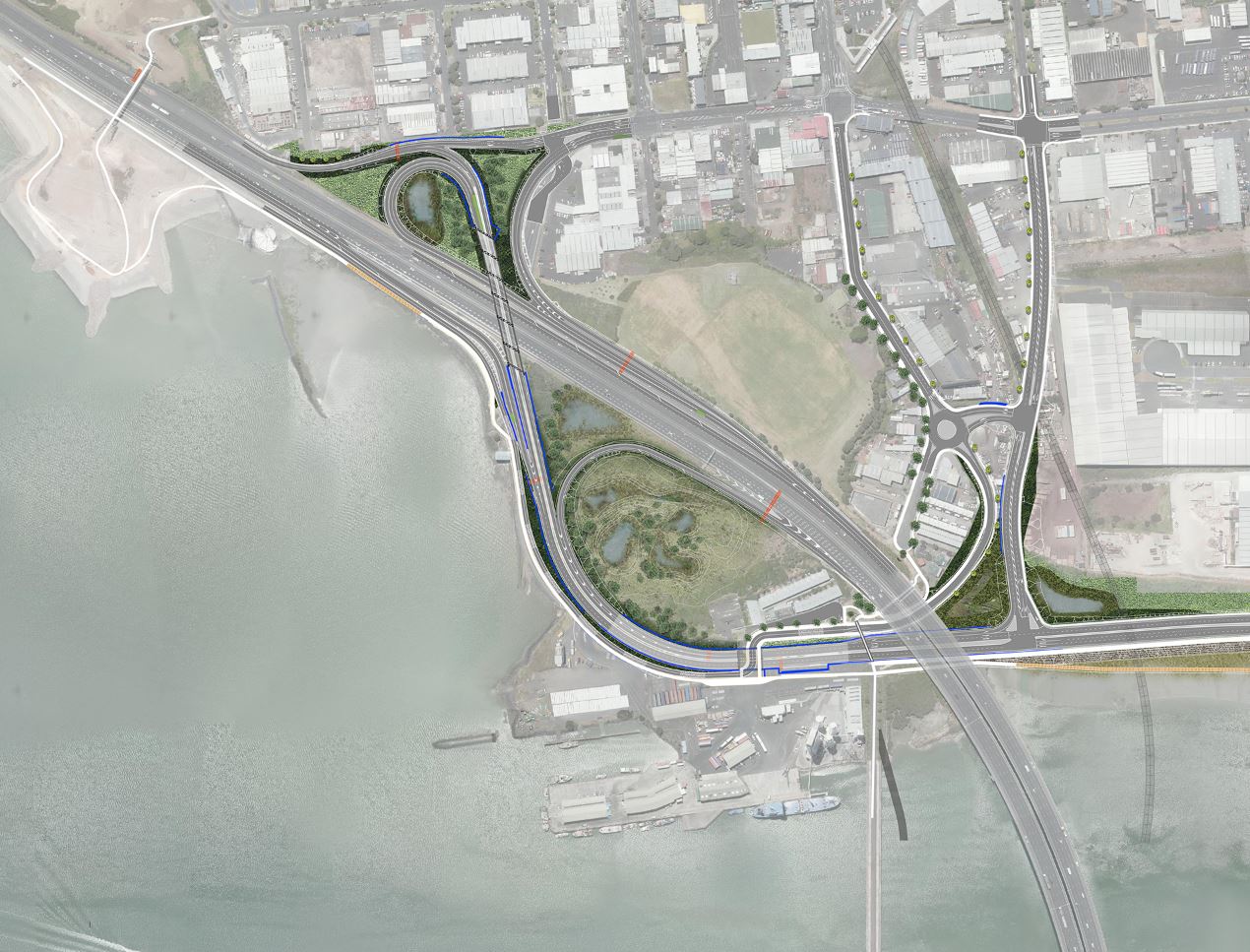 It’s also possible some parts of this structure – connecting Sylvia Park Rd back towards Onehunga – might still be on the cards.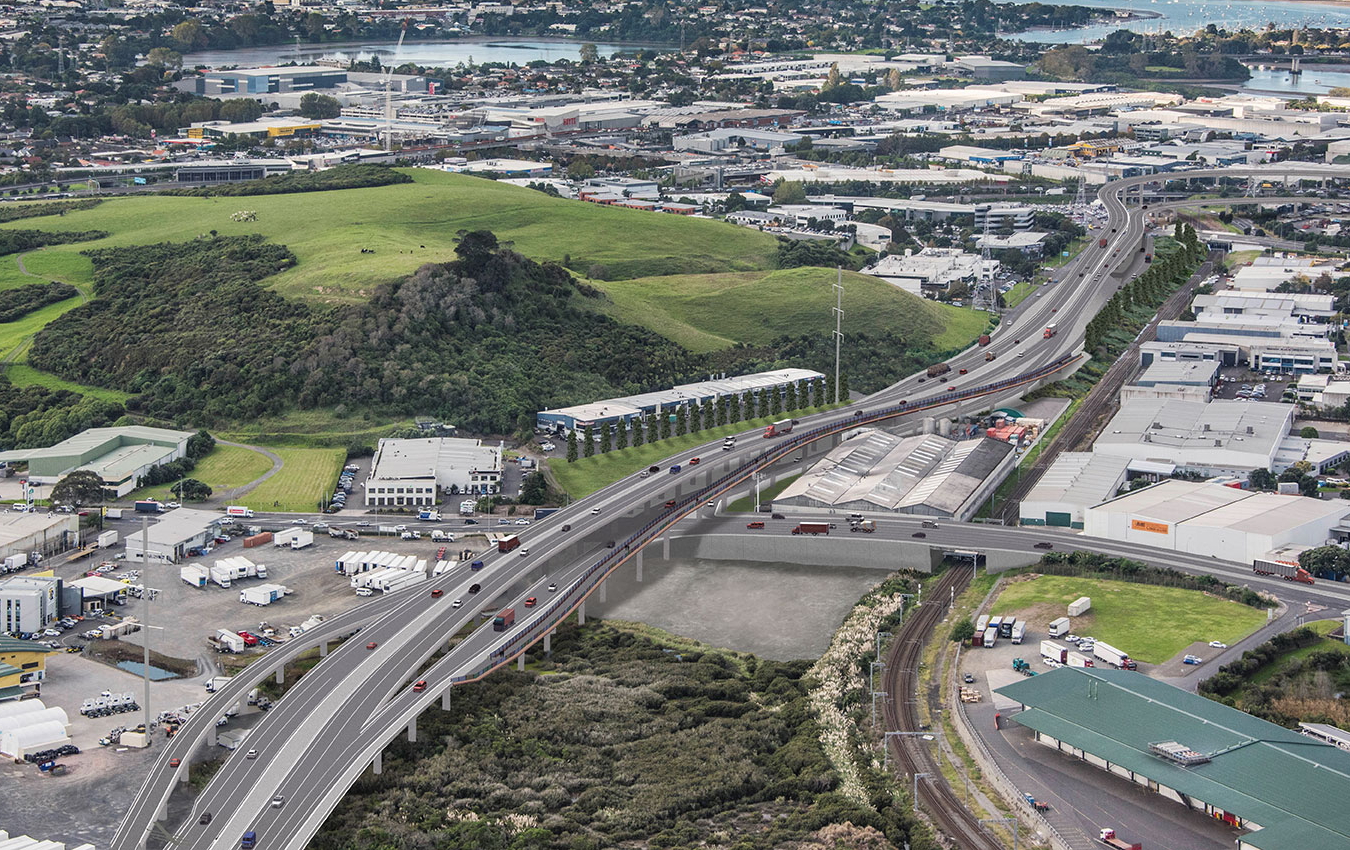
Yesterday’s funding announcement on preparatory work includes this for the East West link:
Funding of $102m to progress design, consenting and route protection.
Hamilton Southern Links
Hamilton has just been successfully bypassed, so clearly it’s time for another highway – this time with the stated goal of opening up more land for development.
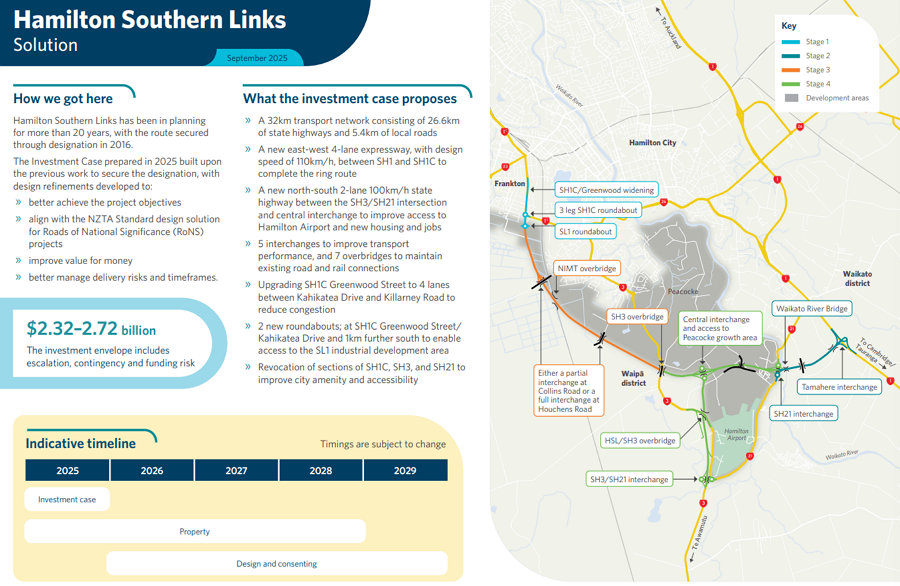
The project will see what is now SH1C extended further south, eventually back to a new connection with the Waikato Expressway. The wider project also encompasses a number of local roads, including the new bridge over the Waikato that was opened last year to serve the new suburb of Peacocke.
Just like the East West Link, this project is expected to cost $3.7-4.1 billion for the following benefits:
By 2055, it will also support access to 17,300 new houses and 7,100 new jobs. The BCR is 1.9 un-tolled, 1.6 tolled, and 2.3 with WEBs included.
The funding announcement included this:
Funding of $100m to progress design, consenting and significant site investigations work.
Petone to Grenada and Cross Valley Link
These two projects seem very close to the Minister’s heart, as both are in his electorate. From yesterday’s announcement:
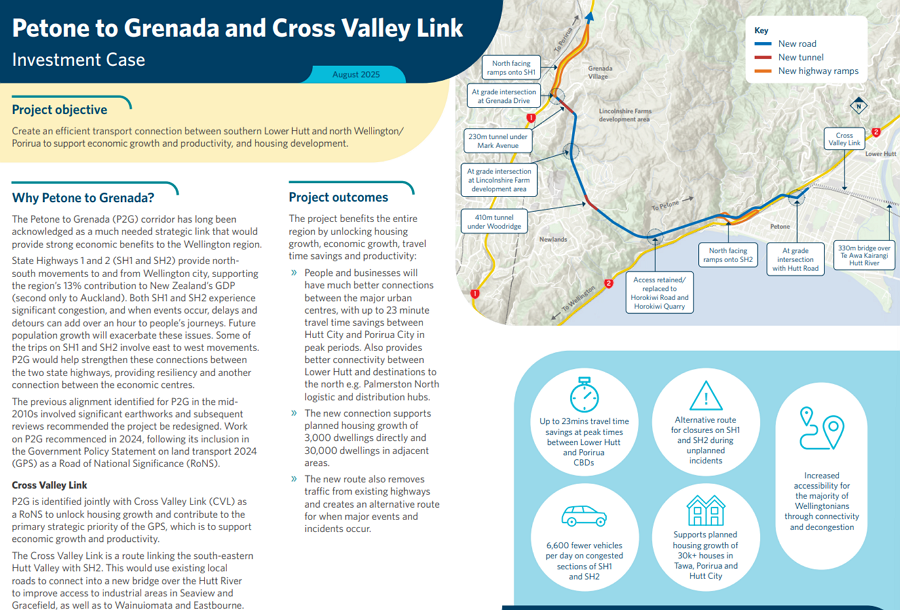
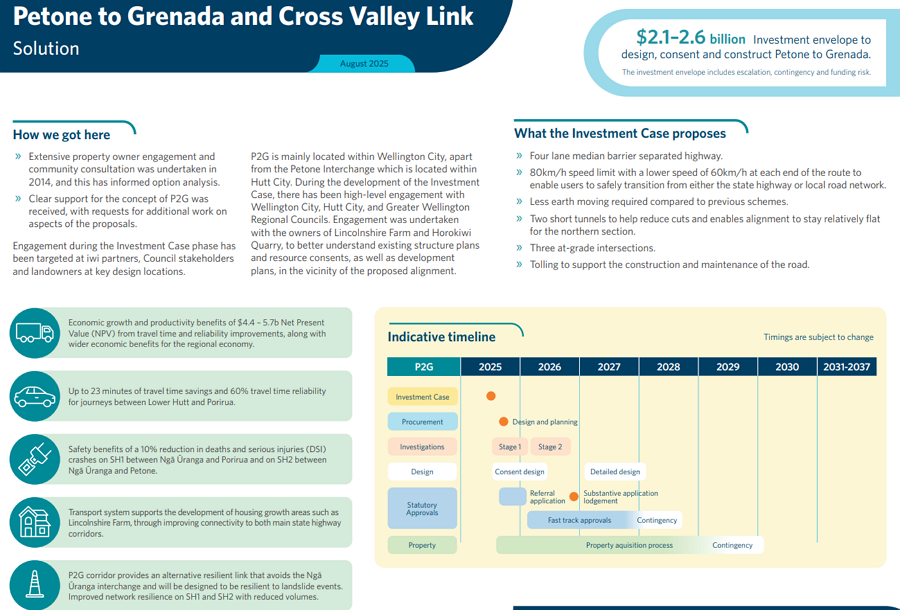
“The investment case for Petone to Grenada has confirmed a preferred and viable route, with travel time savings at peak of up to 23 mins between Lower Hutt and Porirua. The project also supports planned housing growth of more than 30,000 houses in Tawa, Porirua, and Hutt City. The BCR is 1.7 tolled/un-tolled, and 2.7 including WEBs. CVL has an incremental BCR of 2.0 assuming P2G is built first.
“The preferred route provides a more efficient connection with 70 per cent less earth works than previous designs, resulting in lower costs and less impact on communities.
The cost given is $2.1-2.6 billion, but it’s unclear if that’s for both projects, or just Petone to Grenada,
The announcement included:
Funding of $32m to progress design, consenting and procurement activities.
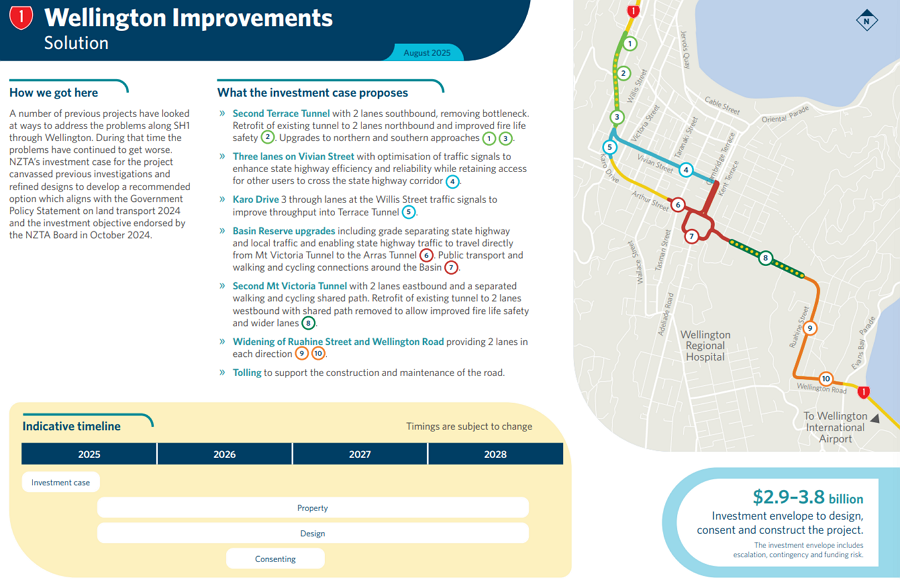
SH1 Wellington Improvements
The plans for a second Terrace tunnel and second Mt Victoria tunnel were confirmed last year after the investigations into a “long tunnel” option.
Now we finally know the cost of these and related changes. All up, this is expected to cost $2.9-3.8 billion – and notably, it has the lowest BCR of the six projects released – 1.0 if tolled, and 1.2 untolled.
“The investment case shows a good case for investment with strong benefits. It makes the best use of the existing SH1 tunnels and roading assets across the city, while also building much needed new capacity, flexibility, and resilience into the corridor. If tolled, the BCR is 1.0 including WEBs, and un-tolled the BCR is 1.2.
“Benefits include future travel times from the Wellington region to the central city, hospital, and airport reducing by up to 10 mins at peak times, travel time variability reducing by up to 40 percent, a 20 percent reduction in peak traffic on the Harbour Quays enabling increased use of buses, and an estimated 200 additional walking and cycling trips per day through the second Mt Victoria Tunnel.
This is what’s currently proposed for the Mt Victoria tunnel
“Walking and cycling between the eastern suburbs and the central city will also be safer with a new 3.6m wide enclosed shared path included in the second Mt Victoria Tunnel. The 1.4m raised path in the existing tunnel will be demolished to enable wider vehicle lanes and improved fire safety measures.
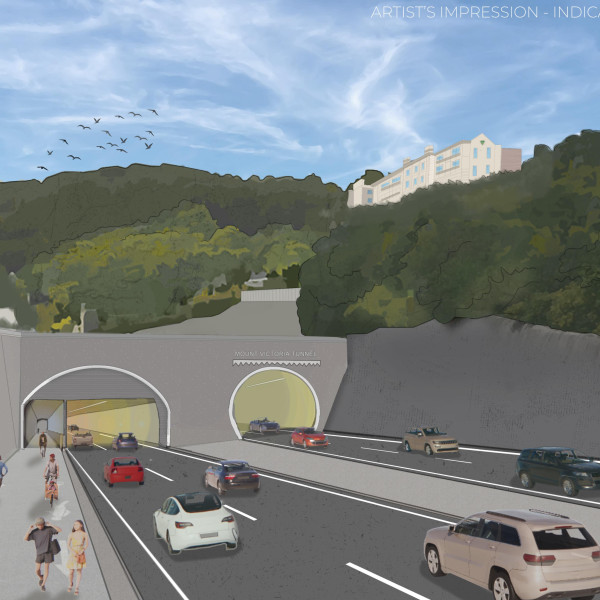
It’s great that Wellingtonians walking and biking will have a dedicated space, compared to the narrow and fume-laden path in the existing tunnel. But could we not squeeze an extra metre and a bit of width to enable separation of walkers and faster-moving people on bikes? Especially given the sums involved.
From the funding announcement:
Funding of $185m to progress design, consenting, and early works development.
Hope Bypass
Last on the list, and one of only two RoNS projects in the South Island, is the Hope Bypass in Richmond. Note that the project as proposed doesn’t actually bypass Hope (which is slightly further south along SH6).
“Delivering the first two stages has strong benefits, with a reduction in peak travel times through Richmond by up to 16 mins, support for 11,000 new homes and a reduction of up to two injury crashes per year. The project will also retain cycleway routes and connections. If tolled, the BCR is 1.1, un-tolled it is 1.7.
The project is only around 4km long but is expected to cost $1.1-1.4 billion.
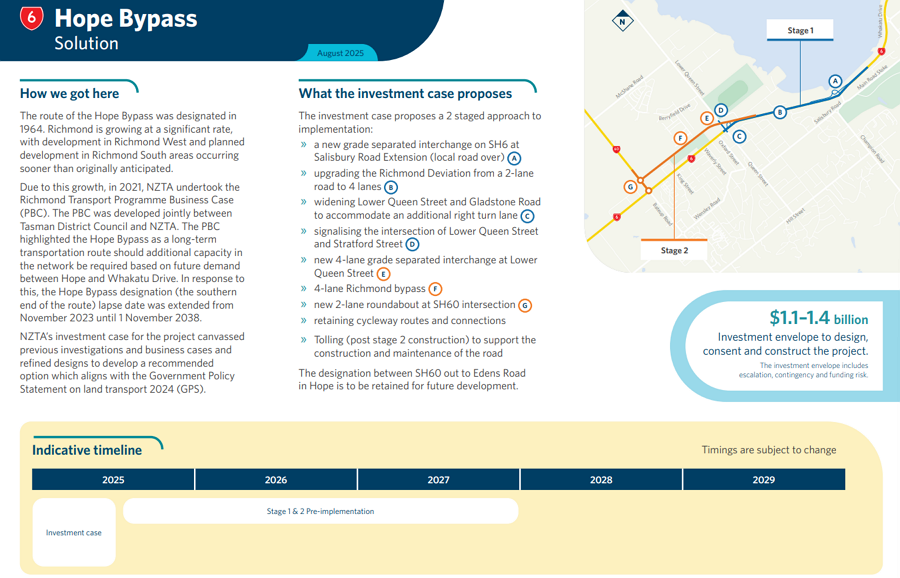
The announcement included:
Funding of $72.6m to progress design, consenting and procurement activities.
All up, that’s $27.4-32.9 billion planned to be spent on the six RoNS projects in yesterday’s announcement.
Combined with some of the costs already announced for other projects, it brings the total for this package up to $40-50 billion. And this still doesn’t include all the other RoNS on the government’s wishlist.
That’s why this line from Bishop’s press release is perhaps the most important:
“It’s important that we also have a clear plan for delivery, including well-reasoned prioritisation to inform the order in which these RoNS are funded and delivered. The Government will have more to say about that in the coming months.
There it is. They know they can’t deliver all of these projects, but they want to pretend they still can. It will be interesting to see how long they keep up this game.
Especially now, in this economy – knowing that even building just half of these mega-roads will suck an enormous amount of public capital away from being able to build schools, hospitals, or anything else our nation urgently needs.
It seems that whatever the question, this government’s answer is “More RoNS”. But more RoNs will bankrupt the nation.
This post, like all our work, is brought to you by the Greater Auckland crew and made possible by generous donations from our readers and fans. If you’d like to support our work, you can join our circle of supporters here, or support us on Substack!

 Processing...
Trains?????
Trains are not roads, Anon. Trains are anachronistic and EXPENSIVE.
Please tell me this is satire
Is “more RoNS” an intended or accidental pun?
This joke may well be the death of RoNS
Yes
More Rons = Morons. Most of these roads won’t be built as they are well moRONic…this government will be sent to the dustbin of history (2026 – looking at you NZ voter) and we may get more sensible policy and better projects will be prioritised. Shameful to see no pushback from NZTA or other government staff against such boondoggle highways. I live in hope.
Most of the staff at NZTA who push back are either:
1. gone – they left when Simeon Brown changed the transport policy
2. sufficiently kowtowed by compliant middle management suppressing the opinion of professionals.
The Warkworth to Te Hana link needs to include a separated bi-directional cycleway as SH1 is the only link between Wellsford and SH12 for cycle tourists heading north, or heading south.
Doesn’t the current GPS literally forbid that? That would make the project multi-modal, and that isn’t allowed anymore.
I wish I was joking, but that was literally the explicit statement of the last GPS.
along those lines i was thinking the walking/cycling path in the wellington tunnel will get removed well before the new tunnels walking/cycle path is recreated.
Additionally 3.6m is really too narrow for a bi-directional shared path.
5m minimum, then at least walking and wheeling can be separated.
You’re correct – the team designing (or whatever stage it is at) for the Takatimu North Link stage 2 has dropped the shared path along side it. Even though Stage 1 (under construction) has one.
Amazing the teams don’t just continue including it, on the realistic expectation that the GPS will be replaced with an evidence-based policy statement. After all, they
have plenty of experience ignoring the GPS – having entirely misrepresented how the activity classes should be used, under Labour.
Wow, we really don’t get much these days for $4.1 billion! How have costs gone up so much? They built Waterview for a third of that.
Yes this is what I’m wondering. Would be really good to see a cost breakdown of each Northland expressway section as some bits they are literally just widening (along with some median barriers of course) the existing road on the existing flat not difficult terrain. Wha gives how has the cost of doing that just ballooned. By these cost metrics starting a new CRL today would cost 9B+
For $2.4 billion more, you could have the CRL.
For $2 billion less we could have had Light Rail – had the Labour party handed AT the cash the day they were elected.
JJ – I think there was about as much chance of the original light rail project being built for $1b as there was of CRL being built for it’s initial cost of $1.2b or Warkworth to Te Hana being build for it’s original cost of $1.5b.
a) The 2% discount rate (real) is an appropriate way to do BCRs. The 10-year bond is ~4%, and assuming 2% inflation gives 2% real. This means that the BCR is effectively being measured against the risk-free rate of return. But with any BCR close to 1.0 you may as well not undertake the project as it will have a risk profile & leaving the money unspent carries no risk.
b) Northland Corridor – given the low traffic volumes why not build it as alternating 2×1 lanes like the Scandi highways? This would cut the cost by about 25% and keep almost the same benefits. The 4 laning could be done when the volumes justify. One could also defer the construction, or stretch out the construction period to improve the economic return.
c) I’m sure the socioeconomic BCR’s would be much higher for properly addressing the record homelessness in NZ, 600,000 foodbank customers per month, very high power prices impacting 100,000+ households in energy poverty & NZs productivity, etc etc etc than most of these projects.
Regarding the discount rate, that logic might be credible if it is funded through government bonds, but not if its funded through a PPP scheme with effective rates of around 10%.
As to the 2+1 vs 4 laning, there is also a question to be asked around what design standard NZTA is adopting. How much of the recent cost escalations is that they have adopted a higher design speed to allow for Simeon’s new 120km/h speed limit option.
Yes, agreed. Because the financing cost for a PPP is higher the BCR will typically be lower.
BCR=PV of Benefits / PV of Total Resource Costs (including financing)
No it isn’t. There isn’t a private company in the world that would ever invest with such a low return. The cost of capital is much higher than 2% and adjusted for the risk inherent in transport projects means most of these will never produce a return over cost. 6% is the minimum and there is a good argument for 8% for transport investment.
As the BCR is in real $, the cost of capital is real $ as well.
The govts cost of capital is ~4% 10-year govt bond less inflation = real 2%.
If its a PPP, yes ~10%+ will be demanded. This will reduce the BCR.
BCR=PV of Benefits / PV of Total Resource Costs (including financing)
The discount rate isn’t just the Government’s real risk free interest rate the Government pays to a lender. The discount rate should be set to a level so the project returns can be compared to another project of ‘equal risk’. The problem is that these public investments carry higher risk. The discount rate should be viewed as the hurdle rate to determine if the project benefit stream measures up rather than soaking up cheap finance with Boondoggles. Check out para 148 to 158 for the theory.
https://www.treasury.govt.nz/sites/default/files/2015-07/cba-guide-jul15.pdf
Hi Miffy,
I don’t agree.
The risk-free rate of return provides an absolute benchmark to compare projects against. Different projects with different risks can be assessed by applying the P90. P95 or even P100 as the cost in the BCR.
The fact the govt chooses to fund projects with a BCR close to one is a separate issue. Ideally all infra projects would be lined up and a BCR cutoff used to match available funding.
When you are comparing social costs and benefits like these the discount rate becomes a policy tool to figure out how much the current generation might value a benefit later. We all accept there will be benefits later- I used to walk to work on a road built by the Romans in Londinium. But there is a point where a benefit is so far in the future we wouldn’t pay anything for it. So there is a hurdle rate otherwise we won’t address the current problems. Even for commercial projects with real tangible returns you would use CAPM to get a discount rate that includes risk in your assessment.
I might be missing the point but…compared to what?
Regardless of how they calculate the BCR, they should have a big set of possible projects (both big and small) and sort them by the BCR. It shouldn’t be “we will do this project because I like it and its cool and has a BCR > 1”, it should be “we will do this project because it has the highest BCR in the country”. Almost all of those will be smaller projects; fixing dangerous intersections etc.
Exactly JJ!
Well I think JJ is being too sensible here. Clearly they have forgotten that we live in a popularity based democracy. Politicians will say or do anything to gain votes hence why Hipkins chickened out on criticising Puhoi to Warkworth once it opened even though the old party line was against this. The Northern expressway( well at least some of it) is going to happen because it’s an popular idea even if it is a rip off, you’re acting like voters actually give two hoots about evidence.
Wonder what the voters would think if another party suggested instead of spending $40+ billion on these roads they would put it towards hospitals, schools etc. That would allow them to say our shiny new thing will be better than your shiny new thing rather than as you say being to scared to criticise the new concrete.
Yeah it’s great to do that, right up until the Brynderwyn hills closes again. Then the political football starts again “see what happens when we stop the road building”. Tbh I am angry at Labour (I did vote for them so can’t be too angry) for stopping the Warkworth to Te Hana section as now it’s going to cost us way way more. But in all honesty it’s the Brynderwyn hills that keep this whole project going hence why they have deceitfully left it till last so people will want to keep supporting it. A smart thing to do would be to propose a Brynderwyn bypass and rush it through so a lot of the noise dies down, but Labour don’t have the guts for that and the Greens are ideologically opposed to any sort of road. Little do they realise doing dumb stuff like setting the speed limit to a safe and appropriate limit will only grow support for a faster expressway. So yeah we absolutely should not build this thing it’s too expensive but…. It’ll probably happen anyway just very slowly with many stop and starts for purely political reasons.
Efficiency – it was the Key government that pulled the pin on Warkworth to Te Hana based on the $1.5 billion cost being too much.
Agree, the Bryderwyns are the most important part of this road to get sorted.
on the 2×1 lane roads, the problem is the Government’s policy is 2×1 roads are out of scope:
“All RoNS will be four-laned, grade-separated highways” (from here: https://www.beehive.govt.nz/release/gps-2024-15-new-roads-national-significance)
The infrastructure commission has had some pretty pointed things to say about the financial risks of politicians committing to specific design features before developing the business case, but that seems to have fallen on deaf ears in the beehive.
Yes the RoNS doctrine is bad, and should be dumped. These numbers surely make that very clear.
Yep, even if you’re pro-roads this is not the best approach to take.
We have a number of skaky regional connections in NZ:
New Plymouth – Hamilton
Napier – Gisborne
Gisborne – Opotiki
Brynderwyns
Nelson – Blenheim
Spend some more money on these.
To someone that spends a lot of time thinking about electricity, this is starting to look a lot like the late 80s. Rapidly spiraling boondoggles like the Clyde Dam. And a massive looming bill that the state was unable to manage, and unable to make smart trade-offs about what to build.
Eventually there will come a time for reform. If either team wants certain outcomes, then you’d better be the one doing the reforms.
As an aside, despite lack of understanding on the part of the public, electricity is actually a really good example of infrastructure reforms going well.
didnt nz fix its overspend on the likes of Clyde Dam by selling half of our energy infrastructure to the Australians ?
Guessing we’re lining up our RoNs for overseas investment $
First there was the reform of NZED (electricity department) into a SOE NZEC (electricity corporation) then the breakup of that into the gentailers we have today. Then a partial sell down onto the NZX.
We could follow a similar path, reform the NZTA into an SOE, divvy it up into 3 or 4 regions (like we were going to do with water). Give them the ability to set RUC’s, fuel taxes, tolls, congestion charges, maybe even land value rates?, within their area. Central government remains a regulator, setting price – quality expectations.
If you were of the state should own / do everything persuasion, then going back to what we had where a separate entity funded projects and the NZTA pitched projects to them would be a start.
Either way, inevitably there will be reform.
I agree some sort of reform is necessary. Breaking NZTA into regional delivery entities like Labour’s water proposal would be one option I would support (as long as identity politics committees with Iwi representative wasn’t part of the reforms – the new organisations would need to merit based, transparent, accountable, evidence based, etc.).
The status quo is not sustainable. NZ compared to other OECD countries is a top 10% of infrastructure spender yet is the bottom 10% for affordable infrastructure delivery. This cannot continue. Either effective reforms will be implemented, or this will be another issue pushing politics into populist backlash territory.
Absolute lunacy. And I thought they were government of prudent spending.
Prudence = spending on what YOU want, not on what you have in the wallet, or based on what is good for everyone.
Grant – you “thought they were government of prudent spending” – where the heck did you learn that from? Oh, that’s right, because they told you they were. If governments repeat a lie often enough, people cannot distinguish it from the truth.
Clearly, a government with the sheer incompetence of Luxon and Willis in charge, who blew up the Cook Strait Rail Ferry deal and a half billion down the tubes on day one, is not a government of “prudent spending”.
Exactly.
Note does not even include vast cost of any additional harbour crossing.
Also, some very simple math: if you lower the discount rate by a third, that means you are tripling the claimed value over time. So just by this shift alone they have changed a 1 into a 3 in the resultant BCR. So if something is given a BCR of 2.4 now, it would have only been given a 0.8 previously, by this one change only. A 1.2 = 0.4, etc etc.
All of these projects are of low value. As is intuitive from their low traffic volumes and high costs. These low volume highways should be upgraded for safety and efficiency in way more cost effective ways, like we used to.
Three laning, 2 + 1 alternating (2 on uphill sections), flat intersections, except where the topography makes going over or under easy and cost effective, and median barriers, are where the value lies.
We need hospitals, schools, alternative urban transport, and alternative freight transport too. Not just roads. Evaluate all infrastructure properly.
The RoNS doctrine should be retired and replaced with IoNS. Infrastructure of National Significance. The idea that roads are only or even especially of ‘National significance’ is childish, distorting, and holds back our development and prosperity.
R (as in roads) is important, its a vote grabber. NZild wants roads, and from my observation – willing to sacrifice future development and prosperity for them.
Yup a few expensive country motorways and four lanes to the planes will halt the mass exodus. That’s why everyone left for Australia.
Well, there is a nice big road on the way to the planes now, so no wonder everyone took the road, jumped on a plane, and left the country…
Dams were a vote winner all the way to Muldoon. But as the process became politicised this corrupted what had started as a legitimate nation building exercise. Muldoon by choosing boondoggles like Clyde dam undermined the whole concept of the public investing in nation building. ‘Think Big’ became a dirty word. He tainted the whole process. New Zealand’s current crop of politicians have learned nothing and repeating the same poor cost control mistakes.
And that IoNS needs to include the bit of SH1 that crosses Cook Strait.
+1
Yet somehow this will still gain support of the public because of the Brynderwyn hills constant slips etc. Warkworth to Te hana needs to happen the inclines and traffic hold ups that happen are just too much. I seriously doubt if we need it any further than that. Just need a solution for the Brynderwyn hills.
Small designed improvements like the Hill Street intersection in Warkworth are needed now, not next decade. Prioritise those.
All the belly aching about the cost of project irex and now this. It just doesn’t add up.
That’s just one project being deRAILed while another one gets on the ROAD…
I would rather have a smaller road on my way to a highclass hospital.
Perfect summary, Viv
Breaking up EWL into these stages makes more sense. Stage 1 is a “must have” that would probably have a good BCR on its own (I wonder what that does to BCR for the rest?). The SH1 connection was always going to be a biggy, tying into a busy area but solving some poor existing road connections. Not messing with the harbour edge is a huge relief.
I can see the East and the West, but there is no Link. Looks to be the East West project. Not sure the conservation values on the harbour edge are great. There are no shipping operations, or manukau ferries to impact.
The $102M funding for planning and consents has its work cut out, as they’ve yet to be be able to put a line on the map with the funding spent to date.
Agree Streetguy. This is a way better version, expensively and unnecessarily sealing off yet another coast line was just horrendous. Especially while leaving on-street parking on Neilson so it goes to two lanes in parts. Rationalising road freight there is sensible. Still is crazy money, and a hideous elevated highway next to a maunga.
Would love to see what adding key passing loops on the eastern line to facilitate rail freight, expresses, and inter cities would cost be comparison?
Basically adding a third track east of the tunnel, GI to Panmure, or better still all the way past Sylvia Park, would surely enable higher volumes, greater speeds, and much higher reliability to all rail modes to both the NIMT and the depots.
I don’t see how this will solve anything at the western end, as all the congestion is entirely due to the onramp lights, and I don’t see that changing anytime soon.
I’ve worked on Neilson street for the last 10 years, half while living in Ellerslie, half in hilsborough. I think a far better BCR could be had by finishing the 4 laning, 1 each way as T2/Truck lane, add some new lights at the metroport entrance and reconfigure Neilson / Church intersection so Neilson to Church has better priority.
It would also be strait forward to improve the driving alternatives by adding a cycleway to the south side of Neilson and Church st with some more connections to the Waikaraka path, and reinstating the bus route that used to use Neilson street.
Phase 2 could include some new southbound onramps at the end of Church street onto SH1. I think this was one of the earlier plans.
Ramp signals have been proven to allow more cars to flow freely on motorways all over the world.
Sure, but the problem remains, traffic will still back up in Onehunga as there will still be ramp signals at the onramp. Traffic northbound on the onehunga ramp backs all the way back to Waikaraka park everyday, due to the control of the onramp lights. Having a better run to the onramp is not going to change anything if the bottle neck remains.
As someone who works for an airline and flies all over the world, the only place I see them is Auckland and from my own experience they simply do not work. They just cause tailbacks on side roads.
If they worked I’m sure you’d see them all over Europe, but you do not.
In 1999 Minneapolis turned off their ramp metering for six weeks, after many complaints. Motorway speeds dropped significantly during rush hour with the meters turned off. Sideswipe crashes also tripled. Slower traffic also meant more emissions and dirtier air, which is kind of a problem for those of us who have lungs. So, clearly the ramp meters work. highway speeds dropped significantly during rush hour with the meters turned off. Sideswipe crashes also tripled, with total wrecks jumping 27%. Slower traffic also meant more emissions and dirtier air, which is kind of a problem for those of us who have lungs. So, clearly the ramp meters work.
traffic management being incredibly complex, though? The data also showed that drivers with longer commutes benefited from the ramp meters much more than drivers who lived in, or just outside of, the city.
traffic management being incredibly complex, though? The data also showed that drivers with longer commutes benefited from the ramp meters much more than drivers who lived in, or just outside of, the city
However, traffic management is complex as the data also showed that drivers with longer commutes benefited more than those who lived closer to the city. Interesting example.
A separated cycleway on Neilson and Church would be great! We also need safe separated connections to the Mangere Pad/Cycle bridge.
Why are these roading designs so bad? Who designed SEART is such a convoluted way that it blocked on and off ramps to Church Street which is the main industrial area?
The SH18 to SH1 designs up in Albany is no better, creating all sorts of swerving and lane changes with Greville and Constellation interchanges so close by.
The competence of NZTA is very questionable in my view.
Project costs would include land purchase but generally don’t allow for residual land sale for development.
Yes, but that would presumably only really make a dent where the project is very urban. Re-selling the odd bit of left-over paddock after the bulldozers are gone isn’t going to bring your BCR up.
Ask not for whom the road tolls, it tolls for thee.
Ask not for whom the road tolls, because once it is built, the local MPs will lobby until the toll gets removed.
I think all these roads are for the trucking lobby and just to give work to the Trucking firms to create jobs?? Not for solving an problem for everyday Kiwis Needing to get somewhere. I always confused that so much goes into connecting Towns and cities rather than internal transport of the city or town in where everyone actually stays, lives and works. It should be hard to get from city to city – that is the point of having a city. If you need to go for work to another city that is sort of your problem and choice. Let the trucking lobby pay for these if they really think thats whats needed. Then they may choose trains or ships anyway.
I would love a journalist to ask Chris Bishop the following question:
“Given the iRex precedent, wouldn’t it be fiscally irresponsible of Labour not to cancel the Northland Corridor regardless of sunk costs, and replace it with a cheaper option?”
+1 !
So who benefits politically from some of these roads- for Northland two prominent members of a party within the ruling coalition.
For Hamilton it’s a swing city with two National MPs- currently.
For Wgtn and Hutt- two senior cabinet members.
I assume that there will be a big fightback in Wellington against the second Mt Vic tunnel.
I doubt there will be a fightback in Wellington, but there should be one in Christchurch. The spending discrepancy between the two cities with a very similar population continues.
Jezza – you “doubt there will be a fightback in Wellington” ?
Clearly you don’t know Wellington people then !
The Mt Victoria Residents Association fight with the passion of a Liberation Army !
Fair call – I was more thinking of the wider population of Wellington that have been wanting 4-lanes to the planes for years.
Do they actually? Would they in an informed, deliberative context? How many use the airport frequently enough for “four lanes to the planes” to impact their lives in a meaningful way?
“What people want” can only really be understood from settings where they are fully informed and with the chance to discuss it calmly with people with other needs. The typical media amplification of loudmouths or kneejerk soundbites isn’t useful in a democracy.
We need 2nd Mt Vic and 2nd Terrace tunnel well before we need a Petone to Grenada. Hutt needs the cross valley instead which should be linked to Dowse interchange.
My region – Canterbury is the second largest contributor to the National Land Transport Fund which is meant to fund NZTA.
Canterbury is a growing and thriving regional economy but because of political corruption and the bankruptcy of the entire road funding mechanism we do not merit inclusion into RoNS 2.0.
So road improvement planning for the coming decades excludes NZs second largest region by populations, and GDP.
I don’t know why me and my regional neighbours pay fuel taxes because we get feck all benefits from the road funding system.
I would happily gut the entire corrupt system.
It’s kind of nuts tbh. I thought they’d at least do 4 lanes to Ashburton (eventually Timaru) and north to the SH7 junction. Like, it’s the 2nd largest source of votes, why would they just ignore it?
You would think there would be votes to be grabbed by a political party taking a fair deal, honest broker approach to reforming transport funding that is fairer to the South Island, delivers infrastructure in an affordable manner, and doesn’t bankrupt the country.
So projects like Brougham St aren’t treated as Rons? https://nzta.govt.nz/projects/sh76-brougham-street-upgrade
or even Rors?
$100 to $150 million for the Brougham Street pedestrian over bridge is a rounding error when the cost of RoNS 2.0 is $50 billion and rising.
Canterbury is getting one RoNS. It is a small one. A simple extension off the Northen Motorway to bypass Wooden. It is projected to cost up to $1bn, which is relatively insignificant compared to the 10s of $billions being spent on the road network in the North Island.
Rors or Rorts? Roads of regional transport significance?
Rorts of Notional Significance.
The amount of road user charge money taken from Canterbury and spent on regions hundreds of miles away on a different island that few Cantabrians will regularly access is not a trivial amount.
Over a three-year period, it is in excess of $1000 per capita. Given that RoNS 2.0 is planned to be implemented over a period of decades the total amount of money extracted from the taxes Cantabrian drivers pay that will be spent on other distant parts of the road network will be many $thousands per capita. On a collective basis it is a robbery of $billions. The below quote has some out-of-date figures because the cost of RoNS 2.0 keeps escalating. But the scale of the theft is easy to see.
“In the 2024/27 NLTP, Canterbury — with 13% of the national population — received 7.7% of indicative funding. This was a slight increase from 6.3% in 2021/24.
If funding had matched its population share since 2021, Canterbury would have an additional $2.6b — enough for several motorways, a decade of local road maintenance, or most of a mass rapid transport (MRT) system.”
https://www.thepress.co.nz/nz-news/360553737/highway-robbery-cantabrians-are-paying-price-governments-indifference
This is how I describe NZ politicians to my overseas friends.
“NZ’s government is bankrupting itself because of how useless it is at building roads. It is political corruption. Luxon the prime minister is useless. NZ needs a cleanout. I hate Wellington politicians because the last lot were as useless as the current lot. There is not a single one who wouldn’t steal from their neighbour for short term political gain.”
They have to test the sensitivity of am 8% discount rate. When thry find the answers are very sensitive do they just ignore this?
The Hope Bypass uses a former railway line corridor. By using this land, the highway will make any future grade-separated public transport in Nelson -Tasman more difficult.
Hopefully this proposal is hot air and nothing more. Roll on 2026 and hopefully some better options to run our country.
Let’s not forget, too, that the BCRs are rubbish because WK refuse to calculate induced traffic correctly, and they don’t use a correct social cost of carbon. This slashes the time savings, safety, and agglomeration “benefits” and increases the maintenance and environmental “costs”.
NZ needs no more roads. We need to focus on traffic reduction, safety and improving access by sustainable modes.
Great point! Wonder if we can OIA the BCR calculation, then do a reworking of them to include carbon costs?
Sure. I’d give my thoughts if someone wants to pull out together.
Warning, though. I’ve pulled these things to pieces before and no one gives a shit. They know full well they’re wildly skewing the calculations and they don’t care.
Which is why it needs to be a challenge to the professional bodies themselves, who are failing to hold their members to account.
Hi Heidi
I had to pause here and think about your comment “…know full well they’re wildly skewing the calculations and they don’t care” – it’s like, well, a very lite version of choose your own truth that we’ve seen on display in good ole US.
Which demands a different strategy and I’ll have to do a bit of research.
Heidi, I think more accurately, the current government does not give a shit. We have seen that recently with the relaxation of targets for methane. It is evident with their focus on increasing tourism. From msn, “Emissions from New Zealand’s international aviation and shipping are equivalent to about 9% of the country’s net domestic emissions. Without action to reduce emissions from these sectors, they could grow to a third of domestic net emissions by 2050, according to the commission.” But as one of the governments climate advisors has said, 1.5 degrees was never realistic anyway. It would be interesting to know what temperature rise she thinks the world can live with and how?
If the economic benefits of the East West link are $49.5M PA (as per NZTA website) and the cost is $4.1B does that mean the project has an 83 year payback period? I am simple and like a simple calculation!
$49.5m is an estimated GDP increase. That’s not the same as the total economic benefits you would calculate in a cost benefit analysis. Not to say its a good project (it clearly isn’t!), but simply dividing project cost by GDP increase isn’t a good way of prioritising public investment, or a meaningful way of calculating payback period.
I don’t have an issue with these projects per se, what I do have a problem with is their cost estimates!
Is infrastructure expensive? Yes.
Is it ok for it to be 4x more expensive than similar projects overseas simply because it is in NZ? Absolutely not!
These are ridiculous sums of money and total BS – someone somewhere is absolutely making a killing out of this, or they have absolutely done a terrible job of value engineering.
Anything more than 1.5x Australia’s costs (with their higher wages no less). should be seriously questioned.
yes this is exactly right. NZTa and all that have favoured contractors and they are the only ones who get a look in. Think Wellington Water and that Fulton Hogan is one of the richest families in the Southern Hemisphere.
We are getting fleeced and the idiots at nzta dont care as they just get paid whether it goes ahead or not. Buy me a few bulldozer il do it for 1/1000 the cost
Glad to see there might be a backpedal on initially doing the Brynderwyn section last! It desperately needs a bypass of some sort and hopefully is next in line after Warkworth to Te Hana which sounds like (barring any delays) starting late 26. Yeah I know we shouldn’t be building a full expressway but I have a change of mind after just driving to Hamilton over the long weekend it’s just so much safer (and faster) bring on the roads (well maybe just this one then we run out of money lol). I actually think this is why it’s been announced now (long weekend) is because heaps of people will get a reminder how nice gold plated expressways are and how horrible single lane goat tracks are smart politics I’ll give them that. One more point is this is going to be the only realistic way to cut deaths on this route the public is not going to accept lower speed limits (and I would agree that’s a poor substitute and makes the case for an expressway stronger).
https://www.nzherald.co.nz/northern-advocate/news/new-expressway-to-cut-nearly-40-minutes-off-trip-between-auckland-and-whangarei/SHBBPXWKJBCLLBV42FV5PELGDE/
Saving 40 minutes on a 2.5 hour journey seems somewhat unlikely. Who’s fudging the numbers here?
Drove from Auckland CBD to Whangarei CBD return a couple of weekends ago. Google said 2hr 5min up and 2hr 4min down.
Took a couple of minutes longer only both ways only because of some navigational errors on my part, in an unfamiliar Whangarei.
Taking 40 minutes off that trip is not just political spin, it is irresponsible political lies.
I think stu is right here probably a bit of number fudging going on, maybe they make the travel speed of the expressway 120kmh and the existing road 70ks like NZTA wanted for all undivided roads. Or they compare it at peak times where the bottle necks in Wellsford and Kaiwaka add the 40 mins just on their own. I would wait till we see how they worked it out before accusing them of full on lying their might be some truth in it maybe NZTA plans to slash the speed limit on the existing road the moment the setting of speed limits rule is changed we just don’t know.
The public don’t need to accept lower speed limits to reduce deaths. They just need to accept a 2 + 1 road.
Well said jezza we need to work out how to talk to the public who more often than not refuse to listen to evidence. Unfortunately an expressway sounds better and gives better vibes. Most people vote based off vibes not evidence unfortunately, it’s the main reason why the Coalition got in so easily is because they told people they don’t have to do anything inconvenient. Labour forgot we live in a democracy and allowed local councils to set speed limits in line with best practice internationally and that didn’t go down well.
Yeah, it’s really nice to use infrastructure like this. Where a huge amount of money is collected somewhere else and spent on making a corridor that bit nicer for the few that use it.
Not being syncial here, is is really nice to get a treat and not pay lol.
Perhaps we shouldn’t structure all land transport funding like this but hey.
That Basin Reserve proposal is the worst thing I’ve ever seen. Talk about cutting something off from its surroundings. Straight out of the Robert Moses playbook, because NZ is still stuck in the 1960s.