Here we are again. For the umpteenth time, more changes are being proposed for Queen Street (and Midtown).
Unfortunately, these are not good changes, and they include pouring traffic back into the short section of Queen Street that’s currently car-free, between Wakefield St. and Wellesley St. The existing restrictions would only apply 7am-7pm, thus opening up the whole street to general traffic overnight. Why??
A free-for-all, the entire length of Queen Street, all night long. Welcome back, boy racers! Start your engines!
This is an important one, but if you want to see a better Queen Street, we need to speak up, so read till the end and considering using your power and taking some action!
We’ll dig into the recent stuff, and what we can do to stop this, but I think it’s important to have some context on how we got here, and how long it has taken.
A brief list of (just some of) the many, many proposals over the years to “pedestrianise Queen Street”
The shape of Queen Street has been debated for decades and decades, as you can read here, continuing into the 21st century.

Traffic in Queen Street, looking south from Fort Street (left), 1982, Auckland Libraries Heritage Collections 1727-100
In fact, Patrick Reynolds’ first post here – in 2011! – asked why we still allowed cars on Queen Street.
Queen St, from the water to Mayoral Drive, has an unusual and unexpected feature for a city street in Auckland. It’s easy to miss but it’s true: There is not one vehicle entrance to a building from Queen St. Not one car parking building, not one loading bay, not one ramp to an executive garage under a tower block. The only way to enter a building from Queen St is on foot. There are a few very short term road side parks among the bus stops and loading bays, but really every car in Queen St is on its way to and from somewhere else. And so slowly.
People often talk about traffic with words like ‘flow’ as if it is best understood as a liquid, when really what it is actually like is a gas. Traffic expands like a gas to fill any space available to it [which is why it is futile to try to road build your out of congestion]. There are cars in Queen St simply because we let them be there, like an old habit we’ve never really thought about. l think it’s time we did.
That was published 14 years ago, when I was 13 years old!
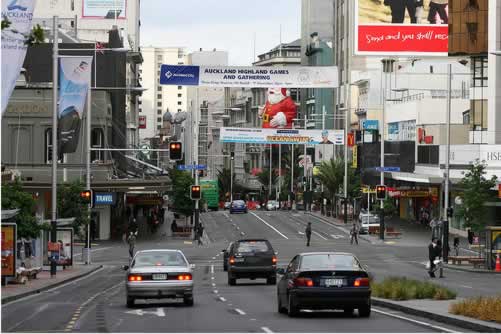
Queen Street 2009
In 2016, picking up on Patrick’s question, Matt penned a post in exploring the longterm impact of street upgrades in the 2000s. Pedestrian numbers rose significantly, while vehicle numbers dropped:
At the time of the upgrade the council estimated there were about 46,000 pedestrians, 40,000 bus passengers and 25,000 people in vehicles. Heart of the City now have fantastic data on pedestrian numbers thanks to automated counters located around the city and they show pedestrian volumes of around 60,000 per day, sometimes more. For example, on Friday 1 April the counter outside 210 Queen St (eastern side) recorded 36,128 people passing by.
[…]
Back in 2004 in the same spot and almost exactly the same day (14 Mar – 20 Mar) the counters recorded an average of 10,300 vehicles using Queen St in each direction over a seven-day period. By comparison counts this March show vehicle volumes are down 48% to an average just 5,300 per direction per day, far more than the predicted 15% reduction in volumes.
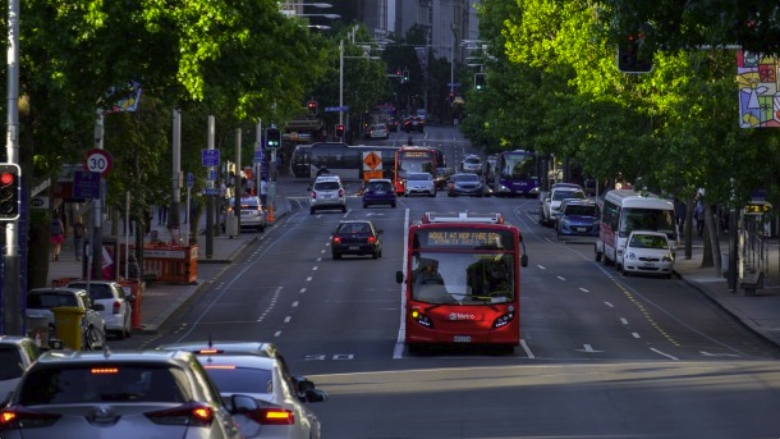
Queen Street 2018
In 2018, Auckland Council voted unanimously to pedestrianise Queen Street. Said then-Mayor Phil Goff:
“Making Queen Street and adjoining streets a pedestrian and public transport zone underpins our desire to put people at the heart of our city centre and waterfront transformation. It is what a world-class city would do. As Mayor of Auckland, it is what I want to do.
“Access for Everyone is a bold step in the right direction. It is a creative urban design approach to complex challenges that will unlock the potential of one of New Zealand’s most iconic streets; it will transform Queen Street, High Street and others in the vicinity into a pedestrian haven with desirable destinations that people will enjoy and explore, allow businesses to prosper and provide a pathway to our beautiful waterfront.”
AT and some Council officials proceed to ignore this directive for two years. Meanwhile, Auckland Council developed the amazing refresh of the City Centre Masterplan (and its transport component, Access for Everyone), which drew 84% support in consultation for pedestrianising Queen Street.
As for many other cities, the arrival of a global pandemic in 2020 provided the definitive catalyst for more people-friendly streets. Temporary changes were rolled out. When Council came out with a much bolder plan (although still not a full “pedestrianisation”) a group of disgruntled businesses took Council to court in opposition.
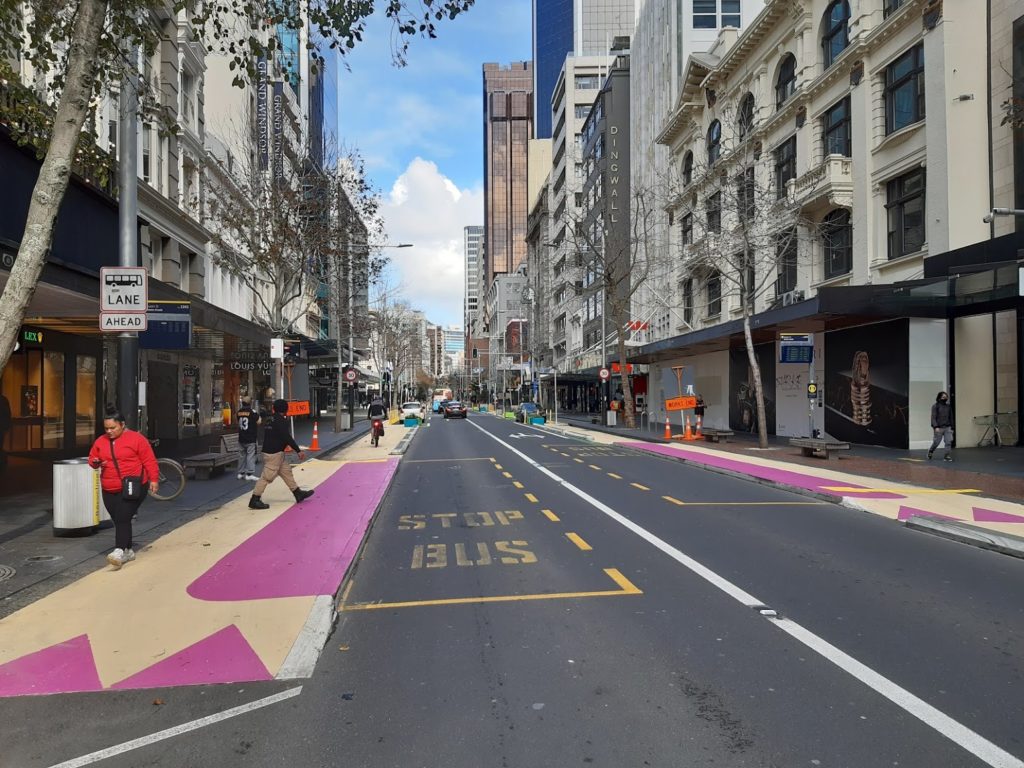
The Queen Street Covid-19 upgrade.
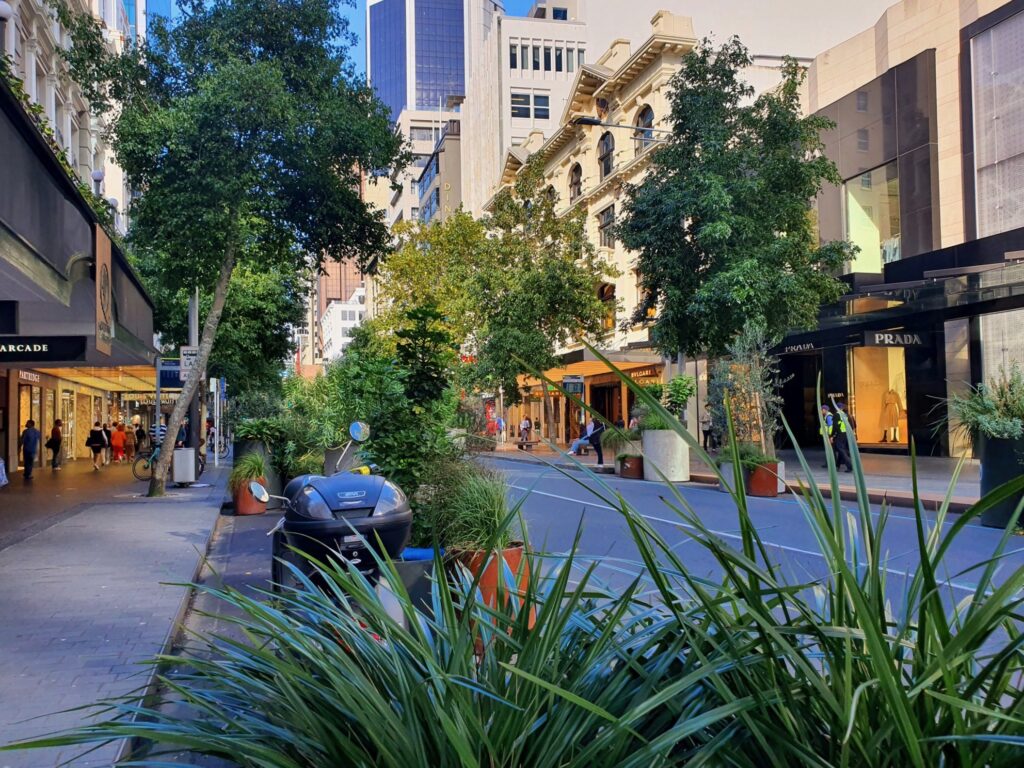
Queen Street 2023
Council won the court case, but subsequent backroom lobbying led to a watered down version. Even so, when it went out (again) for consultation, the vast majority of 900+ submissions opposed the limp version, preferring the bolder plans. This, eventually, led to roughly what we have today, including the current section which restricts general traffic between Wakefield St. and Wellesley St.
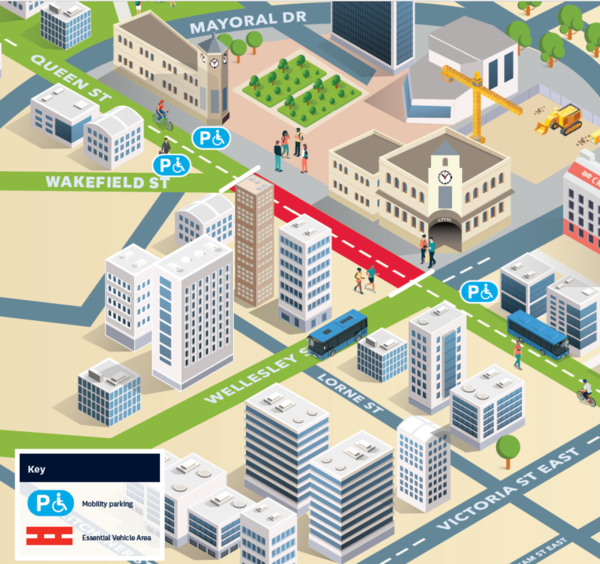
The EVA zone is that strip of red in the middle of the drawing. It’s not clear what the green means. Image source: Our Auckland
This ‘Authorised Vehicles Only’ section, stopped Queen Street from being used as a through-route (aka rat run) for private vehicles, and contributing to a much nicer experience for people.
It’s taken decades to get to this point, but in the last round of changes Queen Street still wasn’t fully pedestrianised as a transit mall (something that had 84% support). At the time in 2022, after a push to fully pedestrianise from Auckland Central MP Chlöe Swarbrick and the City Centre Residents Group, the excuse that came up was due to the disruption from CRL construction, and Covid, it couldn’t happen.
[Then Mayor of Auckland Phil] Goff said he fully supported the pedestrianisation of Queen St, but it needed a “progressive approach” rather than being done at once.
“If we were to fully pedestrianise Queen St all at once it would require significant roadworks and disruption which would have a severe impact on businesses that are already struggling with disruption as a result of Covid-19 and the City Rail Link.”
Yet, CRL disruption is essentially over. So why are we not talking about progressing pedestrianisation, and why are we instead are going backwards?
Running alongside all of this has been the failure since 2020 to develop and implement traffic circulation plans for the City Centre, which are the foundation of Access for Everyone along with proper loading and servicing plans. So, while good stuff has been happening, it hasn’t been as connected as it should to the broader vision outlined in the City Centre Masterplan and Access for Everyone. There’s a fundamental disconnect in the system, which is hobbling the delivery of the vision the public demands.
Hence the Project K debacle, and AT now spitting out these weird last-minute changes for Queen Street.
So what exactly is being proposed now?
Check out Auckland Transport’s presentation to yesterday’s Waitematā Local Board Workshop here.
There are three key proposals:
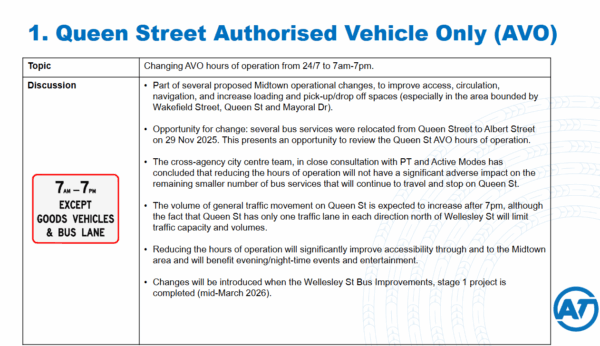
- Shifting the Queen Street Authorised Vehicle-only lane from 24/7 restrictions, to 7am-7pm
- Implementing 7am-7pm bus lanes on Wellesley Street, as a part of the Wellesley St Bus Improvements, Stage 1 project
- Adjusting access to Elliott Street and associated wayfinding
All of these are set to be implemented around mid-March 2026, when the Stage 1 of the Wellesley St Bus Improvements project is completed.
For starters, the bus lanes on Wellesley Street should be 24/7. This is the primary east-west bus corridor in the City Centre, so, if for some reason 24/7 can’t be done, at a minimum the bus lane hours should align with prime time for Te Waihorotiu Station (7am-10pm), to ensure buses aren’t caught up among general traffic, taxis and ride-shares.
But it’s the proposal for Queen Street that’s truly obnoxious. Enabling general traffic to use this section from 7pm to 7am means unrestricted access all night. It will actively encourage more cars along the full length of Auckland’s main street.
Auckland Transport is proposing to ‘launch and learn’, which means making the changes, and then consulting. But launch and learn is something you use for projects that align with agreed official strategies, to allow people to feel comfortable with change – it’s not for random regressive actions.
This out-of-nowhere backsliding is in blatant opposition to the longstanding vision and strategy for the City Centre, enshrined in the City Centre Masterplan and its transport component Access for Everyone. Like successful circulation plans everywhere, the idea is to re-route through-traffic, so you can prioritise people and local access.
Moreover, this regressive step ignores the reality that with CRL opening next year, thousands more people will be flooding into the City Centre via train.
At the Waitematā Local Board Workshop yesterday, staff from AT kept alluding to how certain “stakeholders” wanted to allow more general traffic, to “increase economic activity”. Apparently, due to the past disruptions and the current difficult economic situation, these “stakeholders” they’d consulted wanted a break from restrictions, and more freedom for vehicles.
So apparently this will solve all of that:
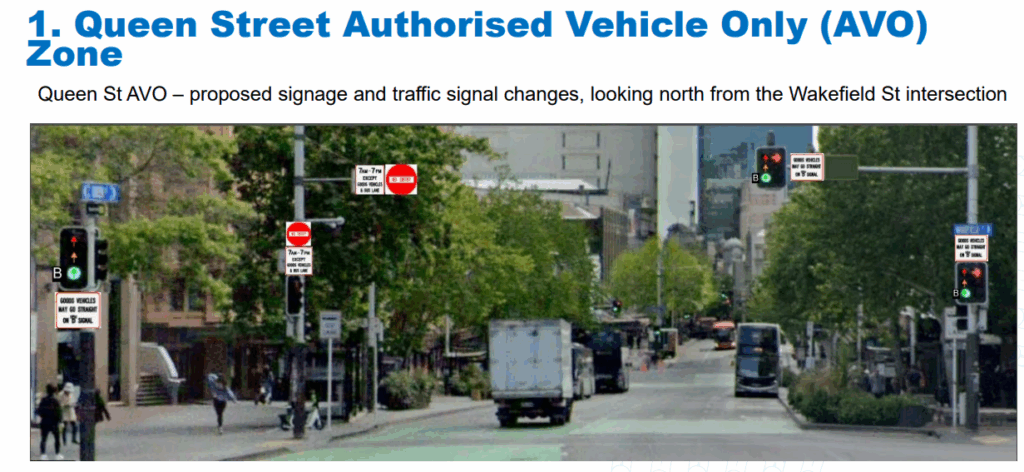
Proposed new signage for the AVO stretch on Queen Street…
Now, who was “consulted” to arrive at this conclusion? AT didn’t specify, and there really wasn’t a lot of concrete detail on how they even got here, so I’ve sent a polite LGOIMA request. But I can say for sure consultation only involved a very small number of people and it hasn’t included the City Centre Residents Group, general public, or seemingly the Waitematā Local Board itself.
However, what AT is doing by watering down the AVO lane appears to match what Viv Beck, the Chief Executive of Heart of the City, has been pushing for a long time – by bringing back vehicle access. Yet, despite Beck’s claim cars need to be brought back for businesses to succeed, its the places where we have created people friendly places are thriving.
As you can see, 2025 numbers Downtown in the City Centre are tracking better than 2024, and starting to return to pre-Covid levels, because people are flocking to the wonderful places that have been created there:
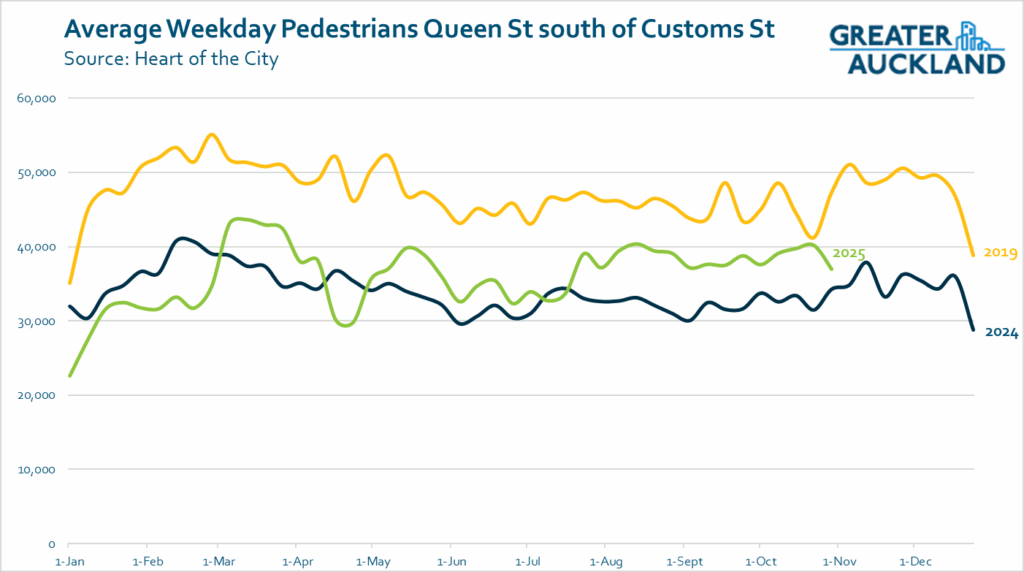
Yet, when you look at pedestrian numbers around Midtown, things are not improving from 2024, let alone nearing pre-Covid numbers:
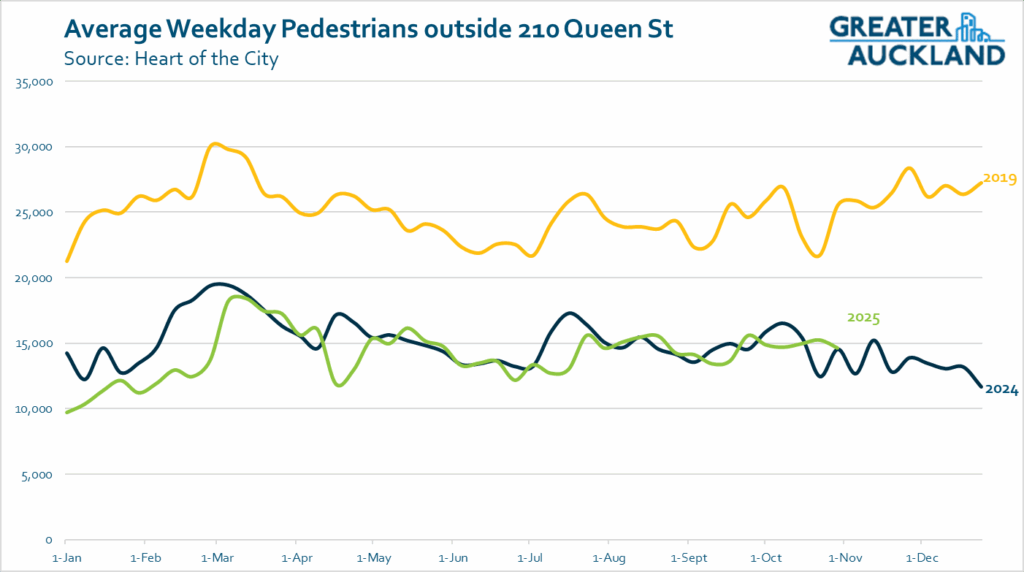
The point, is the places where we have implemented the vision of the City Centre Masterplan are succeeding economically. The places where we have no yet fully embraced the City Centre Masterplan, like Midtown, are still struggling.
And I also think its a lot more likely the constant, negativity, complaining, and denigration of the City Centre from Beck and others has been a big part of driving people away from Queen Street and Midtown, than the minor changes to make it more people friendly.
But, in the words of one Karangahape Rd business owner at a meeting last month: “If people like my nan in Dunedin read in the paper that Queen St isn’t safe, are they going to visit?”
In recent weeks The Post has been receiving complaints from well placed internal sources and Auckland Council suggesting there are ructions over Heart of the City’s approach.
[…]
A source who asked not to be named, who works with the City Centre Advisory Panel, said Heart of the City seemed to have “a curious way of marketing”.
“Their whole MO is to say ‘all the shops are shut, you’ll be stabbed and there’s no one here.’”
Another Auckland Council insider said in their view Heart of the City was “driving people away from the city”.
There may be reasonable concerns being expressed (such as needing proper pick up drop off plans for ubers and taxis to serve people from places like The Civic, or mobility access needs), but if there are, these are being used by a small number of people to try and scupper the core aims of transport in the City Centre and with the Masterplan.
This is starting to sound horribly familiar. Remember the Project K/ Mercury Lane debacle?
As with that example, it’s vital to remember what the public at large has said, over and over again, when consulted on what to do with Queen Street, and ask ourselves…
What and who is Queen Street for?
Do we want a green and lovely environment that attracts and encourages people to linger, mingle, dine and shop? Or a noisy road, chock-full of cars, with ride-share cars roving endlessly, and boy racers pumping up and down the strip?
Do we want a valley of clean, breathable air? Or one that fills our lungs with exhaust fumes and tire particulates?
Do we want our city buses to run like clockwork? Or endless servings of “bus sausage”, unreliable and delayed by traffic, inching along at peak hour?
Do we want easy access for services, deliveries, mobility transport? Or do we want all of those important trips stuck behind single-occupant vehicles just passing through and/or jockeying for parking?
With the City Rail Link about to pour thousands of people hourly into the heart of the city, do we want to roll out the red carpet, a pedestrian paradise? Or let them stumble into a traffic sewer?
And what’s our vision for visitors to our country’s main street, whether they arrive by land or by sea? Will we welcome them to an attractive and inviting golden mile? Or a congestion-clogged nightmare?
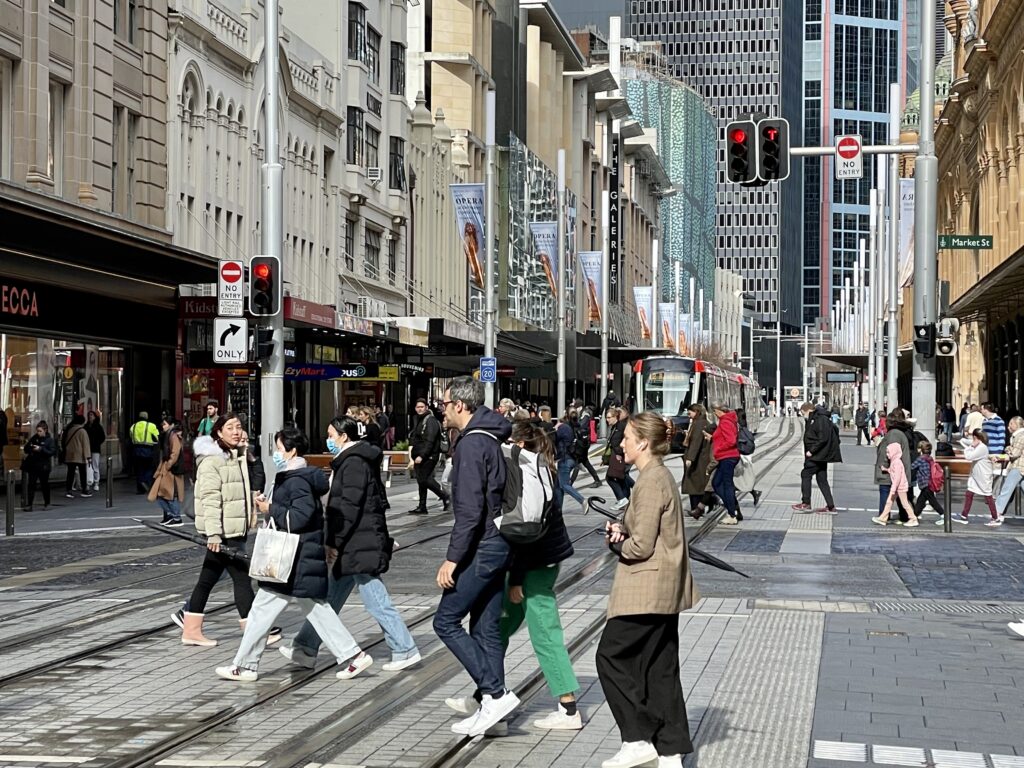
Don’t we want Queen Street to see the same success as George Street in Sydney, where pedestrianisation and a transit mall (with light rail) has seen enormous success?
What can we do about this?
A collective public outcry worked for Project K, and I see no reason it won’t work here.
It’s simply not acceptable that well-supported strategies and plans can be suddenly undermined, for an unknown amount of time, due to the backroom demands of a small number of people (some of whom will likely complain regardless of what happens).
Whatever legitimate points they may or may not have, these should be aired and resolved publicly. In this case, delivering the core transport strategy of the City Centre – Access for Everyone – would likely resolve any legitimate concerns on issues like pick up and drop off, or mobility access.
If you’re alarmed at the prospect of all-night all-comers traffic along Queen Street, and backsliding on progress to appease a handful of voices, and keen to raise your voice, email the following:
We think these elected members may need some convincing on why this is needed:
- Mayor Wayne Brown
- Deputy Mayor Desley Simpson
- Councillor Mike Lee (Waitematā & Gulf Ward)
- Councillor Andy Baker (Chair of the Transport and Infrastructure Delivery Committee)
- Councillor Maurice Williamson (Council appointee to Auckland Transport Board)
We think these elected members are supportive of ensuring people friendly spaces, but could use more examples of why you want a more pedestrian friendly Queen Street
- Councillor Shane Henderson (Deputy Chair of the Transport and Infrastructure Delivery Committee)
- Councillor Richard Hills (Chair of the Policy, Planning and Development Committee)
- Councillor Julie Fairey (Deputy Chair of the Policy, Planning and Development Committee)
Also include Auckland Transport
- Chief Executive of Auckland Transport Dean Kimpton
And, Waitematā Local Board Members:
Who likely support people friendly spaces:
- Chairperson Alex Bonham
- Deputy Chairperson Anahera Rawiri
- Caitlin Wilson
- Kara Kennedy
- Peter Elliott
And those who may need more convincing:
- Greg Moyle
- Sarah Trotman
It’s completely fine to just email all of them at once (and a lot easier).
Here are their emails (you can click here to include all in one email or copy and paste from the list):
As always, be polite but eloquent about your frustrations regarding these changes, the abrupt way they have been handled, and their failure to align with the agreed strategy for the City Centre. Talk about the vision of Queen Street you want to see, and what prioritising people over cars enables; whether it be clean air, a quiet environment, safe streets, or anything else you think important.
Many people on this list support more people-friendly streets, but they need to know the public backs them to hold the line for a better Queen Street.
These are the key asks:
- Keep the existing 24/7 restrictions on general traffic for this section of Queen Street
- At minimum Wellesley Street bus lanes should be 7am-10pm, ideally 24/7
- Implement logical pickup and drop off (PUDO) plans for ubers and taxis around Midtown
- Ensure mobility access is enabled around Midtown, without allowing a free for all of private vehicles
Remember that ultimately, the vision is that the whole of Queen St will be traffic free… a transit mall for people, with set times for deliveries and clever pick-up drop-off spots around every other corner. Actually implementing this would also make it a lot more intuitive to get around for everyone (including drivers). You can and should voice support for this vision in your email. We’ve known for decades this is what people want, and we know from examples in Auckland and overseas that it benefits everyone.
Emailing is really, really, important for things like this, and it’s easy. Most of the time, elected members and AT only hear from people who oppose things. This is a great time to reiterate our support for the good stuff, and for sticking to the well supported strategy for the City Centre.
Project K proved we can make a difference when we take a minute to speak up!
This post, like all our work, is brought to you by the Greater Auckland crew and made possible by generous donations from our readers and fans. If you’d like to support our work, you can join our circle of supporters here.

 Processing...
Probably best if AT opens it as a 4 lane arterial again. Maybe redirect the traffic from the motorway down Queen Street instead of Hobson / Neilson. Watch it thrive.
A few shops facing on to State Highway 1 just after the Newmarket Viaduct too. Think of all the passing trade!
Plenty of parking in the motorway shoulders, an untapped goldmine.
Yeah this does get to the heart of the issue. We do have kilometres of Special Vehicles Zones, with lots of prohibitions. These are called motorways. Motorway strategy is all about speed and volume, about never stopping, vehicles and their movement are the key economic unit here- everything else is even banned.
Urban streets, especially in the very centre of the most urban place in the country, has an opposite strategy (well it should if it is to succeed). Humans on foot are the key economic unit here. Service and PT vehicles are guests, everything else, especially through traffic, and even more especially at any kind of speed and volume, degrade the attractiveness and effectiveness of the place for the key economic unit – People.
And they frustrate those service and PT vehicles (and of course emergency etc). These streets cannot host even small numbers of private vehicles and not have immediate negative outcomes.
How is this hard to understand?
It is actually the same as the motorway strategy. Just appropriately inverted.
Please explain to me what the strategy is served by accelerating higher volumes of traffic through the Queen St valley.
The idea that all roads and streets, everywhere and anywhere, are better the closer they achieve motorway condition, is clearly absurd. Terminal car-brain.
I really hope you missed the irony in Jimbo’s post (for Jimbo’s sake).
I totally agree. It was so much better with traffic. There are not enough blocks in the cbd to close main roads. We’re not in New York
The biggest mistake was shoving buses down Queen St. The old Auckland City Council made sure only a few services were allowed onto Queen Street. But then they had retailers serving on the Council. Once buses started charging through the whole place turned into a public transport terminal. There is not a single mall operator who who allow AT to run buses through the pedestrian area because they know what it would be like.
Unless I’m mistaken the only route that runs up Queen St is the City Link and this dates back to the old Auckland City Council.
Is it electric? That should be the condition for any bus running down Queen Street.
Yes
Shows how long since I have been in there.
Do you mean to say Miffy, that you write about things on which you clearly have no current knowledge on? Shocking!
Out of interest, which parts of Auckland do you see in an average month?
You’re not that K Rd business owner’s nana who lives in Dunedin, right?
I did go to Queen St once this year. I parked in the Aotea carpark, went to a hearing in the Town Hall, avoided an angry homeless man at lunchtime and got out of there as soon as the hearing was over. From the little bit I saw Queen Street is worse than I have ever seen it with the exception of the riot in 1984. It really is best avoided.
This is why Auckland should have built surface light rail up Queen Street when it had the chance in 2018. It’s the only mode of surface transport that actually enhances the pedestrian realm while also bringing tens of thousands of people to the city.
Plenty of New Zealanders experience this every day…by living in Sydney.
Just back from Melbourne – staying somewhere very central – no cars at all, just trams and lots of e-bikes. Amazing how the city works so well. I’m not sure how the shops restock their shelves, but I don’t care – the streets were empty of cars, vans and trucks while I was awake (6am to midnight). We should do what they do…
Turns out it’s much easier to get vans and trucks in when the street isn’t full of traffic and parking.
You don’t see it in Melbourne because it doesn’t take them long.
Because I live in the City Centre, people ask me where to go in the evening for a nice meal. Yes there are a few places including in hotels but they are hidden.
Imagine Queen St, like nice European cities, where there are tables outside and outdoor dining – not hampered by council rules about how many chairs they can have or alcohol rules. And not having to put up with cars.
This is what makes a sophisticated city – not the anti-social environment Heart of the City correctly observes. Heart of the City has no long term clear vision to contribute.
Let’s pedestrianise the whole street as Aucklanders wanted and make it fun. Buskers, music, dining, markets….. the options are endless and easy to copy from cities that get it. The troublemakers presently hanging around will disappear.
Again thank you Connor for your great work and I’m gutted you and Patrick were not elected. Watching Mike Lee moan about CRL at the Council Transport Committee yesterday was beyond depressing.
Quite. Queen St should have less space for cars and more space for fun things. The current regime isn’t all that much fun. Where’s the street-facing bars and cafes?
Spot on!
It will never be that nice for outdoor dining IMO, it’s a wind tunnel directly to the water and doesn’t get enough sun.
High St and Lorne St have always been more human-scale places to linger than Queen St. Pedestrianise them first and finish the pedestrian linkage from Aotea to the water.
Maybe we could contract Rainbows End to provide some ‘rides’ for those who really must travel above walking pace. A roller coaster from K Rd to the Civic could be great fun, especially if it ran in and out of a few buildings on the way.
In all seriousness, if done well it would be very quick. Capacity wouldn’t be high but possibly better than a frequent bus.
The outside tables at nandos get plenty of midday and afternoon sun!
When its 25 degrees and 90% humidity the last thing that you need is sun. That’s why you see so many of our outdoor eating spaces with umbrellas. The reason that Queen St is not pedestrianised is that we have amble people offering reasons why it won’t work, when the evidence from other places is that it can
They have umbrellas fir those days too, but for the majority of the time, its nice to have lunch in the warmth of the sun.
+1 Hopping Mad
I used to live in the CBD and there were loads of nice places to eat.I ate out somewhere different every night..Somehow AT and the council managed to kill the CBD
This is about an absence of vision and leadership. When there is no longer a coherent vision for shaping a the public realm that void will be filled by complaint.
Then the strategy (or rather the non-strategy) will be set by the loudest and most persistent moaners. Who have nothing to offer but grievance.
This is no way to make a great city.
Absolutely Patrick, a sense of vision is needed. But if you can’t imagine, visit La Rambla in Barcelona; the pedestrianised main streets of Vienna and Zurich; the largely pedestrianised centre of Basel; the side avenues of Buenos Aires and some of inner city Milan. But I accept that pedestrianisation brings problems, many of these areas are just too popular.
Why do we keep electing visionless moaners? They only offer young people reasons to leave. I for one do not want to live in a retirement village.
I dont get all this writimg off of the CBD. I can only assume these people never really go.
Its absolutely packed today with the Xmas market and yesterday, you couldnt find a spare outside table at a pub or restuarant around Britomart, Vulcan Lane etc….from about 4pm. I can only imagine what the Viaduct was like.
I found myself on lower Queen St at 10:30pm last night and was amazed at how many people were around given there was practically no hospo open at that time.
Are there a few too many homeless around, some clearly struggling mentally? Yes, but it didnt seem to be worrying too many people.
We need to aspire to better things…oh no wait, we can’t. Says who? Chris Hipkins:
“We’ve had a series of governments now who have encouraged people to be aspirational for New Zealand and have promised things that have been completely unrealistic. I don’t think we can afford to do that anymore.”
Whoop-de-doo. Pure inspiration for your potential voters, Chris.
https://www.rnz.co.nz/news/political/581766/chris-hipkins-promises-different-labour-opportunity-to-stamp-my-own-mark
Should be 24/7. Personally I care more about the Wellesley St bus lanes than Queen St, as end of the day, Queen St will eventually be ripped up and trams will replace traffic.
Meanwhile Wellesley St is one of those projects where if they don’t do 24/7 they’ll leave it far far far too long and hobble late night services, which will get caught up in the mess of Ubers (which will get far worse once Midtown is regenerated).
Plus ca change. In 1973, the Star had the headline ‘QUEEN ST NO-TRAFFIC PLAN MAY BE AXED’. It says, ‘The Auckland City Council is unlikely to close Queen Street, between Wyndham and Customs St, to traffic for 3-month trial period because of Queen ST Business Association opposition .’ The Queen St Business Ass had just 20 members. It called for delay, more studies etc…
Gotta admit that those 20 members were very effective [at causing depressing procrastination]
Connor, this is fully consistent with your perspective on the Karangahape Road debacle earlier this year.
“Auckland Transport had a good project and were doing the right thing…In consultation, public feedback supported the original project, its aims and its design principles.”
https://www.greaterauckland.org.nz/2025/04/09/getting-cross-with-ats-awful-last-minute-re-designs-of-project-k/
Again and again, good plans, with strong support, are diluted at the last minute on the flimsiest pretext. The city centre does not deserve traffic noise, traffic danger and disruption, yet AT seems determined to return to ignore best practice and return to the bad old days.
I shall be emailing today.
As a frequent visitor to the CBD over more than 50 years one noticeable feature of Queen Street was the almost constant flow up and down Queen Street. What I also observed was that part of that flow was made up of “boy racers” who aimlessly cruising up and down for no apparent reason other than to “see and be seen” by their fellow “racers”. In those days Friday night shopping in Queen Street attracted hoards of pedestrians, including many families but also peak numbers of the “boy racers”. Indeed dealing with the “boy racers” was a key plank of Colin Kay’s successful mayoral campaign.
One day I deliberately stopped to observe passing vehjicle at the intersection of Queen and Wellesley for over an hour to confirm that some vehicles were actually noisily circulating every 10 minutes or so. My proposed solution was not to completely pedestrianise Queen Street but to block it to through traffic at one point (even if only for a very short distance) so that delivery vehicles or those with a reason to be there still had access but travelling the length of the street would be prevented.
The “boy racer” thing has largely gone away but there is still far too many vehicles transiting the inner city. The EVA zone which was implemented in recent times has largely succeeded in removing non-essential traffic from a section of Queen Street but there are still hordes of vehicles in other parts.
It is quite unpleasant waiting for a bus during the evening rush, so clearly more needs to be done to ban or discourage through traffic.
The Shortland Street/High Street block has been the same for a long time. Have a beer at Corner Bar on a Friday night and you will see the same cars going round and round and rooounnnd…
Sacrificing street space, public life and amenity to provide room for pointlessly-circulating traffic really is stupid.
Didn’t AT do a detailed observation study about a decade ago and found that a significant amount of the traffic in Queen Street was block circling?
Not to be seen, but searching for a carpark.
It astounds me that people do this, think they can drive to the middle of a CBD and park on street. The few that are available aren’t even affordable.
If you’re driving to town, just drive straight to the parking building.
You get this weird behaviour at Mission Bay as well, from a handful of drivers (usually men) who rev their car engine for a couple of seconds either side of the lights, probably way over the noise limit. Also spewing out fumes over everyone sitting outside at the bars and restaurants. Gross.
https://www.nzta.govt.nz/vehicles/warrants-and-certificates/warrant-of-fitness/noise-tests-for-exhausts
As an aside, it looks like NZ’s light vehicle noise limit of 95dB is 8x higher than the EU limit of 72 dB.
You can, for $550 +GST have your car tuned for “Pops and Bangs” which means the car’s exhaust makes noises like fireworks during deceleration and when the engine is above 3000rpm.
The Euroune ad says: “Call us today to see how we can turn your ride into a fun and attention-grabbing vehicle.” Jeez!
This type of modifcation is incredibly annoying and antisocial, favoured by attention-grabbing nobheads. I cannot see why garages are allowed to offer it. It should be banned outright.
https://www.eurotune.co.nz/tuning/pops-and-bangs/
I suspect alongside any “boy racers” were many “grandma and grandpa car deps”.
Alongside the many bus-savvy members of my parents’ generation, I still come across a fair few who say it’s become “too hard to go to Queen St now” and when I query what they were going in for, they say they just liked to drive through Queen St “to feel the vibe of the CBD [sic]” before going somewhere else with excessive tarmac to park on, a bit closer to home so they “could have a few drinks and not have to drive far afterwards.”
At least many boy racers grow out of it, I guess. Whereas this lot…
I used to like to drive thru Queen St too, indeed, just for the vibe. But I don’t kid myself that it was for anything other than fun, or that it wasn’t pointless.
I don’t think cutting the bus only section will bring back the boy racers, they moved on years before it got installed, but this is still a stupid move.
Open Queen Street up but make it emission free. Boy racer / 90% of car problem solved.
I don’t know anyone hit by cars I. The CBD, however I have personally witnessed 2 people being knocked over by courier cyclists on queen st in the 2000s.. I’m happy to support pedestrians only space on queen st as long as cyclists and micro mobility are banned too
This took about 5 seconds to google:
Car crashes on Auckland’s Queen St: Driver allegedly flees after seriously injuring pedestrian (03 August 2025)
https://www.nzherald.co.nz/nz/car-crashes-on-aucklands-queen-st-driver-allegedly-flees-after-seriously-injuring-pedestrian/AS6B5LJA3JAAXIH76YNAK2ASFY/
But sure, limit active modes because you know two people who were knocked over 20 years ago when there was no proper cycling infrastructure.
As you said there’s improved cycle infrastructure, so why are cyclists so insistent on cycling on footpaths and demand footpaths become shared spaces.. 20 years ago it was only the courier cyclists who rode like psychos on footpaths now its the majority of cyclists…
This: https://thespinoff.co.nz/auckland/20-02-2019/cyclists-1-children-0-school-abandons-walking-bus-on-dangerous-shared-path .. shared spaces are awful for pedestrians
And this from May this year:
https://www.newstalkzb.co.nz/news/national/queen-street-closed-serious-crash-closes-section-of-major-auckland-street/
It’s the bikes! Or maybe NZ Herald and Newstalk ZB are too woke?
Because serious accidents are more newsworthy .. the news is hardly going to report on something like “cyclist hits pedestrian resulting in a broken leg”.. sure it’s not death but still awful.
How do you propose to stop riders without further inconveniencing pedestrians?
As the most space efficient and vulnerable modes, pedestrians and riders should have plenty of motivation and room to avoid each other when the cars vamoose.
Pedestrians and public transport are the most effective use of space.. 4 cyclists require are much space as one car with 4 passengers..
lol sure, find me a car with four passengers in it and we’ll make the comparison shall we?
Solution is cyclists belong on the road or designated bike paths.. shared paths are awful for pedestrians.. alternatively cyclists could treat pedestrians with the same respect they demand from motorists, maybe stopping at pedestrian crossings, giving pedestrians 2 meters space when passing etc etc.. as a pedestrian I notice poor behavior and rule breaking by cyclists far more than cars
Courier cyclist – not exactly a contemporary issue ay.
I think the bike couriers are largely gone. You would see them in the early 2000s, but email and electronic documents have largely replaced them.
True courier drivers aren’t common in NZ anymore BUT uber eats cyclists are and a significant portion of cyclists ride on footpaths like they think they are joseph Gordon-Levitt in Premium rush
Cycle couriors are still in the cdb, but they are on cargo bikes now doing parcels.
The days of the central city being a retail space are pretty much over. Sure there will be some retail for the people that live there / work there / tourists, but people aren’t going to come into the city just to buy stuff that they can easily get elsewhere. The death of retail in the central city has not been due to roads being closed, its due to easier options elsewhere (malls / big stores / etc).
So the central city is now largely office jobs / housing / hospitality / tourism, most of which better aligns to nice car free spaces rather than busy roads full of cars.
Yes, it’s strength now is in hospitality & entertainment being central and not favouring any particular north east south or west area.
We have a lot of spare capacity already in existing bar and restaurant areas. A lot would have to change to make Queen Street appealing to the City’s inhabitants (and perhaps a lot would have to change about Queen Street’s inhabitants).
Still – the existing situation with pedestrianisation should remain on the basis that the CRL will – eventually – will enhance the associated benefits.
If you have seen what light rail has done for retail (and hospitality) on George St in Sydney, you wouldn’t write off Queen St so quickly.
There were some pretty average spaces, outside of the main drag parallel to Pitt St Mall. Not many any more.
Yeah I guess LR opens up the city to the likes of Mt Eden, you can get there in a few minutes.
It’s sad but true.. AT has killed the cbd with its anti car agenda.. hopefully the crl will bring it back to its former glory..
Anti-car, lol.
A2E would have been implemented 2yrs ago and NEX buses wouldnt be stuck in traffic south of the bridge if cars were anything but the priority for AT. Why on earth so yiu think they are proposing these changes?
I’m gonna get shit faced playing this dog whistle drinking game.
It’s almost like AT are in the pockets of westfield and Wilson parking so sad to see the death of independent retail shops on our high streets
Would that be the same AT that undercuts the market in pricing and still cant fill its parking buildings?
Did the chicken or the egg come first.. Street parking was removed and then the cbd died.. no one wants to Pay for parking to look at for lease signs
Auckland city centre isn’t “dead” – go and see for yourself.
There are streets that need sprucing up, sure. And some buildings need to be finished. But “dead”? Sorry mate, you’ve confused Auckland with Tauranga (a city that incidentally is drowning in free car parking).
Loads of people in auckland cbd sure , but unfortunately most of them are homeless and the rest are office workers desperate to go leave..
That isn’t true. If you want to sit and troll people, please go and do it somewhere else.
Bring back the river.
Great idea! My kayak has much lower emissions than any E-bike
Remember that the City Centre Management Plan is run by Auckland Council with AT technical support. Almost exactly the model that is now proposed for the whole region.
Plenty of confusion opportunities with 7am-7pm limits.
The best way to manage PUDO for people to and from the city centre who are not able to access PT safely and easily is the Problem Statement. What do you think the best answer may be? Remember it has to be something that can be managed by Bylaw and signage.
Still some Watercare project work to accommodate in the centre, as well as years of Temporary Traffic Management redeveloping the Downtown Car Park site.
Please think about the balance of uses of Elliott Street and the parallel part of Queen Street. What should these look like and how should they be used across all times of the day?
Would the businesses who are grumbling now say the same this time next year?
Do have a say!
I think those pushing back against pedestrianisation need to be shown the before (traffic sewer) and after (transit mall) of George St, Sydney, and what its done for the street. Light and day.
“That’s Australian,” they will say. “It won’t work here. We’re different. Kiwis love our cars. Auckland’s too small for light rail. And it’s too big for public transport.” And so on.
This will be despite the very obvious example of Te Komititanga just across Customs St, which is always busy and full of people.
There are none so blind as those who will not see.
George St is great! Cyclists are banned from George St, can walk there easily
This kind of destruction is a great way to make people despair, and to kill public interest in civic matters. Democracy-killers.
Thanks for writing this, Connor, couldn’t agree more. One of the arguments is that opening up the roads will support theatres but as you can’t park outside the civic or on much of Queen St anyway it won’t help much but it will increase congestion as Ubers circulate and lead to dangerous drop offs at the traffic lights. Agree too that actually rolling out the parking strategy as planned is a much better idea. As is clearly communicating where you can do servicing loading pick up drop offs etc.
Need to bring the traffic back from upper queen street all the way down instead of half way down queen st the u have to turn left or right and only buses can go straight bring back the old days
This is entirely because of the leadership. The glorious leader who you all applaud for gutting AT is the person who has scrapped the city centre matster plan and Access for All. The armchair experts public support his car first approach and voted him back in with a majority emboldened him to order AT and council around to do whatever he wants no matter what the official strategic documents say.
If AT had lived up to potential and been truly a Transport focused agency free to ignore political interference we might have been in a different place by now.
And why didn’t AT live up to its potential, Translex?
What I saw was that its Board never equipped nor required its executive to deliver on council strategies, and the ELT relied too heavily on a few climate-denying senior engineering, planning and finance staff who were determined to keep AT in the path of car dependence.
This was happening way before the terrible Wayne Brown turned up.
To jog your memory,
here’s a list I wrote in August 2022: https://www.greaterauckland.org.nz/wp-content/uploads/2022/08/Opportunities-for-Changing-Direction.pdf
I agree with you a politically independent AT is the best structure. And had there been even one glint of understanding about Vision Zero and the TERP from the current Board and CEO, many advocates would have been in there fighting to keep AT.
But there was none. We saw them jump to deliver on Simeon’s deranged instructions, well before the legislation allowed his direction to have any sway. Worse, they fudged and prevaricated in front of the GB. They knew what they were doing was wrong.
AT became nothing but a dream-destroyer. I’m sorry you’re mourning its loss, but if you thought there was more to salvage, maybe you could have encouraged staff to revolt against the CEO and Board at the appropriate moments .
Really support the goal of a people‑focused, transit‑first Queen St and don’t want it to go back to a traffic sewer. But in practice you can’t fully “ban” through traffic, only discourage it – and the long signals and low speeds on Queen St already do that pretty well.
The current blanket restriction ends up hitting legitimate short‑stay drop‑off, late‑night customers and loading that local businesses need, while still not realistically stopping every car that passes through. CRL might eventually lift foot traffic, but that’s still unproven and depends a lot on AT’s delivery, so locking in a very strict setup now puts a lot of risk on businesses in the meantime.
A more balanced approach would be: keep it unattractive as a shortcut, keep through‑traffic discouraged, but allow clearly defined, tightly controlled access for drop‑off, loading and mobility instead of trying to exclude almost all vehicles. If CRL really does bring the promised activity, then there’s a solid evidence base to tighten things further later.
There’s also the night‑time safety piece: Queen St already feels pretty empty and uneasy after hours, especially with vacant or neglected buildings. A bit of genuine destination traffic and short‑stay activity can add “eyes on the street” without turning it into a high‑volume route, because the signals and geometry naturally cap speeds and volumes.
Why do you need legitimate through-traffic other than deliveries? Plenty of (European) streets don’t have that and do just fine. Albert Street is one small block away, surely you can arrange your Uber to meet you there (or at the intersections with Customs Street, Wellesley Street, Victoria Street…).
If you cannot travel 150m without a car, I doubt that a few car parks and hasty drop-offs at red lights would be enough for an enjoyable trip.
Cars will NOT be “eyes” on the street. They will add noise and pollution, potentially even encouraging DUIs after a few drinks.
Buchanan Street in Glasgow is a good precedent for what Queen Street could be. It is fully pedestrianised and has a subway station at each end, plus rail connections across Strathclyde and to Edinburgh (45 mins from Queen Street).
There are two roads that cross it at 90° which carry bus services. Deliveries, as far as I am aware, happen outside peak hours. The street furniture is very high quality, as is the paving, lighting etc.
Basically, it feels special. Buchanan Street has many of Glasgow’s best buildings and is always busy and bustling. This is despite the best efforts of a western Scottish climate characterised by perpetual grey dampness.
Post-CRL Auckland will have most of these characteristics, but with better weather. More cars would be SUCH a retrograde step.
between Wakefield St. and Wellesley St. The existing restrictions would only apply 7am-7pm, thus opening up the whole street to general traffic overnight. doesnt seem so bad?
Thank you Connor for taking the time to sit through local board workshops to flush out AT’s latest attempt to undermine core strategies for the City Centre. AT officials are no doubt responding to being shouted at by the Mayor and Viv Beck’s demands because they think they have no choice. However, the transport reforms are exactly why AT’s leadership needs to insist on a transparent decision-making process and not jump to change course (and why AT is responsible for its own demise after 15 years of confusing governance roles and playing politics).
There may be good reasons to review the operation of the AVO and measures are needed to support the revival of mid-town after years of construction but what is proposed is a backward step for Queen Street’s fortunes.
Is the lack of respect for professional expertise likely to stop when people like the mayor and Maurice Williamson are even more in charge? Do enough other councillors see the need for transparency and integrity of decisions?
Any update on the timing of any of this? I have yet to email anyone on it.