“Whatever the problem, build another road” has been a hallmark of policy from the current government. And we’ve long suggested that is simply not affordable or practical – including just a month ago, when the latest costs were released for a bunch of the government’s flagship Roads of National Significance (RoNS) programme.
In a speech yesterday to a roading industry conference, Transport Minister Chris Bishop has given the first indication that reality is indeed starting to hit home.

Is Minister of Transport Chris Bishop (left) finally realising the mess his predecessor (right) has left him? Image via RNZ.
In the speech, Bishop started by covering the usual government talking points about the economy and building the RoNS, but the most interesting bit is towards the end of his speech, where he discusses the challenges ahead.
In particular, he notes just how expensive it is to build more RoNS – and what it would take to fully fund that via our existing process of fuel taxes and road user charges:
Based on current estimates, delivering the RoNS programme in full over the next 20 years would cost $56 billion. Funding this entirely from petrol tax and road user charges, would require a one-off 70% increase. Equivalent to a 49 cent per litre increase in petrol tax.
To be clear, this 49 cent per litre increase, would only allow the RONS to be delivered. It would not provide any funding for other major transport projects such as the Second Waitematā Harbour Crossing, or the North West Busway.
That’s quite the hike: 70 per cent, to be paid by everyone who drives, via fuel taxes and RUC equivalent, whether or not they ever drive on one of the RoNs that levy would go towards.
Will this be what finally pushes the public to start questioning the value of these new roads?
Further on in his speech, Bishop notes that there are already significant petrol tax hikes coming anyway, although I can’t imagine either National or Labour going ahead with the full 12c planned:
Petrol tax is due to go up by 12c per litre in 2027, by six cents on 1 January 2028, and 4 cents in each year after that.
…..
As I’ve said, to deliver all of the RONS petrol tax and RUC would have to rise by 70% or 49c per litre. This would be on top of the planned increases we’ve set out for 2027 onwards.
Currently, petrol taxes are just over 77c per litre. With the planned increases plus the 49c per litre “RoNS tax”, by 2030 we’d be paying about double the fuel taxes we currently do. To put that in perspective, here’s an example of what it might look like:
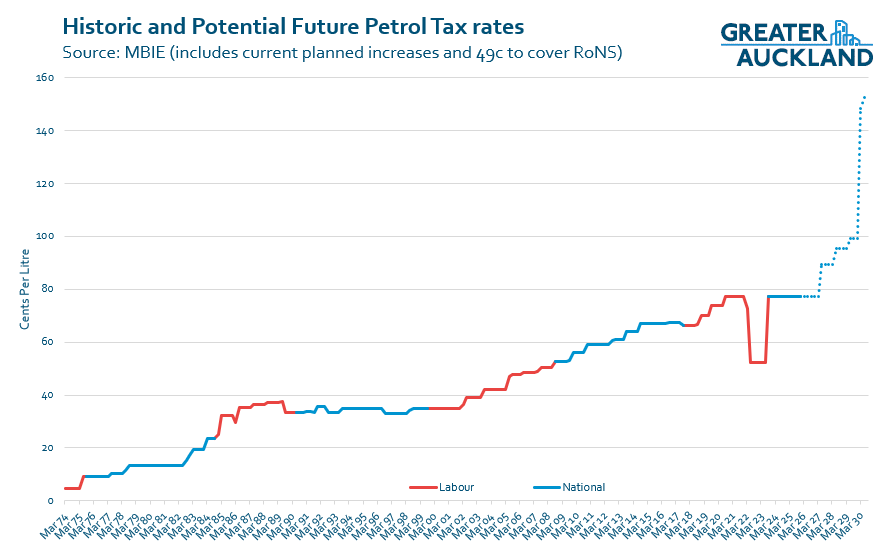
One of the reasons for the currently planned increases is that this funding problem isn’t just a future issue – there’s already a massive funding gap that the government are racing to cover. Back to Bishop’s speech:
Our transport system is supposed to be user pays. In other words, road users pay petrol tax and road user charges and the money goes out the other end on maintenance, upgrades and new projects.
But in recent years, Crown funding has been tipped in more and more, which comes from general taxation – in other words, all taxpayers.
The 2018-21 National Land Transport Programme outlined expenditure of $17 billion over 3 years, and was largely funded by road users, who contributed $13 billion.
Fast forward to the 2024-27 NLTP, and the total investment has nearly doubled at $32.9 billion, but road users are still contributing roughly the same amount, $14.3 billion.
The increased investment has come primarily from Crown funding, with around $12.8 billion of direct Crown funding provided over 2024-27.
Ironically, IF they did actually honour user pays idea and hike fuel tax and RUCs high enough to cover all this (not to mention all the other costs imposed by motoring) then that really would likely solve congestion and emissions as driving rates would plummet.
Helpfully, then Bishop also acknowledges the big problem with pouring ever more Crown funding into roads… but then goes on to say that he supports doing this.
Every dollar of extra Crown capital we put into roading is a dollar that can’t go into health, or education, or defence, or any of the other calls on capital the Crown has.
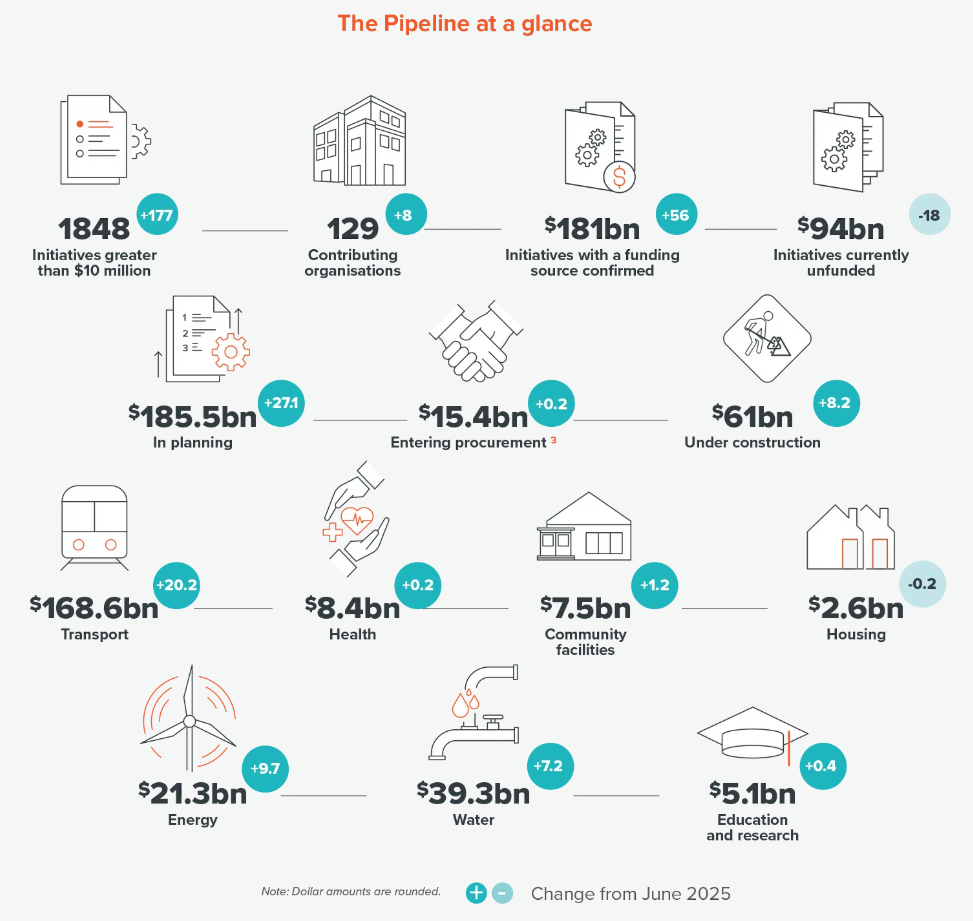
Notably, a few days ago Bishop released the latest quarterly Infrastructure Pipeline snapshot, which shows transport making up over 61% of all projects in the nation’s pipeline of all infrastructure. Some other ways to think of the numbers in the graphic below:
- Transport, mostly in the form of roads, will soak up more than four times as much investment as water (the next biggest category). and around eight times more than energy infrastructure (the third largest category)
- New Zealand is planning to spend twenty times more money on roads than on health infrastructure.
- And we’re planning to spend 33 times more money on roads than on education & research combined.
And remember: in practically every other sector, this government has vigorously descoped and/or defunded projects under the guise of “saving money” – but somehow when it comes to roads, the complete opposite applies.
Getting back to Bishop’s speech: he goes on to say that PPPs, tolls and infrastructure levies aren’t coming to save us:
PPPs are not a magic money tree. They are a procurement tool, that’s all.
They are essentially the Government taking out an extra mortgage to build a road sooner. So yes, they help in terms of procurement and driving efficiency, but the projects still have to be paid for.
Fifth, on tolls.
If I had a dollar [for] every time someone said to me “just chuck a toll on, it will pay for the road in no time”, I would almost have enough money to pay for one of these RONS.
Tolls are useful but they don’t fully fund roads. Not even close. New Zealand just doesn’t have the traffic volumes. They are critical tools in helping fill in the funding stack, and provide important ongoing revenue for maintenance costs. But they are not going to pay for these roads by themselves.
The same is true for infrastructure levies to make sure beneficiaries pay for benefits from public expenditure.
Finally, we get to what this all means in reality. In short, reality bites.
Sixth, and finally, we also have other priorities in the land transport space.
We have critical public transport projects to fund, as well as the second harbour crossing in Auckland – which will be the most expensive infrastructure project ever built in New Zealand.
So where does all this leave us?
The government is committed to the Roads of National Significance but delivering them all tomorrow is not realistic.
Nor, by the way, is it an option for the construction sector.
What we need is a credible, long-term pipeline of transport projects with a variety of funding options and in a logical sequence.
I’ve been calling this a Major Transport Projects Pipeline, or MTPP.
It includes the RONS but also major public transport projects we need to advance as well.
That’s what we are committed to, as well as demonstrating a realistic funding track, synced to what the market can actually sustain.
We’re working hard on that now and will have more to say soon.
…..
This is going to be hard. Hard choices lie ahead. Not everyone is going to get what they want, exactly when they want it.
Some roads won’t be starting for many years.
For a government that has talked such a big talk about building these roads, even the suggestion that some of them could be 20 years away from getting started is an obviously a massive walkback. But an inevitable one after they campaigned using clearly unbelievably low costings for their unwise: “you get a massive highway, and you get a massive highway” all around the country. It should also be noted that this campaign also exaggerated the value of highway building.
It is good that this speech opens this issue too, as nice as it may be to have premier standard roads everywhere, that can only come by diverting funding away from other things, and not just other transport modes, also hospitals, schools, housing, police, etc, and fair incomes for teachers, nurses, and doctors, basically a country that’s viable to live in. The RoNS opportunity cost- where will you be driving to on the big new empty roads, and will you be able to afford to anyway?
While we wait for the “more to say soon”, one obvious solution to help tackle this would be to send NZTA back to the drawing board. Remove the requirement (imposed by Simeon Brown in his ludicrously didactic GPS) that these all be four-lane grade separated highways, and require NZTA to come up with cheaper, more practical solutions.
As we’ve pointed out many times in the past, most of these proposed mega-projects are for corridors that only carry 10-15,000 vehicles per day, which is well below the level needed to justify a four-lane expressway standard road.
On most of the designated RoNS corridors, affordable improvements like additional passing lanes, curve easements and safety barriers could deliver the majority of the benefits of an expressway for a fraction of the cost. These are also the kinds of projects that are much more able to delivered by smaller local firms, keeping cash in the local economy. Whereas the mega-projects that have become far too common often require bringing in significant and costly international expertise.
Lastly: it’s frankly wild that the minister responsible for delivering this flagship policy is being more publicly critical of it than Labour has been in opposition over the last two years. That’s a massive missed opportunity to improve the conversation, especially when it’s this easy to really get your teeth into it.
This post, like all our work, is brought to you by the Greater Auckland crew and made possible by generous donations from our readers and fans. If you’d like to support our work, you can join our circle of supporters here, or support us on Substack.

 Processing...
Certainly feels like Bishop is laying the ground work to move most of those RONS from being funded back to the National Party wish list where they can kick them around every election as vague promises, like they have been doing. I guess the reality that it would probably collapse every other public sector for lack of funding sank in. I still expect they will keep the northland RONS in the pipeline.
A classic Nat move. Keel kicking around a huge laundry list of unfunded and unfundable roads. Campaign on them at each election. Blame Labour for cancelling” them when they inevitably get back in power and don’t fund them, but anything that does get remotely funded they claim credit for (because everything is on their list to start with).
I always like what I hear from Mr Bishop. At the end of the day, the numbers are the numbers and reality will impose itself.
Hmm, there’s some not so good stuff in his speech also. When he talks of economic growth:
“It is the result of a government focused on the fundamentals in our economy: getting spending and debt under control, deregulation, and attacking the drivers and obstacles to economic growth.”
“Every dollar of extra Crown capital we put into roading is a dollar that can’t go into health, or education, or defence, or any of the other calls on capital the Crown has. Of course, all of these areas have significant deficits and similar funding challenges.
I am an advocate for Crown capital helping to fund roads because of all the economic benefits I’ve talked about.
I’m just making the point that there are difficult trade-offs.”
Just making a point of the trade offs and then saying build them anyway isn’t really a good thing at all.
Yes and I think he has presented an open goal for Labour and Greens with that, but think they are still putting their boots on back on the bench.
What’s so very funny is remembering all the oil industry’s foot soldiers who bleated that the TERP was too expensive.
The TERP! The very document which details HOW to shift investment away from stupid road building, so we can meet our goals affordably.
We need a national-level TERP, we need it now, and we need some politicians prepared to depart from devotion to Goddess Flo’. Wake up, Labour.
What Bishop is saying will lend him time, but he’ll never do what’s actually required to transform the networks into the healthy, affordable, accessible, sustainable transport system we need.
Well, he hasn’t forgotten what party he is in. That he’s going as far as he is is impressive, in my view. Most govt ministers (world-wide) would either just forge ahead while castigating the facts as lies – “Damn the torpedoes, its just woke complaints bla bla” – or alternatively, make the course corrections silently without even really acknowledging that they occurred or why they had to occur.
TERP really hasn’t delivered anything near what it intended to. By the end of this LG election cycle it will be politically obsolete.
This government seems to like making people not like them. First they attack renters, beneficiaries, and other groups of disadvantaged persons, and now they are going after, to quote CCTV the band, the “I drive a big car with big wheels”.
It is a very strange political tactic that might be pointing to a general intention to devalue democracy and that is extremely concerning.
As we know, when we are struggling to survive, our political involvement and awareness is reduced, which is quite frightening given the current situation in the wider world.
Do it!
https://tenor.com/en-NZ/view/bitcoin-bitaroo-laser-eyes-laser-rays-do-it-gif-2412002262581471752
Raise the fuel taxes and RUC.
It will take many cars off the roads, we won’t need any RoNS.
Think of what else could be done with the extra revenue.
Less cars on the roads would also mean less fuel/user tax returns….
True. I think fuel demand is pretty inelastic though, seems like around -0.2 to -0.4. So doubling petrol tax ($0.70 to $1.40, increasing overall prices by ~30%) would only reduce fuel consumption by about 8-9%.
I don’t mind driving a bit slower to a well funded hospital.
Good point.
and of course if we all drove that bit slower ( and did more walking or bicycle riding), less would need to go to hospitals.
No mention of emissions in all this.
National really need to be nailed on this; pre-election, they claimed all those new roads won’t cause emissions to increase, as vehicle fleet will be increasingly electric and lower emissions
I just hope that one day in the future, people like Chris Bishop will have to explain to younger people that being able to drive a large polluting SUV fast, was more important than the environment in which we all live
They then seem to do everything to increase vehicle emissions; making zero emission vehicles more expensive to run than low emissions, reduce tax on high emissions vehicles etc
The reduction of the tax on high emission vehciles is the middle finger to any remaining doubt that this government cars about the environment or its climate targets.
Simon Watts’ piece in the Herald this week was written with a smile on his face.
Yes we might increase from 0.17% of global emissions to 0.171%
Worst possible argument; New Zealand doesn’t matter.
Why should anybody anywhere in the world reduce emissions if we won’t? Anybody in the world could also say that what they do, doesn’t change emissions more than a fraction, so why bother? This is a ‘tragedy of the commons’
I am old enough to try and be a ‘tidy kiwi’ and pick up after myself, not throw rubbish out the car window. Do you just not care and throw McDonalds wrappers out the window as “it only increases the rubbish in the environment by 0.001%?”
Reminder than high emissions in ICE vehicles are also associated with high pollution from exhausts. Pollution in the US, China or India may not directly affect you, but just stand near a busy road in Auckland, and the pollution from ICE vehicles is enough to damage your health; or people like your children. https://ehinz.ac.nz/indicators/air-quality/motor-vehicles/
Why should anybody do anything if the four countries responsible for most of the emissions are increasing theirs? Seriously? We would be better off diverting the cash into getting ready for the effects. Otherwise we make ourselves poorer for no reason.
you really think we should be ruled by imaginary numbers, huh
Miffy, our trading partners will care that we are not doing what we promised. Europe’s farmers will welcome the opportunity to punish us economically.
Seems legit. Maybe if we split the world up into enough small accounting areas, climate change will just go away. Have the US lean into the whole states thing.
“If all state actors are small enough, we can justifiably round down the emissions, and they become zero”.
This is an AMAZING suggestion. It works on SO MANY THINGS. Like, if your town had a murder last year, split the town into three roughly equal municipalities, and you can claim no one got killed.
[And if anyone complains that it doesn’t work that way, you could still get two snobby parts of town that can point to being murder-free, and therefore they don’t need to feel any responsibility. As I said, it works in so many ways…]
“We only destroy very small parts of our planet, so don’t mind us – just sit here by the fire we are stoking and lets bask in our lack of responsibility. It’s really just a very small fire, and we’re only using the best native resources for it”.
Hey, we’re punching above our weight on methane.
N-ZED! N-ZED! N-ZED!
[That’s how it works, right? I’m new to this “my country right or wrong” thing, but it sounds so good for one’s mental health.]
yes we are creating more than anyone else on a per capita basis which is what we should be looking at ,THE PER PERSON AMOUNT .China will be less than us in the next 10 years on the per person level and AUS AIS NOW GIVING 3 HOURS OF POWER FREE FOR EVERY HOUSE EVERY DAY BECAUSE OF THE LEVEL OF SOLAR ON ROOF TOPS .
The opposition has left the room
“New Zealand just doesn’t have the traffic volumes”
I wonder when the penny will drop…
“New Zealand just doesn’t have the traffic volumes”
…
National: Lets spend $60b on new roads and try really hard to create some more traffic volume. More roads = more cars, and that is good, right?
Of course we do have some key routes where there is more significant traffic volumes; like the north western route, or Dominion road at peak.
And they are not building light rail, heavy rail, buses or much else to move large numbers of people quickly and efficiently as possible; just mor roads in key electoral areas
That he actually admitted this is WILD. Billions and billions on roads carrying no one, many carry less than some pretty middling Auckland suburban roads, not even arterials.
All down to lobbyists, not economists. Treading along behind Trump in his shadow is not a good direction.
The questions: what can NZ afford to spend on infrastructure, existing and new; what can be built affordably and what real benefits does it produce?
Time for Nicola Willis to dust off her “we can only afford a Corolla not a Ferrari” speech.
On that subject, the Crown limo fleet was due for replacement “later in 2025″….
Great article. It is so frustrating when people think all these roads could possibly be sustainably funded without gigantic tax increases. Journalists and opposition MPs should hang their head in shame for the lack of questioning on this front.
Great article, good to hear someone say all this out loud.
I think it is worth highlighting the plan to inflation adjust FED and RUC’s. This has been a huge hole in the transport budget. In CPI adjusted terms we are back to paying 2009 rates of FED per litre. In CEP (Civil Construction Price Inflation) terms the amount drivers pay per litre is the lowest on my 20 year dataset. You buy a litre of fuel, you’re buying less gravel / asphalt / road cones / concrete than at any point in a generation. Meanwhile spending and construction has exploded.
And that’s before you consider that petrol cars a far more efficient per km now than in the past.
Even with a scaled back RONS program we simply have to pay a lot more to maintain what we’ve got. And reinstate it when it gets whacked by storms.
Here’s a map of the London ‘ringways’ they didn’t build. Looks like one day we’ll a similar map of the RONs they didn’t build.
https://www.sabre-roads.org.uk/maps/index.php?view=51.45770,-0.14039&zoom=11&layer=plans/ringways
The primary objective of the National led government and especially its junior partner, Act, is to transfer the country’s wealth to their backers; the already wealthy. Most of the already easy to sell assets have gone and of what’s left roads are the easiest to transfer, that is why they have allocated so much of the infrastructure spend to road building. Their plan for health is to transfer the activity to private assets – no need to sell the hospitals, just run them down. Their plan for schools is via the Charter School model.
Bishop’s announcement wasn’t directed to you and I, it was an admission to his backers that things are still coming their way but a little slower than previously promised.
I have been told by a well placed person that the East end of the East West Road is due to break ground in 2040.
Bishop gets it. hes a good minister for transport, first good one since Simon Bridges. And for those that are partisan in politics, please tell me what Labour did with their absolute majority. I did not see light rail, pedestrian/bikelanes on harbour bridge etc. They promised the world and delivered nada.
Issue is he has his own party that screams for projects he knows aren’t worth the cost. Bishop wants NW Busway, some of the RoNS, but he knows others are duds (Northland anyone), however politics makes it hard for him from to state it. Fingers crossed Bishop takes over from Luxon IF Nats win the next election or the next Labour government realises that to win you need to please Auckland and promising PT but not building it is not the way to do that…
Some RoNS really should be scaled back from 4 lane A grade divided highways to something more cost effective.
That is 3 laning at least 50% of most of these highways.
What is 3 laning? It’s alternating 2+1 lanes at regular intervals to get must of the benefits of 4 laning but with much lower costs – especially when it is only done in sections where it is cost effective to do so (ie leave out expensive terrain, less bridges/viaducts etc keeping them 2 lane). Absolutely protect and design so that extra lanes can be easily built later on (to not waste the investment).
If you did this you could probably get triple the amount of new lane km for the same cost, or alternatively similar amounts and save the dollars for other things.
An indeed some four laning, widening the existing corridors at regular highway geometries, without the demand they be fully grade separated, offline motorways with a 120km/h design geometry.
A programme of three-four laning, median barriers, targeted curve easements and town bypasses could deliver literally ten times the number of kms for the cost of rural motorway building.
it’s pretty clear the main rationale and attraction for these roads isn’t any economic advantage but an appeal to speed demons/the Mr Wheeler inside of a lot of people – the obsession when isolated from the outside world inside a metal and glass box on wheels to get from Point A to Point B as fast as physically possible
Burrower is correct this is about votes not evidence. Most voters don’t give a damn about evidence. I know plenty of people who want to vroom vroom no matter the cost they all get to vote just as much as us.
Agree and the Northland expressway has the added advantage that a decent chunk of the population drive it once or twice a year.
Not enough to give it decent traffic volumes but enough for them to think it would nicer to drive than the current road.
Well Jezza that’s because it would be nicer to drive than the current road (and a hell of a lot safer too). It has the added benefit that the Brynderwyns keep closing every few months which is going to guarantee National 2 seats for years to come. If Labour goes against this their vote from the north will collapse. I do think the next govt no matter what form is going to continue with Warkworth to Te Hana as bypassing the dome will be a big vote winner. Everytime there is a crash on the route the calls for expressway will grow louder. Everytime the road has a slip the calls grow louder. Everytime there is a traffic jam the calls grow louder. I would say this has the best chance out of the RONS of surviving just because like jezza mentioned a good chunk of Aucklanders drive the route a couple times per year.
hello again Mount Colah, nice to see you back to espousing the suicidal greed and selfishness of the human race over reason and empathy.
But all these fancy country
Motorways will stop the mass exodus of skilled citizens
tHE LAST GOVERNMENT HAD A PROGRAM THAT WAS IMPROVING SAFETY INSTEAD OF BUILDING NEW OVERPRICED ROADS .The Dome valley is an example of this program where median barriers were installed along with wider berms and barriers on each side .I dont think there has been a death since they were completed .Yes it cost 35 million which would have built 300 meters of the new 4 lane race track to TE HANA .tHE TRAVEL TIME MIGHT BE A MINUTE OR TWO SLOWER BUT EVERYONE MAKES IT HOME .A bypass of Wellsford would be the biggest improvement to that piece of road .
I think you’re correct Gordon there is still way too many crashes (one just last week) and I actually am not against 4 lanes to Te Hana as Auckland should have a motorway from end to end it’s a city not a town. Of course once you’re past Te Hana traffic volumes die off significantly and a 2+1 route would suffice. Also I’m pretty sure an expressway built to a 120kmh standard would be significantly faster than the current crawl through the dome travel time could be halved on some days. Not saying I disagree with you on installing more median barriers though more of that please all around the country!
last time I checked Te Hana was a town, not a city, and not considered part of the Auckland urban area.
It’s so funny that Bishop is such a breath of fresh air after the complete disaster that was the last Transport Minister.
Hot air you mean
The latest IEA report on global oil production is quite clear about the big gap between declining current production and realistic future production. In the next few years it looks like the reality will become clear – there just isn’t more oil available for building roads and driving around.
Given the long timeframes for planning/arguing/designing these big projects it just doesn’t seem worth worrying about whether they will get built. I think the current government just wants to be seen to be doing the things their base likes to see as representing ‘progress’.
Bikes and low energy transport are already quietly winning; that’ll accelerate and while it won’t necessarily be a happy revolution for all, culture wars will rage etc at least it looks like the future is going to be set more by bigger drivers (haha) than our current woeful bunch of govt ministers.