Housing has been much in the headlines recently, with a few Auckland Councillors fighting tooth and nail to prevent more of it in their own neighbourhoods and instead push it out to other parts of the city. That approach failed yesterday, with a committee of council as a whole voting to accept a new Plan Change 120, to replace the existing Plan Change 78.
At an extraordinary policy and planning meeting on Wednesday, the councillors, mayor and two houkara (independent Māori statutory board) members, voted 18-5 in favour of significant intensification to parts of Auckland.
Those who voted against it were Christine Fletcher, Mike Lee, Ken Turner, Wayne Walker and John Watson. Had there been a majority against it, Plan Change 78 (PC78), which enabled three-story buildings in flood zone areas would have continued into law.
Fletcher’s amendment to delay a decision for three months to have more time for consultation was voted down.
Resource Management Act Reform Minister Chris Bishop will be formally notified and a submission period will run from November 3 to December 19. There will be hearings following that and it will be wrapped up in 18 months’ time.
The replacement plan, which will be known as Plan Change 120, continues to enable up to 2 million homes to be built in the city. There will be zoning for intensification in some suburbs, along rail corridors and by train and bus stations. It also reduces more building in flood plains.
So what was at stake?
In a nutshell, the new plan aims for the same capacity for housing, but focuses new homes around town centres, major train stations (maximising the CRL investment), and key rapid transit routes. In other words, it puts new dwellings where it makes most sense, because the infrastructure and amenities are already right there. It also allows for “down-zoning”, which is particularly important in areas of flood risk or coastal erosion.
This is in contrast to the pre-existing PC78, which allowed three 3-storey dwellings as of right across most of the isthmus, and didn’t allow for down-zoning in areas deemed unsuitable (or downright dangerous) for housing.
And yes, like PC78, the new plan works towards and within a projected capacity of a total two million homes for Auckland.
This doesn’t mean building two million brand new houses or apartments, because that would be silly.
It doesn’t even mean the city must (or can) have two million total dwellings.
It’s an enabling capacity – which is deliberately larger than the desired outcome to allow for choice and flexibility. It’s the same as how having 24 hours in a day (or two dozen items on a menu) gives you the ability to do (or eat) what and when works best for you.
Here’s a helpful diagram that has been shown to Councillors, which should help calm the farm.
Further to the 2 million figure – here's a diagram that hopefully helps people understand why it is so high – this is from a presentation that councillors are receiving now, and have been shown this diagram in the past.
— Julie Fairey (she/her) (@juliefairey.bsky.social) 2025-09-17T00:13:30.295Z
And here’s another way of looking at it (although this is less technically accurate, as logically you can’t build anything that’s not enabled by the plan:
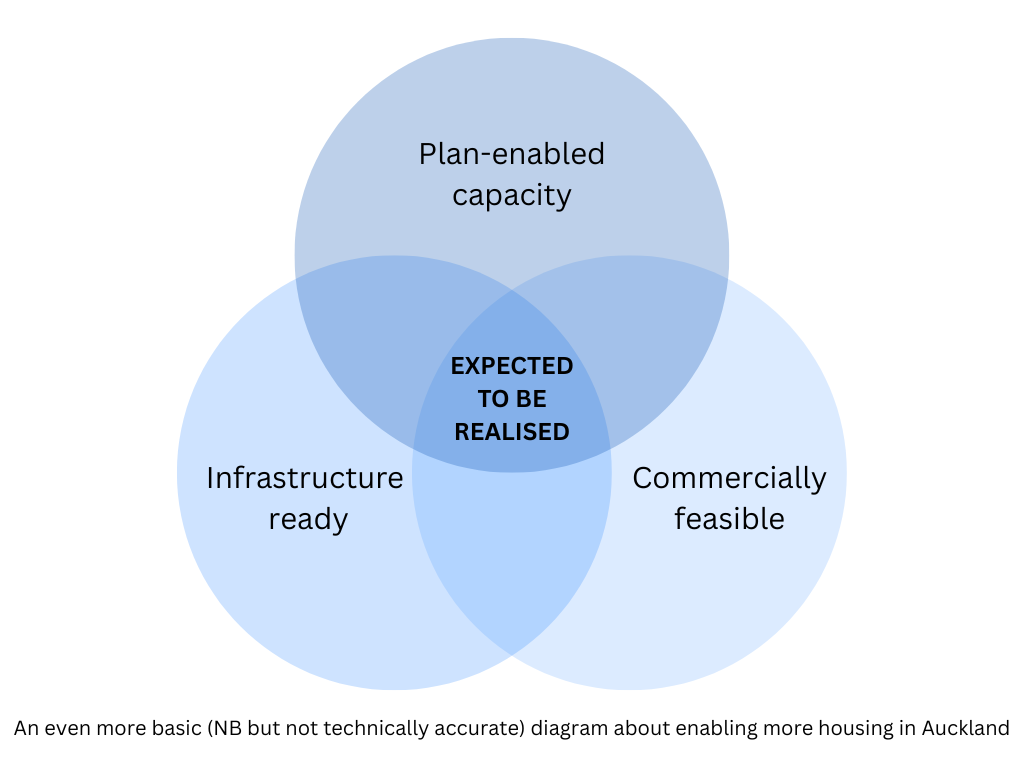 So it’s frankly shocking that some elected leaders – including old hands with track records of shaping Auckland more wisely, who’ve been around the Council table long enough to know better – have persisted in muddying this point and propagating misunderstandings, in a way that seems calculated to scare people.
We deserve much better than this kind of wilful obfuscation.
And yesterday we got better, in the hands of the chair of Policy and Planning Committee, Councillor Richard Hills, who – assisted by his deputy chair, outgoing Councillor Angela Dalton, and others who understood the assignment – did an excellent job of steering an important meeting towards a successful conclusion.
Live-blogs of the blow-by-blow
If you’re looking for a play by play of how it all went down, Simon Wilson live-blogged proceedings for the NZ Herald, as did Jonathan Killick for The Post and the inimicable Hayden Donnell for The Spinoff. And on the socials, Connor simultaneously live tweeted and bleeted throughout, as immortalised by Hayden at the end of his coverage:
And we are done here
The meeting is over. Councillors are filing out. Greater Auckland blogger and Waitematā local board candidate Connor Sharp is slowly unfurling his limbs after frantically live tweeting every exchange from his position in the public gallery.
The politics of more housing: how did we get to this point?
The now replaced PC78 was the council’s response to multiple pieces of bipartisan-supported central government policy aimed at allowing more density near major centres/transit stations, and permitting townhouses throughout the city’s suburbs.
Auckland Council fought and sought to undermine that central government direction at every turn – and the tragic and shocking 2023 floods gave them the best opportunity of a reset, given the natural desire to prevent new housing in flood and hazard-sensitive parts of the city.
(This was a point Cr. Hills emphasised in yesterday’s meeting, noting that it was now 971 days since the floods and the city still had no mechanism to prevent new builds in flood-prone areas. Cr Shane Henderson reiterated this, saying that resisting the new plan would cause insult to Aucklanders still impacted by the legacy of those floods, and injury to future Aucklanders.)
But that resistance couldn’t go on indefinitely. With agreements between the Mayor and Minister Bishop to allow even more housing near rail stations in order to make the most of the $6bn City Rail Link investment, the Minister allowed Auckland to update its plans – but only on the condition that the new Plan Change enabled the same overall capacity as the one it would replace.
Last month, Council revealed their replacement plan, and voted to initiate consultation with local boards and mana whenua before the decision on whether to proceed with the new version (which would itself be subject to full public consultation). At the time, Scott took a look at the good, bad and ugly of the proposed replacement plan in this great post.
Note that Councillors Mike Lee and John Watson were the only ones who voted against even that initial stage.
Perhaps the loudest opponent all along has been Councillor Christine Fletcher, who has numerous times over the last few years compared the prospect of more housing to various different kinds of violent assault. What is it with the hyperbole around housing?
The new plan does indeed allow more housing in parts of her ward – in large part because these are the areas with some of the best public transport connections in the city, especially once CRL opens.
It’s also crucial to point out that when drafting PC78, council had left changes to much of the central isthmus out – creating a giant black hole in the planning map – on the grounds that they were waiting to see what happened with light rail. This was always a weak justification, and it has likely contributed to making the change in this new plan change look more dramatic than it would have been.
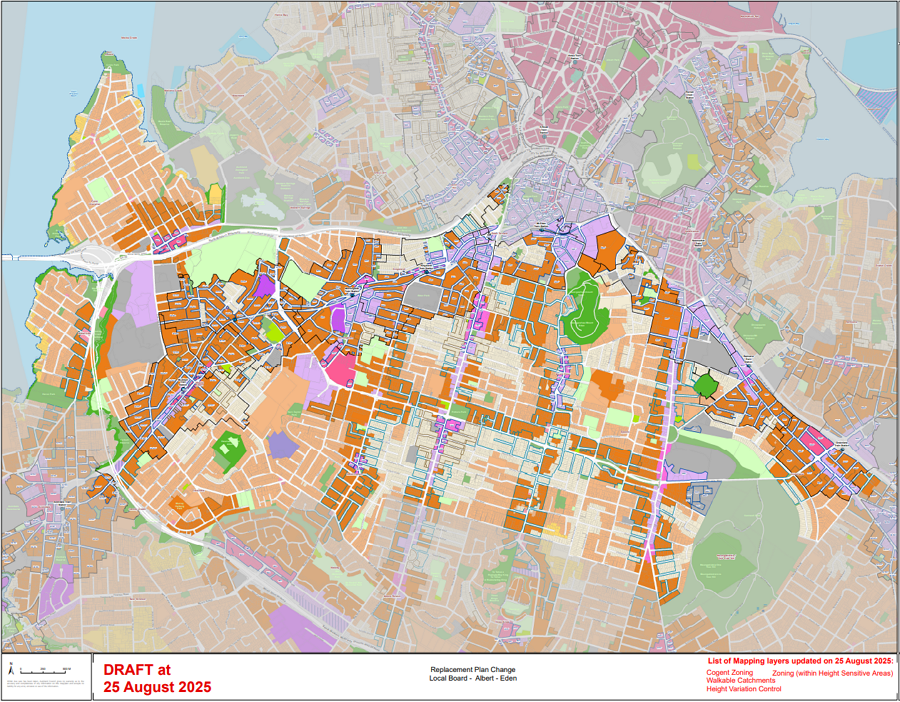
Below is a map of PC120’s implications for Fletcher’s rohe, the Albert-Eden area. For those who don’t speak planning map, the darker orange blocks are where apartments will be allowed under the new PC120. Note there’s also down-zoning compared to PC78, e.g. across much of Point Chevalier.
Highlights and lowlights of the debate
Hayden Donnell’s coverage in the Spinoff of key moments from the meeting captured some of the peak absurdity from those opposed to the plan. Here we have Cr. Maurice Williamson, advancing some outrageous metaphors:
But then, a controversial moment. “We’ve been almost given the choice between the firing squad and a lethal injection,” says Williamson. There’s a hubbub around the council table. It’s not the first time councillors have used questionable metaphors when opposing dense housing, with Albert-Eden-Puketāpapa councillor Christine Fletcher comparing the townhouse law to “gang rape” in a meeting four years ago. “I’m asking for the violent language to stop when we talk about housing,” says committee chair Richard Hills. “It’s a metaphor,” grouses Williamson, though he agrees to amend to “two ghastly options”.
At one point Cr. Mike Lee suggested council corruption:
Waitematā’s Mike Lee has hinted darkly about developers putting pressure on council staff to allow more apartments. “We all know in this building that the council senior management comes under intense pressure from the property market and developers. Some people call it hammer sessions,” he says. He wants to know how much upzoning, particularly in the “Grammar zones”, is motivated by developer pressure.
“Are you saying staff are being pressured by developers? Is that what you’re saying? Because I think that’s really inappropriate,” says Hills.
“Don’t talk about the war. Don’t talk about special interests putting pressure on the council,” retorts Lee.
And a few hours later, he invoked the Byzantine empire for reasons best known to himself:
Waitematā councillor Mike Lee is speaking against today’s proposed plan change. Or at least I think he is. He’s talking about the Byzantine emperor Theophiles, who reigned from 829 to 842AD. “The emperor was processing from one end of Constantinople to another as he did every week and he was stopped by an elderly widow who complained to the emperor that a relation, I think it was his brother-in-law, was expanding the palace so much so to block all her light,” he says. “And the emperor responded by having his brother-in-law tear down the palace. And I think we should take an example from that.”
It’s somewhat ironic he would invoke the Byzantines, given it’s a term that famously describes a system or process that’s excessively complicated, convoluted, often secretive and typically involving a vast amount of administrative detail. Does Mike Lee want more of that? Although, if anything, it perfectly describes how the council have long tried to stop housing in the inner suburbs over many decades.
Speaking of Byzantine, as mentioned up top Cr. Christine Fletcher tried to pass an amendment to extend consultation for longer than planned, which Mike Lee said was needed “to drum up opposition to the plan change“. That amendment was voted down 15-8.
Another unusual metaphor (captured by Jonathan Killick for The Post) came from outgoing Councillor Chris Darby:
Councillor Chris Darby says he recalls the Unitary Plan being called “civil war”.
“Now we’ve got this served to us. We’ve got a choice of dog breeds and which one is going to bite us the hardest and the longest?
“Which one will give us rabies?”
There were some good defences of the plan too, including from Chair of the Policy and Planning Committee, Richard Hills who provided clear and strong guidance across the lengthy meeting. (This and the next two snippets are from Hayden Donnell’s Spinoff coverage):
Hills wants to counter some of the strongest objections to the plan. People say it will enable housing in places with inadequate infrastructure. Actually those places have been downzoned, and the places where apartments are enabled have some of the best infrastructure in the city, he argues. “This actually gives us the future where we accept that more people will live along our bus stations, live along our train stations, live along our metro centres,” he says. “We do not get the choice to not do anything. We do not get to thumb our nose at the government.”
Cr. Shane Henderson, who supported the plan, also critiqued it for the right reasons:
One of the strongest pro-housing voices on council, Waitākere councillor Shane Henderson, has rejected arguments against the plan. On it allegedly helping the already privileged, he says enabling more housing supply stablises, or sometimes reduces, housing prices. In response to infrastructure concerns, he says we know the central isthmus can take more development, and that its wastewater and stormwater systems are equipped to handle intensification. “When we allow more houses in the best places for them, everyone along the spectrum benefits.”
But he does have some problems with the new plan; its just that they’re pretty much the opposite to those of the people speaking against it. He doesn’t accept that we should be keeping 73% of the special character areas established under the 2016 Auckland unitary plan. “Special character areas don’t protect heritage. The category is a council invention that sets up wealthy areas of the central city to operate as gated communities,” he says.
And Cr. Julie Fairey summed up the positives thus, towards the end of the day:
It’s better for emissions reductions and affordability, she says. “More homes next to transport routes where people don’t have to have a car will significantly reduce the cost of transport for them.” Opponents of the plan paint themselves as being concerned about infrastructure and rising council debt. But they’re essentially advocating for sprawl, which is more expensive to service with infrastructure, Fairey says. “And infrastructure is funded with council debt, so join up the lines.”
Who voted which way
In the end, as noted earlier, only five councillors voted to oppose the new plan:
- Christine Fletcher
- Mike Lee
- Ken Turner
- Wayne Walker
- John Watson
It’s also worth recording that the following councillors supported Cr. Fletcher’s attempted amendment to delay the plan, which would have likely caused significant legal issues with central government:
- Daniel Newman
- Sharon Stewart
- Maurice Williamson
And here’s who voted to proceed with the plan change:
- Mayor Wayne Brown
- Deputy Mayor Desley Simpson
- Andy Baker
- Josephine Bartley
- Angela Dalton
- Chris Darby
- Julie Fairey
- Alf Filipaina
- Lotu Fuli
- Shane Henderson
- Richard Hills
- Kerrin Leoni
- Daniel Newman
- Greg Sayers
- Sharon Stewart
- Maurice Williamson
- and Edward Ashby and Tau Henare, Houkura members (formerly Independent Statutory Māori Board)
What happens next?
This new plan will go out to public consultation later this year, and then start through an Independent Hearings Panel process, similar to those for PC78, and the Auckland Unitary Plan before that. So it will still be about 18 months before the plan is fully operational, and we’re bound to see a few more twists and turns before then.
Hopefully the Council will put the maps onto an interactive viewer soon. For now, there are PDF versions of the Local Board level here.
If housing’s your thing, come and hang out!
A special note for those who’ve read all the way to the end: Scott/ Scoot is hosting YIMBY drinks this evening, Thursday 25 September, from 5.15pm onwards at Glass Goose (near the Sky Tower).
The special guest is Jonathan O’Brien from YIMBY Melbourne. See you there?
This post, like all our work, is brought to you by the Greater Auckland crew and made possible by generous donations from our readers and fans. If you’d like to support our work, you can join our circle of supporters here, or support us on Substack.

 Processing...
Two million people in the Isthmus.
Kiwis are still leaving in droves and our birthrate has gone through the floor.
Any idea where New Zealand are going to get these extra people?
For that matter, does anybody remember being consulted about whether we should be letting so many people in?
Enabling 2 million homes does not mean that they will all get built. For example my section is already enabled for probably 10 homes but I choose to only have one on it.
Did you actually read the post? Or did you just miss the Julie Fairey tweet and diagram that explained it in very simple terms that even a politician could understand?
What does Julie Fairey have to do with our immigration settings?
If you can’t joint the dots between RMA Minister Chris Bishop’s decision to prepare Auckland for 2,000,000 people and Immigration Minister Erica Stanford’s decision to radically expand the notion of a ‘skilled’ worker for the purposes of our visa system; then more fool you.
“Reader, he did not read the post.”
[He also keeps missing the fact that external immigration over the recent decades has been like 1/3rd of AKLs growth, from memory of previous discussions over the year. Another 1/3rd was from Auckland itself, and the rest from other parts of NZ. So the idea of simply saying “we have net emigration (across NZ) right now, stop planning for the future” means taking one single point in time, and thinking it will be like that forever. Very typical of the opposition to any change in the Status quo, except that they are using a point in time that is a bit more current, so props for innovation!]
Are you suggesting our tiny country of New Zealand has too many people? Are we overcrowded…or maybe, just maybe, you don’t like people that look like you?
I haven’t anything to do with immigration settings, but I’m playing my part for natural increase; raising three kids I hope stay in Auckland if they want to, rather than being forced to move away because of the cost of housing.
Julie – I share your concerns – however it is demand (as well as supply) that affects the cost of housing.
I guess critical thinking is a foreign concept to you, you appear to be afraid of both. That being critical thinking and anything foreign.
Side note have you ever lived in an apartment?
Doctor, please scroll up to see the diagram in Julie’s embedded tweet. 2 million planned capacity does not mean 2 million people.
And only central government can de-financialise our housing ‘market’ to properly address the demand side.
Our neoliberal economy has turned housing into an economic asset class rather than a place to live.
You’ll complain about congestion in the Southern Motorway when all these homes are built in Drury. Funny when some Kiwis do their OE in London but oppose every form of development here.
Who is arguing to dump these hundreds of thousands of people in Drury?
I’m questioning whether we have been consulted about the numbers intended and whether popular consent exists to import them.
Re: London – I would suspect a lot of opposition to intensification would vanish if we could be assured of the type of quality provided by Victorian brick terraces and mid-century mansion blocks.
Anybody who thinks this change will mean Ockham-quality developments in every street are dreaming.
It will simply shift the axis of dreary CBD apartments (together with the social problems their lack of amenity is generating) further from the Centre.
So what do you suggest is the solution for Auckland’s development? Most cities grow, this is NZ’s biggest city, believe me it will grow either up or out of somewhat in between. We need to choose how we do it rather than just complain and try and stop everything which results in the house prices continue to rise way beyond affordable. Pretty much all our latter governments have supported immigration and seems this will continue unless all families start having 3-4 children on average (figure off the top of my head)…and we wait another 20 years to turn off the pipe. In saying that there is a lot of singles out there too so maybe we have to work on that to start with.
Grant – If we’re going to boost the density of the inner suburbs (something in principle i’m not against) – we need a development plan (driven by a development agency – such as the old Eke Panuku) rather than the blank slate that Plan 120 provides.
This would allow a sensible and sustainable change to be designed and then sold to people (conceptually). This has been fairly successful in places like Avondale and Carrington. As for the Mt Eden area – there is a great opportunity to demonstrate this again in the area between the Dominion Road overpass and Eden Terrace.
Obviously, you are always going to get people reflexively oppose all change in their neighbourhoods (this is simple human nature); the challenge is how to effectively respond to it.
The government has chosen to simply override these people and set up a plan change that essentially confirms their worst fears.
I doubt that this will even be politically sustainable – a tight election is coming up and the Parliament seats for the inner-suburbs will be critically important. Having not bothered to gain popular support, don’t be surprised if this causes a climb-down on Plan 120.
Don’t worry. The Auckland Council will create a whole bunch of rules that will make most developments uneconomic- urban design nonsense etc requiring activated glass frontages for shops that nobody wants to rent, with the cost being added to the price. Auckland planners are past-masters of rules that have no basis in reality. Then there is the issue of demand for homes where you get to listen to train wheels squealing on minor bends all day and night.
Immigration policy is a matter for central government. It’s a different issue.
Central government decides the immigration settings. It’s then the job of regional and local governments that pull the town planning levers to make it possible to house the people.
If you don’t like the immigration settings, lobby the central government. Don’t beat up on the planning authorities that are just trying to help house the population.
God damn this Thursday isn’t my rostered day off I work until 8 would loved to come along
Plenty of time to prepare feedback to PC120 when Notified.
Find the bits you don’t like and work out what amendments would improve it.
Anything that is not in accord with the Controls for a Zone can still be proposed and decided by Commissioners, or Fast-Track Panels.
Instead of panic about 2,000,000, we should worry more about the market forces that will lead to considerably less capacity being built close to transport hubs than the Zones try to allow. Build something now with a quarter of the homes that zoning allows on the site and you have sterilised capacity for the life of the buildings.
The Council debate highlighted the genuine concerns about bad design that a Plan Change can’t control.
People need to look beyond the utility of proximity to transport hubs when considering how to cater for increased density.
To focus on access to outdoor spaces, the areas in the inner-suburbs that are flagged for this radical increase in density are already poorly served by local parks.
This isn’t currently a major problem as most residents have access to a yard.
In other countries that have cities with high densities (at least the types that we should be emulating), this isn’t usually a major problem.
Places like London have sprawling parks regularly dotted throughout. In some places, groups of residents have historically clubbed together to set up small private parks for their sole enjoyment (instead of having tiny individual backyards of no amenity).
What do the powers that be (and their breathless supporters in this comment section) suggest we do for the recreational needs of all of these new Aucklanders?
There will be negative consequences if we allow private developers to create a city with thousands of people crammed together without access to parkland and gardens.
This is exactly where we look to be heading (until National, faced with losing several electoral seats in Auckland in the upcoming tight election lose their bottle; that is).
I am inclined to agree with Doctor Spins – it’s not enough to just unlock zoning to allow developers to build. There needs to be some coherent overarching vision that views new developments within a context of the overall area that provides all the amenities and quality of life improvements that make dense urban living enjoyable. Ultimately developers only care about the return on investment, if the Council or some other public org does not step in to force a bit of vision then then we are squandering an opportunity and will end up with a lot of ugly apartments and not much else. I think the dearth of generic townhouses that have cropped up everywhere is pretty good evidence of that, there is no grander vision of urban or suburban renewal with all the infilling.
I think a council or state org that could redevelop these areas with purpose and vision is necessary, but I would be surprised if we see anything like it – truly transformative works seem beyond any candidates or governments.
I think one of the problems is that in our neoliberal culture, we truly don’t believe in the state (whether through central or local govt) having this kind of role in society. The market rules all and will deliver the best results (for the market, that is).
Agree we need lots of parks and such.
“Ultimately developers only care about the return on investment” How do you know this is correct? It’s not necessarily true (certainly for all cases) as a developer may have quite a pride in their work as well as wanting to make a profit.
Regardless if we have enough built, the market will determine what sells, if it’s cheap and nasty it won’t if there is another choice we can afford.
…and to be honest, cheap and nasty can be a good thing for those that would otherwise have nothing. I’m almost a believer in the slumlord being a good thing (if not too many!), cuz if you tighten rules too much then you end up with those on the street or their car anyway.
I listened to practically all the meeting yesterday some on delay and I liked how Wayne Brown defended the affordability of apartments saying something like his or his prior one (located on or near K’Rd) has a full range of affordability with the most expensive worth about $14,000,000 and the bottom at ~$400,000.
Some councillors struggled with even the basic economics of supply and demand.
Grant, I am sure some developers do take pride in their work, but if it is not commercially feasible they are not going to do it. That is what I mean about return on investment and I am referring to private developers not public like KO.
And to link that to your other point, I don’t see why we should settle for low quality housing for people on the lowest end of incomes; especially when state organisations like KO can invest in good quality housing stock. I agree though that Brown and co are out of touch with regard to costs, they don’t understand how stretched people are.
Grant, people sleeping in cars is a sign of market failure. That’s exactly where the state should step in, under any economic model, preferably beforehand.
Boy, the hysterical (testerical?) language of the housing naysayers is something else! Have they been staying up late and watching too many horror movies?
This was my favourite bit from Hayden Donnell’s wrap-up:
***
Councillors have received a stirring letter from Howick Grey Power’s deputy chair Peter Bankers ahead of the meeting. It raises concerns about the city being “eviscerated” by “an additional two million dwellings”. “We are appalled at the proposed destruction, with no references to the city’s near zero infrastructure, has in effect ambushed all of us,” the letter says. A few things to note:
1. The plan enables capacity for two million dwellings total, not two million additional dwellings.
2. Evisceration refers to the removal of internal organs from a body, whereas this plan enables new housing, meaning in the metaphor it would be more like adding some some extra kidneys, intestines, and suchlike.
***
re point 1, the 2M housing capacity is net additional dwellings, and thats only in the areas that PC78 and PC120 apply to, so not to hand it to Grey Bankers but he was (partly) correct on that point. Capacity in the City Centre, Future Urban, Rural and the Gulf Islands and any plan changes currently underway is all on top of that
The government also allows us to produce unlimited loaves of bread. How do we survive surrounded by unlimited loaves of bread? Oh wait the market only produces the amount we need, not the amount permitted, whew.
But Jimbo, the Government also regulates the production and sale of bread to ensure that it is nutritious and safe to consume.
Without that, the only protection afforded to consumers would be the (faint) consolation that perhaps word would get out among other consumers.
A pretty faint consolation if you happen to end up dead from food poisoning.
The same for housing and for our neighbourhoods.
You used a good line though (I will use this in the future).
Doctor Spins – that’s a fair call for regulations around factors that make a building safe or likely to last, such as fire resistant cladding or treated timber.
It makes no sense for regulating how many houses are built in a certain location.
“But Jimbo, the Government also regulates the production and sale of bread to ensure that it is nutritious and safe to consume.”
Look, nobody is a villain in their own mind, and I do accept that you intend to do good (as do these Councillors who oppose decisions like the one covered in this article). But the thing is – whether in good faith of bad faith, providing good ANCILLARY things that make more intensive housing worth living (say, the extra parks you want) are the thing to come AFTER providing housing. Extra parks isn’t nearly as positive for a city (suffering insufficient housing) than extra parks. And tying the first to the latter just gets used to prevent the first by people with other objectives (including objectives no more sinister OR virtuous than “my voters don’t like it”).
So lets bring on the extra housing. Among other things, that’s a base of people who can also pay for more services and infrastructure. And by intensifying, Council can keep more rates for “extras” rather than paying for lower-density housing.
Finally some sensible planning but 18 months is such a long time. Maps are done, surely consultation can start right now? Finish before the end of October, make some small updates and get it live by Xmas?
With a good portion of 2M becoming available, I’d think sprawl would become less economic. This will be the case, whether we continue with 2% national annual population growth, or not. Hopefully the ~30% drop in house prices stays down
Sure, there are areas in the proposed areas for higher denser populations that do not currently have adequate infrastructure to handle vastly increased populations.
But infrastructure capacity upgrades should be occurring all the time as time expired infrastructure is renewed with larger capacity systems. Pipe diameter has a absolutely a minimal effect on installed costs but a massive effect on capacity.
Signalling that higher density is possible within any new infrastructure’s expected lifetime would remove any temptation to economise infrastructure upgrades to only meet current population densities.
And it would be absurd to have plan changes every time infrastructure upgrades allowed higher density in a street or area.
My take was that intensification is now focussed on the isthmus and away from the strongest areas of National Party support (the North Shore and Howick). See the newsroom map below. I suspect in the long-term those in the outer suburbs will oppose apartments in the inner city.
https://newsroom.co.nz/2025/09/25/housing-solution-two-million-reasons-to-thank-or-scold-chris-bishop/
One of the commentators on Christine Fletcher’s Facebook page bemoans the sprawl of Auckland, comments that some suburbs like Takapuna feel like ghost suburbs, then writes “Well done Christine, never give up. Thank you.” I guess this is meant to be a joke.
Doctor Spins: “Places like London have sprawling parks regularly dotted throughout. In some places, groups of residents have historically clubbed together to set up small private parks for their sole enjoyment (instead of having tiny individual backyards of no amenity).”
This is an interesting take on the question of the balance between communal space and private space in medium density development.
For an alternative or supplementary view see my comment in the recent post on perimeter blocks. (summary: communal open space needs to be properly designed and curated; otherwise it risks becoming the unloved ‘space around the buildings that no-one has worked out what to do with’).
Thank you – I think there’s been a really good discussion in the comments section following this article; from pretty much everyone involved.
to avoid doubt: at the time of writing, my comment in the recent post on perimeter blocks seems to be still in moderation.
So what happens when sea levels rise and the western roading network is flooded and the sewage system like wise ?.2 million toilets create a lot of extra waste along with the same amount of showers daily all needing to be pumped into the sea to poison the food stock in the local ocean .
The plan is not about providing for an expected further two million people and their toilet waste.
It is about maximising individual choice as to where a much lessor amount of additional people can be located, (or relocated to, in response to climate change hazards such as sea level rise).
Over catering the space spreads any zoning uplift in prices across a much wider area, thus lowering the amount of zoning uplift premium on individual up zoned properties. Thus it is a contribution towards housing affordability.
Much much better than PC78. Which I recall had lots of support here, based on a pretty naive view that more density, everywhere, has to be good!
This is much better. Much more focused density, in areas not prone to flooding and with ok Infrastructure.
Although I think we will only seldom see apartments taller than 5-6 storeys.
But that’s fine. Lots of 3-5 storey stuff in good locations can work well.
Now all that is needed is removal of the painfully subjective design reviews on development, that draws out consenting timeframes and escalates costs, really getting in the way of more elastic housing supply.
Nothing like some impartial journalism!
Interesting that the other aspect of Plan120 around natural hazards (flood plain / erosion zones / beachfront) is being largely ignored compared with the proposed intensification. Here is AC justification;
*** Section 1.7 Risk of acting or not acting
It is acknowledged that information relating to natural hazards and climate change is always being updated so that there will never be a time where there is perfect knowledge on this matter. However, not acting means that development may be established in areas subject to natural hazards based on out-of-date information, assessment considerations and risk management frameworks. Therefore, there is a need to act even with imperfect information as the risk of not acting outweighs the risk of acting ***
So despite using data from flawed climate modelling reports and insufficient scientific proof, we are going to go ahead and re-zone as hazardous anyway, leaving affected households with reduced property values, inflated insurance premiums and an expensive hoop-fest if they were to attempt to develop in any way.