New York is the most recent city to implement congestion pricing and it’s already (and predictably) been a success. Will Auckland be the next city to introduce it?
Legislation to introduce “time of use charging” (congestion pricing) is currently making its way through Parliament, with the government intending to pass it before the end of the year. It remains to be seen whether the major issues with the bill – with the government giving itself control of the design of scheme and revenue raised by it – will be addressed by the select committee. While we wait for that process to play out, Auckland Transport has released their latest work studying the impacts of a potential congestion-charging scheme.
The information released by AT essentially expands on the work done in 2020 as part of The Congestion Question, which created a concept scheme that was unanimously supported in an inquiry by Parliament’s Transport and Infrastructure Committee in 2021.
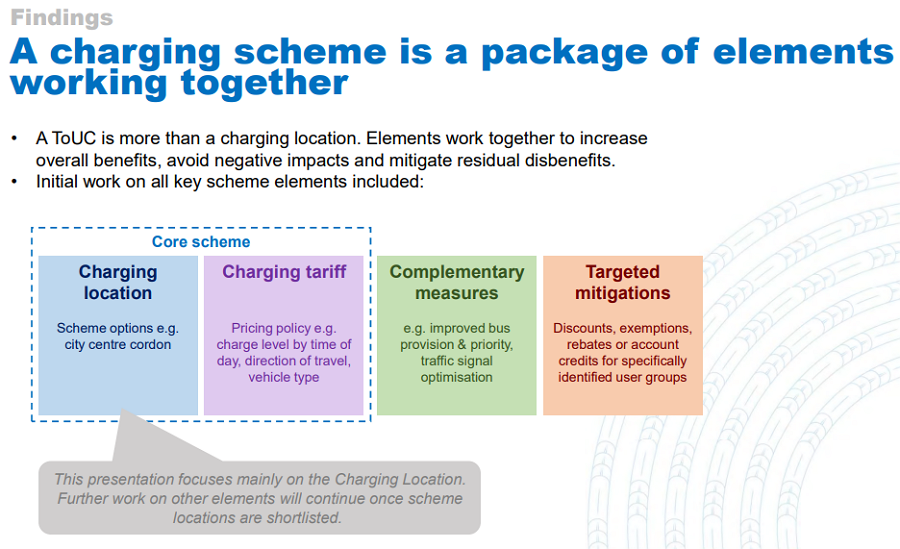
The work released focuses on the location of a congestion pricing scheme, and a summary of the information is covered off in this presentation. There are a lot of other elements to any future scheme that will be needed, such as what the cost is, what else is needed to support a scheme (like changes to public transport), and what other measures are needed to mitigate any impacts of a scheme.
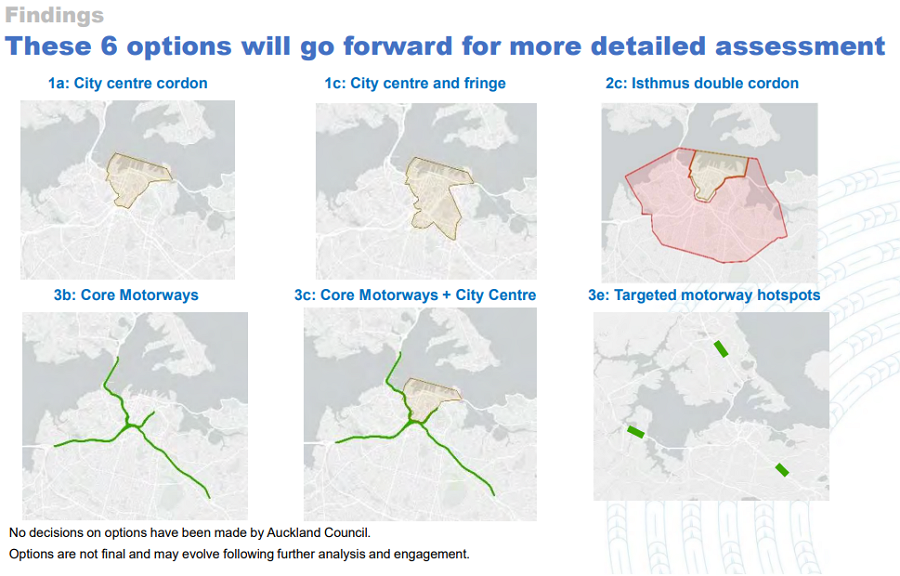
To help answer the location question, AT came up with a list of thirteen different options for comparison, with a mix of area and/or corridor-based options. These were shortlisted to six options. They haven’t come up with a final preferred option yet, as they are waiting for the outcome of the legislation as well as additional work on those other elements mentioned above.
For comparison, these are the seven rejected options:
 For each of the six options left on the shortlist, AT has done some modelling on the impacts of the scheme.
For this, they just used the prices suggested in the 2020 study – which for light vehicles was up to $3.50 per trip at peak times but less at other time – but as noted above, more work would be needed to confirm the exact amounts.
On questioning, AT also acknowledged that the model they use for regional level impacts here doesn’t do well with assessing active modes – so, for the city centre options, where better quality cycling networks exist (for some trips), there could be some good uplift too.
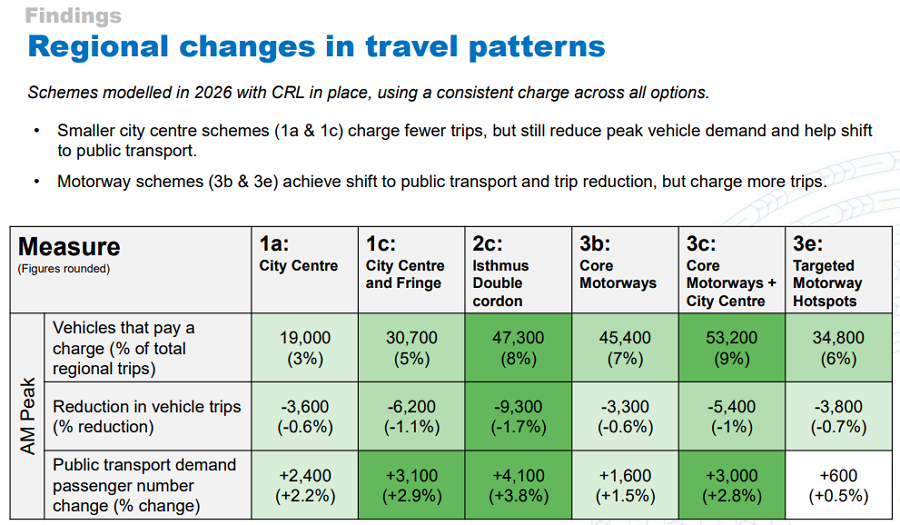
As you can see, there are some big differences between how many trips would be expected to need to pay a charge across each option, and there’s not a linear level of impact on vehicle reduction and PT demand change. For example, Option 1c sees a greater reduction in vehicle trips and a greater increase in PT demand than Option 3c, while charging 22,500 fewer vehicles.
AT noted that this is in large part because the city-centre-focused schemes are more likely to impact trips that already have better available alternatives to driving.
As part of this work, AT has talking to a lot of people, including even running some deliberative democracy sessions. Two of the key takeaways from this were: the need to have good alternatives in place (so people can choose not to drive if they want to), and the need to avoid rat-running through neighbourhoods (by people seeking to avoid being charged).
The modelling undertaken for these options includes looking at where you’d see traffic increases and decreases, based on these schemes. This helps to understand where work might be needed to help mitigate the impacts of whichever option is chosen. AT’s presentation only shows the results of a couple of the options though:
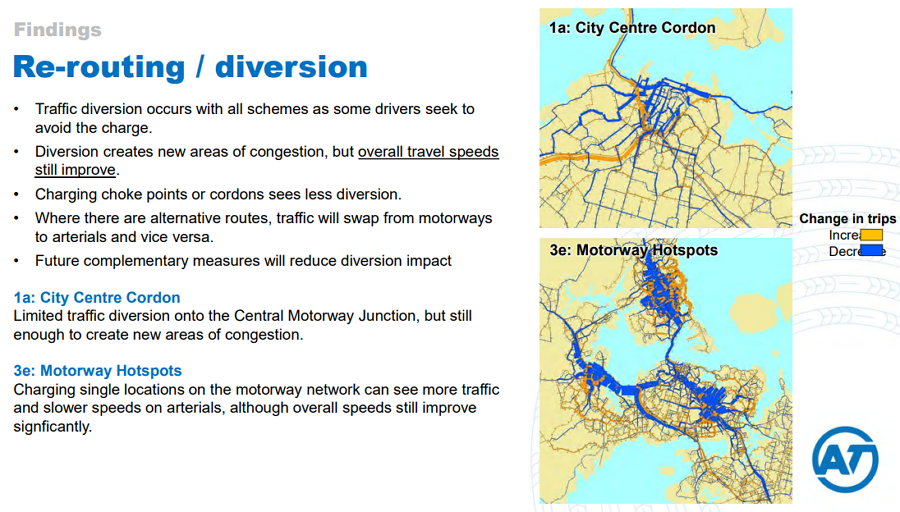
I think how AT chooses to mitigate the impacts will be critically important. For example, with mitigating rat-running, if they just put in standard traffic-calming measures but there’s still a heap of drivers using these routes, it won’t be a great outcome for local streets. Instead, I think it will be even more critical that AT develops and properly implements well-designed Low Traffic Neighbourhoods (and clearly communicates the wider benefits of these for all communities).
Despite the diversion impacts, the modelling suggests that overall, average speeds across the regional will increase in the morning peak by up to 4% (with Option 2c and 3c offering the biggest effect). By comparison, without any pricing scheme, average speeds are expected to decrease by 6% as the city continues to grow. It’s also interesting that there are some quite different outcomes in the afternoon peak.
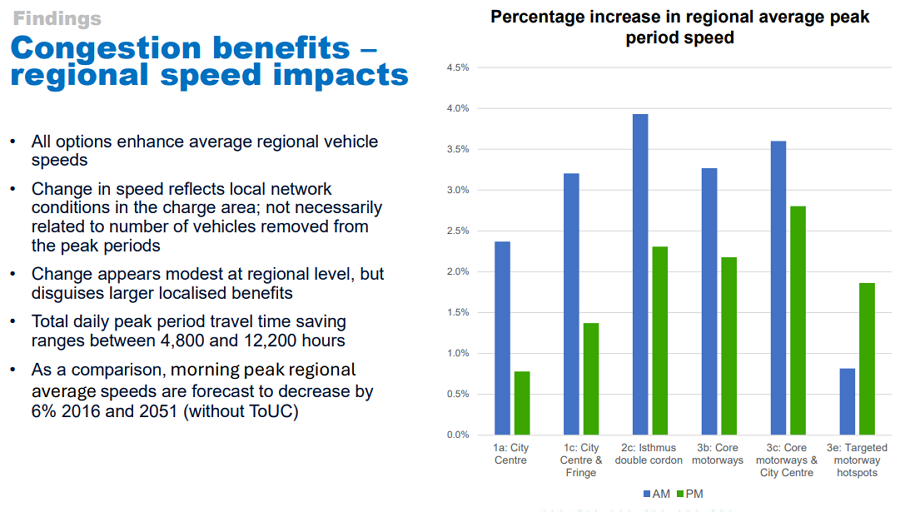
AT was quick to point out that while those percentages might not sound like a lot, for trips more directly impacted by the scheme the impacts could be substantial, and in line with the travel time savings promised by big rural motorway projects. What they don’t note was that these savings would be achieved while also generating additional revenue, which is something those rural motorway projects never do.

In a briefing, AT also came up with what they labelled a ‘crude’ measure of efficiency for these options, by looking at the average minutes saved region-wide compared to how many vehicles would be charged.
Based on this measure, Option 1a (City Centre) was considered the most efficient with an average 10.8 minutes saved across the AM and PM peaks per vehicle charged, followed by Option 1c (City Centre and Fringe) at 10 minutes. Options 2c, 3b and 3e were all similar at around 9.3/9.4 minutes, and Option 3c was the lowest, at 8.8 minutes of saving.
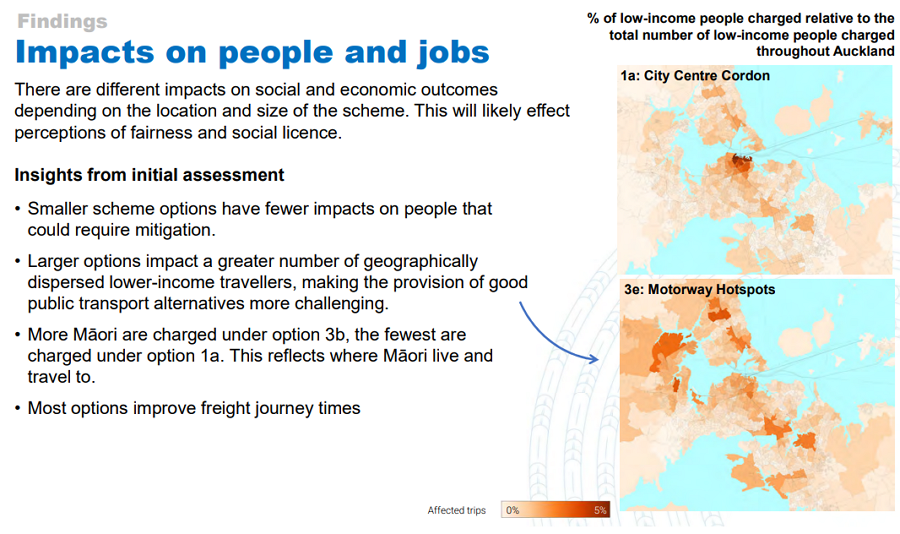
As well as needing to mitigate issues like rat-running, a large focus of the discussion of congestion-pricing schemes has been on the impacts to people on lower incomes. While how specifically that might be mitigated is subject to more work, AT did note that the more city-centre focused schemes have fewer impacts on low-income people.
There are a couple of big things I think AT has missed in their analysis so far, or at least in the summary they shared.
- What are the impacts to public transport?
- Presumably many buses will also enjoy some travel time savings, though some routes may get worse as a result of traffic diversion. Either way, the impacts to all of those passengers should naturally be considered in the analysis.
- As the analysis goes deeper, AT will likely need to understand where exactly that additional PT demand is coming from. Will existing PT routes have enough capacity? Or is additional investment required to improve services?
- What are the impacts on safety? Fewer vehicles on the road should help reduce crashes, but will that be offset by faster journey times?
Personally, I think Option 1c seems to strike a good balance. For only a slightly larger overall area than Option 1a, and which better represents the central city, it achieves a much bigger impact on vehicle reduction with good improvements in travel times as a result. Option 1c also avoids the risk of tying yet another noose around the city centre. Option 2c is also appealing for its even bigger impacts, but it feels like that would be much more technically and politically challenging to implement.
There’s still a lot more work to be done before we get to an actual scheme, and a lot will depend on the final form of the legislation.
This post, like all our work, is brought to you by the Greater Auckland crew and made possible by generous donations from our readers and fans. If you’d like to support our work, you can join our circle of supporters here, or support us on Substack!

 Processing...
The benefits of Low Traffic Neighbourhoods are comprehensive, and well tailored to solving any charging problems. AT should have been implementing them across the city in preparation for charging.
If we had councillors who used their governance role properly, there would have been a clear direction to AT that LTNs should lead this work and shape the city as travel patterns change.
God it’s so frustrating.
Yes, that would have been a good idea. Actually it’s not too late I guess, they could still prepare the LTN’s before any of this is likely to be implemented.
Good to see gains in minutes ,12, and comparison to transmission gully ,10minutes. Clearly show gains that can be made for what appears relatively small negative impacts , (basically cost to some)
Option 3C. As we look towards a future free of the private metal box with wheels, restricting the entry to our city centre, as the Central Rail Link makes it too easy to access it via the train network, would be a forward thinking option.
I personally cannot wait until I can move my kids around predominantly by rail, and I cannot understand why anyone would not want their kids in the heaviest machine available, a train carriage!!!
bah humbug
3e would be an own goal. People could use the motorway, exit prior to the toll, then get back on at the next onramp. What would be the point of creating problems for all the people who live or run a business beside those point?
Presumably this kind of rat-running is addressed with the kind of two-camera average speed monitoring that captures licence plates. If you travelled from motorway point A, B, or C to motorway point G, H, or I within an hour then you’re pinged for the toll zone that’s in D, E, or F regardless of your circuitous route.
Auckland should follow Singapore’s best practice:
a) congestion tolls are different $’s by route reflecting the individual route congestion levels
b) congestion tolls are reviewed every 6 months either up or down as reflected by the congestion evidence.
c) Singapore added small shoulder tolls as well to avoid vehicles parking up and waiting for the peak tolls to end.
Further I’d recommend that the tolls are phased in by incrementing them upwards until the desired congestion management level is reached.
This will give the public time to adjust their behaviour.
Also, while models may be a reasonable tool to estimate travel demand patterns but aren’t always accurate. Tolls are notoriously difficult to model accurately evidenced by numerous cases around the world.
In this case real world evidence should drive the toll $ levels not an arbitrary $3.50 or modelled value.
All good ideas I agree with kiwi.
So AT provides cheap parking to incentivise people to drive into the city, and then charges them congestion charging to do so?
Would it not be easier to just charge people more to park at peak times? They could do that now without the need for law changes, tolling systems, etc.
Almost all countries, if not every one, has given away the ability to control public parking as a transportation system TDM tool by allowing the private sector to operate public car parks. So it would be difficult to use parking pricing in Auckland as a TDM tool.
Having thought about it long and hard I think it is systemically the wrong decision. Transport authorities control every other facit of transport.
I’m happy for private operators provide & operate public parking, but the minimum parking charges should be regulated so that they can used as a TDM tool.
If we wanted to be idealistic then only transport authorities should be able to provide & price “public parking”. The parking arm would have to operate as a CCO or SOE so that it covered its costs, and it would need initial capital to be able to build parking buildings if the TDM strategy needed them.
This would then allow parking and congestion tolls to be used and would have also avoided some of the new suburban mall stuff ups that have occurred which have led to gridlock. The mall parking would have just been priced to manage demand.
AT provide the cheapest parking and effectively set the maximum price, not the minimum. If AT increased their prices, private would probably follow. They could at least try that first and see if it works…
I agree that increasing parking costs would be a much easier first step. I wonder what the statisitcis are of cars in the central zone that park vs others passing through/dropping off etc.
i hope it’s an automated system
It will be, but it will be a pain for people who use the city centre infrequently, such as visitors.
What would work much better is an automated RUC/toll/congestion all in one system to replace fuel excise. Maybe it could automatically add approximated RUCs to any fuel purchase so it isn’t too much of a pain for the masses.
Unlike NYC, in Auckland it’s the working class who have to drive long distances into town or to far flung employment hubs, and the bourgeoisie who can easily use public transport. I think congestion charging will have negative social effects here that it doesn’t have overseas for that reason.
I can’t quite understand your logic. Are you saying the working class can’t use public transport because they work odd hours, live further from PT or something else?
The point is valid Daphne.
a) As a generalisation, with NZs low density cities the lower classes tend to live further from the CBD as the housing costs are relatively lower.
b) This indicates that they are likely to be over-represented by those that have to pay tolls.
c) Its unlikely there would be any welfare transfers provided to offset the costs.
Possible offsets:
d) In some overseas jurisdictions congestion toll revenues are ringfenced so that they are required to be used for enhanced PT services
e) park n ride should be provided at stations outside of the congestion tolled area so PnR is also a viable mode choice, alongside other mode or time of day choices.
I don’t think it is non-canon to describe anyone as part of lower classes. You mean people on lower wages or who can’t work.
yes I did.
Easy solution is to provide 25-50, say, discount for community service card holders. I was looking in the reports and the overseas examples looked at seemed to have this sort of thing or similar. The CSC is the consistent ticket to many such discounts.
25-50% discount obviously.
It will affect poorer people to a higher degree here, but that isn’t a reason to avoid doing the right thing. Jeanette Fitzsimons argued in the 80’s for electricity to be priced at its marginal cost instead of its average cost to allow market signals to reduce energy waste. Her point was that those who couldn’t pay the higher price should have their wages assisted by those of us who can. Welfare is a valid Government function and it is just a transfer cost that lifts utility for society.
A fair statement. Of course welfare gets reduced (sorry, increased below inflation) all the time. Yet fees – especially if charged by corporatised entities, nicely keep up with or go beyond inflation, to ensure C-Suite and shareholder bonuses stay fat.
Capitalism is not for YOU, my friend.
That said, I have no simple answers for a complex topic 🙁
It would be more helpful to see the Re-Routing for all the 6 options. Increased congestion on the NW motorway for 1a is not likely to be palatable. Congestion effects of 3c might be more informative.
LTN won’t help arterial congestion (East Coast Road, Onewa Road, Great North Road etc).
I don’t see 1a or 1c being welcomed by the Government, without revenue from motorway use.
LTNs might not help ‘congestion’, but a ‘decide and provide’ arterial road reallocation design will further our goals of access, improved places, emissions reductions, safety and modeshift – and LTNs flanking those arterials are needed to make the designs function without rat running.
What would have been helpful is if AT/AC had:
1. Refrained from using the Auckland Forecasting Centre’s Macro Strategic Model for this work. It wasn’t designed for this kind of job, and is inappropriate. I can see staff have tried to broaden the analysis to other considerations, but the fundamental errors in the model undermine the basic findings.
2. Looked at the different options in a qualitative way, on the basis of how well they further our goals of enabling active, local, independent travel by improving safety and place quality, rather than looking at travel time savings (which has been directly called out by international experts as a perverse and regressive approach to transport planning).
As they don’t have a model which calculates changes in travel time for active modes, comparing vehicle travel times is a way to systematically prioritise longer distance vehicle travel over shorter distance active travel.
1A, 1C, 2C are fine. No particular preference. The 3’s are terrible and should be rejected. Will just lead to a bunch of traffic driving through Pt Chev to avoid the toll.
3E is garbage. Look at how much of the North and South/East is accessible from the comparable distance to the cordon for the North West, which is mostly just water on one side. Not only that, there’s trains next to the Southern and a separate busway on the North Shore running parallel, while the North West has nothing of the sort.
I’m confused as to why this one wasn’t dumped out of the first round given 2a was.
3C could work, presuming the motorway and city tolls were the same, as you’re only getting a small number of Ponsonby-bound people rat running through Pt Chev (and they’d probably go via Great North Rd anyway)
The level of rat running through Pt Chev and the inner west is already a big problem. It can be solved, though, with low traffic neighbourhoods.
If they decide on 2C, they should consider re-aligning the fare zones to match the congestion zone. There would be a number of areas where you’ll have to pay congestion price to drive anywhere, but also pay for 2 zones to get to the City Centre.
Just as an example, costs will be different for someone at Baldwin Avenue (2 zones, no congestion charge), Kingsland (1 zone, no congestion charge), and Morningside (2 zones and congestion charge). I’m not sure that makes sense for three people who would be using the same transport links and are so close together.
This is probably more a problem with (our) fare zones in general when a distance based system would be more equitable. In terms of the congestion charge areas it would still achieve “the goal” of reducing car use and travel times.
Also, they’ll need to think through the parking impacts, and step up costs and enforcement, where needed.
OK, looking at the 1C which as per Matt, I quite like. I presume it would have almost no effect on motorway travel on a wider scale though of passing through the spaghetti junction or encourage people to use the wider more modern motorways of SH20/Western Ring Route. How does this impact on further north and or Manukau south etc. 1C seems more of a city centre only thing which I’m all for but I live nearish the huge flow of traffic that goes through the Penrose motorway area and times congested. How much of that could be shifted to the Southern or Eastern train and feeder buses or what ever with that encouragement and money raised from any toll.
Actually, maybe we need another option, 1C (city centre & fringe) combined with core motorways rather than just the 3C city centre version with core motorways.
In saying that, I think anything is better than nothing and best to get on and do something (ie probably one simple thing).
i think that once Option 1c was implemented, motorway traffic would naturally drop anyway as a lot of motorway drivers are ultimately heading into the city anyway…The good thing about not tolling motorways is that you aren’t penalizing motorists simply trying to get thru Auckland…
I like option 2c….it captures the area that is serviced the best by public transport into the city i.e the people who make a genuine choice to travel by car to the CBD. It would also stop people driving to the city fringe and parking up to avoid the charge which defeats the purpose of it. I like the swedish model ( mostly as anything from scandanavia seems to wind up the right) of not charging on weekends, public holidays and June( we would be from Xmas to mid Jan I guess). If you have to work nights in the CBD so would be leaving early morning and potentially caught in this then have a system that people can apply to … happens all the time with parking now so not difficult
it’s also predicted to have the biggest impact on PT Usage and reduction in trips
I think it has to be 1a to start with. There will be too many residential areas impacted by 2c, probably needs to be time to get these people on board.
Having a whole lot of commuters parking in their neighbourhoods might help with that process ironically.
From what I’ve seen, reducing ambition because other people aren’t ‘on board’ yet is an approach that backfires. Those people end up believing they had a right to special consideration. And that’s how we end up with a State of the City report that is so poor.
There are many tools to make this a successful win-win for everyone, if rolled out at the same time, or in advance.
In counter to that I’ve also seen many situations where the bigger option was chosen and we ended up with nothing due to opposition.
Lol. We’re probably referring to the same things that failed, but what you call the bigger option is what I think of as having reduced ambition.
It’s irrelevant, really. What’s missing is a process of robust accountability of the leadership and governance levels.
3c, and then we can finally give up on talking about second harbour crossings and whatnot.
3E is the worst overall, you can see people will just go off the motorway, drive round the cameras, then rejoin. Just a bunch more congestion on local streets around there. 3B/3C encourages people to jump off the motorway at Pt Chev and just drive on city streets, which is far worse than them using the motorway. Cordons should be local streets only, or local streets and motorways, but they shouldn’t be encouraging people to leave the motorway and drive through local streets.
I like 1A most tbh, then it should gradually expand as the council wants. But I don’t have strong views, as it’s more a proof of concept rather than a citywide rollout. As PT improves/congestion gets worse, expand the zones more.
Central gov needs to get lost though. Should be a case of providing the tools, then letting local councils choose what to use it for (and keeping the revenue). Then AT can just put cameras on every offramp/on ramp to charge motorway drivers as well as motorways are NZTA’s domain. Sure interregional trips might not get dinged, but can’t let perfect be the enemy of good.
This was a reply to @ButtWizard
Bring it on .. it is long overdue
Combine 2b and 3b. MORE cars being charged!
I’d be in favour of, in addition to the proposed punitive measure for driving in the form of a toll, an incentivizing measure to nudge people to adopt alternative forms of transit (not car), i.e. actually paying people to bike, and heavily subsidizing rail use.