At about the same time as Wellington were announcing their new battery electric regional trains, KiwiRail was talking to the Waikato Regional Transport Committee (WRTC) about a plan to effectively electrify the entire North Island rail network.
You can also watch the presentation here, from about 44 minutes on.
When it comes to carbon emissions, rail is already about 70% more efficient than moving freight by truck – and KiwiRail say they’ve already made some good improvements by achieving a 23% reduction in fuel consumption per 1000 gross tonne kilometres over 8 years to June 2021, predominantly “through fuel saving initiatives such as optimising loads and timetables, and driver behaviour modifications“.
They are looking to reduce their emissions further, with a 40% reduction by 2035 and net zero by 2050. Among their reasons for doing this: reducing reliance on imported fuel (and the price volatility associated with that), and the fact that their customers want them to.
Previous work KiwiRail has done on the issue highlighted that focusing on the Golden Triangle – the Auckland to Tauranga corridor – was the best place to start, as it’s the busiest part of the freight rail network. Investing in the busiest areas is also suggested in the heavily roading-focused Government Policy Statement on Land Transport.
Investments in rail should be focused on the busiest and most productive parts of the existing rail network, to support efficient movement of freight. This will complement investment in our state highway network to deliver a productive and efficient supply chain.
KiwiRail’s previous work also found that a form of electrification was the best way to go, over other options like hydrogen. That work has fed in to the Golden Triangle Electrification Programme (GTEP) Detailed Business Case. On Monday, KiwiRail told the WRTC quite a bit of work has been done on this so far, including looking at expected demands, operational options and timetables.
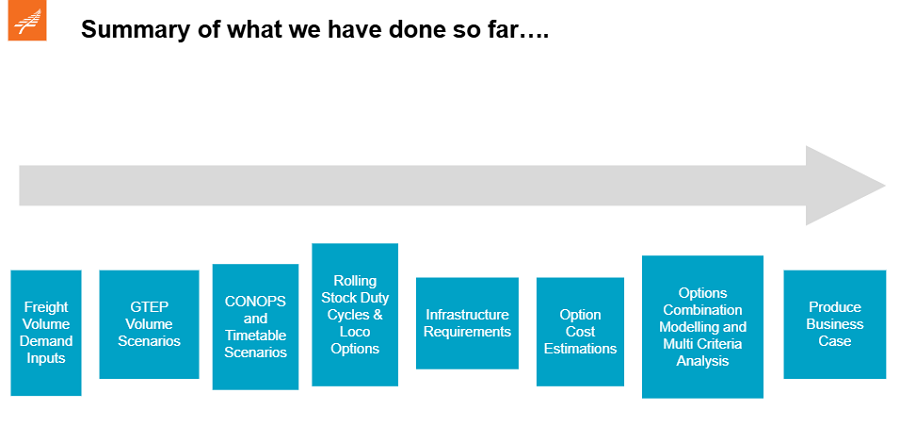
They said that work has already revealed options for improving their network capacity even without electrification:
“One of the main reveals out of that is that the network has a lot of capacity that can be utilised today, so without much more investment in infrastructure. So things like the single line section through the Whangamarino wetland, for example, with some minor enhancements to the signalling you wouldn’t need to double track all that way to create even more capacity than it’s got at the moment.”
Later in the discussion, KiwiRail gave a bit more detail about what is involved with Whangamarino section – which is about 12km long, and the only significant section of single track line between Auckland and Hamilton.
They said that more capacity could be created by slightly lengthening the passing loop in the middle and upgrading the signalling to allow for high-speed arrivals and departures and to simultaneously berth – which is the ability to have trains enter the swamp at about the same time from each end. This is something not possible with the existing signalling system, which dates from the 1960s. Elsewhere, more capacity could come from improvements like new or lengthened passing loops.
KiwiRail’s likely option
Much like the Wellington Regional trains, KiwiRail’s likely solution is to make use of batteries to be able to run off-wire. They noted a lot of work in the business case has been on figuring out just how much transformer and battery equipment could fit on a locomotive, and how to optimise that for our network.
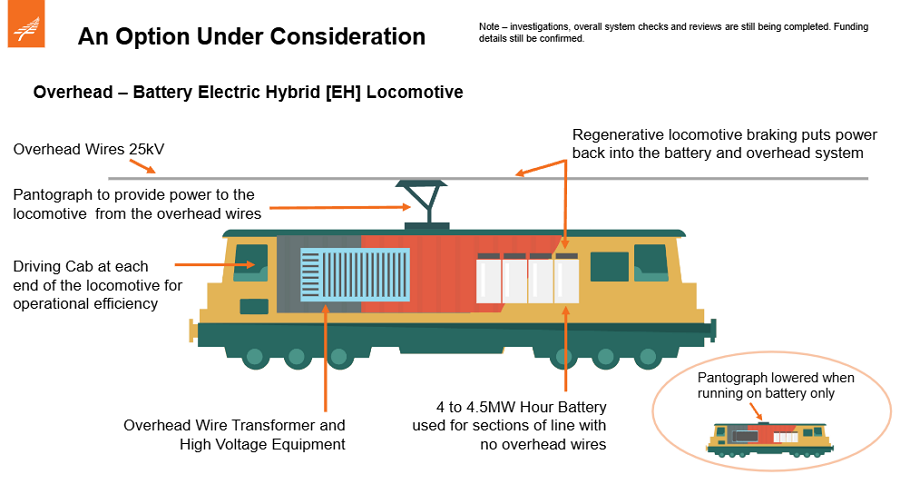
Interestingly, under all scenarios they considered, KiwiRail sees the need to install wires between Pukekohe and Hamilton – so this has become a “no-brainer” project to do. Depending on the actual battery capacity of the trains, they might also need to put some wires east of Hamilton too, so that the trains have enough range to reach Tauranga. They are looking quite closely at just how much is needed in order to minimise costs. They also say they prefer electrification at the western end of the line, due to the location of a power grid exit point at Ruakura.
At Tauranga, there would need to be a recharging facility: KiwiRail noted that the 2-4 hours it takes to strip and reload a train is the perfect amount of time to recharge the batteries. They also mentioned that some of the other options they looked at did decarbonise the railway but added heaps of operational complexity and costs – which is one reason the battery option is preferred.
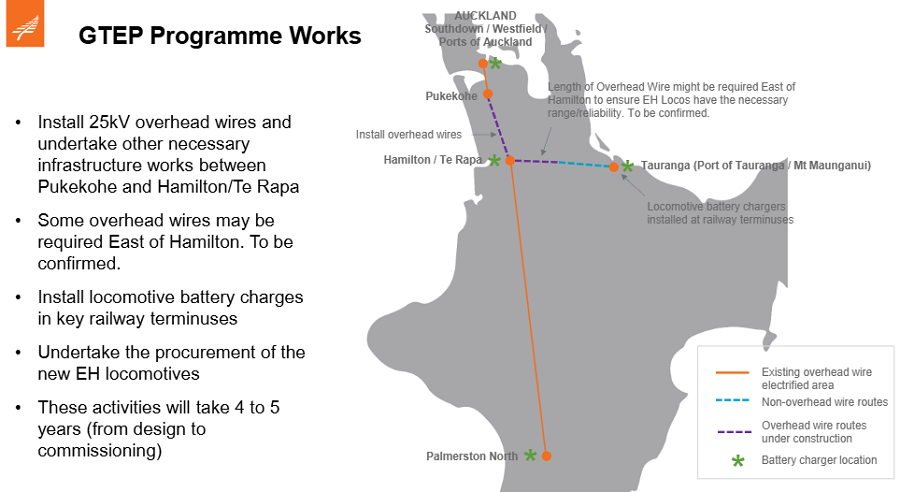
The trains would be able to run all the way to Palmerston North under the wires, so could serve those routes too. KiwiRail explicitly say:
Metro Passenger Electric Multiple Units and Electric Regional and Tourism Passenger trains could operate south of Pukekohe utilising the overhead wires
Running under batteries also removes the often noted constraint of the Kaimai tunnel – i.e. that it needs time to clear the fumes after each diesel train passes through. Solving this would make it much easier to run future passenger services to Tauranga.
It gets better: while the focus of this work is on the Auckland to Tauranga route, KiwiRail has also worked out that with this one class of locomotive and some charging locations at the terminus of lines, they could also serve all of the other feeder lines in the Waikato and Bay of Plenty.
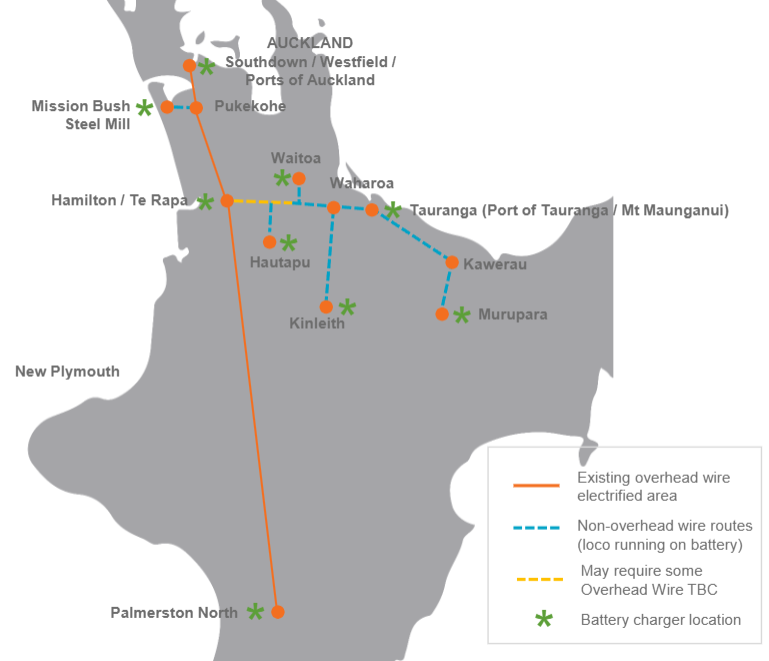
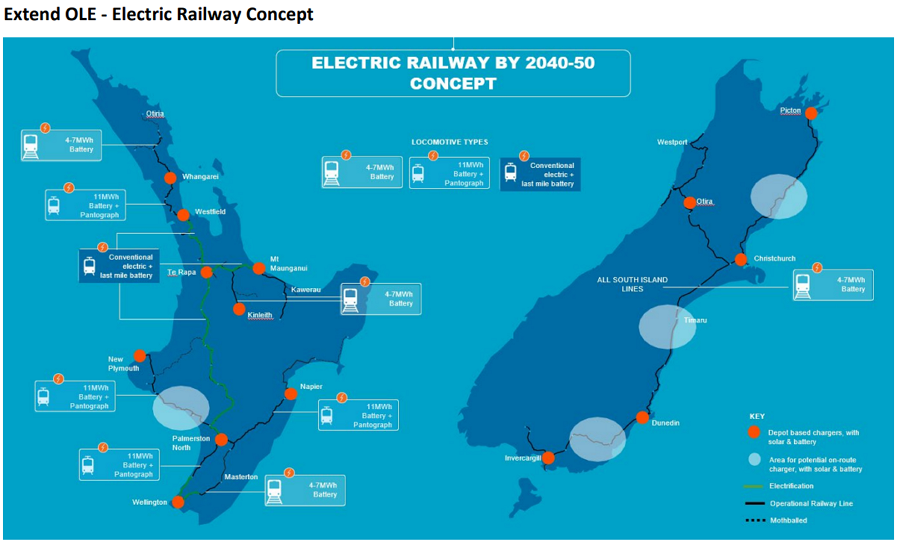
They even say that they’ve got a solution to enable this single class of locomotive to serve all lines across the entire North Island. That would allow them to standardise on a single design of locomotive and ways of operating, which will create additional efficiencies.
This from an earlier study suggests the level of battery capacity needed to serve all routes in the country:
When is it happening?
KiwiRail are still finalising their business case which will confirm the preferred option. Completion of that is expected by the end of this year. They think a further business case is then likely to be needed to nail down the costs, which includes things like which bridges would need to be modified to run wires, and what the preferred option is for each of those.
A big question will of course be if or when this actually gets funded. And, as noted in one of the slides above, once funding is approved it’s likely a 4-5 year process before we see results – so, potentially it’s still quite far away.
We’ll look forward to seeing the actual business case. For now, it looks like KiwiRail has put some great work here and the solution feels like it passes the sniff test. It certainly seems like a far more worthy investment than the current obsession they seem to have with the idea of the Avondale-Southdown Line. It’s also likely far more useful than most of the government’s current obsession with mega-roads.
Combined with the Wellington announcement earlier this week, it does feel like there’s a clear direction for regional passenger services, too. An AC version of those trains could be used to improve the Te Huia service, and then once the wires are installed, it would enable the batteries to be used to extend those services Tauranga.
Let’s hope that KiwiRail can get these next stages completed quickly, and secure the funding needed to get this underway.

 Processing...
Great work KR, signs of good clear thinking in the old beast yet!
Respect too for focussing on getting the most out of existing infra, with extended passing loops and smarter signalling, but it is hard to see any future where double tracking Whangamarino isn’t necessary.
Another place it is intuitive that significantly more throughput could be achieved with signalling and well placed sections of additional track, cost effectively, is on the NIMT-E, or the eastern line.
Some sections are clearly easier to add a third, I would love to see a study on what might be the minimum investment required to get to all day 10 minute Metro services, while enabling more intercity and freight paths too.
Was very disappointed the Rail Programme Business Case didn’t even ask that question.
My understanding was that the third main from Wiri to Westfield allows for all day 10 min frequencies, just AT are choosing not to run this option post-CRL.
At the moment the main use for the third main seems to be empty EMU’s going to and from the Wiri depot also a runway for testing new one. No doubt this will change.
I’m in with Auckland Train Control, and current use of the third main is for EMU testing of the batch 3 units, as well as a significant amount of driver training. Post CRL opening, it will more so be for freight running to/from Westfield. Unaware yet, if limited-stop southern services will utilise it as well.
In the vein of making the most of existing infrastructure – I wonder what is involved in modifying the existing newer diesel electric locomotives to take electricity from a battery tender rather than diesel set. All pantograph charging, battery storage, inverter etc could be included on a separate chassis – with appropriate cabling connection between. An interesting thought at least.
The idea of battery tenders (for electric locos) was looked at in the previous study linked in the post but they said it added operational complexity when it came time to turn locomotives around at the end of lines. Mitigating the issues results in basically a locomotive anyway so better to just do that.
More trouble than it’s worth. It’s likely there will still be sections requiring deisel traction up until at least when the current fleet of DLs is ready to be retired.
Seems like a good plan well thought through especially if they can achieve it without major disruption of existing services. Hope they can pull it off. It would be a major step towards the countries goal of becoming carbon neutral.
And be a major step towards reducing the fuel bill for running services (as well as the better acceleration etc.) Projects can be great economically, and be worth it purely for financial reasons, and as a side benefit improve the environment/climate etc.
Not sure I would say KR have an “obsession” with A2S. They only propose that it be operational by the back-end of their 30yr plan, so 2055….
GA is against it because it’s A) freight, and B) interferes with their light rail vision. Regardless it continues it’s glacial pace towards reality, with KR taking tiny steps towards it – personally I think it’s a good project, and will happen at some point, just not soon.
But what purpose does it serve while there’s only 1 train a day up North?
None just yet (which is why it’s not built). But eventually there will be a NW freight intermodal hub, more trains north, and passenger crosstown trains – all of which will be using Avondale – Southdown as the Avondale – Kingsland stretch will be maxed out with commuter trains. That’s the whole reason the alignment was designated/bought/prepared almost a century ago, and the same reason it’s been kept and small (sometimes big, but mostly small) moves towards it continued to be actioned. I think the NW freight hub/passengers using the line is more of a recent thing.
“he whole reason the alignment was designated/bought/prepared almost a century ago” was they were planning on moving the container port to Te Atatu.
That didn’t happen and now they’re looking for reasons to keep the designation anyway.
None of that is true.
Very encouraging, and look forward to a government and budget that will deliver it.
The parallel road to the Whangamarino section is now an Expressway with a 110 limit for cars, 90 for heavy vehicles. Meanwhile the rail line crawls along at just 50 km/h at the northern end and maybe 70 for the rest. It needs a new straight double tracked route without the speed restrictions.
Batteries for Hamilton to Tauranga is a false economy, just wire it up and be done with it.
In 2021 a KR report estimated it was ~$430 million to electrify each of HAM-TRG and HAM-PUKE, $800 million buys you a fair few locos.
Its quite clear that KR are laying the foundation for the the decisions they are going to have to make in the 30s on replacements of the refurbed EF and DL locos,
Non-electrified section is only halfway from Tauranga to Hamilton. Batteries are less efficient than wires and don’t last as long, short term penny-pinching.
There’s a difference between saving money up front and penny-pinching. This proposal doesn’t stop full electrification in the future, it just makes it more realistic to get government funding.
The same penny-pinching (up front money-saving) ideas have manifested in the Wellington/Wairarapa region with the procurement of hybrid trains instead of extending the electrification through the Remutaka Tunnel and from Waikanae to Palmerston North. It would actually make better financial sense to extend the existing electrical infrastructure with the long-term view of converting to 25 kV AC to align with the rest of the North Island network, but the planners seem to have this myopic view which constrains things by how much can be saved in the short term rather than focusing on a long-term plan.
Stu – I don’t think it would make better financial sense to electrify to Masterton. It’s not a heavily used line and it’s unlikely the savings in not having to purchase or replace batteries would even cover the interest costs on borrowing for that electrification.
Does anyone have any idea of how much it will cost to upgrade Wellington’s regional network to 25kV AC, and can the new hybrid engines be powered by both DC and AC systems?
Found this OIA which answers the question pretty well: https://fyi.org.nz/request/14581-dc-to-ac-overhead-line-conversion
The Stadler Euro Dual Locomotive platform has been converted to be used in the UK ( https://en.wikipedia.org/wiki/British_Rail_Class_99). So this means this locomote will be suitable for NZ as it will fit within the NZ loading gauge and axle weight limits.
The class 99 is an electric/diesel hybrid, so not actually relevant to this discussion. The smaller class 93 is an electric/battery/diesel hybrid, with low electric power, but as batteries continue to develop a future option may be to replace the diesel bit with extra battery capability.
I believe Stadler did a metre gauge version of the Eurodual (see SALi which offers dual mode).
Got to think something like that would be a good start.
Winnie is the Minister of Rail wrt delivering the new ferries. Who is the Minister in charge for this stuff? SOE Minister? Minister of Transport?
Shane Jones is in charge of tipping money down the drain so maybe it’s him.
It would be a negotiation between the Ministers of Rail, Transport and Finance. However, given the Minister of Rail’s negotiating position in the coalition is strengthening it might end up ultimately being him.
Mr Plod – The Minister of Finance and Minister of State Owned Enterprises are the shareholding minister of Kiwirail Holdings Ltd.
Good KiwiRail doing so much work figuring this all out.
Highly encouraging to see. If Puke-Hamilton was wired then passenger services to there might well become more outer surburban than longer distance, in mindset. Much like Palmy and Masterton will do.
Tauranga is another story, but very worth chasing!
This is also very encouraging for the future of rail freight, with Marston Point finally happening too.
Any idea how much faster Te Huia would be from Puke to the City after the 3rd main comes live? Must be able to travel much faster for a significant portion of that distance
Kraut – Te Huia using the 3rd main wont happen until the third platform at Puhinui is built.
I am puzzled by the third main. It is being used to maneuver EMU’s in and out of the Wiri depot. While they are doing that other trains can’t use it. I often see one sitting there right by the station when I go past presumably waiting for a slot to go North or South. I hardly ever see a freight on it. It is being used bi directionally from Otahuhu to Wiri for empty EMU’s.
Time for the Taupo branch. Run it down the main road like in Kawakawa.
Best trolling I’ve seen in ages anywhere!
If only the train right through Palmy city center and stopped in The Square, as it used to.
The current station isn’t a million miles away, and I assume there is a good bus connction straight up Rangitikei St, but it feels so disconnected and isolated.
Yes, it was a 1960s decision build the railway station on the fringe like an airport and get the trains out of town.
The designation is still there but it would likely be very expensive to bring the tracks back into town again.
Of course, I am thinking about it only through the lens of (pretty limited) passenger services. Having freight rolling through the middle of town, and more regularly, not so good…
The freight yard move out of town was the right idea but they should have sunk the mainline under the city like Hamilton and most cities in Europe this keeping the station in the middle of the city.
The decision made was a classic kiwi one of doing the cheapest thing possible with no foresight involved.
I wonder if part of the plan is just to run longer heavier freight trains the type of train that requires two locomotives not one. By paring up a diesel with a battery electric they would still get to recover the braking regeneration energy. I am thinking particularly of the Tauranga Southdown metroport trains which seem to be their main preoccupation these days. The diesel locomotive could be throttled back in the Kaimai tunnel thus reducing the fumes and therefore allow for closer spacing or more trains per day including passenger trains to pass through. Of course they would require longer passing loops. This approach would even work on heavy log trains from Kinlieth and Murupara but because these lines are not so busy maybe longer passing loops would not be required. From what I read online this is how battery locomotives are being used on American (USA) railways who tend to run much longer trains for increased efficiency anyway. Battery locos would be ideal for the relatively short haul traffic which require shunting into private sidings which are away from the overhead. This would be applicable to much of the Dairy traffic in the Waikato as well as trains from Auckland port to Wiri.
This looks more like planning for when the DLs reach the end of their lives in the 30s.
I can’t say I understand your comment but presumably there is always going to be some diesels on the network. Sometimes the overhead is faulty and sometimes there are planned outages. And sometimes there are power cuts its always good to have backup.
Why would we need to do to that Royce?
It’s not the norm in Europe and if our useless governments spent some money actually undergrounding our power network, power cuts would be a thing of the past. I really don’t understand why we don’t put more pressure on all governments and councils to do this.
Underground wiring can be severed during earthquakes. Probably overheads are easier to repair as well. Well I have spent time in Europe there’s plenty of diesels running under the wires also plenty of un electried lines. Battery powered locos are a good option I think the plan is a good one. Also it’s flexible and pragmatic not idealogically driven. A good example of an idealogically plan which caused more trouble than it was worth was the oil and gas exploration ban put in place by the Labour Govt. It wasn’t needed because companies have being drilling for years and found nothing now Shane Jones is using it as a weapon against Labour. We could never justify electrification of our whole network some lines only run a couple of trains per day. We must guard against the big plan people. Big plans might work but usually they don’t. Much better to take an incremental approach then if things don’t work out quite as had being envisaged it’s a relatively simple and cheaper option to fix it. A good example of a plan that went wrong would be the Irex ferries. You can blame Nicola Willis if you must but to me Kiwirail bit off more than they could chew. I will finish with the CRL it looks like it has gone well but there has being huge effort put in. I just hope passenger numbers will justify it. But I have my doubts but I will be happy to be proved wrong.
Royce, as Te Huia, Auckland and Wellington systems all show: “Build it and they (users) will come”.
Young (and not so young) kiwis do not want to be stuck in 4 wheeled metal death traps anymore.
I have in front of me the Beca Systra North Island electrification study of May 2021.
If all the OLE electrification in that report was done, at that year prices, and spread over say 5 years to complete, the upper range cost would have been under 1.3 billion.
A very small amount for a massive decarbonisation compared with at least 4 billion over the next 10 years for roads.
Even if the cost were 3 billion it would still be a big decarbonisation win, and who knows how world oil prices might get to over the same period?
Putting it off puts up the price as we have seen on many major infrastructure projects.
KiwiRail is moving in the right direction, but too slowly.
carbon and climate are no longer deciding factors.
Farmers calling to exit Paris, and decarbonisation is now “too expensive”
Achieving our 2030 goals were once a driver for clean tech adoption. Now we’re looking at a massive purchase of overseas carbon credits if we stay in Paris. Why electrify if we can import coal/diesel ?
With conservatives ruling the roost, diesel imports and a sherry held high to the marsden refinery good old days seems to be our future trajectory.
19KM Pukekohe electrification cost $419M. So $22M/km average.
Using this as a basis:
– The 80km gap to Te Rapa should cost $1,760M.
– The 107km line to Tauranga should cost $2,354M
– Total $4,114M
It needs to be done, so why not keep the existing pukekohe teams going, and keep electrifying at the same pace.
That would be the logical thing to do, as would extending the electrification from Upper Hutt to Masterton and Waikanae to Palmerston North with the view of converting it to 25 kV AC to align with the rest of the network in the long term. The trouble seems to be that those in charge keep focusing on the here and now – what is needed to be spent immediately, and making plans based on that instead of looking at a long-term picture.
Converting the Wellington section from 1750Vdc to 25kVac is very easy as the clearances in a lot of places are insufficient to support 25kV
I agree that the electrification needs to be extended from Pukekohe to Te Rapa. That’s a no-brainer. Compatibility also needs to be addressed between the Auckland metro 25 kV system and the North Island 25 kV system (there are issues with running different types of trains between them at the moment).
What I don’t understand is why the single-line section at Whangamarino cannot be dealt with. If they can extend the passing loop, then why can’t the whole thing just be double tracked?
It’s literally built over old kauri logs driven into the wetland. So not that it can’t be fixed or doubled, just that it is a big job so a bit of passing loop extension is the most they can manage.
If we were as serious country we would simple build a new double track line with cut and fill through solid ground half a kilometre to the west. But we’re not, and we spend all the money on motorways through Wellsford instead.
Hamilton to Auckland needs full double tracking, curve easing, and realignment away from the swamp before electrification.
No point in putting the wires and signalling in the wrong place.
Realignment is actually less disruptive then any rebuilding the track bed on existing alignments.
Anyway Isn’t most of the formation for the swamp bypass in place from work decades ago? Before managed railway decline became an agreed strategy between Governments and road transport lobbyists.
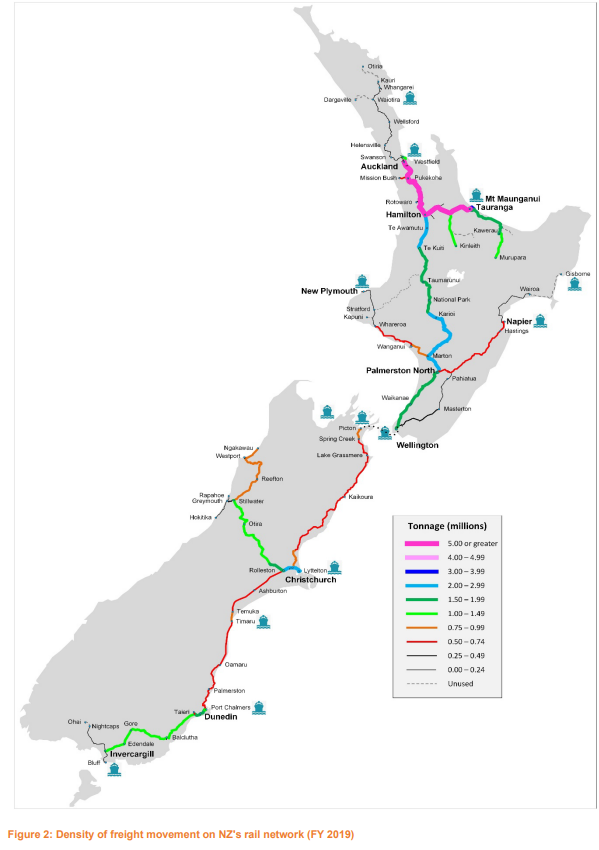
From the Freight tonnage map (2019) used in the article, a high freight tonnage rail line going into the future is the section of line between Wellington and Palmerston North. Obviously, what to do about the 1500-1700 Volt DC overheads, if the aim is to reduce the diesel burning. Potential solutions without buying new Wellington trains. China and the Netherlands run passenger trains with 1500 Volt DC third (electric) rails. The Brits have passenger trains with pantograph & third rail power for the one train. So there could be a future option for just the younger tranche(9-11 years old) of Matangi trains converted for semi-continuous 1500/ 1700 Volt DC third rail with small batteries for up/ down the Kapiti line or have large batteries with on/off charging third rail just at safety upgraded stations. That would enable 25KV overhead lines for freight out of Wellington with the proposed smaller battery locomotives. That is why I consider the Regional lower North Island passenger train specification to be suboptimal/ The Austrians converted a 15KV/ 25KV AC dual overhead voltage EMU three car train to have battery as well as pantograph. 528kWh battery gave 80km of battery only range. That austrian train preconversion spec is similar to what the Auckland CAF emu is, so could use a battery converted CAF (with lav etc) to replace the existing Te Huia to get to Downtown. Since the start of of 2025, Adelaide already has their battery diesel hybrid passenger trains going in an underground station that complies with their Australian safety standards. If the Aus/ NZ safety standards are similar there should be no reason NZ can’t put battery trains underground too.
probably would be simpler to just extend the 1500V DC electrification north to Palmerston North and get dual-voltage locomotives/multiple units that can run on both 25kV AC and 1500V DC
Trains that run on both dc and ac overhead are common, it’s a trivial problem.
All trains power their motors with DC at different voltages to the overhead, and they all have inverters onboard. Dual AC/DC is simply a matter of having a dual capable inverter system. Any train supplier can provide that or retrofit it, it’s not an issue.
Modern AC overhead is cheaper to deliver and more effective, so just do that and they can swap at Waikenae.
Japan runs long distances as well as suburban trains with OLE at 25kva, so either new or secondhand electric locomotives could be sourced from there. That is not the Shinkansen which is standard gauge, of course.
Loading gauge would be a problem though… i believe the rolling stock on the Japanese 1067mm gauge network would be about 15-20cm too wide and high for our network
TL:DR – KR expects to use dual voltage locomotives. As for whether AC or DC is used for the gap is another question. AC would be cheaper to install however since dual voltage locos would be needed anyway it might be cheaper to extend DC so the Wellington EMU don’t need to have AC installed as well. On the other hand I imagine that they might not need to run on AC if they are BEMU.
From KR there was an old OIA request several years ago:
In terms of the need to convert either the Wellington, or Auckland Metro
overhead line systems, current thinking is that we would avoid the need
for any such conversion by running duel voltage locomotives instead.
As you note, any new electric locomotives would need to be dual-voltage to
enable end-to-end services between the 1500 DC system and the 25kV AC
system, but this is now relatively mature technology internationally.
There could also be potential for locomotives to run a small distance on
battery, to and from the yards to the electrified main lines. Our existing
electrified locomotive fleet, which is currently being life, extended
cannot be converted to dual-voltage.
KiwiRail cannot provide an updated per kilometre cost at present. However,
it is likely to be higher than the 2016 cost estimate that was noted to be
$2.5 million per kilometer for electrification. In addition, there are
other factors to consider, such as the cost of improving clearances in
tunnels.
If we were looking to electrify the whole network, a substantial part of
the cost of electrification is civil works in the rail corridor and
installing the foundations for the traction poles. This could be done by
New Zealand firms that have a history in rail construction. However,
currently these are generally at capacity with other rail upgrade projects
and the City Rail Link underway, so it could be difficult for this work to
scale up without major offshore support. Configuring and stringing the
wires is specialist work.
Other elements which would need to considered include the availability of
electric rolling stock (which would need to be purchased internationally)
and the necessary depot improvements.
We hope you find this information useful, any further questions please get
in touch.
Kind regards
Dave
Dave Allard | Government Relations Advisor”
It’s great to see we’re getting on with Pukekohe- Te Rapa electrification that’ll hugely improve Auckland’s accessibility entering & exiting Auckland CBD! Finally!!!! Also the NZ economy isn’t growing too! It’s a fantastic opportunity to invest in a ‘incremental life Heavy Rail project’ that’ll change Auckland accessibility forever! Dominion RD or North Shore Rail line would get the economy back-on-track!
Retail in other parts of New Zealand is faring better than the Auckland CBD! Vacancies on the main CBD streets were “significantly higher” in the five major cities! Auckland CBD shops are suffering a national record 13% vacancy rate, according to a property study. The company’s study that came out and found Auckland CBD shops were more vacant than anywhere else in New Zealand. According to Marketview data paints a broader picture, showing a 6.6% fall in card spending across six central precincts between April and May this year, compared to the same period in 2024. Karangahape led the downturn with a 22% drop, followed by Wynyard Quarter at 10.8%. Electronic card consumer spending in Auckland as measured by Marketview, decreased by 2.6% over the year to June 2025, compared to a year earlier. This compares with a decrease of 1.7% in New Zealand. Quarterly spending was down on a year ago for the fourth consecutive quarter, falling 1.3%pa in the June 2025 quarter compared to June 2024. Consumers have been cautious to spend over the past year, with mortgage rates, the deteriorating labour market, and the trade war likely weighing on spending activity. A pickup in consumer spending is likely to be driven by households continuing to roll onto lower mortgage rates in the second half of 2025, along with primary sector returns flowing through other areas of the economy, ahead of an eventual turnaround in the labour market.
The current government needs to get onboard with adding additional taxes to those who aren’t struggling as much! Any government needs to be adding a Capital Gains Tax on Private vehicles valuing over & above $50,000, nothing below $50,000 and become before taxed! Another Vehicle that should be taxed is fishing boats! That how we fund CRL operational costs!
There’s a pressing need for more Heavy Rail projects just like Pukekohe-Te Rapa for Auckland economy to grow and regular citizens quality of life to be improved! Reviving Auckland CBD economy by road building isn’t possible on ground or below since it require more carparks which there’s no space to accommodate private vehicles! More Heavy Rail projects is the only way!
Light rail down Dominion Rd for the cost of $1 to 2 billion, running in a dedicated green-tracked kerb-protected median, would deliver 450-passenger trams every 5 minutes at peak, taking 18 minutes from Mount Roskill to downtown thanks to traffic light preemption giving it full priority at intersections. This would double capacity over the current 25B, 25L, 252 and 253 bus routes, and improve reliability.
Stations along Dominion Road would be at the intersections with View Road, Valley Road, Milton Road, Balmoral Road, Lambeth Road, Mount Albert Road, and a terminus+ bus interchange at the Dominion Rd/SH20 interchange. Stations in the city would be Wynyard Quarter, Victoria Park, Viaduct Harbour, Waitematā/Britomart, then up Queen St stopping at Wellesley Street and Karangahape Rd
Clearly a no brainer compared to a $7 billion+ heavy rail tunnel with less walkable catchment for a smaller number of deep underground stations and a service barely a few minutes faster, proposed by a foamer who thinks 20-30 minute peak frequencies are acceptable.
Billions for heavy rail would be better off spent on country-wide mainline improvements
The Pukekohe-Te Rapa electrification is good and should be accompanied with full double tracking of the swamp section, plus realignment of curves to enable future 160-200km/h max speed running with tilt trains like those used in Queensland Australia.
the eventual goal should be the revival of long-distance passenger rail. Increasing average end-to-end passenger train speeds to 70km/h or more would make passenger rail time competitive with InterCity buses, if not with driving.
“The Pukekohe-Te Rapa electrification is good and should be accompanied with full double tracking of the swamp section, plus realignment of curves to enable future 160-200km/h max speed running with tilt trains like those used in Queensland Australia.”
Oh good! Glad you finally came round! Shouldn’t have an issue with a Underground Dominion RD Heavy rail corridor!
lol nope. learn to read. I do not blanket support all heavy rail projects just because they are heavy rail.
I support improvements to the mainline rail network outside of Auckland. I do not support your Dominion Rd tunnelled heavy rail, or North Shore heavy rail.
I would support Onehunga-Airport heavy rail if it was cost-effective, and I am on the fence regarding Avondale-Southdown heavy rail.
Less walkable?! Would include 4 stations are within 1.1 km of each station and meaning it is walkable for anybody! 500m from each station it would mean, how’s that not walkable?
Also 20-30 mins been mislead, meant to be for during non-peak hrs and weekends, Should be every 10 mins during peak with 6 car carriage capacity of 746 (460 seated, 286 standing) and would ultimately beat 50km/h light tram by capacity and duration from MT Roskill to Britomart with obstacles of general traffic lights, tram dedicated traffic light and needing to cross roading intersections like Balmoral RD, meaning wait times at traffic lights! Slow light tram station would require 8 stations with 400 m to 500 m stops of each station to include traffic light stops result in longer commute time intersecting Denbigh AVE, Mount Albert RD, Balmoral RD and Valley RD on Dominion RD.
LEARN. TO. READ.
traffic light preemption means the lights will always be green for light rail as they’ll detect the trams
coming and can change phase.
This image proves you wrong. Wider station spacing from underground stations means gaps in the 5 minute walkable catchment of each station. Also you literally ignored me providing a list of stations 800m apart so you can bray your anti light rail propaganda like a donkey.
https://www.greaterauckland.org.nz/wp-content/uploads/2019/08/LRT-Walking-Catchment-analysis.jpg
Not sure why light rail needs a station every 400m but heavy rail only needs one every 1100m. Why are the stations different at all?
light rail doesn’t need a station every 400m, Anon is lying by making a very biased worst-case-scenario example of light rail so they can prop up their heavy rail showboating.
An 800m station spacing for light rail would ensure that all properties along Dominion Road are at least 5 minutes walk from a light rail station, so not too much catchment is lost from the current <400m spacing of bus stops.
The advantage of heavy rail is outright speed, however that advantage is immediately nerfed if you put stations too close together because of the acceleration & deceleration profiles. One of Auckland’s electric trains can only accelerate up to 70-80km/h before having to decelerate if the station spacing is 800m, and this saves only 10 seconds compared to a speed limit of 50km/h. Heavy rail is best suited to longer commutes and station spacings of 1.5km outside of the urban core.
Not to mention deep underground stations require extra time getting between the platforms and street level.
Right now New Zealand needs a government adding additional taxes to those who aren’t struggling as much! Any government needs to be adding a Capital Gains Tax on Private vehicles purchases valuing over & above $50,000, nothing below $50,000 and become before taxed! Another Vehicle that should be taxed is purchased fishing boats! That how we fund CRL operational costs and get on building more Heavy Rail infrastructure across New Zealand and get on building them!
Good to see the planning underway by KiwiRail, and hope that government will fund electrification at 25 kV from Pukekohe to Hamilton and onto Tauranga.
Plus encourage more freight onto rail.
Incidentally, good that over 20 years ago, 25 kV AC was chosen rather 1500 V DC for Auckland electrification.
Time to revisit this given the current global fuel crisis (especially diesel).
Government should be looking to complete both NIMT sections to reduce diesel consumption (along with all the benefits in the OP). They should also look to do the Tauranga section too.
Remembering that it was a previous oil crisis that sparked the previous electrification.
How expensive to electrify a branch line i.e. ~50km of track