This is a guest post by Darren Davis. It originally appeared on his excellent blog, Adventures in Transitland, which we encourage you to check out. It is shared by kind permission.
Tauranga – the weakest leg of the Golden Triangle
Aotearoa is a top-heavy country. Half of the nation’s population lives north of Taupō in the middle of Te Ika-ā-Māui/ North Island. And around 40 per cent lives further north in the Golden Triangle of Tāmaki Makaurau/ Auckland, Kirikiriroa/ Hamilton and Tauranga Moana.
But one leg of the Golden Triangle is weaker than the others. Tauranga on the East Coast is not on the north-south spine of the North Island Main Trunk Railway and State Highway 1, unlike Auckland and Hamilton. Auckland and Hamilton are connected by largely grade-separated motorways and expressways as well as the largely double-tracked North Island Main Trunk railway line.
On the other hand, three-quarters of the drive between Tauranga and Auckland via State Highway 2 and over four-fifths of the drive between Tauranga and Hamilton via State Highway 29 and 1 are one lane per direction highways with periodic passing lanes and the East Coast Main Trunk Line is single-track with periodic passing loops.
This post looks at how revived passenger rail to Tauranga could help rebalance this lopsided triangle.
Current travel choices
Tauranga is largely fly or drive territory apart from three daily Intercity bus services taking around 3 hour 40 minutes, assuming no congestion at either end which is only guaranteed in the middle of the night, assuming no motorway closures for road works.
Flying is the fastest option with a total time of just 40 minutes for the flight with time in the air of around 25 minutes. Air New Zealand has up to six flights a day but they are not exactly cheap with the lowest fare for eight days’ time coming in at $173 and going up to $355 for a seat. If you want to take a bag, that will cost you $30 extra. To travel tomorrow (at the time of writing on 3rd August 2025), the cheapest fare would be $263 excluding baggage. Which is a lot to pay for an air distance of 145 kilometres.
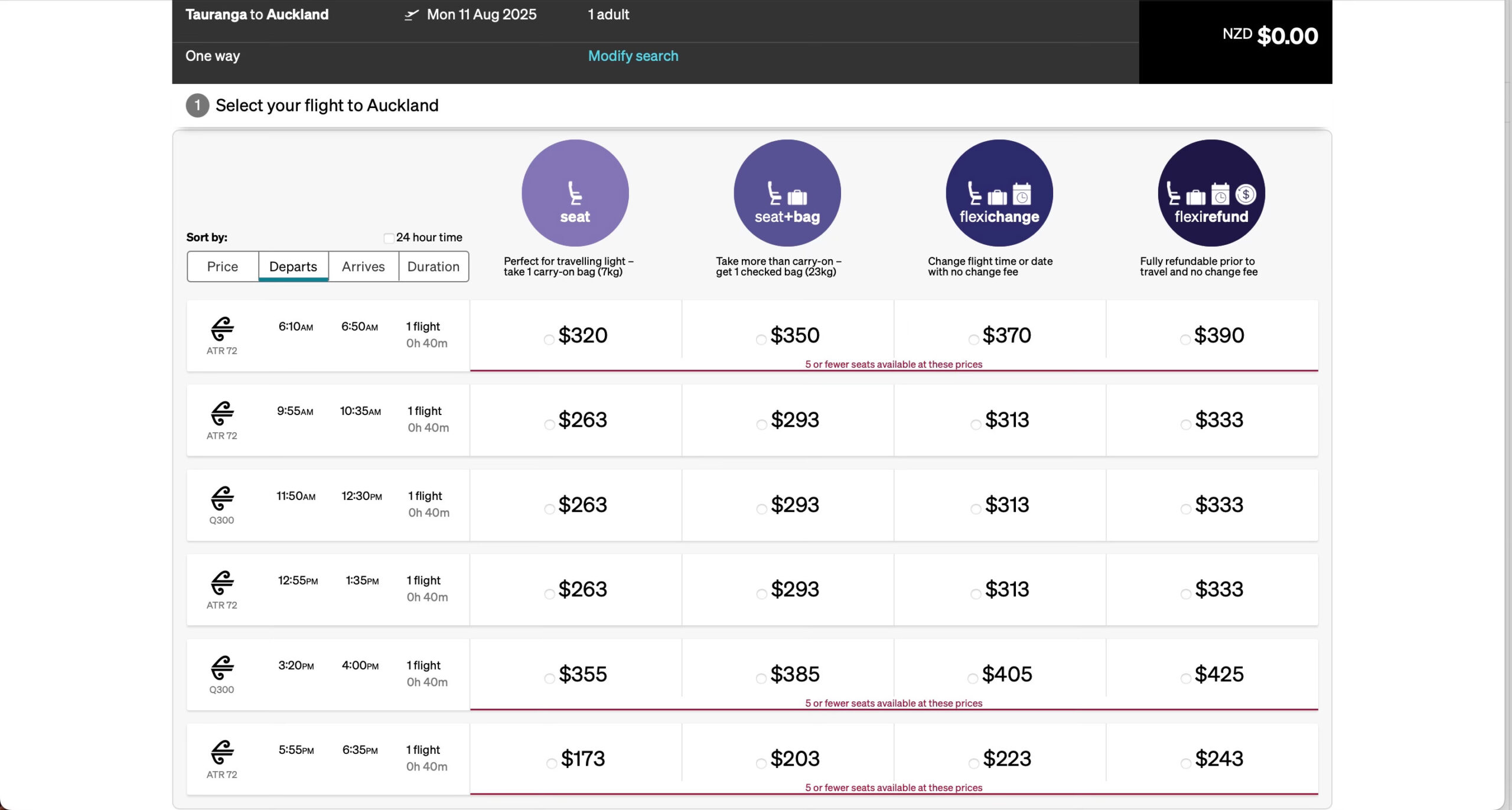
Air New Zealand prices searched on 3 August 2025 for 11 August 2025
Driving is of course an option, assuming access to a motor vehicle and a valid drivers licence. But it is not particularly fast either via State Highway 2 or the Waikato Expressway.
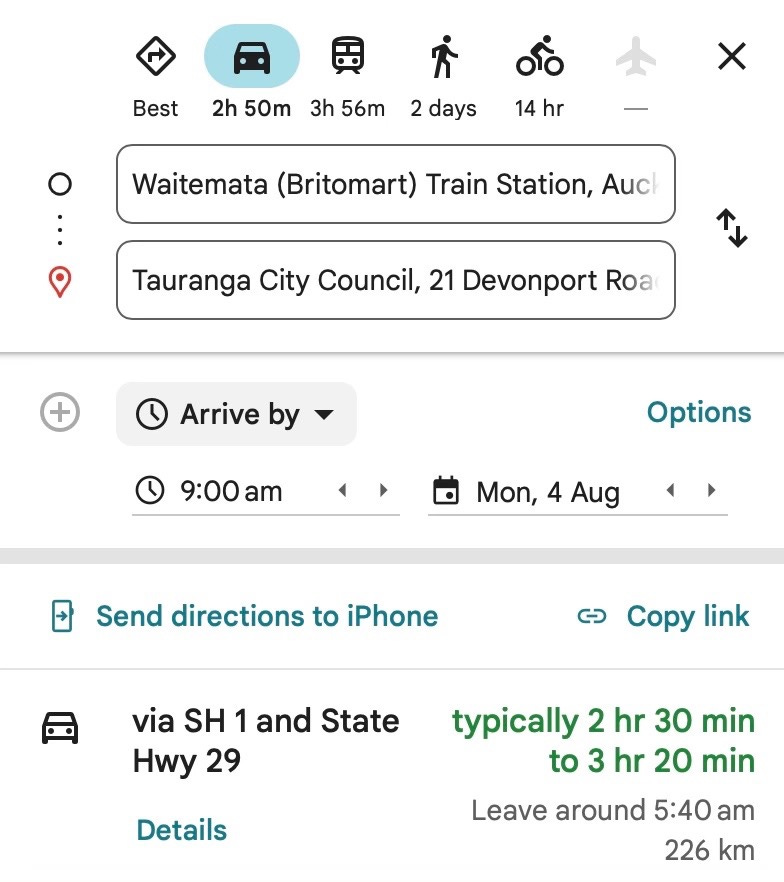
Google Maps drive times from Auckland to Tauranga. © Google Maps 2025
The big variability in travel times from 2 hours 30 minutes to 3 hours 20 minutes factors in the chronic congestion at both ends of the trip and doesn’t provide for rest or comfort breaks en route.
So effectively you need to build in a buffer of at least an hour if you’re travelling by bus or driving to account for possible or even probable delays en route. That means a travel window of 3 hours 30 minutes for driving (excluding pit stops en route) and a travel window of 4 hours and 40 minutes for the bus.
This means that if you are coming from Auckland have a 9am meeting in Tauranga your choices are:
- Driving. Leave home around 5:40am
- Flying: Leave home around 5:30am as the 6:30am flight is the only one that will get you there on time
- Busing: Leave at 5:45pm the previous day thereby having to meet the cost of overnight accommodation
This obviously varies from where you are starting from in Auckland. So add another half hour if you are coming from West Auckland or the North Shore. And an hour from Kumeū/ Huapai or the Hibiscus Coast.
So what about trains?
So unless you can afford to fly, you have to invest half a day to get from Tauranga to Auckland or vice versa. This gives an envelope in which a train needs to operate in order to provide a competitive alternative to driving. While there may be some limited moderation in airfares coming, the high cost of running thin air routes with expensive turboprop aircraft to smaller centres like Tauranga means that the market is limited to those who can afford to pay or, as is often the case, the flight is paid for by an employer or other funder.
The good news is that this is exactly what passenger achieved back in the day when the Kaimai Express operated until 2001. Operating within the window of time that you would need to allow if you were driving or taking a bus. And the better news is that it could still happen today with a revived passenger rail service to Tauranga. More on that later.
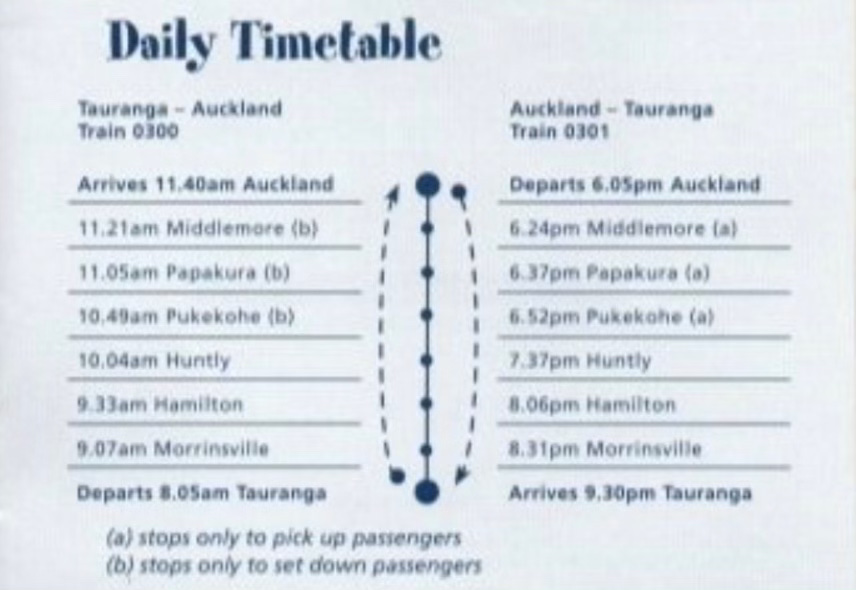
Kaimai Express timetable extract.
So back in the day, up to 2001, the Kaimai Express departed Tauranga at 8:05am, arriving in Auckland at 11:40am. The return service left Auckland at 6:05pm and arrived in Tauranga at 9:30pm. This happened every day of the week.
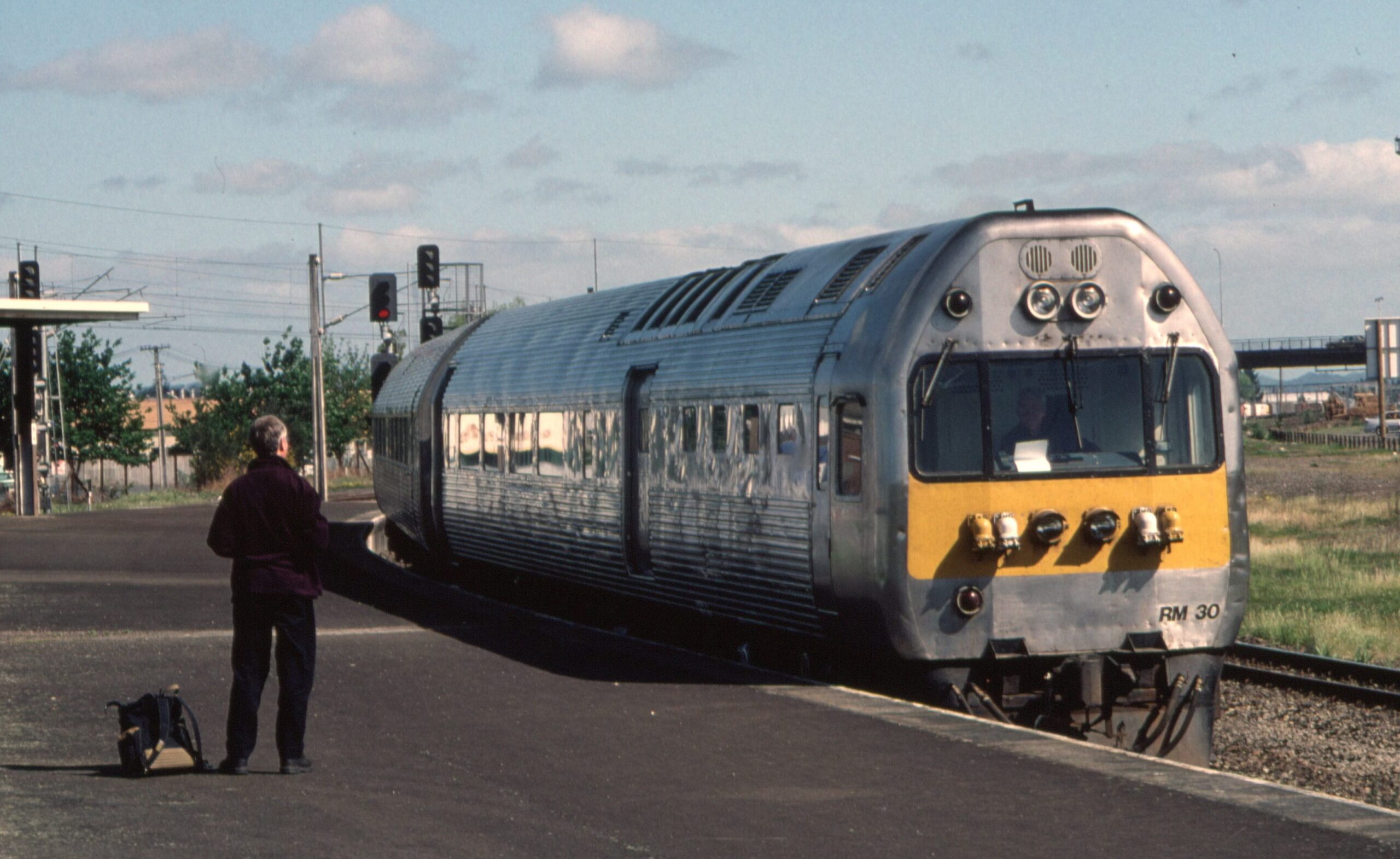
Kaimai Express at Hamilton Frankton Station. Image credit: Weston Langford Railway Photography, CC BY-ND 4.0
But what could passenger rail to Tauranga look like?
This is the (multi) million dollar question and we shouldn’t kid ourselves that this will come cheap. The five-year trial of Te Huia between Hamilton and Auckland will end up costing $98 million. But it also sets a solid basis for building on this investment and extending its benefits to Tauranga and the Bay of Plenty.
So the logical way to go is to build on what we’ve got and take it further – to Tauranga. And this means an extension of Te Huia to the Bay of Plenty.
Let’s assume for the sake of argument that the current 9:30am Te Huia departure on Thursdays and Fridays become Monday to Friday services (i.e. adding in Monday to Wednesday trips), then an extended service could start in Tauranga at 8:00am and get to Auckland Strand at 11:54am. The return trip could be an extension of the current weekday 5:45pm departure from Auckland Strand would arrive in Tauranga around 9:50pm.
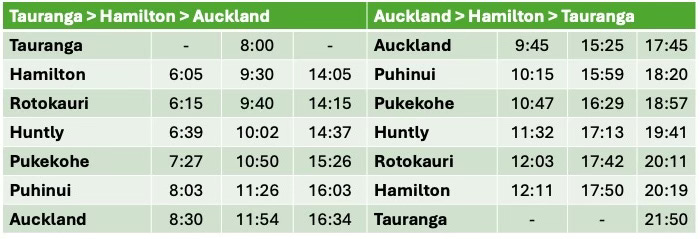
What my hypothetical timetable would look like.
These are not absolutely ideal times, especially the late arrival into Tauranga, but we need to be careful not to make perfect the enemy of good. The world is littered with the debris of good public transport projects that never happened because they got overburdened with desires for them to be absolutely perfect. As a counterpoint, Te Huia is a case study of how to start-up a passenger rail service with a “minimum viable product” and build that up incrementally as resources and circumstances allow, including the recent launch of Sunday services. And any extension to the east could follow this same path.
So what would need to happen to move this forward?
1. Political commitment
Auckland, Wellington and the Waikato have all achieved significant investments in rail in their respective regions by strong political advocacy supported by cold hard cash from their region’s budgets. Money gives you skin in the game.
The Bay of Plenty Regional Land Transport Plan 2024-2034 has this to say about passenger rail (my highlighting):
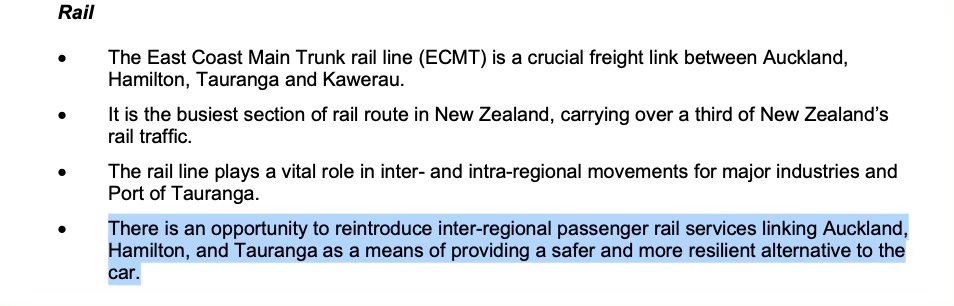
Toi Moana/ Bay of Plenty Regional Land Transport Plan 2024-2034, page 14
This is an equally powerful aspirational statement as to say “there is an opportunity to launch Elon Musk to Mars” as it’s just a self-evident opportunity statement, not backed by a funding bid to NZ Transport Agency / Waka Kotahi to start moving this to action.
While a sum of $532,500 was included in the Bay of Plenty Regional Land Transport Plan for an indicative business case for passenger rail to Hamilton to Auckland, its planning as the 34th priority project means that its inclusion is notional and virtue signalling as this is far below the funding cut-off level. For it to be included, it needed to be prioritised with the top four items, all roading projects, on the Bay of Plenty priority list.
So step number one is for Bay of Plenty politicians, both local and regional, to energetically advocate for passenger rail and including funding in their annual plans to move this forward. Because of Tauranga’s recent return to democracy, there won’t be a local government election for Tauranga City Council this October. But there will be elections for the Bay of Plenty Regional Council which manages the Regional Land Transport Plan and the Regional Public Transport Plan.
2. Stations
The bad news is that Tauranga Strand Station disappeared after the demise of the Kaimai Connection in 2001. But the better news is that Tauranga City Council is “future-proofing for the return of regional passenger rail (and possibly metro rail) to Tauranga by futureproofing for a station at the south end of Taumata Kahawai/Dive Crescent.” This was included in Te Rapunga Ora ki Te Papa City Centre Action and Investment Plan 2022 – 2032. The site is currently used for surface car parking.
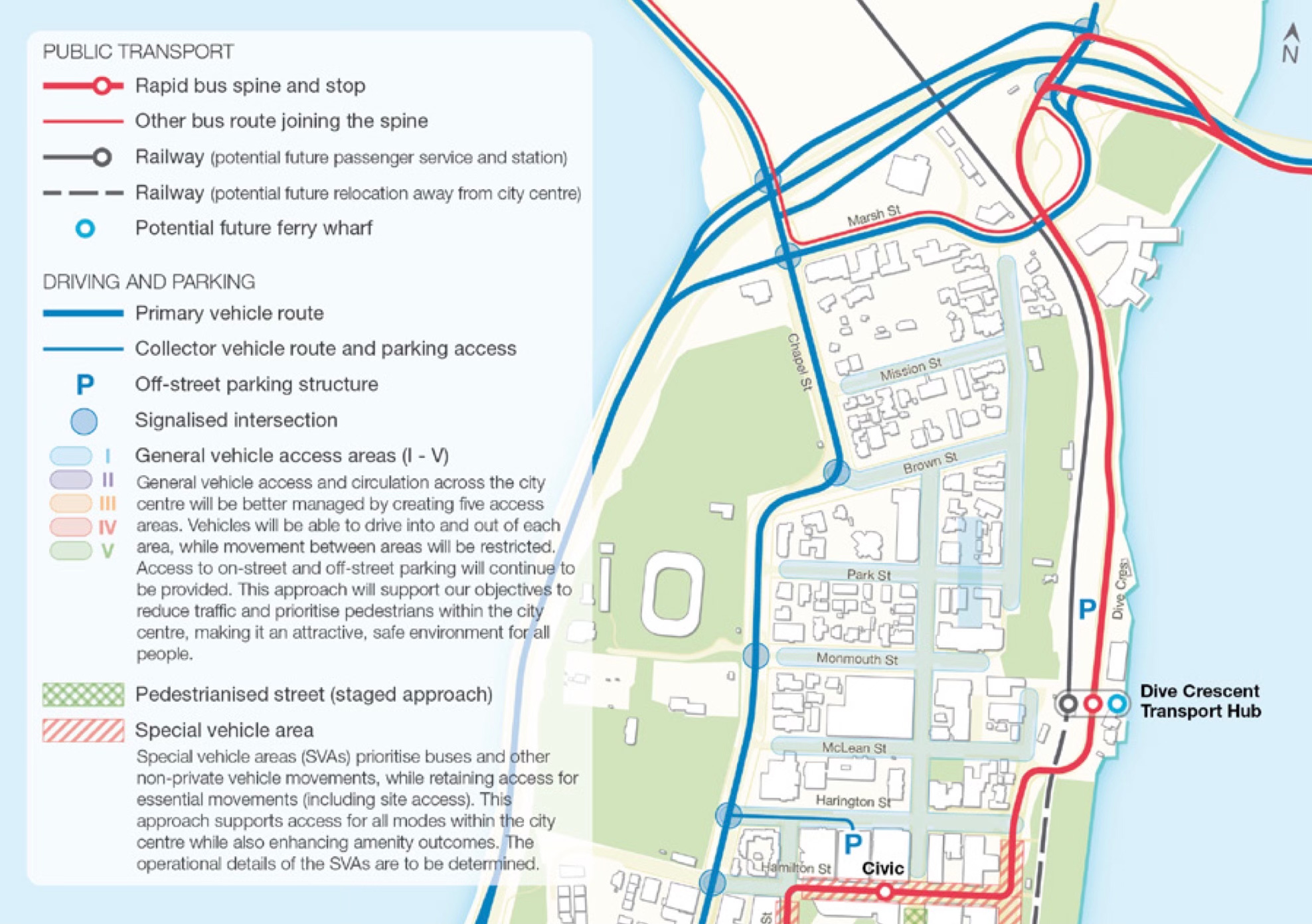
Railway station being future-proofed by Tauranga City Council as part of the Dive Crescent Transport Hub, City Centre Action and Investment Plan, page 50
Also, on the better news front Hamilton Frankton Station still has its disused east-facing platform on the East Coast Main Trunk Line to Tauranga. All its needs is some tender loving care to bring it back to a useable standard.
3. The Kaimai Tunnel
Apart from occasional heritage train journeys, such as the East & West 13 Day Rail Tour by Glenbrook Vintage Railway in November 2025, no passenger trains have been through the Kaimai Tunnel since 2001. Long railway tunnels, such as the 8.9 kilometre Kaimai Tunnel, present specific but not insurmountable safety challenges with diesel train operation. But passenger trains operate through the similar length Remutaka and Otira tunnels with a range of tunnel-specific safety measures in place, including gas measuring equipment, specific evacuation procedures and specially trained staff. My understanding is that for the Kaimai Tunnel, this includes clearance time between trains through the tunnel to enable gases in the tunnel to dissipate. So while this is an issue to be addressed, it is certainly not a show-stopper.
4. Lots of other stuff
There is a myriad of other elements that would need to be worked through before regular passenger service could resume between Tauranga and Hamilton. But the only way to work through them is to start at the beginning and work from there. Needless to say, the earlier you start, the early you can get passenger rail up and running from the Bay of Plenty to Hamilton and on to Auckland.
Final thoughts
To paraphrase the famous Chinese proverb, “the best time to plan passenger rail was 20 years ago. The second best time is now.”

Orignal Chinese Proverb via Carl Setzer
This is especially so as the life cycle of a passenger rail service from inception to implementation is a bit like Hofstadter’s Law which states:
“It always takes longer than you expect,
even when you take into account Hofstadter’s law.”
Getting passenger rail going (again) is a marathon, not a sprint and requires stamina, perseverance and resilience (on top of all of the usual technical disciplines). But it also requires political leadership that has those qualities. Auckland, the Waikato and Wellington have all long demonstrated those qualities. And those three regions have borne the fruits of better passenger rail service as a result.
There are challenges with getting passenger rail back to the Bay of Plenty but none of them are insurmountable with political leadership, strong advocacy and technical prowess.
The forthcoming local elections, especially for regional councils responsible for regional transport planning, is a one in a triennium opportunity to elect representatives across the motu who will be those energetic advocates and co-funders of revived passenger rail services.
So the first thing you as an individual can do is to make your vote count. The second thing you can do is support in whatever way you can, including monetarily, organisations like Future is Rail and Greater Auckland who run on the smell of an oily rag to advocate for better cities and more sustainable transport in Aotearoa.
And here’s hoping for some strong pro-rail political leadership, sorely lacking to date in the Bay of Plenty.
This post, like all our work, is brought to you by the Greater Auckland crew and made possible by generous donations from our readers and fans. If you’d like to support our work, you can join our circle of supporters here, or support us on Substack!

 Processing...
Thanks for that.
I like imagining new train services too however as you noted:
“And here’s hoping for some strong pro-rail political leadership, sorely lacking to date in the Bay of Plenty.”
Te Huia only exists because Waikato Regional Council pushed for it. The service receives no support from Auckland.
Tauranga is the most car-dependent of NZ’s six largest cities and the regional council reflects that.
To be honest, I’ll be happy if Te Huia is still running to Hamilton after next year.
‘ “Just as importantly, it comes in time for us to assess its success ahead of a decision being made early next year on the future of Te Huia by the NZ Transport Agency Waka Kotahi Board,” Mr King said.’
https://www.waikatoregion.govt.nz/community/whats-happening/news/media-releases/final-green-light-given-for-sunday-te-huia-services/
Firstly, everybody needs Auckland.
This entire motu sinks or swims depending on our largest urban area, Tamaki Makaurau.
The men in suits in power in Wellington at the moment all reside in Auckland (not Tamaki Makaurau as they are racist and anti Maori which is very sad for a relatively plural liberal democracy).
Tauranga is a big port, and rail is important for moving freight to area where water cannot reach.
Humans are not freight, although traffickers of humans might disagree; however, we all love to move around, some of us, refugees, by necessity, others for leisure, and plenty for business, the act of pretending to be busy.
We deserve to be able to move on rail. This avoids car dependency, car crashes, and other modern distractive aspects of our existence (particularly the portable telephone that accompanies almost all of us).
The current man who calls himself Prime Minister remarked that catching a train through the new CRL tunnel, was like being on a rocket into space. I do not believe that he has been on a rocket to space, but I would like to believe that he has caught a subway on one of his travels, or during his time leading our semi state owned national airline.
Auckland should have had a subway instead of its still motorways, but unfortunately the Second World War inconveniently produced more outcomes than the ethnic cleansing and genocide that it continues to inspire, being an enforced dependence on fossil fuels.
Technological evolution could not have occurred without coal, without oil, or without gas. But that does not mean continuing these extractive processes is correct, nor positive for the human condition.
An electrified train service to the entire country is the only logical infrastructure project that will prepare us for this century. Hardwired like the Auckland network, will ensure it survives the transition away from fossil fuels, and does not bankrupt our country in the meantime. Also build the Lake Onslow Battery to back up our electricity requirements, although I am aware that the “gentailers” are still protecting their territories against such future proofing projects.
We will be the most desirable place to live on earth, and we need to uphold our plurality. Not many people live here yet, but with climate refugees, we will become Switzerland, as some have always desired. (Incidentally Switzerland is not paradise on earth, it has no Moana nor Tangaroa!)
bah humbug
Interesting how you pulled the racism card on Politicians choosing to use one of two acceptable, accepted and internationally recognised names for our city. Then you identify “Switzerland” in its English name instead of Schweizerische Eidgenossenschaft (German), Confédération suisse (French), Confederazione Svizzera (Italian), and Confederaziun svizra (Romansh). Shame on you.
Forget about recognised names, Matiu doesn’t even understand recognised dictionary definitions. File him under ‘underemployed crank’.
As a former KiwiRail employee in 2012 we took a 6 carriage passenger train to Auckland and back for the day , little slow getting out of Auckland due to waiting for commuter trains , otherwise lots of fun, bar on board and food on hand, awsome daytrip, but Auk-Ham-tga on fridays etc would work, Concerts ,rugby in Auk no driving, Tauranga beachs in the holidays etc its a Win Win ! Proper advertising and service timetable it could really work
Thats the issue… New Zealand relies too much on Auckland for Everything….
We need to make Christchurch the true second city. It has the most growth potential and by far the most opportunity to build a forward focussing city.
Problem is. They wont because Auckland Airport is the main Gateway to the Nation. And will continue to be that until Rail comes to Christchurch which should be the governments next rail project…
South Island Medium Speed Rail.
Christchurch Metro.
Build up Christchurch International Airport.
Those should be the next major infrastructure projects for New Zealand not another stadium.
Not another extension to the Auckland Rail network or a cycleway. Not anything to do with Queen street.
Christchurch has been left behind after visions of a beautiful new post-quake city spark
To be clear, I’m 100% for rail both in general and to Tauranga and would love to see more investment to make it much much faster. I’d also much rather get a trian to Tauranga than ever have to drive there…
However, its not great faith to make a bunch of (valid) arguments against driving, bus and flight on the premise you need to arrive for a 9am meeting, then post a timetable that doesn’t arrive for 9am? Whilst you have to start slow and steady, if there is no demand for a service that arrives either half way through the day or a bedtime then it will be a lot easier to pull the service and just go back to the Hamilton-Auckland service.
I wonder what the demand is for (at the beginning) just a Tauranga-Hamilton service a few times a day?
Maybe start there.
So we could have a Tauranga, Hamilton shuttle as opposed to trying to run through trains. I expect it would be a lot easier to timetable and operate. Also the train sets could be different, we could continue to operate the locomotive hauled Te Huia trains between Auckland and Hamilton and have some kind of a rail multiple units between Tauranga and Hamilton.
Royce – There is merit in what you said for the interim 5 year period with connecting limited coach services connecting Te Huia between Hamilton and Tauranga and Hamilton and Rotorua which also in the Bay of Plenty region.
Thanks Kris I think it’s probably where we should start considering there are no functual stations east of Hamilton except for Matamata which is not on the direct line to Tauranga anyway. As you point our the Te Huia sets are not that suitable either. Not impossible but the whole thing is messy with the way the junctions are setup too. Long term I think we could look at two trains like the days of the Silver Ferns.
I wonder waht DMU’s that the UK has free that we could pick up and use for this?
None. Wrong guage. Plus they would be old, polluting and clapped out.
We are better off building off the Lower North Island purchase.
Actually UK has the right loading gauge for NZ, just a broader track gauge… but it’s relatively easy to rebuild bogies for narrower tracks if the rest of the train will fit.
Easiest of course is to just buy some new trains designed for purpose. Multiple units really don’t cost much compared to everything else in the transport sector.
If the government put all that money into a bus service instead it could potentially be much better. For example maybe they could do bus lanes the length of the South Western motorway and then use Dominion Road bus lanes. Add some new fancy bus terminals and nice buses. The advantage of buses is the lower running costs, so they could be much more frequent and usable.
The bus is probably the easiest to get up and running (although as we’ve seen from the NW, continuous shoulder bus lanes are still a decent project), however it will hit a ceiling quicker.
A train is the only real option to make this journey in say 2:30 at some point. Te Huia is the beginning of this, extending to Tauranga is probably the next logical step.
My feeling is the next left leaning government will be the one to make the call to electrify between Auckland and Hamilton and get new units as they have for Palmerston North.
Can it ever be 2:30? It suffers the same issue as buses do – congestion in Auckland. A train from Papakura to Britomart takes almost an hour. This train will always get stuck behind one of those wont it? Unless it ever gets any serious usage, it would be hard to justify making it express.
I’m thinking long term. The Westfield to Wiri 3rd main should allow it to get past at least a couple of metro services from next year and I think it’s likely there will be a 3rd main to Papakura in the next decade.
I’d say 2:30 is probably 25 years away but it will never happen with a bus. There is the bones of a really good rail corridor on the golden triangle, which I think will become a more and more valuable asset as the population continues to grow.
Most hate buses are regional transport. Almost everyone would choose a train over a bus. Intrinsically a better way to travel. Like air travel without the turbulence, but slower.
I would gladly take a train Akl to Palmy or Tga, but intercity would only be if I had to.
I have had Auckland Tauranga intercity busses take more than 6 hours.
Busses are great for short trips around the city and fantastic when given their own lanes.
Given reasonable bus priority and no stops, I don’t see why it should take significantly longer than the 2:30 it takes by car. Maybe 3 hours on average, 4 hours worst case (that worst case being about the same as the train)
Reasonable priority is the key there. It would have to be provided along significant parts of the corridor entirely to service intercity buses.
In contrast – 3rd and 4th tracking will likely be needed in Auckland in the future purely for freight services, metro express services. Intercity trains will just be an additional user.
Bus journeys of that length are pretty awful, and unpopular. Won’t scale.
While I would usually agree, I do wonder if a 3 hour bus trip that leaves every hour is better than a four hour train that leaves once or twice a day. Because realistically that’s probably the two options unless our population grows massively.
I took a bus trip from Johor Bahru to Kuala Lumpur once, a drive that would normally take about 4hrs by car.
Promised business-class like seating and it wasn’t far off – separated seats, reclined a decent amount, small meal included, TV monitor, etc. It was a relatively new luxury bus that couldn’t be faulted. It also took at least 6hrs without much traffic – mainly due to rest stops – and I’d never do it again.
And if you don’t know that route, its basically a flat, straight, 4 lane motorway between the two cities. Nothing challenging at all.
I think a train leaving every couple of hours between a city of 1.7 million, a city of 200,000 and a city of 160,000 is entirely reasonable.
I travelled 35 hours on a bus in South America..I travelled 35 hours on a train in Asia. I can tell you now which one I prefered 🙂
Trying to create Bus solutions when half the infrastrcuture is in place for trains is just deflection.
‘I think a train leaving every couple of hours between a city of 1.7 million, a city of 200,000 and a city of 160,000 is entirely reasonable.’
Most normal countries for sure, but in NZ we seem to think we are some weird outlier, who has never seen transit beofre despite having some of the best transit in the world during a few people who are still alive here’s lifetimes
Start of with a connecting bus with a early morning start from Tauranga via Matamata Morrinsville and maybe Cambridge. Straight onto a train leaving Hamilton about 9.00 am. Return about 4 pm then víš a versa to get back to Tauranga by about 8.00 pm. Something like that. Have a look at what V Line does in Victoria. The aim would be for a day in Auckland for Tauranga people. Meanwhile crack on with building stations in the northern Waikato.
Not a bad idea. Would prove the demand.
No it wouldn’t, but would show bus demand.
Also the bus misses the key route advantage of rail – the tunnel. Plus of course being subject to any driving congestion and disruption.
Agree. The sole reason that the small Wairarapa towns have continuously maintained passenger train services to Wellington since the demise of provincial rail car services in the rest of New Zealand 50 years ago, is because the Remutaka rail tunnel provides a much better journey then over the hill on the road.
This is inspite of the multi millions been spent on the road compared to only minimal expenditure on the rail link since the tunnel was opened 70 years ago.
Earlier this century the trains still consisted of 65 year old carriages hauled by 40 year old locomotives.
Patrick Reynolds – There is merit in Royce comment. I have looked at connecting limited stop ‘express’ coach services between Hamilton (Frankton station and Transport Centre) and Tauranga , Rotorua both being in the Bay of Plenty region and between Hamilton and Taupo.
As you know, Te Huia in its current ‘push/pull’ operating configuration is licenced by NZTA to operate, when in ‘push’ mode between Hamilton and Auckland, as there is only two uncontrolled road level crossings.
I am not sure if you are aware, Kiwirail is developing a detailed business case to electrify the East Coast Main Trunk rail corridor between Pukekohe, Hamilton and Tauranga.
Not a bad idea, although the cities in Victoria that are served by buses are generally a lot smaller than Tauranga. I’d go straight to the train myself.
Traralgon is only 26,000 population, 157.5km by rail from Melbourne. It’s going to forty min off peak services shortly.
Warnambool is slightly larger with 35,000 and five trains per day to Melbourne.
There you go. NZ just needs to emulate Victoria’s successful regional train network. It even operates on the same narrow gauge, i believe.
Can we buy some of their old stock?…
Agree, there’s no reason that Tauranga couldn’t have reasonably frequent services.
Peter – Victoria uses broad guage, Queensland and WA are on our guage.
Traralgon isn’t the point of the Traralgon line, it’s just the last in a string of eight towns served in the Latrobe valley that have about 200,000 people between them.
Still, about the same population as Tauranga and eastern Waikato
I am going over in October and will be catching the train and bus to Mount Gambier via Ballerat on the way to Mount Gambier and Warambool on the way back. By the way the one way fare is 11 dollars.
Another possibility would be to have the train run to Matamata as there is already a station there although no doubt Kiwirail would require an upgrade before it would be deemed safe.Then the only other station that would be required would be in Morrinsville. It would keep the whole thing in the Waikato district. The trip over the Kaimai to Matamata is not too bad these days. The other possibility would be to run the train to Tokoroa and have a connecting bus to Rotorua as well. I only suggest this because I can imagine what Kiwirail will demand before a regular passenger train is allowed through the tunnel. Also anything they do takes a very long time. Only problem with a Matamata or Tokoroa train is empty running to get trains into position morning and night.
That looks like it could work for a 9:00 Northbound service (requiring a Strand, Tauranga, departure time of 7:00AM – give or take).
Would be tough to convince anybody to do the same journey for the 6:05 AM departure though!
I do buy into this article’s ‘an incremental start is better than none at all’ though.
With that said we really need to make a big investment in the actual trackwork and signalling in order to improve the average speed (and safety) of the journey though.
Otherwise we’re stuck with an only modestly useful proof of concept (which is better than nothing, I stress).
Yes, as per some few years ago posts. Some decent track work and straightening bit by bit (if budget is sparse) should see some better times, reliability & maintenance costs.
Trains to Matatmata, yea please. Being able to go from Auckland to Matamata and back in a day, would be a fantastic next step for Te Huia.
But still wouldn’t you want these trains to End/start in the massive city of Tauranga?
When / if the new regional trainsets for the Wellington – Masterton; and Palmerston North routes arrive there will be additional available rolling stock that could possibly be used to kick-start a Tauranga – Hamilton – Auckland service.
Thinking even more optimistically, perhaps the additional orders could be tacked on to the above trainset orders for service in the Upper North Island.
Finland provides an example as to how a country with a relatively small population and a lower population density than New Zealand can support intercity passenger rail such as between Auckland and Tauranga. Rail links two smallish cities in the north in Finland, Tampere and Oulu. Both are of similar sizes with a bit more than 200,000 residents. In comparison Auckland is much larger, but Tauranga city is smaller. However, Hamilton is on route, as are some smaller towns like Matamata, so overall the three New Zealand cities plus smaller towns combined population is significantly bigger. If you wanted to catch a train from Tampere to Oulu during the week you could hop on the night train coming through from Helsinki at 2.37am. Or you could catch the 7.02, 8.02, 10.02, 12.02, 14.02, 15.02, 16.02, 18.02 and 20.02.
Love to be able to go to Hamilton/ Auckland again from Tauranga on the train it was really convenient back in the day. Should be able to go to Wellington also then from Picton to Christchurch?
Kaimai Express up to 2001, Auckland to Hamilton, 4 stops Middlemore, Papakura, Pukekohe, Huntly, 2hr 3min
Te Huia, Auckland to Hamilton, 5 stops Papakura, Pukekohe, Tuakau, Huntly, Rotokauri, 2hr 40min
Speeding up the train to what it used to achieve would be good. Hardly an inspiring stretch goal thou.
There was a lot more spare capacity on the Auckland network back then. To achieve that now we would need a 3rd main from Pukekohe to at least Glen Innes (which isn’t a bad idea).
In the latest time table Te Huia is now 10 to 15 minutes faster. Not perfect, but a start.
Yes I was looking last night after this comment, but seems Sunday and other times it is slower. Not sure why, more passengers to load on & off or more freight etc in the way?
also @Commuter Te Huia stops at Pukekohe instead of Papakura now the line is electrified to Puke for the AT metro service.
A slightly different direction. Most of the air traffic between Tauranga and Auckland is connecting at Auckland to head somewhere else – either back down the country, or into an international transfer. With good timings, there would be *some* scope to encourage people connecting to international services to use the train instead of flying or indeed driving.
Indeed.
If there is a strong argument for heavy rail to the airport, it would presumably be that it could not only allow access to the Airport from Central Auckland but potentially from the Waikato and Bay of Plenty as well.
That said, maybe people are doing this already with Te Huia (although probably not many as its unlikely the timing of existing stops matches with many outbound flights from Auckland).
No we don’t need heavy rail to the airport as the shuttle from Puhinui Station is fast, frequent and reliable with buses configured for passengers with luggage.
Agreed. I have done the train-bus transfer (with luggage). Its a great service.
Yes, I think I agree with you; and there is also the option of the direct bus from the central city straight to the airport. This also has the virtue of avoiding the transfer, as people will travel directly when and where they can.
Yes we all ready have it from the Waikato if you get off at Puhinui albeit limited times to suit.
Would really be good to sort that central Hamilton underground station for this purpose & for Tauranga (back on topic).
MrPlod agree I was most impressed Puhinui to Airport service. [shocked that my 30yo niece had no idea who MrPlod was]
I would be a supporter of a passenger train to Auckland. I see the benefit of getting a service underway sooner rather than later but In an ideal world the service needs to be quicker and more often than suggested in this article. Electrification would also be a huge benefit with better trains and less emissions.
Traveling times are overrated. It is more important to provide frequent and on time services. One service a day is not enough. So how do I come to this conclusion? I am currently living in Austria, which has a great rail system with the highest usage in the European Union. And what makes the Austrian rail system so nice to use in the background is something called the “integrierter Taktfahrplan”. Your German word of the day 😉
I will take these words apart and try to explain:
“Fahrplan” just means schedule,
“Takt” here refers to that a train operates at consistent intervals, usually every hour but sometimes 2 hours or half an hour. This makes it also easy to remember!
“Integrater” (integrated) here means that at railway nodes (e.g. Hamilton) trains from different directions (e.g. Auckland, Palmerston North, Tauranga, Totorua) arrive at the same time and are leaving a few minutes later. This allows to transfer between many different services and waiting times are minimized. But for it to work is utterly important that trains are on time. This works nicely in Austria and Switzerland, but causes lots of frustrations in Germany, where trains are frequently late.
So how to bring a “integrierter Taktfahrplan” to NZ?
First fix trains between Auckland and Hamilton. For example it is currently it is very awkward to book a day trip to Hamilton. You could take the 9:45 am Te Huia from the Strand and the 4:25 pm Northern Explorer from Hamilton, but only Wednesdays and Fridays. And Kiwirail, can we please agree that it should be possible to look up and book all your services on one website!
Eight trains a day and each direction are needed to provide a service every two hours from around 6 am to 8 pm. Nowadays Te Huia offers 3 services Wednesday to Friday each direction and Northern Explorer one service in one direction. So we only need Auckland regional council to step in and pay for three return services as Hamilton does. And the Northern Explorer should really offer at least 2 daily services in each direction. As there are apparently 2 services per hour possible between Auckland and Hamilton. Taking one slot every 2 hours leaves more than enough space for freight.
And even better it will take only two train sets to run a 2-hourly service between Tauranga and Hamilton!
What seems missing is the vision, the political will and some reallocation of money.
Greetings from Graz.
Yes, always need more services. It started with less, so it’s getting there.
Have you read this post (bit dated now but still relevant in it’s key ideas):
https://www.greaterauckland.org.nz/regional-rapid-rail/
Yes, I read it. And I agree with most of it. But there is nothing about what there intervals of the trains should be. And I think it should promote transfers more. You can provide better frequency for less bucks if you make it easy to transfer. I think transfers were not a thing in Auckland a few years ago without the frequent network and integrated ticketing. These things made a big difference in AKL and work very similar for regional trains.
The PDF downloads in the appendix – for Stage 1, 2 or 3 have the Trips per hour base. Stage 3 has hourly all day and 1/2 hourly at peak (peak direction) but Stage 1 kind basically starts at 2 hourly. Stage 1 had assumed a starting point of only 3 old Silver Fern refurbished trains, but think needs to be some other option now.
Why not think about a road tunnel through the Kaimai’s again. I believe we have the machinery to do it. Obviously a huge cost, but road toll could be used to help pay the costs.
I am not sure where there is a belief by some, that Te Huia will be able to extent services between Hamilton and Tauranga.
The reality is, it wont happen. Te Huia in its current ‘push/pull’ operating configuration is licenced by NZTA to operate, when in ‘push’ mode between Hamilton and Auckland only, as there is only two uncontrolled road level crossings.
There is a strong need to operate inter-regional passenger rail services between Tauranga and Rotorua both in the Bay of Plenty region, to Hamilton (Frankton, Central and Rotorkauri stations) to Auckland (Britomat) using next generation of bi power mode, bi directional 4-5 carriage train sets, based on the final production specifications of the new 18 train sets being procured for Wellington to Masterton and Palmerston North passenger services.
There is case for connecting limited stop ‘express’ coach services with Te Huia, between Hamilton (Frankton station and Transport Centre) and Tauranga, Rotorua both being in the Bay of Plenty region and between Hamilton and Taupo.
These connecting limited stop ‘express’ coach services can happen now under Te Huia’s current timetable.
I don’t know why people would think something can’t happen in the future because of a current rule.
A couple of years ago Te Huia wasn’t even licenced to run push/pull between Auckland and Hamilton, it’s entirely possible to get these licences amended.
Agreed.
I think the main focus should be on filling in north Waikato stations but this future stuff needs to gather support and be planned well in advance.
Jezza – Correct but it was expensive due to towing an additional 80 ton locomotive at the end of each train consist.
Te Huia’s business case was for operating three 4 carriage/locomotive ‘push/pull’ train sets, 2 for revenue service and one for operation standby between Hamilton and Auckland.
There are no spare ‘SR’ 50 seat carriages,17 seat ‘SRC’ carriages and 27 seat ‘SRV/SRG’ carriages with driving compartment as Te Huia and the Capital Connection are the only ‘branded’ train sets using them.
Whilst Kiwirail has spare former AT Metro ‘SA’ and ‘SD’ carriages in storage, Kiwrail has said, they will not certified them for mainline use after 2035 as the carriages will 60+ years and the DFB locomotives. with be in their 50’s.
It would be more economical to buy next generation bi power mode, bi-directional 4-5 carriage train sets, built to the final production specifications of the new train sets being procured for Wellington intra/inter regional passenger services from 2029/2030 onwards.
Yes, enough of restoring old things unless it really suits. Get some proper modern trains that can run on wires/batteries/diesel when needed.
My point was Te Huia could become licenced to run push/pull to Tauranga at some point, it’s not an insurmountable hurdle.
Agree, it would make more sense to buy new units and have sufficient rolling stock to be able to run more services to Tauranga than just the start and end of day.
Jezza – There a lot more uncontrolled road level crossings between Hamilton and Tauranga for ‘push’ operation reducing Te Huia speed, depending on the crossing, between 24 to 40kph. This is due to vehicle/animal impact to the driver’s compartment.
Anyway, the union wouldn’t allow Te Huia to operate between Hamilton and Tauranga due to driver safety.
Between Hamilton and Auckland, there are only two uncontrolled road level crossings, with one crossing having a speed restriction of 24kph and the other at 40kph,
If Auckland isn’t going to stump any cash for this and funding disappears under the coalition government. Te Huia should revert to a primarily Waikato service.
Go north to Puhinui (for change at the airport link) and passengers than can then transfer to the Auckland network. Then head south. But in both directions, service the northern Waitkato towns, particularly bringing them into Hamilton central in the morning.
If the Waikato council are paying, then let’s get access to more of the MooLoos.
Then BoP council can look at helping fund an extension to Tauranga.
KLK – Auckland council is strongly hinting that Te Huia could be terminating at Pukekohe, if Kiwirail can not fit ETCS 2 equipment in the DFB locomotives being used for Te Huia and the Northern Explorer, plus they are sticking to their concept that Te Huia has no ‘economic’ benefit to Auckland region, so why should they help to pay for it.
There is a proposal that DL locomotive’s could be used for both trains if their maximum speed of 80kph can be lifted to 90kph due to the ETCS 2 ‘path’ slots on the Auckland metro rail corridor being set for 80kph workings. DL’s were built for freight only and have a max speed of 80kph hence the building of the 3rd main.
With regards to Puhinui, there is no 3rd platform to terminate Te Huia plus Puhinui is a junction station for the Southern and Eastern lines.
Whilst Puhinui was built for 3 platforms, the question is, who is going to pay for the 3rd platform to cater for Te Huia?
By the way, Te Huia is licenced by NZTA to operate between Auckland and Hamilton only due to its push/pull operating configuration.
Why would anyone in this post covid video conferencing world need to be going to and from Auckland and Tauranga for a “meeting”? That is a crazy use of time and climate changing resources. Using a trial to get to such a meeting rather than having the meeting online should be frowned upon even we cant make it actually illegal.
BUT tourists and other forms of personal travel exist. Taking such a trip by rail supported by taxis or micromobility at either end makes much more sense and doesn’t need the early morning departures and arrivals.
Interesting that some of AKL’s old rolling stock has been bought by a private firm in Christchurch, to run special event trains to the stadium:
https://www.thepress.co.nz/nz-news/360785002/greater-christchurch-track-events-express
The beginning of a rail network for Christchurch?
For operational purposes the trains would highly likely run to/from Mount Maunganui, so you could probably add a station there too. The Kaimai Express railcar used to overnight at the Mount, where the servicing and crew base is.
But as good as it would be to have Tauranga added, I think a more realistic and easier to implement initiative would be to extend some Te Huia services to start from Matamata (picking up Matamata and Morrinsville passengers) and Te Awamutu. Don’t have to worry about the Kaimai tunnel issues then, and don’t need the big bucks for lots of new infrastructure.
Great idea, but some improvements to connectivity required. No bus connection to Strand station and not clear as to where the bus stops are to get to Britomart- they are about 5 minutes walk away on Beach Road- lugging suitcase and all. Only a fence away from the western line and southern line trains , but a stiff walk to Britomart or to Parnell if you want to catch one (hint there is a shortcut via the Carlaw Park student precinct if you dont get lost). Whole platform is fenced off and gated until the train arrives, and no functioning cafe.
A stop at Orakei for the Huia might help with transferability to local trains to Britomart- other option is to mix it with commuters from Puhinui and take your chances. Must be galling though to residents of Pokeno to see the fast connnection to Auckland pass on through, leaving a long drive on the southern to the city.
Dont get me wrong, its a great service, and to take it further from the windblown deserted terminal at Hamilton, through to the underground station in Downtown Hamilton, and on to Tauranga, can only be a win. It can only improve.
The Gippsland Railway Line in Eastern Victoria, Aus is fortunate in the current day to benefit from the legacy build of railway infrastructure. Melbourne had coal fired power stations in the past that used dark coal from New South Wales. The coal fired power stations were switched to brown coal briquettes from Victoria’s La Trobe Valley and the rail line was mostly upgraded/ double tracked (1950s) to transport the briquettes (for power & heating). Natural gas for heating was discovered in the Barracouta Field/ Bass Strait (1965) and more coal fired power stations were built in the La Trobe Valley closer to the coal fields. Current day, the existing old rail corridor is fairly easily upgraded for Victoria’s growing population. Newport D gas-fired power station (close to Melbourne) is said to be a back up to power Melbourne’s trains.
NZ- the obvious priority is to complete the double track (swamp & bridge) between Hamilton & Pukekohe, followed by electrification. Primarily the electrification is done for freight transport purposes, relatively small intercity passenger services might leverage this. IMO it would be short-sighted to purchase new diesel passenger trains for intercity operations. Tauranga-Hamilton passenger train. There should be no requirement for dual end controls/ push-pull, if a dual end control locomotive like a DL can be end swapped on the passenger carriages in Frankton and Sulphur Point rail yards. Hamilton – dig in a new passenger railway station next to Seddon Park. 200 metres from the (bus) Transport Centre. Tauranga – passenger railway in/ by Sulphur Point Port/ Marina- with bus shuttle to central bus area.
Most hate buses as regional transport. Almost everyone would choose a train over a bus. Intrinsically a better way to travel. Like air travel without the turbulence, but slower.
I would gladly take a train Akl to Palmy or Tga, but intercity would only be if I had to.
Interesting comments from the mayor about an intra-BoP service.
I wish someone would have asked the Chairman of the Regional Council, if now is not the right time to look at passenger rail given Tauranga’s chronic traffic congestion, when would it be? After how many new tolled motorways?
Link:
https://www.1news.co.nz/2025/07/25/greens-want-passenger-trains-between-auckland-and-tauranga/