Election campaigning is now in full swing. We’ve previously reported on the (unwise) promises about fuel taxes from the two major parties re fuel taxes, and will continue to cover transport policies as they appear – and specifically, what they mean for Auckland.
It’s been a busy few days, with three parties announcing significant packages for transport. We’ll dig into the details below, but in short:
- On Sunday morning, National said it would build the first stage of the Mill Road project (drawing fire from coalition partner Winston Peters, who said this was an example of “constant plagiary” of NZ First policy). And on Monday it was the South Island’s turn, with National promising to start the Belfast-Pegasus motorway and Woodend Bypass. (Video here, and a good report from the scene by Newsroom here.)
- The Greens rolled out a comprehensive transport package over three days, starting on Saturday with reviving intercity rail (including an Auckland-Wellington overnight train), followed by a Sunday announcement of free public transport for children and youth, apprentices and people with Community Service Cards, and $2 fares for all others; improvements to buses, and a plan for rapid transit (potentially light rail) in the main cities. They followed up on Monday with a announcement on funding the level crossings along Auckland’s Western Line.
- And on Monday, Labour announced a broad package it called “a fair go for Kiwi drivers“, promising greater scrutiny of fuel prices, a “right to repair” so more mechanics can fix more cars, and greater competition for fuel stations and EV charging. (Their public transport fare-cap policy was launched back in September, and we covered it then).
So, how do these promises stack up in terms of meeting Auckland’s priorities?
All electioneering is of course subject to confirmation of budget, timeline and feasibility. But one way to assess the propositions is to ask: if you had a few billion dollars to fix Auckland’s traffic woes, what would you invest in? Encouraging more traffic, or giving people more traffic-free options?
Today we’ll focus on the announcements from the National and the Greens, given they contain a lot more specifics for Auckland compared to Labour’s – but do check out our previous coverage of Labour’s fare-cap policy.
First, here are some handy videos of the recent major announcements (in order of delivery):
And here’s the Greens’ announcement about level crossings – we’re including this because it’s a critical issue for Auckland, and also for the moment (five minutes in) where an errant driver proves the point by driving in front of a moving train while the barrier arm is down and the bells are ringing.
As Henry Oliver writes in the Spinoff this morning:
…standing at Morningside, watching a car cut through a barrier as a train approached at speed with its horn on full … was a stark reminder that all of these announcements and policies could have real world implications. Most won’t, of course. Most will fall by the wayside, either by the election result, the following coalition negotiations, the future budget or just the busy business of governing. But some of the things politicians are saying at staged events with their colleagues performatively nodding behind them, could actually impact your life and the life of the country, whether you like them or not and whether you vote for them or not.
Right. On with the analysis…
National promises (again) to build Mill Road
Mill Road in South Auckland is a project that’s been repeatedly announced and then deferred, and has changed shape many times over the years, including in the teeth of environmental challenges. In its current form, it would essentially duplicate the State Highway, creating a four-lane road that runs parallel to SH1 for 21.5km.
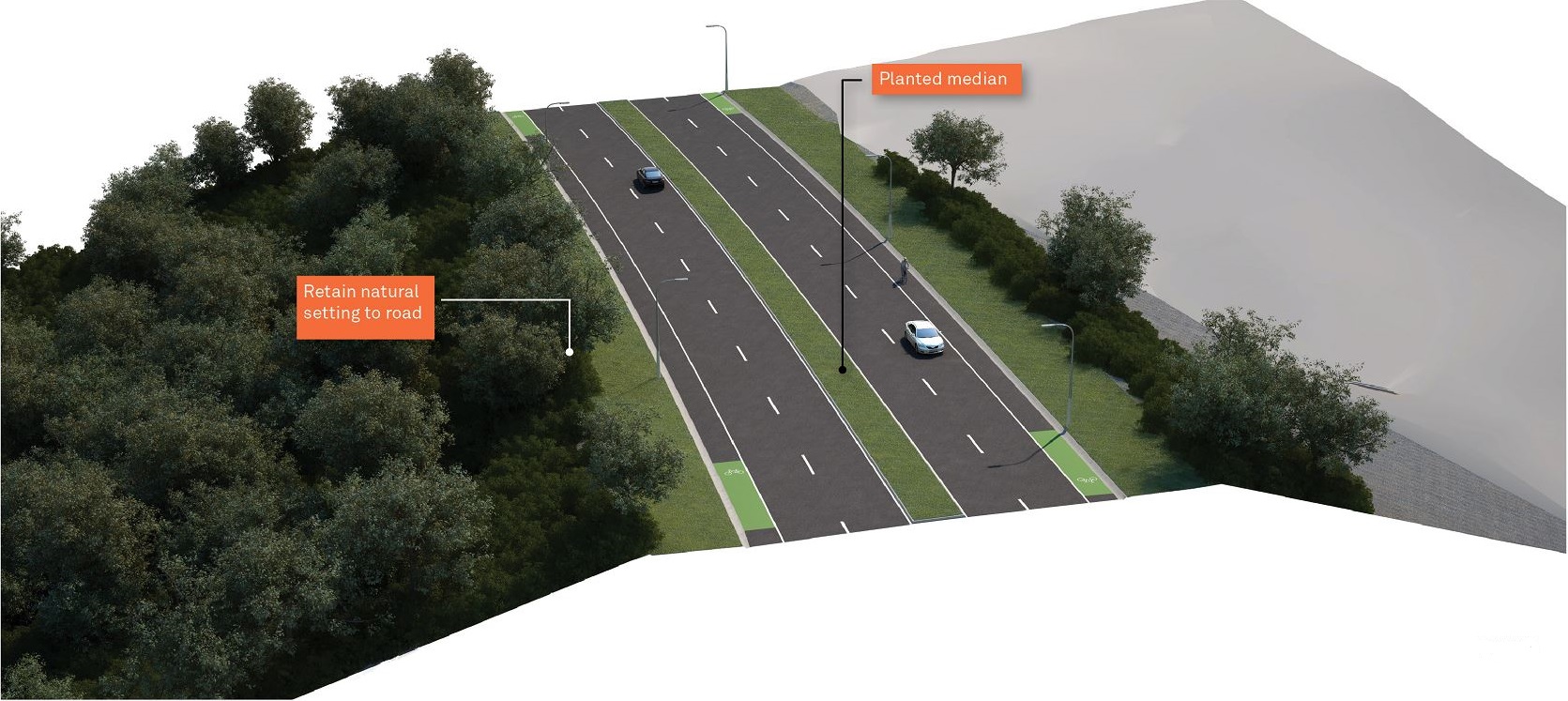
A render of one version of Mill Road, from 2018. Image: NZTA
At a glance, this is the wrong project, and the wrong size. It will simply generate more traffic, and is a poor use of billions of dollars.
It’s crucial to note that National’s commitment of $1.75bn of future funding is only for Stage 1, the 7km from Manukau to Alfriston, with “additional costs [to] be met from the State Highway Improvements Activity class of [the] National Land Transport Fund”.
In other words: this project will cost, at minimum, $250 million per kilometre – for a local road with multiple sets of traffic lights and roundabouts.
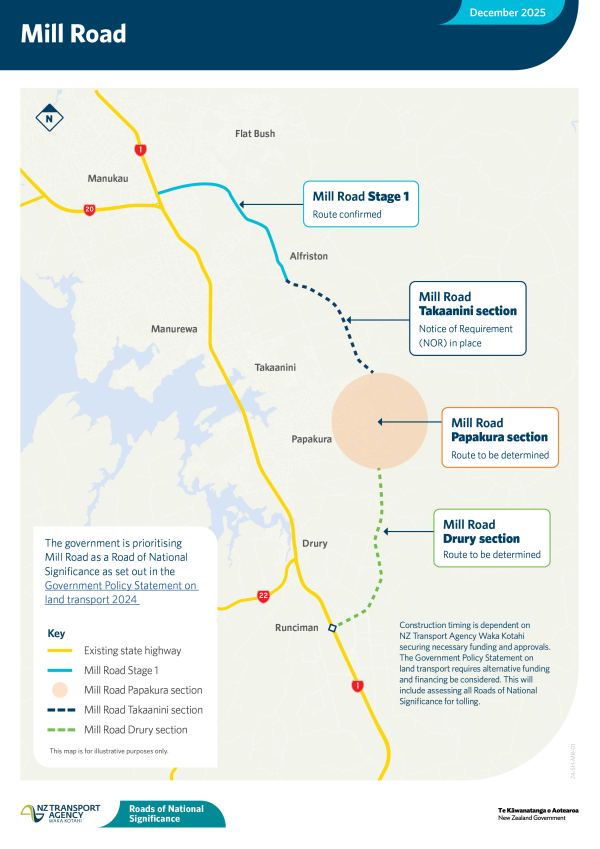
Image: Waka Kotahi the New Zealand Transport Agency
But wait, there’s more: National has also promised $100m to “progress route protection” for Stages 2 and 3 through to Drury.
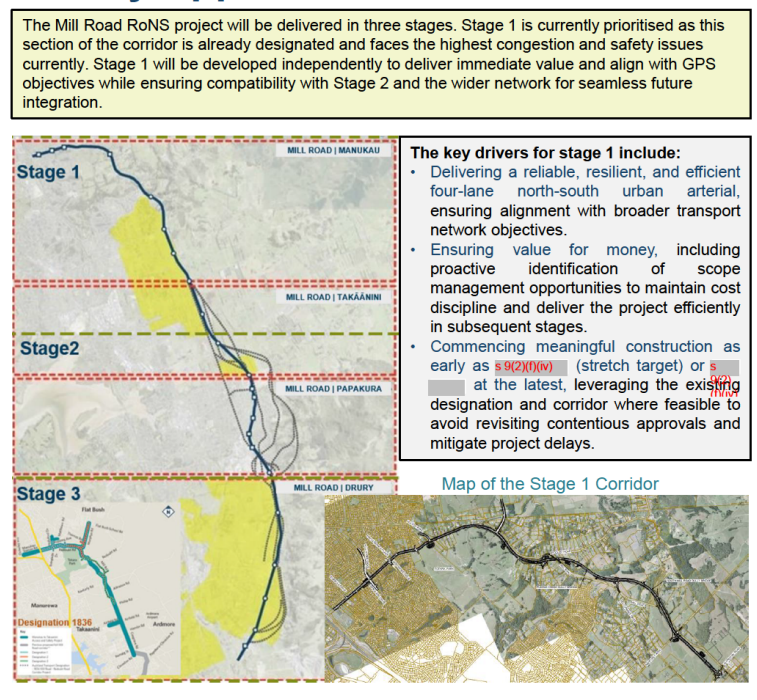
… so if you do the math, if it costs $1.75 billion (plus “additional costs”) to build just 1/3 of the project (and the easiest part), you’re looking at well over $6 billion at current prices, to complete the whole thing.
In other words, it would cost the country more than the entire City Rail Link project… to enlarge one local road in Auckland, parallel to an existing motorway, in a way that will change nothing: people will still be stuck in traffic.
For a fraction of that budget, you could fix the key traffic choke-points and give people better options for connecting east-west with the new rail stations.
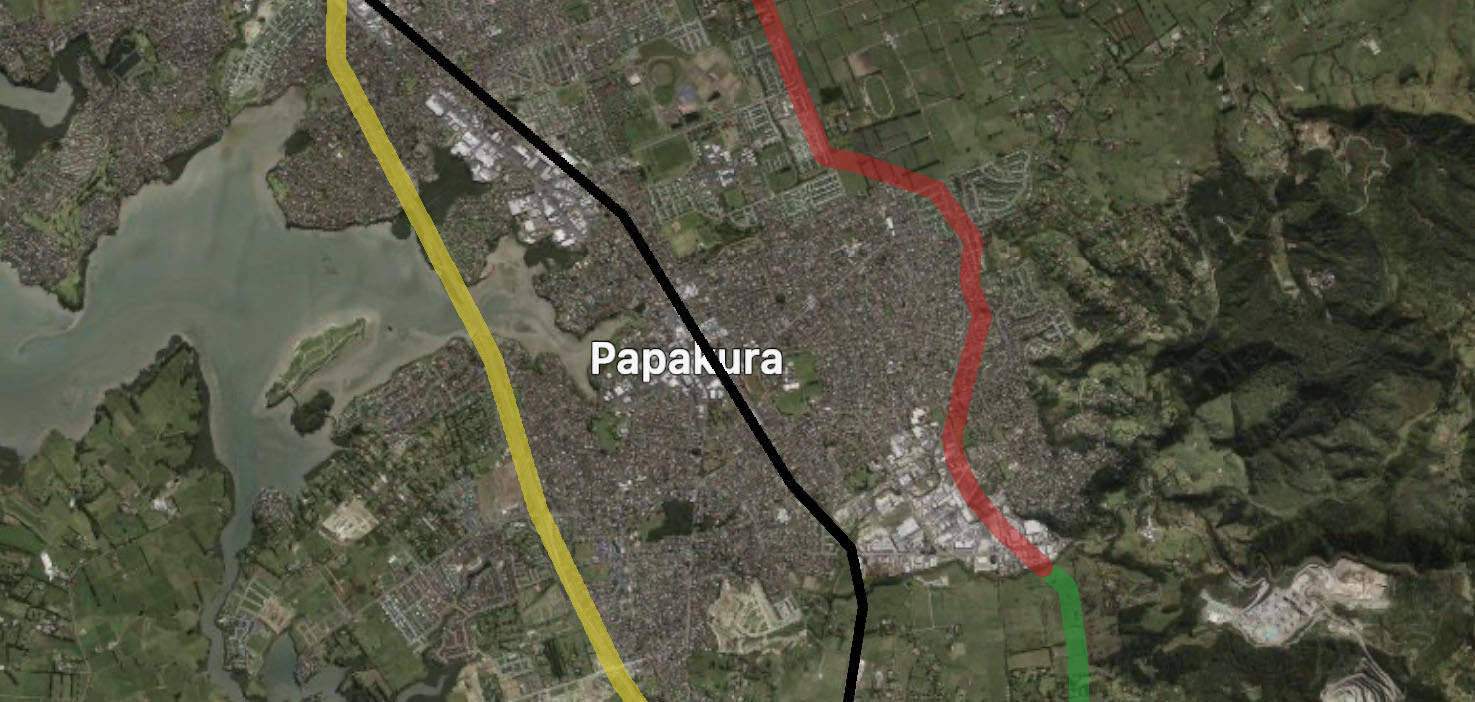
A rough indication of Stage 2 of Mill Road as currently planned (in red), with the railway line (in black, with Papakura station just below the R of Papakura), and the existing SH1 motorway (yellow). Where, and in what, and when, would you invest a finite funding pool, if you wanted to help locals get out of traffic?
Just like Warkworth to Te Hana, Mill Road is an over-scoped project with a budget – and timeline for completion – that’s demonstrably out of whack with local needs, capacity, and funding, both now and in the future.
So it was no surprise that Mayor Wayne Brown was quick to call the announcement “idiotic”, as reported by the NZ Herald (see also Stuff):
Brown told the Herald the $1.75 billion price tag was an “idiotic sum to fix three intersections”.
He said the existing dynamic lane, which changes direction to accommodate peak-hour traffic, should be extended instead.
“Building a new four-lane road full of traffic lights isn’t the answer.”
Our own Matt Lowrie put it slightly more diplomatically, at RNZ:
Greater Auckland director Matt Lowrie said the project was like “taking a sledgehammer to crack a nut”.
He said work was needed on the transport corridor, but smaller solutions could deliver the same benefits at a smaller cost overall.
He pointed to the dynamic lanes added to Redoubt Road, which he said had helped ease congestion.
He said money could be better spent on improving public transport, offering people alternatives to travel around Auckland.
“We’ve just seen the opening of the City Rail Link in Auckland, which has been very successful already.”
Lowrie added funding for stages two and three could cost even more than stage one.
Whose priority is Mill Road?
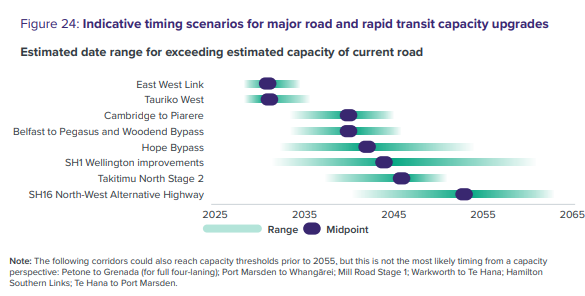
Another key thing to point out here is that there is no urgency for this project. The Infrastructure Commission’s National Infrastructure Plan, endorsed by all parties in government, states that Mill Road Stage 1 is likely not needed until after 2055.
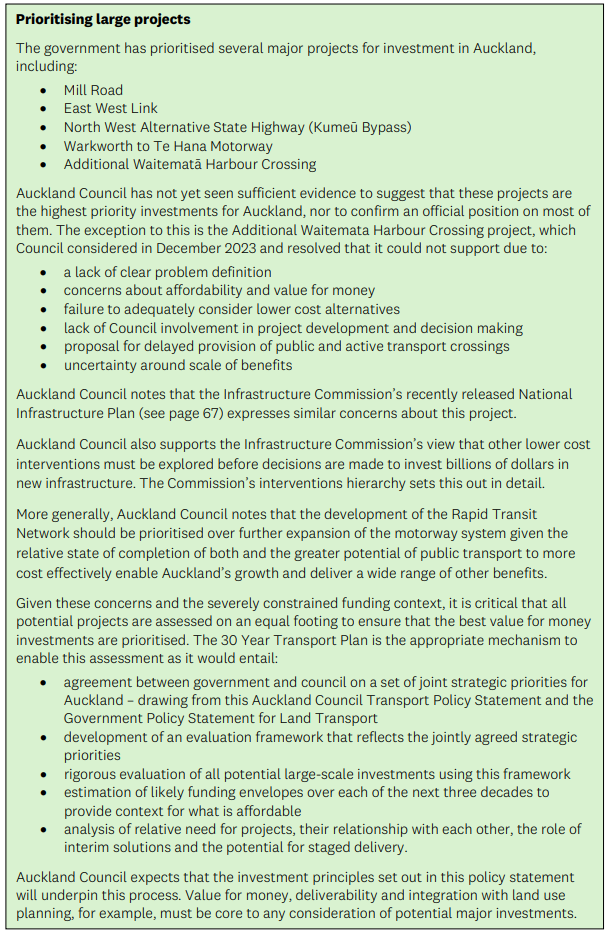
Nor is Mill Road a priority in for Auckland Council. Their 2026 Transport Policy Statement (see document here) makes clear that while Mill Road (and other highways) may be on central government’s priority list,
Auckland Council has not yet seen sufficient evidence to suggest that these projects are the highest priority investments for Auckland, nor to confirm an official position on most of them.
Who’s campaigning for what?
So why has this project leapt to the top of National’s campaigning list? The announcement says it’s about “crushing congestion” – but what congestion? The traffic data for an average rush hour suggests it’s not a major issue in the immediate area…
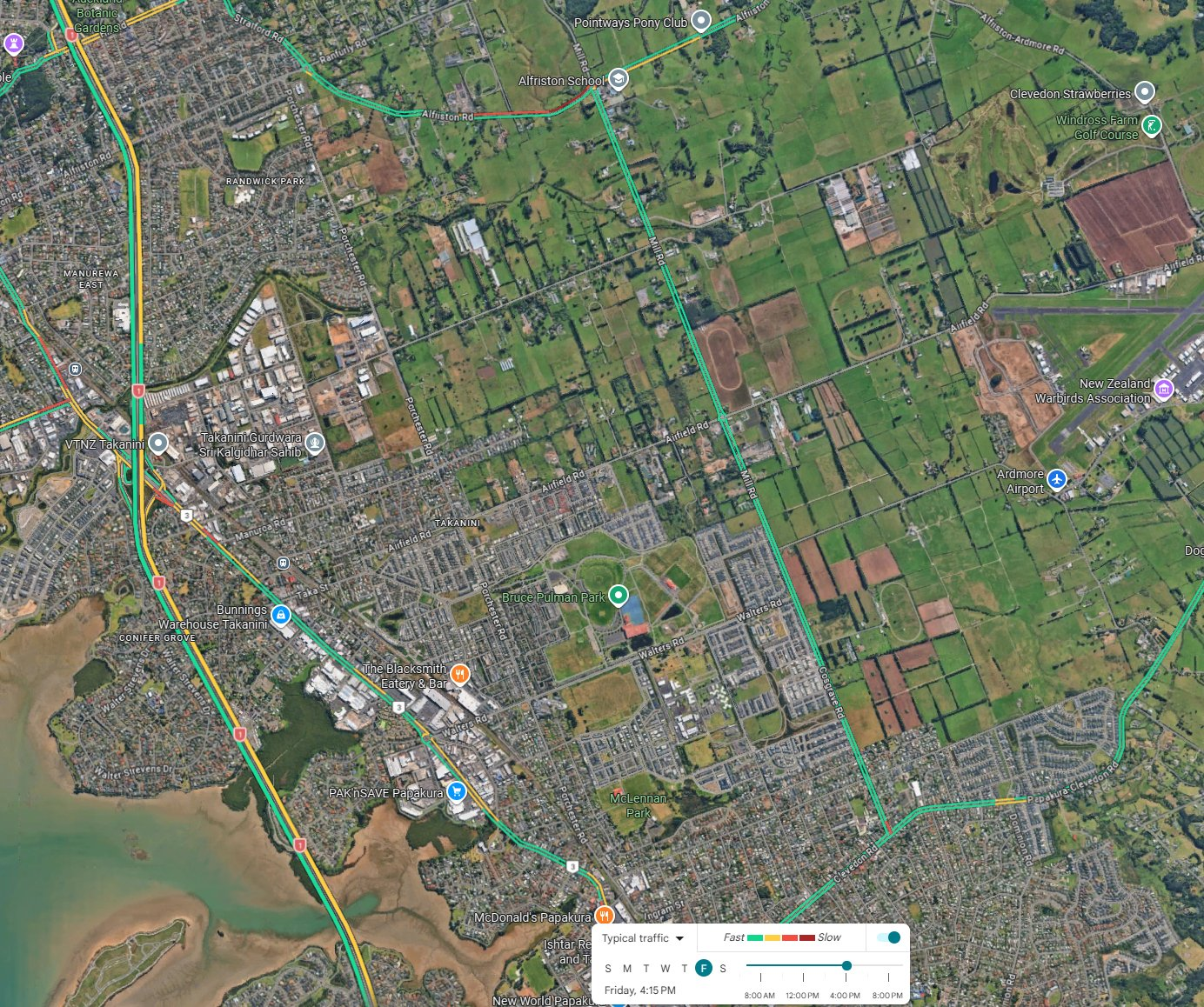
Google Maps showing typical traffic in the Mill Road area at 4.15pm on a Friday.
And looking at the broader picture for Auckland for the same timeframe, if you really wanted to solve rush-hour road congestion, you’d focus on:
- The inner southern corridor (Newmarket to Ōtāhuhu)
- Māngere
- NW corridor
- Across the harbour
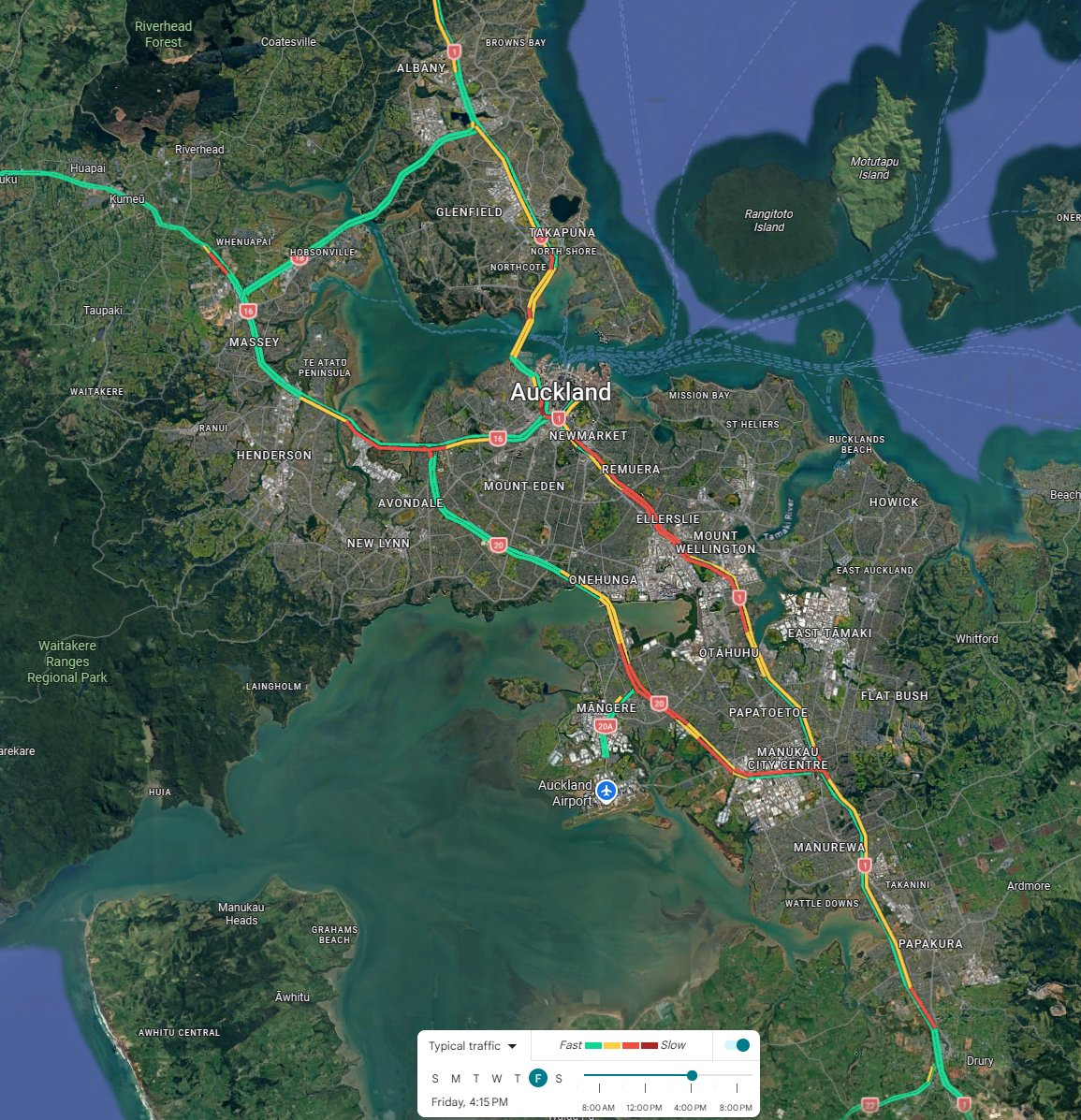
Google Maps showing typical traffic across Auckland at 4.15pm on a Friday.
In short, it seems National is choosing to ignore the Infrastructure Commission’s work, and Auckland Council’s priorities, in order to push what they assume is a vote-winner.
And that’s a doubtful assumption. Widening this route to enable more north-south traffic to feed into SH1 to and from the city is exactly the wrong way to address chronic congestion. Urban road widening just encourages more driving, which makes things worse for drivers, and for transport of people and freight. It’s a clumsy application of rural highway planning to complex urban systems.
Under this government, Steven Joyce’s Roads of National Significance has grown into a blue-coded political monster, with announcements (and reannouncements) of expensive new mega-roads seemingly the only transport idea – despite NZTA’s best efforts to pivot to meaningful solutions for our biggest city.
Now, even having accepted they can’t widen or duplicate SH1 from Newmarket to Ōtāhuhu, their next move is to pump even more traffic onto it. Which is extraordinary.
With Mill Road, the current government, and NZTA under its direction, looks to be making the same mistake it did with the East-West Link. Instead of quickly and affordably improving key intersections and alternative travel options, it has opened its policy tool bag and found the only bit of kit in there: a massive new road.
With the East-West Link, eventually reality won out – will that happen here as well?
Okay, so what does Mill Road actually need?
That’s a fair question. A rational approach would home in on a couple of particularly gnarly intersections that should have been signalised 15 years ago when housing growth really kicked in.
So, you’d fix the intersections of Murphys Road and Redoubt Road, and also look at closing Hilltop (or making it left in/left out). And, as the Mayor notes, you’d extend the dynamic lane to Murphys Road.
Then, with some of the billions left over, you can deliver what this area really needs: improvements that are exactly perpendicular to the Mill Road corridor – like better east-west public transport links to the train stations, to give more people congestion-free travel choices.
In other words, you’d invest to “make the most of CRL”, as the current catch-cry goes. Make it easier for more people, more often, to choose to use the newly improved Rapid Transit system, that’s right there.
Greens prioritise public transport
The Greens also announced a swathe of transport policy over the weekend, with the key policies relevant to Auckland being:
- Free bus and train trips for children, students, apprentices, Community Service Card holders, Total Mobility Users, and people aged 25 and under
- $2 Fare Caps for everyone else
- Overnight passenger train between Auckland and Wellington
- Extend Te Huia to Tauranga
- Deliver immediate improvements to bus routes along the planned Mass Rapid Transit routes in Auckland, Wellington and Christchurch.
- Plan and deliver light rail or bus rapid transit in line with the Infrastructure Commission’s preferred option
- Work with Auckland Transport to fund and deliver level crossing removals – allowing for more frequent trains, fewer delays, and better safety outcomes.
The Greens have costed their full policy package at around $21 billion, meaning about $1bn annually over the next two decades. This funding would be available if the National Land Transport Fund was reprioritised, away from its current imbalance in favour of low-value parallel highway projects and towards a greater range of transport options.
The policy also mentions the Infrastructure Commission, which is important, as there is – in theory – universal political agreement that all major infrastructure should be scrutinised by them.
By contrast, the current government has exempted from scrutiny all NZTA projects funded through the National Land Transport Fund, including the Roads of National Significance (of which Mill Road Stage 1 is an example).
How does this measure up for Auckland?
At a glance, the Greens policy package seems much more aligned with what Auckland needs. It addresses the gap in rapid transit in the isthmus, and targets better connections to Māngere.
And rather than pinning everything on a few big projects, it works for both the immediate and longer term, at local and regional levels. The fare plans can be enacted quickly, with intercity rail services ramped up in the medium term (at least as start-ups on existing track and systems), and new urban rapid transit over the longer term.
Greater Auckland has long seen the value of extending Intercity passenger rail in the upper North Island, which we called Regional Rapid Rail, and an AKL-WGTN sleeper service (see here, and here). The return of the Southerner from Christchurch-Dunedin, while out of our rohe, also sounds good.
It’s also worth noting that the estimate for improving Golden Triangle passenger rail will likely be about the same as Mill Road. We leave it to readers to weigh up the relative value of one parallel highway versus reviving passenger rail in the country’s most populated zone, while also enabling more freight to move to rail, taking trucks off the road.
Note that the policy includes light rail on the medium-term horizon – not just for Auckland, but for other major cities, Wellington and Christchurch. We can probably assume this is surface light rail – the more deliverable alternative to the over-scoped underground metro-light-rail towards which Labour was led up the garden path.
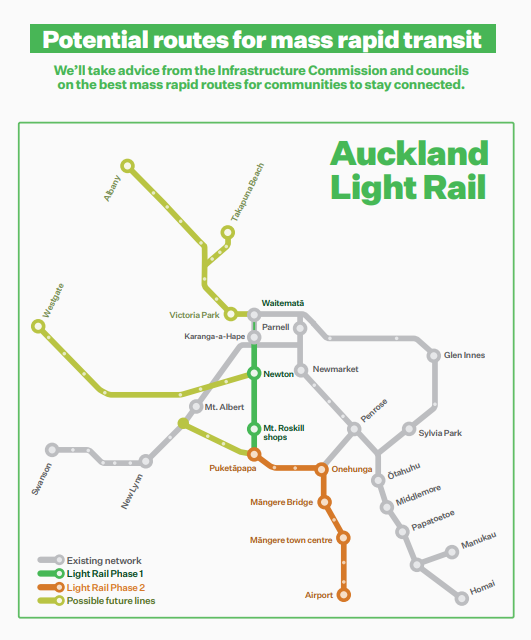
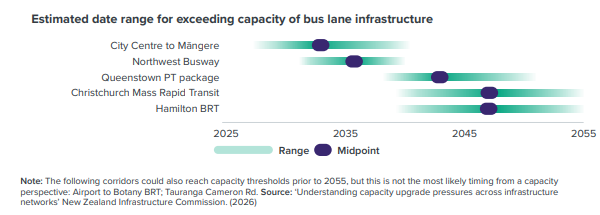
It’s good to be planning towards rapit transit: the National Infrastructure Plan is clear that Auckland needs rapid transit, including the City Centre to Māngere corridor, where bus-based solutions will cease to be able to provide the needed capacity in the next decade. (Once again, we thank Connor for getting that issue included in the NIP).
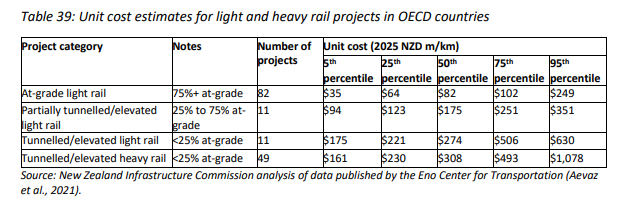
The Greens have also used some of the Infrastructure Commission’s work to estimate the potential costs for light rail. They used the highest value (the 95th percentile of projects the Infrastructure Commission looked at), which is $250m per km.
However, the 75th percentile of surface light rail projects comes in at $100m per km or under. So, while it’s unlikely any initial light rail line in New Zealand will be on the cheaper end, the Greens numbers are still likely an overestimation. This is especially relevant given the tendencies of National to consistency use the lower end of costs when it comes to their “Roads of National Significance.
Lastly, the Greens have also announced a commitment to funding the removal of level crossings on the Western Line – a critical programme that, as yet, has no guaranteed funding. The announcement included this near miss of a car going through a level crossing mid press conference. It’s hard to think of a more tangible live illustration of the benefits of a campaign policy in New Zealand political history!
Over to our readers:
What are your thoughts on the transport policy announcements so far?
Which of the policies do you rate in terms of value for Auckland?
What do you think of Labour’s more general policies, in relation to our region’s needs?
Lastly: a friendly reminder to check and confirm your enrolment to vote, well before before October 25th, which is when enrolment closes and when early voting starts. Make sure friends and family are enrolled to vote as well!

 Processing...
Mill Road???? I’m looking forward to the east west link being revived as well
Is there anything in the Greens’ policy about increasing the frequency of Te Huia between Hamilton and Auckland, to make it a viable option for far more people than it is now? Currently it’s 15 return trips per week; ideally it would be closer to 15 trips per day.
Increasing the speed of Te Huia is arguably more important, to make it more competitive with driving. Track straightening could be done at the same time as electrification.
I don’t think that is remotely arguable. Trains compete with driving on both convenience and time. Currently the wait time or inconvenience of working around the schedule is the biggest barrier to use.
The current timetable doesn’t work at all for travel to Hamilton. The current timetable doesn’t allow passengers to go to either city for the evening. The average wait time is almost 11 hours.
By far the biggest improvement for passengers comes from adding another service, the next biggest improvement comes from adding one more service.
The minimum service should be a departure each way every 3 hours from 6am to 9pm every day with midnight services on the weekend. This could be operated by 2 trains.
The trains will be slower of peak, but they are reliable and enjoyable compared to driving.
The timetable is set up for people going to Auckland from the Waikato. Natural given Waikato is funding it and Auckland isn’t.
Any improvements should be aimed towards getting Aucklanders to the Waikato (essentially doubling the frequency by making a service leave both ends at the same time).
Electrification/track improvements should be left as part of freight (they should be done ASAP under different funding streams), but passenger rail is way more likely to be cancelled, so having low costs and high ridership is what protects them.
Speed wise Te Huia will continually get more competitive purely because more homes/housing congests SH1/SH20 faster than they can add lanes.
—
Re electrification, KR should be given a budget to electrify X kms each year. As too often things are made into big projects rather than regular little ones.
Extending Te Huia to Tauranga.
How’s that going to work?
As it now leaves Hamilton at early morning, if it started from Tauranga, it would be an 0330/0400 start.
The best use of Te Huia is to increase the frequency as others have suggested. Tauranga is a seperate long distance service idea that needs to be carefully considered, but in the long run it would likely be viable.
Other suggestions are the South Waikato starting from Te Kuiti calling at Otorohanga, Te Awamutu etc.
At Hamilton a Tauranga service could join etc, and the same in reverse, but this may be far into the future.
Vote catching is what has given way to sensible, doable projects.
@PH I’m not advocating for Tauranga just yet. As Auckland – Tron needs a stronger connection and looks far more promising for electrification (to reduce the costs of the service and allow direct link into Britomart + heart of the Tron)
Re Waikato local rail to towns within the region, that’s not really a central gov or Auckland thing, it’s for their councils (whatever form they end up in) to do once they feel buses aren’t a good alternative.
Te Huia has three trains per day both ways, one train set does two return trips, the other does one.
Plenty of potential to run them more, for every hour the fleet spends underway it spends three hours parked up and waiting.
For example the train that heads north from Hamilton at 9:35am could start with a run to Tauranga at 6:30am, then head back around 8am and carry on through Hamilton to Auckland. Do the same with the afternoon train that gets back to Hamilton from Auckland at 6:10pm, out to Tauranga by 7.40pm, then back to Hamilton a little after 9pm.
Re golden triangle electrification, would be useful to at least start with electrification to the Ruakura inland port with a station for transfers to Waikato Uni
Spending the money on increasing the speed is only ever going to make sense if there are more services to justify the cost.
One extraordinary thing for me about the Mill Rd project as currently planned is simply what it is at a high level.
In contrast with the Woodend project, which is a highway bypass of a town, a conventionally well accepted good idea. Keep through traffic out of conurbations, go round.
Mill Rd is a bypass of SH1, an existing highway, THROUGH a town. Basically daft.
This shows the insanity of allowing your transport agency only one trick.
New highways are certainly not the only answer for improving an economy and society. Hell, they are not even the only answer to every question in transport.
Re: Mill Rd
Be interested to see the viability of AT/Kiwirail building the ‘Southern Link’ now.
Aka, the corner between the Southern line and the Manukau branch that was never built, but space was made for under SH20.
https://www.greaterauckland.org.nz/2013/02/09/does-a-manukau-southern-link-make-sense/
It does appear that that space may be too hard to change with the KiwiRail Wiri port in place just south of it,
but for what could potentially be a simple rail connection could actually open the doors for a Papakura ( or Drury even) to Manukau direct service, which, fancifully, could open the doors/help to justify to extend the Manukau branch east.
It would surely be a lot cheaper than $1.75b for 6km of Mill Rd (and $6b for the whole thing!) which will only add to congestion.
Much more urgent to improve connections between those growing suburbs and existing stations, to make using the improved rail services an easier choice for more people more often.
Station access upgrades, more entry points, better bus routes and transfer connections, connected, complete, and separated cycleways centred on stations.
First mile/Last mile.
Run of the mill (pun intended), fiddly, bread and butter, transport optimisation projects.
Thing NZTA is not meant to do under the current GPS, but is what is needed.
We have spent a lot to get the rail service a hell of a lot better, the above work may not seem like rail network work, but it is.
Councillor Andy Baker told me the CRL and new Southern Station have saved him an hour a day! He scoots to a new station and trains directly to City Hall, saving 30 mins each way over driving to Papakura and walking up from Waitematā.
Stick that into your Travel Time Savings BCR calculator!
Multi modal Andy Baker needs to share the multi modal love.
Hi Patrick, I think it would be interesting if GA had another look (now 13 years on!) at the viability of the ‘Southern Link
I think about a journey from say Homai, Manurewa, or Takaanini to Manukau.
Currently involves going in the wrong direction and transferring at Puhinui.
Or, its a bus. Either of those journeys are above 30 minutes, either having to train transfer, or take a slow bus.
A car is currently 15-25 minutes, depending on traffic.
it is quite damning that the recommended PT journey between two Southern train stations (Homai and Manukau) is to take a bus lol.
A direct service would actually properly connect the South to Manukau on rail.
I estimate that a direct service (if this ‘Southern Link’ was built) between Homai and Manukau would be about 10 minutes.
Papakura to Manukau would be 20 minutes (Currently 30 minutes, with transfers).
Some common sense from the Greens.
You’re right that it’s surface light rail.
From the Greens policy page:
3.1.1. Building surface light rail through key routes in our major cities
If the left wins it looks like the Greens will have a fairly major say, not like the old days where Labour got 4x as many votes as them. In fact would say there is an outside chance that the Greens get more votes than Labour and Chloe is PM!
So all of a sudden LRT is back on the cards when I thought it was dead and buried.
Thankfully the NW busway progress is so glacial that it might end up back on the cards too, at least as a LRT project first.
Transport policy is dull but at least it is better than seeing them all pretend they can do anything about the cost of living.
They could remove GST off food like most other countries. Would be much more sensible and effective than breaking up companies to possibly squeeze a 1% price drop.
And add it on to something else. Governments are pretty much helpless in a supply shock, but it is fatal to them to admit that. The really sad part is inflation is ramping up in fixed charges that people can’t avoid. If rice goes up in price you can eat less of it and you can buy more potatoes. But when rates and insurance go up you don’t have any choice.
Food is less essential than insurance?
Wouldn’t do a thing, as they charge what people will pay, not what it costs them. The 15% would be absorbed into profit margins throughout the supply chain within a year or two, the gov would have less revenue, and costs would go up to pay for the computer system upgrades to allow it to happen.
Food is a low margin cost+ business. If they increased their margin by a whopping 15% then I am sure there would all of a sudden be more competitors. The local dairy could probably compete.
@JJ they wouldn’t up their margin by 15%. Each supplier up the chain would absorb some of it. Also I’m not sure what dairies you go to, but mine are not within 15% of supermarket cost or remotely close.
Most other countries? Are you sure this is true? I know that discounted rates exist though.
It seems like a reasonable idea but there would need to be mechanisms in place to ensure that the 13% price drop (15/115) is actually passed on to customers, and not pocketed by the supermarkets.
I should have said other similar countries. According to AI:
“In Australia, basic food staples are generally exempt from the 10% Goods and Services Tax (GST), while processed, hot, or restaurant-consumed foods are taxable”
“In the United Kingdom, most basic grocery food is zero-rated (0% VAT), while hot food, catering, and luxury items carry the standard VAT rate of 20%”
“The United States does not have a federal Goods and Services Tax (GST)”
“In Ireland, Zero Rate (0%) applies to most basic foodstuffs sold in retail shops, including fresh meat, milk, vegetables, bread, and cold takeaway food”
“Basic groceries are taxed at 0% (zero-rated) nationwide in Canada”
“New Zealand charges a standard 15% Goods and Services Tax (GST) on almost all food and non-alcoholic beverages, with no exemptions for basic staples or fresh produce”
Yeah, naaah. UK policy on VATis crazy ad requires huge admin. Different VAT ratings on food whether it is hot or cold, or fresh or pre-cooked, or green or orange – or some such craziness. So a sandwich may have VAT on some parts, and less VAT on other parts etc.
Honestly, far easier to have VAT / GST on everything, and make rebates available. Whole lot less admin to administer.
I agree with you to an extent. But let’s be honest about it – the reason NZers cant afford food is so our tax system can be simpler than other idiot countries that are richer than us.
GST is not the reason people can’t afford food. Removing GST wouldn’t change that. Better to just provide a subsidy of $X to people below a threshold, more targeted and can make more of a difference to people’s lives, and would cost less.
We are a nation of non thinkers. We build just to build. We drive around, just to drive around. It is all a complete waste of time, destructive to our economy, our environment, and our health.
We could be building mid rise apartment communities, with good public transport access, within a sensible area for a motu and cities of such low populations; by world scales.
We need to stop driving. It is a stressful activity. It shortens our lives, through deaths on roads, poisoning of our air and pollution of our waterways (via tyre dust). In the South Island fake fertiliser has a lot to do with polluting waterways too.
The city of Tamaki Makaurau Auckland loses billions of dollars per year because we live in congested car traffic.
We cannot even house every human.
Something went wrong after World War Two, then again will the neo liberalised ninety eighties; and we continue down this spiral to oblivion.
George Orwell wrote 1984 in the nineteen forties. Totaliarian Europe of Mussolini and Hitler and Franco taught us everything we needed to know about the worst that we could look forward was; but we choose to forget.
We choose to forget the the New Zealand Colonial Project almost annihilated Maori in the eighteen hundreds.
History can teach us many things about the past, science can teach us to accept that change is possible.
Arts make like worth living.
bah humbug
I am against Green’s promises to massively reduce fares.
I think the $50 fare cap is at about the right level to make a meaningful cost saving for high users.
The biggest problem with public transport is not it’s cost to users. The small decline in private motoring due to current high fuel costs is testament to only small price elasticity in transport provision.
The biggest problem is that currently Public Transport is not a viable alternative for far too many highly used journeys. It needs far greater reach, more frequency, and greater journey time speed and reliability. Hamilton to Auckland is a prime example, as is regional transport in Canterbury. Rolleston residents need a better public transport connection to Christchurch ahead of lower fares.
This will cost money in a constrained economy. But having fare income will make it much easier to justify the needed new routes and enhanced service levels on existing routes.
Repurpose lanes- huge savings to be had on the NW busway as an example and actually incentivise using PT instead of the car.
It could work? Look at QLD. It costs 50c to travel to gold coast by train from Brisbane. Essentially any train journey is 50c. Huge uptake in train travel since they changed that.
Focusing on fair income will just give detractors too much “but it doesn’t make a profit” arguements. Which are stupid because that isn’t the point.
You are 100% correct about viability for lots of high use journeys in this country.
But if the same amount of government money is added to current fare rate income then far more routes and frequency could be added.
Or look at Italy. The high speed trains aren’t cheap, unless you buy months ahead; but what really helps drive patronage is that you pay about $12/100km as an autostrada toll. The convenience of a 300kph train must help too.
I am generally not in favor of ‘free’ fares for many reasons, but capping $2 a fare is at least better; maybe making it universal though like in Queensland with its 50c fares.
I suspect $50 a week cap is fine for many people in work, but that is a big chunk out of say a low income family of 4 to travel using PT or a single person not working
I do wish that they use tools of central government to implement some policy, but defer setting actual values to local government
So if Auckland decided they need more fare recovery to pay for more rapid expansion/light rail upgrades or to help deal with over subscribed services like over full ferries on tourist routes, they should be free to increase or even decrease if a service is profitable
Overall though, I take your point, but think – why not both?; lower caps/average fares, induce demand and try and introduce more services with more frequency in more locations.
If we can shift some of that spending from RONS to other infrastructure we can afford to transform NZ
Good point re the lower fares. As an example for our whanau of 3 , a return trip into the city from Te Atatū on PT will cost us $33.80 ( including our child’s concesion) -for those who are not regular commuters ( and so getting the benefits of the $50 cap) that is pretty high and you can see why they consider the car and parking costs
The Mill Rd route would provide network redundancy to SH1 should that link be blocked.
NZTA could designate the Mill Rd route and the then just build it to the Infrastructure Commission timeline &:
a) address the congested intersections first
b) complete it as 1×1 with passing lanes.
c) eventually undertake the full duplication once justified by the traffic
+1. I was told by a contractor that the marine bed soil around Takaanini has the consistency of toothpaste. We need a resilient north-south road further inland. Just to a more affordable standard than currently proposed.
Great South Road is there, it’s multiple lanes in the majority of it’s length.
That provides resilience.
The problem is there is too much traffic on Sh1 – and people are using Mill Road as a somewhat rat run to avoid Sh1, and that the car based growth development pattern the south / east have been undertaking for the last 50 + years. Yes do some work on Mill Road, make it a multi-modal corridor (t3 or bus lanes + 1 general traffic each way, along with good cycle infrastructure and footpaths) and leave it at that.
Quote from Newsroom editorial by Jonathan Milne yesterday which seems important to these discussions:
“Mill Rd (from Manukau, round the back of Totara Park and finishing at political donor Chris Meehan’s proposed Sunfield residential development behind Takanini)”
The proposed new houses on a flood plain…
This is exactly why lobbying regulations and much lower political donation caps are urgently needed. Opportunity, Green Party and Labour have decent policy proposals in that area. Otherwise we will keep getting what a few wealthy folks and big companies think is best.
Just like Penlink, the old NZTA boss and the Stillwater subdivisions. Personally I don’t mind the projects, I just feel like we pay too much for them.
I am hoping the next government does a comparative cost-benefit analysis on the different mode options for the city-airport connection. Underground metro may have been the second most expensive idea, but that does not make it the worst. That table says that at-grade light rail is the cheapest, but their are no at-grade options for crossing the Mangere Inlet. A new bridge or tunnel is needed. I think at-grade light rail is a fantastic idea for other routes, but not the city-airport link; which has the largest destinations at the ends of the route. The Auckland Light Rail project was worked on by professionals. They knew something about what they were doing, they probably knew more than the rest of us.
The City Centre to Airport trip is something like 6-8% of patronage for the City Centre to Māngere corridor, its a minority of trips. The main reason for building Rapid Transit is to link up all the other places in the corridor, of which that specific corridor it makes much much more sense to do at grade!
The reason you might extend at grade light rail to the airport is its relatively straightforward from Māngere and provides a good connection for all the people employed in the area, with a cherry on top of providing that one seat City Centre to Airport line.
Of course, doing a metro would still be good for Auckland, but another corridor/route would probably make more sense, not to mention doing at grade light rail doesn’t preclude you from doing a metro in the future either!
Extending light rail across the inlet is not straightforward though. The cost of bridges and tunnels it was eats into the savings. I recall that the estimated cost of at-grade light rail was $9 Billion, not the $35 Million/km shown in the table here. I only think we should do the comparative cost benefit analysis first. A third option could be at-grade light rail on Dominion Road, and a heavy rail connection to the airport from Onehunga or Otahuhu.
Extending the Onehunga branch line or a new Otahuhu–Airport routing is even less straightforward. The OBL would require closure and rebuilding on a grade-separated alignment, and the vaguely reserved right-of-way alongside SH20 and above SH20A is not suited to heavy rail curve and gradient geometry. Stations at Favona and Ascot might not be able to be built.
It would be twice as expensive as surface LRT, at least, for a service half as frequent and probably no more than 5 minutes quicker to downtown.
We’re not even at the point where we need higher modes of transport to the airport. Buses + bus lanes that can be done for super cheap (not busways which are super expensive) and handle demand. Can be rolled out quickly as well. Then we can focus investment in other areas with higher modes (LR/trams to replace overcrowded local buses, heavy rail/automated light metro to replace overcrowded area to area buses like WX1).
All the LR options etc. are slower to the CBD than train + airport bus. Sure it improves travel times for various suburbs to the airport, but a bus with bus lanes etc. would do exactly that for a fraction of a % of the cost.
I’m now fully on board with the bus lane option for a cheap win, but more importantly a quick one.
Once we do that, we’ll really see where rail is needed; there’ll be a bus apocalypse where the demand is, so it will become obvious where we use the unspent cash.
@Freddie last time I checked surface LRT was projected to be 45 minutes downtown to the Airport, and the AirportLINK + green line train combo is an hour on the current timetable. Maybe that could be shaved down to 50 minutes if the trains run as fast as they were supposed to
Is it really 13 minutes from Wynyard to Britomart? Just comparing Britomart at the time of writing, was 57 minutes for PT, and 58 minutes from Wynyard for the surface LR option from here: https://www.lightrail.co.nz/media/xdzgzsd2/briefing-to-incoming-minister-alr-2023.pdf – the 2016 AT estimates had it closer to that figure though (with it being 10 minutes or so longer than the heavy rail option).
Regardless, it’s not a route that is needing a mode upgrade (the Mt Roskill to Airport part). Dom Rd is (to reduce bus congestion in the CBD and congestion in the CBD adjacent section of Dom Rd), but upgrading the busiest sections of a crowded local bus route is very different to building rapid transit for the region.
Re Airport Bus + rail – I think they could save significant time both on rail dwell times, and with better priority around the airport itself/the bridge, and the non SH20B sections of the route. I think they’ve done decent with the bus lanes from the bridge on SH20B to SH20.
For the route duplicating SH20A/SH20 to Onehunga, bus lanes + frequent bus service will be enough for a while. The development benefits from the projects would be very similar with just good bus service + rezoning, vs good LR service + rezoning.
I’m not for a busway along the route like others have suggested in the past, buses + bus lanes are super underrated, busways are massively overrated – as bus lanes in general are cheap, busways are getting to similar cost of higher level modes but don’t have much more benefit compared to just decent bus frequency and lanes.
Eastern Busway (Pakuranga to Botany) is great and all, but they could’ve got most of the same benefits by replacing a general lane with a bus lane, putting up some cameras, and running more buses.
Don’t bother citing anything sent from ALR to the minister, after telling everyone their option was amazing and the AT option was terrible, all the evidence was finely curated to make their option look amazing and the AT option look terrible.
Note for example they add ten minutes to walk from Queen Street to University for the surface light rail option (about 500m), but no walk time for their option which had the ‘university’ station up on Symonds south of Wakefield street.
Or likewise the travel time to wynyard, which for surface was to the end of wynyard point, with the second to last stop at Fahshawe Street. While for the metro the ‘wynyard’ station was under Victoria park almost a kilometre short of wynyard. Where was the twelve minutes needed to walk the rest of the way?
Or deciding that they could just call the Wesley station Mt Roskill to meet the criteria (it’s 1.5km away) , while the surface actually had a station at mount roskill shops.
And talking about ‘ultimate capacity’ was a big piece of bullshit when they didn’t need even a third of that, and weren’t planning to build stations long enough to get even a third of that.
The city-airport connection via Mangere etc can easily be handled by frequent buses and bus lanes.
CBD, then Dom Rd city end are the only bits requiring mode upgrades in the short – mid term.
We already have transit to the airport via Puhinui.
To improve it, speed up the train by reducing dwell times (which AT is finally looking at), so 37 mins to Te Wai Horotiu becomes 33-34 mins.
Then increase the frequency of the AIR bus to every 5 mins and run it so that it stops at the domestic terminal in both directions rather than looping round via the international terminal on its way back to Puhinui. 10 mins.
With the new train frequencies that would get you a decent chance at ~45 mins in each direction. No new infrastructure needed.
Decent stuff from the Greens.
Does anyone think part of this Mill Rd (and other) silly overpriced mostly pointless road announcements are partially to tie up money for future governments to prevent investment in PT or other modes of non-car tranport?
This isn’t electioneering because that electorate is true blue National, so they aren’t going to win anything from it.
Could it honestly just be cynical to keep money away from rail? There are other actual worthwhile roading projects they could fund. Or is it just typical right wing hatred of all non-car modes of transport because……..??? reasons?
“This isn’t electioneering” – I never understood why they don’t spend time trying to appeal to new voters rather than existing. Could have spent that money on a Dominion Road busway for example and kept Mt Roskill voting blue while also killing LRT.
Excellent point. Why didn’t they do that.. because that would have been smart. But also gone against their “government spend money bad” philosphy for everything except tax breaks and roads. If the right ever do something remotely sensible transit-wise (usually to reverse the fact they didn’t do it decades earlier) it is because public pressure and just bullying gets them over the line see: CRL. Also having someone in the Simeon Bridges (as transport) or the Bish sort of vein.
Smart enough to realise “wait…this might actually be a good idea we are ignorning because of our ideology”
Misleading re CC2M capacity, implies capacity constraints to Mangere. The capacity constraints are on Dom Rd, buses crosstown with shoulder bus lanes/emergency lanes can easily handle the capacity not on Dom Rd.
LR should be Wynyard to Britomart phase 1 (extending heritage line), only complexity is replacing the bridge deck (bridge base is already designed for trams but was cut last second). More of a Wynyard connection project.
Britomart to Aotea Square along Queen St should be phase 2, more a pedestrianising Queen St project.
Phase 3 is when it becomes a PT one, Queen St to Dom Rd interchange (where you can build a tram depot), then future phases gradually along Dom Rd terminating the 25 variants where the tram is.
Eventually it’ll reach Richardson Rd/Dom Rd extension, interchanging with the various crosstown routes (64/65/66/67/Avondale-Southdown).
If they do it in smaller projects, each one a couple of blocks as part of road renewals, the bits hitting capacity (CBD and over time inner parts of Dom Rd) will be upgraded without the enormous cost of building the whole line at once.
Also by doing lots of little projects, they can learn from each one and politicians can cut ribbons/ground breaking ceremonies etc. for each stage.
Nah do the lot to Mt Roskill. Otherwise National will get in again and cancel it. Get AT lined up now and get the diggers onto Dominion Road the day they win (if they win).
I’d prefer it if they forget about the Mangere / Airport part altogether, that has always caused the issues.
Fair. I always just thought it should be descoped to the level where council can afford to do each section ourselves rather than relying on Wellington incompetence. It’s a local road.
With taxpayer funding for automated light metro for NW, CRL2 to North Shore, replacing all emergency shoulders on the motorway with speed limited bus/emergency lanes, cameras for ramp signals, interim bus stops along the motorway for services like UHEX, rail stuff like Avondale Southdown, Westfield grade seperation etc – basically the things NZTA/KR controls gov pays for, things we can control we do ourselves.
There is a benefit in separating large projects into smaller chunks but starting LR with a 900m ‘extension’ of a heritage tram/tourist attraction along one of the most walkable places in the country?
You can’t build Britomart to Aotea Square first as no depot. So then the decision is between Aotea Square and Dom Rd interchange, or Britomart and Wynyard. Rebuilding the Dom Rd interchange/brand new depot etc. is a lot bigger scope project, terminates only at Midtown requiring 3 transfers which is a bit much, and it’s about lots of little wins.
Ideally we’d build every stage at once with unlimited budget and political capital, but we don’t have that. Plus the bridge needs to be replaced and can be part of the wider revamp with the downtown carpark.
PT wise we’re not going to get the benefits until it’s Wynyard to Dom Rd interchange.
So instead doing a project improving connections to Wynyard, then a project pedestrianising Queen St, then finally a PT one, makes more sense than building part of a PT one that wouldn’t work well, force unpopular transfers and poison opinions.
I think technically you could build Dom Rd to Britomart and get the PT benefits, but it’s two big projects as one, which kinda defeats my bite size salami slicing of the project so it’s affordable.
You could actually build a starter line without a depot, and stable and service the trains at the terminal station… for a time at least.
When brand new trains don’t need much in the way of maintenance, and for what they do need you could transporter truck them off site. You could go maybe 18 months or two years without a real depot.
Sounds crazy but there is a scenario where you build the depot separate from the first stage.
It’s exactly what they first proposed until a heavy maintenance depot was built near mt roskill.
I’m not too precious on the exact order. If they don’t need a depot initially that means you could probably defer stage 1 (Britomart – Wynyard) until when tram volumes got high enough that they didn’t want them terminating @Britomart.
I don’t think Aotea Square – Dom Rd interchange would work by itself, as you’re then forcing people to transfer twice to get to Britomart (plus whatever other transfers their journey requires), first by terminating the Dom Rd buses early, 2nd by forcing a transfer @Aotea Square.
It does feel like Wynyard – Britomart should be first though, as they’re looking at redoing that whole area in the next few years.
At that point, Queen St would be due for a revamp. Then at that point, the appetite for redoing the top part of Queen St/Dom Rd as the area would be gentrifying and look shabby in comparison (and buses would be becoming a big enough issue to justify short stopping existing bus services and forcing the transfer).
But my point is less that, and more that they need to break it down into super simple, small, easily achievable projects with clear goals, as they’re getting lost in the big picture.
Big picture in 60 – 100 years or whatever there will be an underground metro duplicating it doing the long distance fast with the tram handling local area trips with frequent stops.
So they don’t need to worry as much about planning to connect it to the shore or airport or whatever other rabbit hole they go down, as that’ll be handled by a higher capacity, higher speed mode. They’re just upgrading a local bus route with a better mode that can handle the capacity issues.
Yours is exactly the right approach Freddy.Stuff all the ceremony and expense which surround transport projects in this country. A similar approach should be taken with electrifying between Pukekohe and Hamilton. Just chip away at it year after year until it’s done. Give Kiwirail an annual allowance like how things used to be done. Comstant improvement stable work force learn from your mistakes
If anything more stages allows politicians to have more ribbon cutting moments. They get almost the same political benefit opening up 1km vs 15km, but they can do it 15 times.
Agreed re electrification as well. I’m not sure what the right figure would be, less than $100m a year but maybe $20-$40m a year? Needs to support two work streams (Tron north, Pukekohe south) as projects seem to be better when there are two teams, as they begin to compete with one another.
Rather than build a whole new development from scratch on the edge of Takanini & Papakura, why not infill Manakau with high density housing? The infrastructure is already there, and Manakau has more car parks than it has reasons to visit.
The massive cost of Drury sprawl – motorway, mill road, 3 new train stations, and it will still be very slow to get anywhere. Could have built many more houses on the isthmus and put down some LRT tracks.
Drury sums up everything that’s shit about NZ’s approach to urban planning.
We simply don’t need all these greenfield zone changes. Especially with PC120, we will have more than enough housing capacity in good, existing urban locations.
Hopefully we get a centre-left government who will get rid of, or at least heavily modify, the fast-track legislation. Let’s get real, the primary benefactors of all these greenfield housing developments are consultants and developers. The planning consultants who put their names to some of these projects need to look themselves in the mirror…
Who would Mill Road Stage 1 serve? Flat Bush plus Clevedon and one quarry.
Whose electorates? —-
What does it not include? Murphys Road.
What would relieve the congestion? Airport to Botany. And signals at Diorella and Murphys.
For later stages, there is the fairy tale (sorry, Fast Track) carless community at Sunfield.
All the growth at Drury would benefit from the P2D southern interchange to Great South Road and Maketu Road and its unplanned continuation to Fitzgerald Road.
$100,000,000 to Designate the route already prepared by SGA before NZTA took it over?
A thing that strikes me as interesting about the Greens’ announcement is that there may be a relatively quick win for Te Huia that’s being overlooked. There is an opportunity right now to extend the existing GWRC/Alstom contract to procure additional trains. If the next government, Waikato Regional Council, and Auckland Transport get their ducks in a row, Te Huia could potentially have BEMUs in service as early as 2030. The only main design change to the trains would be making them capable with 25 kV AC electrification. This would enable Te Huia to run directly into central Auckland via the City Rail Link, significantly improving the service’s attractiveness and convenience for passengers.
Yeah, agree, although would you believe we have different platform heights in the lower and upper North Islands! Which maybe a bigger change than between DC and AC.
But not to run it through the CRL (there are no slots) but into the currently unused terminal platforms at Waitematā.
I would like to see a feasibility study for converting the Wellington network to 25kv AC, from what I understand the AC system needs far fewer traction substations due to AC power not experiencing the same voltage loss over distance as a DC system. Don’t know if the existing overheads could handle the change in power supply though.
They did a study years ago before buying the Matangi trains. Was expensive with no real advantage at the time. It’s a different system from contact wire to substations so a lot to rebuild for no particular benefit.
There has been some brief looks since but the LNI work found it was simple just to buy dual voltage trains and locomotives. So yeah, just do that.
Do you remember the name of the study? The Tūhono sets are not planned to be dual voltage, so seems we’ve ended up with the worst of both worlds. Hopefully won’t be too difficult to change the electrics in the DC sets to be usable on the AC sections, but that won’t remove the need for changeovers.
Patrick: Platform height is not an issue. Tūhono unit low floor height is 740mm, Wellington platform height is 730mm and Auckland platform height is 750mm. 10mm difference is fine…
Do you know what the rest of the country is like platform height wise? I never even considered there might be different heights in various regions.
The Greens’ fare-cap proposals are gonna cost quite a lot more than they fondly imagine. A $2 adult fare cap nationwide is a policy directive. Implementing this would require regional councils to adjust their fare settings within the Motu Move framework and would involve significant subsidy and funding decisions by the central government. I doubt that this has been costed after discussion with these bodies – just a consultant’s spreadsheet, with the always-reliable reason that ‘Yeah, it’ll Do that’.
And as for variable GST – that’s a definitions nightmare. See https://waymad.blogspot.com/2017/11/ah-gst-i-hardly-knew-ye.html for a aged but oh-so-relevant rant about the possibility of differing rates for differing Things.
TL:DR – Once a first step onto this slippery slide is taken, the basis of our current GST – free of exemptions for the most part, single or zero rate for the most part – is foobarred. The exemptions list, being essentially political in the first place, is of course then open to pressure from identity groups for their favoured set of products. And all of them will have a justification, and some apparently sound reasons for arguing their cases. And all of them can Vote. Which will, in short order, turn the Exemptions List into an essentially pork-barrel politics exercise. The result will be a fatal and probably irrevocable infection of a hitherto internationally recognised best-practise ad valorem tax system.
The Woodend bypass is also flawed, they have used traffic density south of Woodend to justify a 4 lane bypass to the north . (making 6 lanes total to the North , as you pointed out on the north auckland motorway). If you street view south and north of Woodend, you’ll see traffic to the north is less than 1/2 that to Woodend / Pesagaus area itself. a 2 lane bypass without flyovers would be more than enough. There is merit in a bypass for heavy traffic through Woodend. of course , there is minimal public transport , and the rail is down to 2 freight trains a day .
I understand there is an option to order more of the Battery-EMU trains from Alstom built into the LNIRIM contract, with possibility for some to be 25kV compatible. Committing to exercising these options for Te Huia would be a good election promise. Have any parties mentioned it?