The absurdly high cost – potentially $50 billion – of the government’s focus on building MOAR RoNS (Roads of National Significance) was highlighted last week, with the release of new costings for six of the 17 projects.
I covered some initial implications in a first post, Reality Bites: RoNS will bankrupt the nation.
Since then, I’ve had a few additional thoughts on the projects, some of which I’ve assembled below.
Wild cost inflation
One thing that really stands out with these projects is just how expensive they are. It wasn’t all that long ago when a really expensive transport project would cost a few hundred million dollars. Now even seemingly straightforward projects seem to cost at least a billion.
(Note: a billion is a thousand times a million. A million seconds adds up to 11 and a half days; while a billion seconds is over thirty years. Here are some handy visuals of the difference in scale. See also this great scrollable version.)
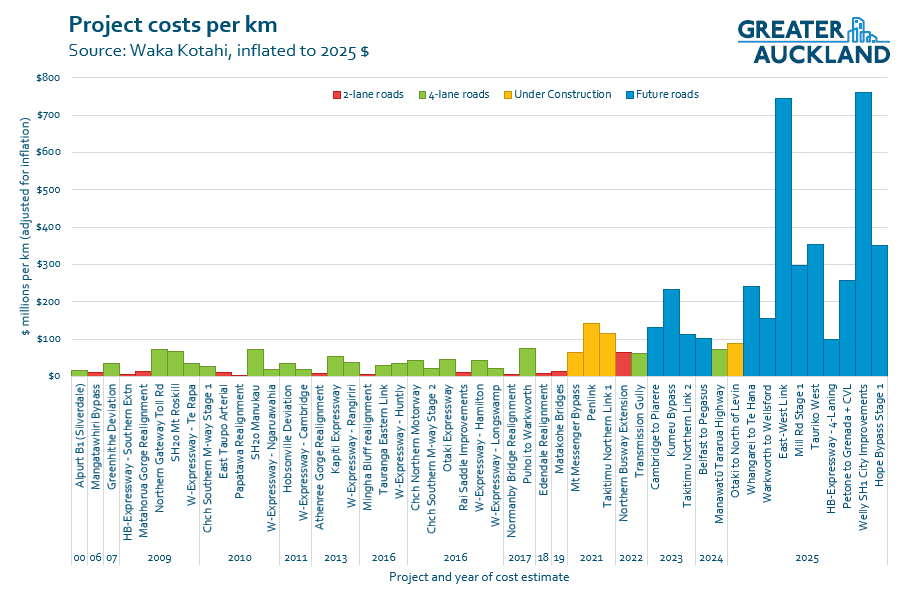
Below is a chart I’ve used a few times before – I didn’t have time to update it for my last post, but I have now. It looks at how much transport projects cost per km. For this version, the costs for projects completed in the past are inflated to 2025 dollars to give a better comparison.
A few things stand out:
- Prior to the arrival of COVID, four-lane motorway/expressway projects would cost $20-70 million per km, with most being less than $50m and the median being $34m. Those at the upper end were the more recent ones like Puhoi to Warkworth ($73.7m), Transmission Gully ($61.7m) and Te Ahu a Turanga–Manawatū Tararua Highway ($73.2m).
- Otaki to North of Levin – which has just started construction – is the cheapest of these new RoNS projects at $87.5m; the rest are coming often well above $100m per km.
- Back in 2017, the East-West Link was estimated to cost $1.8 billion, or $327m per km. Back then, it was billed by the infrastructure lobby as one of the most expensive roads in the world – they even compared its cost to a corruption-ridden road in Russia. It is now estimated to cost up to $4.1 billion… for a smaller version of the project.
- However, the East-West Link has now been pipped as the most expensive of all RoNS [ed: and thus the most expensive roading project in New Zealand history, and possibly the world?] by the SH1 improvements through Wellington, which include a second Terrace Tunnel and second Mt Victoria Tunnel.**Updated 9.30am: The Post reports today that NZTA has gone around Wellington City Council to send notices to around 200 properties expected to be affected by this project. Pukehinau/ Lambton ward councillor Geordie Rogers is “incredibly disappointed”, with the secretive approach, highlighting concerns about the impact on traffic volumes through the heart of downtown. Wellington. Rongotai MP (and Green transport spokesperson Julie Anne Genter) notes the project – which has “the worst cost-benefit of all the RoNS nationally” – remains unfunded beyond the planning and property acquisition stage.
Back to the question of cost escalation: given the cost inflation we’re seeing on transport projects, it’s a good thing the CRL didn’t get delayed more than it already was, I’d hate to think what the cost would be if we were starting it today. That said, you could also say the CRL is looking like incredibly good value if you were to compare it to some of these projects.
As I highlighted last week, these road projects have managed to generate a Benefit Cost Ratio of over 1 thanks to changes in how the BCR is calculated, with longer assessment times and lower discount rates. I wonder what the BCR of the CRL would be under these new rules?
An obvious question is, what can be done to get these project costs back down to somewhat sensible levels? Getting them back to where things were before COVID would see them collectively costing closer to $10-15 billion. That’s still a lot of money – but certainly a more reasonable figure.
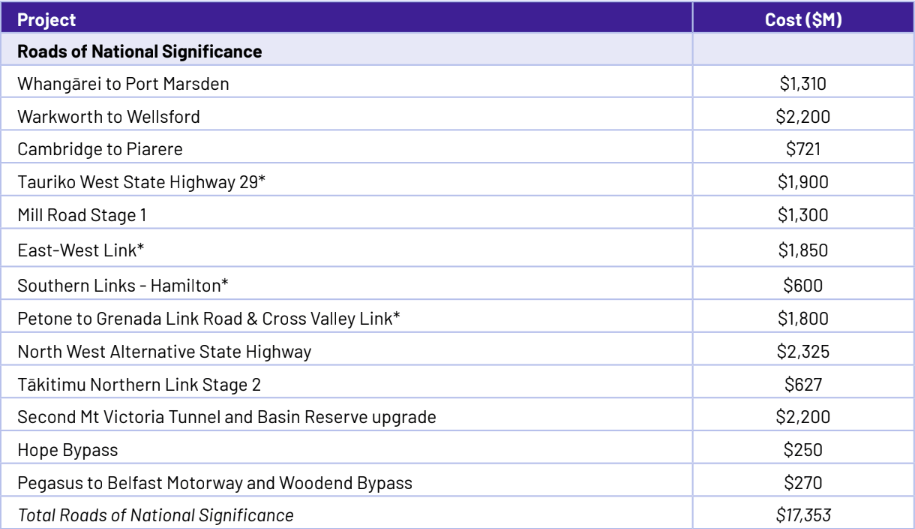
Note, these are the costs National claimed for the projects in 2023:
How Fast?
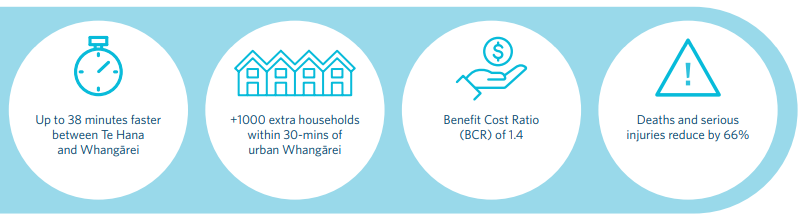
The claimed benefits for the Whangarei to Te Hana project note that it will be up to 38 minutes faster. The road is about 75km long, and Google tells me that most of the time it takes about 58 minutes to drive this distance. In this context, saving 38 minutes would be a massive amount – but it also equates to vehicles needing to average over 200km/h which doesn’t seem all that safe
Time for a rethink?
Maybe it’s time for the government to rethink its MOAR RoNS policy. Maybe Nicola Willis could even save some money by recycling her first ever press release as the Minister of Finance. It would only need a few tweaks:
The coalition Government has declined a
KiwiRailNZTA request to contribute significant additional funding to address cost escalations in theproject to replace the Interislander ferry fleetRoads of National Signifance programme, Finance Minister Nicola Willis says.
KiwiRailNZTA had requested an additional$1.47$30 billion,a component of which had been agreed to in-principle by the previous government,to address cost escalationsrelated to associated harbourside infrastructure.“The Government remains committed to a resilient safe and reliable
Cook Strait connectionroad network, but the cost of thisprojectprogramme has almost quadrupled since20182023 to approximately$3$50 billion,” Ms Willis says.
“It is also now the case that only 21 per cent of these costs are associated with the core project of replacing ageing ferries.“Ministers do not have confidence that there will not be further increases and are concerned about the continued significant cost blow-outs and the changing nature of the investment they are being asked to make.
“Furthermore, agreeing to
KiwiRail’sNZTA’s request would reduce the Government’s ability to address the cost pressures that are impacting on New Zealanders, fund other essential projects and get the Crown’s books back in order.”
All jokes aside, that $3 billion for the ferries and new harbourside infrastructure is looking pretty good now when compared to the cost of many of these projects. And frankly, it’s no joking matter that $50 billion is vastly more than the $1.47 bn that allegedly broke the bank.
What misses out, when RoNS are hoovering up all possible investment?
One of the problems of spending (or even dreaming of spending) so much of our collective wealth on these massive projects is that it crowds out the funding for so many other, often more valuable projects.
It should be reiterated: the $40-50 billion price tag for the RoNS programme is significantly more than the amount available from existing transport funding, and so most of the money will need to come from the government. That’s our money that could otherwise be spent on things like hospitals and schools.
Even if you devoted that colossal amount of money to just transport spending, it could build significant portions of the active and rapid transit networks our major cities desperately need to give people real alternatives in how they get around – in the process significantly improving health, safety, environmental and productivity outcomes.
There will even be a lot of good road projects out there which will not be as expensive (nor as politically glamourous) as a big motorway project, but which have higher benefits. A package of these kinds of projects could deliver significant value, especially if they help improve road safety.
This includes things like minor highway realignments, safety barriers, intersection upgrades, and even small bypasses of towns. These are the kinds of projects which have had money and resource sucked away from them to help pay for the RoNS.
I was reminded of one of these while travelling over the weekend: the upgrades to SH2 around Maramarua as described in my 2016 post, A Good Highway Upgrade.
This project has been planned and then stopped several times over the last decades. What’s particularly of interest to today’s discussion is this document from 2009, which highlights how the upgrades could be achieved in stages, starting with bypasses and safety improvements and new passing lanes.
This is exactly the kind of smart, prudent approach that should be being taken with most of these RoNS. And maybe it would be if the government weren’t so busy mandating projects and controlling detailed design outcomes.
(For example, that 2016 post included this quote from then minister Simon Bridges: “We also want to provide safer choices for cyclists and ensure local people have safe access to their homes, schools and businesses” – sensible benefits that are now likely out of scope, after Simeon Brown’s unprecedentedly hands-on revamp of transport funding policy.)
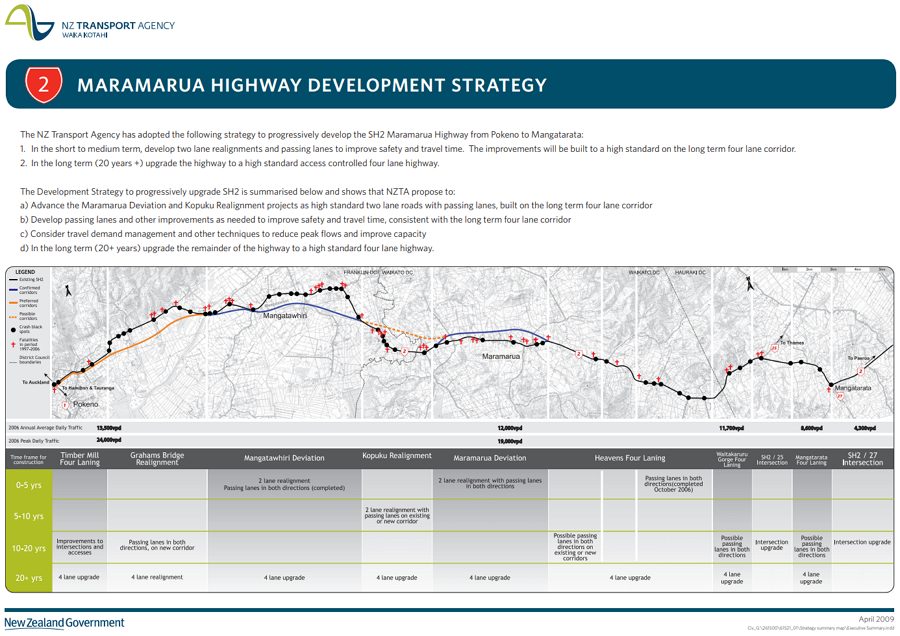
The Maramarua project did get funding again in 2016, but it was put on hold again a few years later. Would it – or other possibly higher-value projects – be already built now if transport planning hadn’t been made so political?
What other vital projects like this are missing out on funding and delivery, due to the focus on RoNS?
This analysis, like all our work, is brought to you by the Greater Auckland crew and is made possible by generous donations from our readers and fans. If you’d like to support more of this work, you can join our circle of supporters here, or support us on Substack.
Postscript: related coverage of the RoNS blowout
Bernard Hickey, The Kaka: The problem(s) with the RoNS and tolls, 22 October:
This is just time-wasting magical thinking that only enables us all to avoid the hard realities.
Blayne Slabbert, The Press: South Island receives just 6% of 1.2bn road funding package, 22 October:
In this round, the lion’s share is going to motorway corridors in the North Island, including Auckland’s East West Link, the Hamilton Southern Links, a new Mt Victoria Tunnel in Wellington and further upgrades in Northland.
Marc Daalder, Newsroom: $5b-plus blowout for eight Roads of National Significance, 23 October:
The total anticipated bill for the Government’s 17 Roads of National Significance has swelled to an estimated $44 to $54 billion – a gargantuan figure more than 23 times the cost of the Dunedin Hospital rebuild.
Joel MacManus, The Spinoff: We’re spending all our money on roads that suck, 28 October:
…the government is obsessed with finding fancy new ways to fund big infrastructure projects. But the far, far bigger problem is that the government keeps building roads that suck.
The New Zealand government is now basically a road-building authority with bits tacked on.
David Slack, More Than a Feilding: Chris Bishop takes his noble beasts for a drive, 28 October:
Even though The Infrastructure Commission laid it on the line: this one single project will consume 10% of the nation’s entire infrastructure budget, not just roads, everything) for the next 25 goddamn years; this government of asphalt-loving car-humpers stared back unblinking and said: Sounds good, let’s do it.
And various folk have been doing the maths on social media: the current $18bn price tag for the Northland Expressway alone is six times the cost of the Cook Strait crossing upgrade, or 327 times what the government spends on basic science; a thousand years worth of Creative NZ funding; the Wellington project equates to light rail in Welly plus making the whole of the South Island SH1 safer; the whole RoNS programme could build 150,000 state houses, etc.

 Processing...
Having lived in the UK, the most obvious omission in New Zealand seems to be the humble bypass. Rather than building to motorway standard, places like Kaiwaka, Tirau, Maramarua etc. would have a simple bypass maybe with a couple of roundabouts. You could have far more of these simple upgrades all around the country rather than pouring billions into a specific route to Whangarei, and I think generally it would be more popular too.
Nek minnit in NZ:
A simple bypass, four motorway lanes* and maybe with a couple of grade-separated interchanges. We are not barbarians after all.
*No cycleways though. That’s wasteful.
Agree, I’d add a few as well.
Inglewood
Katikati
Paeroa
Taihape
Ashburton (bigger scale than the others)
Meanwhile the Whangamarino swamp section remains much as it was in the 1870s despite being the “golden triangle” connection between Auckland and the port of Tauranga.
Compare this to how much light rail or even light metro in Auckland would cost, and you realise that it’s ideology, all the way down
In fairness it’s also a stark reminder of how much those projects would cost and how important it is to make the smaller improvements that will maximise what we already have.
If I were to go ahead with one LR project in the country it would be in Christchurch, a city with no rapid transit in a region that has been underfunded in terms of transport for decades.
I completely agree Jezza. A fee $bn on transit in Greater Christchurch would be transformational for NZs 2nd largest city. It would be affordable compared to the $50bn to be spent on RoNS. And its effect on the productive economy which National claims to be laser focused would be far more significant than any of the $2bn RoNS projects.
A *few* $bn
The public should be made aware that RoNS means stasis if not death to every other public infrastructure category. That RoNS means allocating all public capital for infrastructure nationwide for at least the next 15 years to a few avoured road projects. Everything else will stagnate.
A constrained hospital build pipeline, a limited classroom build pipeline. No public investment in a new port in Clifford Bay to reduce travel time between the North and South Islands. No funding for regional passenger rail. No money to build or upgrade transit in urban areas where most New Zealanders live. No revamping of applied research to reorient the economy. No public capital for investing in the energy tranisition. The opportunity costs of RoNS are massive.
For the South Island where I live it means looking forward to at least 2040 nothing improves wrt public infrastructure except a bypass around a northern Christchurch township and a southern township of Nelson.
Well ALR was exactly this. They took the light rail plan, gave it to NZTA who promptly gave it the old RoNS treatment of using a sledgehammer to drive a nail, tripling the cost and impact, then having the thing collapse from being completely impractical and unfundable.
Per km is a bit unfair on EW Link, having it reduced to motorway access ramps, bridging over the railway and some congestion-relieving dreadlock-braiding on SH1. But still horribly expensive.
So far above anything remotely normal in terms of Costs for E-W link and the Wellington Inner City “Improvements” that to be honest, NZTA really should scrap those two and start the tendering or costing again. They are just nonsensical.
There is something very wrong with the Anglo-American-Oz-NZ pricing/costing system. I’ve said it before – we should seek contractors from places where they know how to build these things for a tenth of the price we are being quoted on. Spain, Portugal, France, Korea. They have proper grown-up contractors who don’t blow up the budget. Our NZ Contractors are taking the piss.
This. Our contractors aren’t even Kiwi, they’re often Aussie. Or if contractors won’t save money, do it in house. The point of outsourcing stuff is to save money, not quintuple costs.
We await their decision on a harbour crossing. Will it include any bikeway or PT? Note too that they have $15 billion for the NW busway.
Bishop has intimated that these projects will not be purchased via traditional means, as they are clearly unaffordable – as you say.
Instead, he / willis plan to use PPP to build and fund them. That way, no large upfront costs to pay !!!
Also, at least 30 years of annual payments to fork out instead.
Transmission Gully was, I understand, purchased this way. No one had a spare billion to pay for it up front, so instead we will pay X hundred million per year for the next 25 years of our lives. Works out way more expensive that way of course, but also: voters have very short memories. And the sums can get lost in the boondoggles…
Is there any indication on how much that Transmission Gully is costing us? Surely the company that currently owns the road should be stumping up for the repair cost. But National’s ideology will not allow that
Also these projects are doing a good job of making Transmission Gully look like reasonable value (relatively).
Sorry, I can’t remember the exact amount that we (ie the Government, ie us the taxpayer) have to pay per year – was it $125 million per year? Which, at that rate for 25 years, would be $3.125 billion.
Also, the company that built it (“The Alliance”) was an Aussie conglomerate who buggered off near the end and said “Finish it off yourself” or something like that, allegedly due to Covid. So, who is fixing the potholes? I suspect probably Downers or Fulton Hogan will have scored the contract for that. Not sure what happens to the yearly maintenance bill.
Ah yes, Transmission Gully. All run by the Wellington Gateway Project chaired by none other than Sir Brian Roche, former chair, and chair again of Waka Kotahi and currently the Public Service Commissioner. Such a disinterested party.
Sounds like meticulous credentials for the top public servant under a National led government.
Tbh I partially blame Labour for this. They were in govt for 6 years they could’ve started a Brynderwyn bypass and this would’ve likely dampened the noise down for the 18B Northland road anyway. Compare that to National who are only in their second year of govt and are already charging ahead with finalising plans on the Warkworth to Te Hana section with contruction to start as early as late next year. Very smart politics as no one likes driving through Dome valley especially as there is almost nowhere to pass a truck if you get stuck behind one.
If there’s one positive to come out of this is that it gets the discussion started on 2+1 roads and the huge benefits on time savings especially for trucks and massive safety benefits compared to the existing road. Surely labour would be smart enough to announce they will bypass the Brynderwyns ASAP… oh who am I kidding when Puhoi to Warkworth opened Hipkins was all over it almost forgetting that Labour was one against it. When it comes down to it politicians are always going to choose votes.
There needs to an intermediate standard below the 120kph design speed, 4 lane plus safety shoulders and wide medium, that seems to be the current default for state highway upgrades.
Halving the cost per km, but upgrading twice as many kilometres will probably save more lives and more transit minutes.
Great to point out the magnitude of what a billion dollars actually means. I think they can just make those numbers fly above many people’s heads. People will lose their minds if a $70 million expense for walking or biking is proposed (just pulling a number at random) but billions to save a few minutes getting on the motorway at Onehunga is greeted with shrug of shoulders and ‘oh well they need to do something about it.’ While the health and education systems crumble and much of what doctors and experts think could resolve their issues could be completely covered by saving the cost of those few minutes at the onramp.
Millions can be quickly guaged against what your house is worth for example but billions is too abstract.
Kiwis need to get over it. Put your hands in ya pockets and remove the barbwire…start paying! Tolls for all roads not just Rons…pay for infrastructure you demand. Keep the tolls on after the roads have been paid for. For too long kiwis have been too tight…
Tolls for all roads. RUC and petrol taxes already exist. Maybe you mean pay more ?
Yes, a lot more needs to be paid. RUC and FED dont come remotely close to covering the spend the government has laid out, or even the spend in this year.
This is mostly because the spend has ballooned beyond anyone’s wildest imaginations, but also because RUC and FED aren’t automatically adjusted for inflation. In inflation adjusted terms they are at their lowest rates since the early 2000’s.
To cover the spend I think we’re talking on the order of doubling fuel tax and RUC’s. Probably better to have some tolls mixed in because many areas are paying vastly more in tax than they get out. (ie Canterbury and the wider south island)
Where is the integrated transport strategy in all this comment. When is rail planned to take the heavy loads off the road. When do we have roundabouts designed fit for purpose rather than one design fits all. When do we return to passenger rail service as we had in the 60-70’s.
It is very transparent that alot of the preliminary investigation and specification is incorrect as we observe seal failure on most, if not all new roads. Is the design not up to standard, geotech not carried out, or trucks overloaded for the purpose of the road. Whatever the excuse, something is seriously and systemically wrong.
Have we not learnt that any infrastructure budget struck by Central and Local Government appears to be darts at the wall, as the fi al outcome is often well in excess of the original number and no-one is held to account.
I think we are looking at the wrong perspective on things. Rather than simply write off a project as being too expensive, I think we need to investigate just why inflation for such projects has ballooned out of control – miles above normal inflation. How much do similar scale projects cost in Europe, or the US, or Australia? Why is it that Norway can build a 20km long undersea tunnel using very expensive Norwegian labour for a couple billion bucks when the same in NZ using comparatively cheap NZ labour costs 10 times as much? As much as it would be unpopular, perhaps we need the Singapore or Emirates model of importing cheap labour to do the hard graft on these projects? Unless we do, we will never be as wealthy as a country as our peers.