Last week it was deeply frustrating to see major parties of both the government and opposition say they won’t increase fuel taxes and road user charges, including Labour saying they won’t increase them at all for the next three years.
As reported by Stuff:
Nicola Willis has clarified that halting a planned fuel tax is a National Party position, not yet official Government policy.
The finance minister told reporters on Thursday that the Government would not go ahead with a scheduled increase of 12 cents per litre of fuel, but confirmed Cabinet was yet to sign off on the decision.
“We will not be increasing fuel tax on the 1st of January next year,” she said. “We just need to formalise that decision.”
She said this “has been the Government’s position for some time”, but did not make any commitments around two further increases, scheduled for the first months of 2028 and 2029.
Willis made the comments after Labour leader Chris Hipkins announced that none of the scheduled hikes would happen if he is elected in November.
“We will not be increasing fuel tax in the next term,” he said.
There are two reasons this is really bad policy-making.
The first is that the transport system desperately needs the funding that steady increases in fuel taxes and road user charges provide, just to keep up with inflation and maintain current programmes. Already politicians are raiding other funds, that should go on hospitals and schools, just to maintain roads and run buses, while also promising a long list of massive new highways.
The second is that this runs completely contradictory to the recommendations of the National Infrastructure Plan from Te Waihanga/ the Infrastructure Commission. Parties across the political spectrum have spent the past year being all ‘high and mighty’ about how much they support this plan, and how they’re finally going to move past silly partisan political posturing on infrastructure.
So what now?
Let’s start with the first reason and dive into a little bit more detail.
Where will our transport funding come from?
Over the past couple of months Transport Minister Chris Bishop has been slowly letting the cat out of the bag about how incredibly stuffed our transport funding situation is.
Firstly he essentially cancelled most of the so-named Roads of National Significance [RoNS] for the foreseeable future. Then he somewhat quietly released a “draft GPS but not really a draft GPS“, which sets out the broader funding situation for land transport. (Document archived here: Ministerial-statement-on-land-transport-13-August-2026)
Here’s the key section:
![A screenshot of key paragraphs from a 13 August 2026 "Ministerial statement on land transport investment." Document here: https://www.mcert.govt.nz/assets/Uploads/Transport/Ministerial-statement-on-land-transport-13-August-2026.pdf The text reads: "The case for a more sustainable system Land transport investment needs a long-term, credible funding path. Major infrastructure takes years to plan and deliver, and councils, NZTA and the market need stable signals. But we cannot keep relying on deferred revenue decisions or Crown top-ups to sustain the programme. The National Land Transport Fund (NLTF) is expected to face significant pressure over the coming decade. GPS 2024 included $8 billion of Crown funding and financing, but that support will expire. Increases to Fuel Excise Duty and Road User Charges will take time to build revenue, while the National Land Transport Fund must also repay debt from the 2021–24 and 2024–27 programmes. [Graph showing Land Transport Revenue Actuals & Forecast] Over 2027/28–2036/37, NLTF revenue is likely to be enough only for continuous programmes (for road maintenance, operations and renewals, rail, public transport services, safety), critical resilience activities, debt repayments and projects already underway. New improvements will require savings, reprioritisation, higher user charges, or further Crown funding. These are hard choices. They either require the system to stop or defer lower-value work, ask users to pay more, or place further pressure on the Crown at a time when fiscal constraints are already significant." Footnote 1 Net Revenue = NLTF Revenue (such as FED and RUC) – any debt servicing that is required in that year.](https://www.greaterauckland.org.nz/wp-content/uploads/2026/08/GPS27-funding-situation.jpg)
There’s a lot to unpack here, but basically:
- The total bars show how much money the government as a whole is spending on transport (or plans to, for future years).
- The orange bars show how much money is coming from fuel taxes (Fuel Excise Duty, or FED) and road user charges (RUC).
- The black and the grey are Crown funding and loans from general taxation, respectively. These loans need to be paid back, which presumably explains why 2034 has a slightly random drop in net revenue.
But that’s not the most important thing about the graph above, and the text around it. The two most important things are:
- The orange bars assume future increases in FED/RUC of 12 cents per litre in 2027, then 6 cents per litre in 2028, and then annual increases thereafter of 4 cents per litre (and RUC equivalents). Otherwise the orange bar would be a lot lower – presumably at around the $4 billion per year mark it is in 2026 rather than the $6b/year mark it is in most future years.
- All of this money is needed just to cover the basics: completing projects that are already under way; servicing debt; and funding continuous programmes like public transport services, road policing, and road maintenance – and, meeting PPP payments.
If around $6 billion per year is needed just to fund these basics, and funding the basics requires quite big increases to FED and RUC, and now both major parties are walking away from that… we are in really big trouble looking ahead.
It’s hard to work out exactly how much less funding might be available if National or Labour go ahead with their deferrals/cancellations of FED/RUC increases – but we’re probably talking in the vicinity of a $13-15 billion fiscal hole over the next decade if increases planned for the next three years don’t happen.
And, based on the projections of revenue & expenditure from this document received via OIA from MCERT, this really does not look good.
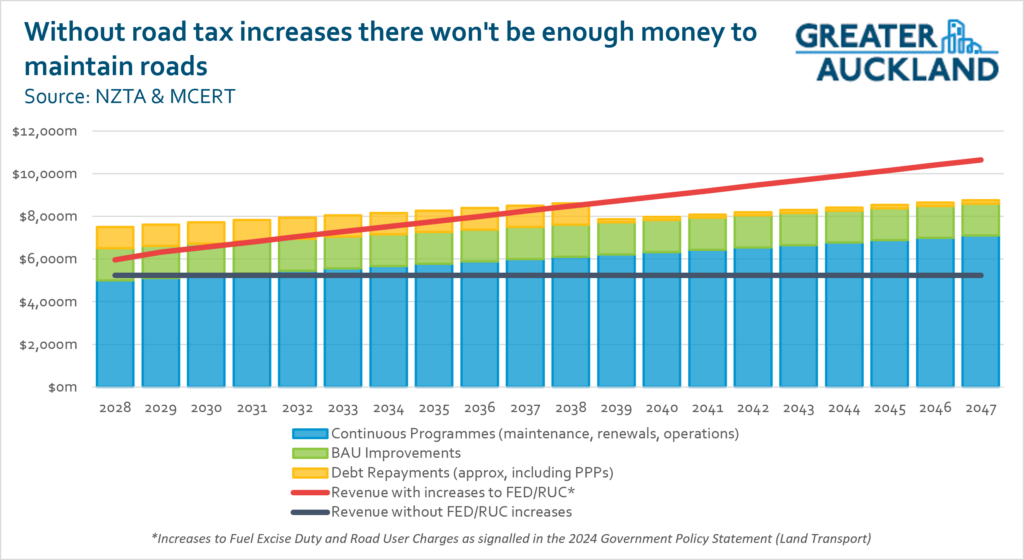
That dark line cutting across the future expenditure is what will happen to transport funding if the government – of whichever stripe – doesn’t raise fuel taxes and road user charges. You can see how it slices across continuous programmes: maintenance, renewals, operations.
What this means is that future trade-offs won’t be about which major new project can or can’t be funded. Forget being anywhere near having a single spare dollar to invest in anything new, no matter how necessary.
Rather, we will be rapidly facing serious compromises on truly fundamental stuff – like whose public transport services get cut, where; or which large parts of the transport system we simply can’t continue to maintain.
Are both major parties abandoning the National Infrastructure Plan?
The second issue with last week’s announcements is that they completely contradict what both major parties have been saying over and over again about the Infrastructure Commission’s National Infrastructure Plan. How much they like it, how proud they are about getting more bipartisan agreement, and how they’re putting short-term petty politics aside when it comes to infrastructure, etc.
Let’s look at what the National Infrastructure Plan says about how the transport system is funded, and what needs to change.
Firstly, the National Infrastructure Plan says transport should return to being mostly user funded – so Crown money from general taxation can be freed up for use on things like hospitals and schools (and emergency recovery events) that are far harder to fund through user charging:
Return to a system funded predominantly by user charges. Doing so will give agencies like NZTA direct feedback on whether users are prepared to pay for investing in and operating land transport networks. There are some possible exceptions, including the ongoing use of rates to co-fund local roads and public and active transport, as well as cross-subsidies for public transport, active transport and rail initiatives that allow for more efficient use of existing networks. Crown funding can also play a role for emergency recovery events. In general, the funding model should shift to a state where Crown loans and grants aren’t required for land transport.
Then the Plan explains how these user charges haven’t kept up with inflation. This means their real value has declined massively over time, requiring ongoing top-ups from general taxation:
Revenue levels should reflect the cost of operating, maintaining, renewing and improving networks. There is currently no prescribed methodology for setting fuel taxes or road user charges, meaning charges can end up too high or too low.71For example, the Government may hold user charges down during periods of high inflation even as the cost of operating the network rises. In recent years, revenue collected per kilometre travelled has been about 30% below the historical average despite elevated investment levels, reflecting short-term decisions to cut petrol taxes in response to inflation.72 Transport also generates wider costs, like air pollution and the health system impacts of road crashes, that are not currently factored into user charges, but could be considered as part of future revenue-setting approaches.
The plan also notes the dramatic reduction in value (or, “purchasing power”) of the National Land Transport Fund since the last time fuel duty and road user charges were raised:
User charges also need to reflect users’ ability and willingness to pay. Charges may need to increase to overcome price freezes, which contributed to the NLTF’s inflation-adjusted purchasing power falling 21% since the last increase in FED and RUC.
Where does this leave us?
The long and short of all this is that both major parties have basically tossed the National Infrastructure Plan onto the bonfire, so they can revert to their worst instincts of politicking over who is promising to increase taxes and who isn’t.
But the really tough questions about how to fund the transport system won’t go away.
Even with the RoNS now essentially cancelled, the next government will have to face seriously tough choices when it comes to transport. And if they’re going to continue to let the National Land Transport Fund shrink in real value, those decisions just got way harder.
Everyone, from media to voters to advocates and industry, should be asking these questions, and more:
- Will the next government take a huge amount of Crown funding away from hospitals and schools (and emergency response preparedness) and instead spend it on topping up the transport basics?
- Will they underfund maintenance, and let our roads fall apart?
- Will they have the guts to cancel the Warkworth to Te Hana PPP and save the country billions?
- Will they gut public transport services around the country, just when New Zealanders most need options that provide alternatives to driving and reduce our collective exposure to fuel price shocks?
And by the way, if our elected leaders won’t sensibly fund the maintenance and operations to keep going with the transport infrastructure New Zealand already has, there is zero chance of any new major projects – so get ready to wave goodbye to new rapid transit lines like the NW Busway, let alone a new harbour crossing for Auckland.
Related reading
Henry Cooke, The Post (opinion), 29 August 2026: National’s attacks on Labour’s fuel tax freeze incredibly hypocritical
The last time fuel taxes went up was in July 2020. In the six years since then pouring concrete has got a lot more expensive – civil construction inflation is up a cumulative 36%, so whatever $1 million bought you back then can now only be had for $1.36m. But the amount raised by fuel tax for every litre of petrol has stayed constant.
Of course, New Zealand hasn’t stopped building or maintaining roads in that time – the nation has just stopped paying for them through fuel taxes. The land transport programme has seen $8.9 billion in top-ups over the last six budgets, not including either the Roads of National Significance programme, loans made to the fund from the Crown, or the forward spending forecast in this year’s Budget. Add those in and you get $29.6b – including roughly $20b under [Nicola] Willis herself.
This is not how the “user-pays” transport system is meant to work, and means billions and billions of dollars that could be spent on hospitals or schools or frigates or superannuation is going to roads. And it would get far worse if another three years of fuel tax increases were deferred, as Hipkins has pledged.
Kerre Woodham, Newstalk ZB (opinion), 28 August 2026: Politicians need to stop ruling out raising the fuel tax
The thing with taxes and excise duties, tariffs, whatever you want to call them, they provide an income. Without money coming in, as Transporting New Zealand pointed out, there’ll be no money for new roads, for roading repair and maintenance, and any money saved from not having to pay more for petrol will show up in the cost of living through the increased price of goods because it’s going to take longer for trucks to get places.
…
Because the issue is, if you’re not putting more money into roads, you get potholes everywhere, you get bridges that get washed away in major cyclones that can’t be rebuilt, you get road closures that can’t be fixed up.

 Processing...
Labour’s announcement makes me really worried they simply don’t have a clue about the transport portfolio. I’m not even sure who their spokesperson is, they certainly haven’t said anything memorable or dug into the mess Simeon Brown left.
Given Labour struggled to be effective in transport, even under Twyford and Wood who knew their stuff but trusted govt officials far too much, it’s really hard to feel optimistic that a change in govt would help fix the mess we face.
Depressing.
A change in government might not help with Transport but is needed for many other reasons.
I agree that both of the two larger parties have dropped the ball, which is why I will vote Green again.
Cancelling user pays for roads due to the cost of living crisis is a direct handout to the Oil Companies. The oil companies get to recover their increased costs through higher fuel prices and new roads still get built (inducing more traffic) by pulling funds away from hospitals, schools and social housing. Sickening!!
Lets’ hope we get a change of Government and Julie Anne Genter from the Greens gets Transport. Julie Anne has the knowledge and experience to do this role and the Greens have the balls to say no to the Fossil Fuel lobby.
road to zero was a fantastic initiative.
It was a vision of reduced DSI – not zero. It was funded billions.
NZTA successfully didnt install median barriers and other mandates – this was the true failure, and its legacy of appropriate speeds around kids easily undone with the stroke of a pen
Labour is too busy fighting on the left to have anything sensible to say about anything. Because of the current crop of idiots in Labour we will all have to endure another 3 years of the clown show that is the current government..
It’s Tangi Utikere, very pro rail and public transport.
Bit this is not really about transport , its about the no new taxes battle between the 2 major parties.
Its a real worry where all this is heading. All parties seem to be abandoning sensible neoliberal policy like user pays and private investment so they can look like they are tackling the “cost of living crisis”. Many other rich countries are doing similarly stupid things (USA / UK / Australia for example), unaware of how good they actually have it and what this will lead to.
The last thing the country needs right now with an ageing population is more public debt and more reliance on the government for our day to day lives.
Yes it is pretty obvious that what an ageing population needs more than more duplicate over-capacity new highways is a fully functioning health system.
Especially ones current govt are forcing future generations to fund (through PPPs and debt), while also restricting immigration, when a consistently growing population is the only way to be sure taking on more debt is sustainable.
Investing in valuable infrastructure is also more sustainable when taxation is fairer and not so low.
All such short term electioneering. How to get away from that?
“Sensible neoliberal policy”
Not heard that one since about 1989.
Cheers for the larf
labour + national are addressing the cost of living by keeping petrol cheap(er)
Thats sending very clear market signals to invest in petrol vehicles.
With polluting car penalties being 1/10th of those of Australia and a fraction of the UK’s, a UK imported V8 petrol range rover with a couple of jetski’s on the trailer is the winner in this high carbon subsidy war.
We can understand Hipkins saying cheap petrol for the people – but where is the conversation, the interview challenging this decision. GA – your points are on point, but this just comes across to the masses as Labour for cheap petrol.
Conversely – any party who wants generational infrastructure planning is keeping their heads down at risk of losing votes. Our voting system is setting us up for the fail.
Do “the masses” want hospitals?
If there was a party offering zero taxation, i believe they would lead the voting in this country. How about “Kiwi Tax Free” has a nice ring.
Your Hospitals? question is way too sophisticated and too many intellectual leaps away from where do our taxes go.
It is a user pays system, and the users don’t want to pay.
Can we increase term limits to 5 years, the campaign cycle is taking a toll on my sanity. Seeing the smiling faces of politicians plastered on billboards all over town brings me no joy.
We need major checks and balances added to our parliamentary governance system before increasing the executive’s term.
Hell no. Five year terms has ruined the UK.
4 years is optimal. 3 years is too short and 5 too long.
3 is fine. If a gov is good they’ll be re-elected, vast majority of our govs have been re-elected. The only check and balance we have on the gov is 3 year terms, so reducing that is just bad.
Another example of good politics but bad policy.
No new taxes, means current taxes, income and gst, need to be set at too higher rate to generate the required income to provide necessary services.
And probably the worst example of this, is how road user taxes, including petrol tax, is currently insufficient to pay our current roading costs, necessitating a substantial transfer from income and gst tax. Or even more borrowing, including the very substantial, but hidden, borrowing inherent in PPP roading arrangements.
We need more, and more targetted taxes, to reduce our income and gst tax burdens.
Capital gains tax is a start, but migrating petrol cars to the common system with other power options, and then setting road user rates, to more closely align with road strength and maintenance requirements of increasing vehicle weights should be a no brainer.
Labour needs to break free of National setting the tax agenda, by instead selling rational tax alternatives, including even more targetted new taxes, that can therefore allow lowered income and gst tax rates.
Really wish someone was bold enough to say they would save money on projects like NW Busway ( and hope the student hit by a car this morning at the Te Atatū interchange is ok) by repurposing lanes to give PT benefits at fraction of the cost.
Both parties will walk back this position as part of coalition negotiations.
National will use ACT as cover to walk it back and implement user pays.
Labour will use the Greens and/or TOP to walk it back.
“RoNS now essentially cancelled”
Except National have stitched up future governments; including any future versions of the National government, with the Warkworth to Te Hana PPP.
That really screws over future generations; and Simeon/Chris B should be held responsible for this decision
Well, you say that, but we also don’t want the constant yo-yo of projects being approved, cancelled, approved, cancelled that comes with changes of Government. Part of the mess we’re in has been Labour and National not wanting to scare off votes…which results in them doing nothing.
I think Wellington has broken the NLTF and the user pays concept of road funding by making political commitments to transport projects ahead of any conceivable funding source (RoNS was $50 bn in the red before Bishop unofficially canceĺled it) and the NLTF further lost its social license by significantly underfunding particular regions across multiple 3-year build periods, such as South Island regions.
The original concept of the NLTF with fuel taxes going into a centralised fund dates back a century to the Main Highways Act of 1922 – it is time for an overhaul.
I certainly think public transport should be separated off. Auckland has made huge advances in its congestion free network. The city couldn’t function without it. Wellington likewise couldn’t work without its trains. Greater Christchurch which is New Zealand’s second fastest urbanising city by a wide margin deserves a chance to build a similar network.
Vital city transport networks being the poor cousin to a failing transport fund originally conceived to build a nationwide highway network is clearly a dysfunctional policy prescription.
Alternative funding options, include France’s cities being able to access a small payroll tax of 1 to 2% should be considered. This would require a genuine commitment to devolution rather than the delegation model we see in NZ. It should incentivise good behaviour (cities that make good decisions that attract workers and productive businesses get more revenue) rather than compelling whatever behaviour particular Transport Ministers and officials have a bee in their bonnet about.
https://www.centreforcities.org/blog/should-transport-in-london-be-funded-in-the-same-way-as-in-paris/
Another option (perhaps complementary option) is New Zealand adopts Japan’s laws on land readjustment. Not only does this fund and plan a significant proportion of Japan’s impressive urban infrastructures, it is also responsible in one form or another for 30% of the country’s urban development.
https://worksinprogress.co/issue/how-to-redraw-a-city/
Given the narrow and simplistic narratives coming from the two main political parties I am not hopeful that successful reform will be implemented. But maybe eventually, after repeated failure, what has been a success elsewhere will be adopted in NZ.
An example of how broken the NLTF and NZTA has become is Greater Christchurch’s two busiest bus lines cannot get funding to expand their service. The fact tha patrons frequently miss scheduled services because buses can not stop because they are already over capacity is not considered evidence an immediate upgrade is essential.
Basically the system is broken. Labour and National’s silence in the face of piss poor performance is pathetic.
https://www.thepress.co.nz/nz-news/361069289/fury-revelation-government-fuel-relief-public-transport-came-price-upgrades
Furthermore, as competition in the petrol market is imperfect, ‘freezing’ the tax likely benefits retail profit margins more than it reduces prices for consumers anyway. Basically a gift from Aotearoa’s taxpayers to BP.
Labour is scared witless of losing the election by being tarred by the tax brush. No wonder – considering they got nothing to get people enthusiastic about voting for them, they might even be right. So they have no real convictions or courage, because they are constantly looking into the mirror and comparing themselves to National (“Like them bit a bit nicer! Vote for us!”).
We can take solace in knowing that parliament will eventually run out of people to blame for their poor decision making and will have to accept that their foot-shooting is a big reason for political discontent in this country.
On the other hand, bad information leads to bad choices, so there is a lot of blame to be attributed to the machine feeding the ministers bad information.
Thankfully there are other parties. E.g. https://www.thepost.co.nz/politics/361070485/opportunity-refuses-back-freeze-fuel-tax
Just stop building roads then. We do not need them. We have rivers and sea, plus tracks for trains.
We do not need roads for anything.
The legacy political parties are stuck in the late nineteen seventies.
This is twenty twenty six, we are sinking faster than when Split Enz released “six months in a leaky boat!”
Bah humbug
The question to ask first and foremost is “is this affordable”?
We have a cost of living crisis with no end in sight. Costs including rates are rising much faster than incomes, so the question has already been answered. It’s no.
NZ needs to stop pretending it’s a rich nation, and reduce spending to what the people can afford. Otherwise it’s just a spending race to financial oblivion, and for what? There’s no reason to do it.
Get stuck in to gutting regulations and compliance requirements. Make government (central and local) smaller is what is needed. As a country we need to live within our means, and that means accepting we are not rich and cannot keep spending as though we are.
ACT party should be all over cycling. It is the ultimate in libertarianism – pure individual effort, no being chained to expensive overheads imposed by corporates and government, extremely cheap infrastructure (many of us mountainbikers even go and build our own tracks), minimal regulation needed, and so on.
So that was what the mystery $ 450 million allowance in the last budget was for.
1) As long as there is enough fuel excise tax to support maintenance, operations & services the basic transport system will survive.
2) Whilst general tax and fuel excise taxes come from slightly different components of society they are both revenue withdrawn from NZ Inc by the govt.
3) The biggest issue is what is the overall BCR for transport spend verses BCR’s for spending on hospitals or social housing etc. The solution to that equation should define the level of transport spending.
4) Given the poor BCRs on the RONs projects, it suggests a lower spend on transport targeted at high BCR projects would be appropriate and free up funding for other major issues NZ Inc faces via taxation.