This is a guest post by Darren Davis. It originally appeared on his excellent blog, Adventures in Transitland, which we encourage you to check out. It is shared by kind permission.
Prologue
It’s been 25 years since the Bay of Plenty has had a regular passenger service in the form of the Kaimai Express. And May 2026’s Glenbrook Vintage Railway excursion train was apparently the first passenger train to enter the Bay of Plenty in over a decade. And it sold out in record time – less than two days – with minimal publicity. Which kinda shows some sort of latent demand for interregional passenger rail in Aotearoa.
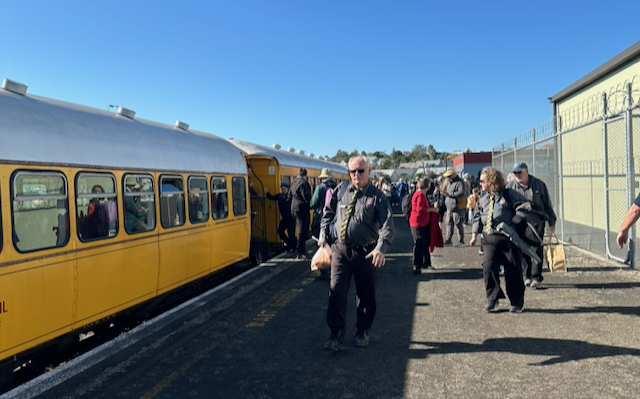
What shouldn’t be a once in a decade plus shot – a passenger train boarding actual passengers at the east facing platform at Hamilton Frankton Station. Photo credit: Darren Davis
This absence of regular passenger rail service is in spite of the fact that the Bay of Plenty forms one leg of the Upper North Island’s Golden Triangle, home to 40 per cent of Aotearoa’s population, whose rail network carries 30 per cent of Aotearoa’s rail freight.
And as a reminder that such a thing actually existed back in the day, below is the timetable of the dear departed Kaimai Express, which ran until 2001.
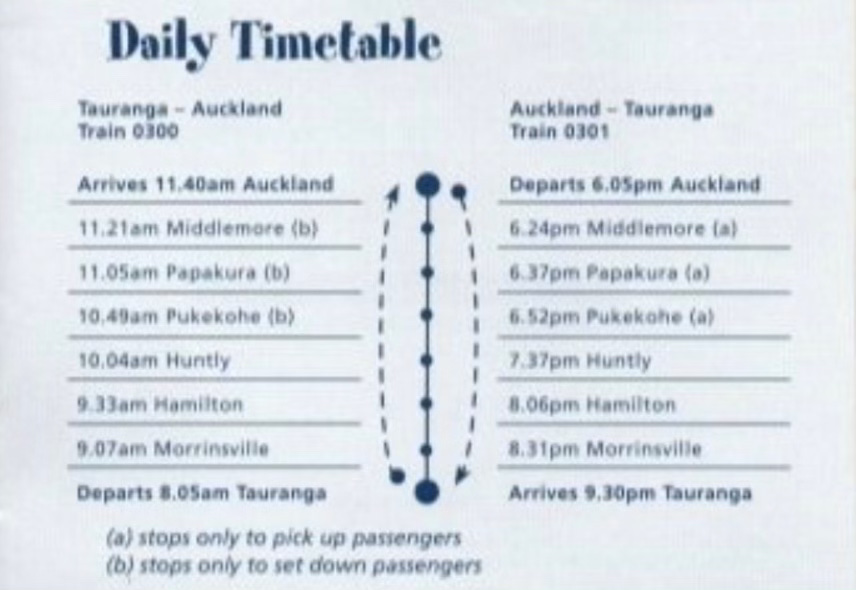
Kaimai Express timetable up to its enforced demise in 2001
I have previously written about the case for restoring passenger rail to Toi Moana/ Bay of Plenty here. So worth having a read of this for my views on the case for rail to the Bay of Plenty and a possible Te Huia based option.
What are the options for restoring passenger rail to Tauranga?
So what would it take to get passenger rail back to the Bay of Plenty? Quite a lot in fact. The elephant in the room is the constraint presented by the Kaimai Tunnel as well as the cost of addressing decades of underinvestment in passenger rail in Aotearoa.
But that doesn’t mean that it’s impossible, just difficult and likely expensive. As I see it, there are two basic options:
- Extending the current Auckland to Hamilton Te Huia service to Tauranga
- New battery electric multiple unit service
Both options would require work on the Kaimai Tunnel to make it safer for train passengers and rail crew. So let’s dive into the options.
Te Huia to Tauranga
I have covered this in my earlier piece so in case this content looks familiar, it is as it paraphrased from my previous blog post on the subject.
Extending Te Huia to Tauranga is the (multi) million dollar question, and we shouldn’t kid ourselves that this will come cheap. The five-year trial of Te Huia between Hamilton and Auckland – now extended for a sixth year – ended up costing $98 million. But it also set a solid basis for building on this investment and extending its benefits to Tauranga and the Bay of Plenty, assuming of course that the service becomes permanent in 2027.
So the logical way to go is to build on what we’ve got and take it further – to Tauranga. And this means an extension of Te Huia to the Bay of Plenty.
Let’s assume for the sake of argument that the current 9:30am Te Huia departure on Thursdays and Fridays become Monday to Friday services (i.e. adding in Monday to Wednesday trips), then an extended service could start in Tauranga at 8:00am and get to Auckland Strand at 11:54am. The return trip could be an extension of the current weekday 5:45pm departure from Auckland Strand would arrive in Tauranga around 9:50pm.
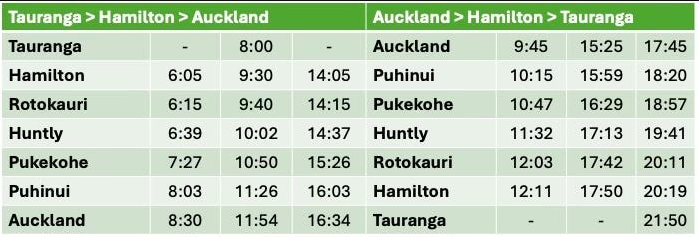
My hypothetical Te Huia to Tauranga timetable
At weekends, based on extending current services in the Te Huia timetable, this could be a 7:30am departure from Tauranga on Saturdays and a 1:15pm departure on Sundays and public holidays. Return trips would leave Auckland at 5:30pm on Saturday and 6:15pm on Sundays and public holidays with late evening arrivals into Tauranga.
These are not absolutely ideal times, especially the late arrivals into Tauranga, but we need to be careful not to make perfect the enemy of good. But to make this work, we would need to address the 8.879 kilometre long elephant in the room – the Kaimai Tunnel. At the moment, a combination of a large number of daily trains from the Port of Tauranga to Metroport in Southdown in Auckland and the time required to clear the tunnel of diesel exhaust emissions severely constrains the potential slots available to operate passenger trains through the tunnel. More on this later.
Battery electric train option
The simple logic of this option is that Aotearoa is investing $900 million in battery electric trains to run improved, and hopefully faster, services on the Wairarapa and Manawatū lines in the Lower North Island. There is a narrow window of opportunity for the Upper North Island to add its requirements to this order, to achieve some economies of scale in terms of the size of the train order.
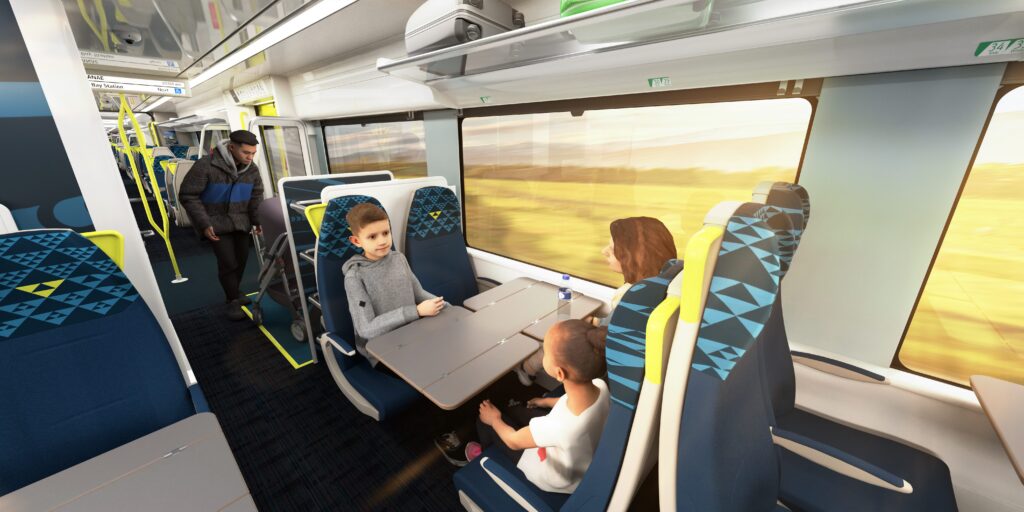
Render of interior of Tūhono Lower North Island battery electric trains. Image source: Horizons Regional Council
There are some technical differences to address, such as differences in platform heights between stations in the lower and upper North Island (why a country as small as Aotearoa can’t standardise platform heights is quite beyond me), but I have been advised by people with rail technical know-how that this is far from an unresolvable issues.
But the biggest technical difficulty is that the current battery range of around 80 kilometres would require the approximately 76 kilometre gap in North Island Main Trunk electrification between Pukekohe and Hamilton to be closed first, and probably extended as far as Morrinsville on the East Coast Main Trunk from Hamilton along with the ability to fully charge up the train battery overnight in Tauranga.
KiwiRail has done a lot of work on the electrification of the Golden Triangle rail network in the Upper North Island which I have previously covered in this blog post which I recommend reading.
In a presentation to the Waikato Regional Transport Committee on 9th March 2026, KiwiRail outlined the following updates to this work.
- Currently completing the Detailed Business Case to identify the best and preferred electric solution plus the staged delivery pathway.
- After this it is expected that further work on the funding options will be discussed with key stakeholders. This will include exploring funding options for the delivery stages from within KiwiRail and potential Government budget bids.
- It is also likely that further technical work will be recommended on the preferred option to further increase confidence in the programme estimates and help narrow the risk contingency range.
It’s clear from this that Golden Triangle electrification does not seem to be anyone’s fast track. And as this electrification is a precursor to a battery electric train option to Tauranga (which notably is a viable option for replacing Te Huia between Auckland and Hamilton as the electrification gap is around 76 kilometres, within battery range), extending the current Te Huia diesel train service to Tauranga seems to be the only viable shorter term option.
The elephant in the tunnel
The elephant in the room is the Kaimai Tunnel. While passenger trains do run through similar length tunnels around 9 kilometres long (Remutaka Tunnel for the Wairarapa Line and the Otira Tunnel for the Tranz Alpine train) with a range of precautionary safety measures in place, the issues with ventilating the Kaimai Tunnel requires lengthy gaps between trains to clear out the exhaust emissions in the tunnel. These lengthy gaps were in play for the recent Glenbrook Vintage Railway excursion, requiring a late departure from Tauranga to fit in with an available tunnel slot.
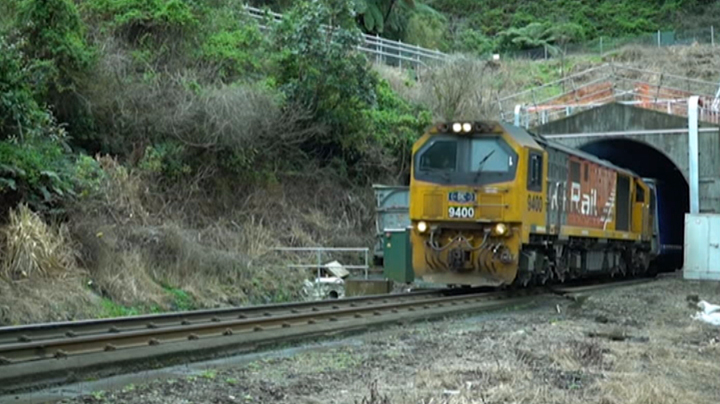
Freight train emerging from the Kaimai Tunnel.
Given that the ventilation issues in the Kaimai Tunnel are a clear and present health and safety risk for the KiwiRail locomotive engineers and maintenance staff whose work involves the tunnel, it would seem that addressing those issues would deliver a win-win for both KiwiRail’s freight operation, which would have more slots available and equally a win for slots for passenger rail, not contingent on waiting for an available gap around a busy schedule of freight trains.
Final thoughts
While advocacy groups such as Future is Rail and Tauranga Connect have been energetic in their advocacy for passenger rail in the Bay of Plenty, elected members at all tiers of government have been rather less energetic in their advocacy. Without this political drive and momentum, noting a forthcoming national election in early November 2026, it is hard to see much action forthcoming unless it becomes an election issue.
It took the Waikato a decade of solid and highly energetic political advocacy to get Te Huia off the ground between Hamilton and Auckland. And it’s going to take solid and highly energetic political advocacy in the Bay of Plenty to get passenger rail restored east of the Kaimai Ranges in the Bay of Plenty.
Greater Auckland’s work is made possible by generous donations from our readers and fans. We’re now a registered charity, so your donations are tax-deductible. If you’d like to support our work you can join our circle of supporters here.
Make sure to check out Darren’s blog here.

 Processing...
Some second-hand railcars from Aus / Asia would probably do the job
InterCity run a bus at 7.35, reaching Auckland at 11.15, so how much demand would there be for a train leaving 25 min later and arriving 39 min later? Until 2001 trains left 30 min later and arrived 25 min later, but still there weren’t enough passengers to keep it going. It’s 237km by rail, but only 200km via SH2 for a car journey of under 3hr. The Paeroa to Pōkeno link would have cut the rail distance to about 217km, but until electrification brings faster speeds, how likely is it that a train once a day is going to succeed? Billions have been spent on the roads. A fraction of that spending would produce a railway able to compete.
Whilst scenic, the road trip either way is congested , and often delayed. But yes , they really need to cut a 1/2 hour out of the Hamilton – Auckland time.
Inclined to agree, I think it will need a pretty bold vision to make something like this successful. Half-hearted and slow rail is not going to do it.
Part of the resistance to passenger numbers will be the fact that Ham and Tga don’t have great public transport, and are highly car orientated cities. That means we aren’t designing a network that links up metro systems, but rather are trying to compete with the cars that probably ~90% of the adult population of each city already owns. Given that te huia is already slower and more costly than driving, the pool of users for intercity rail remains fairly small.
The uncomfortable reality is that to get a from my place in Hamilton to the train station using PT is about a 45min trip if being realistic (walking to the bus stop, margin for error, etc). By that time a car would already be closing in on the bombay hills. The ~$30 per person fare would be more than the fuel cost, which when you have high car ownership is the only marginal cost that people consider.
Not trying to be antagonistic, just stating some facts. Since the late 1990s car ownership per 1000 people has gone from 600 to 850 and this is a massive headwind for trying to get non-urban PT projects moving. I would love to see us go back to ~600 cars per 1000 people, where non-car ownership was normal and households had just one car, but it won’t happen overnight.
Unfortunately our cities have already been built for cars (sprawl), which makes it difficult to get anywhere without using a car. For rail services to be competitive, dense housing need to be built close to station catchments, not way out in the suburbs like has been done in Auckland.
There are five to eight return plane flights between Tauranga and Auckland each day. The lack of great public transport doesn’t seem to stop people catching planes.
Despite it’s slow speed Te Huia is getting around 60 people per train on average. When the last services between Auckland and Hamilton ran it was in single figures, despite them being quicker.
While there is room for improvement, the populations have all grown significantly during that period and I think there is plenty of evidence for demand for intercity public transport.
You wonder how much either shade of government is holding back on rail infrastructure in this area because services might well cannabalise Air NZ, resulting in bail out/additional support money further down the track. A double-cost, if you will.
Electrification of the Kaimai tunnel is required regardless of any passenger services.
Required just to remove the health hazard of diesel fumes on railways staff in the tunnel and remove the current limitation these impose on frequency of rail operations.
Completing the electrification of the Golden Triangle would be a huge enabler of unlocking the unrealised potential for moving both freight and people in the most populous part of our country.
But it would work very much against the interests of those hidden submitters to the bill to remove climate change liabilities from big polluters.
You would think electrifying the tunnel section loop to loop , or to Whararoa ( to pick up a power feed ) wouldnt be too expensive. Just have an EF tow all trains through .
Don R – Kiwirail is developing a business case called Golden Triangle Electrification Programme – (GTEP) for its shareholder – the government, to electricfy Pukekohe to Frankton to Ruakura or Morrinsville, installing ETCS 2 train control, using battery’ electric locomotive’s similar to Stadler’s EURO9000, with battery recharging locations at Southdown (Auckland), Mission Bush Steel Mill (Auckland), Te Rapa, Hautapu, Waitoa, Tauranga, Kinleith, Kawerau and Murupara.
This would help in the introduction of battery/electric (25kva) passenger train services between Auckland, Hamilton, Tokoroa, Te Kuiti and Tauranga/Te Puke and between Hamilton and Palmerston North from 2035.
KiwiRail needs to be more active, and visible in selling this to political parties, especially the two majors, the local authorities, and to the public.
Public pressure can translate into political pressure, as the really quite spectacular progress in Auckland Commuter Rail has demonstrated over the last three decades.
Likewise, for firstly just the retention of regional rail, and then expansion and upgrades out of Wellington in the same period.
Don R – Under the current business model of Kiwirail Holdings Ltd T/A as Kiwirail, being a rail freight and logistics operator, I don’t see Kiwirail going into subsidised ‘public transport’ style and/or non-subsidised ‘book & travel’ passenger rail, as they are currently happy with their Great Journeys NZ ‘scenic’ passenger rail operation.
Subsidised ‘public transport’ style intra/inter regional passenger train services like the business and operating model of Te Huia and lessor extent the Capital Connection, will be up to the 13 regional public transport operating authority’s to develop, plan, fund with central government finance and rate payer assistance, as seen with Te Huia and the revamped Capital Connection train services using new ‘Tuhono’ Class battery/electric train sets from 2029.
With regards to non-subsidised, commercialised ‘book & travel’ long distance passenger day/night train services between Auckland and Wellington, Picton and Dunedin or Christchurch , Dunedin and Invercargill would be owned and operated by a private ‘for profit’ train operator.
Thanks for your posts on where, at least some people are working within KiwiRail, on a scheme to electrify the Golden Triangle, and even provide the means for others, most probably the territorial councils, to provide regional rail using BEM trains. It all seems quite sound thinking.
Progress beyond concept though, is firstly dependent on achieving political patronage. Do you have any feelings about progress here with our various political parties? and are kiwirail actively engaged in presenting, and selling, this scheme?
Like the CRL, progress beyond concept, will require a champion, or champions, to make it a public, and therefore a political issue.
So far there is no sign of any Len Brown on this issue, but Chris Bishop is perhaps a little more distant from our NZTA RONs promotion cabal.
Especially with the current scrutiny of NZTA roading procurement and contract management shortcomings.
Can’t they use tri-mode or just diesel-electric with enough battery pack to get through the tunnel (~10km of range, not 80km)
Ideally full electrification of the main lines between Akl-Ham-TGA, but seems like replacing the locomotives/engine units is a relatively low hanging fruit that is much more likely to be done in the short to medium term, and if tri-mode is selected, they can be kept and get more efficient over time as more of the of easy to electrify sections are completed.
Electrification of the entire line from Te Rapa to Tauranga should be the goal as this would deliver multiple, sustained and ongoing benefits. Locos for freight and passenger could all be electric, reducing the use of fossil fuels. Trains would be able to use the tunnel with time-efficient schedules. Carbon emissions would be eliminated. Services would be contiguous and faster.
As usual, this country can find plenty of money to build new roads and vehicle tunnels but can’t find enough to complete what has already been done. Everything ends up being a “stop-gap” measure rather than seeing things through until we have a proper system. Just in the same way that we know when lines are ripped up that they never go back down, if they only run electrification part of the way from Te Rapa to Tauranga it will likely stay that way and never be extended.
The Central Rail Link is supposedly our biggest ever infrastructure investment. I personally think the constant refurbishment and upgrades to our road network are a much greater waste of time and money than a nice little subway extension that will make train travel direct competition to the motorway.
What would be the logical next step? Given we have a very successful passenger service from Tamaki to Kirikiriroa, Tauranga makes sense. We contain between us perhaps half or more of the people in our motu, so we are responsible for more evil emissions than the farmers, although cows balance us out in terms of evil.
We cannot change the reliance of our economy on farms easily, but we could easily make travelling by train more easy.
Connect the dots. Tauranga next. Three highly populated cities connected by a modern transport network (also a not so modern transport network).
Less car crashes, less motorbike crashes, less truck crashes, less cycle crashes, less pedestrian mortality: LESS CRASHES.
Less life lost. Less drunk in charge of a vehicle, again, and again and again.
Quality of life improved, chance of death lowered.
Who could argue against such an outcome?
bah humbug
I think the train from Tauranga to Auckland would be so good as I would take it so would other people that don’t have a car as it would mean you can get off were you want to love the ideal
Next time we have a tunneling machine in the country drill another tunnel then build another line to take fast passenger trains .These are needed to be a lot faster than the freight trains and more frequent .Yes it would be a big INVESTMENT but would be cheaper than 4 lane RON money pits .
No need for a second tunnel at the moment. With the right signalling and ventilation (or electrification) the tunnel could handle 4 tph. This is more than enough for passenger train each way every hour.
We had a TBM and tunnellers in New Zealand to dig CRL in 2019-22. The sensible thing would have been to use this skill and equipement for the next generation of rail tunnels, e.g.
– Bombay Hills base tunnel (cutting off three sides of a square via Pukekohe)
– Second Kaimai tunnel (for higher capacity and to allow both bores to be electrified without disrupting services)
– Paekākāriki tunnels – replacement with long, double-track tunnel under the Pukerua saddle
– Straightening out wiggly bits of line (practically everywhere in New Zealand)
Instead all the tunnellers have left NZ and it’d be an expensive effort to get them all to come back to dig again.
A regular TBM is not that expensive, ($30-$50m) but are usually bespoke based on the type of ground they are chewing through,
You can get multiple condition ones, but they tend to be much more expensive, and in terns of the cost of a tunnel the main cost is not the machine, its the army of people running them and all the stuff like the 1000s of concrete curves they install as they progress..
Unless NZ can create a tunnel “pipeline” of continues work, its always going to be a case of being a series of one off jobs..
The tunellers will be back shortly! The Warkworth to Te Hana Motorway is about to start. I believe theres an 850m tunnel to bore. Then theres the Brnderwyns?
Ew, motorway tunnels
$22 billon should be going towards public transport rail, and local road improvements ALL across Aotearoa, benefitting everybody. NOT a vanity road for upper class boy racers to get to their holiday mansion a few seconds faster.
Tell me who would use this Train service to Auckland not for shopping
train station is a good walk to down town centre .The bus goes wright into
the centre
I have suggested it before but for sake of consistency I will post it again. Run the existing sets to Matamata with connecting buses to Tauranga and Rotorua.At least there is a platform there. And yes Kris I know Kiwirail don’t want to run the DF driving end first but there is an option to turn the train on the triangle at Waharoa. And you have talked about them using upgraded DL’s. I suppose Kiwirail could even find another excuse why they couldn’t do it. How about we can’t reverse at Matamata. We can’t run the locomotive around the train because the crossing sidings have been removed. My point is we need to start somewhere. The tunnel is difficult I get that hence the compromise. At least doing this picks up two destinations instead of one plus two smaller Waikato towns. Although the next move for Te Huia should be stations at Pokeno, Tuakau and Te Kauwhata. Doing it this way keeps the train part of the journey in the Waikato so no need to involve bay of Plenty too much although they could integrate the buses with there own bus networks.Use the existing slots in Auckland network means no involvement of AT other than what they grudgingly already give is needed.
Who wants to get a bus over the Kaimai Ranges? Part of the appeal of the rail tunnel is that it’s completely flat – a much nicer journey*.
Also, going by train eliminates the nead to use Tauranga’s road system, which is always a good thing.
*See also: Remutaka Tunnel
Royce – Once the CRL is operating, the DFB’s will not be allowed to operate on the Auckland metro rail corridor’s as they will not have ETCS 1 train control system fitted, hence the DL fleet is in the process of being fitted with ETCS 1 system’s allowing them to operated on the corridor’s after CRL is open.
Te Huia’s current two 4 or possibly 5 carriage DL hauled consists will be required to operate between Hamilton and The Strand hopefully from August 2026 with a new Te Huia’s new timetable and increased frequencies hopefully from June 2027 under the new funding cycle and the release of additional path slots from AT and AOR.
Any frequent inter-regional ‘tap & travel’ passenger train services between Auckland, Hamilton, Tauranga/Te Puke, Tokoroa and Te Kuiti will be battery/electric (25kva) train sets based on the final production specification’s of Wellington’s new ‘Tuhono’ Class battery/electric train sets, if DBFMO (design, build. finance, maintain and operate) PPP procurement is approved by late 2028 for delivery of the first train sets from 2035.
KR’s long term loco plans appear to be to dump a fair chunk of the DLs,
It looks like they currently have 5 DLs with ETCS retrofitted , but the ride results weren’t great …
Longer term KR said they intend to use 19 of the new DMs in Auckland as they will have ETCS factory fitted…
https://www.kiwirail.co.nz/media/kiwirail-partners-with-stadler-for-new-low-emissions-locomotives/
greenwelly – 15 DL’s of the 73 DL’s have have been withdrawn from service due to unreliability issues and stored at Woburn.
Those DL’s currently assigned for freight duties travelling on the Auckland metro rail network between Auckland, Whangarei, Hamilton, Tauranga on the ECMT and those being used on long haul freight duties between Auckland and Palmerston North including the 5 DL’s with increased speed for Northern Explorer and Te Huia duties are being fitted with ETCS 1.
Yes, 19 DM’s assigned for duties in the North Island will be ETCS 1 enabled.
DL ride above 80km is abysmal. National brought junk that Kiwirail are currently trying to flog off overseas as they were so bad (10+ DLs laid up already).
“What needs to happen” is largely dependant on purpose, i.e. who will the passengers be? If its tourists and the elderly who may enjoy a slow scenic train ride, then organising and marketing repeats of the Glenbrook excursion train could be done at little cost.
Otherwise, it must compete with cars, buses and flying, where time and point to point convenience are important.
The point to point will in most cases be provided metro rail and bus connections, with limited transfers to higher speed intercity rail.
A typical base load of passengers is Auckland Airport, where it should stop to minimise luggage transfer.
Service should run Britomart & Aotea for PT connections & hotels etc, Auckland airport, Pukekohe, Huntly, Hamilton, Morrinsville, Tauranga.
Time means nothing less than tilt trains and minimum 160kmh, requiring grade separation, ETCS, triple/quad tracking metro networks to allow express passenger service, and seperate freight movements.
Staged construction will be needed where possible with this end goal in mind in order to keep costs palatable and I’d expect this to start with the Auckland metro network.
Intercity trains will never go to Te Wai Horotiu, Waitemata potentially but definitely not through the CRL.
Auckland doesn’t even have a “Main railway station”. Britomart isn’t it (despite all the fanfare) because intercity and excursion (steam and diesel) trains can’t use it. The Strand platform isn’t it because suburban services don’t connect to it and is “ersatz” at best.
They’ve got the Intercity buses arriving and departing from Sky City – not at a railway station – you have to walk in the rain to get to the nearest one.
The old Auckland Railway Station on Beach Rd was the perfect candidate – it’s what it was built for! It even had light rail stopping right outside the front door. It should have been returned to being the “main” Auckland station. It could be once again, with some effort – but it seems those in charge don’t have the vision to have a truly integrated transport centre for NZ’s largest city. It’s just madness. People will say “but it was too far from the city centre” which actually isn’t an issue now that the CRL is in place, and they could have built a light rail to replace the trams that used to run from there around to Queen St or up Parnell Rise if it was really needed.
Until such time as we get someone at the helm who knows how to design and run a proper transit system and can secure the funding to enable it, we’ll continue to have the piecemeal operations that currently exist.
Ideally Auckland needs a Central Station equivalent, in Sydney you still have to transfer from intercity trains to catch a train downtown. Logistically makes more sense even though it’s less convenient for out of towners
Excursion trains are irrelevant. Intercity trains could use Waitemata, if they were battery electric like the new Wellington regionals.
Another option is Maungawhau, it will have two almost unused platforms on the main line.
Old Auckland Railway Station doesn’t work well because the tracks to Waitemata cut off the station from the platforms and the shape of the curves mean it’s basically impossible to build suburban platforms there.
So it’s left with The Strand as what remains, that could still work with a suburban platform built on the eastern line tracks back close to The Strand overbridge.
I do think The Strand could have Eastern platforms added. That area could easily shed some big box and some intensified apartment development. If they were high enough, you’d have great views above the containers!
It’s also good for the arena, and a Quay St exit might be helpful for employees at the Port.
Stadler FLIRT Akku has a battery range of 150km (with a 3-car formation having a world record of 224km in winter conditions – 0c). It has a stated recharge of 15mins (although it is unclear what that was – but I thought I read previously it was 0 to 80% just can’t find that anymore).
I think you could avoid electrification of the entire line by developing several charging islands as safe guards.
* electrification from Rotokauri to Te Rapa (2kms) plus electrification of the ECMT platform at Frankton… this would give a decent run under overhead wires to top up the battery before the run north to Pukekohe or east to TRG. (plus the dwell times at Rotokauri and Frankton).
* you could electrify Morrisnville station, again offering a few minutes top up while stopped.
* build a charging island of 5kms near Waharoa, to again top up the battery after the climb from TRG through the tunnel or while waiting for the tunnel to clear.
Whether something like the Stadler Class 93 (tri-mode) to haul freight could solve the emissions issue for the Kamai tunnel is unclear… but I’m sure in a few years there could be more feasible options. (spending billions on full electrification might become unnecessary in the next few years)
Marcel – A modified power (25kva) version of Wellington’s new ‘Tuhono’ Class battery/electric train sets, based on Alstom’s Adessia platform, is being proposed for Golden Triangle passenger rail services initially between Auckland, Hamilton and Tauranga/Te Puke, Auckland, Hamilton, Tokoroa and Te Kuiti and Hamilton and Palmerston North with future services between Auckland, Hamilton and Rotorua and Tauranga/Te Puke and between Tauranga/Te Puke, Matamata and Rotorua once the the Rotorua branch line is rebuilt for freight and passenger train services.
Personally, I think there is significant value in building a modern pair of tunnels to allow for freight expansion as well as enabling passenger trains.
It would be expensive, but it would completely uncap the bottleneck and allow us to plan for long term increases in freight use along the line.
Your posts always feel like breath of fresh air in feed
The main issue not raised here is that this line is single track, and freight to Port of Tauranga will always have priority. Will passengers tolerate sitting at a loop while freight trains pass? Will the freight and passenger timetables be reliable enough to allow a clean run in the required direction? I think this is a much bigger issue than the tunnel.
Not optimal, but not a deal breaker either. There is a freight train roughly every two hours between Hamilton and Tauranga, so a passenger train would generally cross one freight service.
As passenger services grow it will help build the case for double tracking sections and also giving trains with passengers priority over trains with generally non-time-sensitive containers or log wagons.
It’s also trivial to double track large sections of the line, you don’t need to do every last metre.
In 2012 they built eleven new passing loops for $13m and doubled the capacity of the ECMT.
AMF – Under Kiwirail’s ‘Golden Triangle Electrification Programme’ it is planned to operate ETCS 2 train control management system from Pukekohe to Hamilton to Tauranga to allow increase train movements to/from Tauranga including the Port of Tauranga.
Break it up into stages, like the RoNS geniuses do.
Extend the current service out to include Hamilton Central, Morrinsville and Waharoa stations, the latter setting up the route south to Matamata and east to Tauranga. At the same time, sort out the plan for the Kaimai Tunnel. At some time during that process, start Te Puke to Tauranga from the other end (that would presumably be useful in its own right) given all the development between the two (Papamoa).
To do that though, you need the central government committment to a building programme over the next 10yrs. Doubt that will happen under this government, unless Bishop agrees to it under the bipartisan infrastructure plan with Labour, to ensure his own projects don’t get binned next time they are in opposition.
Ok Kris so we wait maybe I won’t see it. I wonder if the Te Huia sets will last the distance. Maybe the answer is just to extend the electrified tracks in sections to Hamilton and damm the artificial barriers the regional based public transport governence puts on us. Presumably we can buy more AM sets. You would have to hope they electrify 10 or 15 Kilometres a year. With all due respect to Greater Auckland my opinion is full electrification to Tauranga would have being a more worthy project than the CRL so there you go. I think there will be demand if a reasonable service can be provided. Have a look at the park n ride in Pukekohe It’s full with many more parked on local streets. It’s a pity but Kiwirail won’t compromise on only operating gold plated services so that’s that. Maybe things might be a bit clearer after the election. I haven’t heard anything from any party yet
Royce, the cars all come from Pokeno/Mercer, you and I both know that.
Stations at those two places would drastically increase Te Huia ridership.
Very true the park n ride was full up at 5.50 am this morning. The new stations at Paerata and Dury will change things again.I am waiting for this to become a political issue for the election. I want to support Te Huia but I still think extension of the Auckland trains should be looked at. The new housing that was built at Pokeno was built there because of Auckland. The regional boundaries are artificial they shouldn’t be allowed to get in the way of common sense.
I live in the London commuter belt in Buckinghamshire. While close to London, TfL has nothing to do with my trains, and not should it. London tax payers subsidise it, not Bucks.
The fares a quite expensive at $80 return for a 30/40 km trip but the trains are always full and where I live is really quite small (Palmy N sized).
Waikato could pay their share. We need to work out what is the best solution that can be implemented reasonably quickly not some gold plated stuff that might be implemented by 2035.
I think before Waikato pays their “fair share” for extension to Pokeno, Waikato would ask for Auckland to open the wallet for Te Huia and the benefits it provides to Auckland commuuters and workers.
Ok look at it like this if the the section between Pukekohe and Mercer was to be electrified in the next couple of years there would be an immediate use for it and enough time to purchase some more AM sets to operate it. I am assuming we would go to Mercer because there is already track which could be used to reverse the units there. Obviously there would also be time to build stations at Tuakau and Pokeno . Maybe there could be a similar case to electrify from Frankton junction to Ruakura so freight trains from the main trunk can run straight through to the inland port. In either case we would be building a section of electrified track which would have an immediate use. The planning can continue in parallel as the technology evolves and freight and passenger needs change. But from what I can see both theses sections will need to be electrified and we already have rolling stock available or at least we can readily purchase more. We can write some more reports or we can act now.
Mercer’s basically empty in terms of passenger catchment. Since Pōkeno Station would have to be built from the ground up, putting a passing track or a stub platform for trains terminating there would probably be more viable.
Also I believe I’ve heard somewhere that there’s some law about trains making journeys significantly longer than an hour needing on-board toilets? Waitematā to Pukekohe is already 1hr 13 minutes, so all the way to Pōkeno would possibly be pushing an hour and a half. Certainly to go all the way to Hamilton you’d want at least one onboard toilet.
Yeah don’t no if there a law but your right its too long. Still passengers could get off at Puhinui there’s easy access to toilets there. I wasn’t advocating for a station at Mercer I was just envisaging trains running there to reverse on to the other track. Still I don’t suppose there’s to much point in agonising over the details. I was just trying to suggest a way forward that didn’t involve waiting till 2035. Still its election year we need some party to take up the cause but even then unless you can get all coalition members to agree you will end up in a similar situation to the light rail debacle. Where NZ first Kyboshed Labours plans.
yes, and my point simply is that when there’s no station infrastructure currently at Pōkeno, and you’d have to build a whole new station around an active main trunk line, it makes more sense to build the infrastructure to terminate and turn around suburban trains + let long distance express trains run past.
if the suburban EMUs could be sped up to as fast as they were specified for in the original tender, they might be able to do Pōkeno to the central city in 1hr 10mins all stops, with Te Huia complementing it as an express service
I think you will find its much easier just to build two platforms either side of the tracks the same as they are doing at Dury, Paerata and the other station which are being built at the moment between Papakura and Pukekohe. Anyway that’s only part of my suggestion the aim is to get started on the electrification. I wonder how far they can extend the electrification without having to put in another feeder station. Regarding the timetable there seems to be 4 minute wait at Papakura at the moment. So as I posted further up the park n ride at Pukekohe is full by 5.50 if I catch the 6.01 train going past Papatoetoe at 6.42 I see about 10 cars in the park n ride there. So the demand definitely seems to be for the longer commute. Also the longer the commute the more that can be charged. I imagine AT are aware of this maybe the penny will drop.
Royce – Waikato District Council is association with Waikato Regional Council commissioned the ‘Upper North Waikato Railway Stations’ report August 2023 concerning building of railway station’s at Tuakau, Pokeno and Te Kauwhata.
The project costs of building the following station using 2023 prices –
Tuakau – $6.39M
Pokeno – $9.23M
Te Kauwhata – $7.42M
Funding for these station would need to come from NZ Transport Agency, Waikato Regional and Waikato District councils, as are deemed by Kiwirail ‘metro’ stations which Kiwirail is not responsible for.
Royce – Kiwirail have said to the Rail Safety Regulator, they will certify Te Huia and Capital Connection SR, SRC and SRV/SRG passenger rolling stock for main line operations until 2030 possibly to 2035.
As you know, Kiwirail is developing a business case called Golden Triangle Electrification Programme – (GTEP) for its shareholder – the government, to electrify Pukekohe to Frankton to Ruakura or Morrinsville, installing ETCS 2 train control, using battery’ electric locomotive’s similar to Stadler’s EURO9000, with battery recharging locations at Southdown (Auckland), Mission Bush Steel Mill (Auckland), Te Rapa, Hautapu, Waitoa, Tauranga, Kinleith, Kawerau and Murupara.
This would help in the introduction of battery/electric (25kva) passenger train services initially between Auckland, Hamilton, Tokoroa, Te Kuiti and Tauranga/Te Puke and between Hamilton and Palmerston North from 2035.
Is this April Fool’s Day?
Perhaps including a bus link from Wiri Station (or other suitable) to Auckland International Airport would be worthy of consideration. Perhaps even designating one particular carriage for Airport travelers.
they already have that: the AirportLINK from Puhinui Station to the Airport.
Wiri Station was closed in 2004 and now is only used by crews for the electric train depot
Te Huia stops at Puhinui Station now for passengers to catch the Airport Link. There are a number of things that need sorting with regional rail but this isn’t one.
Do we know how they managed to get from papakura to Auckland Central in 35 minutes and now the trip to Waitemata takes 53? Were there just no local commuter trains back then between 11 and 12 so that the long distance rail could speed through all the stations?
Pretty much, the frequency was so low during the day it didn’t impact on regional trains.
Yes, from what I can see on the 90s timetable, the last suburban train got in to Auckland at 10am on weekday mornings, and the next one out wasn’t until almost 2pm.
Report of a minor bus crash on SH29 today. Electric planes that can travel between Tauranga and Mangere are not too far off. Hybrid planes if you want to go further. The main purpose of upgrading rail would be to improve rail freight efficiency around the Western Bay of Plenty & to the Waikato. A figure used is 2800/ day heavy truck journeys go over the Kaimai route. Intercity has upgraded to some Scania K450 coaches for Auckland to Tauranga & Auckland to Wellington. Some of the bus companies are D and A testing bus drivers pre- shift. Bus makers are upping the automation so journeys are likely to become more consistent for ‘autodriving’ behavior /The upgraded rail and rail bridges in the Tauranga area would allow peak hour passenger rail. The current road building in Tauranga is likely to be speeding motorists to the back of the queue at peak times. Central downtown Tauranga & business area of Northern Mt Maunganui have a finite number of vehicle parking spaces. Passenger trains for Tauranga- use older AMs from Auckland and add batteries as has been done elsewhere. Min service in town, extra back to the main base. “Freight and logging trucks frequently get caught up in—and sometimes actively contribute to—Tauranga’s heavy traffic congestion. Major industrial routes and highways leading to the Port of Tauranga are well-known bottlenecks where heavy vehicles experience major delays.” Freight truck/ transport companies could? have more profit if more peak hour Tauranga/ Western Bay commuters were on rail.
Good comment we tend to forget that Tauranga has its own congestion problems. And if we can’t go through the tunnel we can fly over everything using 100 percent renewable electric powered planes.
Those 100% renewable electric powered planes are a long way off, if they will be ever achievable at all on larger scales.
Li-ion power density not high enough to scale well on larger aircraft
Last time we were in Tauranga/Mt. Maunganui, Cameron Road was being refigured or whatever they were doing, so it was single lane each way. We managed to find a 4 hour park in Greerton and caught the bus to the City, and then changed to get to the Mount.
Everywhere it was a mass of cars.
There is a very good suburban bus service ( has been for years, and improving and extending) but, of course, the buses get caught in traffic.
We have long associations with the area having family there at one time and having visited and used the buses every time.
Traffic in Tauranga/ the Mount is worse than it ever was. When we speak to people who know the area the say driving is a nightmare, and that has been our experience on every visit over the last ten years.
Imagine this. For rail to be successful in the future the NIMT alignment needs to be reimagined. A new eastern NIMT running from Hamilton direct to Taupo with new tracks running from Tauranga/Te Puke and Rotorua south to Taupo (also). Then a new eastern alignment (east of the lake) south to Waiouru. Build with higher speed capable rail and electrify the lot. Taupo being the key, the north island’s new hub. The present NIMT would be used primarily for intra regional rail; Te Kuiti and Taumarunui connected to Hamilton by commuter type services, as would Marton, Taihape, Feilding and Whanganui be connected to Palmerston and points to the south. Having Taupo as a rail hub would be advantageous. All before the end of the century.
Good luck with that. Even if you could find a route around the Kaimanawa mountains that has with a grade flat enough to build a new corridor for cheap, you then run into all the gullies on the eastern side of lake Taupo which would all need to be bridged over
probably the only viable Taupō railway alignments are an extension of the Murupara branch (investigated by NZR in the 1980s) or that extension of the Rotorua line following SH5 that nearly happened in the late 1920s.
ik some people would probably advocate for the Kinleth branch to get extended, but the terrain in the Kinleth forest seems challenging to overcome especially when the old TTT Co bush tramway was so steep and bendy that trains ran at walking speed on it. A modern alignment, especially one with regional rapid rail in mind, would want to support higher speeds
https://commons.wikimedia.org/wiki/File:Railway_line_owned_by_the_Taupo_Totara_Timber_Company_showing_%22the_corkscrew%22,_with_five_different_levels_visible_at_this_point._ATLIB_293639.png
Who said it would be cheap. However, it would revolutionise our rail network and its ability serve the max number of people efficiently and effectively.
Prioritise to connect the greatest number of people with the least cost.
Auckland environs to Hamilton environs and to Tauranga environs.
Small population centres in the very hilly centre of the island are well down any rational priority list. Railway lala land.
Who said it would be cheap. However, it would revolutionise our rail network and its ability serve the max number of people efficiently and effectively. I imagine an alignment closer to SH1 than i think you might.
problem is rail, especially freight rail, would not be designed above a 1 in 50 gradient at most. Road gradients go well above 1 in 50. Extensive tunnelling and earthworks would be needed, and the project could very well be many tens, if not over a hundred billion dollars. Not viable unless we had major population increase, which I don’t think many people want.
A more feasible (albeit still expensive) means of getting rail to Taupō would be to refurbish and reopen the Rotorua branch line and extend it on the proposed 1928 alignment alongside SH5 to Taupō, along with an extension of the Murupara branch. That way you have lines to serve forestry and mills, and the line via Rotorua could support a regional rapid rail passenger service to Auckland.
I take your point Burrower, thanks. That would serve a greater number of people, growth nodes and offer the possibility of more rapid inter regional rail to the north. But what about southwards.
It’s probably simple enough to get rail to Turangi or thereabouts, and north from Waiouru about a third of the way to Turangi, but the climb immediately south of Turangi up to the Desert Rd plateau is pretty steep and would either require tunnels and viaducts or something like the Raurimu Spiral. Might be hard to justify that financially
Probably the more feasible medium term solution for speeding up Auckland–Wellington trains is smaller deviations and curve easings, and something like the tilting trains in Japan and Queensland to go faster around curves. Just with that you could probably cut the Auckland-Wellington travel time to maybe 8½–9 hours instead of 11, competitive with driving, and enabling more than one daytime departure from each end (a early morning train to arrive mid-afternoon, and a mid-morning train to arrive early evening).
Southbound journeys from Taupō to Wellington might have to be catered for by intercity bus until population and demand justifies rail
Those Japanese non-shinkansen main lines have a top speed of 140km/h, but average 100km/h including stops. That tells you that not only do they have tilting trains, but the tracks are built and maintained to keep the speeds up the whole way.
Not cheap, but not impossible. Would probably need a whack of capital funding for track and alignment upgrades and a management revolution at kiwirail…
But 100km/h average speed would mean Auckland-Wellington in seven hours, and things like Auckland-Hamilton-Tauranga in two and a half hours.
Forget the stupid trains. Lets build motorways instead.
Then you can enjoy your traffic jams instead of hooning around like a dumb boy racer. Trains take people and freight off roads and move them around much more space efficiently, safely, and comfortably.
That way, we don’t need hideous tarmac motorways carving through native bush and productive farmland, and any necessary highway projects need only be 2+1 highways instead of ungodly 6-lane monstrosities. Sorry, not sorry – you’re in the wrong Carl. Morally and factually.
The only way that Auckland-Wellington would be viable for passengers in the modern-world would be as a sleeper-train service.
Other than potentially knocking off 1/2 nights of accommodations, there’s very little economic rationale justifying spending 11+ hours on train over flying.
It would be a whole lot cheaper than realignment anyway.
by that argument there shouldn’t be anyone driving or catching the intercity bus between Auckland and Wellington – and yet there are
an optimised Japanese narrow-gauge style daytime Auckland–Wellington train could, as I said, cut the travel time down from 11hrs to 9hrs, which undercuts the intercity bus timetable significantly and is competitive with driving including lunch, toilet, and fuel stops. If it undercut airline fares in cost as well you would see a switch and there would be enough demand to support both a daytime train (at least 1 per direction each day) as well as a sleeper train
Back in the 60’s railway enthusiasts ran a plain ordinary railcar between Auckland and Wellington in under nine hours running time. And that was before the Mangaweka Deviation among other improvements.
We totally need a passenger rail body that would give an ongoing work stream to build more passenger rail routes in NZ. Constant steady stream of work would benefit everyone. Improved tracks, running stock, timetables, stations & connections. Stop fluffing around with these crumbs NZ.
Electrification of existing lines too I should of said.
No more trains, we want four lane motorways!
You mean you want the rape of the planet Earth and its resources, and the destruction of its ability to support human life
Don’t feed the trolls, they thrive on shit.
“But he did not answer her a word. And his disciples came and begged him, saying, “Send her away, for she is crying out after us.” 24 He answered, “I was sent only to the lost sheep of the house of Israel.” 25 But she came and knelt before him, saying, “Lord, help me.” 26 And he answered, “It is not right to take the children’s bread and throw it to the dogs.” 27 She said, “Yes, Lord, yet even the dogs eat the crumbs that fall from their masters’ table.””
– Matthew 15:23-27