Election campaigning is now in full swing. We’ve previously reported on the (unwise) promises about fuel taxes from the two major parties re fuel taxes, and will continue to cover transport policies as they appear – and specifically, what they mean for Auckland.
It’s been a busy few days, with three parties announcing significant packages for transport. We’ll dig into the details below, but in short:
- On Sunday morning, National said it would build the first stage of the Mill Road project (drawing fire from coalition partner Winston Peters, who said this was an example of “constant plagiary” of NZ First policy). And on Monday it was the South Island’s turn, with National promising to start the Belfast-Pegasus motorway and Woodend Bypass. (Video here, and a good report from the scene by Newsroom here.)
- The Greens rolled out a comprehensive transport package over three days, starting on Saturday with reviving intercity rail (including an Auckland-Wellington overnight train), followed by a Sunday announcement of free public transport for children and youth, apprentices and people with Community Service Cards, and $2 fares for all others; improvements to buses, and a plan for rapid transit (potentially light rail) in the main cities. They followed up on Monday with a announcement on funding the level crossings along Auckland’s Western Line.
- And on Monday, Labour announced a broad package it called “a fair go for Kiwi drivers“, promising greater scrutiny of fuel prices, a “right to repair” so more mechanics can fix more cars, and greater competition for fuel stations and EV charging. (Their public transport fare-cap policy was launched back in September, and we covered it then).
So, how do these promises stack up in terms of meeting Auckland’s priorities?
All electioneering is of course subject to confirmation of budget, timeline and feasibility. But one way to assess the propositions is to ask: if you had a few billion dollars to fix Auckland’s traffic woes, what would you invest in? Encouraging more traffic, or giving people more traffic-free options?
Today we’ll focus on the announcements from the National and the Greens, given they contain a lot more specifics for Auckland compared to Labour’s – but do check out our previous coverage of Labour’s fare-cap policy.
First, here are some handy videos of the recent major announcements (in order of delivery):
And here’s the Greens’ announcement about level crossings – we’re including this because it’s a critical issue for Auckland, and also for the moment (five minutes in) where an errant driver proves the point by driving in front of a moving train while the barrier arm is down and the bells are ringing.
As Henry Oliver writes in the Spinoff this morning:
…standing at Morningside, watching a car cut through a barrier as a train approached at speed with its horn on full … was a stark reminder that all of these announcements and policies could have real world implications. Most won’t, of course. Most will fall by the wayside, either by the election result, the following coalition negotiations, the future budget or just the busy business of governing. But some of the things politicians are saying at staged events with their colleagues performatively nodding behind them, could actually impact your life and the life of the country, whether you like them or not and whether you vote for them or not.
Right. On with the analysis…
National promises (again) to build Mill Road
Mill Road in South Auckland is a project that’s been repeatedly announced and then deferred, and has changed shape many times over the years, including in the teeth of environmental challenges. In its current form, it would essentially duplicate the State Highway, creating a four-lane road that runs parallel to SH1 for 21.5km.
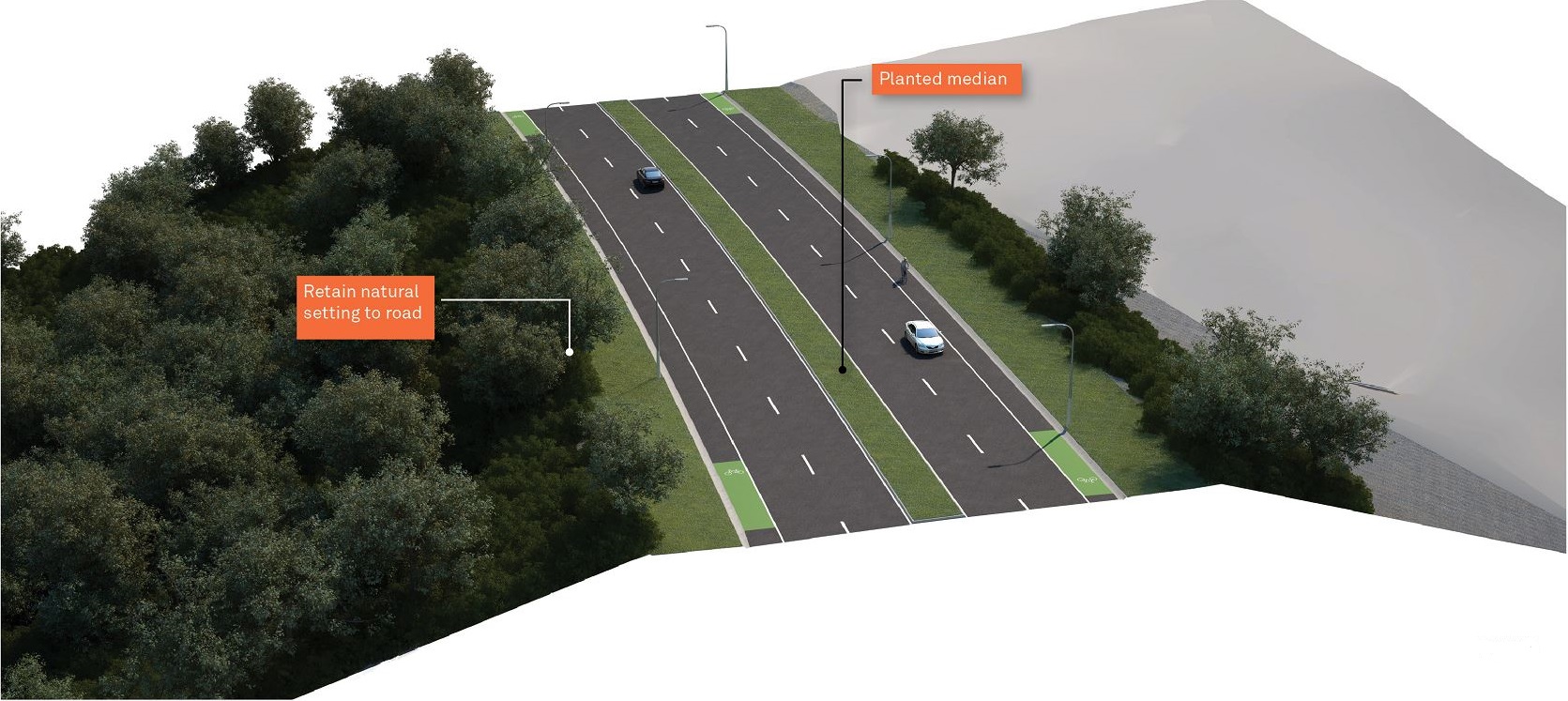
A render of one version of Mill Road, from 2018. Image: NZTA
At a glance, this is the wrong project, and the wrong size. It will simply generate more traffic, and is a poor use of billions of dollars.
It’s crucial to note that National’s commitment of $1.75bn of future funding is only for Stage 1, the 7km from Manukau to Alfriston, with “additional costs [to] be met from the State Highway Improvements Activity class of [the] National Land Transport Fund”.
In other words: this project will cost, at minimum, $250 million per kilometre – for a local road with multiple sets of traffic lights and roundabouts.
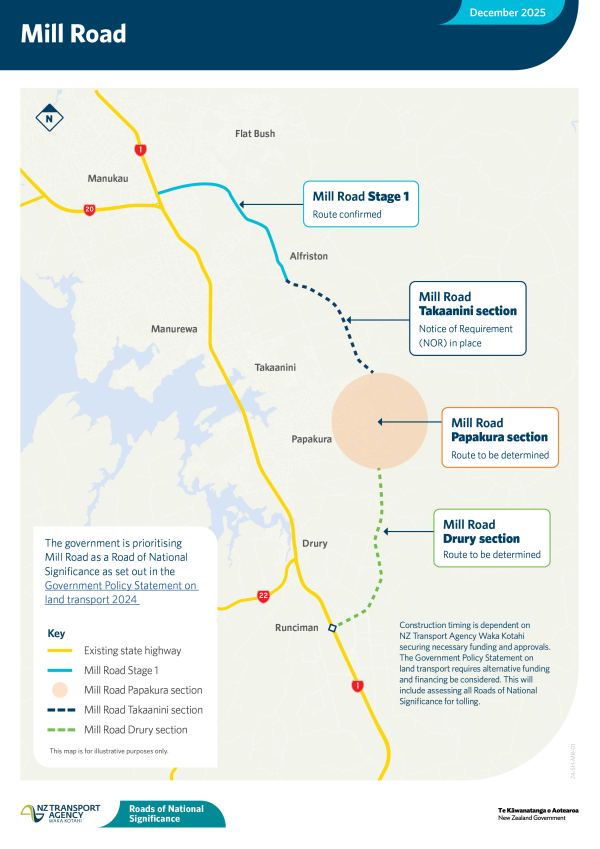
Image: Waka Kotahi the New Zealand Transport Agency
But wait, there’s more: National has also promised $100m to “progress route protection” for Stages 2 and 3 through to Drury.
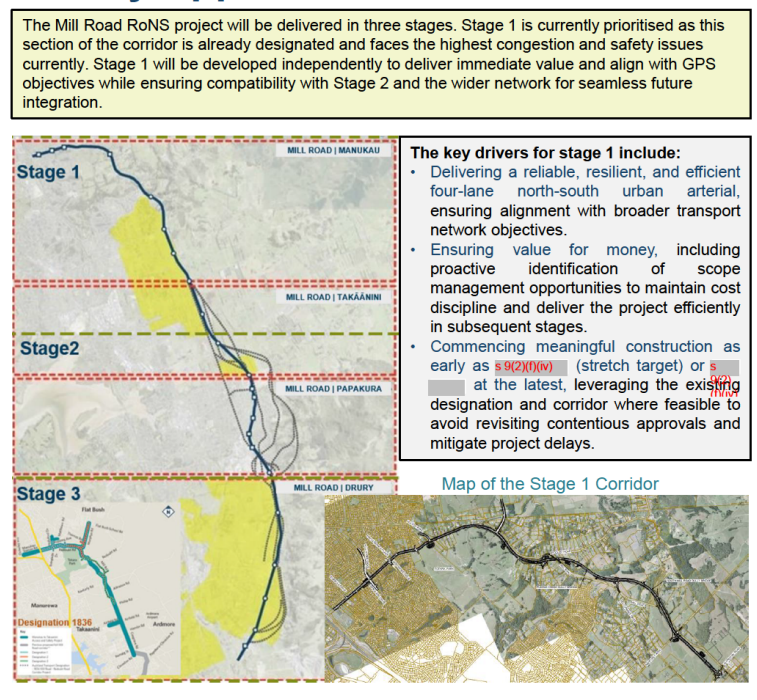
… so if you do the math, if it costs $1.75 billion (plus “additional costs”) to build just 1/3 of the project (and the easiest part), you’re looking at well over $6 billion at current prices, to complete the whole thing.
In other words, it would cost the country more than the entire City Rail Link project… to enlarge one local road in Auckland, parallel to an existing motorway, in a way that will change nothing: people will still be stuck in traffic.
For a fraction of that budget, you could fix the key traffic choke-points and give people better options for connecting east-west with the new rail stations.
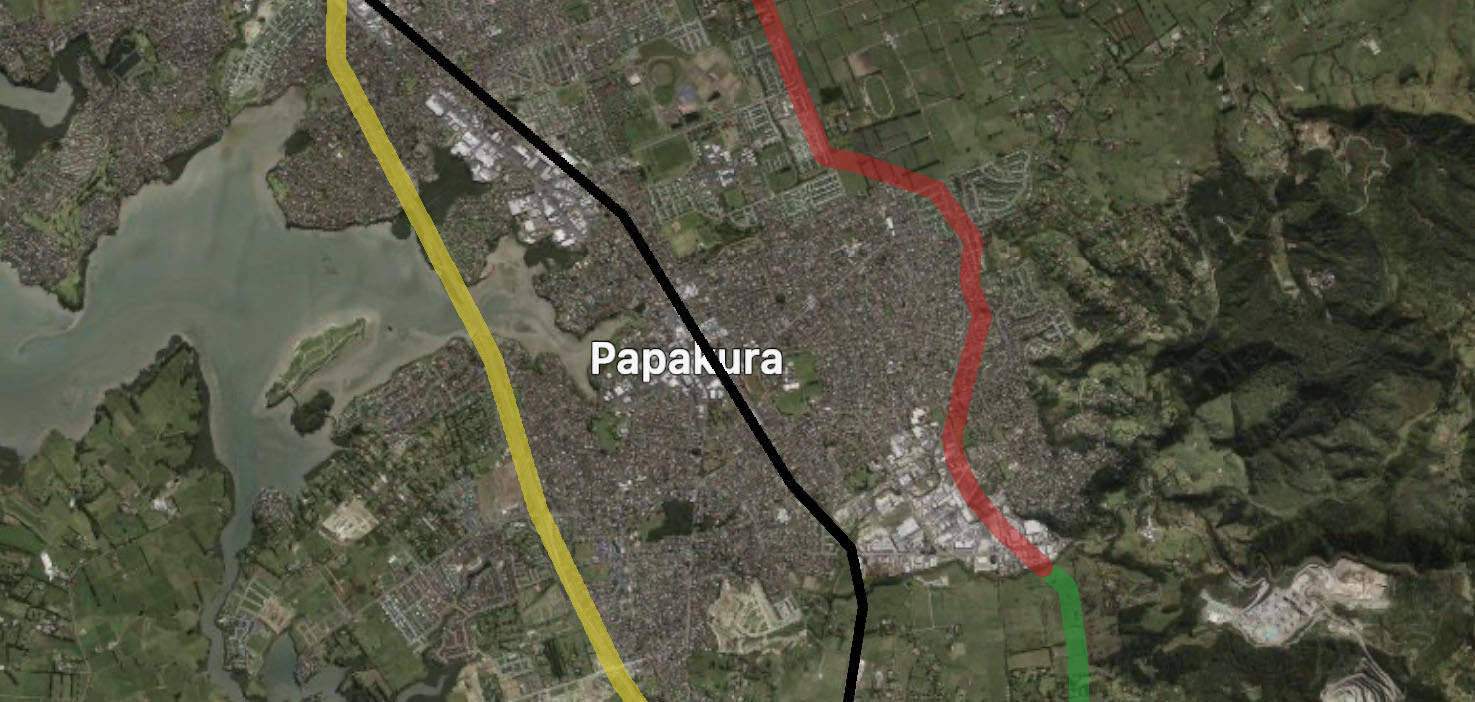
A rough indication of Stage 2 of Mill Road as currently planned (in red), with the railway line (in black, with Papakura station just below the R of Papakura), and the existing SH1 motorway (yellow). Where, and in what, and when, would you invest a finite funding pool, if you wanted to help locals get out of traffic?
Just like Warkworth to Te Hana, Mill Road is an over-scoped project with a budget – and timeline for completion – that’s demonstrably out of whack with local needs, capacity, and funding, both now and in the future.
So it was no surprise that Mayor Wayne Brown was quick to call the announcement “idiotic”, as reported by the NZ Herald (see also Stuff):
Brown told the Herald the $1.75 billion price tag was an “idiotic sum to fix three intersections”.
He said the existing dynamic lane, which changes direction to accommodate peak-hour traffic, should be extended instead.
“Building a new four-lane road full of traffic lights isn’t the answer.”
Our own Matt Lowrie put it slightly more diplomatically, at RNZ:
Greater Auckland director Matt Lowrie said the project was like “taking a sledgehammer to crack a nut”.
He said work was needed on the transport corridor, but smaller solutions could deliver the same benefits at a smaller cost overall.
He pointed to the dynamic lanes added to Redoubt Road, which he said had helped ease congestion.
He said money could be better spent on improving public transport, offering people alternatives to travel around Auckland.
“We’ve just seen the opening of the City Rail Link in Auckland, which has been very successful already.”
Lowrie added funding for stages two and three could cost even more than stage one.
Whose priority is Mill Road?
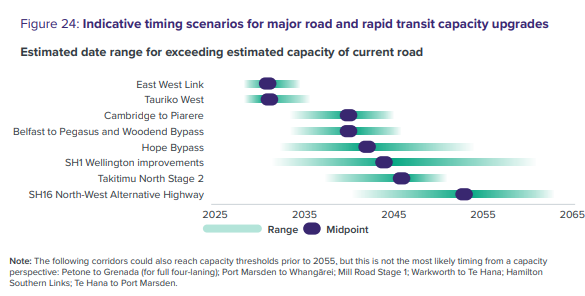
Another key thing to point out here is that there is no urgency for this project. The Infrastructure Commission’s National Infrastructure Plan, endorsed by all parties in government, states that Mill Road Stage 1 is likely not needed until after 2055.
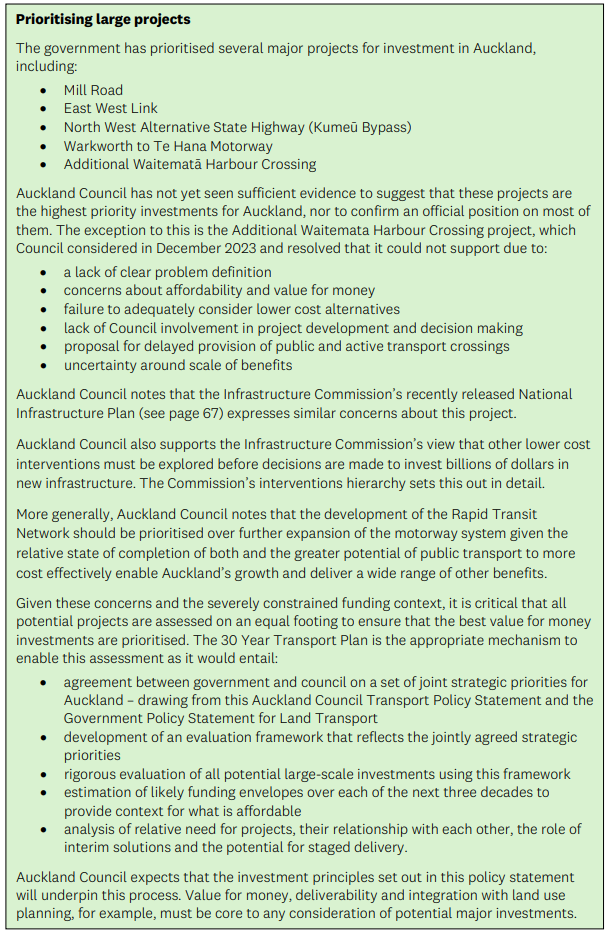
Nor is Mill Road a priority in for Auckland Council. Their 2026 Transport Policy Statement (see document here) makes clear that while Mill Road (and other highways) may be on central government’s priority list,
Auckland Council has not yet seen sufficient evidence to suggest that these projects are the highest priority investments for Auckland, nor to confirm an official position on most of them.
Who’s campaigning for what?
So why has this project leapt to the top of National’s campaigning list? The announcement says it’s about “crushing congestion” – but what congestion? The traffic data for an average rush hour suggests it’s not a major issue in the immediate area…
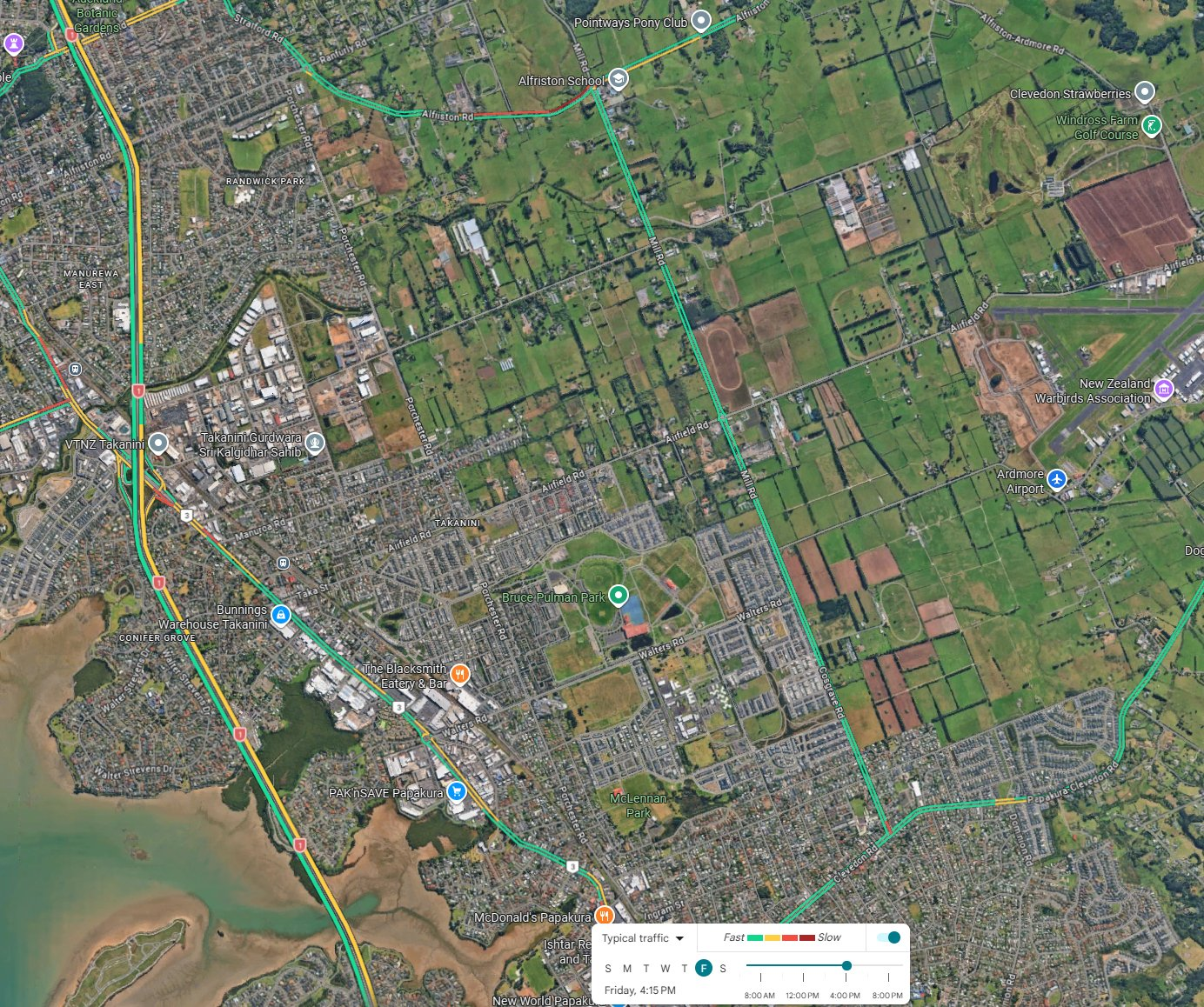
Google Maps showing typical traffic in the Mill Road area at 4.15pm on a Friday.
And looking at the broader picture for Auckland for the same timeframe, if you really wanted to solve rush-hour road congestion, you’d focus on:
- The inner southern corridor (Newmarket to Ōtāhuhu)
- Māngere
- NW corridor
- Across the harbour
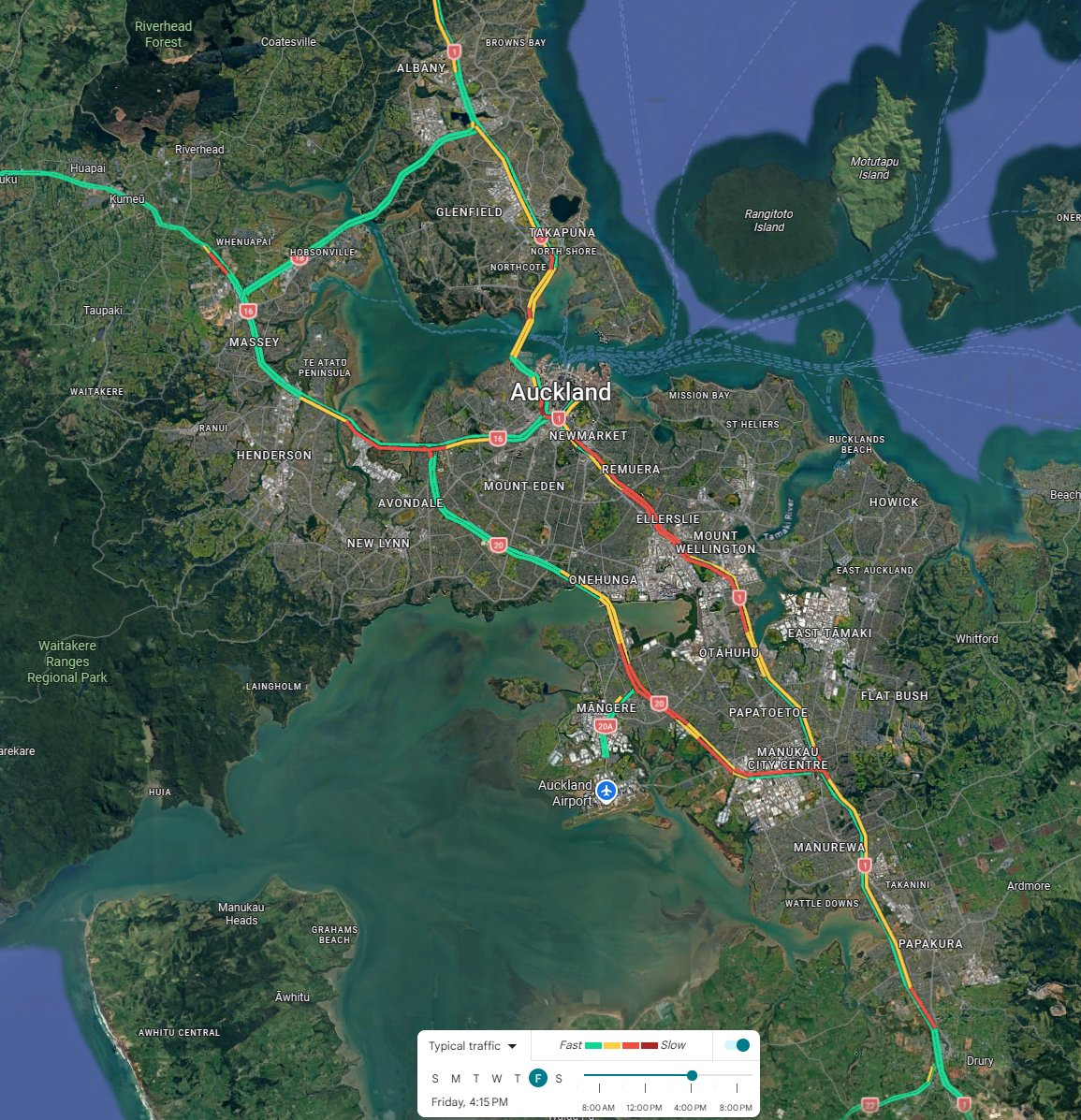
Google Maps showing typical traffic across Auckland at 4.15pm on a Friday.
In short, it seems National is choosing to ignore the Infrastructure Commission’s work, and Auckland Council’s priorities, in order to push what they assume is a vote-winner.
And that’s a doubtful assumption. Widening this route to enable more north-south traffic to feed into SH1 to and from the city is exactly the wrong way to address chronic congestion. Urban road widening just encourages more driving, which makes things worse for drivers, and for transport of people and freight. It’s a clumsy application of rural highway planning to complex urban systems.
Under this government, Steven Joyce’s Roads of National Significance has grown into a blue-coded political monster, with announcements (and reannouncements) of expensive new mega-roads seemingly the only transport idea – despite NZTA’s best efforts to pivot to meaningful solutions for our biggest city.
Now, even having accepted they can’t widen or duplicate SH1 from Newmarket to Ōtāhuhu, their next move is to pump even more traffic onto it. Which is extraordinary.
With Mill Road, the current government, and NZTA under its direction, looks to be making the same mistake it did with the East-West Link. Instead of quickly and affordably improving key intersections and alternative travel options, it has opened its policy tool bag and found the only bit of kit in there: a massive new road.
With the East-West Link, eventually reality won out – will that happen here as well?
Okay, so what does Mill Road actually need?
That’s a fair question. A rational approach would home in on a couple of particularly gnarly intersections that should have been signalised 15 years ago when housing growth really kicked in.
So, you’d fix the intersections of Murphys Road and Redoubt Road, and also look at closing Hilltop (or making it left in/left out). And, as the Mayor notes, you’d extend the dynamic lane to Murphys Road.
Then, with some of the billions left over, you can deliver what this area really needs: improvements that are exactly perpendicular to the Mill Road corridor – like better east-west public transport links to the train stations, to give more people congestion-free travel choices.
In other words, you’d invest to “make the most of CRL”, as the current catch-cry goes. Make it easier for more people, more often, to choose to use the newly improved Rapid Transit system, that’s right there.
Greens prioritise public transport
The Greens also announced a swathe of transport policy over the weekend, with the key policies relevant to Auckland being:
- Free bus and train trips for children, students, apprentices, Community Service Card holders, Total Mobility Users, and people aged 25 and under
- $2 Fare Caps for everyone else
- Overnight passenger train between Auckland and Wellington
- Extend Te Huia to Tauranga
- Deliver immediate improvements to bus routes along the planned Mass Rapid Transit routes in Auckland, Wellington and Christchurch.
- Plan and deliver light rail or bus rapid transit in line with the Infrastructure Commission’s preferred option
- Work with Auckland Transport to fund and deliver level crossing removals – allowing for more frequent trains, fewer delays, and better safety outcomes.
The Greens have costed their full policy package at around $21 billion, meaning about $1bn annually over the next two decades. This funding would be available if the National Land Transport Fund was reprioritised, away from its current imbalance in favour of low-value parallel highway projects and towards a greater range of transport options.
The policy also mentions the Infrastructure Commission, which is important, as there is – in theory – universal political agreement that all major infrastructure should be scrutinised by them.
By contrast, the current government has exempted from scrutiny all NZTA projects funded through the National Land Transport Fund, including the Roads of National Significance (of which Mill Road Stage 1 is an example).
How does this measure up for Auckland?
At a glance, the Greens policy package seems much more aligned with what Auckland needs. It addresses the gap in rapid transit in the isthmus, and targets better connections to Māngere.
And rather than pinning everything on a few big projects, it works for both the immediate and longer term, at local and regional levels. The fare plans can be enacted quickly, with intercity rail services ramped up in the medium term (at least as start-ups on existing track and systems), and new urban rapid transit over the longer term.
Greater Auckland has long seen the value of extending Intercity passenger rail in the upper North Island, which we called Regional Rapid Rail, and an AKL-WGTN sleeper service (see here, and here). The return of the Southerner from Christchurch-Dunedin, while out of our rohe, also sounds good.
It’s also worth noting that the estimate for improving Golden Triangle passenger rail will likely be about the same as Mill Road. We leave it to readers to weigh up the relative value of one parallel highway versus reviving passenger rail in the country’s most populated zone, while also enabling more freight to move to rail, taking trucks off the road.
Note that the policy includes light rail on the medium-term horizon – not just for Auckland, but for other major cities, Wellington and Christchurch. We can probably assume this is surface light rail – the more deliverable alternative to the over-scoped underground metro-light-rail towards which Labour was led up the garden path.
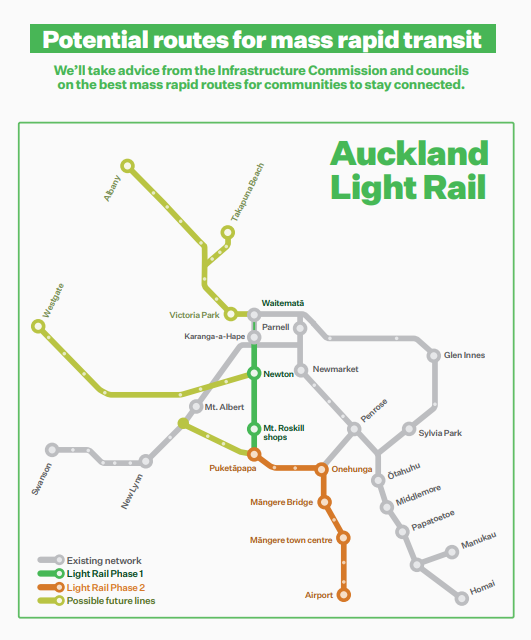
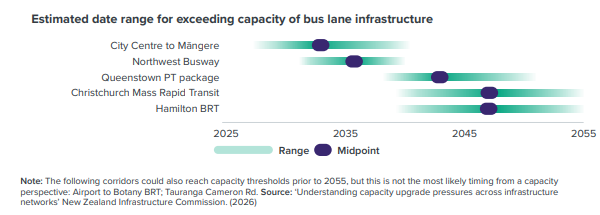
It’s good to be planning towards rapit transit: the National Infrastructure Plan is clear that Auckland needs rapid transit, including the City Centre to Māngere corridor, where bus-based solutions will cease to be able to provide the needed capacity in the next decade. (Once again, we thank Connor for getting that issue included in the NIP).
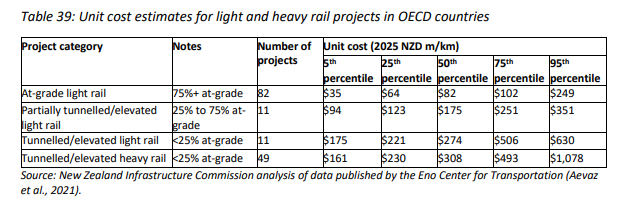
The Greens have also used some of the Infrastructure Commission’s work to estimate the potential costs for light rail. They used the highest value (the 95th percentile of projects the Infrastructure Commission looked at), which is $250m per km.
However, the 75th percentile of surface light rail projects comes in at $100m per km or under. So, while it’s unlikely any initial light rail line in New Zealand will be on the cheaper end, the Greens numbers are still likely an overestimation. This is especially relevant given the tendencies of National to consistency use the lower end of costs when it comes to their “Roads of National Significance.
Lastly, the Greens have also announced a commitment to funding the removal of level crossings on the Western Line – a critical programme that, as yet, has no guaranteed funding. The announcement included this near miss of a car going through a level crossing mid press conference. It’s hard to think of a more tangible live illustration of the benefits of a campaign policy in New Zealand political history!
Over to our readers:
What are your thoughts on the transport policy announcements so far?
Which of the policies do you rate in terms of value for Auckland?
What do you think of Labour’s more general policies, in relation to our region’s needs?
Lastly: a friendly reminder to check and confirm your enrolment to vote, well before before October 25th, which is when enrolment closes and when early voting starts. Make sure friends and family are enrolled to vote as well!

 Processing...
Mill Road???? I’m looking forward to the east west link being revived as well
Is there anything in the Greens’ policy about increasing the frequency of Te Huia between Hamilton and Auckland, to make it a viable option for far more people than it is now? Currently it’s 15 return trips per week; ideally it would be closer to 15 trips per day.
Increasing the speed of Te Huia is arguably more important, to make it more competitive with driving. Track straightening could be done at the same time as electrification.
One extraordinary thing for me about the Mill Rd project as currently planned is simply what it is at a high level.
In contrast with the Woodend project, which is a highway bypass of a town, a conventionally well accepted good idea. Keep through traffic out of conurbations, go round.
Mill Rd is a bypass of SH1, an existing highway, THROUGH a town. Basically daft.
This shows the insanity of allowing your transport agency only one trick.
New highways are certainly not the only answer for improving an economy and society. Hell, they are not even the only answer to every question in transport.
Re: Mill Rd
Be interested to see the viability of AT/Kiwirail building the ‘Southern Link’ now.
Aka, the corner between the Southern line and the Manukau branch that was never built, but space was made for under SH20.
https://www.greaterauckland.org.nz/2013/02/09/does-a-manukau-southern-link-make-sense/
It does appear that that space may be too hard to change with the KiwiRail Wiri port in place just south of it,
but for what could potentially be a simple rail connection could actually open the doors for a Papakura ( or Drury even) to Manukau direct service, which, fancifully, could open the doors/help to justify to extend the Manukau branch east.
It would surely be a lot cheaper than $1.75b for 6km of Mill Rd (and $6b for the whole thing!) which will only add to congestion.
Much more urgent to improve connections between those growing suburbs and existing stations, to make using the improved rail services an easier choice for more people more often.
Station access upgrades, more entry points, better bus routes and transfer connections, connected, complete, and separated cycleways centred on stations.
First mile/Last mile.
Run of the mill (pun intended), fiddly, bread and butter, transport optimisation projects.
Thing NZTA is not meant to do under the current GPS, but is what is needed.
We have spent a lot to get the rail service a hell of a lot better, the above work may not seem like rail network work, but it is.
Councillor Andy Baker told me the CRL and new Southern Station have saved him an hour a day! He scoots to a new station and trains directly to City Hall, saving 30 mins each way over driving to Papakura and walking up from Waitematā.
Stick that into your Travel Time Savings BCR calculator!
Hi Patrick, I think it would be interesting if GA had another look (now 13 years on!) at the viability of the ‘Southern Link
I think about a journey from say Homai, Manurewa, or Takaanini to Manukau.
Currently involves going in the wrong direction and transferring at Puhinui.
Or, its a bus. Either of those journeys are above 30 minutes, either having to train transfer, or take a slow bus.
A car is currently 15-25 minutes, depending on traffic.
it is quite damning that the recommended PT journey between two Southern train stations (Homai and Manukau) is to take a bus lol.
A direct service would actually properly connect the South to Manukau on rail.
I estimate that a direct service (if this ‘Southern Link’ was built) between Homai and Manukau would be about 10 minutes.
Papakura to Manukau would be 20 minutes (Currently 30 minutes, with transfers).
Some common sense from the Greens.
You’re right that it’s surface light rail.
From the Greens policy page:
3.1.1. Building surface light rail through key routes in our major cities
Transport policy is dull but at least it is better than seeing them all pretend they can do anything about the cost of living.
We are a nation of non thinkers. We build just to build. We drive around, just to drive around. It is all a complete waste of time, destructive to our economy, our environment, and our health.
We could be building mid rise apartment communities, with good public transport access, within a sensible area for a motu and cities of such low populations; by world scales.
We need to stop driving. It is a stressful activity. It shortens our lives, through deaths on roads, poisoning of our air and pollution of our waterways (via tyre dust). In the South Island fake fertiliser has a lot to do with polluting waterways too.
The city of Tamaki Makaurau Auckland loses billions of dollars per year because we live in congested car traffic.
We cannot even house every human.
Something went wrong after World War Two, then again will the neo liberalised ninety eighties; and we continue down this spiral to oblivion.
George Orwell wrote 1984 in the nineteen forties. Totaliarian Europe of Mussolini and Hitler and Franco taught us everything we needed to know about the worst that we could look forward was; but we choose to forget.
We choose to forget the the New Zealand Colonial Project almost annihilated Maori in the eighteen hundreds.
History can teach us many things about the past, science can teach us to accept that change is possible.
Arts make like worth living.
bah humbug
I am against Green’s promises to massively reduce fares.
I think the $50 fare cap is at about the right level to make a meaningful cost saving for high users.
The biggest problem with public transport is not it’s cost to users. The small decline in private motoring due to current high fuel costs is testament to only small price elasticity in transport provision.
The biggest problem is that currently Public Transport is not a viable alternative for far too many highly used journeys. It needs far greater reach, more frequency, and greater journey time speed and reliability. Hamilton to Auckland is a prime example, as is regional transport in Canterbury. Rolleston residents need a better public transport connection to Christchurch ahead of lower fares.
This will cost money in a constrained economy. But having fare income will make it much easier to justify the needed new routes and enhanced service levels on existing routes.
Repurpose lanes- huge savings to be had on the NW busway as an example and actually incentivise using PT instead of the car.
It could work? Look at QLD. It costs 50c to travel to gold coast by train from Brisbane. Essentially any train journey is 50c. Huge uptake in train travel since they changed that.
Focusing on fair income will just give detractors too much “but it doesn’t make a profit” arguements. Which are stupid because that isn’t the point.
You are 100% correct about viability for lots of high use journeys in this country.
The Mill Rd route would provide network redundancy to SH1 should that link be blocked.
NZTA could designate the Mill Rd route and the then just build it to the Infrastructure Commission timeline &:
a) address the congested intersections first
b) complete it as 1×1 with passing lanes.
c) eventually undertake the full duplication once justified by the traffic
Quote from Newsroom editorial by Jonathan Milne yesterday which seems important to these discussions:
“Mill Rd (from Manukau, round the back of Totara Park and finishing at political donor Chris Meehan’s proposed Sunfield residential development behind Takanini)”
The proposed new houses on a flood plain…
This is exactly why lobbying regulations and much lower political donation caps are urgently needed. Opportunity, Green Party and Labour have decent policy proposals in that area. Otherwise we will keep getting what a few wealthy folks and big companies think is best.
I am hoping the next government does a comparative cost-benefit analysis on the different mode options for the city-airport connection. Underground metro may have been the second most expensive idea, but that does not make it the worst. That table says that at-grade light rail is the cheapest, but their are no at-grade options for crossing the Mangere Inlet. A new bridge or tunnel is needed. I think at-grade light rail is a fantastic idea for other routes, but not the city-airport link; which has the largest destinations at the ends of the route. The Auckland Light Rail project was worked on by professionals. They knew something about what they were doing, they probably knew more than the rest of us.
Decent stuff from the Greens.
Does anyone think part of this Mill Rd (and other) silly overpriced mostly pointless road announcements are partially to tie up money for future governments to prevent investment in PT or other modes of non-car tranport?
This isn’t electioneering because that electorate is true blue National, so they aren’t going to win anything from it.
Could it honestly just be cynical to keep money away from rail? There are other actual worthwhile roading projects they could fund. Or is it just typical right wing hatred of all non-car modes of transport because……..??? reasons?