The Labour Party has finally delivered an election policy: it’s about transport and the cost of living, and we think it’s a good one – they propose capping the cost of public transport.
Labour will make it cheaper for New Zealanders to catch the bus or train, by capping weekly fares at just $20 in Auckland, Wellington and Christchurch, and $10 a week everywhere else in New Zealand.
“Our fare cap is a major cost-of-living commitment designed to put money back into the pockets of commuters, students and families,” Labour Leader Chris Hipkins said.
“New Zealanders will be able to use public transport as much as they want all week for only $20 in our major cities and just $10 everywhere else – keeping more money in their back pockets.
“From 1 July 2027 under a Labour Government, once a commuter has reached their fare cap, every additional trip that week is free.
“Cheaper fares mean more freedom, freedom to get to work, freedom to study, freedom to attend appointments and freedom to spend time with family and friends without worrying about the cost.
“This is real cost-of-living relief. It means cheaper commutes, more money left at the end of the week, and a public transport system that works for everyone,” Chris Hipkins said.
“Public transport should help people get ahead, not become a luxury people get priced out of,” Labour transport spokesperson Tangi Utikere said.
“Families deserve certainty. Under Labour’s weekly fare cap, people will know exactly what the maximum cost of getting around will be each week.
“We want people catching buses, trains and ferries more often because that means lower household transport costs, less congestion on our roads and stronger public transport networks.
“Labour’s weekly fare cap will ensure New Zealanders can travel with confidence, knowing affordable public transport is there when they need it,” Tangi Utikere said.
Key policy details:
- Weekly fares capped at $20 in Auckland, Wellington and Christchurch.
- Weekly fares capped at $10 in all other regions.
- Applies across buses, trains and some ferries in Auckland, Wellington and Christchurch.
- Once the weekly cap is reached, all further public transport trips that week are free.
- Begins from July 2027 under a Labour Government.
- Costed at approximately $65m per year or less than 1% of the National Land Transport Fund.
- InterCity buses, Capital Connection, Te Huia, Mainlander and Waiheke ferries not included.
The announcement was covered widely, including by:
RNZ: Labour vows to put $20 a week cap on public transport, $10 outside main centres
Newsroom: Labour leads with its chin on transport cap costs: critics swing wildly
The NZ Herald:Weekly public transport costs would be capped at $20 for Auckland, Wellington and Christchurch under Labour government
Stuff: Labour reveals public transport fare cap in long-awaited election policy
The Post: Labour fare cap: The five public transport trips where travellers would gain the most
Pacific Morning News: Labour’s fare cap under scrutiny over cost, reach and real impact
Fare Cap vs Discount: what’s the difference?
The policy immediately invites comparison to the 50% fare discount Labour put in place between April 2022 and July 2023.
At the time, ridership patterns were still down due to COVID /work-from-home, and fuel prices were also significantly discounted. Even so, the half-price fares had a positive impact, enabling journeys that wouldn’t otherwise have been made by public transport, according to research (supported via the NZ Transport Agency):
For the period that half-price fares were available for all users, close to a third of public transport users have reported that some of their past-week travel was a direct result of half-price fares.
• As a share of the total population, this was equivalent to between 6% and 9% of New Zealanders each week.
• However, for the entire period the proportion impacted may be higher. Based on responses in July-September 2023, close to a quarter (23%) of adults 15+ reported some form of new or additional PT usage due to HPF during this 14-month period.
The thing about a discount is, you still pay for every extra trip you make.
Whereas a fare cap acts as more of an incentive to make more trips – because once you’ve hit the cap, all of your remaining trips that week are free.
This means you’d think differently about how you travel, including using PT for trips you might not have otherwise done so. Anyone who’s used a Monthly Pass travel card gets this. As David Slack put it over the weekend:
We understand this principle perfectly well in other parts of life. We love a flat rate, an all-you-can-eat, an annual pass. We don’t need to get out the calculator and add up the costs of running even the cheapest of cars to make the comparison. $20 a week to get around (yes, granted, assuming it’s available to you) is a bloody good proposition.
In our view, a fare cap is a much cleverer model than a discount for stimulating greater public transport use, and the more people make more trips on public transport, the better the outcomes for the cost-of-living, and traffic decongestion.
There’s also something clever – and even subversive – about the proposal that the cap be $20 in cities.
Auckland’s current $50 weekly cap works well for people who travel long distances by public transport. But most trips in Auckland are just 1-2 zones, which means it’s hard to make enough trips to reach the $50 cap.
Whereas with a $20 cap, even someone commuting within a single zone would hit the cap after just over three days in the office – i.e. from Thursday afternoon, your trips for the rest of that week (and the weekend!) would be free. Or Wednesday afternoon for two zones. Wednesday morning for three zones, and Tuesday afternoon for four zones. Zing!
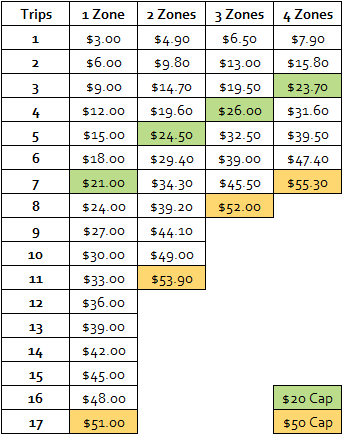
How many trips you’d need to take in Auckland, to hit the existing $50 cap (yellow) and Labour’s proposed $20 cap (green).
Another really interesting scenario we haven’t seen anyone discuss yet is: if the fare cap attracts new users, each contributing their $20 share, at some point the amount of fare income would start to go up. Win-win!
Fare Price vs More Services
The policy drew an immediate response from the government (and others), with the Transport Minister arguing that the research suggests it’s better to invest in services – more buses and trains, more often, in more places – than fare subsidies. (We can’t lie, it is gratifying to see such nuanced discussion of public transport policy, so quick off the bat!)
[Transport Minister Chris Bishop] said the government had looked at a range of fare subsidy options as a response to the fuel crisis.
“The advice from the officials is ‘don’t do this’.
“If you’re going to spend another dollar on public transport, it should go into public transport services rather than subsidies, which tend to be untargeted and tend not to be effective.”
The question of whether it’s better to invest in services or fare subsidies often comes up when there’s talk of making PT entirely free – and our view has always been, it’s not good if a fare subsidy takes away from an existing operating budget.
But that isn’t what’s being proposed here. Labour’s fare cap policy would be new funding for the PT sector.
Moreover, services have been improved over the last few years. Auckland has kept expanding its frequent bus network, adding the NX1, 12, 65 and 67 routes, even lauching a few more frequent services over the weekend. Plus rail services are about to get a major boost with the opening of the City Rail Link.
Of course, we can always use more – but the point is, the network is even better now than it was during the half-price fares, and something like a $20 fare cap would surely encourage more use of this improved network.
Interestingly, while former transport minister Simeon Brown called Labour’s policy “fanciful” and questioned where $65 million would come from, Bishop suggested investing many times that in services instead, saying the government:
would “possibly” consider using the $450 million emergency fund set aside in the Budget to put on more trains and buses during peak periods, he said.
This is of course a false binary. Encouraging more use of existing PT by reducing the cost barrier doesn’t rule out also investing in the quality and quantity of options. And the government is welcome any time to improve PT services across the motu, at peak and otherwise. Let’s hope they do.
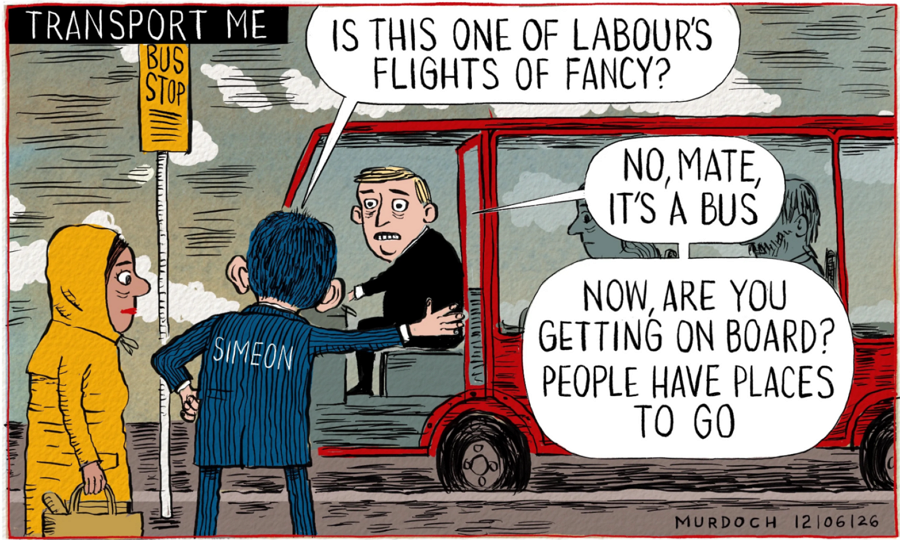
Cartoon by Sharon Murdoch for Stuff
Paying for it
Labour has said the cap would be funded from the National Land Transport Fund (NLTF), which is administered by NZTA/Waka Kotahi.
About 60% of the NLTF is sourced from fuel taxes and Road User Charges, with the rest coming from general taxes. Public transport operations are funded by a mix of NLTF, a local government share (via rates), and people paying fares.
The estimated $65 million/ year for Labour’s public transport fare cap amounts to less than 1% of the NLTF. As Hayden Donnell (and many social media wits have pointed out) that would buy you a short stretch of four-lane highway:
…what if the party ends up getting rid of roughly 103 metres worth of the East-West Link in Auckland, which is expected to set us back $3.8bn-$4.1bn for just 5.5kms of new tarseal? Nothing says wasteful spending like paring back the most costly per-kilometre road in the world.
The government was quick to highlight that the NLTF is already “oversubscribed” – without clarifying that this is because of the many over-sized, low value, unaffordable highways that dominate their current transport plans. The Minister himself understands this, but seems unable to fix the problem.
Subsidy isn’t a bad word
There’s been a lot of talk about a fare cap being a “subsidy”. And of course it is. Subsidies are common throughout the transport sector, and it’s peculiar that some seem to think they just need to say the word to damn an idea.
The question isn’t: is a fare cap a subsidy? The question is: is it a valuable one?
An affordable public transport trip is immediately valuable for the person making it. If your daily commute to work or study is suddenly free from the middle of the week onwards, you instantly have a bit more money for the other costs of living. Or to put into savings. Or to afford a treat – good news for hospo and retail.
But the benefits go well beyond the person on the bus. More people using PT means less traffic congestion, better air and water quality, and let’s not forget: less dependence on imported fossil fuel. Which is why, all over the planet, governments happily subsidise public transport – because the value outweighs the costs.
All transport is subsidised
Financial subsidies, or transfers, are used to unlock value that we’d otherwise miss out on.
The 40% of the NLTF that comes from the Crown is a subsidy. Road taxes poured into the NLTF from busy city streets routinely subsidise emptier rural roads. And local councils use rates to subsidise all transport modes.
There are transfers everywhere in the system. That’s because the benefit to the wider economy of functional transport networks is diffuse, and there’s no easy and efficient way to charge all those who benefit all the time (road pricing, please!).
And yes, some of the cost of operating PT comes from road taxes – precisely because drivers benefit from all those people choosing PT, or biking and walking, who free up space so that drivers can keep driving.
As described by David Slack, again:
…if you’re in Nelson you probably don’t use the Waikato Expressway, and if you’re in Henderson you probably don’t use Transmission Gully much. But where’s the guts-aching about that? We pay for plenty of things we don’t personally use: schools after our kids have left them; hospitals while we’re healthy; frigates pretty much always, because that’s what a country is.
And regarding the roads you do use: Who paid for them? Everyone did, including the people on the bus, who are subsidising your driving rather more heavily than you’ll ever subsidise their fare.
Questions and Answers on Q&A
On Sunday’s Q&A on TVNZ, Labour’s transport spokesperson Tangi Utikere got quite a grilling about the policy. You can watch the video here, and there’s a written version of the story here.
Jack Tame and his researchers did a very thorough job, offering many edge cases and some (confused and confusing) attempts to find financial holes in the plan. You can see why the Prime Minister and others are famously reluctant to sit in that chair.
It’s not our place to answer these questions – but we want to address a few, in the interest of public understanding.
1. Why is the fare cap not means-tested?
Or, as Tame posed it: what if a rich person from Eastbourne benefits from the fare cap?
Is this question ever asked about roads? Rich and poor New Zealanders alike drive on all our roads at the same cost – road tolls, fuel tax, and road user charges are the same for everyone, regardless of financial status. We look forward to Q&A asking if the fuel tax should be higher for those with higher incomes.
Obviously – just as with road tolls, fuel tax, and road user charges – it is much cheaper and easier to administer these things as a flat rate.
Besides, a successful PT system is one that is so useful and easy to use that people of all kinds can and do use it. That’s true whether you’re living in Eastbourne or Ōtara, Naenae or Remuera, whether you’re commuting to your high-paying city job or travelling in the other direction to clean a house or a hospital.
More well-off people on the bus or train? Big win. Especially for congestion.
As famously articulated by the former mayor of Bogotá, Enrique Penalosa, “An advanced city is not one where even the poor use cars, but rather one where even the rich use public transport.”
2. How do the benefits to individuals add up to greater than the cost of the scheme?
This one’s easy.
Tame attempted, as have others, to locate a fiscal gap… by adding up possible individual savings, multiplying them by potential users, and then comparing that to the $65m proposed budget. As reported in The Bulletin:
According to Tame’s accounting, $25 a week, on average, for $65m a year means, it’s only 50,000 people, not hundreds of thousands of people. So, Tame presses, it’s of significant benefit to less than 1% of the population. Hundreds of thousands might benefit, he said, but not every week, and certainly not at $25 a week.
It simply doesn’t work like that. The genius of a fare cap (as opposed to a discount) is that you don’t need to fund a whole new bus or train every time a person takes a new journey under the fare cap.
The bus or train already exists, and has existing spare capacity. The individual benefits multiply and accrue, way ahead of the collective cost. Another reason to like the idea.
3. But aren’t buses and trains full already?
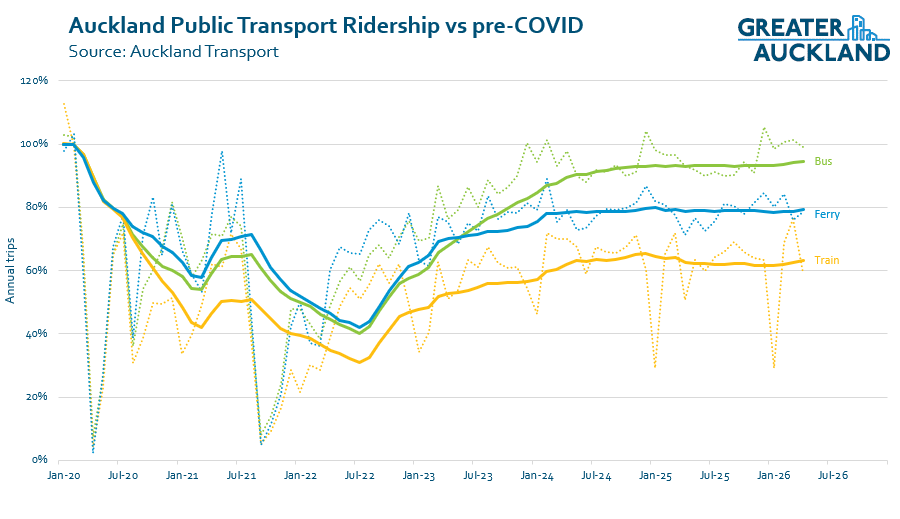
Some PT services are indeed full or busy at peak. But the majority of journeys people make are outside the morning and evening peak (In Auckland 2/3 of PT trips occur outside of the peaks). And in general, there’s a lot of spare capacity all through schedules. In most areas, outside of Otago, ridership is still below pre-COVID levels.
The nature of a fare cap incentivises more uptake at all kinds of times – you might say, the “all you can eat” aspect encourages people to graze. For existing passengers who already travel at peak times, once a cap is in place all sorts of new journeys for any purpose become free.
So we can expect a lot of new riders to fill the existing capacity across the day, and during weekends.
One obvious example is Auckland’s trains. For reasons well covered on this site, the system currently only carries a little over 60% of pre-pandemic ridership.
However, Auckland now has some 95 trains, up from the original 57. With peak services after the CRL opens going from 6 trains per hour to 8, that’s an immediate 1/3 increase in peak capacity coming in a few months, ie before this policy can be implemented. So there is an enormous amount of latent capacity at the very core of the new Auckland system, ready and waiting for exactly this sort of stimulus.
And thanks to Council’s Climate Action Targeted Rate there are also more – and more frequent – bus services too, many of which are electric. This is a system waiting to make a quantum leap.
And it’s not just trains and buses in Auckland and Wellington – buses in provincial towns all over the motu have capacity too.
4. Is the MoT just plain wrong on this stuff?
We concur with Jack Tame that Utikere should have taken the time to read the Ministry of Transport’s official advice on fare subsidies – because it’s so easily demolished.
The MoT’s opinions on this are frankly bizarre. For starters, they come down against universal fare subsidies on the grounds they “will result in many people who do not need support with their transport costs receiving it.” In other words, if a few well-off people were to benefit, well then, it’s far preferable if nobody benefits at all.
This is daft, and a completely invented moral hazard, given the same terror is never applied to other modes of travel. Does the MoT advise against Crown funding for new roads, lest some rich people drive on them (which they certainly do)? Of course not. We know the wealthy fly way more than any other group, so why are there public roads to airports, let alone open to all?
The MoT also says fare subsidies are bad because they would increase use of public transport, even “risk[ing] patronage increases beyond what the network can currently accommodate at peak times”. What a fine problem to have!
Increasing patronage is the point! And it’s baffling the Ministry can’t see the value of utilising the existing capacity. There is no world in which more ridership is a bad thing – unless, that is, the MoT truly believes public transport costs more than the value it provides.
And if so, that idea must be grounded in the (mistaken) belief that the only public transport use that counts is commuting, i.e. people getting to work, at peak times.
Here’s the thing. Journeys to work only make up around 20% of all trips! So it’s a profound mistake to use Census journey-to-work data to stand in for all travel. Just as bad as using the word ‘commuter’ to describe people moving around for all the myriad human reasons we do.
An understandable slip by Joe Public, perhaps – but inexcusable from the Ministry, who should know better.
In conclusion
Overall, we view this proposed policy positively.
A key issue for New Zealand – and a huge opportunity – is the imbalance in New Zealand’s transport networks, especially in cities and towns, which is also where most of us live. This imbalance is both a symptom and a cause of the low productivity of our urban economies, so fixing it, along with the land use it supports, should be a core focus of governments at all levels.
And there’s also the fact that across the motu, our public transport networks are steadily improving – and certainly have spare capacity.
Labour’s proposal for a fare cap, which would ideally go hand in hand with continued improvement to services, looks like a clever, relatively modest but quick-acting way to address this imbalance.
Moreover, it offers a helpful quick fix to a range of pressing issues, not least the cost of living, and reliance on costly imported fossil fuels (remember this one), traffic congestion, pollution and emissions, road safety, public health, as well as greater independent travel options for children and young people and disabled people and older citizens who can’t or don’t drive, and efficient use of existing infrastructure.
All in all, what’s not to like?
We look forward to other major election policies on transport from all parties.

 Processing...
GA Labour Shills? Every study on this in the world has said that new money being invested in PT should not go to reducing fares, instead on improving services. You even wrote about it in 2018, and in 2014 . Also see “Considering Fare-Free Transit in The Context of Research on Transit Service and Pricing: A Research Synthesis (UCLA, 2023). Jarret Walker/Human Transit, who GA have advertised before, has a long standing position on this issue too that he still brings up today, see his post “should we cut fares or increase service? an advocacy parable”.
This policy might be ok if you frame it as a purely cost-of-living policy, but Labour aren’t. First post-budget policy of the election? Congrats on the second term as PM Chris Luxon.
Mathew you might try reading the post.
This is a false binary, the $65m is new money for PT, so is not sourced from reducing services.
Jarrett writes at length about the trade-off between investing in services of discounting fares, especially in the US where services he works on are often very sparse, and the fares already negligible. We agree fully with him about that.
As we say in the post there is no such trade-off here.
Cost is a real barrier to many, and there is no better way for winning funding to improve services than rising ridership. If successful at boosting ridership it is highly likely that this policy would accelerate investment in services from all sources: fares, local govt, and central govt.
So in our view addressing cost, especially through a fare cap, is a worthwhile and cost-effective programme.
“This is a false binary, the $65m is new money for PT, so is not sourced from reducing services.”
I really struggle with this argument. It’s true enough in the short term, in the three-year financial cycles of local and national government, but in the long term this is money that could have been invested elsewhere and it will change the political and financial calculus behind service improvements, which will become more expensive. So a short term positive impact followed by a long tail of negative effects as PT becomes an increasing liability for government and ratepayers.
I would far prefer not to have this red-blue back-and-forth every time government changes. Let’s set fares low but not crazily so, generous concessions for people with less ability to pay, and just have a stable policy that doesn’t swing wildly with governments, so that we can put our limited energy into what’s most important, which is service level and service quality.
Let’s rewrite that: “Let’s set ROAD USER CHARGES low but not crazily so, generous concessions for people with less ability to pay, and just have a stable policy that doesn’t swing wildly with governments” Funny how everyone is happy for ‘all you can eat’ road user charges to be capped with only a single annual reset but when we suggest PT USER CHARGES have an ‘all you can eat’ cap that resets weekly the sky is falling in.
“Cost is a real barrier to many”, yeah that’s true but the fare cap barely helps those who need it most in fact most of the $65 million (we all know it’ll cost more than that) will go to the wealthy buisness commuters.
Patrick do you not understand that more services cost money. You talk about adding more services like it’s some easy that just happens with higher ridership. Now you’ve capped revenue there is no more reason to fund more ridership, in fact every time you add services the subsidy grows even larger.
“it is highly likely that this policy would accelerate investment in services from all sources: fares, local govt, and central govt”
Yeah right, you talk about cost being a barrier but you want to I guess raise GST or income tax and Rates seeing as you’ve capped fares so literally no more revenue will come in from that. Patrick admit it what Matthew said is correct you guys literally write all the time about how more services over fare subsidies but suddenly because you know it’s the only chance at the left bloc getting in you’re trying to make labours policy look good when it’s anything but.
I disagree this policy would cap revenue. The purpose of a policy like this is to encourage people to stop using their cars so much, if someone who always drives their car starts taking the bus then that’s new revenue, even if capped.
James, no, our consistent line is that there is more than enough money spent on transport in NZ, a view strongly supported by the Te Waihanga. But that this money is spent unwisely and in particularly in an inefficient imbalanced way.
We always argued for more to be spent on the underdeveloped modes and less on low value massive duplicative roading projects.
So not more taxation but better use of existing resources.
craw, you can’t be serious the policy LITERALLY caps revenue. If people wanted to stop using their cars they already would’ve done that with the higher fuel prices. How much more subsidy you want get real.
Patrick, you’re not capable of living in a demokracy. It’s not imbalanced funding gets prioritised as to how voters want it to be. The voters are demanding these roading projects which is why Labour has shied away from cancelling or criticising them.
Also you’re asking money to be moved away from roads that could save LIVES and into public transport subsidies. Like it or not the vast majority of people in NZ get around via the roads. New suburbs with good PT connections you still see cars everywhere, people like cars it’s something that we have to deal with.
Whoa james, Transport spending is always shifted around both at the technical level and the political one. That’s literally democracy in action.
What Labour have said here, quite explicitly, is they intend to change the GPS, Government Policy Statement on transport, in order to shift more funding to PT to cover this away from other modes. That would reverse a little of what this govt did when it slashed non driving modes funding.
As for the claim that the only way to reduce the road toll is to build one mega highway somewhere, well have i got a wall of evidence for you that says the complete opposite.
$4b for one RoNS (or $12b if by PPP) buys a great many more lives saved much sooner by upgrading every existing road in Northland.
As shown by the already huge success of the Dome Valley median barrier (and 80kph limit).
Apparently 93% of people go to work in a car, and the other 7% of people use public transport. Imagine if we increased the amount of people using public transport to 30% or so?
“Also you’re asking money to be moved away from roads that could save LIVES and into public transport subsidies.”
Then let’s just take the road subsidies and divert those to PT. It will be in the billions.
Patrick they can intend all they like but they aren’t getting elected unless something really bad happens for the current lot. Patrick you’re ignoring democracy once again I said voters prefer a 4 lane highway no one in the north is asking for the dome valley treatment most of them are asking for a 4 lane highway.
“Patrick you’re ignoring democracy once again I said voters prefer a 4 lane highway no one in the north is asking for the dome valley treatment most of them are asking for a 4 lane highway.”
No voters south of Auckland want either.
“Unless something really bad happens” – like the reserves run out?
Ok KLK fair. But ask the voters south of Auckland if the govt should build light rail or a 4 lane expressway to Whangarei if those are something that has to happen. Theres your answer roads are popular.
Depends, is the light rail option an extension of the Christchurch trams?
Ok KLK fair. But ask the voters south of Auckland if the govt should build light rail or a 4 lane expressway to Whangarei if those are something that has to happen. Theres your answer roads are popular.
I think you’ll get the same answer.
But if you asked the voters between Pukekohe and Whangarei, the light rail would win hands down.
More potential users.
“every study on this in the world…”
Thanks Matthew, you’re quite well read obviously.
Well this isn’t about reducing fares, they’re not changing. It’s reducing costs for frequent users.
Labour: ““Our fare cap is a major cost-of-living commitment designed to put money back into the pockets of commuters, students and families,” Labour Leader Chris Hipkins said.”
Dim poster: “Labour aren’t calling it purely a cost-of-living policy, checkmate.”
Air Chathams are threatening to stop flying from Kapiti, and one of the first things I see about it on Facebook is Tim Costly MP promising to subsidise the service so they can keep flying.
If we’re scrutinising public transport subsidies, let’s start with the airlines
He is the electorate MP for an area on the periphery of Wellington with rail services from Waikanae and Paraparaumu all the way to Wellington city. I’d say a good number of residents in those towns will be very pleased with this policy and his challenger Sophie Handford has been very quick to point that out.
Currently Auckland and Christchurch have ratepayers funded weekly fare caps.. Wellington and other regions do not…
Is this burden on local ratepayers in Auckland and Christchurch equitable when other regions don’t do it..
Labour’s costings appears to rely on these ratepayers funded caps remaining… Is this fair on these councils who went out and did what many would call ” the right thing” and now Labour reward them by giving all the other councils a larger contribution.
Also the Eastbourne Ferry mentioned by Jack Tame continues to use manual Clip Tickets , managing a weekly fare cap on these will be a PITA..
– and don’t say they will all be replaced by Motu Move by the time this things happens, because I have absolutely no faith that will happen…
Also. presumably once MM does roll out, the caps will apply nationally??. If you are travelling your trips accumulate to the $20 anywhere in the country??
If I was Auckland Council I would pull the rug on all my PT subsidy’s and let Labour pick up the bill, typical Labour policy it wasn’t thought out at all and that Q&A interview was a train wreck for Labour. Oh and like I’ve been saying Labour will continue will the 4 lane highways for vote reasons they are desperate to get elected.
So for all you who think there is an alternative to a 4 lane highway to Whangarei like I’ve said before ITS A 4 LANE HIGHWAY OR NOTHING!
Ps I’m not saying National is economically responsible in fact I think they are not, just that they aren’t Labour who just oozes incompetence. They are not a serious party that wants to return to government.
Given the February date for an announcement on the Wellsford bypass has sailed by, and the budget didn’t make any allowance for a crown loan for this road then it’s looking more likely by the day it will be nothing.
That’s unfortunate, but as you say there is no plan for any alternative so that will likely be the way it stays in the near future.
Yeah we will lose many more lives while we wait. I think Warkworth to Te Hana will get done but the other sections will remain as they are for a long time.
Just drive slower James
Slower than the average speed through the Dome of 70kmh sometimes lower if you get stuck behind the wrong truck. Hell no. I really could not give a damn if the evidence found out this road was a waste of money I mean I kinda already know that by many people’s mental health cannot take the old road being the main route a minute longer.
it’s nice you don’t live rurally craw but lower speeds create significantly longer driving times I lived in the North for a short time and know the nightmare of accessing Auckland anytime after 6 in the morning.
A 120 expressway will be safer than the current 80 through the dome and you know it
You can’t argue with physics, moving people and freight by road or by air is just less efficient than moving it by rail because of one reason: friction. Less friction between steel / steel than between rubber and road, and less engines needed to move the same payload. And can be electrified.
You’re right craw I can’t argue with physics. But that’s not what I was arguing was I, I’ll make it very clear I do not care about evidence or cost I want this thing built. I don’t want to try justify it just build it anyway problem solved.
Also I agree I love rail it just doesn’t make sense for the north as there isn’t rail lines to the majority of the north. Even freight rail is questionable if the western line is going to grow in frequency.
Now craw what’s your real alternative, I know you don’t care about the north you’ve made that clear. How on earth would you make a route north that connects everywhere with the same safety and travel time benefits of the current expressway WITH LINKS TO SOURCE. I’ll answer that for you there is none, it’s either a 4 lane expressway or nothing get used to that fact.
The alternative would be first building a train line across the harbour to Auckland’s North Shore, then connecting it further North. It makes sense to fund the railways in the North because of the Marsden Point project, and because the North Shore needs passenger rail.
Sorry I can’t provide you with a detailed design for this alternative, because unlike NZTA engineers I’m not getting paid for this shit.
Craw you’re not serious a rail line good enough to provide passenger and freight connections to Northland via the harbour would make the 22B spent on a 4 lane expressway look like an absolute bargain you’re probably looking at 80B+ and yet it won’t even be able to serve the north. Again Craw go up there and ask the Iwi and residents they want the road built. Also I said with the same reliability, safety and resilience. I’ll give you the safety but the reliability and resilience will have no match for the road. Face it things are going to be getting spent on thing you don’t want but remember this is what the majority want is more roads. Labour has poisoned rail accidentally by getting egged on by Greater Auckland into saying they would build light rail. I sincerely hope the CRL turns things around. The main difference between rail and roads is once the road is built it can actually pay for its own maintenance where as rail requires more and more subsidies. Your passenger rail to the north would require a simply enormous subsidy.
Oh btw I took a drive through Dome Valley today to see if I was maybe misremembering and….no it’s still an absolute nightmare got stuck behind a truck doing 65Ks most of the way.
Can’t be that hard, every other developed country on the planet knows how to build railways, but we’re supposed to stay stuck in the 1950s because ‘trust me bro’ it’s better to have all our civil contractors building roads
Of course they would say they want it built if everyone else is paying for it.
“like I’ve said before ITS A 4 LANE HIGHWAY OR NOTHING!”
Nothing sounds good to me.
A study into the mental health condition of drivers becoming impatient, aggro, and selfish behind the wheel would do good too.
That old Disney cartoon with Goofy – Motor Mania – is right on the money. Cars turn Jekylls into Hydes.
I’m not convinced a fare cap is that fair, for example I get penalised because I don’t need to commute, so I end up paying full price when I use off peak services (I don’t spend $20 a week), while someone else gets loads of free trips a week because they commute. But I do agree it will be effective.
Although whenever I use the bus it feels like I’m the only 1 beeper that gets on, everyone else seems to be getting some kind of extra subsidy already.
But it might make you use the services more though right?
And if not, then it might make others use PT … which free’s up road space for others.
It really is a good policy.
Apparently it will lead to an 85% subsidy. At that level I wonder if its best just to make it free? The cost of running transport cards, administering concessions, the time penalty of waiting for people to tag on and off, would free travel actually cost less?
How do you get penalised Jimbo?
I’m not complaining, I think its a pretty good idea. I was just pointing out that it isn’t as fair as a general fare reduction would be, but it will be much more effective.
I think the difference is that a fare cap targets relief at the people spending the most on public transport.
If I only take the bus occasionally and spend $10 a week, a 20% fare reduction saves me $2, whereas a $20 fare cap saves me nothing. On the face of it, that seems less fair.
But someone spending $30 a week would save $6 under the fare reduction and $10 under the fare cap. They’re the person facing the larger transport bill, so the policy gives them more support.
The other advantage is behavioural. Once you’ve reached the cap, every additional trip is effectively free. That makes it much easier to decide to take the bus for an extra shopping trip, social outing, or weekend journey. With a simple fare reduction, every extra trip still has a cost attached, so there’s less incentive to use PT more often.
As an occasional user, I might miss out on a small saving, but I’m also only spending a small amount to begin with. The cap is designed less as a discount and more as an incentive to make public transport someone’s default travel choice.
I think it’s a good approach because it still charges people full price for their first trips, the ones that are most important to them which are the ones they get the most value from.
It’s the subsequent trips that get discounted, the marginal trips. The best thing is it sets up that all you can eat effect where once you’ve paid for the first course, you can use it for free for the rest of the time when maybe trips aren’t quite as important or valuable to you.
That means a lot of folk will suddenly get the thing where an extra trip in the evening, or later in the week or on the weekend, that is effectively the free bonus trips. So they can try it out for something less important without having to pay the full fare again. The real beauty of that is it costs the city practically nothing to do that. More people travelling outside of peak is a case of filling up spare seats that are running anyway.
It’s an interesting policy, and to me at least, evaluation needs to start with what the goal is.
– Do we want to reduce congestion? Without a disincentive to drive, roads quickly clog back up again. Sometimes this disincentive is external, like a war in the middle east, but in Auckland at least it should really be in the form of a congestion charge. You could also reward other modes of transport, through things like bike discounts and so on.
– Do we want to improve utilisation of PT? This is a worthy goal as better used PT usually leads to a better network, more economies of scale, etc.
– Is it about reducing the cost of living for people? This is where it gets tricky, because many of the places with the best PT are also high income areas. I think one also needs to be careful about not unjustly rewarding those with long commutes. If you buy a house in Orewa but work in the city then the cost of that commute was part of your decision in choosing where to live (and often a lower housing cost reflects this). Is it fair that some people will benefit significantly more than others?
Just questions and thoughts. Not a PT hater by any means – I haven’t even owned a car since 2018
Congestion charging has, unfortunately, been pushed back by central government to at least 2028.
How is it unfair? If it’s not something you need, why are you opposed to other people getting what they need? It doesn’t take anything away from you.
It reminds me of the saying “The only time you should look at someone else’s plate is to check if they have enough”
It wasn’t meant to be about me, it was about all occasional users.
Would you deem it fair if the government set a household petrol cap of $50 a week? People who didn’t drive much paid about the same amount in petrol as someone who did thousands of Kms a week?
I agree though that the fare cap is probably very effective compared to any other approach other than making it entirely free.
We want people to catch the bus more, we want them to drive a car less. Thats why fare capping is a great idea. We have fare capping for walking and cycling user charges, library access, parks access, emergency medical care, fire fighting, and policing because we want people to use those services when they need them. Why should PT be any different.
The difference there is that more driving is basically a bad thing for society, because it increases traffic congestion, fuel consumption, emissions and pollution and externalises them onto society as a whole.
Meanwhile more public transport use is basically a good thing for society, or at least neutral. Negligible direct impacts on traffic, fuel, emissions or pollution, and if it results in people substituting for driving it means reducing those things and externalising the benefits to society.
More or cheaper driving is a benefit for the individual, but it’s a pretty bad thing for society overall. More or cheaper public transport is a benefit for the individual and for society.
Wait until you hear about the gold card!
You inner nimby car drivers are non being punished by people with longer commutes paying less.
No need to make it personal or make assumptions about where and how people live.
It’s not about ‘punishment’ but rather fairness.
Given that public transport is already subsided to the tune of 85% I do not support this policy. I pay enough in rates and taxes, no thanks to big spending socialist policy that only benefit a select few. Also Labour has got no idea how to use a calculator or do basic maths – 1 million PT users will benefit an average of $1200 or $1500 a year. The maths aint mathing! No thanks Labour!
Sorry but your numbers are all wrong. Read the post.
Driving is subsidised in the billions.
Your rates and taxes also pay for roads. Would you prefer much higher fuel taxes to remove the socialism?
And where in this policy does it say money will be required from rates or taxes? It’s being used from the existing NLTF – the money is there, instead of it going on RONS – a tiny fraction will be used to benefit people all over NZ.
Might have hit the old Labour/National nerve with this post.
Great to have the PT is too expensive folks, somebody has to support congestion in Auckland.
Not sure about the big spending socialist elite. Heard on the radio NZ has 26 Billionaires now, we’re a very wealthy little nation, with too many kids below the poverty line.
Someone has fallen for the National party spin
When I take the bus to commute, they are usually full with people from all walks of life – primary school students and their parents, college students, university students, and blue and white collar workers. So there are definitely a lot of people who would benefit from this.
Yes, my observation is that the diversity of PT users have been steadily increasing as services have improved this century. We are beginning to get closer to better systems across the world where all walks of life use it, than the terrible US situation where it is (mostly) only considered as a bare minimum service for those with no other choice (NY, DC and others excepted).
I took the bus in LA once, I wouldn’t do that again.
Actually I took the bus in LA once or twice too – from the LAX to Santa Monica and back – it was perfectly fine. Stopped at every single block on the twenty mile journey, which meant that it took a while, but it’s a great way to see the city.
More to the point though, is that even LA has underground metro lines these days – at least two – and it, like Auckland, is finally growing up.
We took the bus a few times in Chicago, in 2019, because they stopped adding rail lines decades ago the great L system remains completely radial. To travel across town there’s only buses. We found the buses to be fantastic largely because we were engaged with a lot by regular uses who clearly hardly ever see (white) tourists on the buses.
They were frequent, on time, and a good network, helped by the common US urban grid pattern. Had some memorable conversations with locals – ordinary Americans are often so open and engaging.
While I find the amount of begging etc on the streets pretty shocking in US, on the buses and trains was all very polite and social.
My experience was 20 years ago so it has probably changed a lot since then. And also you can feel less safe in other countries. The bus was fairly full and it felt like 50% of the passengers were on another planet, and not a good one.
Funny, couple years ago I took the bus from downtown LA to south central after watching Straight Outta Compton on the plane over.
Was a little disappointed to find it was incredibly efficient, clean and civilised. Was pretty crowded though, standing room only for most of the trip.
You would really rather a 100 meters of road that 95% of the country will never see?
You’re okay with “socialist” policies if they benefit drivers though eh
National have been quick to go on the warpath over Labour’s policy announcement and it’s plain to see why, because it’s good. If National understood the mood of voters right now, they’d have worked out that the Cost of Living ranks #1 amongst voters, according to the recent Ipsos Issues Monitor and Labour were the political party deemed most capable of managing it.
Fare caps are there primary to provide relief to regular users, many of which cannot afford to use a car, or choose to because it’s more practical. More public transport users means fewer people clogging the roads in cars and putting them under undue strain. Fare caps incentivise travel in the weekends as well. This policy has the potential to draw in more PT users, who will all be fare paying users up to the weekly cap. The operational costs are likely to be negligible, with the only drawback being they may end up becoming too successful and fill up some services, stranding other passengers.
Chris Bishop is right to say that improving public transport also involves improving accessibility and frequency of services. However his government has done nothing in the way of allowing this to happen, in fact the government cut subsidies as soon as they came into office, leading to increased fares and many services being reduced. His idea on spending the $450 million contingency fund announced in the budget on PT improvements is really too little too late. Remember this is a roads-first orientated government, and they have many donors with interests in road transport to please.
Surely this policy won’t be for everyone, but it will be a godsend for many commuters in our populated cities struggling with the basic fundamentals of getting around.
Agreed, Alex. I now see why Labour has been gun shy in releasing policy. This is a paltry $65M, (103m of tarmac) and listening to Brown, Willis et al you’d think Labour had launched a Universal Basic Wage or something else really expensive. You’re right the Nats are scared and the poll response to Nicky-No-Boats latest budget shows that we’re all going ‘yeah-nay’. The more of these well designed cheap cost-of-living responses the opposition proposes the more of my support they will get even when I’ll mostly NOT be a recipient.
Yes amazing how a $65m fundable proposal gets scrutinised to death, while nationals $65,000m completely unfundable rons fantasy plan gets a free ride.
Public transport is first and foremost “public transport”.
It is there to provide a mode of travel to those that don’t have access to a car.
As a generalisation those without access to a car tend to be the poorer in society.
Capping PT fares is an appropriate policy response and commonly done across the world.
The fare cap could potentially be done through welfare transfers, but the administrative burden would be enormous.
I would have saved a lot of money when I was travelling Papakura to Auckland and back, 4-5 days for university.
Great policy!
Shared a ride back from Field days with friends who dropped me off at my motorway intersection, leaving them to carry on with their journey north. 1m later my bus continued my journey and 30m later dropped me outside my doorway. The alternative after 6pm was a 45m return car trip to pick me up. $3 bus ticket rocked. While the timing was fortunate (30m bus service) its testimony that Aucklands PT is delivering and a service im starting to depend upon, and most importantly not requiring me to schedule my life around as their is enough busses delivering.
We’re not seeing enough commentary on what Auckland looks like without PT or more relevant, car is king congestion and carparking nightmares that Simeons GPS delivers.
Ministry of Transport is out here arguing for means testing superannuation, based on their logic.
One ironic thing about this MoT advice is it is a little window on how often neoliberal tropes dominate much civil service thinking and output. It often seems like their opinions are written by a very enthusiastic intern fresh from discovering Ayn Rand, such is their suspicion of public benefits.
Ironic cos the political right has an image of these institutions as hotbeds of wasteful softies who have never seen a spreadsheet, let alone having any concern for costs and benefit. My experience in the beltway found the opposite was much more often the case.
A second irony is why do these public service hating “drys” so flock to work in the public system? Perhaps the actual clarity and rough and tumble of the private sector is too terrifying for them.
Ideologies usually make for poor business operators. The real world is just not that simple.
“Ironic cos the political right has an image of these institutions as hotbeds of wasteful softies who have never seen a spreadsheet, let alone having any concern for costs and benefit. My experience in the beltway found the opposite was much more often the case.”
This is quite different from other English speaking countries, let alone continental Europe.
But our current fashionable ideology, and transport, and land development policies, have largely come, not from continental Europe, but from the conservative lobbyists and vested interests in the US, with reinforcement from aligned interests in both the UK or Australia.
The push to elevate private property “rights” ahead of broader community interests is globally unusually advanced in our anglosphere countries.
If I had P/T where I live I would be over the moon .I have a medical appointment this week which relies on someone traveling 80 km to collect me then drive me 20 km to the appointment then 20km to take me home after then drive the 80km back to their home .If I had PT i would be more than happy and it would be way cheaper than the $50 for fuel for my ride .
This obviously depends on a number of factors, but have you considered using a taxi or Uber for this ride? If you factor in the time the other person has to spend even at minimum wage, it will likely be much cheaper.
I think this is great policy, once our whanau meet the $20 cap we will be able to take recreational PT trips to the city and elsewhere without having to factor in a $50 + cost to visit a museum, gallery, event etc. This will free up more of the city for our diverse communities.
I think your point 4 would be arguing against the classic axiom in any basic Microeconomics course: the deadweight loss. I know your counterexample is saying at least somebody benefits. But you will get laughed off in any Stage 1 Economics classes (or MBA Economics course) classroom at any decent New Zealand tertiary institution. How would you argue against this fundamental economic truth here?
The author is arguing that there is no deadweight loss in this case. We want people to catch PT more,so even if they don’t pay anything for the marginal trip, it still gives us an economic benefit. A deadweight loss can only occur if supplying the thing has a cost, in this case, supplying the thing is a benefit in and of itself.
I think it’s a good policy, super cheap in terms of the transport budget. It’s not focused on PT (as I think every dollar is better spent on service) but more about the CoL, with PT benefiting from it.
It’s a high enough barrier that dodgy people probably won’t pay but low enough to make PT cheap for most, especially the regions.
I find PT seems rather expensive in NZ, Wellington more specifically. Especially compared to what’s on offer in Melbourne, Sydney etc. I would have thought cheaper off peak fares is a no brainer but this method of making it cheaper is great too.
As per usual Waiheke ferries excluded!!!
As apparently rail to Masterton is included (currently $555 per month) and ferry routes (Pine Harbour, Gulf Harbour) longer than the Waiheke on are included it is way beyond time that the PTOM exemption was removed.
Why can’t Labour come out and just say they won’t build one of the RONS. Tangi skirts around it so much in this interview, and then gifts National a soundbite by saying he’d take it out of the pothole fund. Yes, that fund is bizarre and expensive (around 28k a pothole atm) but are Labour so committed to building these massive roads as well?
Yes I was concerned with Labour again seemingly not wanting to scare the horses and state they will honour any contracts signed – this just gives Coalition even more opportunity to shove bad decisons through. Surely if Labour said they would examine any contracts signed to ensure they would delive best value and care for people and planet that would be accepted by majority of voters as financially prudent?
I recall Mayoral Candidate Efeso Collins’ (Rest in Peace) well costed proposal to make public transport zero cost to Auckland passengers that utilise this service.
Those of us who use public transport are saving our city billions of dollars, compared to those who drive cars and waste their time controlling a vehicle, when they could be sitting in public transport on a laptop, or writing in a notebook, or reading a book, or anything more constructive and creative than the mind deadening activity of driving around in circles.
We have a horrific car culture that is been installed post World War Two, and it has caused as many deaths as any war ever will.
Read a particularly explicit novel from the 1970s, Crash, and realise how automobiles are directly connected to pornography. Then fast forward to now and see how many problems we have with pornography, but forget that it is connected to the the power of driving a vehicle.
I gave up driving a few years ago, and due to the privilege of inner city central living, can survive walking, riding a bike, and using bus, ferry or train services that all meet in the city centre.
I realise that construction in the inner city concentrates on hotels and offices, for rentability, but having a larger permanent population our city centre will naturally increase safety, and suburbanites can stop believing the exaggeration of dangers in our urban centre.
Living in the era of Fake News, even real news needs to be investigated for its reliability, and am happy to be labelled a Conspiracist, as being anti automobile puts me a a minority, and although there is excellent scientific proof of the health risk posed by fossil fueled vehicles, few of us have time to understand the science behind it.
Big Oil is not interested in us, it is interested in the profit it can extract from us, and our planet, before we all burn and drown (simultaneously I can imagine).
Climate Change began with Colonialism, and it will continue to accelerate under our Neo Capitalist government.
BUT…reducing the cost of public transport in this environment is a revolutionary act, so it is positive to see a truly cost of living focused proposal from the Labour Party. May we see many more between now and November the 7th.
bah humbug
Free PT is bad due to the dodgy people it brings, look at the CityLink and why it got made paid again (basically dodgy people were riding it all day, they made it hop only but easy for people to get a card, then HoTC pulled the plug entirely and it’s paid.
Plus there is the whole displacing active modes/loss of data to target PT improvements etc. Cheap PT is good though which is what this one provides.
It started when PT was made free during Covid, and now the trouble makers don’t bother tagging onto buses (trains are a bit harder to dodge). I use public transport a lot and noticed the change as it happened.
The limited fare caps of Auckland (that essentially only apply to longer distance travellers) aren’t all that is possible with fare capping. You can set fare caps differently for zonal travel, so that there is a fare cap for 2-zone travel, a fare cap for 1-zone travel, and mechanisms for combining those fare caps across varied travel. The NTS has these options built-in and they could be done in existing systems as well (although won’t be).
If Labour wants to fund some generous fare caps, set the caps relative to base costs, e.g. the cost of 7-8 trips per week, maybe decreasing (in trip numbers, while increasing in $ value) for multi-zone travel.
This fare capping is going to be very rough for councils (including Auckland and Wellington) who are running a lot of long-distance services that are going to just see crowding — people will pay in different ways. If Labour and allies are committed to this somewhat excessively generous policy, maybe they could soften it in a few places to reduce the impact on longer-distance travel And hey, use the savings to invest in PT service improvements instead.
A lot of development in Auckland has been forced to occur in the West and South – These people often face the largest cost of transport, with the longest commutes. Helping them out with a cost reduction is good policy IMO. If trains or buses suffer from overcrowding, then people will adjust – perhaps changing their travel time etc. Or if it eventually justifies extra services, then that’s not a horrible outcome either. (yes peak services are the most expensive to provide).
Hey, it might spur on investment in making the 9-car train carriages happen sooner than predicted.
I think the concept is good and agree with your analysis.
How will it work though? How will it track usage?
In Auckland, it might be coupled to your HOP card like the current $50 fare cap is. There is probably no way to link it to a person so that you could use your HOP card, phone and credit card and still benefit from the fare cap.
Anyone know if the fare cap applies to PT users with Mobility Cards?
I believe it will do, except if the existing cap for that concession is lower then the lower applies.
I think it would be helpful to examine this policy from the angle that it is a change in pricing strategy.
It is a move from usage to subscription based pricing.
The private sector has subscription based pricing for a lot sectors. Gym membership, some internet and telecommunication services, video or music streaming products, etc.
Why is subscription based pricing used is some circumstances? I think it is because these services seem to have high fixed costs and low operating costs and the subscription model gives a steady predictable stream of revenue to repay the fixed costs.
In some ways this does describe public transport networks.
From a customer perspective subscription charges incentives them to use up spare capacity in the service because its reduces their marginal cost for further useage to zero.
This does raise the question of what to do if the gym, telecom network, bus or train becomes overcrowded. If it can the service provider should use the revenue from more customers paying the regular full subscription price to expand the capacity of the service so these congestion issues are a infrequent or minor inconvenience. Public transport with enough upfront investment because of its spatial nature has a high capacity to avoid congestion issues. So this doesn’t seem to be an unreasonable assumption.
In conclusion, this Labour party policy could be seen as entrepreneurial use of spare capacity to address cost of living issues rather than the more typical cross subsidy situation that many are viewing it as.
Great analogy, Brendon! In the car space the annual rego fee is a subscription and RUCs and fuel excise is the usage fee. In electricity the line charge is the subscription and the power purchased is the usage.
Exactly!
Also of note due to using a different pricing strategy to better use up spare capacity this policy is far more than just a simple play of taxpayers subsidising public transport.
The benefits can outweigh the costs and questions about why this policy can benefit x number of kiwis by y$ must mean it cost xy$ are not true and are not the gotcha questions that some people think it is.
This is really important nuance, thanks. Anyone: I want a picture to illustrate this – the spare capacity filling up, etc etc… can anyone point me to something useful?
Very good Brendon.
Thanks Patrick
The Labour Party must be kept out of power. Didnt they borrow $66 billion during the Covid era?
What’s worse is National have borrowed more in a shorter time not in the covid era.
Not sure if thats true? Proof please.
See the budget documents: https://www.treasury.govt.nz/sites/default/files/2026-05/befu26.pdf
Government net debt was $74b in 2023 when the current government took office and they’ve expanded that to $182b projected for year end 2026.
So they have borrowed $108 billion dollars over three years.
according to Stats NZ and Treasury Net Core Crown Debt ($B) was $57.7B in 2019. It was $155.3B in 2023. It is forecast to be $191.8B in 2026.
$20 fare cap is a good idea.
Yes, once you read that cap, you may venture out when otherwise would not of, so now may spend more at businesses, stimulating the economy.
Incredible. The working poor and students get a break, and instead of celebrating the pundit class and rich agonise over the purity of the system. Neoliberal groupthink has penetrated into every orifice of our elites.
Is the $20 per week cap on urban public transport cheaper, then providing the equivalent people moving capacity by building more urban and suburban lane kilometres?
Given the horrendous costings of recent roading capacity projects, I think incentivising existing public transport uptake is probably a bargain.
Thinking this though – at a household level, it will have an effect even beyond the individual who reaches the fare cap. Currently, I’m unlikely to reach the fare cap, but in my household we have two current regular users of public transport, and two very-infrequent-users (the main commute for two of us uses active means). However, at the weekend there are often errands or trips that would be possible to do by public transport, but the cost of 4 people paying full fares means it’s inevitably more economical to drive (and sadly, many of these are in areas that feel far too dangerous to cycle to). With the proposed fare cap, half of the family would effectively be ‘free’, so we’d be more likely to use a bus or a train as we’d only be paying extra for two of us. Another car off the road; and actually more fare paying passengers on PT.
I am amazed and puzzled how controversial fare caps seem to be in NZ. Let’s face it, a fare cap is just a fancy and complicated version of a monthly or yearly pass.
Every city I lived in or visited has had some kind of monthly or yearly pass. And these are all pretty cheap in comparison to a single ticket, which are mainly sold to tourists. Auckland must have been the exception in the world! Even in Palmerston North I could use the local buses with my university card. The 50$ fare cap per week or 200$ per month in Auckland seem to be quite high for what value you get.
Here are for comparison the prices for some monthly passes, mostly in Europe, I was just lazy to look things up:
Boston 90$ (yes the one in the US), Paris 90€,
Deutschlandticket 63€ (public transport in every city and local trains all around Germany) and Spain introduced just something similar ticket for 60€.
And some prices for some yearly passes in Austria, where I currently live:
Vienna 461€ (was 365€ for many years),
Graz 414€, also allows you to take any train in Styria.
Klimaticket Austria 1400€, all trains and public transport in Austria. In Austria you can use all trains, also the fast ones. And the Austrian trains system is one of the best in Europe.
I forgot there are no passes in Luxembourg, but there public transport is free.
Greetings from Austria
One thing not mentioned…
It was said the complication of a national tap n pay PT was due to the complexity of differing concession rates around the country. Surely a simple two-level fare cap eliminates that
I depends where you live.
The squeaky wheel gets the oil.
Where I live, there is no public transport.
Most people have a vehicle to do their daily tasks.
Going to work and back, shopping, visits to the doctor and more.
Our population is under 5,000, and there are at least another 15 towns with similar numbers.
Ask anyone on the street and they will likely say an election bribe, and this in a very Labour area historically.
There is no money sloshing around in the NZTA account to pay for this, if there was why are the roads in such bad condition?
Also, the figures don’t add up.
The RoNS are very likely to be cut back, National won’t mention that, of course.
Building 4 lane expressways that 70% of New Zealanders won’t ever use, and will not see the benefit of even if they are built.
My big concern is that it’s very easy to promise the world in opposition.
Will Labour actually carry it through if (fingers crossed) voted in later this year, or will it be ditched like most promises political parties of all colours and persuasions make?
It’s such a small amount of money in the grand scheme of things, and effectively funded already (less than 1% of the NLTF). I am sure it would go through.
Then again, I highly doubt Labour will be in government anyway.