Election day is almost upon us, and we thought it useful to collate all the different parties’ policies for Auckland to help inform your vote. (Note: this is an updated version of a post that went out earlier this morning)
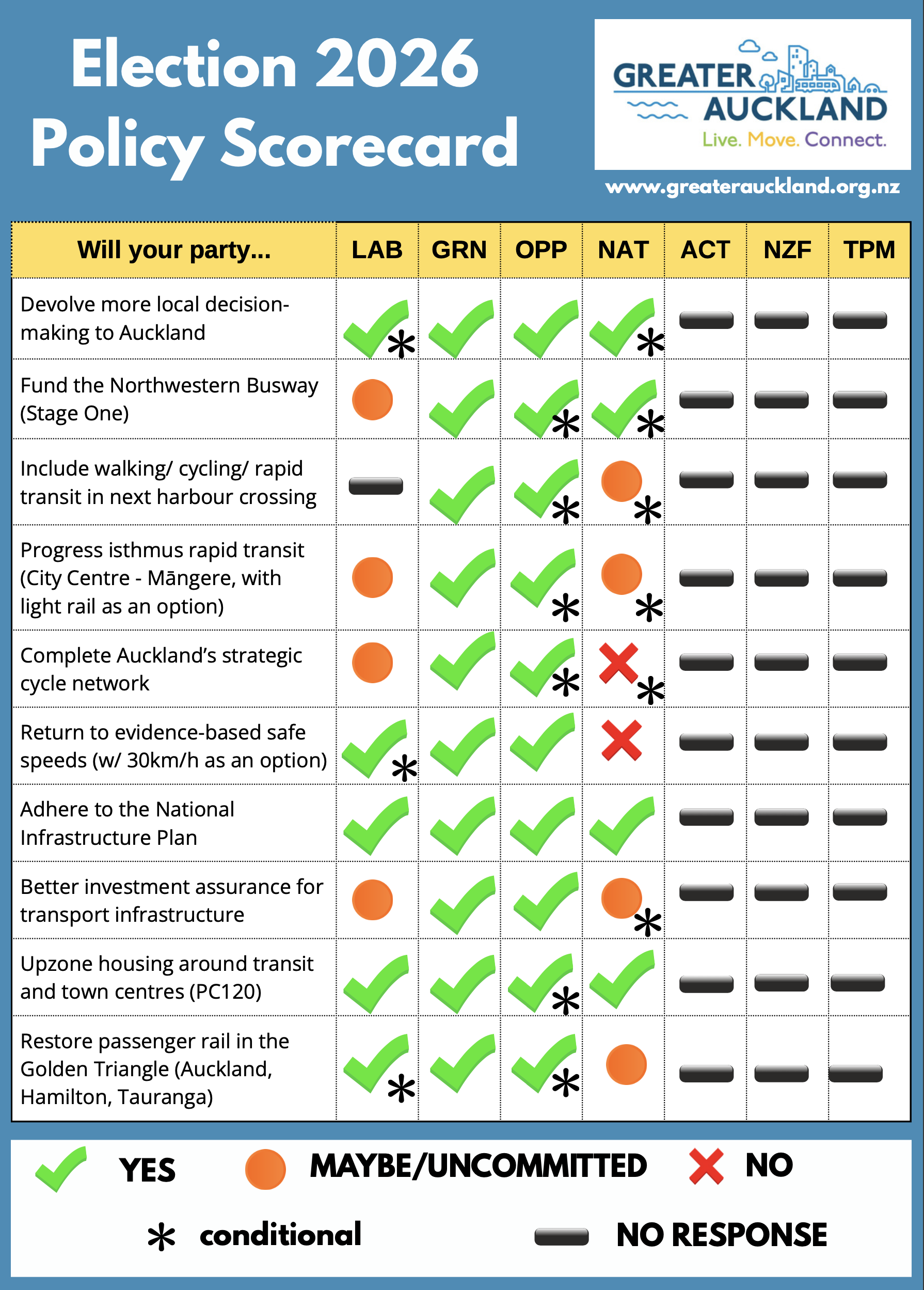
We have also created a handy scorecard, based on how (and whether) the parties answered our policy questionnaire. You’ll want to check their longer statements to see why some answers are marked as “conditional” – and we’ve used our best judgement about what counts as yes/ no/ maybe.
You can also check out some of our previous coverage and views on key election policies here, and here.
Feel free to discuss in the comments any other Auckland-related policies we may have missed.
Here’s the scorecard – with crucial voting information below; then notes on policies from the major parties.
Voting information
You have until 7pm on Saturday 7th November to vote. If you are in line to vote, you should stay in line after that time.
Reminder: you do not need an EasyVote card (or other identification) to cast your vote. Staff at the polling locations can look you up by your name.
While enrolments have already closed, if you’re unsure whether or not you’re on the roll (or on the dormant roll) you can go to a polling station anyway, and you may be able to cast a special vote. More about that here.
You can find voting places here.
Notes on policies from the parties
Labour
Labour has come out with three main policies relevant to Auckland:
- Weekly Public Transport Fare Caps of $20 in Auckland, Wellington and Christchurch, and $10 everywhere else in New Zealand
- ‘Fair go for drivers‘
- Fuel tax freeze
(See our previous coverage of the fare cap, and fuel tax freezes.)
National
National has these policies for Auckland:
- Removing the ban on minimum carparking requirements (except areas identified for intensification around city centres and rapid transit)
- Progressing Mill Road Stage 1 through a $1.8billion Crown Grant
- Public Transport Police
They have also stated a desire to progress:
- Northwest Busway
- The next Harbour Crossing
And they say they are committed to the:
- National Infrastructure Plan
- Auckland Deal
And have endorsed:
- the Auckland Motorway Strategic Plan
(See our previous coverage of fuel tax freezes, the Auckland Motorway Strategic Plan, the anticipated costs of the next recently ground-broken Road of National Significance, and the Waitematā Harbour Crossing reset, also here.)
Greens
The Green Party is running on these key priorities:
- Universal $2 public transport fares, and free for under 25’s, Community Card Holders, Total Mobility Users
- Immediate improvements to bus routes on planned Mass Rapid Transit routes in Auckland, Christchurch, and Wellington
- Long term planning for Mass Rapid Transit
- Regional Public Transport
- Level Crossing removal
(See our previous coverage of Greens announcements along with other parties here)
ACT
From ACT’s transport policy:
- Require major projects to public the lowest-cost safe option alongside the preferred option
- Build roads ‘ahead of growth’ where hitting thresholds will ‘trigger’ planning and building additional lanes
- Require Councils to repair roads before funding street redesigns by ring fencing renewal funding
- Stop the National Land Transport Fund paying for art
- Scrap vehicle emission settings
NZ First
NZ First’s policy is focused on rail:
- Heavy Rail Investment
- Reforming Auckland and Wellington Metro rail organisations to a joint run central and local government organisation
- Make Te Huia pemanent
- Level Crossings
- Third and Fourth Mains on the Southern Line and Avondale Southdown
Although they also support Mill Road Stage 1.
Opportunity
[Updated 9.50 am 5 November 2026] Opportunity supports universal free Public Transport and has a list of transport policies here:
Making public transport free to users.
Increasing long-term public infrastructure investment.
Developing a 30-year infrastructure framework.
Reducing the cancellation of projects after elections.
Giving maintenance and renewals greater protection.
Completing the replacement of the Resource Management Act.
Using user-pays and value-capture funding where appropriate.
Expanding renewable electricity generation.
Electrifying public-transport systems.
Accelerating business purchases of electric vehicles.
Using long-term savings capital to support infrastructure and national development.
They also have commitments to the National Infrastructure Plan, and want to ensure 60% of future infrastructure goes to maintenance and renewals (while also making it more difficult to cancel large projects).
Te Pāti Māori
[Updated 9.45am 5 November 2026] Te Pāti Māori has a cost-of-living policy package that includes transport affordability. Under the heading Make Public Transport Free Immediately, they propose to:
- Make public transport free for tamariki, students, and Community Service card holders and reinstate half-price fares for everyone else
- Extend free public transport to everyone within 5 years
- Expand and strengthen public transport in the regions
That’s our quick roundup – feel free to note anything we’ve missed, and above all, remember to vote!
As a great New Zealander once said: “Do not think your single vote does not matter much. The rain that refreshes the parched ground is made up of single drops.”
Appropriately orange-tinged image for election vibes: Patrick Reynolds

 Processing...
Opportunity do have quite a few transport commitments
while they aren’t all in one document its has been summarised here: https://www.kiwicoaches.co.nz/the-opportunity-party-2026-transport
Cheers, Goose – we’ve now added that in, and updated Te Pāti Māori policy references too.
ACT: “Scrap vehicle emission settings”
I mean… why?
I agree/disagree with policies on a case by case basis and we can argue if free fares vs $2 or whatever is ‘right’, but this just seems anti-evidence ideological nonsense
Climate change seems like a topic that is barely an afterthought in this election, despite both Greens and OPP forming a large block of people who think the environment is important.
This blog is focused on transport, but climate should also be part of any transport conversations
Blacksmith, yes I strongly agree. For example, one of the many smaller but devastating anti-climate action moves of this government, that had a terrible impact on transport funding, was the cynical raiding of the CERF money jar (Climate Emissions Response Fund). This was co-funding really great bus electrification and service pattern upgrades all over the country. Nelson, Whanganui etc. These have now all stopped.
Also CERF is smart, it gives incentives to polluters to stop, and offers assistance to fund the necessary upgrades.
And how valuable are those electric bus (and ferry) fleets now for local authorities with Diesel price. It is also a great value for money programme.
This government are not, as they claim, focused on efficiency and VfM, as culture-war, fossil-fuel donors, and just reversing whatever the previous govt did over-ruled those important aims.
Recent upgrades proposed by Whanganui better bus routes) and AKL (electric ferries) all rejected by this govt and their proxies (NZTA under strict nonsensical instruction).
I suppose you might risk editorialising their policy platform, but a cursory look at that scorecard has me wondering if NZ First’s policies satisfy a few of those questions. I guess it was for them to respond specifically to the questionnaire though.
Likely true, such as regional rail, but they didn’t provide a response so we decided not to. If a party did provide a response we did interpret their answers (ie see Labour)
I like TOP but not sure I like free public transport. Very rarely does making something completely free lead to it being a good service in the long run. Many studies, both in NZ and overseas, have found that cost isn’t one of the top 3 barriers to using PT regularly. Many people would rather have better networks than free fares.
It should be affordable, either through low fares or fare caps, but not free in my view. If someone is commuting say Orewa to the CBD and back each day then they absolutely should pay something towards the trip. Free PT has a place maybe on short high volume hop on hop off routes like the city link, or special events like big concerts. For groups of society who do struggle with costs then we address that through concessions or at a higher level the social security system of benefits, student allowances, etc.
Agree.
Farebox revenue would allow further extending PT reach and frequency. This should be prioritised ahead of price reductions
Strongly agree, free fares is not the unalloyed good it may appear. However cost is a barrier for specific communities, so should be addressed in a targeted fashion.
I note Te Parti Māori therefore, has the more evidenced and rational policy than Opportunity…