A few weeks ago, I asked what Warkworth to Te Hana (WW2TH) will actually cost us. A fair question, given the government’s rush to sign a Public Private Partnership (PPP) for this new four-lane expressway ahead of the election, without releasing the numbers of what it will really cost.
We now have a lot more information, thanks to
- Details revealed by a series of Parliamentary Written Questions (PWQ) from Labour’s transport spokesperson Tangi Utikere to Minister of Transport Chris Bishop.
- Documents released on 30th July by the Ministry for Cities, Environment, Regions, and Transport (MCERT).
So, while we still lack full transparency, we can take a reasonable crack at working out the true cost of the Warkworth to Te Hana PPP. Hold onto your hats.
Without more revenue, Warkworth to Te Hana will devour 10% of transport funding in its first decade, and cost ~$9bn all up
I’ll lay out my workings below, but in a nutshell:
We know the average annual Unitary Charges will be $290m per year, for 25 years.
We also know that over the first 10 years of the PPP period (2034-2044):
- paying back the $1.4m PPP financing will account for 3.5% of NLTF revenue*
- paying back the $1.6bn Crown Loan (principal and interest) will account for 2.5% of NLTF
- So, a total of 6% of NLTF revenue will go towards this one road.
*NOTE: The NLTF (National Land Transport Fund) is made up of revenue from Fuel Tax and Road User Charges, and recently, direct Crown funding top-ups, It is the primary pot of money for all land transport in New Zealand. And the Warkworth to Te Hana expressway is just one part of one road, and not even the urgent part. So 6% of that investment pot on one 26km expressway is a lot. That % likely assumes the increases from the GPS2024, of 12c in 2027, 6c in 2028, and 4c annually from there.
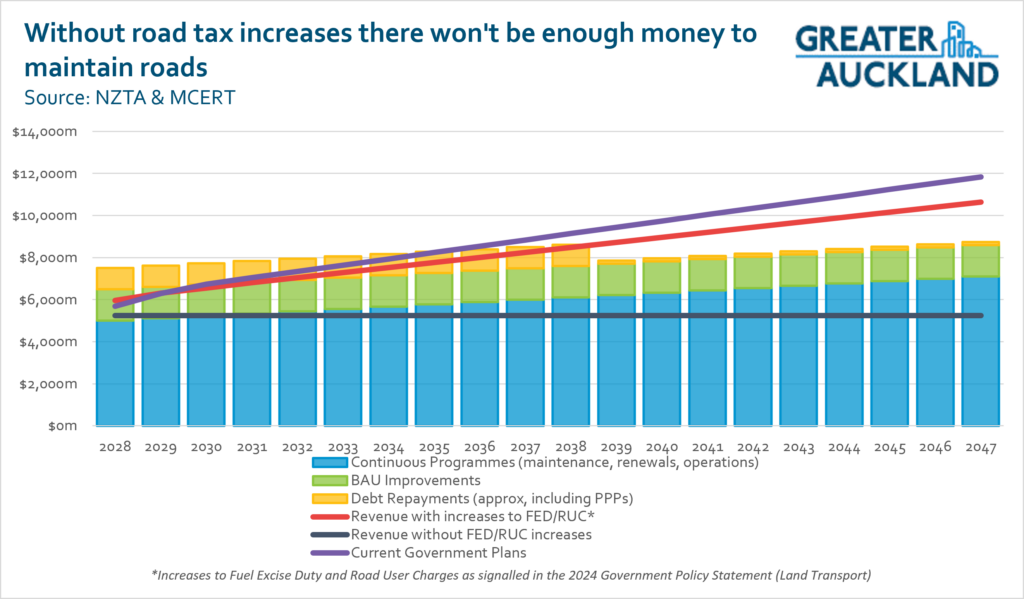
But wait – those percentages were worked out before both National and Labour backed away from (overdue) increases to Fuel Tax and Road User Charges. As we covered yesterday, this will leave a funding gap in the billions.
So without those planned increases, the Warkworth to Te Hana PPP in its first decade will in fact soak up more like 10% of NLTF revenue. One dollar in ten, on just one shiny new road, for a generation.
However, yesterday, the current government also said they would start increasing FED/RUC from 2028 at a rate of 5c every 6 months, and then annually at 5c from 2030. Under that metrics, Warkworth to Te Hana would consume 5.5% of NLTF revenue during the first decade – although of course, they are kicking the decision to increase revenue by another year so who knows if they would even follow through.
Worse: the government has consciously chosen to pay more than it needs to for this road, knowing that financing infrastructure through private entities costs more than raising Crown funds. In short, Joe Public (that’s us) is paying more thanks to the higher cost of private debt, and an unknown cost of ‘risk transfer’.
How much more? Working with available data points towards at least $9 billion, all up. That’s 9000 million dollars.
Even just looking at the base project, which costs $3billion to build, is already over scoped and over expensive.
Brand new duplicate expressways built to high-speed spec cost vastly more than the alternatives, as Thomas Manch writes in an article for Business Desk:
The [Infrastructure Commission of New Zealand] looked at evidence produced by the European Court of Auditors, which analysed 24 road projects across the European Union funded by the European Union’s “cohesion fund”. In places that chose “an entirely new road, in a new alignment built, to a higher speed limit”, these projects typically cost 76% more than a road with less capacity but similar actual traffic volume, at a different design speed. “They were having to sort of basically go and do more earthworks and do more property acquisition to get a road of a higher speed. ”
If the alternative lower design speed option for Warkworth to Te Hana matched that evidence, there would be an alternative solution costed at $1.7 billion.
So not only are we spending more through this PPP, the original project potentially could have saved $1.3 billion if it was a more reasonable scope.
Smoke-and-mirrors: the PPP approach in a nutshell
PPPs like Warkworth to Te Hana (and like Transmission Gully and Puhoi to Warkworth) are sold to the public as a clever way to build big things, like getting a “mortgage” for a house. But as practised in New Zealand, they’re not that smart, they’re more like robbing Peter to pay Paul. Also, a road is not a house.
Here’s the guts of it:
- Entering into a PPP involves the Government knowingly shouldering a costlier form of debt. It has the ability to borrow much more cheaply itself, but chooses not to.
- The repayment structure pushes the cost onto future generations (and future governments). The annual Unitary Charges don’t kick in until the project is delivered – in the case of Warkworth to Te Hana, that’ll be 2034 or thereabouts – long after the current decision-makers are off the scene.
- Accounting smoke-and-mirrors is leveraged to obfuscate the cost of the project on the government’s books. The repayments all come from the NLTF and NZTA, through Fuel Tax and RUC. We pay for it, but requests for public transparency – us, asking where our money is going – are rejected due to claimed “commercial sensitivity”.
- The idea that risk is somehow transferred to the private entity vanishes when the road is finished. Once the road is open, all the risk reverts to us regardless of the deal. Governments will do whatever it costs to keep the road open (see the costly Transmission Gully debacle). It’s a double-whammy: we, the public, paid a premium for “risk transfer” during construction, and we could also pay for any post-construction issues. They saw us coming AND going.
- To use the Minister’s mortgage metaphor, kickstarting a PPP by taking out a Crown loan is like borrowing a deposit in order to secure a mortgage. You’re then stuck with two sets of repayments to stay on top of. Which might be vaguely plausible if your purchase had a whopping Benefit Cost Ratio (say, 3 or 4+), rather than the paltry 1.4 of WW2TH.
Showing our workings: the known information
So, how did I work out the $9billion price tag?
First, the answer to one PWQ from Tangi Utikere revealed that the average annual Unitary Charge repayments for the PPP are expected to be $290m per year, for 25 years.
Next, an unredacted paragraph of the 30th July MCERT document revealed that for the first decade of the PPP, the annual repayments were expected to use an estimated 3.5% of National Land Transport Fund (NLTF) revenue, and servicing the Crown Loan would soak up around 2.5% of NLTF revenue.
Here’s the full text:
Implications for the NLTF.
81. The Project remains affordable for the NLTF. NZTA forecasts that the average Unitary Charges of [redacted under s 9(2)(i)] over the operational period (FY2034-FY2058), will represent around 3.5 per cent of NLTF revenue on average over the first decade. The annual debt servicing costs (principal and interest payments) to NZTA of the $1.6 billion Crown loan is forecast to represent around 2.5 per cent of NLTF revenue on average of available over the same period. The Minister of Transport intends to address the revenue pressure across the NLTF through GPS 2027.
The redaction hides the exact amount of the average annual Unitary Charges for the PPP deal during that period (i.e. the annual repayments we will be making on this “mortgage”, to the private entity that is financing it for us).
But the paragraph still clearly states what proportion this is of NLTF revenue; likewise for paying down the $1.6bn Crown loan (i.e. the stake the government had to put in, to get the financing off the ground).
- For the first decade of the PPP (FY2034-2044), the average Unitary Charges for the PPP will represent 3.5% of NLTF revenue.
- Over the same period, NZTA’s debt servicing (principal and interest) for the $1.6 billion Crown Loan will represent 2.5% of NLTF revenue.
Note: those figures almost certainly assume the NLTF revenue will include the proposed increases to Fuel Excise Duty and Road User Charges (signalled by the 2024 Government Policy Statement on Land Transport) of 12c per litre from 2027, 6c the next year, and 4c each year from there on. However, as we know, both major parties have recently committed to not raising the fuel tax any time soon.
From another answer to a Parliamentary Written Question, we also know a breakdown of the Unitary Charge Payment with the Financing Component, although only as ‘net present value’ (NPV) which is an adjusted number. On the table below, it’s $1,736 (millions, so 1.736 billion over 25 years).
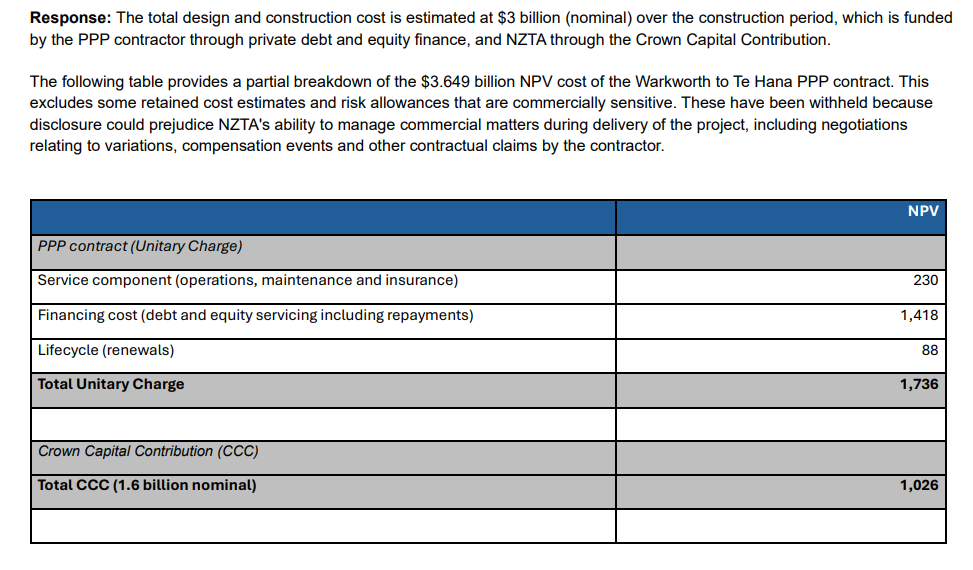
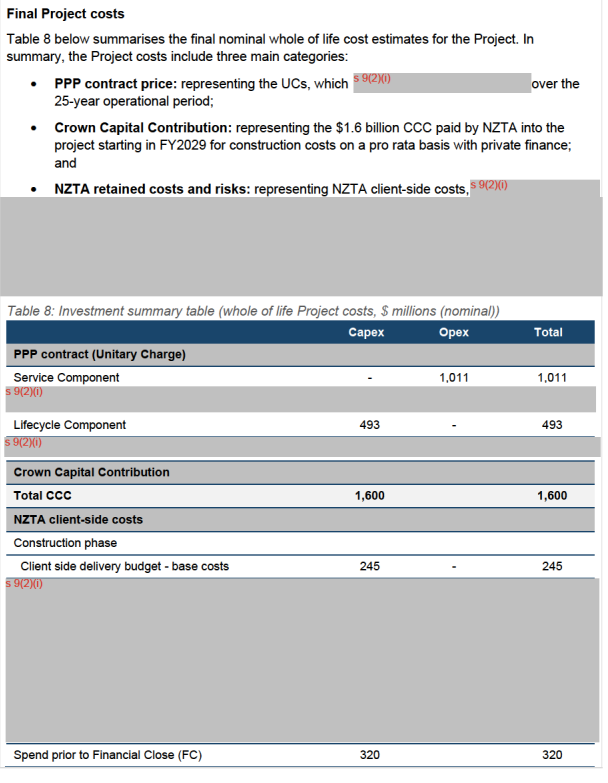
This differs from the ‘nominal value’, aka the amount of money that is actually paid (without adjusting for change in value due to inflation). In the MCERT documents, the breakdown for this figure is redacted:
So, now we have some numbers in hand, what can we estimate?
Annual payments of $290m on average for 25 years
Knowing the average annual repayment, we can get a basic calculation of the nominal cost of the entire PPP deal.
Given the average annual repayment is $290m each year for 25 years, that comes to $7.25billion.
And, because we know the nominal value of the ‘Service’ and ‘Lifecycle’ components ($1.504billion), we can estimate that the financing component of the Warkworth to Te Hana PPP has a whole of life cost of $5.746billion.
That is the amount the public will be paying (through fuel tax and road user charges) to the private entity, in order to service the debt that entity raised to cover $1.4billion of the $3billion construction costs.
Given so much of this remains redacted, this is an estimate based on what information we have. So, is it accurate? Let’s compare.
As a % of NLTF revenue
We know that the first decade of repayments for the Warkworth to Te Hana section of expressway will absorb, all up, an estimated 6 per cent of total projected transport funding revenue for the entire country during the first decade of the PPP repayments.
We don’t know the exact numbers, but it’s almost certain the projection of NLTF revenue includes the expected increases to Fuel Tax and Road User Charges as indicated in the 2024 GPS. That’s equivalent to Fuel Tax increases of 12c in 2027, 6c in 2028, and annual increases of 4c from 2029 onwards.
So, by those numbers, we can estimate that NLTF revenue between 2034-44 comes to approximately $88.4 billion.
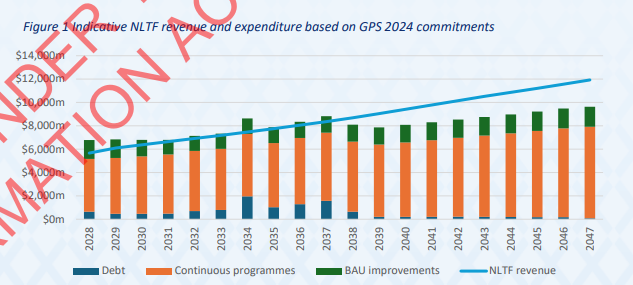
3rd September 2025 Ministry of Transport projection of GPS 2024 FED/RUC increases and expenditure
So 3.5% of that, is $3.357 billion, or $309.4 million per year in Unitary Charges for the PPP (which is pretty close to the known number of $290million per year of average Unitary Charges)
And 2.5% of that, is $2.398 billion, or $221 million per year, to pay back the Crown Loan (principal + interest).
Of course, this is just an estimate. But if we add the known number of $290million per year + the $2.398billion estimate for the total repayment for the Crown Loan, we get $9.648 billion.
If we assume the average Unitary Charge of $290 million per year applies during that first decade, and work backwards as a % of NLTF revenue, the Crown Loan repayments would total $2.07b, leading to a total of $9.3 billion.
So it’s a pretty solid assumption that the total cost of this project is over $9 billion.
And hold your horses, because it gets worse: as we wrote yesterday, Labour are promising to not raise FED/RUC next term and National delaying increases. If there is no increase to FED/RUC, then under current estimates, the Warkworth to Te Hana expressway would consume approximately 10% of all NLTF revenue.
Some unknowns, and a hypothetical on the cost of debt
We do not know the ‘value’ of transferring risk to the private entity. This is a core element (and selling point) of a PPP, and will represent a decent cost to the public. It may be additional to the numbers given, or included in part of the costs.
We also do not know the exact numbers behind the Crown Loan. Nor do we know the cost of the private debt the private entity has raised.
But we do know that government debt, i.e. the Crown Loan, will be ‘cheaper’ than any private debt, because the interest costs will be lower.
Additionally, we know the private entity would want some profit margin on top. Let’s say 15%.
To illustrate how much more this can mean the public is paying, let’s do an exercise.
If we know government bonds in New Zealand have a approx 4.7% interest rate and, for argument’s sake, we assume the cost of private debt is 0.5 percentage points higher (so, 5.2%) – then how much more might that add up to in interest over a 25-year period?
Without reducing the principal, 4.7% annual interest applied quarterly would lead to a total amount of $4.5billion over 25 years.
Whereas, the 5.2% rate would result in a total amount of $5.1billion. And, if the private entity wanted a 15% profit margin, the would then become $5.86billion.
So in our hypothetical example, because of the private lending, the public would wind up paying $1.35billion more – 30% more in interest – than if the whole project had been financed via a Crown loan.
With the WW2TH PPP, we do not know exactly what it cost the government to raise its Crown Loan, or what interest rates they are charging NZTA (other than they are at ‘commercial’ rates). Nor do we know the costs of the private entity’s debt.
But we do know the cost of debt for the private entity will be a lot more, and that they’ll want a return on top. The point of the hypothetical example above, is to show how even small changes in interest rates add up substantially over time.
In short, under the PPP the public is paying a lot more in order for the government to be able to avoid putting debt on its balance sheet.
Is that fair?

The PPP Payment Profile for Transmission Gully
The government’s ‘savings’
When Minister Bishop announced the signing, he claimed ‘savings’ of $251 million (NPV) by procuring Warkworth to Te Hana through a PPP instead of the traditional approach.
This number was derived from comparing the net present value cost of the Public Sector Comparator (i.e. if the road was delivered the traditional way), estimated at $3.9 billion (NPV).
This is confounding, because we know we are paying more to private financiers than we would if the government itself borrowed the money to fund the project.
How much more? That’s entirely unclear because again, there has been a complete refusal to release the detailed numbers behind anything to do with this, so who knows where these ‘savings’ are actually coming from.
But to be clear, the government is proudly telling us they’ve ‘saved’ $251 million… by signing us up to spend much more on extra financing costs, all the way through to 2058.
If we were paying of a Crown Loan across that length of time, our loan payments would be going back into the public coffers. Instead, they’ll go straight to the private financiers – made up of banks and overseas lenders.
In other words, from now until 2058, every single person contributing to the NLTF, from Cape Reinga to Bluff, will be subsidising this one multi-billion-dollar project. And we’re expected to be thrilled about a ‘savings’ of a few percent?
The much bigger story is the enormous opportunity cost – how much more heavily every one of us will be subsidising this project, in terms of what we can’t afford, because we blew it all on one road.
Assuming we the public are ultimately paying a price of $9.3billion for Warkworth to Te Hana – that’s the equivalent of:
- 1.7 City Rail Links ($5.5b)
- 5.1 Cambridge to Piarere Expressways ($1.8b)
- 3.6 full 100km Waikato Expressways ($2.56b in 2025 dollars)
- 6.8 Puhoi to Warkworths ($1.37b in 2025 dollars)
- 51% of the rest ($18b) of the actual Northland Expressway yet to be committed to (Te Hana to Whangārei)
- 1,033 Hill Street Intersection-sized safety improvements ($9m NZTA portion)
- 71 years of the annual walking and cycling budget ($130m)
- 62 years of the scrapped Auckland Regional Fuel Tax ($150m per year)
And those are just transport examples. The same money would fund the recently scrapped Marsden research fund ($77m) for 121 years, for example, or any number of hospitals, schools, resilience projects, repairs for damage from weather events. New Zealanders are locked into spending billions on one road (and additional hundreds of millions, thanks to how the deal was structured) which, unless this deal is canned, can now never be invested in anything else we might need and want.
So where does this leave us?
A rational government would find a way to rework the deal and downscope this project.
Even at face value, the scale and scope of Warkworth to Te Hana has never made sense, and yet it was pushed through the pipeline like an unstoppable juggernaut.
Projects like Warkworth to Te Hana, a complete duplicated state highway, will always be substantially more expensive than viable alternatives and don’t make sense. Add onto this a PPP, and reality is nowhere to be seen.
A government keen to involve the private sector, on the assumption that the private sector may be better at innovation, say, could do that that via models like an Alliance, as was used for CRL and the Waterview Tunnel.
Likewise, if the government is looking to lock maintenance and renewal costs for the long term (a claimed benefit of a PPP), you can sign long term maintenance and operation contracts with an entity without resorting to private finances. And, as pointed out by Geoff Cooper, Chief Executive of the Infrastructure Commission, to Parliament’s Transport and Infrastructure Select Committee in June of this year:
That has been sort of purported to be a good thing about PPPs. But it is in many ways a very expensive way to solve a maintenance problem. We would hope that you wouldn’t have to use a PPP just to get good maintenance practices.
(See from 1:23:44 in the video below) Worth noting here, too, that Warkworth to Te Hana was never scrutinised by the Infrastructure Commission under the apolitical, bipartisan-backed National Infrastructure Plan.
The overall point is that the government has actively chosen to advance a project that’s already well beyond the brink of affordability, via an approach that will cost the public vastly more than it needs to, for little actual tangible benefit.
Why else are all of these deals so shrouded in secrecy? Why else is the government – and public agencies such as NZTA – constantly delaying and obfuscating the release of basic information about these deals?
Think about the scrutiny given to cycling projects that cost less than a tenth of just ONE annual repayment for the Warkworth to Te Hana PPP!
$290million per year on average, for 25 years, of public money (plus the Crown Loan), locked up in a contract we are not allowed to know the important details of, for a project we know has significant flaws and is costlier than viable alternatives.
How does this make sense? How is this ‘fiscally responsible‘?

 Processing...
Saying, for a second time, we’ll raise road taxes later to pay for things we are committing to now, is jam now, and pain tomorrow. Again.
But every time the pain is kicked down the road it becomes even harder to actually apply, because the costs and the debt are higher, so the tax has to be too. And therefore harder to sell.
This is clear in the new govt tax rise plan; instead of one 12c catch-up rise followed by annual 4c rises, they are now promising 2 x 10c years followed by annual 5c rises. Do we believe they will have the courage to impose this on the public, in 2028, anymore than they do now? Will all their coalition partners resist the populist play of saving the poor motorist from tax rises?
Labour have the same problem. Will they raise these taxes similarly, or will they have the courage to walk away from Warkworth to Te Hana, for example?
I am sorry, but the only available option is more spending with less tax (and therefore more debt).
I submitted an OIA request for the schedule of unitary charges. I look forward to finding out in a few days that my request has been declined due to “commercial sensitivity”.
Direct monetary financing for infrastructure now. Plus dump these roads of national party significance and revert to proper transport and mobility planning.
“revert to proper transport and mobility planning.”
Please explain what this means in reality. Does this mean more plans, more delays and less building?
As I keep saying the whole edifice of the fuel taxes and road user charges funding the NLTF, which the NZTA then wisely spends the proceeds is going to fail. Poor political management is ensuring its bankruptcy. It no longer fulfils its purpose of being a hypothecated funding tool for building and maintaining the state highway network. Its century old design (dating back to the 1922 Main Highways Act) has been so distorted by political promises that cannot be kept. Lies and a lack of accountability to the public footing the bill may keep the system stumbling along in the short term. But the systems inevitable failure is just a matter time. The whole thing needs to scrapped and rebuilt from first principles.
It’s the opportunity cost arguments that get me. Just today there is an article in the Press about another delay to upgrading frequencies of the 1 and 5 Bus routes in Christchurch, as NZTA lacks money to co-fund. Literally talking about maybe $1m a year for an overwhelmed bus route serving the fastest growing urban area in NZ (Rolleston).
I’m sure there are similar stories in other areas around the country.
Yes and then there’s the whole economy beyond transport – we need properly funded hospitals and health system way before we need this over-sized parallel highway, especially when procured in the most costly way possible…
I think Canterbury can state that National’s claim that growth will pay for new infrastructure is bull shit. Selwyn, Canterbury and the South Island have been leading on most metrics for several years now. Whether that be on population, regional gdp growth or unemployment. Yet try to get a few $million for more buses so that all the passengers waiting on scheduled services can be picked up. It is a big fat yeah-nah. And what is the reason -stupid political promises.
Selwyn should have a high frequency train or MRT service. It is the Greater Christchurch equivalent to Wellington’s Hutt Valley or Porirua. It is obvious Christchurch’ Southern motorway will choke off in a decade or two because it will not be able cope with the growth in Selwyn. Yet we have a so-call hypothecated transport funding system that cannot do anything about it.
Our political leaders are pathetic. They provide no leadership even when the problems and solutions are staring them in the face.
im sticking to the old SH1 and avoiding traveling to Te Hana.
Does that mean i can get walking and cycling infrastructure for my community ?
Thanks Connor and team, but we’re stuck in a cycle of poor performing transport decisions. BCR 1.4 is hard to imagine, the small benefits, and large costs.
Someone is making good coin, documenting who pays (again) just makes the case (again) for significant political reform, before we go broke with a nice highway we cant afford the tolls or RUC’s to cover.
2019 business case had a BCR of 0.7 when the cost was $4B.
Great to know we’ve managed to double the spend and the BCR.
Something is rotten in Wellington.
https://www.1news.co.nz/2026/05/20/public-in-dark-on-cost-of-huge-northland-road-as-govt-nears-deal/
Italy reversed its inflating infrastructure cost disease issues about 30 years ago because it saw it as corruption. NZ is so polite we are 30 years behind the times. Italy enacted Public Works legislation to ensure transparency, competition, expertise and accountability. Measures, such as, all projects must bid using standardized unit pricing, a single named professional being responsible for a projects scope design and another for project delivery etc.
https://transitcosts.com/city/italy/
Central government should concentrate on the overall planning and infrastructure architecture. For instance Chris Bishop has done an excellent job continuing the work on Competitive Urban Land Markets that Labour started.
Public Works reform should be the next stage.
I genuinely believe the politics of place is important when it comes to making our cities and regions the best they can be. Each place will have a different optimal tradeoff between the various agglomeration tailwinds and disagglomeration headwinds. A one size fits all central government approach will not work. We need devolution including fiscal devolution not delegation. Incentives as well as sticks, is what seems to work best overseas.
This is vitally important, it is about giving the next generation opportunities not burdens.
I fear if NZ doesn’t embrace this sort of liberal project then it will fall into a populist trap, like we are seeing elsewhere in the West.
What if it is a scorched earth policy, where the future costs will deny future governments the possibility to successfully implement alternatives.
I think its utter nonsense to say we can’t afford this project.
The government’s recent $20 a week tax cut cost $3 billion a year. If instead they had put that money into an infrastructure fund, we could afford to start a project like this every 1.3 years without the need for debt or future generations being shafted. On top of that the build process would bring in tax revenue and keep people employed.
Would this project be the first cab off my rank – no. I would build Auckland and Wellington LR first, then Cambridge to Piarere. Maybe after those it would have got a look in.
do you live in Te Hana ?
No, and I don’t live in Piarere either.
If we had a $3 billion a year new infrastructure fund, they could probably kick off about 10 projects this size on day one without needing any debt. Then another one each time one finishes. $3 billion a year is only about 2% of the government tax take. Its not that we can’t afford it.
“Cambridge to Piarere” How many people per day would use this service? Would it be cheaper to just pay their taxi fares for this trip?
Piarere has a population of a little over 400, why would this project be on your priority list?
Solution: Ask China to build and pay for this highway, in return for 20 years of the toll income on that stretch of road.