After the Government’s announcement of a revised approach to planning the next Waitematā Harbour Crossing, we had thoughts – and quite a few questions.
The Minister has provided answers, which we share below. While a lot of it this remains promising, we also have a lot of remaining concerns, and quite a few follow-up questions as well.
Questions for the Minister – and answers provided
How will questions and possibilities about the project be socialised?
As we move into the Detailed Business Case stage, we will progress planning for stakeholder and public engagement. We will have more to share in due course.
How will the government ensure opposition parties are involved from the get-go?
We have provided multiple briefings to the Opposition over the past year, including ahead of yesterday’s announcement. This is something I plan to continue through the next phase of the project.
How will the public and Auckland Council be involved?
Auckland Council will be engaged through the Auckland Regional Transport Committee currently being established to coordinate central and local government transport plans in Auckland and create a unified 30 year transport plan.
The Chair of this Committee will be a member of the Waitematā Harbour Crossing project’s Steering Group – providing oversight and input into the project. In addition, the study into Meola Reef will be jointly commissioned by central government and Auckland Council.
How wide a range of options will this new approach consider?
We aren’t starting from scratch in the next phase, instead we are simply being as transparent as we can be about the options taken forward. We will be progressing the two existing bridge and tunnel options from NZTA’s Investment Case through the Detailed Business Case, and considering the Meola Reef investigation and the Market-Led Proposal in parallel.
Will any solutions be required to include the missing modes – rapid transit, and walking & cycling?
Any option for an additional crossing would increase lane capacity across the harbour. There would be options for how those lanes can be best used to support transport demand.
Both the bridge and tunnel options from NZTA’s Investment Case include dedicated lanes (one lane each direction) for a rapid transit busway across the harbour.
Will consideration be given to changing the law to enable cheaper options (such as consenting)?
The Government has already made significant progress on reforms that will make it easier to plan and consent infrastructure projects. We introduced Bills to replace the Resource Management Act last December and expect to pass them later this year. Infrastructure projects will benefit from spatial planning, standardised rules, and a more consistent consenting process. The Bills will also ensure consent conditions are proportionate to the scale and significance of effects, avoiding unnecessary costs and requirements for applicants.
Will there be a set budget envelope for the project to ensure the development of realistic options?
At this stage, we are not planning to set or share a specific budget envelope. However, Cabinet has been clear in its expectations that the next phase of the work continues to look at opportunities to reduce costs where appropriate.
How will the government ensure the next phase takes a properly independent view?
A common assessment framework will be developed to fairly assess all four options. They will also go through the same assurance process which will be based off the Infrastructure Commission’s existing assurance process and adapted to a project of this scale and complexity. This will be overseen by an Independent Assurance Panel and will assess both the assessment framework used, and the quality of each of the options developed.
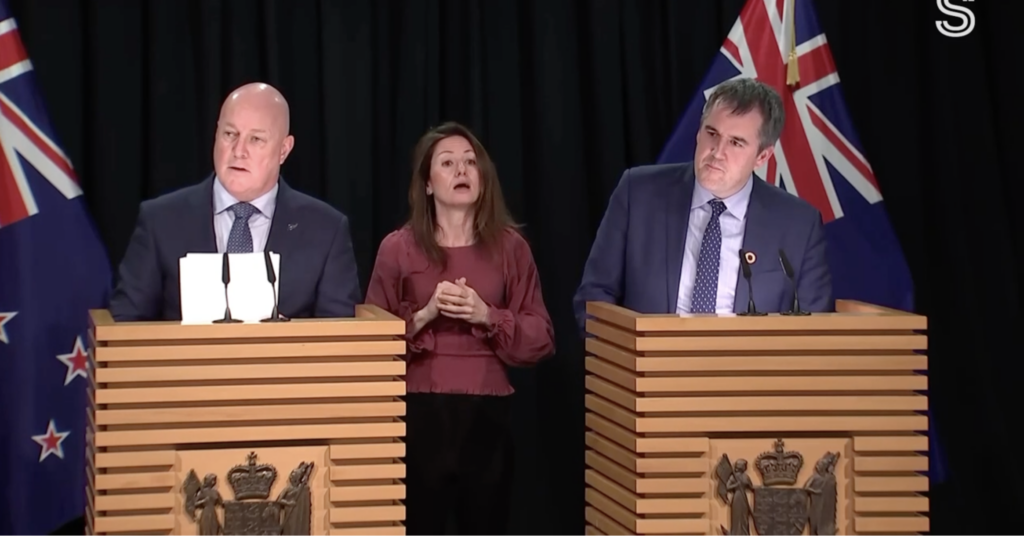
Prime Minister Christopher Luxon and Minister of Transport Chris Bishop announcing the changes on Monday
The good bits
First of all, it’s great that the intention is for more transparency going forward. As we’ve long argued, the secrecy that has surrounded this project has been immense, and has prevented a real conversation about what’s best for Auckland.
It’s also good to know that the project will being scrutinised by an Independent Assurance Panel, based on the Infrastructure Commission’s existing framework for assessing major investment.
These are not small things. The best way for a project to happen is to build public support through openness and public conversation. And, the best way to ensure we get the best version of the best solution, is to have an open process with proper independent scrutiny.
So far, there look to be some good moves in this area, and this could go further using processes like deliberative democracy, along with regular consultation; to get informed views of regular Aucklanders and build up the social licence of any solution.
What needs improvement
While there is some positive direction in other areas, we think this should go a lot further.
For example: while it is good that Auckland Council will have more involvement in the project, that’s set to happen through the Auckland Regional Transport Committee. And it should be noted that the chairperson of the Auckland Regional Transport Committee is jointly appointed by both central and local government.
So although they might be on the Harbour Crossings steering group, they are essentially only half a representative of Auckland Council itself.
We suggest Auckland Council should have its own chosen representative on this steering group.
Likewise with the involvement of other political parties in this process. If the intention of this project is to have true cross-party involvement, so the project can successfully span multiple changes of government, then it would be equally useful for the opposition to have their own representative on something like the steering group (which should remain through a change of government).
Additionally, we would like to see more of an appetite to set cost envelopes for the project. Any proposed “solution” that ties up the entire city’s – or the whole country’s – available resources for decades (whether funding, gear, or person-power), is not a practical solution.
Finally, a project as complex and significant as this should likely come with its own enabling legislation. It’s not clear to us the existing consenting process, even after the governments reforms, would make sense in order to produce the best option here. It often seems that viable solutions (such as a bridge, or in other projects something like elevated rail) are too easily brushed aside due to claimed difficulties with consenting.
That isn’t to say things like the environmental impact shouldn’t have a lot of importance in the process. Rather, when something will change the visual landscape of our city as much as a new Harbour Crossing could, this should require a more project-specific approach.
Highly concerning
While we appreciate the Minister’s responses to our questions, they highlight a number of things that we are extremely concerned about.
First and foremost, this new process – if it is to truly take a fresh and considered approach – must be tasked with questioning the assumptions and work of prior reports.
It is absolutely right to take this project out of the space that has produced unworkable report after report, for decades. We commend the government for creating the opportunity for a better process, and thus ideally a better outcome.
However, a failure to question the assumptions of prior solutions would be catastrophic.
There will undoubtedly be useful components of the decades of work so far (such as geotechnical inspections over the last couple of years) that can be used in this refreshed process. But the key premises – and founding assumptions – of what NZTA has produced thus far deserve to be questioned, and rethought if required.
We can all see the cost of the failure to do this. Unquestioningly carrying forward set assumptions, project scopes that have accreted to monumental size, and the occasional surprise bid has been a fatal flaw of projects such as Auckland Light Rail and Warkworth to Te Hana, where wildly over-scaled “solutions” have been advanced under a claim of “there is no alternative”. This is especially harmful when there were always alternatives that were both fundable and buildable.
So, this is why a more transparent and open process is crucial. The prior process has operated under an extraordinary shroud of secrecy. While we don’t know exactly what has been produced (hopefully this will change soon with the public release of details, including what this Market-Led Proposal is, any guesses?), we do know that process is likely to have repeatedly produced the same unworkable solutions, again and again. If not, a project would already be underway.
The only way to solve that is to have a public and transparent conversation – and to give the new process the mandate to consider reputable independent proposals, such as the bridge proposition we have endorsed.
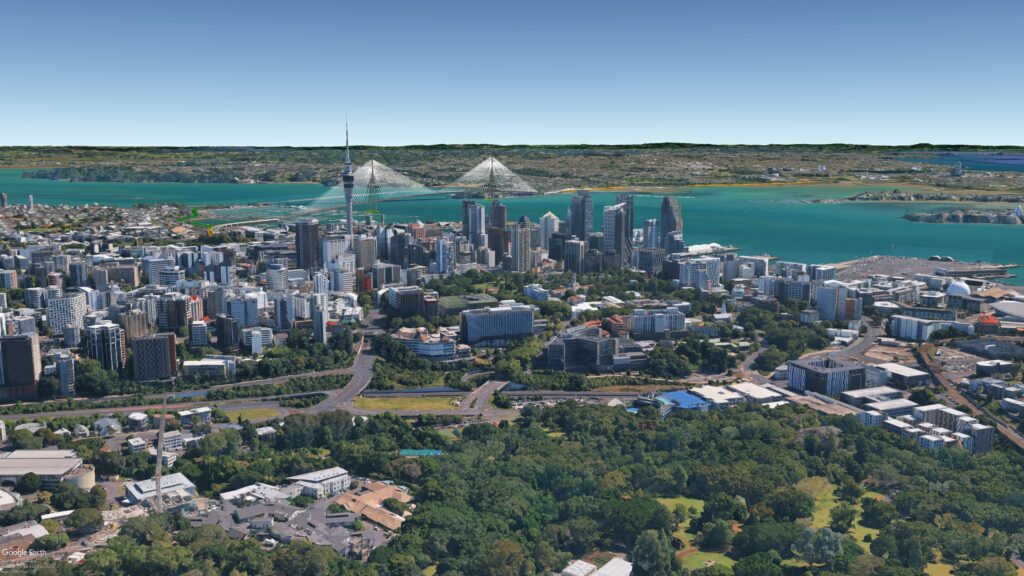
Our endorsed bridge proposal from across the city Image: Nicolas Reid/ MRCagney
There’s a reason why we have endorsed this particular proposal: it seeks to solve the real problems that any Harbour Crossing needs to resolve if it’s going to be a lifelong benefit to our city. Starting with an accurate problem statement is vital.
And that’s why any proposed solution must embrace and prioritise the currently missing modes. Any solution that does not have walking and cycling at the top of the list is an immediate no-go.
On that note, it is striking that the Minister’s answer doesn’t simply say something along the lines of: “Of course a priority of any new crossing will be to enable Aucklanders and visitors to walk, bike, stroll and scoot across their beautiful harbour, just as in every peer city we can compare ourselves to. This is a glaring deficit that we are both excited and delighted to fix.”
Honestly, how hard would it be to say something like that? And what is it telling us, if a sensible minister isn’t saying it?
The same goes for rapid transit: a commitment to a single lane feels bare minimum. The key reason the existing Harbour Crossing has worked for as long as it has, is due to the enormous proportion of people who travel across on buses rather than driving. So, planning for Rapid Transit must be front and centre in any solution, and it must be future-proofed for greater usage, and to ultimately enable rail.
After all, the main benefit, and indeed the main point, of building any new crossing is to deliver purpose-built new modal connections that are fit and proper for keeping a sustainable city moving, in the world we now live in.
Only when these missing modes are top of the planning list will we be sure we’re actually on the right track here.
To sum up, this change offers an opportunity for a better outcome for the Harbour Crossing project. But only if it is done right.
- For any solution to be legitimate, it must include walking, cycling, and rapid transit connections (future-proofed for rail).
- We ask for more extensive involvement of Auckland Council and the Opposition parties.
- We support the intention for more transparency, and greater independent scrutiny of the project options.
- We would like reputable proposals, such as our endorsed bridge proposal, to be evaluated as part of this process.
Time will tell whether this will be just another report, or a genuine move towards delivering the next Harbour Crossing.

 Processing...
“Honestly, how hard would it be to say something like that? And what is it telling us, if a sensible minister isn’t saying it?”
Real leadership is about stating a clear vision that can be accepted by everyone.
Surely the starting point should be defining the problems to be solved.
And getting wide acceptance on this first.
This may well give a different answer then “We are running short of vehicle capacity across the harbour”
Probably the most dramatic illustration of this, is how an alternative to more lanes , The Northern Busway, delayed the capacity crunch on the current harbour bridge by decades..
The issue is the “wide acceptance” you are dreaming of. You won’t get that – instead you get wide divergence, from “Aucklanders like cars, and any agency that doesn’t keep that front in mind in investment and decisions hates cars & their drivers” on the one extreme to “Cars are damaging to so many facets of our society, no more money should be spent on any infrastructure for them, we already have far too much” on the other side.
I freely admit that I think doing the second for a decade or two would lead to a much better-balanced transport network, because we went in so hard for the other option for the last 50+ years.
But in reality, the two positions (and the proponents of their less extreme versions) will always struggle to agree – let alone agree when it’s talking of billions of investment. The best we can hope for is a compromise that doesn’t stink or beggar us.
Agree that this feels like the biggest piece missing from the discussion so far – what problems is this new harbour crossing explicitly solving? Without that, it’s just going to turn into another jumble of consultants’ bright ideas.
The problem is, that the problem is defined as “we build big highway infrastructure because that’s what we’ve always done and what we know how to do, and we love highways, and we love pumping money into big infrastructure to keep our construction economy boiling over, and we’ve got decades of big highway tunnel plans we love to keep redoing, and we’re a highway building organization with highway funding stream and highway builders whispering in the ear of the minister for fast driving and big roads”
Absolutely this- and when we think we could pivot the construction into things like hospitals or schools the Government realise they would have to pay nurses,doctors and teachers to do the mahi- so that’s a big NO.
Credit where credit is due, stepping back from $100 million in sunk cost must have been a difficult decision… A bargain compared to $228 million spent on the scrapped Auckland Light Rail at least. Paper is cheaper than concrete and steel.
And if Labour gets elected in November do not let Michael Wood anywhere near any responsibility for transport. At least he wasn’t positively dangerous like Simeon Brown, but took transport provision back in Auckland at least half a decade, with upsizing projects to fantasy affordability.
Simeon Brown was pretty based though, one of the only transport ministers to actually listen to what people wanted (majority of anyway) and delivered it. Yes a few more minor crashes may have come from speed reversals but it’s a risk most are willing to take to save 30 seconds on their commute.
I think his best line was calling the road safety award “woke” the reaction from the bloke was funny as hell!
Also you can’t deny he was very good at delivery and it exposed just how many transport agencies and councils are way overstaffed with people sitting at desks.
Also yes to your point on Micheal Wood he was asleep at the wheel while letting consultants make projects bigger and bigger for no reason. While I always thought Light rail to the airport and Mangere is something we just don’t need and I know for a fact people in Mangere like their cars the carpark near the Nga Iwi lesuire centre is always full. It would’ve been nice to at least get light rail from the city to Dominion to replace the ugly busses driving up and down it all day, at least now they don’t make the air toxic as they are slowly becoming electric.
Welcome back, “James”/”Colah”/”Fassifern”, i see you’ve given up yet another of your former identities in an attempt to bolster your case for kakistocracy
“I know for a fact people in Mangere like their cars.” lol.
Apparently Wood had his own views but was overruled by cabinet
Hopefully the ongoing maintenance and operational costs will also be considered along side the initial capex for the options considered.
Agreed. A bridge will be much cheaper in opex as well, our tunnel maintenance and testing setup is wildly expensive, even for brand new infra!
Surely the elephant in the room is what funding bucket is the harbour crossing coming from?
If it comes from National Land Transport Fund then what does that mean for the currently poorly funded regions like the South Island. The question will become – how far can the social contract of paying transport taxes and not receiving transport spending stretch?
If it comes from general taxation then there is an opportunity cost. For instance, a 60 year old hospital building that should be replace will not be.
If it comes from an Auckland specific revenue source, such as, congestion charging, target rates or some other land value capture tool, or perhaps a tool that taxes Auckland agglomeration gains then shouldn’t the spending of that funding be decided in Auckland not Wellington?
If the Transport minister or the Prime Minister are unable to answer these funding bucket questions then are they serious about delivering a new harbour crossing. Or is this just performative politics? Eis it simply eectioneering for vote gathering purposes. In which case the long term viability of the project is highly questionable.
With around 180,000 vehicles crossing the bridge per day, this is probably the one project in NZ that could be entirely funded by a toll.
If you tolled every vehicle crossing the harbour $10 return, at all times on both the new and old crossings, you could pay for a six billion dollar capital project.
Remember that when they come back with a twenty something billion project, it’s costing taxpayers upwards of $40 per return car trip.
Think about it though. Take away the bus subsidy and daily vehicle trips will increase across the bridge probably another 100,000 vehicles per week bringing in additional revenue. The only reason it would cost 20B+ is if some form of light rail tunnel was built if you think people will pay for it in the ticket price be my guest but most of us aren’t willing to subsidise that. Personally I’m sick of subsidies put fuel tax up and end public transport subsidies. Time for everyone to know the true cost of getting around!
Oi why is it not working?
I can’t see a $20 billion project getting built.
hell yeah James! no more fuel subsidies, no more RUC. IF you want that gold plated highway, you’re gonna get out there and build it with your own two hands and your own cash!
The original toll should never have been removed.
(I assume that it was a Vote Winner for some government to remove it.)
Somebody just emptied all the buckets into the forest south of Te Hana.
But remember, that’s for Northland. All our future disposable transport money is going to the good of Northland.
When there’s potholes on your street, or no pedestrian crossing over your local street, just lie back and think of Northland, which will finally get a 4-lane motorway (which isn’t in Northland, but details).
Auckland’s problem is CARS. Queenstown has the same problem.
It is difficult not to laugh at both places, because both have allowed cars to take over, for the past hundred years or so.
As we begin to experience the City Rail Link, and the time savings it will introduce for moving around our city, we can become more aggressive about reducing where cars are allowed to be.
Akoranga provides some parking at the bus station. Drury clearly has a monster carpark, that could potentially go upwards if demand increases.
Albany is mostly carpark, with a little bus station sanctuary above it.
As a thought experiment: NO MORE CARS ON THE HARBOUR BRIDGE.
Fjordland has stopped cars driving on its fjord, so as a city, we could stop cars from entering certain areas.
First, the harbour bridge. Trucks and buses continue, and space is made for bike, scooters and walkers.
Cars can drive around the long way if they want to, but they can also park at a Northern Busway Station, and use the bus.
This is a big challenge to an entire city that has been raised on the car, driveway: convenient lifestyle; but if we want to provide a liveable city to our children and grandchildren and great grandchildren, we need to make it liveable.
Cars do not kill people, but people driving cars do kill people.
bah humbug
The Chris collective can’t campaign on a car crossing ’cause it costs a considerable chunk of change
I’m reminded that a major project such as this, and minor ones for that matter, when they’re conducted in France, require input from more than engineering consultancies and politicians. They require the input of environmentalists, historians, aestheticians and more. In our case Tangata Whenua. Nuance is all.
Bishop’s deliberate side-skirting of the active modes is concerning.
I just cannot fathom how in 2026 we would follow the same ill-fated decision of the original AHB in not providing for active transport across the harbour. It defies belief.
to be fair a lot of people are dumb, and a lot of people in power – especially those who are “anti-woke” are spiteful and sadistic in addition to greedy
The question i never get a consistent answer to: is the bridge fucked or will it last another 100 years. The decision of what to build is massively dependent on that question. If the bridge will last, just build a transit / walking / cycling.
The bridge is fine, on account of the fact they currently do nothing to manage or control heavy vehicles or anything else, and are happy to kick the can with yet an other business case.
If it was fucked they’d be treating it as so.
The original bridge is fine. It is the clip-ons that are fkd. They have maybe 20 years left with moderate restrictions. They have previously been upgraded and strengthened but are unable to be further improved. This is why both main parties have been looking into it the past 6 years as a decision needs to be made in the next 5 years to allow a 5 year design and build with breathing room.
It would be interesting if we could get the Waka Kotahi report recommending tunnels.
Their analysis and methods used to decide on tunnels and the costs and benefits would be helpful for us in deciding a way forward.
Those consultants have been paid $millions for their thorough and detailed reports.
We have to be very careful that we don’t build current dogma structurally into our decision making and even into our economy.
Three decades ago “You will never get Aucklanders out of their cars”, was still the prevailing dogma that had totally driven transport investment and facilitation in Auckland for at least the previous five decades.
The biggest departure from this was the purchase of a few second hand rail cars to replace pre war carriages towed by 1960’s locomotives.
We had competing, but declining bus services, the result of late 20th C dogma that competing private interests were the answer to everything.
Maintaining and even strengthening the status quo is fundamental conservatism. Existing commercial interests defend their positions robustly and are well resourced and well versed in our political structures. Aucklanders in Cars is truely a massive New Zealand industry with significant international support. An industry that had enjoyed decades of post WW2 massive annual growth. But now an industry whose expansion at these previous rates is threatened by further public transport uptake, a reduction in mean journey length by further city intensification, and even by bicycles.