The Post has been running a series of think-pieces on how to fix the country, and invited Greater Auckland director Matt Lowrie, among others, for an ideal “first 100 days” plan. We’re happy to share Matt’s take with our readers. Turns out you can say quite a lot in 750 words!
In Aotearoa, we pride ourselves on our natural landscape and agricultural prowess. It’s how we sell ourselves to the world, even as we’re increasingly reminded just how fragile our environment is.
And yet most of us live in urban areas. Also, many of us are struggling. And far too many of our friends and family are leaving for livelier cities abroad.
Vibrant cities are economic powerhouses, where small changes can have an outsized impact on our shared prosperity, and improve wellbeing for the majority of New Zealanders.
So, in my first 100 days I’d focus on how we can build resilience, reform government and reimagine our cities.
My government would start with a massive electrification drive, to liberate us from dependence on imported fuels and shield us from price shocks. We’d expand rooftop solar and add more grid-scale battery solutions – to provide a vital backup for vulnerable towns and cities, and help electrify everything, from machinery to vehicles.
Making cities great begins with transport. It doesn’t make the top 10 issues people tend to vote on, alongside the cost of living, the economy, our health system, housing, education or climate change. But transport powerfully affects all aspects of our lives, and small tweaks bring large dividends.

Matt Lowrie (left) with other Greater Aucklanders (Jolisa & Patrick), enjoying a special preview of the revamped Maungawhau Station, June 2026.
All eyes are rightly on the imminent opening of Auckland’s transformative City Rail Link (CRL). But it’s just one part of the long-planned citywide Rapid Transit Network (RTN), which combines rail and dedicated busways, and is our closest equivalent to the impressive metro systems New Zealanders love riding when we travel abroad.
I’d bring that sensation home, and give Kiwis reliable congestion-free ways to get around our own cities. I’d accelerate interim solutions ahead of permanent improvements, not just in Auckland – in all major cities. And because housing gravitates to great transport options, this will help guide healthier urban growth.
There’s a governance paradox to solve. Transport tends to be a noisier topic in local elections than national ones, perhaps because the impacts feel closer to home, from potholes to whether kids can safely bike to school.
And yet New Zealand is one of the most centralised countries in the developed world, with nearly 90% of all taxation and public expenditure controlled by government, compared with an OECD average of just over half.
If I were prime minister, I’d hand as much of that power and choice as I could back to communities.
As things stand, local councils can’t even fill in a pothole without asking the government for co-funding. And because the government dominates funding and decision-making, we get perverse outcomes. Councils become state highway begging machines, demanding low-use roads be upscaled to four-lane highways, knowing government picks up the tab. Government, in turn, politicises tarmac for votes.
It’s a ruinously costly game. The Roads of National Significance programme has blown out to over $50 billion for brand new highways alongside rural roads that carry less traffic than your average two-lane urban arterial. Meanwhile, hundreds of small, smart local fixes languish.
So here’s my take. The current government is keen on local body amalgamation. Auckland’s supercity has been mostly successful; we wouldn’t have had the CRL without it.
But forced amalgamation will fail us all, if it loads councils with more responsibility while withholding the power to fund and influence what’s built. Locals deserve a greater say.
As PM, I’d decentralise transport funding and offer newly amalgamated regions the carrot of bulk funding arrangements. They could invest in transport priorities as they see fit – while also maintaining and developing infrastructure including state highways.
Central government would then focus on setting policy to achieve overarching aims, like reducing emissions and improving safety outcomes.
The results will quickly become tangible. Giving people more travel options creates room on the roads for freight, tradies, and others. As the fleet electrifies, we’ll see fewer emissions, and an economy less liable to be held to ransom by foreign wars.
More people travelling actively and via public transport – catching a bus, biking to work, walking to school – leads to safer streets, livelier neighbourhoods, and a healthier population overall, putting less pressure on our health system.
And giving our kids more ways to get around is great for independence and frees up productive parental time. Indeed, a measure of success will be how our children are doing: can they get around their neighbourhood? Do they see a future here?
Let’s make our cities great places to live, attracting and enabling people to live their best lives and tackle the challenges of our age together.
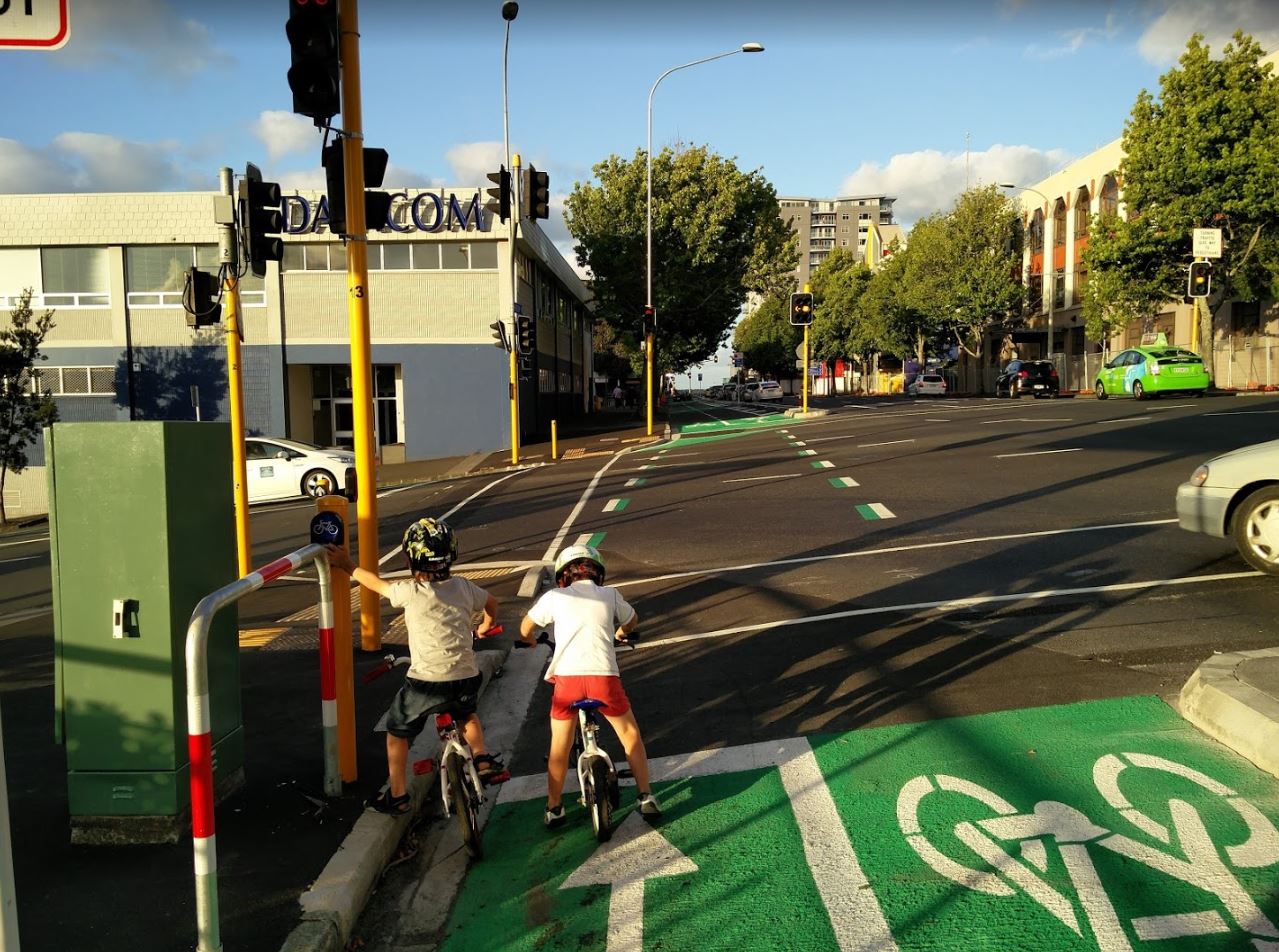
Do it for them. Photo by Matt Lowrie, from December 2015 – same point applies over a decade onwards.

 Processing...
Nice. Matt for PM!
Excellent thinking. But we haven’t a decent prime minister since Jacinda, so let’s make sure a Lady leads our motu again. Men in suits are failing, they look the same as they did fifty, seventy, one hundred and thirty years ago. Not a single good idea in all that time…
bah humbug
When did you last see Matt in a suit, weddings excluded?
The real problem with amalgamation is it pushes power into the hands of the managers and out of the hands of the people elected to represent. I have watched large Councils approve huge expenditure with little assessment who then argue about the location of a bus stop. They debate what they can understand. (Wellington spent $1/2Billion on a sludge plant that sits idle because the wastewater plant wasn’t up to the task). Small Councils tend to be better at controlling costs because they know they will be held to account. Grand schemes don’t make cities better to live. Having a good income with adequate disposable income makes cities better places to live. Making cities great doesn’t ‘start’ with transport, people are right, it isn’t even in the top ten issues.
But transport influences many of the ‘things’ people care about.
Education – Ministry education funding used for massive carparks surrounding school grounds.
Health – Ministry funding used for massive amounts of carparks for staff and visitors. Let alone the health benefits of people having more active transport options … safer streets, kids being outdoors more.
Cost of living … If your options limited to driving, you are much more vulnerable to oil price fluctuations. This ties in with the wider freight network also … congestion affecting the cost of goods with wasted time sitting in traffic.
You aren’t silly, you know this stuff.
In no order all of these are more important than transport:
Peace
Absence of violent crime
Disposable income
Good housing
Healthcare
Lack of corruption
Politically stable
Good schools
Family and social connection
Clean air
Clean water
Parks
Transport is important, but it is almost never the most important. That is why the most able person is never made the Minister of Transport.
Yes transport does have a relationship with some of these. But I know you can’t make people prosper by fleecing them to build marginal boondoggles whether it is bridges, motorways or CRL. Everyone with a Kiwisaver can get a better return on their money.
Agree that councils aren’t perfect, but Government aren’t either.
I’d say the government are actually more wasteful in general, but its less obvious as they get a hidden income rise every year and keep increasing borrowing.
Private organisations are also far from perfect.
Incompetence (and competence for that matter) straddles sectors.
I would ban urban sprawl and build upward and make a compact city would be my 100 days goal.
Yes, many studies have shown the high cost of sprawl that sometimes is up to 6 times the cost of intensification. For examle there are about 24 000 km of underground pipes in Auckland and the cost of maintaining them is very high. We should learn from what successful overseas cities are doing. At several Auckland Conversations meetings over the past few years we have learned from one speaker about Barcelona”s super blocks and another speaker about how cities must continually monitor traffic, job locations, housing growth areas, shopping areas etc and then offer more suport to the winners rather than investing in slow areas. At times in downtown Auckland there are big crowds of people attending events at our many theaters. People living in suburbs 20 or 30 km out will be spending 5 or 10 hours a week driving and have not much time to enjoy our many events
Yet look at the big transport projects – pretty much all of them are geared at sprawl. Extending the NEX further north, rail further south, busways in Botany, busways to Westgate; but nothing in the Central Isthmus. I live in Mt Roskill and its getting to the point where I should move another 10km further from the city to get a quicker public transport option!
Keep requesting to AT for more bus priority lanes then. There’s heaps of room for improvement with more bus lanes, longer operating hours.
Yes, many studies have shown the high cost of sprawl that sometimes is up to 6 times the cost of intensification. For examle there are about 24 000 km of underground pipes in Auckland and the cost of maintaining them is very high. We should learn from what successful overseas cities are doing. At several Auckland Conversations meetings over the past few years we have learned from one speaker about Barcelona”s super blocks and another speaker about how cities must continually monitor traffic, job locations, housing growth areas, shopping areas etc and then offer more suport to the winners rather than investing in slow areas. At times in downtown Auckland there are big crowds of people attending events at our many theaters. People living in suburbs 20 or 30 km out will be spending 5 or 10 hours a week driving and have not much time to enjoy our many events
Under fractional funding would large projects like CRL even be possible, or would they be hamstrung by limited money and reduced to smaller projects that are less transformational?
A strong argument for centralised funding is that big projects can be confidently planned and carried out. Sure, some of them are Roads To Nowhere, but local politicians are no less likely to build ego projects that they can point to in the next election than national politicians are.
The Future is Rail would like to see a National Public Transport Agency to plan and fund many aspects of PT. Not interferring with local transport decisions but working on a joined up way for regional trains and buses to cross regional boundaries.
Paul I am coming to the conclusion that Intercity buses should be brought into the public transport system. Not because they are doing a bad job but because regional transport needs to be more coordinated and it needs to be cheaper or maybe just plain subsidised. Much like it was back in the day when it was run as a division of NZR. Then we can run passenger trains where they are appropriate and buses to destinations which are remote from the rail or where passenger numbers do not justify running a train. A lot of journeys will involve trains and buses. So there would be one publicly owned national long distance passenger transport network. Surge pricing would only exist to keep buses and trains nearly full. Extra capacity would be arranged if possible. Then we get rid of the artificial boundaries like the one that exist between Hamilton and Auckland.
And with all the money that has been allocated to small, regional airports there is a precedent for subsidising trips from places like you discribe. And it can be cleaner and more sustainable.
Royce – With the rollout of Motu Move – the national ‘tap & travel’ contactless payment system will allow for the re-introduction ofn ‘tap & travel inter-regional passenger train and bus services across the country.
It has already started with Te Huia being New Zealand’s first ever subsidised ‘tap & travel’ inter-regional train service between Hamilton and Auckland and inter-regional ‘tap & travel bus services between Nelson, Richmond and Motueka with both services using BeeCard. .
The next phase would be the new ‘Tuhono’ inter-regional passenger train services between Wellington and Palmerston North from late 2028/early 2029 using Motu Move.
Ok Kris keep up the good work of keeping up to date with developments. I suppose I am getting a little impatient with how slowly these things move. I have recently returned from Victoria where I travelled on the vline network. Very cheap full buses and trains easy online ticketing and seamless transfer between rail and Coach. Seems to me that is a model we should be copying. Some services took myki cards the drivers were issuing tickets for cash it all seemed so easy. It actually made me want to immigrate.
The Future is Rail would like to see a National Public Transport Agency to plan and fund many aspects of PT. Not interferring with local transport decisions but working on a joined up way for regional trains and buses to cross regional boundaries.
Paul Callister – Until Part 5 of the Land Transport Management Act 2003 has been amended, any passenger transport service/s as defined under the Act, needs to be included in a regional council Regional Public Transport Plan (RPTP) as part of their Regional Land Transport Plan (RLTP) if they intend to get funding from the National Land Transport Fund.
Te Huia is currently the only inter-regional passenger train service to receive funding as a public transport service as it included in Waikato Regional Council’s Regional Public Transport Plan.
That is why a National Public Transport Agency needs to work with the 13 regional Public Transport Authority’s (the current regional councils) to fund any inter-regional public transport bus and/or passenger train service/s.
National Infrastructure Programme can cover the funding for the big stuff, Regional devolved funding manages the small and medium project and programme spending, allowing maintenance and renewal to follow fully-funded Asset Management Plans, not politics.
The squeaky wheel gets the oil!
The main cities get a larger proportion of money for infrastructure than do the smaller towns.
The exception is, of course, Christchurch, where a suburban rail system using existing tracks could be up and running very quickly.
It looks like a private operator has already kicked it off, and is also offering regular long distance trains south of the city to Dunedin and Invercargill and major towns in between.
To show willing (caught on the hop!) KiwiRail is running the Coastal Pacific set south in the off season.
There is no leadership from the top in KiwiRail on the subject of passenger services, they continually put any idea like that in the too hard basket.
I wonder how long it will take to trial Mt. Maunganui/Tauranga to Auckland?
Devolving decisions backed with money to the regions is a no-brainer, they are doing it successfully in the UK, why is NZ so far behind?
Exactly Phil. I have no trust that a large infrastructure delivering organisation headquartered in the North Island will ever champion major projects for South Island towns and cities. The history over the last century for multiple organizations, such as NZ Rail and NLTF/NZTA shows it doesn’t happen.
Dunedin is in a pretty similar situation re passenger rail – except the councils want to run it, and KR is blocking them as they ripped out the double tracking and KR is running enough freight services along it they don’t want competition.
KR should’ve been split long ago back into an Ontrack 2.0/Network Rail entity to manage the tracks/landholdings, and KR to run the freight/whatever services they do – with Interislander needing some sort of open access agreement for rail so that you don’t get a situation where KR forces their competitors to only be able to operate in a single island.