In something of a Matariki miracle, the government has finally acknowledged that their mega-road programme isn’t feasible (as we’ve been pointing out for quite some time), and have scaled it back accordingly.
Transport Minister Chris Bishop has been hinting for some months that this was probably going to happen, with the Roads of National Significance (RoNS) programme alone expected to cost over $50 billion, but it’s good to finally have it confirmed as of last Thursday:
Transport Minister Chris Bishop is welcoming the publication of NZTA’s Major Transport Projects Pipeline, setting out the phasing for projects including the Roads of National Significance and major public transport projects.
“The Government has an ambitious transport programme that will help grow the economy by moving people and freight safely and efficiently around the country,” Mr Bishop says.
“The New Zealand Transport Agency (NZTA) has been getting on with delivering the Government’s Roads of National Significance, Roads of Regional Significance, and major public transport projects like the Northwestern and Eastern Busways in Auckland.
“Significant progress has been made over the last three years.”
…..
“The construction sector has been clear it needs a strong pipeline of future work. That is why the Government committed to the 17 RoNS listed in the 2024 Transport Government Policy Statement, and major public transport projects.
“We’ve always seen the roads and public transport projects as part of a multi-year pipeline to drive jobs and growth around the country, and today’s pipeline release reflects that.
“The pipeline shows why a phased approach to delivering the Roads of National Significance is important. As I’ve said many times, not all projects can start immediately. It takes time to get projects ready for construction, with route protection (designations and consenting), detailed design, and property acquisition all needing to be completed before main construction works can begin.”
…..
“Phasing the RoNS programme means we can keep investing across the wider transport network, including in projects that improve reliability, strengthen resilience, and meet local and regional transport needs.
“Major new corridors are important, but New Zealanders also need a safe, reliable and resilient transport system every day.
“That is why the RoNS programme sits alongside significant investment in maintaining and renewing existing infrastructure, strengthening resilience to natural hazards and extreme weather, improving safety, and keeping communities connected.
“Fuel excise duty has fallen in real terms by 21 per cent since 2020 when it was last increased, while construction costs have risen significantly over the same period, with the recent conflict in the Middle East contributing to that challenge.
“This pipeline demonstrates that we have struck the right balance with our ambitious and responsible transport programme, which is part of our Government’s wider plan to build New Zealand’s future.”
The RoNS programme has always been headed for a fall
It’s been clear for a long time now that this scaling back needed to happen. For example, the Infrastructure Commission highlighted just how big the gap had grown between transport revenues and funding intentions:
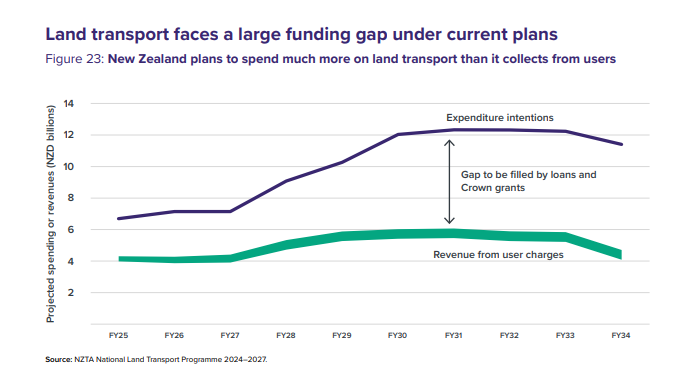 Before the last election, National claimed their RoNS programme would cost around $17 billion – but even then, they were told the costs they were using were unrealistic. It’s one thing to campaign on a policy like this; it was a whole other thing entirely to continue the lie when in government, by doubling down with what is probably the most ideological, unbalanced and petty transport policy the country has seen.
To be fair to Bishop, it was his predecessor, Simeon Brown, who was in charge of that formal transport policy – and Bishop is largely having to clean up the mess. He’s been hinting since at least late last year that this was on the cards, noting that to deliver the RoNS programme over 20 years would require a 70% increase in transport taxes, the equivalent of an extra 49c a litre in petrol tax.
A big part of the problem is the compounding issues with many of the projects. Costs have escalated significantly over the last few years, with billions becoming the new norm. The sticker cost of a project like Warkworth to Te Hana has more than doubled, to potentially $4 billion; and as well-covered by Connor in many posts here, if it goes ahead – especially if delivered via a Public-Private Partnership as signalled – it will be the most expensive road project New Zealand has ever built (so far).
Almost all the RoNS projects are now calculated as costing over a billion dollars, and that’s before you even include factors like the rising cost of bitumen. It’s not even just that these are bigger projects: on a cost-per-km basis, too, they really stick out like a sore thumb.
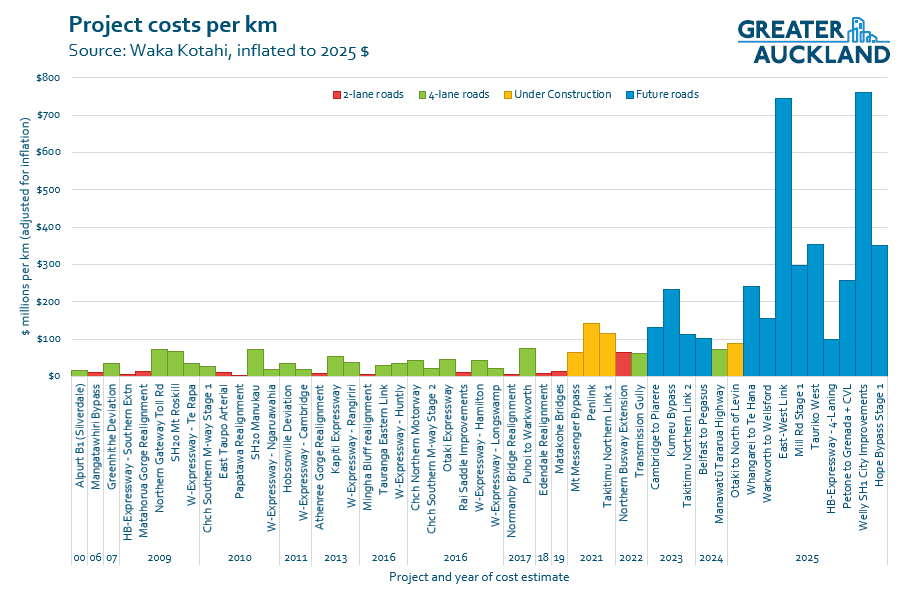 Perhaps some of this escalation could be forgiven if these were truly high-value projects fulfilling an urgent need.
But as well as coming at extraordinary cost, most of these mega-projects are intended to replace existing roads that currently have very low traffic volumes. Many are only carrying 10-15k vehicles per day, which is well below the 24k per day that NZTA say is the threshold at which four-laning becomes justified.
A big part of the RoNS problem was the insistence (as of Simeon Brown’s update to the Government Policy Statement) that all of the new roads must be four-lane highways.
It’s not that we shouldn’t be looking to improve these corridors, but in most cases the old 80:20 rule applies, where you can likely achieve 80% of the benefits at 20% of the cost. And the truth is that simpler fixes – safety improvements, easing curves, improving intersections, resilience upgrades and adding passing lanes – can be achieved for a fraction of the cost of four-laning a route.
What’s more, these smaller, more affordable fixes can be delivered by local crews, whereas mega-projects as currently being promoted often require international companies to deliver them, which of course adds to the cost.
So what’s in the Major Transport Projects Pipeline?
The MTPP essentially puts projects into one of three buckets, with NZTA saying “this approach allows us to balance investment across the wider network while ensuring projects are positioned to move forward when the timing and funding are right“.
The three buckets are:
- Under construction and procurement
- Preparing for construction, and route protection
- Continuing more slowly
The language from the Minister and NZTA is all about these projects still being on the books and potentially being worked on, but this is seriously sugar-coating it. Make no mistake, those projects in Phase 2 and 3 are essentially dead, because there will be no extra money in the transport budget for a long, long time.
The projects in each phase are shown in the images below.
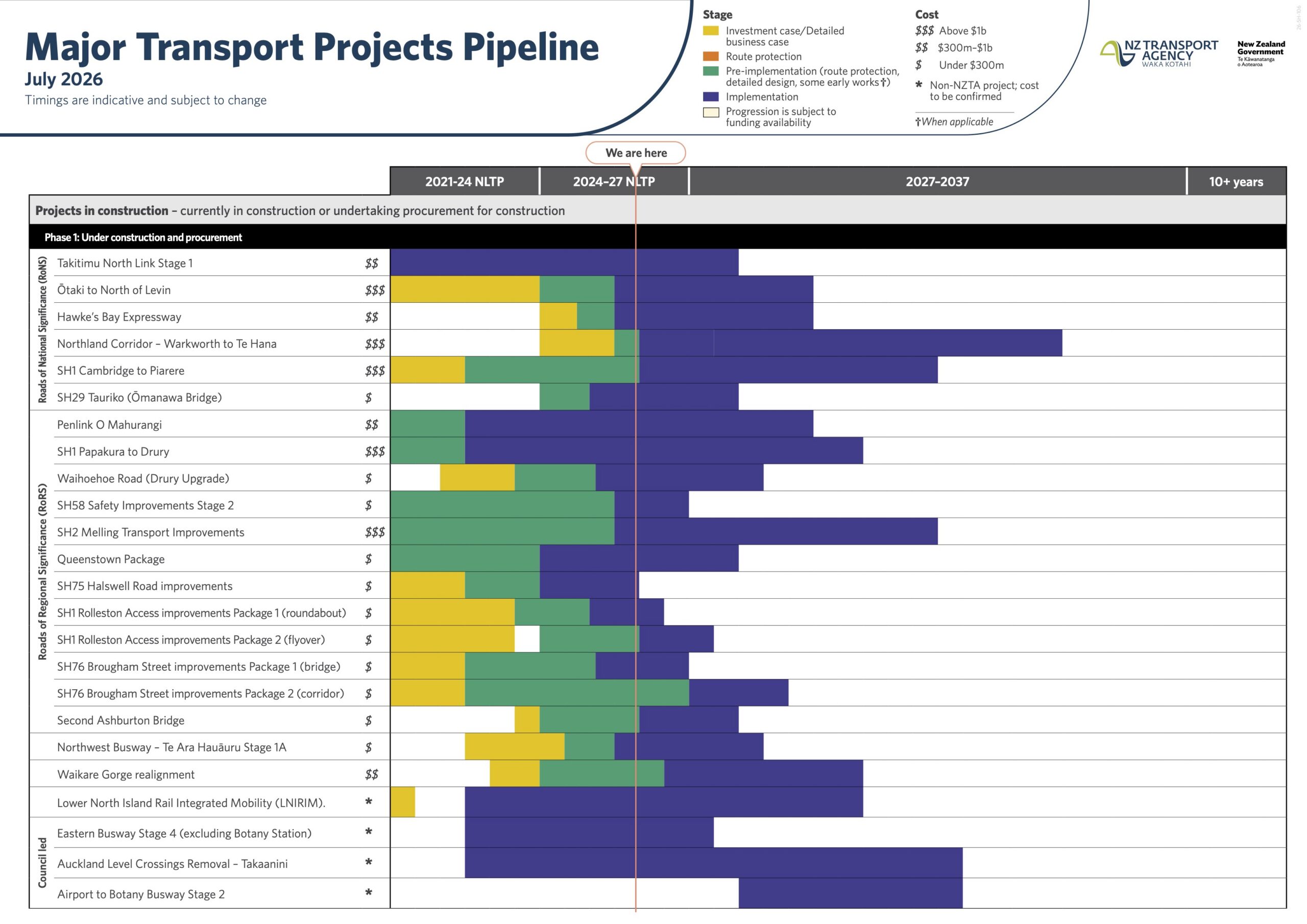 It’s great to see a bunch of busway projects on this list, including some that haven’t started yet.
But it’s very frustrating that Warkworth to Te Hana (WW2TH) is still there in Phase 1. If the government commits New Zealand to this project, it will soak up an outsized amount of transport funding for the foreseeable future, effectively crowding out many more worthy opportunities to improve the transport network. And if built as currently conceived, it will create a four-lane highway that stops short of the Northland border, with no plausible funding to continue to the Brynderwyns, let alone all the way to Whangārei. Where’s the value in that?
Moving on to the projects that are now officially unlikely to happen:
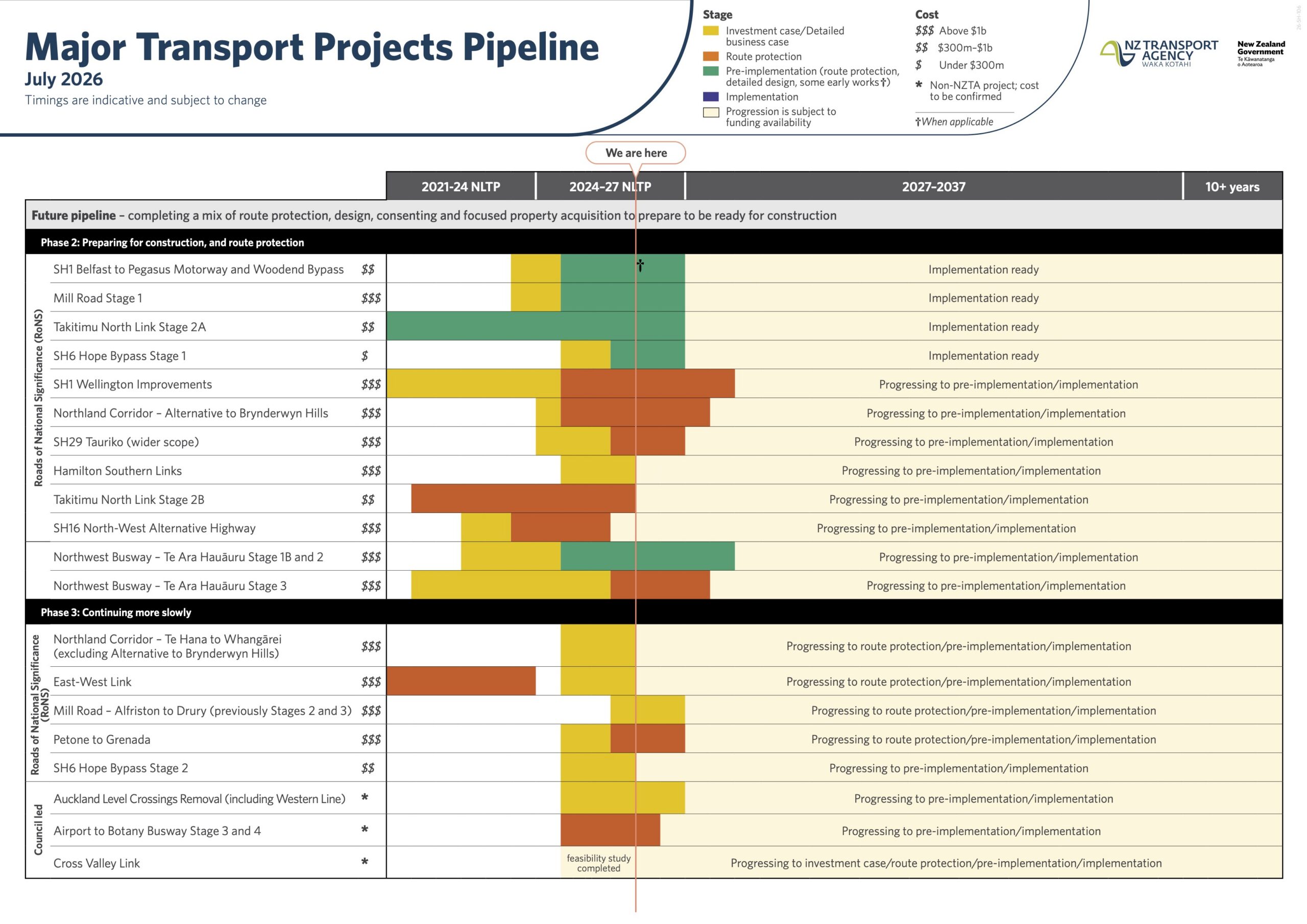 It’s interesting to see that East-West Link has moved back from route protection to the investigation phase. Hopefully this means a wider rethink of that project is happening.
And what have we learned from all this?
A couple of thoughts spring to mind looking at the MTPP:
- Where’s the next Waitematā Harbour crossing? At potentially $10+ billion, this is a massive project that will be even harder to justify now if funding is already so tight.
- Why on earth was the RoNS funding fallacy allowed to go on this long? As highlighted earlier, it’s been clear for years that the programme was unfundable, and that something would have to give.
- It’s notable that since this announcement, many media organisations have been saying, in effect, that this issue was well known. Sure, there has been some recent reporting and questioning of the RoNS and the government’s commitment to them. But given the scale of the funding deficit, you have to ask: why hasn’t this been given more attention? Why hasn’t it been non-stop headlines about a RoNS-sized fiscal hole? It’s frankly irresponsible that the government has been allowed to pretend for three full years that all of this was achievable.
- How much has been spent so far on all the work for investigation and route protection? And perhaps even more importantly, if more right-sized projects had been scoped, how much could have been invested already in making real improvements to these corridors – saving lives, making journeys easier and more reliable, and contributing to a more equitable transport system across the motu?
Overall, it’s great that this announcement has finally happened – and especially that it’s happened ahead of the election, which hopefully means we can have an election without silly road-fantasy promises. And maybe we can finally start talking about what the country really needs in the way of transport investment that works for everyone.

 Processing...
I would cynically suggest that this was always going to be the case. The current govt has always known that it would never be able to deliver these roads, they are used as a political tool to garner votes and then they can happy trim/aggressively carve off the projects they know cannot happen until the next time they have an election coming up and need some easy-to-promise, hard-to-deliver items for their voters.
Only lasts for so long before the voters become wise though. Labour were punished for exactly this at the 2023 election.
Here’s a wild thought.
Why not progress the Southdown link, the land is set aside for the most part, it has been mooted for decades, and would unlock more of the Auckland suburban rail system.
Why is it always roads when some relatively cheap rail add-ons would make a big difference to surface transport.
While I am at it, there was the Beca Sytra report for major North Island electrification that at 2021 prices was almost the same as Warkworth – Te Hana.
NZTA knows what its funding envelope is.
It should itself be scoping, developing and scheduling projects to meet that funding envelope that provide the best socioeconomic return and putting that to government.
If the Minister wants to meddle, then at least there is an affordable and effective program is the starting point.
Perhaps it’s time to modify NZTA’s statutory objective again.
“undertake its functions in a way that contributes to an efficient, effective, and safe land transport system in the public interest”
I don’t see affordable or socioeconomic return in its function definition.
Tolls should not have been removed from the Auckland Harbour Bridge.
The toll money could be paying for the next Harbour Crossing AND converting the existing bridge to a all modes crossing.
Politically removing tolls is short sighted.
Politics are short-sighted by nature. In our case, very much so (3 year terms).
When you sell tolls to bridge users on the promise of “They will only last until the bridge is paid off” its a bit rough to then say we need to keep them for another 50 years to pay for the replacement,…
At a recent Auckland conversations meeting urban planner Alain Bertaud’s message was about monitoring all moving parts of a city. Where the new jobs are, where traffic flows are changing, where the new suburbs are, where and how people are living, is public transport increasing or decreasing etc.
In the next year and every year there will be changes. The new CRL, Intensification, congestion charges, the cost of petrol, the number of students coming to Auckland, etc. So there is change and I trust NZTA is constantly monitoring and noticing what is working and what is not so as to make Auckland a better place
Hopefully the NorthWest Busway can also be considered with an 80:20 oversight. Repurposing lanes would achieve all the desired outcomes and for once signal prioritising PT over single occupancy vehicles
“Show us the Money” is something that our press and opposition parties should have been asking loud and clear. For years now. But the weren’t.
At least, we now have further confirmation that the National Party’s stewardship of public spending is more about winning votes and donations then actually doing the best socially and economically for the country.
Our roads do need more expenditure, but not so concentrated on just a few kilometres of road. It is needed to make the rest of the network safer and more resilient. And to fix those inevitably more frequent potholes, as a result of the inadequately funded higher gross weight trucks now allowed.
The road to hell is paved with good intentions, but you have to wonder what kind of advice the ministers have been receiving from their ministries for it to go on this long. Is this a case of willful ignorance, or have the legions of government advisors been underselling the RoNS problem for fear of losing their cushy jobs?
No, the ministries, the NZTA, the private consultants involved have all, for years, been telling the ministers that none of this is affordable. Lets not throw the civil servants and professionals under the bus because the ministers have been deliberately playing dumb about the cost. The Infrastructure Commission in particular was *scathing* in their criticism of RoNS.
Even further south, no mention of rapid transit to the South Island’s biggest (and NZ’s second biggest) city
Is there a way an 80/20 rule be built into scoping these projects – so that if 80% of benefits at 20% of cost can be achieved, is the last 20% of benefits worth it?
I am guessing on many projects that is done when assessing the options.
But with the RoNS, it sounds like they start with the problem “we don’t have a 4-lane highway in this location” and so the end is basically pre-determined. It’s then just confirming route, etc.
Yes this RONS was an electioneering candy device, was pure fantasy.
And the eventual proposal for a Airport CBD underground metro/light rail wasn’t ??
Bit silly how light rail was preferred over heavy rail for the airport connection because it wouldn’t require tunnelling under the airport, only for the most recent ALR proposal to recommend putting the CBD end of the line in tunnels instead.
Really was hoping the Airport to Botany busway was gonna be higher priority.
So what’s your take on funding/timeline for the Northwest Busway stages then, given this: https://www.beehive.govt.nz/release/northwest-busway-takes-another-step-forward
If Stage 1 is still going ahead (i.e. building Brigham Creek and Lincoln Rd stations), what would the point of that be without building the busway that connects them?
https://www.greaterauckland.org.nz/2025/11/11/more-progress-on-the-northwest-busway/
The Lincoln Rd station will only ever be of any use if there is some bus priority on Lincoln Rd.
There is so many benefits to Warkworth to Te Hana the government would be crazy not to built it! The journey times, safety, reduced inclines for trucks, more pleasant town centres, keeps state highway 1 flowing even during public holidays.
Yes it’s expensive but the terrain we are talking about here is very very difficult and requires some extra work to make a resilient road. This blog hasn’t proposed any costed alternatives they just want to selfishly take this away from Northland because it’s a road that doesn’t suit the narrative.
I WILL SAY IT OUT LOUD FOR THOSE IN THE BACK IF NOT THIS ROAD THEN WHAT YOU CANT LEAVE THE EXISITING ROAD AS IT IS!!!!
“This blog hasn’t proposed any costed alternatives they just want to selfishly take this away from Northland because it’s a road that doesn’t suit the narrative.”
Since when was it the job of GA to create alternative plans for the petrol addled?
If you believed the lies of the National Party during the 2020 election about the costings for their roading plans, then that’s on you.
Oh! And cry harder because honestly, if a 5, 20 or 60 second delay due to traffic is traumatic for you, then you’re a child.
@Cinder I didn’t vote for National in the 2020 election, I actually voted Labour (back then I was in favour of safer speeds and smarter spending on roads), until I had to actually do the safer speeds and the Dome Valley “improvements” then I realised it’s just a big anti car scam. Coatesville riverhead hwy is a great example of overreach by government a road that used to be 100 then dropped to 80 which I thought was reasonable then the anti car lot took over and it was dropped all the way to 60. And then the speed cameras and police had a field day targeting the area (they still do). There’s countless other examples of this round the country Hopetoun st near the city or Kerikeri road in the north it’s asking too much.
No one has been able to explain to me how the blog supports zero road upgrades and safe speeds which means a maximum 70kmh speed limit from Warkworth to Cape Reinga slowing down even further to 30kmh in the towns and cities will add a significant amount of travel time to the trip sounds like we have to build a big 4 lane highway to make sure the north isn’t left behind. THAT IS WHAT THIS BLOG IS PROPOSING EVEN IF ITS UNINTENTIONAL.
If you want no road upgrades north be prepared for more road deaths people are not willing to slow down to save lives.
This blog has been supportive of rolling out safety improvements such as median barriers and intersection upgrades.
“people are not willing to slow down to save lives.”
Not even their own?
Sounds like we need greater speed calming measures, not billions of dollars to encourage people to speed and feel insulated from risk.
@jezza I didn’t say they wernt in favour of that stuff the issue is that’s only a band aid solution it actually makes journey times longer overall if there is a tractor the whole line of traffic backs up with nowhere to pass. The blog has also proposed 2+1 which we all know before the Waikato expressway it was actually worse than a single lane road and it’s more unsafe I would argue. Good in theory but people can’t merge in NZ.
No KLK they aren’t unfortunately. You’ve obviously never lived in the far north where the speed minimum is 90kmh drive any slower and you’ll get run off the road and 110-115 is a common cruise speed. When I lived there if I did 105 (100 actual speed) I would get passed by about 4 cars over a 13k drive. Unfortunately NZTA lowered speeds and well none of the locals who they were supposed to save actually followed it. Got tooted at a lot through Kareponia and Kaingaroa when they dropped the speeds for no good reason through there. The Awanui straight is also more dangerous at 80 as now more people are overtaking. The really funny thing about driving north is the speeds on the Waipu straights are actually higher on average than the northern motorway everyone does 105-110 but for some reason it actually feels really safe because literally no one drives slower than that.
James – the idea that the 2 + 1 road was less safe than the death trap single lane road it replaced shows how far from reality you are.
The simple presence of a median barrier made it far safer. There was also plenty of room with a large shoulder to get past tractors etc.
Here’s that thing James / Mount Colon.
People who use multiple handles on blogs rarely argue in good faith.
You are Mount Colon. Your communication style is as distinctive as mine.
When I raised the issue of higher vehicle speeds endangering our most vulnerable communities and reducing their capacity to participate in society…
You laughed in my face and told the elderly, children and the disabled to suck it.
So forgive me for calling you a rank hypocrite whenever you talk about road safety.
All your “arguments” are disingenuous at best and rely on a level of cherry picking which makes you eligible for employment under the RSE scheme.
Are you aware that your behaviours and communication style make you sound like an addict? I mean that sincerely.
I honestly don’t care about your travel times, it seems you’ve just made a lot of bad decisions and choices to end up in that situation.
We agree that the exiting cannot stay as it is. A road with plenty of passing lanes would leave money for other projects in Northland.
For instance;
Double lane the one lane bridges. Look at this HGV hold up near Mareretu.
Improve Brynderwyn by-pass through Mareretu.
Flood protection
Upgrade Highway 15
James, ever the idiot, thinks that this is somehow a binary issue because like a tantruming toddler he will only accept what he wanted in the first place, a stupid, overexpensive 6 lane motorway to a region that does not have the population to support it, for unrealistic delusional time savings.
Sadly typical of road-crazy morons, they do not debate in good faith and force rail and public transport/active travel advocates to be the ones to compromise on safety and space allocation, instead of accepting incremental safety improvements and targeted local bypasses.
Burrower you don’t get how a democratic society works, it’s majority rules.
Are you forgetting when the election is? The week after Labour Day, the delays even if it’s only for that one day will be fresh on the minds of thousands of swing voters and if they know that National will fix this issue then they will vote accordingly. Which is exactly why Labour hasn’t actually said they would progress with the road if the contract is signed.
The long story short is more swing voters would want this road than those who don’t because most swing voters are in the Auckland/Northland region as these often seem to have big changes from election to election.
You’re not debating in good faith you have no plan it’s just words “local bypasses” WHERE AND HOW MUCH? “Incremental safety improvements AHH THERE IS YOU WANT TO LEAVE THE ROAD UNSAFE TO FUND YOUR OTHER AGENDA!
Show us your plan Burrower or a plan somewhere. Not one person has a plan, costing or even a sketch or a single shred of evidence anything but the 4 lane highway is possible. WE HAVE A PLAN RIGHT NOW ABOUT TO GET FUNDED! Don’t stop this keep going.
This road will be of absolutely no consequence on election day to practically anyone outside of Northland.
They’ve also put Mill Rd, the Northwestern Busway and East-West link into never-never land so it’s debatable how this will play out on election day in Auckland.
Either way it’s unsurprising that there is a reasonable chance they will become our first ever one term National government.
yeah, James. My agenda is an environmentally friendly, STABLE, evidence-based safe society that isn’t going to drive every life form on the planet to extinction. How utterly horrid and inhumane of me, right?
also double irony James, Neil responded to you with specific examples of targeted local upgrades that should be more important and higher priority than your personal drag strip fellatio nonsense. But you don’t want to engage with that, do you? Can’t pop the bubble of your puny little echo chamber that it’s all “motorway or nothing”
@Burrower Neil’s comment is just that a comment. There’s no actual evidence that these are possible or links to source or even a costing or even so much as a drawing. There’s nothing, meanwhile back in the real world we are getting on with building the 4 lane highway Northland needs.
Like I’ve mentioned we have just about everything we need for this road we are literally just waiting for NZTA to pick its preferred tender then we sign the contract and we can drop this silly debate and just get on with building the road north. To be quite frank I’m sick of the hysterics by you and others trying to strangle Northland off from the rest of the country for decades now. First you lot didn’t want the Northern gateway but it’s made all the seaside towns and urban areas it’s bypassed safer and Hatfields beach was able to get a lower speed limit. Then you jump up and down at Puhoi to Warkworth right up until it opened then you realised it made the old road significantly safer and the hill street intersection was bypassed now I drive through and barely any issues. Labour quickly changed its tune from Transport blogs crappy proposals (I admit I supported it at the time) to supporting the 4 lane highway and continuing it north.
Waikato didn’t have to go through any of this to get its expressway it should be no different for the North.
Come on James, Waikato’s population is 5 times of Northland as well as being the gateway to the rest of the country, the Expressway at least makes strategic sesnse
Northland is a sparesely populated cul de sac that has no need for expensive highways
@James
HAHAHAHAHAHAHAHAHAHAHAHAHAHA… *inhale*… HAHAHAHAHAHAHAHAHA
so you think a $20+ billion dollar motorway is realistic, but doubling one-way bridges and reasonable-scale flood protection isn’t?
God, your brain must genuinely be poisoned by lead or particulate pollution or something. I’m so sorry I have to share a planet with mindless idiots like you who are dead set on destroying it for young people like me.
You complain that there is no concrete plan from users on a transport blog, but completely neglect that GreaterAuckland have repeatedly given ideas for better spent money (median barriers, additional passing lanes, Wellsford bypass) despite doing this work for free and not as a full-time job like NZTA engineers, and that the current estimated cost is very likely to be way less than what the government initially said.
You also ignore other improvements in Northland, such as double-laning one lane bridges, or making local roads like the Whangaruru access more resilient in inclement weather.
It feels like you don’t actually care about people in Northland or about arguing in good faith.
@JohnBgoode provide links to source then where’s GAs brilliant ideas huh? Northland needs a 4 lane highway to just past the Brynderwyn Hills then the current road is fine after that it just needs median barriers as most people already travel at 110 an expressway is unnecessary for this section.
Also bugger off with your comment I don’t care about Northland I’m the only one here who actually used to live there. I know what it’s like you’re using assumptions we have had a few great bridges been done recently near Taipa and on SH10 just past Kaeo. The blanket speed limit reductions made life a misery near Kaitaia and National should’ve reversed more speeds than it did. You have no idea what it’s like to live there you selfish little piece of work.
Do you really think that spending ~12 billion on a road entirely in Auckland will be the best possible improvement for the people of Kaitaia for that money?
Greater Auckland arguing for right-sizing Warkworth to Te Hana: https://www.greaterauckland.org.nz/2026/06/18/urgent-call-to-rescope-warkworth-to-te-hana/
“A far more prudent path to fixing the real issues (access, safety, and productivity) is a clear cross-party commitment to rescope and reprioritise the RoNS, starting with Warkworth to Te Hana – to focus instead on more realistic, affordable, evidence-based and deliverable solutions like 2+1-style upgrades, median barriers, bypasses and intersection improvements.
That will deliver much greater value-for-money, quicker and more right-sized fixes, and leeway for other infrastructure priorities in line with the National Infrastructure Plan’s advice. “
Pages 57-69:
https://www.nzta.govt.nz/assets/projects/ara-tuhono-warkworth-to-wellsford/detailed-business-case-oct-2019.pdf
GA also advocate for (unspecific, to be fair) road improvements in the north:
“To be absolutely clear, Northland needs better, safer and more resilient roads but the idea that should be provided by motorways, or that offer unquestionable value is absurd.”
https://www.greaterauckland.org.nz/2023/06/21/puhoi-to-warkworth-opens/
The article above also outlines that despite all the travel time improvements, not a lot of economic growth was induced in Northland.
Not to mention with traffic volumes for north of Warkworth around 10–12K vehicles per day (half or less of the threshhold that justifies 4+ lane highways), a 2+1 road would suffice for those traffic volumes.
Religiously advocating for this motorway when its own business case says it is low value seems like a dumb hill to die on. What is the point in doing a business case in the first place if we build the thing regardless of whether the financial case makes sense?
yeah, like i tried to tell James elsewhere, if a small region of 200,000 people “needs” a $20+ billion, 6 lane motorway, then to make it a fair per-person investment, a city of 1.7 million people needs a transport budget of $170 billion, with most of that going to mass transit and public transport.
@JohnBGoode YES I DO.
@craw I don’t really give a damn what the evidence says tbh I just want the thing built and there’s nothing wrong with that in fact it’s a popular opinion.
You’re exactly right I don’t get why we do a business case with the speed limits either if the majority wants higher speeds just raise the speeds anyway, problem solved. Facts and evidence is the old way, we’ve moved past that now it’s about vibes and short attention spans.
So if you don’t care about evidence, why do you want plans for other options?
The vibe here is that this is a bad idea and a giant waste of money and there are many roads between Whangarei and Kaitaia that could be fixed while leaving a bit left to fund, for example, schools in the area.
Ironically, this is based on the fact that the business case is pretty shite, but that doesn’t really matter, does it?
Well it’s quite simple isn’t it. I want to see plans because this blog jumps up and down about having them not because I actually care about them.
The road really isn’t that bad from Kaitaia (via SH10, i never go SH1as I get motion sickness) to Whangarei it just needs better sealing and to do away with any speed limit below 100.
The issue is the vibe here is not representative of the majority, this anti car blog is not a good representation of what kiwis want.
And yes you’re right the fact the business case sucks does not matter in the slightest, it was a waste of time doing one.
What is your motivation James? I’d rather my taxpayer dollars were spent on electrifying the rail network and fund regional passenger trains, not paying off a multi-decade loan for a behemoth motorway to a town of 120 people
You lost me at “anti-car”.
@craw my motivation is to get the frickin road built so then people can shut up about not building it
@KLK we didn’t lose you in fact you even commented, just admit this is a good road.
Man, you’re really killing the vibe here.
You keep saying this site is anti-Northland but apparently forget that zero of Warkworth to Te Hana is in Northland…
Maybe now Northland can get improvements that actually are worth their (and our) money being spent.
If the liar “James” / Mount Colon actually lived in Northland he would know the majority of road deaths occur on the rural roads, not arterial routes.
It’s pretty clear that James just wants to drive fast. That’s all.
I do notice he’s dropped off the radar since I reminded him of his shitty attitude towards pedestrians.
I know that this being an Auckland-facing blog and all, there will be little sympathy for a solution for Wellington problem, yet there it is: “SH1 Wellington Improvements” is officially now on the Never-Never list.
While I totally agree that the full case scenario of doubling the Mt Vic tunnel and doubling the Terrace tunnel was just pure stupidity from Bishop and his NZTA henchmen, there is still work that needs to be done – and work that could be done simply, at relatively little cost – and they could start right now on the small parts. We in Wellington have waited over 20 years now, and in that time not a single thing has been done. Seriously Bishop, sort your road out !
How many Golden Miles could we get for the price of a new Mount Vic tunnel
None, because they’re not funding the new Mount Vic tunnel.
I am very very happy that the SH1 build out is now on the never-never list. There are too many cars already in the city center and inducing even more vehicles into it was a stupid idea (and don’t get us started on the cost).
Note that this government is very much not into doing “little things” (well, the same can be said of course for the previous government), so do not get your hopes up. And WLG council now has taken the conscious decision to manage a gradual decline of the city so there is nothing to expect from them either. The best we can hope for is that is not being made worse (which the SH1 “improvements” certainly would have done).
I think you are obviously correct in that ” there is still work that needs to be done” and that is true across the entire country. I would like to see a solid commitment that all transport funding must meet certain criteria. Something like- ” improves safety for all users, does not induce traffic, supports PT and active modes, reduces carbon emissions, has lowest impact on environment’ etc
Hi all, I know this is abit further south down the island but I really think a 2/3 lane bypass of Tirau is needed and also Te Poroporo Bulli point Taupo bypass as some trucks have gone off that corner into the lake.
There’s a whole lot of really useful bypasses of towns and nasty curves they could do if they weren’t focussed on spending tens of billions on rural motorways.
For the price of the little motorway extension to warkworth you could build thirty major bypasses around the country.