Last year, I posted about the challenges I faced, trying to daylight public-interest information about the government’s Roads of National Significance programme. As I wrote then, entire documents – including even titles – were being withheld on what looked to me like flimsy grounds.
Now, months later, after going to the Ombudsman, I have some new information.
Specifically, about the RoNS that’s closest to breaking ground: SH1 from Warkworth to Te Hana.
For context: this project was originally part of the previous (2008-2017) National Government’s Roads of National Significance programme, and is now considered to be stage one of three for the 100km Northland Expressway between Warkworth and Whangārei.
Additionally in 2024, under prior Minister of Transport Simeon Brown, NZTA developed a strategy to deliver all three sections of the Northland Expressway by 2039 – the full cost of which is (currently) estimated at around NZD $22,000,000,000. These were all mandated, under Brown’s 2024 Government Policy Statement on Land Transport, to be four-laned, grade-separated highways.
What’s going on?
A Cabinet paper from mid-2025 reveals that the government plans to sign a Public Private Partnership (PPP) by July 2026 for Warkworth to Te Hana. It also notes a preferred bidder is to be confirmed in February 2026. So, around now, which may be why the document was finally released.
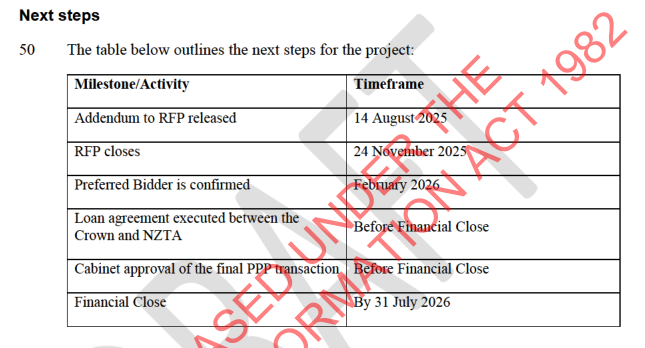
The paper also suggests the government’s plan was to commit to this PPP without the public knowing anything about the terms or total cost until after it was signed (if at all). Given the lack of information since, this assumption probably still stands.
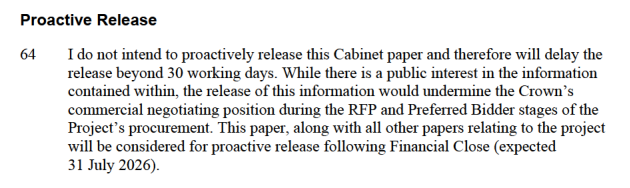
Why the secrecy? Is it because this PPP would have a significantly higher ‘peak debt’ requirement – with debt that would last over 10 years longer than any Public Private Partnership New Zealand has ever entered into?
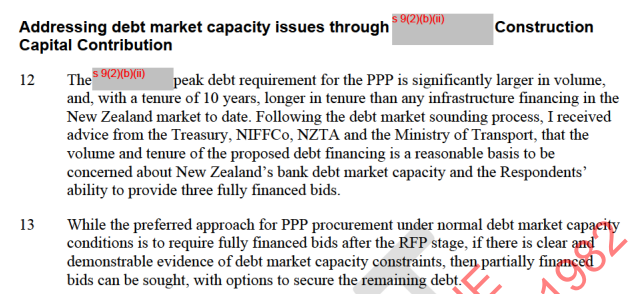
This involves a repayment commitment so huge (and note, this is for just Stage 1 of the full expressway!) that, according to this Cabinet paper, a debt-market sounding indicated:
‘[there is] unlikely to be sufficient liquidity in the New Zealand debt market for more than one fully financed bid.’
So where will the funding come from?
The government can’t afford to pay for the RoNS through the National Land Transport Fund as it is, but also didn’t want to raise taxes in their first term. So they’ve planned to raise fuel taxes by 12c per litre in January 2027, 6c per litre in January 2028 and 4c per litre in January 2029, with more increases potentially coming in the 2027 GPS.
In other words, the cost of transport for everyone who drives in New Zealand is already set to go up, to help fund for Warkworth to Te Hana. But it’s still not quite enough.
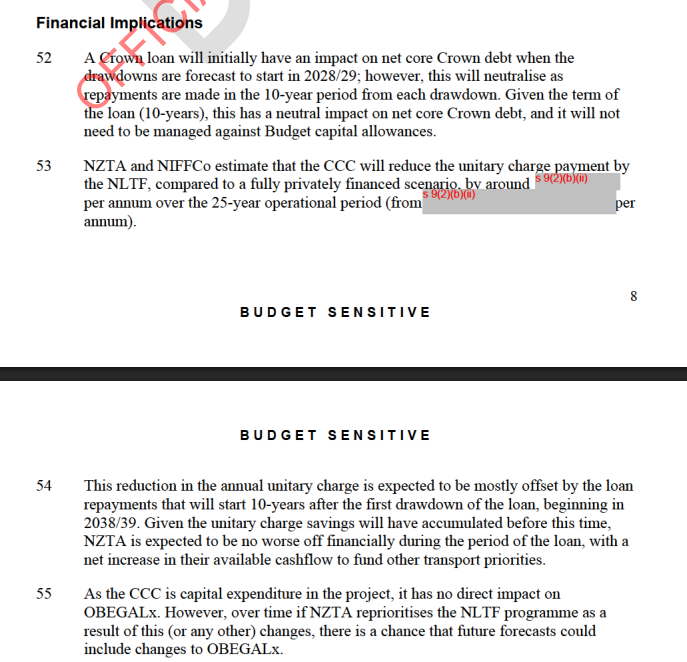
So the Cabinet paper recommends a ‘construction capital contribution’ (CCC) – whereby the government gives money to NZTA to give to the delivery entity. Specifically, the Ministers of Transport and Finance recommend that government ‘take[s] advantage of the Crown’s lower cost of capital’, and use a 10-year Crown loan with commercial terms.
The paper notes this would reduce the overall cost of the project, as NZTA would have less to pay in the way of annual charges required by the PPP itself.
You read that right: the Cabinet paper says that if the government directly funds a project, the overall cost to the country is much lower than a PPP.
Because under a PPP, the government, i.e. the public, are essentially borrowing at commercial rates.
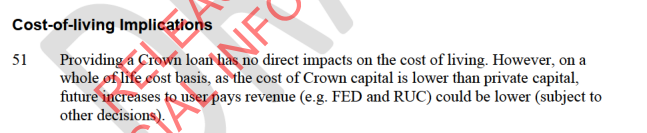
Now the government is also being sneaky here: because, by covering a part of the project through a Crown loan, they are clipping the ticket and funnelling fuel tax and road user charge revenue back into Crown accounts.
In which case you may be wondering: why do a PPP at all, if it costs us more?
In theory, the benefit is that the private sector takes on the risk of financing, building, and potentially operating and maintaining the project over a long contract period.
But given the examples of Transmission Gully and Moa Point – where it’s doubtful the private entities involved will see any repercussions – how are we supposed to believe that the government won’t be left holding the bag, if and when things go wrong?
Even leaving aside the PPP angle, the government concedes two things:
- this project needs a Crown loan – in addition to private financing – to get under way.
- and NZTA won’t have enough funding in the NLTF to pay for the Construction Crown Contribution during the project’s construction period.
But it also asserts that NZTA will have enough once it needs to start repayments on the Crown loan and the PPP charges… around 2038/39.
However, this is only true if the proposed increases in Road User Charges and Fuel Excise Duty actually happen from 2027 onwards.
That’s a pretty confident claim about future funds – especially with climate disasters wrecking more and more roads and bridges around the country each year – but okay.
On that point: apparently this Cabinet paper saw no need for an assessment of climate implications.

But we haven’t mentioned an even bigger issue. Which is, that with all this debt set to be paid back from the NLTF, that’s going to be hundreds of millions of dollars a year spent paying back this debt (for one road) that then can’t be spent on other transport projects or maintenance.
The opportunity cost for going forward with this project could be enormous – not just for transport, for the country as a whole.
All of this dancing around the funding issue raises the question: what’s the actual price tag for Warkworth to Te Hana? Shouldn’t we have at least an inkling, before this government signs New Zealand up to any contract, in advance of the election?
What will this project cost?
This is currently being kept under wraps, with redactions of every single instance that would show what this project (and its PPP deal) will cost us.
But we can make an educated guess, based on a few parameters.
The 2019 Detailed Business Case for Warkworth to Te Hana had the project between $1.7 billion to $2.1 billion, which is the number that the National Party ran on in its 2023 campaign.
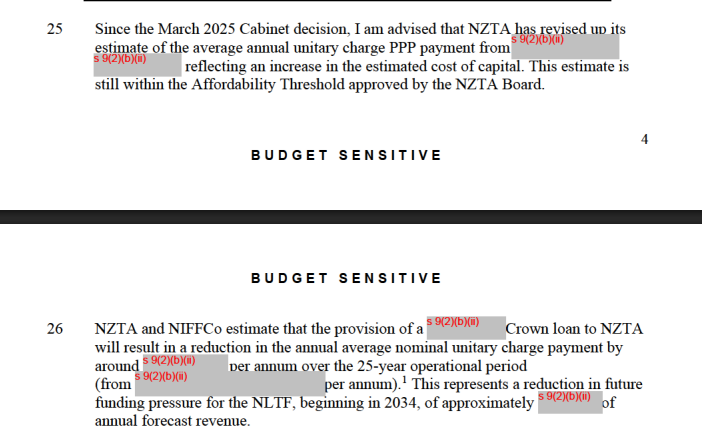
More recent costings put the work at $3.5 billion to $4 billion. In fact, based on the Cabinet paper, it seems like the estimated capital cost has increased since then:
Based on previous PPPs, we can reasonably expect any project delivered via a PPP to exceed predicted costs by some way.
But let’s stick with $4bn, the cost of just Phase 1.
What’s NZ$4,000,000,000 between friends?
To put this potential price tag into perspective, what would it work out at if you split the cost between the ~700,000 households in Northland and Auckland?
$5,714 per household, just for Stage 1 of the Northland Expressway.
Now add the costs of Stage 2 and 3, to get us all the way to Whāngarei – which looks to be $18 billion combined… that’s another $25,746 per household.
In other words, $31,460 per household in Northland and Auckland to build the full road.
And all in all, at approximately $22,000,000,000 to build all 95km from Warkworth to Whangārei… that’s $232 million per km.
But wait, there’s more! There’s always more. Everyone knows big roading project budgets blow out. Look at Transmission Gully, where the total final cost appears to be $2.5bn – double the projected cost of $1.25bn.
And we already know the estimated cost of the Warkworth to Te Hana section has increased, because it says so in the Cabinet paper. So the real amount is likely to be a lot more than that. (Who knows, per km it may even rival the – shelved for now – East-West Link for the title of most expensive road in the world.)
To be clear, the cost of the Northland expressway won’t be localised to Auckland and Northland. Unless a completely prohibitive toll is charged ($31+++), only a very minuscule amount would ever be reclaimed from those who actually use it – meaning the vast majority of cost will be spread across the entire nation, via taxes, fuel levy and road user charges.
Moreover, once that money is spent, it’s spent. And the costs don’t end there: the road will then require significant maintenance, in perpetuity – costing us more over its lifetime than the alternatives. (And yes: there are more affordable alternatives for this route, which I’ll get into further down).
The $22,000,000,000 question: what else can you get for that?
Speaking of alternatives: you might well wonder, what could a small country buy for twenty-two billion dollary-doos, these days?
Here’s a few options:
- four City Rail Links ($5.5b)
- seven fully equipped Dunedin hospitals ($3b)
- seven Cook Strait ferry terminals ($3b)
- 99 contract-cancellations for no Cook Strait Ferries ($222m)
- fully funded 7kwh solar panel and battery systems for all 700,000 dwellings in Auckland and Northland ($21b)
- 169 times the annual walking and cycling budget in the 2024 GPS ($130m)
- Enough funding to run the Te Huia train between Auckland and Hamilton for 3780 years… (EDITOR’S NOTE 9 March 2026: We’d previously estimated 150 years of running Te Huia, but that’s using the total capex+opex. In fact, the operating cost is $5.82m per year, so we’ve updated this bullet point accordingly.)
- … or, how about free passenger rail across the whole country for effectively forever?
- four and a half Northwest Busways ($5b)
- seven Airport to Botany Busways ($3b)
- 22 twice built International Convention Centres ($1b)
And I’m sure you would only need a fraction of that money to electrify the Golden Triangle train network, and extend regional passenger rail services.
Or, hey – if you wanted to fund an entire transport programme for our premier city, you could probably deliver the entirety of the Congestion Free Network (assuming a doubling of capital cost since 2016).

Or, one (1) four-lane road from Warkworth to Whāngarei.
You could even ask – given this is ostensibly about unlocking regional potential – the people of Northland what they’d like to do with $22,000,000,000. Or even just with the $4,000,000,000 for the first stage, an amount this government is apparently on the brink of signing a deal for.
And of course, we could also expand this discussion across other regions to query what the government plans to spend on the other RoNS, which have a total bill of upwards of $40-50 billion (so far), not including any repair bills for climate chaos.
But for now, let’s home back in on that $4,000,000,000 project the government is keen to lock us all into before the election.
How urgent is it, exactly? What’s our framework for making these kinds of big decisions?
Do we even need this project – and do we need it now?
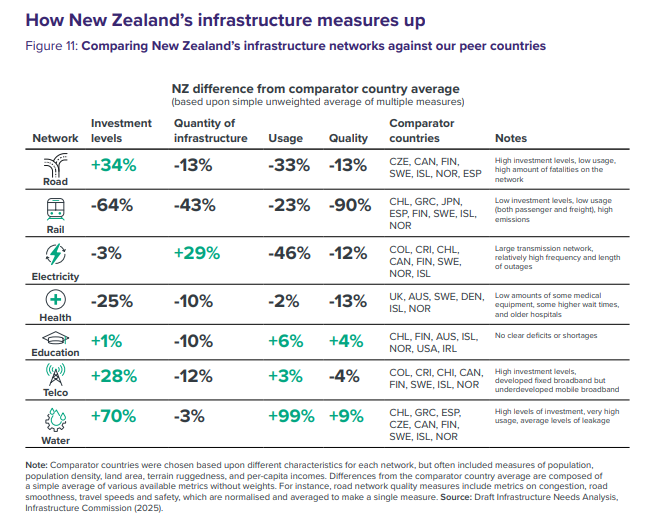
Helpfully, a wonderful piece of work was released a few weeks ago from Te Waihanga/Infrastructure Commission, in the form of the National Infrastructure Plan. It states clearly that future investment in land transport needs to be:
a) lower, and
b) more focused on outcomes that decarbonise New Zealand (like public transport, walking and cycling), as well as maintenance, renewals, and resilience – and away from state highway improvements.
Our Forward Guidance suggests capital spending on land transport should moderate from recent elevated levels. We forecast investment demand based on New Zealanders’ historical willingness to pay. Slowing population and income growth, alongside the potential for shifts in network usage as our economy decarbonises, suggest that land transport costs should represent a smaller share of household expenditure going forward. In this context, we would expect investment to shift away from state highway improvements toward maintenance, renewals, public transport, and resilience. Our Forward Guidance can inform decisions on funding levels and the user charges needed to support them.
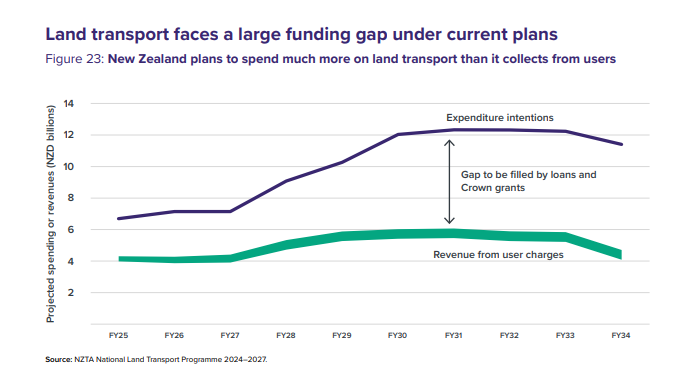
It also spells out our over-investment in roads, and the significant funding gap between revenue streams and planned investment. A Roads of National Significance-sized-and-shaped gap:
The NIP gives us a clear and evidence-based rationale to seriously question the level of investment in the Roads of National Significance.
So let’s do that.
For one, the benefits derived from the RoNS do not stack up. And Warkworth to Te Hana, which is one of the ‘better’ RoNS, really does not stack up.
When consent was issued for this project in 2019, when it was set to cost $1.7bn to $2.1bn, it had a Benefit Cost Ratio of only 0.7 – meaning for every dollar spent, we’d only get 70c back.
Now, the project cost is at least double that 2019 estimate, so that BCR is likely even worse – even with the changes in methodology that has projects assessed over time with a lower discount rate.
Even putting aside tenuous claims of benefits, the 2019 Detailed Business Case stated that certain triggers were required to go ahead, due to uncertainty re the exact timing of long-term investment on this scale.
Does the project clear these hurdles? Let’s see…
To trigger investment, according to the 2019 DBC, Warkworth to Te Hana needed to meet at least 2 of the following:
- DSI savings forecast from Dome Valley safety improvements not achieved within 3 years
- A 30% increase in total number of closure hours per annum from 2018 levels
- Forecast traffic volumes are predicted to exceed 25,000 AADT
So first, the Dome Valley safety improvements project.
This was part of the huge 2018 Road Safety Programme from the last government, when Phil Twyford was Minister of Transport and Julie Anne Genter was Associate Transport Minister, and was largely completed in 2022.
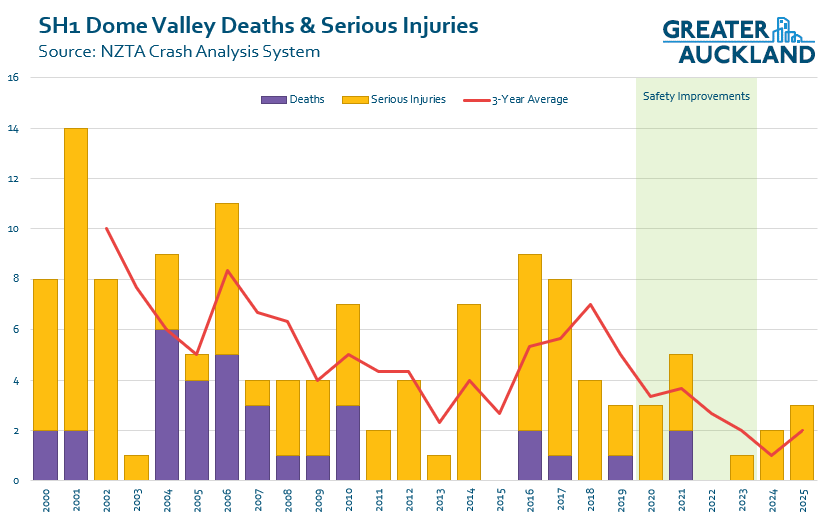
And anyone who has driven through the Dome Valley since the improvements knows how much better it feels. But what does the data say? Looking at NZTA’s Crash Analysis System, we may need a few more years to confirm, but the project looks to have significantly reduced the risk of DSIs from crashes.
Second, the number of closure hours. Data is hard to come by, but given the increase in extreme weather events, it would be fair to say closures have probably increased – while at the same time, we can expect fewer closures due to crashes, thanks to the safety improvements on Dome Valley.
But let’s assume the measure of total closure hours has been achieved.
That leaves forecast volumes of traffic – the most nebulous trigger, because forecasting traffic via modelling should not be treated as an absolute. Modelling is just one tool, and certainly shouldn’t be used as a trigger point for decision-making on this scale.
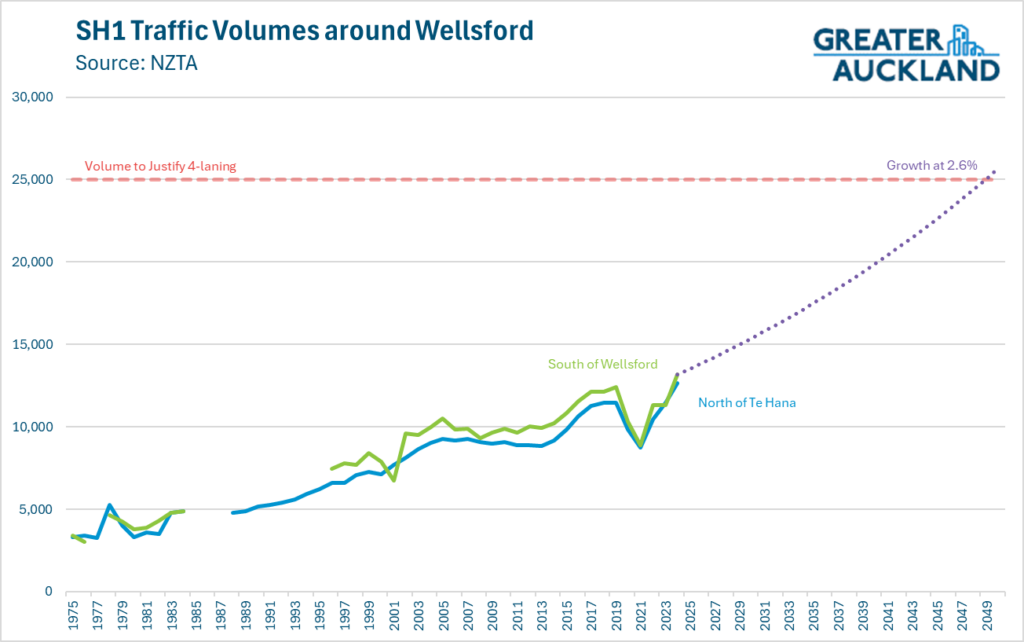
As the chart below shows, traffic growth ramped up after 2013, and in the 10 years to 2024 vehicle volumes south of Wellsford grew by an average of 2.6% per year (notwithstanding the COVID dip).
Assuming a similar level of continuing growth, we wouldn’t hit the 25,000 per day threshold until around 2050. That would mean needing to start construction in the early 2040s.
To put it another way, locking in a deal by July 2026 would mean we’re starting this project fifteen years too early by official measures.
And that’s assuming traffic volumes continue to grow. The current population growth projections for Northland are, at the high estimate, half of 2.6% per year. So, not only is the government rushing into starting this project a decade-and-a-half too early, a four-lane expressway may never be needed.
Why the rush – when the more affordable alternatives are better for us all?
There are huge and very real consequences of racing ahead with PPP contracts for RoNS like the Northland Expressway – not least, the massive opportunity cost.
Ramming through these mega-projects (and their mega-budgets) means we lose out on so many more much-needed, right-sized solutions that deliver most of the benefits we’re supposedly chasing. We simply don’t need to spend upwards of $22,000,000,000 on this one corridor.
There really are only three important features of the Northland expressway:
- safety
- reliability
- and resilience.
Safety and reliability can be achieved with 2+1 style projects (three total lanes, with two in one direction and one in the other, depending on location), separating oncoming traffic with median safety barriers, and adding more passing lanes. Arguably you wouldn’t need a full 2+1 everywhere either.
Resilience is primarily an issue in the Brynderwyns, where slips often close the road, and might require a more expensive intervention such as tunnelling. Any other hotspot areas could likely be resolved with smaller scale interventions.
All of the above still comes at a fraction of the cost of 95km of four-lane 110km/h expressway.
The Dome Valley safety improvements (median barriers, fixing dangerous corners, shoulder-widening,) cost about $80m for 15km. The proposed Northland Expressway is about 95km, or 6.3 times longer. So at a rough estimate, upgrading the entire corridor with Dome Valley style improvements…
…would still only cost about $500m.
That is 1/44th of $22 billion.
To put that into perspective, for $22 billion, you could do 4,180km of Dome Valley style improvements – over twice the current total length of State Highway 1 itself (2,006km).
And two-lane roads are substantially cheaper to build (and maintain!) than four-lane expressways:
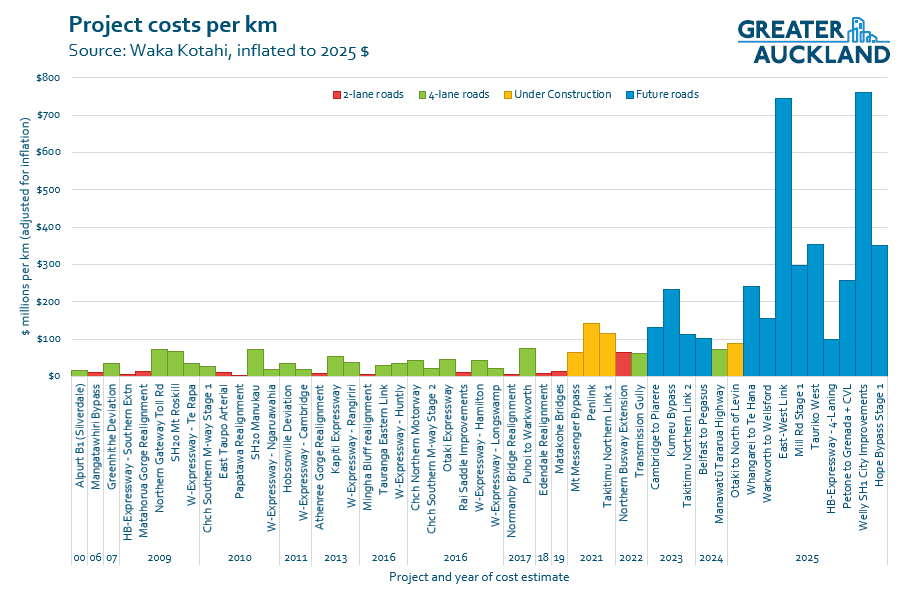
The scale of the proposed work, both Stage 1 of Warkworth to Te Hana, and Stage 2 and 3 of the Northland expressway, is exorbitant – and these are the cheaper RoNS!
The $22,000,000,000 question demands answers
I’m still pursuing the exact cost of Warkworth to Te Hana, via the Ombudsman. But even while awaiting the number, we know enough to demand answers.
What is better for Northland, Auckland, and the country as a whole? Smaller, targeted upgrades that can be delivered far more quickly, cheaply and reliably?
Or a handful of megaprojects that risk blowing out both budget and construction time, and put our fortunes in the hands of PPPs with private entities who may or may not be around when things fall apart?
Why is the government rushing ahead with a project that’s simply not fit for our needs nor our budget, as the Infrastructure Commission has made clear?
Why, as with so much major national investment, are key details being kept from the public? The fact we’re being secretly signed up to black-box billion-dollar deals for projects that don’t even stack up by the flawed metrics of a flawed business case, should shock us.
If we’re being committed to a $4,000,000,000+ project, surely we should know what the deal is? (And Government parties-in-waiting should also want to know what size can they’ll be expected to carry, if contracts are about to be signed).
Shouldn’t we all be allowed to weigh up the more affordable alternatives that will achieve the same goals, faster, and leave money for all the other things?
Just because the project has already got this far doesn’t mean we have to keep going. That’s a classic sunk cost fallacy, and we’re smarter than that.
If we truly want to solve our infrastructure challenges – which are huge – we need to pause this project and any moves towards a PPP. It’s time to stop throwing our money into a RoNS-shaped black hole.
Now’s a good moment for whoever’s in charge to be the grown-up, and to treat citizens like grown-ups. Our current leadership (and our would-be leaders) need to take a deep breath, daylight the discussion, and start to right-size the ridiculous RoNS fairy-tale fantasies.
It’s the only way we’ll ensure we actually have the resources – and the workforce – to achieve all the many other things we need, to thrive as a country.
If you want to see more in-depth posts like this one, consider supporting us by sharing it on social media, or making a donation.
Greater Auckland’s work is made possible by generous donations from our readers and fans. We’re now a registered charity, so your donations are tax-deductible. If you’d like to support our work you can join our circle of supporters here.

 Processing...
Great work Connor.
For FFFFF FFFFFFFFFFFFFFFFFFFF FFFFFFFFFFFFFFFFFFFF FFFFFFFFFFFFFFFFFFFFFFFFFFFFFFFFFFFFFFFFFFFFFFFFFFFFFFFFFFF Sake. Heroic work thanks Brother. Oh what utter utter utter morons – all a big sh1t sham show for the 2026 election – look Northland what we are doing for you. And our media will publish nothing to inform the public. Maybe you could do a cut down summary for consumptive outrage of the general public.
There are also thousands of kilometres of ordinary two lane State Highways across the country that will be starved of funds because of this megalomania. These are the ones that get washed out and leave whole communities cut off in climate events, the ones all the all farm produce relies on.
Many are screaming out for preventative improvements, both for resilience as well as increased safety and productivity. Curves eased, banks held up, culverts doubled, structures upgraded.
It is likely this work would create far great value all across the country, but won’t be funded cos of the funding squeeze created by mega-road projects.
Agree. Living in Taranaki now we are regularly impacted by slips and washouts on the road north, and we’re relatively fortunate as one of the few regions with a large project (Mt Messenger).
In a country that is failing in so many areas, why would any Government tie NZ to become unable to remain, even tenuously in the first world.
And wait until the NZTA cough up on why the decks of the Okura and Puhoi viaducts on the Holiday Highway are starting to break up already.
Infuriating stuff, thanks. The comparison to what else we could be putting that money into really shows the poor value of the endeavour. The fact that no climate implication assessment was done is really disturbing for a piece of infrastructure this large, expensive, and – by the govts argument – critical is quite worrying. What can we do to stop this going ahead in its current form?
$25K per household is a lot of solar on every house……..I’d rather have that thanks.
The infuriating thing about solar, is that it doesn’t have to be ‘free’ solar installs at tens of thousands each
Just a modest incentive on new consents for new builds/renovations; you get a few k cash back for PV that is grid tied. May more if battery backed/grid controlled and scaled from 3KW to more on up.
And people installing gas on new installs, pay a penalty.
It would mean that the government is not footing the bill, but encouraging the public to contribute and invest in energy production. Which you think would be the right thing for a center right government like National rather than taxing people and pouring it in a giant hole in the ground.
Simeon Brown is an ideologue, and the number one reason I won’t vote for National
Given what is happening in the middle east
Great work Connor.
Keep up your work of getting the whole picture out in front of New Zealanders, so we can make financially informed decisions, come election times, on where we want our scarce monies spent. And make our own informed judgements on the financial competence of our governments.
Expect more Luxon word salads.
And this is also why they are so averse to doing anything to support PT, Active Modes and even E Vehicles- they need people to keep driving to pay the increased road charges to pay for this.
I agree, why are they so averse to supporting PT (passenger rail), active modes, and E vehicles (light rail and electric trains)?
that is because the ACT and National parties dont want rail
Unfortunately the problem runs much deeper than the usual political blame game, though I do wonder if the current government don’t want to talk about rail due to it being Winston’s ministry
It’s American-inspired culture war nonsense. Sustainable modes are “woke” which means they’re socialist which means they’re bad.
They definitely would’ve costed any reduction in fuel tax income due to more people driving EV right? Right?!
Absolute BS. Who’s getting kick backs? This government is meant better for the economy right? But think this is a good deal? Yeah right.
EVs pay RUCs, under current policy settings more people driving EVs actually increases revenue
Fair point. But this article says they’re planning to offset the cost by increasing the fuel tax. Which is my point.
Are they also planning to increase RUC and just not told anyone?
Rucs always increase at the same time that fuel tax increases
Dear political parties, NZTA needs to be turned into a non-profit SOE (but must cover all its costs) so that it is at more than arms-length from the govt.
NZTA’s constitution would require it to balance its books over every X year period, use CBA and simplified Safety CBAs to scope and stage projects etc, and to provide the safest and most efficient network for all road users at the lowest practical cost.
(As noted in the article) We would end up with a lot more 1x1s, 1x1s with passing lanes and alternating 2×1 rural highways that the country can afford and only go to 2×2 when the traffic volumes justify.
It might require an initial lift in fuel excise tax, congestion tolling/time of day tolling and possibly some outright toll roads (as the direct crown subsidy into NZTA is significant) but would stop dead in its tracks the overspend in NZ on RONS which the Infrastructure Commission has highlighted.
(Aside: NZ would still have cheap electricity had it adopted this non-profit SOE model for power generation. Real power prices have risen 60% since the reforms)
NZTA should start to Toll the Auckland Harbour Bridge at a rate which covers the maintenance & upkeep plus a margin.
I believe that Tolls should not be removed once the asset / loan has been paid for. Reduced, yes to a rate as mentioned above.
Thanks Conner.
How did the “switzerland of the south pacific” get so pathetic that making a new road could cost so much of our finances.
What size tolls will this lovely new pavement cost us, and what price will LNG be by then to keep the lights on ?
Its our kids will be paying for this, unless they head to Australia for 50c train tickets, and national wealth invested into productive assets.
I travel Warkworth to Whangarei often and cannot see the need for a 4 lane highway. Yes, the Brynderwyns need to be more resilient on the southern side and a bypass of Wellsford would stop the bottle neck at holiday times but two lanes with a few passing zones would be sufficient and considerably more efficient use of funds The costs of 4 lanes recorded in this article are horrendous and the public need to be made aware to give input, especially now, before a signature is put on the PPP and the election
Warkworth to Te Hana makes some sense as the current road sucks. Also some kind of 2 lane Brynderwyns bypass. The rest of it is fine as a 2 lane road, surely roads like SH2 to Tauranga etc would have much more need for 4 lanes.
If you look purely at traffic volumes SH1 north carries more traffic than SH2 south. The busiest section is between Whangarei and Marsden Point, while the quietest section is SH2 from the Matamata turnoff to Katikati.
Simeon made a lot of road promises without understanding the true cost or the state of the government’s budget. I think they will try and back out or downscale many of them, there simply isn’t the money available.
Simeon had/has far more access to far more information, including the real dollar numbers than Conner has
He just chooses to ignore evidence and do what he wants regardless.
The role of advisors is clearly just to hide real information and try and spin it so the road gets built
What a great artical–well researched and very informative
Maybe we should have not removed the Ministry of Works
They always built and managed infrastructure better and at a lower cost
But then what did R.P & R.D. know they were just L.P. politicians
Spending the transport budget on just a few mega projects takes the money away from other transport funding. Transport funding like public transport provision, cycling infrastructure, and rail upgrades. Providing more of these has a significant and negative effect on sales of new motor vehicles, and their ongoing service industry.
And who are the big political donors? They are in order; The property industry, and the road transport industry.
Given that the trucking industry pays a minor fraction of the wear and tear they cause on existing roads, maybe it’s time to insist they cough up or send traffic by other means.
Thanks Connor. Great work.
Now would all those people who love to sound reasonable please stop saying this road is an exception to the rest of the unaffordable RoNS?
It’s no exception.
We can serve Northland far better with targeted road upgrades, investment in a public transport network (preferably with parcel transfer too) and cycle paths.
Imagine what passenger rail could do for Northland!
“Imagine what passenger rail could do for Northland!” – probably not much, very few people would live near it so they would end up driving anyway.
Passenger rail could connect our bigger cities, but Whangarei isn’t particularly high up that list.
Meh.
Resilience is best provided through modal alternatives; how do we value resilience now, given climate events?
If there aren’t the trips there to justify passenger rail, there’s no way they should be looking at a road, with it’s higher ongoing maintenance costs.
The rails already exist.
Northland deserves a transformation that delivers accessibility and safety without the high household costs of car dependence. That’s what passenger rail plus connecting buses could do.
Could start off with a decent hourly or two hourly Intercity bus service from Auckland – Whangarei – Kerikeri rather than the current 3-4 services a day.
Yes, and the connections to it need to be several times a day, too. Rather than twice a week, as is often the case.
Helensville maybe. But it is the lines south to the big population centres Hamilton and onwards to Tauranga that should be next off the block nationally for regional rail. Ahead of even Canturbury.
Yes, I agree passenger rail to Tauranga needs to be next.
It’s time for discussing what the whole country needs, though, too, and to constantly point out that car dependence has been a very costly experiment, from which we must depart.
These country motorways will surely stop the exodus of talented citizens overseas.
Share this message with all your Linkedin and non-transport contacts, there is still time to hold the Government to account.
Keep the message simple:
– $20,000,000,000 on one road
– No way to pay for it without taking out a massive load that will lock in future generations to foreign payments
– This is one the biggest infrastructure project ever in New Zealand, why the secrecy if it’s such a good deal?
– Everything else this could be spent on: especially non-transport infra e.g. schools, hospitals,
We need to tap into the outrage of the fiscal conservative boomers who complain about spending money on anything.
The dimwitted Labour Party spent $66 Billion during Covid, all borrowed. This road is cheaper!
FYI, the NZ government under Labour’s leadership increased GDP over the excellent peak response in 2020 and early 2021 compared to Australia, the US, and Canada – a 5% increase in GDP between 2019 and 2021 while most other countries decreased theirs.
https://www.institutmolinari.org/2021/09/21/new-zealand-growth-in-q2-2021-confirms-the-zero-covid-strategy-outperforms-the-mitigation-strategy-of-the-g10-countries-44-times-less-deaths-pre-crisis-gdp-exceeded-mobility-and-daily-freedoms-bett/
We also a lower rate of unemployment compared to other countries,
Your useless, wasteful, environmentally destructive $20 billion highway where there is not enough traffic to justify it should be worthless. Speed demon freaks can book time at a racetrack if they want to hoon around above 100km/h. This sort of money would be far better spent on maintenance for local roads, mass transit and public transport in our biggest cities, denser housing, and other such areas of worthwhile, environmentally beneficial improvement. Not a vanity project for greedy Big Oil lobbyists and politicians who’ve been huffing petrol fumes.
Omg Burrower I know you barely use the road but you have no idea how bad it is some days it can be a literal crawl through Dome Valley as some poor truck has to navigate a road that is not fit for purpose.
It’s not “useless” it’ll unlock so much potential for the North, how is a 20 min travel time saving and hugely safer road “useless”.
“Where there is not enough traffic to justify it” like I’ve said before don’t justify it just build it anyway problem solved.
It’s not a “vanity project” this is important for Whangarei and Further north it finally gives them a resilient link to Auckland something they have been crying out for and they have to deal with people like you who either have never driven the road or haven’t been on it enough to understand how bad it really is.
Sorry Burrower but you just have no idea I lived up there for a short while and accessing Auckland even on some weekends was a nightmare.
$22,000,000,000 for a 20 minute time saving for approximately 15,000 people is absurdly low value. I quite frequently drive this road. You will very occasionally sit behind a truck doing 40 through the steep sections of the Dome or the Brynderwyns. Those can be solved with short, 1 lane bypasses, not a $22,000,000,000 motorway.
We should be asking what it would cost the next government (whoever it is) to cancel this too much, too soon deal. This government has some experience of cancellation.
Let’s have some focus on that affordable, if hugely expensive, NIP without the burden of RoNS that smack of overseas debt stranglehold.
With our climate how it is, keeping the country running plus modest improvements while we develop a new level of resilience makes much more sense, as anyone the wrong side of a washout/landslide could tell us.
We need a pipeline of projects, not a pipe dream.
It would be good to have a post from Greater Auckland on the National Infrastructure Plan. It was commissioned by this government, and seems at first glance like a sensible way forward….but I haven’t gone into it in any depth.
+1
Do you think we might be overseeing the future of our country going down the drain?
Great work. Opposition parties should come out with a clear statement that they will not honour any PPP contract that this Govt intend to sign before the election.
Interesting article. Last CBR I saw was 1.4 but unsure what this included.
We need a decent alternative to the dodgy Bryderwyn Hills but do we need 2×2… unsure. Though it is cheaper to build all at once than widen later and wear is spread over a wider area.
Traffic volumes will grow dramatically as the road moves north encouraging subdivisions for people computing to Auckland and the service towns like Wellsford and Whangarei.
Getting the Rail spur to Marsden Point to enable exporting from there will be amazing. Trucking from Kaitaia to Auckland, or usually Tauranga, to export goods, as happens currently, is flamin ridiculous.
We really don’t want to encourage tons of people working in Auckland to move further north than Silverdale and then drive into the city.
A train might work though…
Yes indeed
The more trucks etc we can get off the road in favour of rail, the better. Our roads are getting pummeled, particularly by logging trucks and trucks moving shipping containers.
Less damage = less needed repairs = less traffic disruption and more funds available for safety improvements and road upgrades.
We need to pull finger and get rail to Northport, increase diversity and functionality at Northport, allowing it to handle more containers, exports and imports. Take the pressure off Auckland and raise productivity and economic activity in both places. One regions gain does not have to come at the cost of another.
If we put more containers through Northport and free up space in Auckland the economic stimulation could be astronomical. Transfer some container handling (for example) to Northport and use the freed up space in Auckland for increased ferries or harbour cruises, Hotels, restaurants or shops. NZ is increasingly missing out on hosting events or concerts etc due to the lack of suitable accommodation, dining and transport.
The main section to be fixed is the south side of the Brynderwyns. Cure that and the present road does its job. Most of the time there is insufficient traffic to justify a dual carriageway. More passing lanes would be the simplest solution plus a robust median barrier.
The southern end of the Brynderwyn’s needs a $500m viaduct and that’s the most vulnerable stretch between Auckland and Whangarei sorted.
The gradients and curves needed for the speed that Simeon wants make carving through two ranges hideously expensive as well as damaging.
If the PPP option is noted to cost more than if was built by the Crown, it would be interesting to see the cost comparison of total repayment cost vs cost to build of the previous PPP projects. Perhaps this could become an eye opener for many
Don’t forget the unique geology that the new road will be constructed over. Ask any roading engineer and they will comment on the condition of geology just north of Auckland.
For the neo-liberals on this page, surely selling government owned roading assets to private operators is a prime target for paying off government debts?
Give NZTA the New Zealand Railways treatment and see how they fare
Great report. Well done. How stupidity is stopped with the number and quality of politions with their fingers on the till is the hard part. Maybe slow down population growth and concentrate on food and fuel security. Replace hospitals, old bridges existing roads etc rather than new roads and “defence” stuff.
Given NZ1st’s likely stranglehold on the coming election’s outcome, its altogether possible that this stupid boondoggle gets built.
Great article.
Good lets build it!
Transport funding central govt. have allocated to building roads is about 30x the funding the railways receive. How about instead of making the problem worse by building this road, we don’t do that?
Nah, Northland needs this road I do not care how many ideas you come up with instead of a multi lane highway everyone knows that the ONLY way Northland sees improvement is the government building a brand new 4 lane highway. You know I’m right. No opposition party has come out and said “this is what we will do differently and here’s our plan to fund it”. The voters want a 4 lane highway or nothing at all.
As much as I like trains a solid road connection is far more important than a few extra trains. Northland can survive without a rail line but it can’t survive without a road connection. It’s really as simple as that. Stop being selfish you lot may as well give up on trying to divert funds as it’s likely to happen and you’ll be powerless to stop it 🙂
“Stop being selfish” is a bit rich coming from you.
James has been huffing the leaded petrol fumes methinks, if he is in fact genuine and not just trolling for the sake of it like dear old Fassifern/Colah was
I assume you’re deaf too all criticism of this project because your job is on the line, but what regional Aotearoa actually needs is regional transport options that aren’t drive or catch a flight. Ideally fuel efficient or electric so we’re not so vulnerable to fossil fuel energy shortages.
My job isn’t on the line but my life is every-time I have to drive the existing route. Let’s fix that build a new road, again none of you can answer the fact no one has an alternative to a 4 lane highway that is politically acceptable!
Of course I’m genuine just like all supporters of this great idea!
Regional Aotearoa may need that but regional New Zealand needs roads!
My life is on the line every time I walk across town because I have to share the public realm with people in cars who wish death upon anyone who isn’t driving. It would help if you had some other argument to convince us all why building this road is such a great idea besides “it will let me drive faster” and “it’s going to happen anyway”.
“What regional NZ needs is roads” – last I checked regional NZ had more roads than they could afford to maintain
I had plenty of reasons why we need this road craw, you must’ve missed my earlier comment. I’ll list them out here to make it easier.
The new road is faster, safer, saves fuel for drivers, saves time, higher speed limit, reduced inclines for trucks, reduced congestion, no more dangerous passing, more resilient link, less callouts and quicker response for emergency services, busses north become much faster, easier for tourists who aren’t used to our goat tracks, Wellsford gets freed of the choked traffic, reduced fatigue, economic benefits for Whangarei and further north and Brings NZ into line with the latest in road design.
Oh and it’s alright we will pay for it it’s a state highway not a regional road. Also called an inter-egional connector they are supposed to be high speed efficient driving routes, a majority of the public when consulted wanted these to be a MINIMUM of 100kmh (Dome Valley does NOT meet this criteria) and the majority of the public voted in favour of allowing 120kmh roads like this one when they are built.
Craw I can see you’re a little bit woke which there is nothing wrong with but unfortunately it means you’re not actually willing to look at any of the benefits of this project you only look at the downsides because you have an ideological opposition to roads.
You know full well if the government put out an option to voters spend 20B on a Warkworth to Whangarei expressway or spend 20B on light rail and busses the road would win by a LANDSLIDE. That is why I am defending this road I’m sticking up for demo-cracy which people are openly out here trying to squish.
It is indeed a great road that would be transformative for Northland and deliver all the benefits you say.
But it’s not worth $22bn dollars. It’s not justifiable to spend 10c in every national infrastructure dollar for the next 25yrs, for less than 10,000 vehicles a day. It can be a great, transformative project and a completely unaffordable one, both at the same time. Like the ridiculous tunneled LRT plan.
However, we could get most of the benefits for much less a cost. That would be the logical thing to do by “good economic managers” and a “fiscally responsible government”. But this road will prove National to be, once again, we’ll short of those standards.
hmm, James, let me test your (obviously very low) intelligence.
$20 billion spent for a region with a population of 200,000… or $15 billion spent for a city with a population of 1.7 million people. Which serves more people, and is therefore better value for money?
Oh, my bad. The righties don’t care about being smart with money when it’s their pet projects. Sleepy sleepy anti-wokes with their eyes shut. Maybe you need to check you aren’t suffering from carbon monoxide poisoning James.
KLK I’m justifying it under majority rules which both yourself and Burrower glossed over because you hate Democratic systems. And like I’ve said before don’t justify it just build it anyway problem solved.
Burrower I utterly reject the premise of your statement this road serves far more people indirectly than your overpriced light rail.
Both of you have refused to say how you would improve the road North we all know due to the geology a completely new road has to be built anyway just do it once do it right.
Also I agree with you KLK National aren’t good economic managers just like Labour but luckily in this case I’m expecting them to do so and get the road built. 20B on a transformative road is far far better than 20B blown on an overreaction to covid. (Which btw if that doesn’t prove “experts” and “evidence” shouldn’t always be taken seriously I don’t know what does. Labour is still paying the price for listening to so called “experts”.
Colah – you’re more optimistic than me if you think National are going to get on and build a $20b road. At most we’re going to get a $4b section built at some point in the next 10 years, and even then the annoucement date for that has drifted by with silence.
I’m sure Northlander’s will be stoked with this new road in the Auckland region though and will enjoy paying the toll on it whenever they go to leave their region.
You also seem to be under the impression that public opinion can and should not be influenced, James. The influence of most people on this blog is limited to (public) discussions, stating evidence, and making arguments as well as educating people about the potential consequences and alternatives (big shiny road with a rather high toll or more money for hospitals, schools, local improvements, and trucks off the road?)
That is a major part of the democratic process, even far more so than a government pushing through something without proper public dialogue. Just because something is democratic, does not mean the outcome is good. Just because people disagree with the outcome of a democratic process, does not mean that they hate the democratic system. Just because I don’t agree with your opinion and think you are acting in bad faith under multiple usernames, does not mean I don’t think we should have free speech.
This part from the Weekly Roundup underlines my point. A perfectly legal and democratic process, but still what the actual fuck?
[…]Consensus. Super-consensus. Everyone agreed.
But at that board meeting, Grant proposed a motion that effectively rejected the consensus advice. It passed unanimously. What happened?
John thanks for falsely accusing me of using multiple account names. But I respect your right to free speech so you can say what you like. Grant needs to be sacked if he’s ignoring what the majority want.
Also I never said that public opinion can’t be influenced. You are being selfish and trying to delay the road as long as possible in the hopes public opinion will somehow magically shift towards cycleways and bus lanes.
YOU KNOW FULL WELL IT WILL NOT. Kiwis like to drive and a surprising amount of the new kiwis like to drive too. It’s going to get built suck it up. (Well at least the Warkworth to Te Hana will before we run out of money lol)
You keep saying there is no alternative to building this road, the alternative is obviously to build a new train line across the Waitematā that runs up North and/or improve the existing line and start running passenger trains to Northland again.
Pretty sure kiwis don’t like to drive because they are flightless birds??
Yeah right craw, that’d have a worse BCR than the road would (not that I care about BCRs) but since you probably do it’s worth mentioning.
Again I’m waiting for someone to prove with an actual doable plan not just sentences written out I’m talking links to source on how you would make the road more resilient without this 4 lane highway. The truth is and you know it is that THERE IS NO ALTERNATIVE!
We have a plan RIGHT NOW with proven designs that is just waiting for funding to go ahead and bypass the death trap that is the existing road.
I do not give a rats bum if it takes money away from traffic calming or any other nonsense like that. What I’m saying craw is if you’re so desperate to stop the road from going ahead prepare to be disappointed NZ firsts say in the next election is going UP so prepare to SUCK IT UP the road is getting built and prepare to pay for it
Sounds like you’re more desperate to have the road be built than we are to stop it. Reallocating RoNS funding to pay for regional passenger rail is a far more resilient plan than ‘BUILD THIS ROAD’ because then we won’t have to burn so much jet fuel to move people around the country
craw – no point arguing, you know rightists are mentally disturbed lunatics who’ve been so brainwashed into individualism and a culture war against empathy and community that they actively support things that hurt themselves.
Case in point, the trumper cult
Speechless
Burrower how is a SAFER road and a QUICKER journey time hurting oneself. All I’m hearing here is “I’m anti car and I’m not willing to budge even slightly on the issue instead of having any empathy for the north I will act like a spoilt brat when not every dollar of funding goes towards the stuff I want. The difference here is I support projects like the CRL and Te Hana expressway that’s what makes us different which theres nothing wrong with. Trump is an idiot your not wrong there but he does things the majority want while the opposition seems to go out of their way to make themselves unpopular when they could just get in on not being Trump.
I know I’m arguing with a brick wall here Burrower is too pigheaded to change their mind or even admit the expressway is the only way Northland sees travel time and safety improvement at the same time.
Burrower I will give you one more chance at a reasonable debate. With LINKS TO SOURCE how would you do this road differently but it has to provide the same Safety and Resilience as the expressway, Ill let you get away with the travel time argument for this sake as we both know you can’t match the expressway on that. You need concrete evidence not just links to someone’s “possible ideas” I’m talking a complete plan ready to be funded like this road (that is getting built) already is.
Here’s my plan $4B build the expressway as proposed. Evidence is posted in every second GA post or on the NZTA website.
At least NZTA engineers are getting good salaries for printing roads
Do they want to build a Sunshine Coast north of Auckland?
Northland is currently about half the population of the Sunshine Coast at 200 k residents. So, better get busy subdividing those coastal plots. You need to double the population!
But there’s more: There is at least another million people living north of that in Queensland. Not many people are living in the Kermadecs…
So what is this expressway for?
I will put my paranoid hat on and say that it could be:
a windfall for the property development industry;
a way to increase Auckland’s hinterland to take some pressure off real estate costs (a subsidy);
and (for the “anti-statists”) a way to weaken the NZ govt’s ability to fund other infrastructure – especially social infrastructure.
It would be good to know what the actual motivations may be!
If I was to be conspiratorial, I might say to provide capacity for all these people travelling to auckland for medical treatments, as Northland District Health Board was swallowed up by Auckland under Nationals Health reforms centralising health care.
Lets double the population!
yay! suburban sprawl all over our native bush and growing soils! extinction of precious native species! relying on imported fruit and vegetables! gridlock traffic on every motorway! billions of dollars wasted and billions more in productivity lost!
Lets build more motorways and skyscrapers!
correction: skyscrapers and public transport. Trains. Light rail. Busways.
What a great article. Could you bottle up just a little of your talent and put them in a free dispenser in the beehive
Crazy prices for these types of roads for little need.
Love the comparison list of what we could get instead especially some that I’m sure you were laughing about as you wrote them like:
“99 contract-cancellations for no Cook Strait Ferries ($222m)”
All of the road building by National,has nothing to do with better roads.It is all about national MP,s getting there names up on plaques .To then tell everybody I!! did this or that and there is the proof.My name is on that plaque in perpetuity for everybody to know who I am or was.National is always interested in only the biggest things to get there names on.
The project itself isn’t necessarily the problem, it’s the ridiculous construction costs in this country!!
In pretty much any other developed country this project would be between $4B and $10B at most. Not only would they build it for less, but the quality is typically far higher too – think rigid concrete pavement construction that lasts far longer and is cheaper to maintain vs our crapy flexible pavement roads.
So unless we find a way to lower costs (I’d be happy with $11B ie half), then this project needs to be drastically scaled back. I would suggest the first stage to Te Hana is ok. Brynderwyns can be improved much more cheaply and Whangarei to Marsden can similarly be improved with a handful of passing lanes.
Based purely on traffic volumes Whangarei to Marsden Point would be the 1st bit to be upgraded, however it doesn’t benefit Auckland holiday makers as much.
Regarding cost New Zealand geology is very complex, especially north of Auckland, cost comparisons with projects in other parts of the world.
So! What chance has the South Island got of getting a few pennies from central or local govt for OUR as much needed infrastructure, hospitals, schools etc ?
Dunedin hospital, Christchurch stadium?
Firstly can we start calling it by the right name, Please.
It is the Auckland to Whangarei Corridor not the Northland Corridor. The $22 billion stage 1 – Warkworth to Te Hana – does not even reach Northland, with the Te Hana petrol station on the Northern Edge of Te Hana, 5+ km from the border between Northland Region and Auckland Region.
NZ will always have issues when we have such a low population, and so much land, leading to great distances between population centres, combined with challenging Topography.
There are many properties in the Auckland to Whangarei Corridor just waiting for a more reliable connection to Roading and other infrastructure to subdivide, in some cases over several stages to provide several thousand properties, and related buisnesses, facilities and employment opportunities. Helping thousands achieve the kiwi dream of home ownership.
We need to look at all funding opportunities, such as Capital Contributions from subdivisions and Tolls. It seems stupid not to toll a new link road/tunnel where there are free alternatives. If a van with 3 builders, which are charged out a say… $200 an hour, take the toll road, which saves 15mins each way, that saves the company $50 each trip, then a $10 toll, is a pittance, for the company and helps make it easier and cheaper to get a tradesperson, benefiting everyone.
We need to think outside the box, to actually plan ahead, rather than building as small or cheap as possible and then spend millions repairing and upgrading within 5 – 10 years.
The solution to this problem: “a low population, and so much land, leading to great distances between population centres, combined with challenging Topography”… is proper planning. Good density at each urban centre, connected by rail and bus, with minimal numbers of private vehicles. No more sprawl. It’s a different model to what NZ has seen, but it’s what we need. A transport system heavily reliant on the private vehicle is unsustainable and unaffordable.
As for this: “There are many properties in the Auckland to Whangarei Corridor just waiting for a more reliable connection to Roading and other infrastructure to subdivide”… All best practice advice, whether focused on climate, safety, accessibility or asset management affordability, is that these properties should not be developed. That approach has been NZ’s biggest failure.
Great article and analysis.
Positively the extension through to warkworth has dramatically improved travel times into northland even in the peak holidays.
Yes the current dome valley and brynderwens need better tactical solutions but with our national debt ballooning by billions over the last 6 years, I fully agree the full northland highway needs to be shelved! Agree far more investment needed elsewhere, rail etc.
2017 – Wikipedia Waterview Connection page shows it opened for around $1.7 billion for 4.5km of tunnel and roading. A cost of around $380 million per km. With a benefit ratio of $1.15 or $1.16 per $1.00 spent. Yet due to the high voter base in Auckland this was deemed essential infrastructure and kept toll free.
This is despite an estimated 83,000 vehicles using the Waterview Connection per day by 2026, easily bring in $850,000 per day given the prevalence of trucks. $850,000 per day to target into Auckland projects, like Labour did with the 10c per litre targeted RUC, which National removed without providing alternative funding.
2019 – Detailed Buisness Case for Warkworth to Te Hana placed cost at $1.7 – $2.1 billion, for around 26 km of tunnel and roading. A cost of around $65 – $81 million per km.
2023 election – National campaigned on Warkworth to Te Hana at $1.7 – $2.1 billion, with a benefit ratio of $1.40 for every $1.00 spent.
More recent estimates put it over $3.5 – $4 billion. Which means the starting price for the 26km, Warkworth to Te Hana project has more than doubled since 2019.
Doubling over 6 years is 16.67% increase each year, extrapolated to the 8 years since the Waterview Connection $1.7 billion in 2017, and that is around $2.26 Billion if we were to start the Waterview Connection in 2026.
Makes $3.5 – $4 Billion for 26 km of tunnel and roading in the suburbs of Auckland look cheap.
As one who appears to be directly impacted by the Northland Corridor I note that no one seems to have considered another loss to our community if a 2×2 highway is built. Land. Land that is currently producing primary produce both for export and local consumption. Add to that many small businesses and the cost increases. Also I haven’t seen any costs for the various on going payments which I understand are being paid to ‘adjacent neighbours’ who are inconvenienced or distressed by road pollution and/or loss of amenity.
Chat GPT suggests these options for resisting this:
Here’s what the article is arguing (in plain terms), and then a menu of advocacy options you can use to force a rethink.
What the article is saying (why this is contestable)
The Government plans to sign a PPP by July 2026 for the Warkworth–Te Hana section (stage 1 of the broader “Northland Expressway”), with a preferred bidder to be confirmed around February 2026.
Key cost/contract details are being withheld/redacted, with an explicit intent to delay release until after “financial close”.
The programme-level cost cited is about $22b to deliver all three stages by 2039, with stage 1 suggested to be $3.5–$4b (up from earlier business-case estimates).
Funding assumptions include future increases in fuel excise and road user charges (from Jan 2027, 2028, 2029), plus a Crown loan / “construction capital contribution”.
The 2019 consent-era business case had a BCR ~0.7, and even on its own “triggers” logic, the article argues the project is being advanced ~15 years too early (traffic threshold not until ~2050 on historic growth).
The piece claims the core outcomes (safety/reliability/resilience) could be achieved largely via 2+1 / median barrier / targeted resilience works, at a fraction of the cost (order of ~$500m for corridor-style “Dome Valley” upgrades vs $22b for full build-out).
That combination—lock-in deadline (July 2026), secrecy, big fiscal opportunity cost, weak BCR / timing case, and credible lower-cost alternatives—creates multiple pressure points.
Options advocates can pursue (with pros/cons)
1) Intensify OIA requests + Ombudsman complaints (target: cost, risk, value-for-money, decision rationale)
What to do
File coordinated OIAs (to MoT, NZTA/Waka Kotahi, Treasury) for: updated cost ranges, affordability thresholds, BCR/peer reviews, PPP evaluation criteria, risk allocation, “public interest” balancing, and any updated modelling since the 2019 DBC.
When refused for “commercial sensitivity,” challenge with tightly framed requests and ask for partial releases / summaries / ranges.
Escalate promptly to the Ombudsman when withholding is over-broad or delays are unjustified (the article itself notes Ombudsman involvement as the path to releases).
Pros
Creates an evidence base that journalists, opposition MPs, and local leaders can use.
Ombudsman guidance makes clear “commercial” grounds aren’t a blank cheque; agencies must still consider public interest.
High legitimacy: “we’re asking for the basis of a multi-billion commitment.”
Cons
Can be slow; agencies often “run the clock,” especially around procurement.
Releases may be heavily redacted or arrive after key milestones unless pursued aggressively and in parallel.
2) Push an Auditor-General inquiry / performance audit (value-for-money, governance, procurement integrity)
What to do
Submit a formal request to the Office of the Auditor-General (OAG) to examine governance, procurement and value-for-money aspects (especially if secrecy prevents scrutiny before contract lock-in).
Frame it as a “major spending commitment with long-tail fiscal implications,” plus procurement/process transparency.
Pros
OAG is a high-trust watchdog; even the start of an inquiry can change behaviour.
OAG has an established work programme and public reporting on procurement practices across government.
Cons
OAG may not move quickly enough to affect the July 2026 decision window.
OAG can recommend improvements but can’t directly cancel a project.
3) Use Parliament tools: petition + select committee pressure + opposition briefings
What to do
Launch a Parliamentary petition calling for: (a) release of headline contract/whole-of-life cost ranges before signing; (b) an independent review comparing staged/2+1 alternatives; (c) deferral until after an election or until triggers are met.
Brief transport spokespeople across parties and sympathetic government backbenchers; supply a 2-page “cost, timing, alternatives” pack anchored to official sources.
Pros
Petitions are explicitly designed to ask the House to act on policy.
Creates a public record and forces formal responses/hearings (depending on committee handling).
Politically salient because the article’s core critique is about locking in before the public can see the deal.
Cons
Government can still ignore (especially with a stable majority).
Needs scale and smart comms to avoid being dismissed as “fringe transport nerd stuff.”
4) Attack the “lock-in” moment: demand a pre-signing transparency package (ranges + key terms)
What to do
Run a focused campaign on one demand: “No signature before disclosure”—release at least:
capital cost range, whole-of-life cost range,
tolling assumptions,
Crown loan/CCC size,
updated BCR / sensitivity ranges,
and a plain-language risk allocation summary.
Tie it to the Cabinet-paper intent to delay proactive release until after financial close.
Pros
Simple, high-resonance message: even PPP supporters can agree transparency is basic hygiene.
Doesn’t require winning the whole mode debate—just forces daylight and slows momentum.
Cons
Government may claim “commercial negotiations” make this impossible.
If they do release, it might be “spinful” and selectively framed.
5) Build a “credible alternative package” (safety + resilience now, defer capacity later)
What to do
Advocate a staged package aligned to the article’s “safety/reliability/resilience” framing:
2+1/median barrier and passing lanes where warranted,
targeted Brynderwyns resilience (potentially tunnelling only where necessary),
small-bore bottleneck fixes (e.g., holiday peaks) rather than 4-lane end-to-end.
Use the article’s rough comparative: corridor-style improvements in the hundreds of millions vs tens of billions, and “too early” trigger logic.
Pros
Harder to caricature as “anti-Northland.”
Lets local business and safety advocates join without endorsing mega-motorway scale.
Cons
Requires technical credibility (engineers/road safety experts) to avoid “armchair planning” attacks.
Government can respond: “we’re already doing some of that and the expressway.”
6) Legal route: explore judicial review (process failures, irrationality, or unlawful secrecy)
What to do
Get public-law advice early (Community Law / pro bono / public interest firms).
The strongest angle is usually process: whether decision-makers properly considered mandatory factors, acted reasonably on evidence, and complied with statutory obligations (rather than courts second-guessing policy merits).
Pros
Injunction risk can force delay/disclosure.
Raises the political cost of rushing decisions.
Cons
Expensive, high threshold, uncertain outcome.
Courts are cautious about stepping into big infrastructure choices unless process defects are clear.
(Even Treasury’s own PPP/OIA material acknowledges procurement decisions can be judicially reviewed in principle, though PPP-specific case law is limited.)
7) Local government + regional coalition strategy (make it broader than “transport mode wars”)
What to do
Secure formal positions from Auckland Council / Northland councils, business groups, freight interests, safety groups, climate/resilience advocates:
“We support safety/resilience upgrades now, but oppose signing a fiscally risky PPP without disclosed costs and an alternatives assessment.”
Encourage councils to pass resolutions and request ministerial briefings.
Pros
Cross-sector legitimacy; harder for Ministers to dismiss.
Helps shift the media frame from “bloggers vs roads” to “regional governance dispute.”
Cons
Councils vary politically; some will be pro-expressway.
Coalition management is work: messaging discipline matters.
8) Media + narrative campaigning (convert complexity into one or two “sticky” accountability lines)
What to do
Use a small number of repeatable claims anchored to official documents:
“Sign by July 2026; public sees terms later.”
“Triggers imply ~2050 for traffic threshold; we’re building ~15 years early.”
“Safety/reliability can be achieved with 2+1 + barriers at a fraction of the cost.”
Place op-eds, talkback briefs, local papers, and business press. Pair with simple visuals (per-km costs, household-equivalent framing, opportunity cost).
Pros
This is the lever that makes the other levers work (OIA, Parliament, OAG).
Time-sensitive: can bite before financial close.
Cons
Risk of oversimplification or a fact-check hit if numbers are not carefully sourced.
Attention cycles are short; needs sustained cadence.
Practical sequencing (to hit the July 2026 window)
Now (immediately): coordinated OIAs + Ombudsman escalation; launch the “no signature before disclosure” demand.
Next 4–8 weeks: petition + brief MPs; line up councils/anchors; place 1–2 major media pieces.
Parallel: OAG request; commission an independent “alternative package” one-pager with credible engineers/economists.
If they proceed anyway: consider judicial review (process) and make the election accountability case.
If you tell me what kind of advocacy you’re doing (community group vs professional NGO vs local politicians), I can tailor this into a tight campaign plan with specific draft OIA questions and a one-page “asks + evidence” brief.
We need to look at who has their hands in the pockets of Simeon, Chris, Winston, etc. IMO.
Well written article, and I’m delighted to see that I’m not the only one calling into question the viability of this what I can best describe as a Vanity Project.
I live in the Far North and spent a lot of my life in and around the Whangarei area, including a lot of travel to and from Auckland, so my feeling is this:
– Does Northland need a better and more resilient roading link to Auckland? Absolutely yes!
– Do we need a new motorway that will soak up around !0% of all funds designated for infrastructure spend for the next ten years or more?
Absolutely not.
The justification for this project is all very ethereal: “It will unlock potential!” What does that actually mean? No one can actually say, because it’s something that has never been quantified.
The same goes for the Benefit Cost Ratio: 1.4 sounds great in theory, but where did that figure come from? 0.7 in any financial measure is a bright red flashing light!
Then get to the Infrastructure Commission’s report – it is not exactly a shining endorsement of the project.
And the consider the interview with Chris Bishop on Q and A last week. He admitted that the goalposts have moved substantially with the Middle East conflict, and with it the financial considerations.
For example, less people travelling so buying less petrol, so the take from the Fuel Excise Tax goes down, and although he wouldn’t rule out the proposed rises in the excise tax being canned, he said “They were unlikely to proceed”.
More EV’s, so less tax take.
And then the actual project cost. The chances of it coming in on or under budget are small at the best of time without the use of creative bookkeeping, but the obvious hit is the price and availability of diesel. This project, just like all the other RoNS projects, will require millions (?) of litres of fuel to operate the machinery from Go to Whoa – but the diesel price has almost doubled, so the calculations on costs and benefits are now so far out they are almost irrelevant.
So, is there a better or more practicaL option? The article alludes to the improvements in Dome Valley which were carried out at a fraction of the cost. Still not ideal in that we would still be left with some windy stretches of road, bu if “Fiscal Responsibility” is going to remain the catch cry, then perhaps the Government should be looking to stop the expensive and exorbitant promises and remember the old saying: “Cut your coat to match the cloth”.
Northland’s future prosperity lies with local enterprises that don’t rely on roads. Highways are 1950s thinking.
The full Chris Bishop interview on Q&A 19 April (31m):
https://www.youtube.com/watch?v=nZi5z04fZzQ
I totally agree that this road is not needed. Yes. The southern side of the Brynderwyns needs a better solution but the northern side is great. Perhaps a bypass road around Wellsford would alleviate the bottleneck that used to be at Warkworth. Schools, hospitals, ferries, road improvements etc could use the massive one road cost far more efficiently.
Now that we know that the Green Party also wants a road safe for 120kmh it’s time to get on and build this thing. A bit ironic I’m asking for roads engineered up to 120kmh and some politicians just do 120kmh on the existing roads.
Side note: Can I just say Marama Davidson actually seemed quite a competent driver and from the video I see no reason why we shouldn’t raise the speed limit to 120kmh on the current expressway, clearly most people can handle it given I will set the cruise to 114 (110 actual speed) and a huge volume of traffic still passes me.
I know many of you want the money for some other type of projects but none of them give Northland as much resilience or safety or the huge travel time improvement this road will provide. That’s why it must be built.
Problem is it gives Taranaki, Tairawhiti, Hawkes Bay, Nelson, Otago etc no resilience safety or travel time savings, yet unless they are planning a special tax for Northland they will be paying for it.
Meh that’s too bad for them. Northland has the advantage of being closer to Auckland than most of those regions so it’s more in the minds of Aucklanders who can make or break elections for political parties as Labour found out pissing off Auckland didn’t go down too well whether it was low speed limits, excessive traffic calming or overzealous lockdowns, they paid the ultimate price come election time.
jezza I do believe you’re a bit more honest than most others on here, I think you know just as well as I do that because of the complex geology of the terrain and the complex political geology the ONLY way Northland sees real improvement is by going ahead with this proposal even just the Warkworth to Te Hana section will make such a difference to Northlanders needing to access the very large business opportunities in Auckland.
I’m not denying smaller improvements wouldn’t help, we know Dome Valley needs a new alignment as there is no way to make the current road any more resilient unless you carve half the hills away from around the road. Yes 2+1 would be cheaper but you would struggle selling that to voters who just want to be able to pass trucks without stress of a speeding ticket.
$4B is really nothing in the grand scheme of things. The toll road can at least cover its yearly operating expenses plus a little extra to start paying down a bit of the debt. But I agree there are some difficult decisions ahead as the Harbour Bridge won’t last forever. Im supportive of the CRL and can’t wait for its opening but the yearly running bill is about $260 million dollars, we could save a lot of lives by putting that money towards upgrading more roads. It’s sad these are the sort of decisions we have to make but thanks to Labour firing up the money printer we have to make these decisions now ONLY funding the most POPULAR projects. If the CRL doesn’t drive a significant patronage increase we are stuck with a massive bill to pay off just like this road. Funny the double standards on this. Why is it ok to be sneaky around the CRL and only mention the rates increase AFTER it’s built but when it’s a road everything must be fully funded. I do think it’s important the government is honest exactly how this road will be funded however there’s nothing wrong with spreading the cost over 50 years given those people will actually see the majority of the benefits.
The motorway has extended approximately 40km north in the last 25 years and I don’t think there’s any evidence of a significant benefit to Northland. I can’t see why the next extension will be any different.
If we wanted to seriously unlock the Northland economy we would improve connections to Marsden Point, improve connections to Kaitaia and sort out the treaty settlement with Ngapuhi.
As for CRL it should never have been 50 % funded by council, we’re not asking them to fund 50 % of the northern motorway extension, nor have we asked the Western Bay of Plenty council to pay for the Tauranga Northern Motorway.
Maybe regional councils should have to fund 50% of their duplicate motorways the same way Auckland paid for 50% of it’s rail tunnel.
There’s 87,000 ratepayers north of Auckland. For Warkworth to Te Hana their share would be about two billion dollars, so about $23,000 each. Spread it over ten years for $2,300 a year?
Well jezza id argue the Waikato didn’t see significant benefit until the expressway was fully completed there either, now as we all know it’s unlocked new suburbs and because of the ease of connections to the largest market Hamilton is booming. Whangarei has grown slowly with the motorway but the progress here is much slower due to the terrain increasing cost.
There is a clear difference Riccardo, CRL is a benefit mainly to the Auckland CBD where as the Northern expressway unlocks an entire region. The three major pinch points north are Dome Valley, Wellsford town centre and the Brynderwyn hills. Because there is no easy way to bypass the dome the cost here is worth it. I’d be happy if the government got on and built a smaller bypass of the Brynderwyns. This would resolve a huge amount of stress and anxiety driving north. Other small benefits like letting people do 110 to overtake on the Waipu straights when trailers often speed up to 95-98 and makes it hard to pass safely.
jezza you know just as well as I do there’s no alternative for Dome Valley, there is NO OTHER PLANS. No evidence that it’s possible to bypass it at all without building the existing plan. These are state highways and have always been 100% paid for by the state through fuel taxes and other means. Rail is different because (as much as I like trains) is often a money pit that you have to keep filling. I just can’t understand why we are pouring so much into Auckland public transport to be honest other regions are growing based on Births Auckland literally is only growing from Immigration cut that off and we actually don’t really need to make anymore huge investments into PT in AKL. Before anyone says this road is a money pit I agree however roads are essential think Police, Fire, Ambos where as rail and I do really like trains is a nice to have, but honesty is important in this conversation.
Again one last time THE ONLY WAY NORTHLAND SEES ANY IMPROVEMENT TO THE ROAD IS THIS PLAN, THERE IS NO ALTERNATIVE. We all know it but I’m one of the few on here with the guts to say it how it is, It’s a full expressway or nothing we all know this.
James you are right, in that expenditure of $22 000 000 000 on one road will definitely improve things for Northland.
And even very slightly improve things for Auckland.
But $22 000 000 000 of NZ’s money can be much better spent on other improvements elsewhere, in the government provision of services. Even just in Northand.
It is an extravagance we simply cannot afford right now.
The only way Inter-island travel sees improvement is new ferries, yet the government broke that contract because they were concerned about cost blowouts. Just because we can build something doesn’t mean we should.
You know very well that there’s an alternative to the existing plan, it’s just it involves having a 2+1 road, more curvature to reduce the need for tunnelling and roundabouts instead of interchanges.
It won’t be as popular with users (but it equally might be more popular with the majority of the country that won’t be using it but will be paying) but that’s very different to there being no alternative.
No jezza the 2+1 road is 100% hearsay, there’s no plan, no costing and no evidence it provides any benefit. Links to source like I’ve already said? That’s because there is no source is there.
The government should quickly spend what Labour want to use on yet another lolly scramble on this road it’ll save far more lives than a $20 cap on public transport. Clearly all those saying we can’t afford it are just upset the money is getting spent on a road and not the stuff they want when the revenue comes from road users funny that.
Public transport is a huge money pit you can keep pouring money into but in NZ it only seems to keep needing an ever increasing subsidy, that’s because the majority of people actually don’t want to use it mainly because there is disruptive people on busses and in stations and that’ll never be fixed. But what Labour has done is proved there is money for this. Let that $65 million yearly fund pay for half over about 30 years and collect the other $2B from tolls and RUCs or fuel excise.
In all seriousness typical Labour print print print, they say it’s funded but it’s probably going to lead to money printing as they are forgetting that less people driving means less NLTF revenue. This is ONCE AGAIN subsidising wealthy business people commuting into the CBDs of major cities while not improving services enough for others to actually want to use PT. TERRIBLE POLICY!
Lets get this motorway built James!
$20+ billion down the drain! that’s what we call “fiscal responsibility” in this day and age of petrolhead doublethink, easily explainable by brain damage caused by the inhaling of car exhaust fumes.
https://environmentalhealth.ucdavis.edu/air-pollution/brain-health
https://www.nature.com/articles/d41586-025-00053-y
https://hsph.harvard.edu/news/how-air-pollution-impacts-our-brains/
Lets build it James!
As for the Waikato, Hamilton has been on a significant growth trajectory since not long after the 2nd world war. The Waikato Expressway has been built as a result of this growth, not the other way around.
The justification that it would improve the economy in Northland has never been tested. I went to an urban economics course, and the economist made the point that improving the connection to Auckland, would be more likely to encourage businesses to move to be closer to the city in the country.
I also wonder if it would also result in more Aucklanders trying to make money from Airbnb etc. Making it even more unaffordable for locals and further stretching infrastructure and with very little going in their pockets.
The best thing we can do is a 4 lane 120kmh expressway to just north of the Brynderwyns then change the law to allow 110kmh speed limits on long wide straight regular roads like in Australia (eg the Waipu racetrack) given everyone already does 110 on that section anyway. We effectively have an expressway the full length without actually needing to build it the whole way.
Suggesting we don’t need a Dome Valley bypass is complete crap. The Dome is restricted to the slowest vehicle on it, it’s not uncommon during the week to get stuck behind a truck doing 20-30kmh. It’s horrific.
The government should figure out the cost of the Brynderwyns extension then we can have the cost for an effective “expressway” all the way north. Obviously before we raise the speed limit it would have Median barriers the whole length and no right turns etc. NZTA was completely insane wanting to lower the speed limit and ultimately it cost Labour votes at the election.
Looking further north we really need to straighten out some sections of road and just better maintenance , the road is badly worn out on many parts of the network north of Whangarei. The government should go ahead with a fuel excise increase or introduce it through RUCs by stealth. PT also needs to pull its weight we should be expecting it is a bit more self funding the FBR seems to get worse all the time.
Then other frustrating things about driving north like contractors leaving up “temporary” speeds for months. Or repairs that just sit undone for 2 years. NZTA does not give a crap about Northland and they made it clear when they said they would put a blanket 80kmh speed limit on the whole network.
Long story short we should have 22B for Northland spend 15B on the expressway to North of the Brynderwyns and the remaining 7B on median barriers and then what’s left over we put into making Kaitaia more attractive to tourists as this is what we need to really start the economy up there. I used to live near Kaitaia it can be a really depressing town with not much opportunity for young people, we need to change that it should be a proper gateway to Cape Reinga not a rundown strip with a few motels and a Pak N Save.
oh so $44 billion for a region of 200,000 people then? $220,000 per person?
Well, in that case Auckland deserves a $330 billion dollar investment in infrastructure! It’s only fair and equal, so I know you’ll support that James. Bring on the massive rollout of rail!
You’re quite obsessed with a fast trip to Northland aren’t you. Usually starts with a claim of how vital it is, when that is debunked it becomes we’ll it’s what voters want, then finishes with a classic primary school – Na na na na na, it’s getting built whether you like it or not.
You’re probably right on the last one, although the February announcement sailed on by and were now halfway through July, the most recent suggestion for an announcement, so who knows.
Either way it looks like anything north of Te Hana is dead for a long time.
Yes I am so what? It is vital and it hasn’t been debunked. And yeah even if it was yes it’s getting built whether anyone on here likes it or not.
Don’t worry the announcement is coming they are just waiting for closer to the election so it’s fresher in voters minds.
Anything north of Te Hana being dead is ok except for the section 2A must be built it’s essential.
I had a friend who looked into the business case of high speed rail between Sydney and Canberra, to facilitate a second airport in the later.
They came to the realisation that it was cheaper to run cessnas back and forth for 30yrs. $22,000,000,000 would buy a lot of flights and be significantly safer, leaving the roads to freight and those preferring to drive.
I’m only half joking.