On Monday Greater Auckland wrote to all political parties calling for a pause on signing a Public-Private Partnership for the Warkworth to Te Hana expressway, and urging the government to work with opposition parties to rescope and right-size the project following the recommendations outlined in the National Infrastructure Plan.
We invited the parties to provide a response.
Below is the letter we sent, followed by the responses received from political parties (as of publication). If we receive any other responses we will add them.
Kia ora to all political parties.
Greater Auckland is a transport and urban advocacy non-profit, working to help make Tāmaki Makaurau a better place to live, move around, and connect with others.
We are writing to alert you to an urgent opportunity to steer our country in a more affordable and transparent direction, by resetting infrastructure expenditure. Now is the moment for all parties to put down the shovel and refuse to keep digging our country into a RoNS -shaped fiscal hole.
Against prevailing advice and all available evidence, the Government is set to lock in a Public-Private Partnership (PPP) for the Warkworth to Te Hana (WW2TH) expressway by July of this year, i.e. before the election. NZTA has already identified a preferred bidder.
No PPP for this project should go ahead without full and proper scrutiny of value-for-money, as strongly recommended by the National Infrastructure Plan. In short, it would be irresponsible to fast-track this project, in this form, at this moment.
We acknowledge a desire to avoid political “flip-flopping” on key infrastructure; the nation cannot afford another high-profile infrastructure debacle like iRex or ALR. That is precisely why there is consensus that all major infrastructure decisions must be guided by the National Infrastructure Plan, as tabled in Parliament by Minister Chris Bishop in February 2026.
This raises the urgent question: why is the Government giving this multi-billion dollar project a free pass, allowing it to escape the required scrutiny? Especially when the proposed four-lane expressway as designed is not justified by current or projected usage, nor does the scale of investment match the claimed benefits.
Everyone should know the true cost of Warkworth to Te Hana
If financed fully through a PPP, WW2TH will likely cost us at least $10.5-12 billion. How do we know this? A 2019 [typo actually 2024/5] estimate arrived at $3.5-4bn via traditional procurement – but as Transmission Gully shows, delivery via PPP triples the ultimate cost to the public. Moreover fuel-crisis inflation is now hitting the sector, with project costs soaring as diesel prices rise.
Why is this price tag even worse than it looks?
- It will lock up the bulk of all discretionary NLTF transport funding for the foreseeable future, on a stretch of four-lane highway ending in the middle of the countryside.
- It forecloses investment in far more affordable and more quickly deliverable solutions to the known safety and resilience issues on the existing route, and across Northland.
- There is no viable plan to continue the four-lane expressway through to Whangārei, including the high-priority stretch through the Brynderwyns – so, if completed, this is likely to be a piece of orphaned infrastructure for decades to come.
- Tolling this expressway will not even touch the sides of projected costs – worse, it will likely reduce demand, inducing more traffic back onto the existing route, which is unlikely to have received the necessary safety improvements in the interim.
- Locking in future transport funding on this scale – along with any additional borrowing and PPPs for other RoNS or infrastructure projects – will severely restrict the ability of all future governments to set and progress any other transport policy and investment, whether via the Crown or the National Land Transport Fund.
- And, given this Government no longer intends to raise fuel excise duty, responding to the growing gap in transport funding will fall on the shoulders of future governments.
- The extra state highway lanes will also vastly increase maintenance costs – already a rapidly growing liability due to increasingly climate-charged extreme weather events.
- This single project would consume a large proportion of our country’s infrastructure workforce for a decade or more, further raising the cost of other (far higher priority) projects, including ongoing maintenance and emergency repairs as per above.
The wider costs of an improper and rushed process
We are equally concerned by the process that has led up to this moment, as it doesn’t meet the standard New Zealanders should expect for national investment on this scale.
- Analysis in the 2019 business case for WW2TH predicted the project would likely not be needed until the 2050s. So why is it being fast-tracked now?
- For the past 17 years the NZ Transport Agency has continued working towards this mega-project – including under the last Labour-led Government, who directly instructed NZTA to rethink and right-size the RoNS approach to align with evidence.
- Over that time, normal-sized and readily achievable fixes to the existing route have been cast aside at huge and growing cost to Northland’s productivity and road safety.
- Meanwhile, NZTA and the Ministry of Transport continue to refuse to disclose any up-to-date information on the cost or benefits of this project.
- The last publicly visible Benefit-Cost Ratio was 0.7 – meaning that for every dollar spent, we would only see 70c in benefits. Note: that was from 2019 (pre-COVID), when the estimated cost of the project was half its current estimate of $3.5-4 billion.
- Recent changes made to official BCR methodology may have produced a nominally higher score, even accounting for cost increases in the interim. But this will be a number with little basis in reality, and deserves fresh and intense scrutiny.
- The Infrastructure Commission has called for urgent reconsideration and re-scoping of the RoNS programme, and Parliament agrees. But the Government won’t require such scrutiny until later this year – after locking us into a contract for WW2TH. Nor will the scrutiny apply to projects solely funded through the NLTF like WW2TH. Why?
Auckland Council opposes this project (and other Auckland region RoNS)
Major transport projects should have local government support, especially in Auckland. This is particularly crucial given the transport reforms in Auckland will create a Regional Transport Committee – in charge of developing long-term plans for transport in the Auckland region.
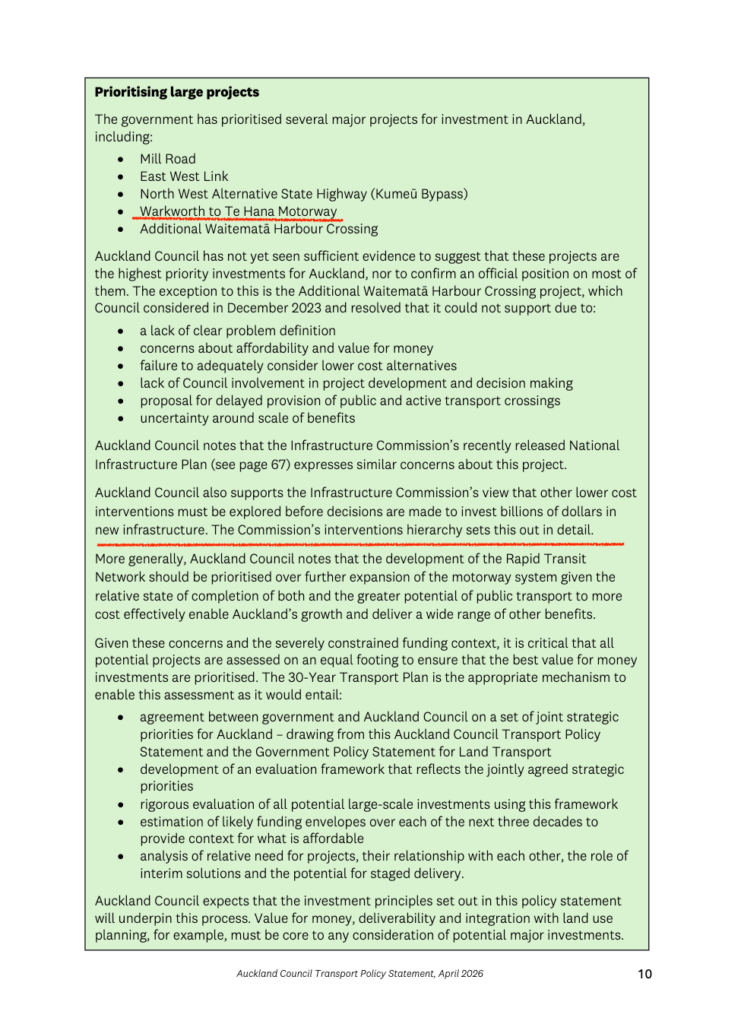
Notably, Auckland Council does not support WW2TH in its current form (nor the other regional RoNS), as noted on p10 of its Transport Policy Statement unanimously adopted on 28 April 2026 by Councillors from a very wide spectrum of political views:
Auckland Council has not yet seen sufficient evidence to suggest that these projects are the highest priority investments for Auckland, nor to confirm an official position on most of them.
If the largest council in the country cannot see sufficient justification for WW2TH and the other RoNS in its rohe, what does this say about the viability of these projects? And if the largest council in the country can develop a unanimously agreed Transport Policy Statement despite different political views, why can’t parties in Parliament do the same?
Now is the time to right-size the Roads of National Significance
“Roads of National Significance”, as both a slogan and a programme, emerged from the 2007 National Party election campaign. For almost two decades, the RoNS juggernaut has rolled across the planning and investment pipeline, putting increasingly unbearable pressure on affordability while the world around us has changed significantly.
The RoNS have struggled to meet basic investment principles, and have grown increasingly over-scoped over time. At the last election, National undercosted the RoNS – its key campaign plank – by around $20bn. The blowout is not just coming from construction costs and repayments: the Infrastructure Commission advises that if completed as scoped, the RoNS will double the cost of maintaining the entire State Highway network.
As you also know, the current Government’s Policy Statement on Land Transport (GPS) requires all RoNS to be built as brand new four-lane highways (and sans active modes) whether or not this makes practical, economic or local sense. To be frank, it doesn’t.
Moreover, state highway spending is a major factor in the unsustainability of the NLTF. And the focus on RoNS comes at the expense of transport networks that support the nation as a whole. By all reasonable measures, Cambridge to Piarere, announced last month, should be the last of the old-school, gold-plated, mandatory four-lane fully separated RoNS.
The National Infrastructure Plan provides a way through
Tabled in Parliament in February, the National Infrastructure Plan (NIP), produced by the independent Infrastructure Commission/ Te Waihanga, identifies the urgent need to re-prioritise infrastructure funding, particularly for roading mega-projects like the RoNS:
”New Zealand spends more on land transport than any other infrastructure class, yet current investment plans exceed what can be sustainably funded by users. Without stronger prioritisation, this risks displacing investment in other sectors and increasing pressure on general taxes. Reform is needed to better align transport investment with what users can fund, supported by clearer and more independent oversight to ensure spending is focused on maintaining existing networks and delivering new projects only where they respond to demand and provide clear value for money.”
In addition, the NIP identifies in its forward guidance that spending on road transport needs to be moderated and focus on renewals, and funding in land transport for new infrastructure should prioritise rail, public transport and active modes due to the need to decarbonise.
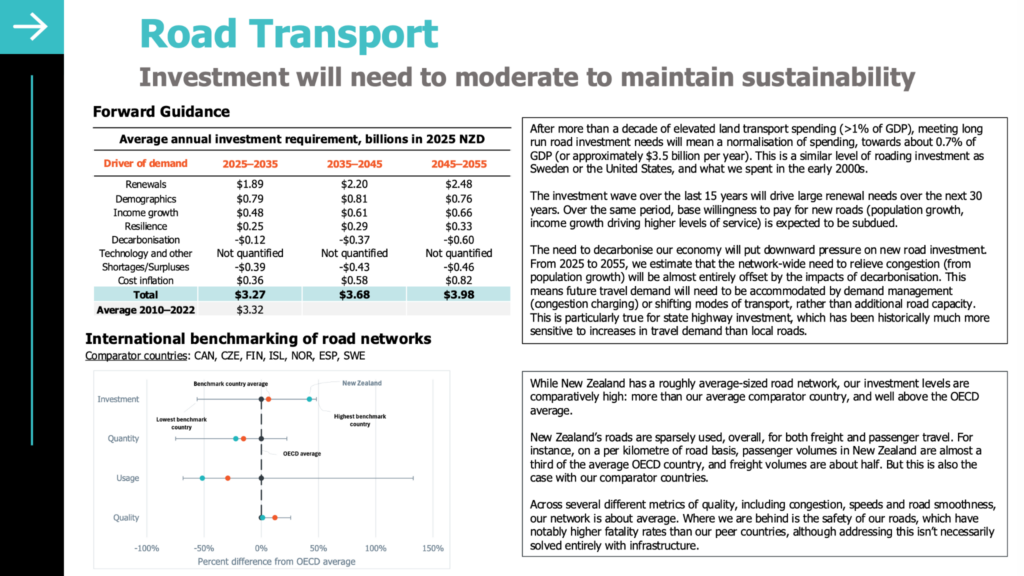
Following the NIP will free us from the trap of ploughing ahead with poorly-evidenced projects that would not only drain all available transport funds (plus Crown top-ups), but also come with onerous PPP repayment schemes that will balloon across a generation.
In other words, the National Infrastructure Plan offers all political parties a chance to break the impoverishing cycle of the RoNS and make the case for fairer, better-value transport investment. We are counting on you all to seize this opportunity.
There are practical, right-sized alternatives – and they’re better for all of us
We’re reaching out to all political parties because it is essential that major infrastructure decisions in New Zealand are made transparently, align with the evidence and with local need, and reflect the real and rapidly changing needs of our country.
At this point, the RoNS have become a “Think Big”-style political and economic albatross. Disentangling them from our transport planning and investment is the key to resilience, and will enable more judicious and more equitable investment across the motu, for all modes.
A far more prudent path to fixing the real issues (access, safety, and productivity) is a clear cross-party commitment to rescope and reprioritise the RoNS, starting with Warkworth to Te Hana – to focus instead on more realistic, affordable, evidence-based and deliverable solutions like 2+1-style upgrades, median barriers, bypasses and intersection improvements.
That will deliver much greater value-for-money, quicker and more right-sized fixes, and leeway for other infrastructure priorities in line with the National Infrastructure Plan’s advice.
We appeal to all political parties to lead the way on this, by agreeing not to rush into a PPP for Warkworth to Te Hana before the election. Instead, please commit to rescoping this project and sending it for review by the Infrastructure Commission – with a path for cross-party consultation and clear alignment with Auckland Council’s goals and priorities.
New Zealand deserves genuine cross-party planning for our collective future, starting now.
Please do not hesitate to contact us for further details – we’re always here for discussion of more rational and resilient approaches to transport.
We look forward to hearing from you.
Kind regards,
Greater Auckland
Political parties respond
Labour
Tangi Utikere, Labour’s spokesperson for Transport, sent us the following:
We have been consistent that the Roads of National Significance programme has grown well beyond what the country can sustainably fund, and we share real concerns about whether Warkworth to Te Hana, as currently scoped, represents value for money. A full four-lane expressway whose costs and benefits have never been transparently released, ending well short of Whangārei, is clearly problematic. Your central point, that there should be proper scrutiny of this project’s value for money before any contract is signed, is the right one.
Labour backs the National Infrastructure Plan and the new assurance reforms, and my colleague Kieran McAnulty’s foreword to the Government’s response to the Plan says so plainly. The whole stated purpose of the new Investment Decision Assurance function, which moves to the Infrastructure Commission from 1 November 2026, is, in the Minister’s own words, to let ministers make informed decisions and stop money going to projects that don’t stack up. We agree.
Which is exactly why the gap you have identified matters. On the Minister’s own account, two large and contested discretionary bets – the LNG terminal and the Roads of National Significance – are ones that will not actually go through that assurance process. Because the new process does not apply to NZTA’s NLTF-funded programme, the bulk of RoNS spending – including Warkworth to Te Hana – skips independent assurance entirely.
So Labour’s call is simple and consistent – this government must apply the test across the board. Major new RoNS, including Warkworth to Te Hana, should go through the Commission’s full Investment Decision Assurance, not avoid it through ‘strategic priority’ labelling under the GPS or because the Crown will not own the asset. If the government means what it says about informed decisions and value for money, it should meet those words with action and send these projects through the very process it has just built, before anything is locked in. We will be pressing exactly that case.
On PPPs and contracts our position is unchanged, and I want to be straight about it. We do not support PPPs across the board, but where they genuinely stack up in transport we have been open about that, and where contracts are in place, funding is committed and projects genuinely have spades in the ground, we will honour them. New Zealand cannot afford another round of stop-start, flip-flopping infrastructure. But honouring genuine commitments is different from endorsing how this project has been scoped, or the rush to sign it, which is precisely why the assurance has to happen now, not after contracts are signed.
Greens
Hon Julie Anne Genter, the Green’s spokesperson for Transport and Infrastructure, sent us the following:
The Green Party fully agrees that any major transport project, including Warkworth to Te Hana, should be subject to the new investor assurance process before proceeding.
As the Minister of Transport, Hon Chris Bishop, has himself said, the National Infrastructure Plan is a wakeup call for the country. Land transport spending has not been good value for money in recent decades and threatens to consume a very large share of public money in the future.
Now is an opportunity to pause, rather than rushing ahead and signing up to a long-term contract with private financiers for a project that will cost many times more than the Coalition parties knew when they signed the coalition agreement.
This should not be a political football. New Zealand’s road network is in need of investment in maintenance, renewals, and improvements to safety and capacity along many thousands of kilometres.
We also need investment in health infrastructure, water, flood protection, renewable electricity and climate adaptation. We need to ensure that we have sufficient public funding in future years to make these investments for the good of the whole country.
Many New Zealanders, especially those in the civil construction industry, have called for cross-party consensus and a long-term approach to infrastructure. This is an opportunity to show leadership and build cross-party support for an enduring, effective, and affordable solution to improve transport in Northland.
We hope that Minister Bishop and the Coalition Government will take the responsible route and look to rescope improvements to State Highway 1 from Warkworth to Te Hana (and, indeed, Whangarei), so that we can deliver greater benefits and more public infrastructure to Northland and the entire country.
We have yet to receive a reply from other parties, but will add them here if we do.
Greater Auckland’s work is made possible by generous donations from our readers and fans. Support our work by joining our circle of supporters here and setting up a reoccurring donation.

 Processing...
Thank you, Greater Auckland, for holding this project to account! This money can be spent in far better ways. I’m really hoping proper scrutiny is exercised before anything is signed. What can we do to also challenge this project as you have done?
Catastrophically stupid W2TH project and RONS in general. So bad it makes you think are they trying to funnel money to their mates?
No ferries…yes to LNG terminal and fossil fuel subsidies. Clowns is too charitable a description.
Motorways are wonderfull. Think of new tunnels and interchangers.
Bleh. Gross. Who wants ugly smelly tarmac tarnishing our native forests? Kills native birds, too.
The real need is a bypass of Wellsford ,which has been a choke point for 60 years of my life .Follow the rail line from the south entrance and rejoin the hiway mid way between Wellsford and Tehana .Build a new bridge at Tehana and a roundabout at the Mangawhai turn off .
And straighten the railway out while they are at it .
Agree, a bypass for Wellsford is the most critical part of this route, along with probably a resilient bypass of the Brynderwyn Hills.
jezza, I thought you said you’ve driven the road. Or do you only drive it during holidays?
I lived up in the far north for a little while and the drive (outside of Holliday periods) all the way to the Brynderwyns was lovely. The moment you hit the Brynderwyns it becomes a nightmare.
Wellsford is only an issue for holiday makers it’s DOME VALLEY that is hellish for regular users. How can you say a road with constant steep inclines for trucks doesn’t need a full bypass? The current route from Warkworth to just North of the Brynderwyns is simply not fit for purpose.
We have a tip opening soon which is going massively increase truck movements through the dome causing even more delays.
If orgs like GA didn’t butt in and convince Labour to scrap this road 8 years ago the problem would almost be gone and at a much lower cost.
Interegional connnectors are supposed to be 100kmh MINIMUM! The public was consulted on if they would like this and a majority said it should be 100kmh. The fact that we have 80/70/60/50 and NZTA even tried 40 at one point thank god that was stopped.
SH1 between Auckland and Whangarei is an interegional connector having towns and 80k speed limits on significant chunks of road means it is no longer fit for purpose.
Marsden Point rail connection will take trucks off the road. Running passenger trains to Northland would take cars off the road.
Asking people to decide if they want either a new motorway or nothing at all is dumb because those aren’t the only two options.
No craw rail connection will keep the truck numbers stable as we want to be growing northlands economy, hence the new road.
Running passenger trains to Northland would not take any cars off the road as no one would pay for the tickets even if it was 50% subsidised. Anyway we want to induce traffic to go north in the hopes it goes further north to stimulate the economy.
Craw where’s the other option huh? I am yet to see any other plan to fix the road with links to source.
We have a plan RIGHT NOW just waiting for funding.
Truck drivers are complaining about cost of diesel eating into their operating costs, if only there was a cheaper way to move freight that didn’t burn so much fuel.
I bet plenty of people would use a train service if one actually existed, but it doesn’t and the reason it doesn’t exist is because the government refuses to spend money on the railways.
Roads are heavily subsidised, I’m saying the government needs to subsidise the railways as well.
North Island electrification for $1.5 billion would give a lot more benefits than bypassing dome valley for $4 billion
@james, actually, lower speed limits are sensible and determined through science
30km/h in town centres and residential areas is correct because pedestrians are the main hazard cars need to give way to. A person hit by a car at 30km/h has a 90% chance of survival; at vehicular speeds higher than 30km/h the chance of death and the stopping distance increases sharply.
50km/h as the maximum urban road speed makes sense where the biggest risk is side on collisions. Past 50km/h the chance of injury or death in a side on collision increases exponentially.
70km/h is the ideal speed for rural highways with no central barrier, as past this speed head-on collisions become exponentially deadlier.
And cars become increasingly fuel inefficient past 80-100km/h, so even on high-grade motorway infrastructure there really is no advantage to speed limits over 100km/h. I know that’s triggering to speed freaks and idiocracy advocates such as yourself, but facts are facts, going faster only hurts you in the wallet at the petrol station.
It would be better value for money to psychologically evaluate why getting behind the wheel makes human beings into aggressive and individualistic monsters, perhaps to find treatments other than the obvious ‘wean the human race off our forced dependance on an environmentally destructive and socially isolating mode of transport’
Good work. GA
The deficiencies in the current road have been coming more and more apparent for decades now.
But these deficiencies are suddely not now so urgent that justifies such a hugely expensive decision being committed on, in the just the next four months.
There are undoubtedly better overall alternatives when evaluating against other uses for scarce public funds. Let there be wider, and wiser input.
Chris Bishop & Simeon Brown are spending our transports future funding for a 7-10 minute trip reduction to Te Hana and a $4.50 toll.
They are doing it with what looks like 7-10 minutes of scrutiny. Rushing the signatures before the election is telling.
NZ’s Auditor General (Grant Taylor) needs to have a very public word with the Attorney General (Chris Bishop) on the reckless spending decisions and rushed process of the Minister of Transport (Chris Bishop) and team road.
The AG’s role is to “provide independent oversight of public spending”. Their 2025 audit of NZTA explicitly excluded RoNs projects.
Is a 7-10 minute quicker trip to Te Hana really worth all those finance payments ?
If we are to compete on the world stage, we shouldn’t afterpay a new road.
We arnt afterpaying it, thats interest free and 4 equal payments. We are also avoiding putting on the mortgage because we dont want to discuss it with the bank and the other half becasue they both have previously said it sounds like a dumb idea. Instead we are rushing to make a deal with a shady payday lender at crazy interest rates who also have mates that will ‘give us a good deal’ that also binds the other half without thier knowledge or permission.
I’m very surprised this hasn’t been reported … well, I certainly haven’t seen any reporting on it.
Massive scandal really, that they’d attempt to sign up to such a terribly expensive project.
fully agree the mainstream media are hiding this. Articles like this (big thanks GA) could be summarised into mainstream media format – clear succint with headline facts exposed for attention and easy reading. E.g. “Government secretly aims to put $12B debt onto NZ for $4B asset that is not needed”…Please GA try writing for mainstream media as well as long read here for us transport die hards.
Should we just abandon a project every time it’s expensive? No CRL, No busways, No motorways just misery.
This is critical for Northland and there is real potential for industries to start but the state of SH1 is terrible and is no longer fit for purpose.
It’s a massive scandal this hasn’t been started sooner! This is needed badly. Dome Valley is horrific.
Absolutely James this motorway should be done ASAP.
Yes CRL, yes busways, yes light rail. No motorways.
More walking, more cycling, better health. More green space, better health.
More time for checking emails or walking while on bus or train. Free Wi-Fi should be made possible. Less stress. Less rush. More socialisation. More community.
Less misery 🙂
Motorways please!
Carl wants more air pollution, more deforestation, more landslides, more social disconnect, more dead animals, more expensive imported fruit and vegetables, more time spent stuck in traffic, more national debt.
Don’t be like Carl.
Motorway tunnels are good. Lets people get places faster.
Trains are better. 130–160km/h is possible on the gauge of track we have here – faster than any car will ever legally travel on the road.
An hour and a quarter or less from Auckland to Hamilton, with an onboard cafe car, comfortable seats, Wi-Fi, tables, the ability to walk around and not wear a seatbelt, and toilets – let’s do it! No need for nasty, ugly motorways.
Critical? The economic future of Northland is not trucking stuff to Auckland.
Last time I checked Sasha getting goods into port marsden and Auckland were very very important to the wider norths economy. It’s only NZs biggest market though I can see why you’d get confused.
Seriously this is just anti motorway sentiment don’t think that this article will somehow stop this from going ahead either. It’s going ahead so prepare yourself to be disappointed if you thought the voters were going to listen to common sense and reason.
The Golden Mile just got halted and will be rescoped, iReX was halted and rescoped, Ara Tūhono likely to be next on the chopping block
If any (serious) election candidate decides to campaign on axing this road it will weaken the contract. One big reason contractors don’t work with Kiwirail is because of big contracts getting scrapped in the past, which is bad for business. Be upfront and alert the preferred builder a rescope might happen before they invest too heavily.
Why don’t they just bank transfer half of the Land Transport Fund to Kiwirail (~$15b), could call it something like ‘Railways of National Significance’
NZTA need to come out of the metaphorical closet and address the white elephants in the room before the price tags get any bigger
NZTA doubled down on Warkworth to Te Hana in Parliaments Transport and Infrastructure Committee this morning sooooo
Is there a link to the committee live feed… how to get this info Connor?
Wonder what other Chris thinks about all the transport funding drama
The Beca/Systra 2021 North Island Electrification study says golden triangle electrification can be done for under $1 billion, imagine what they could do with $15 billion
https://ibb.co/6J7hfT5M
A lot of the time we vote against things rather than for them.
The way this Coalition is pushing through and locking in this Highway plan and the LNG Terminal after making all the soothing noises about long term consensus infrastructure planning. That will stop me voting for any of them, no matter what the rest of their policies say.
When I see an alternative that stops Northland from being LITERALLY cut off from the rest of the country for months when the Brnderwyns collapses I might agree. Moaning Aucklanders who just want all the money and who use fancy words like rescoping and reprioritising which means do nothing don’t resonate with me. Piss off Auckland. You got your rail, now is Northlands turn.
Well this does nothing for the Brnderwyns. Our preference is literally to invest in Northland (noting this road is actually still in the Auckland Region), but targeted, and all over. Fix those critical issues everywhere, rather than massively bypass just one point, and not even the most urgent one.
The comparison with the CRL would be more compelling in Northland ratepayers were paying for half of this proposed boondoggle, as AKL is with CRL. But obviously that is not going to happen. Instead the rest of the nation is, 1/3 of which is Auckland. We absolutely get to have views on this as we are paying for it.
Well it is the Holiday Highway so Auckland should pay!
Agree, it’s the users that should pay. Problem with that is the toll would send everyone through the Dome Valley anyway.
Patrick once again shows his lack of understanding of the route. This doesn’t massively bypass “one point” at the very least it bypasses Dome Valley, The outskirts of Wellsford which are notoriously dangerous (why else would there be a speed camera there) and the congestion through the Wellsford town centre and the delays through Te Hana town centre. That’s about 4 points minimum. I appreciate you want the money for cycleways but this is needed a lot more than that.
You can’t use the holiday highway nonsense with this one either, sure it helps reduce congestion on Holidays but this is about unlocking Northland as a region. I would argue the travel time benefits are actually understated here as there is developers asking for lower speed limits all throughout the corridor. Greater Auckland supports a 70kmh speed limit the whole way between Warkworth to Whangarei given that is what best practice recommends.
So let’s do some pretty simple maths we will assume the new road is a mix of 120/90 (90 for the tunnels) so let’s assume across the whole drive the average speed for a car/van is about 110. At 110kmh to cover 100 which is the distance is about 55 minutes rounded up. Now let’s do the same with the existing route with 70 speed limits between towns and 30 speed limits in towns given that’s what GA wants. Let’s make the average speed 60 it’ll take 1hr40. 40 minutes is a SIGNIFICANT difference I know what I would support.
45 minutes difference in travel time and probably 1 hour difference when it’s being used as a holiday highway.
James you are greatly overestimating average speeds. It’s more like a 20km/h difference between top speed and average speed for your gold-plated trumpian motorway delusions.
144km Auckland to Cambridge takes 1hr 35m, so the average speed for that is 90km/h despite the 110km/h max speed limit.
You are also greatly lowering the actual average speed for the current SH1 from Warkworth to Whangarei, to support your agenda of course.
100km/h Warkworth to Whangarei takes 1hr 20mins in good traffic, so the average speed for that is actually 75km/h. With an average speed of 90km/h on this hypothetical and unnecessary highway of yours, the journey time would be 1 hour and 7 minutes – 13 minutes saved, not your wildly exaggerated and thoroughly false ¾ of an hour.
No Burrower you are wrong. I said between Warkworth to Whangarei. Which won’t have the city congestion between Auckland to Hamilton. So you can set cruise to 124 (120 actual speed) and you will hit the travel time savings I’ve talked about. The current route you can’t really use cruise as it’s too dangerous and windy.
Burrower you stated in another comment earlier that “lower speed limits made sense” so I was comparing what Greater Auckland wants which is 30/70 speed limits compared to the 120/90 the whole way expressway.
If you claim to support safety based speed limits then yes the new motorway improves things over the existing route by quite a considerable margin.
Unless now you support 100kmh speeds to better suit your narrative which I would welcome as higher speeds are better as they save motorists and police time.
More speed matters to me, because I’ve seen the time savings!
lol you have so many reading comprehension issues James.
1. I did give speed and time equations for Warkworth–Whangarei
2. I do not support speed limits over 100kph for reasons of efficiency, for both ICE vehicles and BEVs, air resistance increases, more power is required and higher speeds just lead to less range.
The objectively correct mode of transport for speeds higher than that is rail. The 1067mm gauge we use can support train speeds of up to 130-160kph) if properly upgraded and maintained. Imagine what $22 billion could do to enhance rail, spread across the whole country! It’s just common sense, James.
Again Burrower you’ve tip toed around the point of my argument. You support best practice for speed limits do you not?
That is 30 in towns and 70 kmh in between towns. Where as the expressway I’m supporting is 120 outside of tunnels and 90 inside of tunnels. Not that hard to work out the travel time difference there.
Like it or not this will save fuel over the existing route even at the higher speed particularly for trucks. I know this doesn’t suit your narrative but you need to wake up and see the reality the old road is simply not fit for purpose anymore. Stop blaring on about passenger rail for the north it doesn’t even go to most places in the north meaning people wouldn’t use it and would be a waste of money. Roads for the North rail for the south.
“Like it or not this will save fuel over the existing route even at the higher speed particularly for trucks.”
There’s plenty of research and evidence showing that the most fuel-efficient speed is between 50 and 80 km/h.
Above this speed zone, vehicles use increasingly more fuel the faster they go.
A lot of this is due to physics, i.e. the aerodynamic effect.
And before you say “but in New Zealand”, read NZTA’s research report 582.
No Wilbert read what I wrote again. Do you seriously think the old route where you are constantly climbing up steep hills is going to use less fuel than a flat expressway even if you’re travelling slightly faster you’re not having to acellerate and decelerate constantly saving fuel. It’s a bit like the fact it takes less fuel to use the exisiting toll road over the free route now even though you’re travelling significantly faster.
On the contrary. Maintaining a lower speed means you don’t have to accelerate and decelerate as much.
Feel free to spend more on fuel though; it’s your wallet, not mine.
Once again Wilbert you show your lack of empathy and understanding for the North. The iwi up there is begging for this, the young people need jobs and a good connection to Auckland will create those jobs. More tourism, more manufacturing, more exports.
You’ve once again delicately ignored that you can’t keep a consistently low speed unless you make the speed limit 50 the whole way. I’m quite happy to burn a few extra litres of fuel anyway to save 45 minutes. Anyway by the time this thing is actually open and built half of us will be driving EVs anyway so just use a few more KWH. Most people know that 110 uses more fuel as all you have to do is drive once on the Waikato expressway to realise you’ll use slightly more fuel.
Anyway thanks Wilbert i will happily spend a bit more on fuel anyway more revenue for the government which they desperately need.
Wait why are we even having this argument lol, no one is saying you have to drive at 120 you can do 80 in the left lane while the rest of us pass on the right no issues really, I’m assuming Burrower was whinging about emissions or something?
The true irony is if the government scraped the ETS component off fuel and just kept it but going towards the NLTF we could have this road AND more rail.
Two statements from you:
“Like it or not this will save fuel over the existing route even at the higher speed particularly for trucks.”
“Most people know that 110 uses more fuel as all you have to do is drive once on the Waikato expressway to realise you’ll use slightly more fuel.”
So which one is it?
PS Attacking me personally, e.g. lack of empathy, does not work with me.
Once again Wilbert selective reading from you. I was comparing Waikato expressway at 100 to 110. With the northern corridor I’m comparing the existing goat track to a modern expressway. It’s obvious you’ll use less fuel on the expressway.
There was no personal attacks in that comment stop creating drama.
We are literally saying do not blow the entire discretionary transport budget on a road that is entirely in the Auckland Region and instead invest in the entire SH1 corridor including the Brynderwyns!
Or Connor scrap the ETS and we can pay for all that you’re talking about and this great road!
This road is entirely in Auckland, it does nothing to solve the issues with the Brynderwyns or through the Mangamukas.
Have you even read the article!?
If anything, it would guarantee that there will never be any money to fix the Brynderwyns. What Northland really needs is a road that is resilient against weather events, is safe to drive on and can carry the rather small amount of traffic that can be expected in the future and to get those affordable upgrades as soon as possible. Carving a brand new super-highway through forested hills to Te Hana doesn’t look like useful steps towards those goals.
NIP this one in the bud.
As others have said, the part of SH1 north that needs most attention is the Brynderwyns, not the Dome Valley.
There are two alternative routes when that is closed, however. No need to exaggerate the case.
Absoluely, lets build the motorway. Maybe reduce the cost somehow?
Yes, and the most obvious option to reduce the cost is to get rid of interchanges, reduce the number of lanes to something that matches the traffic volume and not build it for 120kmh speed limits.
That’s not how it works.
Auckland? or another city Tamaki something?
It’s actually up to 5 lanes wide. 3 lanes in the north-bound tunnel.
Bishop claims the project still has a BCR above 1, but won’t release the figures cos commercial negotiations.
Paywalled story, including some quotes from Connor:
https://businessdesk.co.nz/article/infrastructure/budget-gives-glimpse-of-crown-loan-for-warkworth-to-te-hana
Only reason it’s above 1 is due to the way they measure BCRs changing, and it won’t be that much higher otherwise they absolutely would release it.
You also have to compare that BCR with other options under the same way of measuring which… defs hasn’t happened.
I wonder what other big spends they will try to jam through before 1 Nov?
I’m kind of disappointed that Labour is committing to actually completing any contracted projects. The iREX precedent gives the party the perfect cover to cancel any PPP and re-scope the project regardless of sunk cost.
The current government has boxed them in by claiming constantly that Labour ‘left them with a mess’ economically.
Labour’s deliberate ‘small target’ approach this term has left the lie unchallenged. If they lose the election then we’ve all paid a high price for that decision.
Hopefully Labour loses the election. They borrowed $66 Billion during Covid. Makes the Warkworth to Whangarei Motorway look cheap!
Imagine how much this government would have exceeded that. They are addicted to borrowing and dont even have a pandemic to deal with.
Lol, seams like typical nz mind set in the comments and the article. Dont build 4 lines we only need 3. Then in 15 years spend double to add an extra line. Warkworth and wellsford and growing rapidly! Nz infrastructure must be ready for the future not today.
Car infrastructure isn’t the future, it’s wasting money on the past.
This is real advocacy – issue and policy first (not party) – and exactly what you exist for, bravo and am thankful I contributed to the mission.
I hope some of the others who were hesitant because of small things (no-one is ever 100% aligned with anyone else on everything) – will also now support.
I think it would be a smart choice for a new government to proceed only with that section of the project between Wayby Valley Road and Mangawhai Road, along the designated alignement but only built a two-lane road. This would provide for a bypass of Wellsford (which I expect is the majority of the benefits of this length of the project) while future proofing for the full RoNS if/when there is the demand and funds for it. I expect that BCR would be much higher. It would provide an improvement without breaking the bank completely.
bingo, theres a whole number of things like this you could do along the entire SH1 from Warkworth to Whangārei for an absolute fraction of the cost while giving you like 80% of the benefits.
Sick and tired of this anti motorway attitude. The Dome Valley, Wellsford and Te Hana need bypasssing. The Dome is an 80 km zone and is very dangerous. Auckland gets the CRL and Waikato gets another motorway extension so the North gets one!
Except the North doesn’t get one as all three areas mentioned by you are in the Auckland region.
Ok point taken. But its still north of Auckland!
Yes, and Bluff is south of Auckland so what’s your point?
Also, having travelled through Dome Valley numerous times, it’s no more dangerous than any other road in NZ. You just have to adapt to the circumstances, something you – hopefully – learned when you were getting your driver license.
A vote for more motorways is a vote for higher rates to maintain roads the motorways replace.
There hasn’t been a death on the dome valley section since they finished the median barriers right? from an average of one or two a year.
Don’t think so, although I think there may have been one on the Warkworth side by the Sheep World intersection
Broke down other data here
https://www.greaterauckland.org.nz/2026/05/12/the-road-toll-of-the-rons/
Well said Carl, 80kmh is not an inter-regional connector as defined by the public voting on this that they must be 100kmh. This proves the road through the Dome is now obsolete.
Also @Wilbert while it’s less of an issue now the camber in Dome Valley while slightly better now is still off in many places. It’s definitely more dangerous than other roads in NZ, I agree the median barriers have helped although it screws emergency services if they need to respond to a crash or medical event as the lane isn’t wide enough in places. Oh and the cops can’t pull u turns right in front of you anymore although I suppose that’s a safety benefit. Cops in Auckland will do anything stupid just to issue a ticket lol. (I’ve never received one myself but in my drives north they seem to love the 80k areas and the long straight between Waipu and Whangarei).
That’s not how it works.
A vastly more economical way to improve the resilience of the Northland roading network would be to upgrade Wellsford-Mangawhai-Waipu to State Highway standard safety improvements, passing lanes etc, and upgrade SH 16 Auckland-Wellsford – safety improvements, passing lanes etc.
I wonder how many of you that are negative about this project, have ever travelled on the road from Auckland -North. Or have lost loved ones on it. I have. It is a dangerous road.
It is very backward thinking to not go ahead with it. It should have been built 40 to 50 years ago. The 13 billion that went missing during covid would have easily paid for it.
There are no ifs or buts. I needs to be built.
Yep, lets build it! A brand new four lane motorway!
Carl Motorway
Money pit. Disasterous.
You’d do better and a lot cheaper to put median barriers on the current highway, some small bypasses where needed and more passing lanes, get freight off trucks and onto trains, and a running programme of safety on roads other than SH1. Remember those bridges that still haven’t been fixed?
Unfortunately speed addicted individualist freaks can’t see the woods for the trees, they want them all cut down so they can satisfy their toxic base animal instinct to go fast.
Speed Thrills!
Yes! 160km/h trains! Good to have you on the correct side at last, Carl
There are ways to improve safety on a highway that aren’t spending billions to build a brand new unnecessary 4-lane motorway.
Signed, someone who has driven that stretch of highway many times.
But we want the motorway!
I don’t
Ive really had enough of people opposing the Warkworth to Te Hana Motorway. As James says its the only option and it just needs funding. Its not the Holiday Highway its an Economic Highway. Lets build it.
more like the Economy Crashing highway! pile on the $22 billion in debt!
It is a waste of money and does not even address the most critical parts of the route.
We really want the motorway built ASAP.
I don’t.