With a long weekend to celebrate Matariki, we’ve pulled together another bumper weekly roundup for you to enjoy.
This Week in Greater Auckland
- On Monday Patrick took a look at Te Ara Tupua in Wellington and what we can learn from it.
- On Tuesday we published an open letter to Chis Bishop about the Warkworth to Te Hana project.
- And on Thursday, Connor took a look at why the Roads of National Significance are becoming even more unthinkable (on top of being unfundable).
Today’s header image, by Patrick, is from last night’s Matariki celebrations on Karangahape Road. How good was that!
Greater Auckland’s research and advocacy is powered by hundreds of hours of work each month, and your support helps keep us going! We warmly welcome your donations, and are always open to offers of guest posts, practical help, and pro-bono expertise.
PS Another great way to back the kaupapa: Greater Auckland tees, totes, and caps! Remember, these are print-on-demand (no returns possible), so be sure to double-check sizing before ordering.
Greater Auckland in the news
It’s been a very busy few weeks. Connor popped up on the 6pm 1News last Thursday, talking about Warkworth to Te Hana and the Roads of National Significance (RoNS). Check out the clip:
Tom Hunt from The Post also spoke with Connor about the RoNS prioritisation and the Wellington Tunnel:
Connor Sharp, campaign director for advocacy group Greater Auckland, obtained the OIA and said it showed Wellington’s low benefit-cost ratio meant the project was unlikely to ever be built.
“If you had $3.7b there are much better things to do with that money. You could fix the entire train network, plus roll out the cycleway network, plus fix buses plus fix local roads,” he said.
A separate OIA release shows that, in a draft July 2025 ministry document, it was noted that even with increases to fuel excise duty and road user charges there was only RoNS funding to deliver phase 1 of the Northland Expressway – the Warkworth to Te Hana road.
And speaking of the RoNS…
A real RoNS rethink! (And/or rearranging a few deck chairs?)
In breaking news yesterday, the Government hailed the publication by NZTA of something they’re calling the Major Transport Projects Pipeline (MTPP), with Minister Chris Bishop saying it “provides certainty”.
Here’s NZTA’s overview of the MTPP, and a handy-dandy PDF outlining what’s on the horizon. (You can click to embiggen the two images below, and we’ve also saved the PDF here for reference: major-transport-projects-pipeline-infographic)
Note that it doesn’t show funding, which remains a mammoth unanswered question, just sequencing. Basically, the projects with a purple bar are the ones where something is actually happening.
Mainstream media is largely reporting this as a bit of a backdown on the RoNS, which it is:
- Henry Cooke, The Post: RoNS backdown: Chris Bishop cleaning up Simeon Brown’s mess
- James Ball, 1News: Govt pulls flagship roading projects into the slow lane
- Jamie Ensor, NZ Herald: Road projects across New Zealand: what’s happening with RoNS near you
- Thomas Manch, Business Desk: Major roading projects pushed out in new Government pipeline
…which – not to be the “told you so” guys, but guys: we’ve been telling you so, since ages ago!
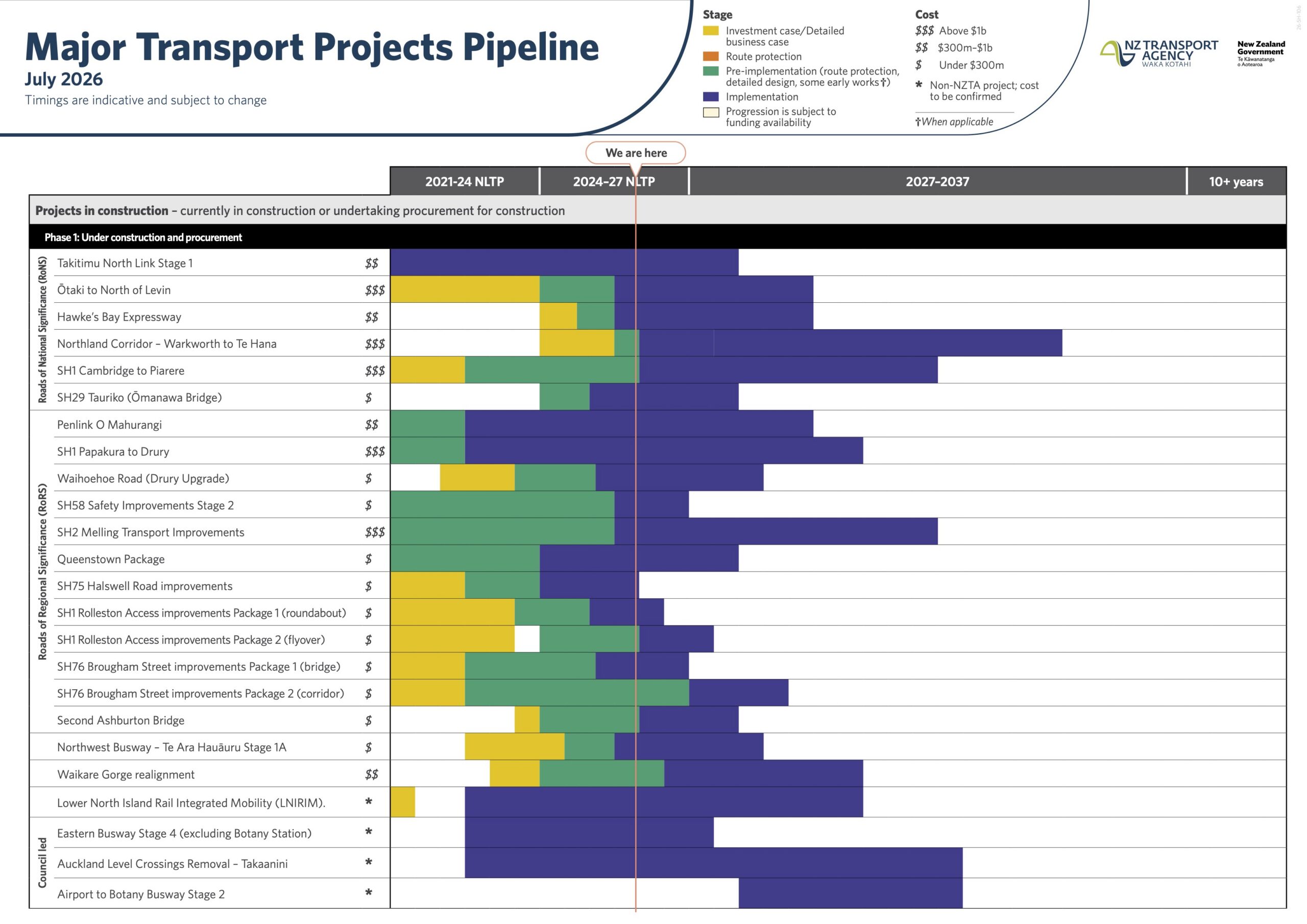
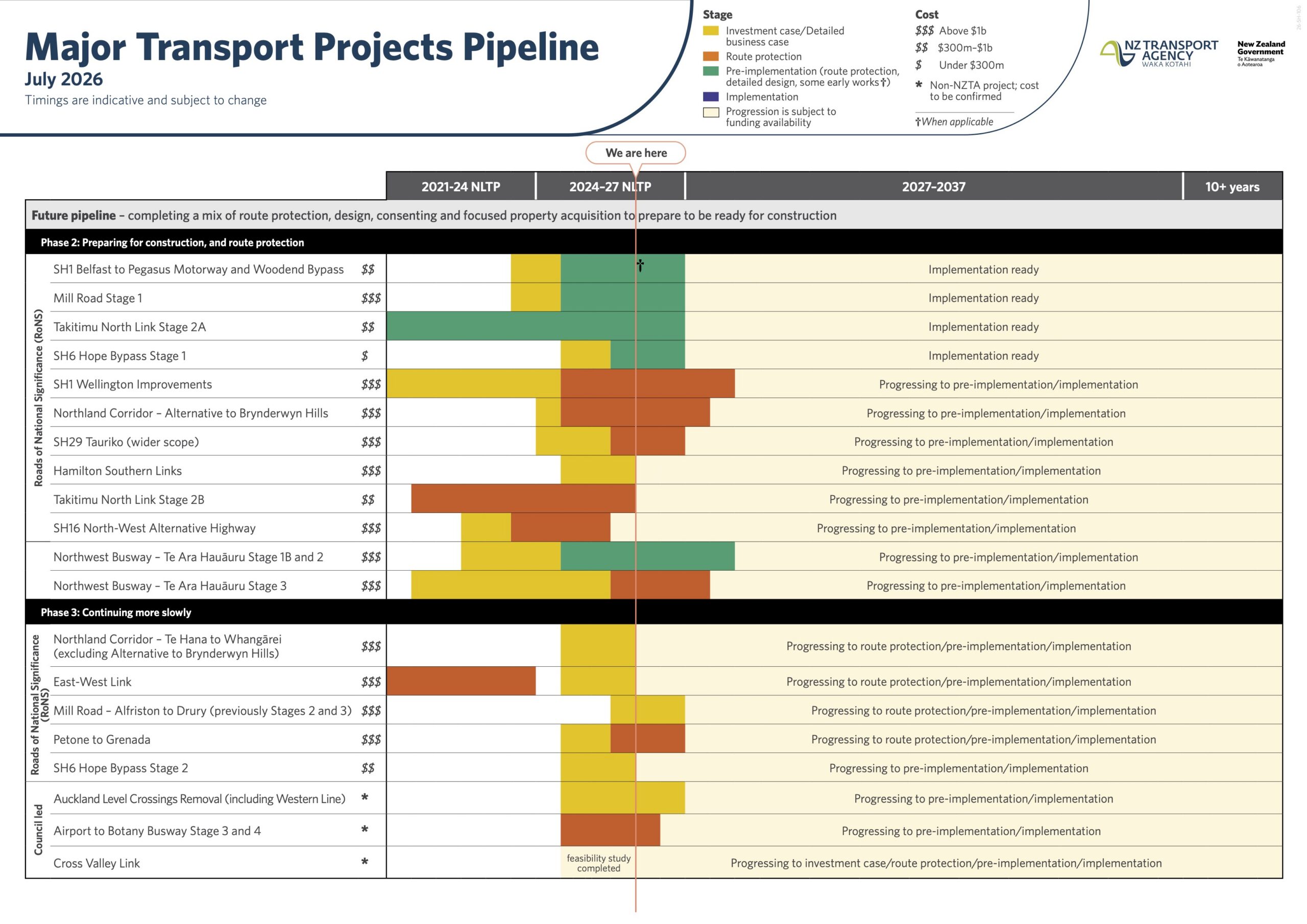 A few things of note, in terms of what we’ve been keeping our eye on:
Under “Phase 1: Construction and Procurement”:
- It’s concerning that the Warkworth to Te Hana project is still showing as imminently happening. This remains a huge worry. Not just the enormous cost and relatively low BCR, but the fact it will soak up all available funding headroom for new projects.
- On the other hand, good to see things like Airport to Botany Busway (Stage 2), and level crossing removal out south.
Under “Phase 2: Preparing for construction, and route protection”:
- Alternative to Brynderwyn Hills. This is the most critical part of the route, but is getting nothing more than an investment case and “route protection”, i.e. buying up houses and land.
- Northwest Busway: Stage 1B, 2 are getting some early works, while Stage 3 only gets route protection.
Under “Phase 3: continuing more slowly” (which, is that another way of saying “the never-never”?):
- Te Hana to Whangārei, i.e. the bit of the Northland Expressway that’s actually in Northland. Nothing is planned beyond some current business-casing. Which raises the question: why rush into starting Warkworth to Te Hana??
- East-West Link, aka the world’s most expensive road per km: this also grinds to a halt, effectively cancelled?
- Mill Road: ditto, just some more business-case work, nothing tangible happening.
- Auckland level crossing removal, including the Western Line – why is nothing confirmed beyond the business case? We’d love to see this one moved into Phase 1, to help maximise the value of CRL.
- Airport to Botany Busway, stages 3 and 4: just route protection, but another good candidate for faster delivery.
And here’s the government’s media release in full. It seems that the Minister is finally reading the (elephant in the) room, as well as the increasingly alarming weather reports:
“Phasing the RoNS programme means we can keep investing across the wider transport network, including in projects that improve reliability, strengthen resilience, and meet local and regional transport needs.
“Major new corridors are important, but New Zealanders also need a safe, reliable and resilient transport system every day. [emphasis added by us]
“That is why the RoNS programme sits alongside significant investment in maintaining and renewing existing infrastructure, strengthening resilience to natural hazards and extreme weather, improving safety, and keeping communities connected.
“Fuel excise duty has fallen in real terms by 21 per cent since 2020 when it was last increased, while construction costs have risen significantly over the same period, with the recent conflict in the Middle East contributing to that challenge.
“This pipeline demonstrates that we have struck the right balance with our ambitious and responsible transport programme, which is part of our Government’s wider plan to build New Zealand’s future.”
They made the CRL happen
The rail network is closed today and the rest of this weekend for City Rail Link testing and further network upgrades.
While we wait for news of when the project will finally open, enjoy this video of former Prime Minister Sir John Key and former Mayor Len Brown (aka the top ten politicians who made CRL happen), after being given a tour of Te Waihorotiu by Auckland Transport. It’s great to celebrate courageous decision-making and cross-party cooperation for teh public good.
Speaking of opening day, The Spinoff’s Toby Manhire has taken a stab at working out exactly when CRL might open:
…so that leaves three Sundays.
- September 6
- September 13
- September 20
And, look, any would probably do it. I attempted to swindle Wayne Brown by asking him what he thought of those dates, but his response was uncharacteristically gnomic. “Could be,” said the mayor. “I’m keeping fit so I live long enough.”
Assuming no gremlins lurch out of the dress rehearsal weekend, it just makes sense to do it as soon as safely practicable. People have waited a hell of a long time; if it’s ready, open it, and get any exuberance and/or teething issues out of the way before everything gets sucked into the election vortex.
This date falls eight weeks after Matariki weekend, which leaves a good window for that six- to eight-week advance notice, and what better activity for a Father’s Day than pootling about on a brand new trainset?
Accordingly, may it please the court, my $20 is on the CRL opening on:
- September 6
Plausible. But then! Yesterday afternoon, Business Desk said “multiple sources” (unnamed) reckon 30 August.
Either way, now’s a great time to order your very own CRL-themed T-shirts, given there’s a one-week turnaround for delivery. (Note: these are print-on-demand, no backsies, so be sure to double-check your sizing before order!)
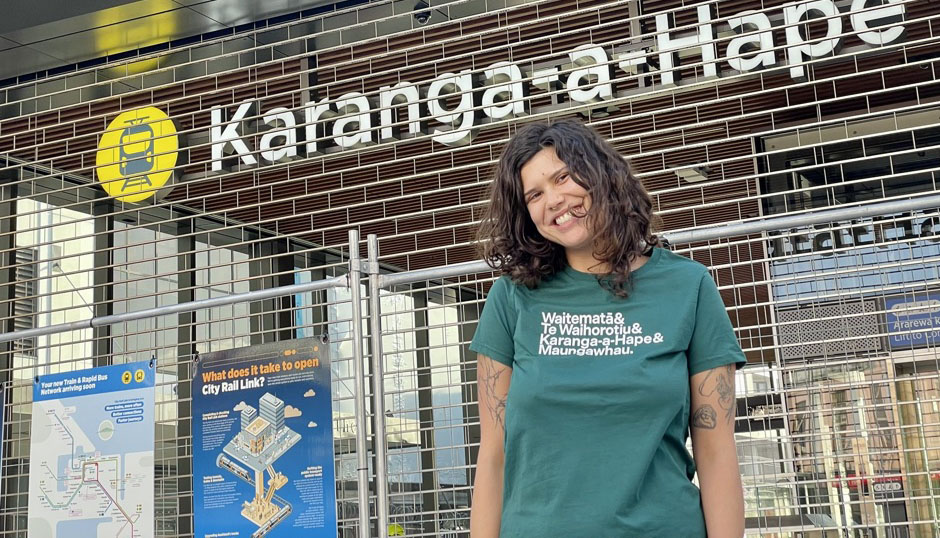
Get your “list of four” CRL station T-shirt here!
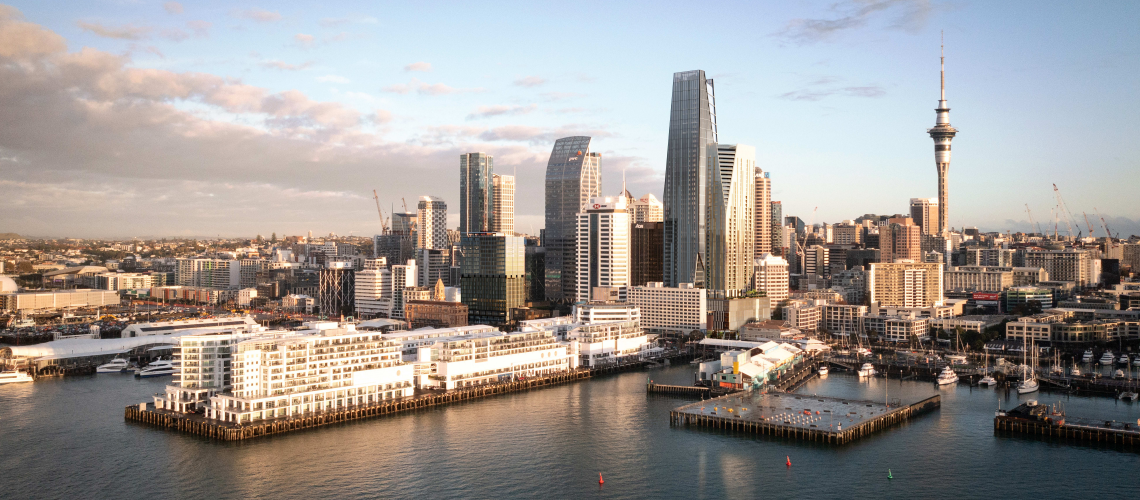
Pūmanawa Downtown West given draft approval
After it emerged last week that Auckland Council’s planning department seems to be living in their own world, thoroughly detached from Council’s strategic direction, some good news – the development of the downtown carpark site has been given draft approval.
A comprehensive redevelopment of the Downtown Carpark site in central Auckland has been granted draft fast-track approval, clearing a major hurdle for the multi-billion-dollar project.
The decision by the three-member Expert Consenting Panel formally approves the application by Precinct Properties NZ Ltd and its iwi partner, Ngāti Whātua Ōrākei, to demolish the existing seven-storey, 2000-car park building and replace it with a mixed-use development.
…..
Disputes resolved by panel
The fast-track approval follows extensive deliberations regarding distinct conditioning outcomes that were in dispute between Precinct Properties, Auckland Council, and Auckland Transport.
Auckland Council’s regulatory team had raised concerns over the physical scale of the towers, but the panel endorsed the applicant’s design and urban evidence, finding the slender, chamfered forms of the towers and their specific orientation avoided a closed “wall effect” while contributing a high-quality landmark to the Auckland skyline.
The panel noted that the physical adverse impacts were acceptable and did not meet the high threshold required to decline a project of significant regional benefit under fast-track legislation.
Auckland Transport’s concerns regarding the design and operational safety of the hotel’s pick-up and drop-off area were similarly resolved through enforceable conditions, structural protocols, and targeted management plans.
Choose your fighter: Auckland Transport to display travel times by bike
RNZ reports that Auckland Transport are looking to show real-time cycling and public transport journey times on some of the electronic displays around Auckland later this year:
Cycling advocates are welcoming a new initiative they hope will get more Aucklanders thinking about how they travel. By October this year, Auckland Transport will be trialling smart roadside signs that display live travel times by car, public transport and bike, giving commuters a way to compare their travel options. Bike Auckland chair Karen Hormann spoke to Ingrid Hipkiss.
This is something we’ve long suggested would be a smart idea for both AT and NZTA to highlight the value of investment in the growing cycle network – including along SH16, which is also home to the city’s busiest bike commute route.
These are the first five locations planned:
- Constellation Drive, Northshore (Outside Gilmours heading west towards SH1)
- Te Atatu Road, Te Atatū Peninsula (Near Harbourview Orangihina Park heading south towards SH16)
- Pakuranga Road, Pakuranga (Between Lewis Road and Greenhill Crescent heading west towards Ra Hihi Flyover)
- Ti Rakau Drive, Pakuranga (between Mattson Road and Roseburn Place heading west)
- Apirana Ave, Glen Innes (Before the Merton Road roundabout approaching from the south)
AT did a version of this on Triangle Rd in the middle of last year; the new signs will be similar but more appealingly designed and branded.
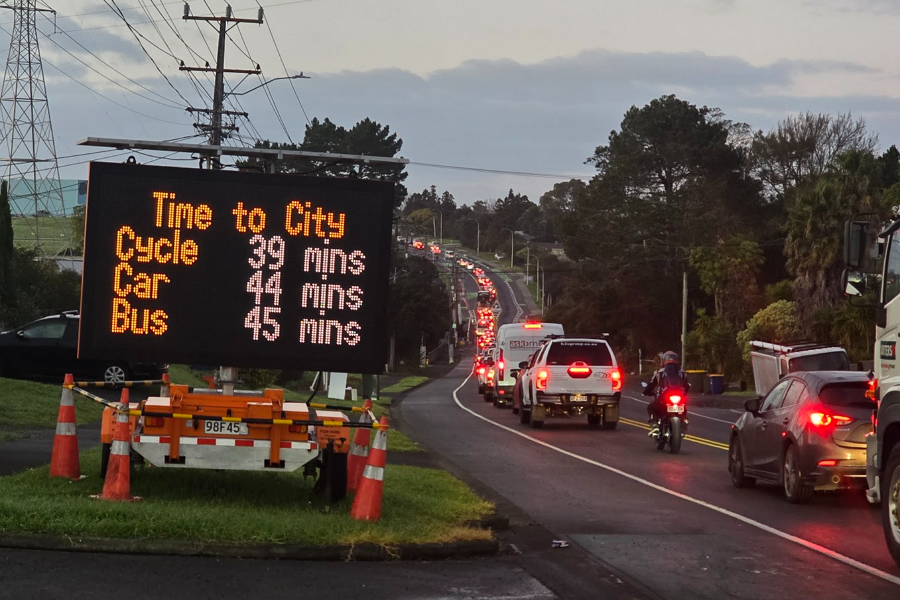
Reliable journeys made visible: an electronic billboard on Triangle Road showing travel time into the city by bike (39 minutes), car (44 minutes) and bus (45 minutes, roll on the NW busway!), alongside a stream of vehicles with their brake lights showing. Photo taken by Matt on a bike.
How to get to the World Cup stadiums
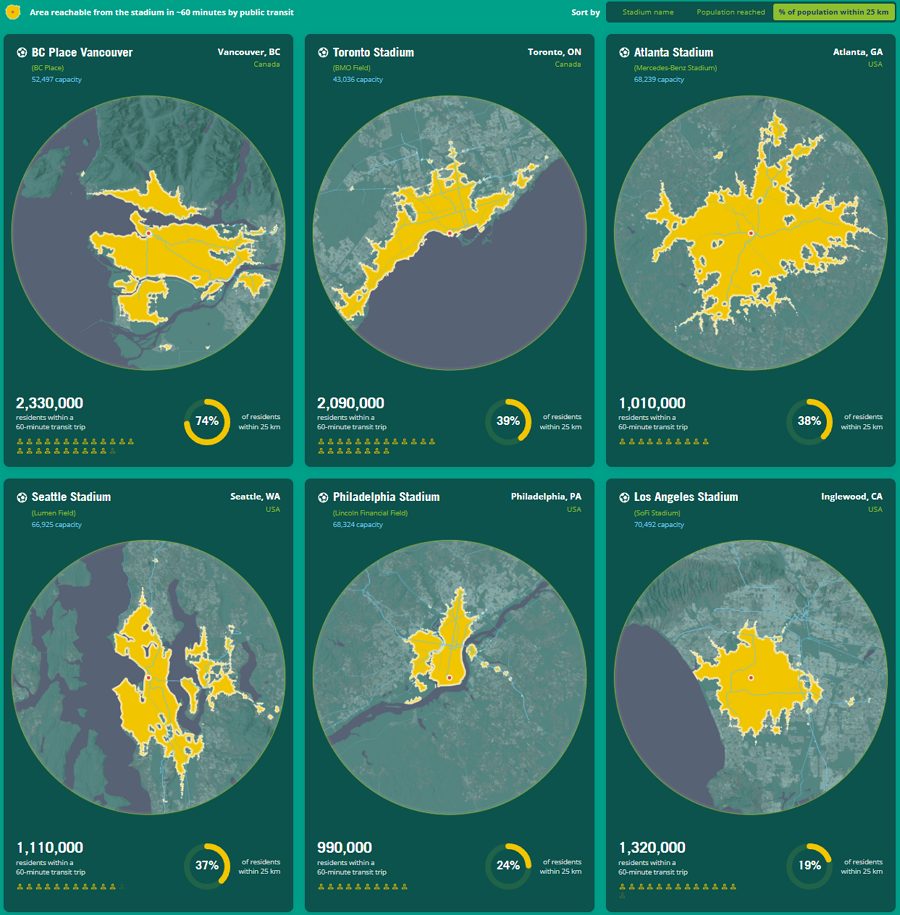
The football World Cup is quickly getting to the pointy end. The University of Toronto has taken a look at how easily it is to reach the stadiums within 60 minutes by public transport.
How well are FIFA World Cup 2026 stadiums connected to their host cities by public transit?
We mapped how far you can travel in 60 minutes by public transit around every stadium. Then we estimated how much of each metro’s population lives within this area. The maps and data show that cities vary widely in how connected their stadiums are to the rest of the city via public transit.
Reducing speeds for safety as well as fuel savings
As we reported in last week’s roundup, while the government dismissed calls to reduce speeds to save fuel, it turns out they do have that in their plans, for if we ever reached the highest level of restrictions. Good to know, as the much-touted ceasefire seems to have been broken, again, and who knows if or when the fuel crisis will in fact end.
Today, The Post reported that the Energy Efficiency Conservation Authority (EECA) wrapped up its “Stretch Every Tank” campaign in late May, saying the “$3.8 million campaign to educate Kiwis on fuel use is estimated to have delivered more than $21m in savings.”
Questions: if it’s working that well, why not keep it rolling? Or, were people largely making their own decisions – as with the boom in cycle numbers despite the bare-bones bike network? And are we being invited to read between the lines here…
EECA also confirmed to The Post it was its decision to end the campaign on May 26.
In response to the authority’s statement, Energy Minister Simeon Brown said “when businesses and households are being very careful with their spending, government departments and agencies need to be doing the same”.
“I acknowledge the importance of people receiving good advice about how to conserve fuel to lower their bills and expect EECA to deliver its campaigns as effectively as possible.”
Brown said there was always an appropriate balance to be found. “I am sure EECA understands that.”
Meanwhile, RNZ reports on a victory for residents of a retirement village who campaigned for safer speeds, after the speed limit at their gate was forcibly raised by order of Simeon Brown and his ideological Speed Rule:
Residents of a lower North Island retirement village lost their first battle to stop the speed limit on the highway outside their gate returning to 100km/h.
But Speldhurst Country Estate near Levin has now won the war, as transport officials on Monday confirmed a drop back to 80km/h.
It follows another round of consultation, where village residents made sure their voices were heard.
[…]
“When NZTA came to us earlier this year and said they were reviewing those speed limits and invited submissions we rounded up the residents of the village and everybody put submissions in and signed a petition,” Parton said.“We’re delighted to see it go back to what it was. The only thing that concerns me is the amount of time and energy that it has taken to get back to where we were when we started.”
And NZTA Waka Kotahi has been quietly consulting on a number of speed reductions around the motu, in response to community concerns and local issues. They’re reporting new (safer) speed limits are on the way for Waikato and Bay of Plenty, and currently consulting on two other areas.
- Have your say on proposed speed changes on Hawkes Bay state highways (open till 19 August 2026)
- Have your say on proposed speed changes for Manawatu/Whanganui state highways (open till 19 August 2026)
While of course safety shouldn’t be put to the vote, it seems the consultations may still be a bit of a numbers game. So now’s a good time to make sure your voices are heard.
All feedback will be considered alongside technical assessments, safety data, and cost-benefit analysis before a final decision is made.
Auckland company wins big electric ferry contract in Australia, while Auckland Transport triples down on diesel ferries – make it make sense
The NZ Herald’s Chris Keall reports as Auckland Transport continues to buy diesel ferries:
Auckland Transport’s retreat from electric ferries continues with news that five 24m diesel ferries are on the way for the city’s western routes.
The move means the Auckland Council-controlled organisation now has at least eight diesel vessels on the way.
Yet another casualty of the government’s 2024 GPS, which effectively issued a fatwa on electrifying the ferry fleet:
AT earlier said its long-term plan remains to electrify the city’s fleet of 30 ferries, but that central Government funding that had subsidised its first four electric vessels had dried up.
Meanwhile, an Auckland-based firm is proudly equipping a city with electric ferries… over the ditch:
EV Maritime is proud to announce its appointment by leading Australian shipbuilder Echo Marine Group as electric propulsion systems integrator for five new battery-electric fast ferries being built for the Public Transport Authority of Western Australia (PTA).
The five 24-metre high-speed vessels form part of the METRONET on Swan Ferry Service Expansion, the largest-ever expansion of Perth’s ferry network. Echo Marine Group was awarded the A$66 million contract to design and construct the fleet.
The firm’s role in the Perth project builds on the success of their first two “EVM200” 24-metre electric passenger ferries, which were built for Auckland Transport. EV Maritime was responsible for all aspects of design, engineering and system integration for these 200-passenger carbon fibre vessels, which each carry up to 200 passengers and are amongst the fastest fully-electric ferries in the world.
Makes you wonder why AT didn’t seek more funding from Council to keep going with electric ferries…??
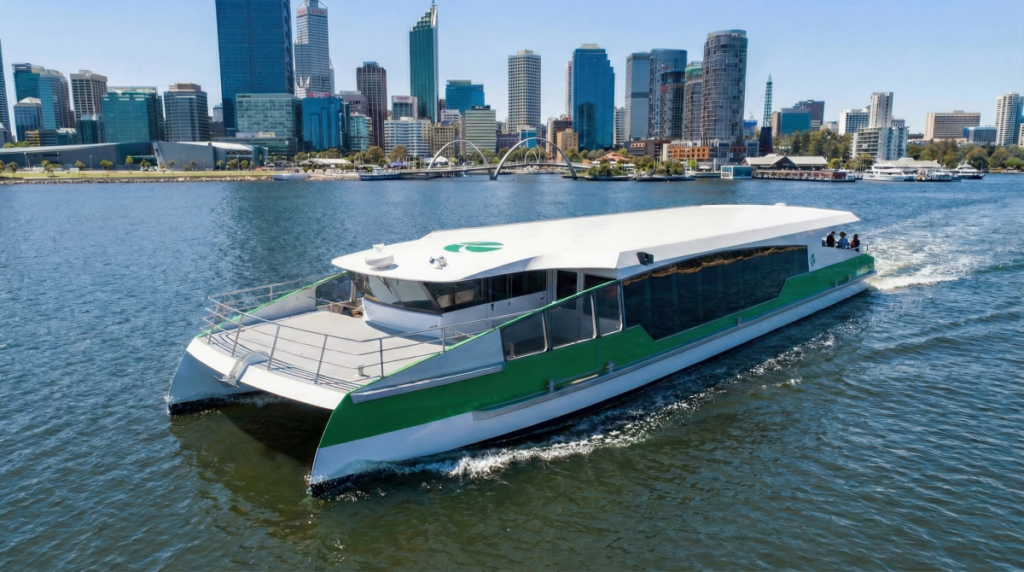
24m Electric Fast Ferry for Public Transport Authority of Western Australia. Source: One2three Naval Architects & Echo Marine Group
Videos to watch
What morning peak might look like at Karanga-a-Hape Station:
Auckland seen through outside eyes:
Mexico City’s contraflow bus lanes:
That’s us for the week – Mānawatia a Matariki, and have a lovely long weekend!

 Processing...
It’s very thought-provoking to listen to the first five minutes of Sir John Key and Len Brown and imagine a former Prime Minister and Mayor (of Auckland? Northland?) talking about a just-about-to-open Warkworth to Te Hana expressway. Can you imagine them saying the same things as about the CRL?
Talking about the elephant that is still in the room, this latest announcement still ties you, your children and their children to be paying to feed the creature with very little opportunity to ride on it.
Some of the Stage 2 and 3 projects are there because they are just not as advanced yet. any benefits that they could offer are pushed out of reach by the one which so far is about to fund the expedition of geotech engineers Dr Livingstone and H.M. Stanley setting of to meet somewhere in the forest west of Dome Valley.
Route protection isn’t about buying the land for a project, just stopping people from making it harder to buy and build in the future.
Making a safe, resilient 80 km/h highway from Warkworth to Whangārei instead of the solid gold dream (a little bit of gold leaf might be nice, you know, but really…) would leave something in the NIP for some real benefits elsewhere. For example, the really useful bits of EWL linking to the motorways could save ten times the journey savings for freight as that vanity project.
Flip-flop on Mill Road is making any development planning for south Auckland impossible. Such a lot of the SGA route protection to support development is left with empty purses while Fast-Track housing can go up in any random paddock.
There still seems to be a big step to make to shape the NIP as the common Plan to stick to.
The other elephant in the room is when does Christchurch get passenger trains