Our open letter to Chris Bishop, imploring him to bring some sense to the overblown Roads of National Significance juggernaut, has sparked a lot of discussion and some very good questions about the way ahead.
Once upon a time, the RoNS were a shiny election bauble, a vision of brand-new highways sweeping across the country.
More roads! More lanes! More to build (and also more to maintain), somehow turbo-charging the economy by virtue of existing. It didn’t seem to matter that they were almost all in the North Island, nor that they couldn’t feasibly be built or funded any time soon: once set in motion as an idea, they became the pipeline for the machine. The tail wagging the dog.
But in the cold light of today, with fossil-fuel driven climate change now turbo-charging extreme weather events (as we’re seeing this week across the South Island), the RoNS are looking questionable. A mono-modal mania, and an electoral treat that’s getting harder to sell.
Outdated. Antediluvian, even.
However you feel about them politically, they deserve cool-headed analysis. Even if we wanted to see them built, could they even be built? Which is to say: can they even be funded? Can New Zealand afford any of them, let alone all of them?
So, let’s do some numbers.
Between 2024-2027, under the requirements of the 2024 Government Policy Statement on Land Transport (GPS), NZTA is planning to spend approximately $7.6 billion in the National Land Transport Programme (NLTP) on improvements to land transport, specifically in the categories of:
- Public Transport
- State Highways
- Local Roads and
- Walking and Cycling.
On average, this is about $2.534 billion per year during this three-year period.
If we were to extrapolate that out over the next two decades, under the planned average annual spend of the 2024 GPS, NZTA would be looking to spend around $50.68 billion over 20 years on all improvements to land transport in New Zealand through the NLTP.
So, $50.68 billion for Public Transport, State Highways, Local Roads, and Walking and Cycling.
Meanwhile, the Roads of National Significance – the government’s flagship transport programme – would cost $56 billion to deliver over the next 20 years.
There are 17 RoNS on the list, and 14 of those – $49 billion worth – are currently unfunded through the transport fund. As in, there is no money for them in the plan.
Let’s look at that visually. This is assuming equal spend per year, and ignoring inflation, so a rough projection:
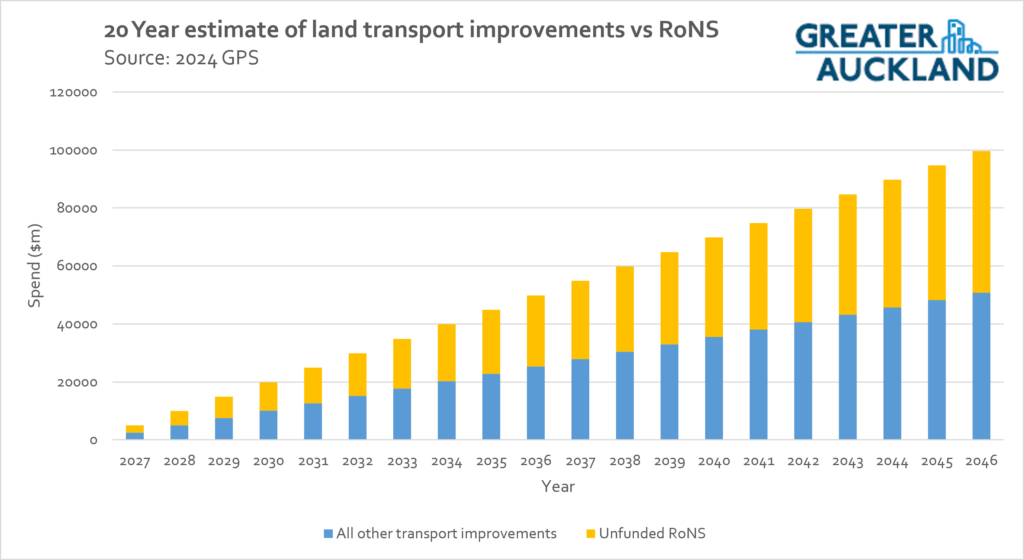
According to the Infrastructure Commission, if the government were to look to pay for the RoNS the way it funds other roads, funding the entire $56 billion RoNS programme would require a 70% increase in petrol tax and road user charges. That’s equivalent to an extra 49c per litre in petrol tax. Something Transport Minister Chris Bishop is all too aware of.
And note we haven’t even included other major projects, such as the Waitematā Harbour Crossing, and the Northwest Busway, as well as other rapid transit projects that will be needed – not just here in Auckland but around the country.
This is a precarious situation, already.
What makes it even more alarming is that the government may imminently be about to sign the country up to a Public Private Partnership for the Warkworth to Te Hana project. This is a section of the proposed Northland Expressway – except that it doesn’t even get to Northland, barely reaching the northern edge of Auckland, where it will grind to a halt at Te Hana, )(population: 130).
The sticker price for Warkworth to Te Hana is $3.5-4 billion.
But, delivered as a PPP – which is effectively buying a road on layby, and paying it off over the long term – it would grow to approximately three times that price, over the 25 years of the agreement.
If the agreement is signed, part of it will be financed through a Crown loan – like putting down a deposit – potentially on the order of $1-1.5 billion as hinted at in the budget.
This means the total cost to the public of this one project – Warkworth to Te Hana – may be between $7.5-12 billion by the time it’s paid off.
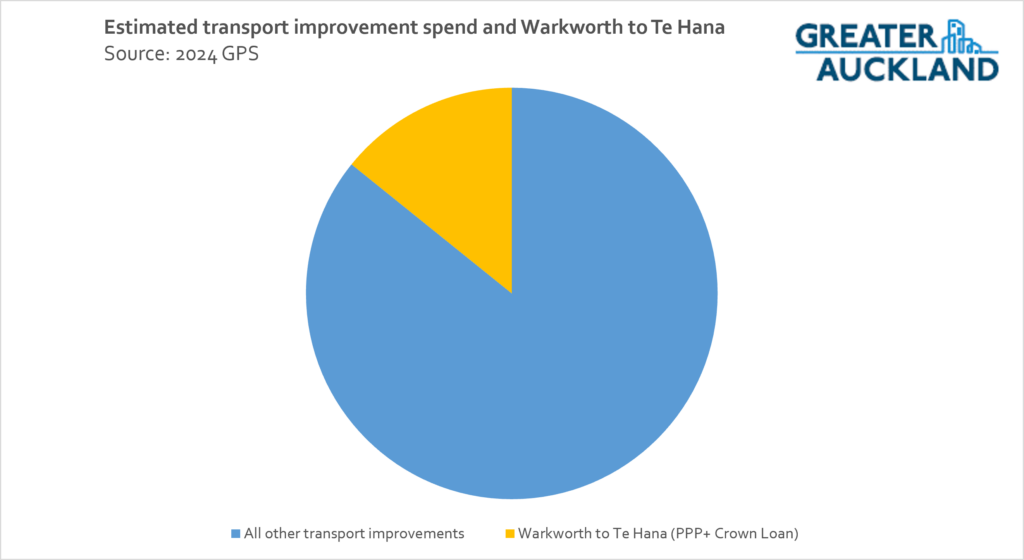
Let’s be conservative, and say the government is about to lock us into a bill of $9 billion over 25 years.
That is equivalent, under our extrapolation, to 14% per annum of all spending on transport improvements for the next 20 years.
Fourteen per cent of national transport funding for the next two decades. On one road. That hasn’t even met the traffic threshold for triggering the project. And that doesn’t even go all the way to Northland, let alone solve the most pressing (and climate-impacted) section, through the Brynderwyns.
If this isn’t alarming enough, we also haven’t accounted for all the other required expenditure in the National Land Transport Fund, such as operations and maintenance of state highways and local roads; and public transport operations. Together, these cost an average of $4.2 billion per annum between 2024-27.
The Infrastructure Commission advised the Ministry of Transport that building the entire RoNS programme would likely double the operations and renewal cost of the entire State Highway network.
So, extrapolating from NZTA’s expected annual spend for 2024-27, if the RoNS were completed as proposed, just maintaining and repairing the State Highway network would go from $1.6 billion per year to $3.2 billion per year. Or $64 billion over 20 years.
And we haven’t included the cost of repairs, which is both rising and highly unpredictable, given the way extreme weather events can wash out highways and bridges, some of which have already been rebuilt. (For example, in Budget 2024 the government set aside $609.25 million to repair the previous year’s weather damage to the state highway network. So twenty years of that – a conservative estimate, given the rising frequency of extreme storms – is around $12 billion.)
[Ed: an article in The Press this morning notes that a new report for the Infrastructure Commission says “flood-related financial losses are expected to exceed those from any other natural hazard in most regions over the coming decades.” The estimates “count direct damage to infrastructure assets, but not the wider disruption when roads close, freight is delayed, customers cannot reach businesses, or workers cannot get to their jobs. The modelling also excludes some major infrastructure sectors, including ports and airports, and does not include rainfall-triggered landslides.”]
All these numbers are just estimates and extrapolation, but the point is the same.
The RoNS programme is the glaring white elephant in the room.
Which is probably why the Infrastructure Commission dedicated an entire section in the National Infrastructure Plan to “Fixing land transport funding and investment” and explicitly called for less expenditure on State Highways.
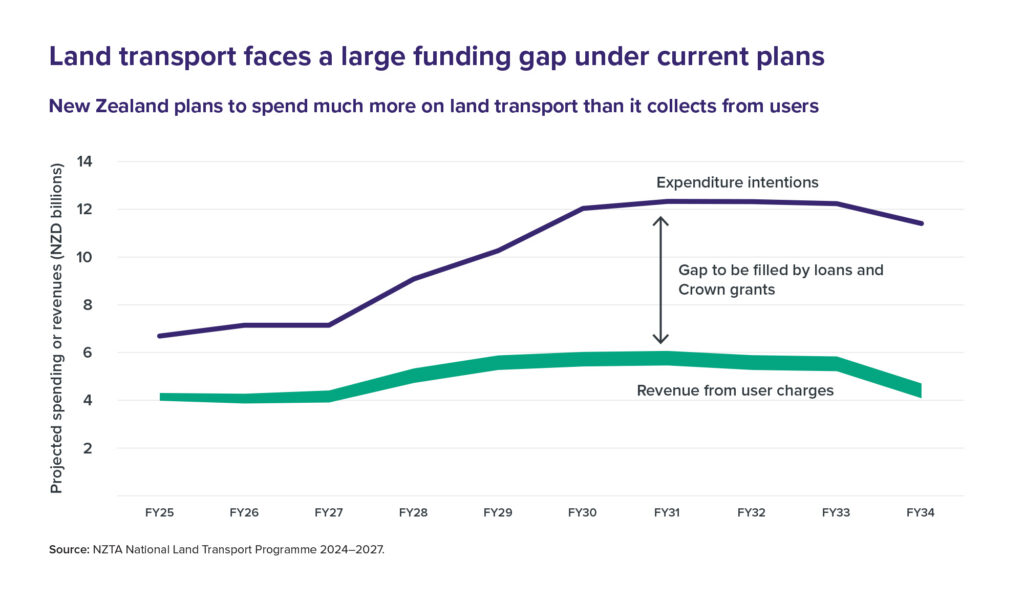
The RoNS programme, as mandated under the 2024 GPS and as driven forward by NZTA, is completely unsustainable without enormous amounts of direct Crown funding diverted from other national needs.
Much like the current direction of the Waitematā Harbour Crossing project, many of the cases for the RoNS exploit legitimate issues and genuine problems to push forward “solutions” that are wildly over-scoped, gold-plated, and mono-modal, which is the opposite of resilient. Others make almost no sense at all, and are completely divorced from the reality of local needs.
The RoNS are politically driven, and they’re being hustled along by a national transport agency that – rather than focusing on public benefit and rational investment, has been willing to go along with the delusional political push.
There is a way out, and this government has opened the door. If we want to fix the way we do land transport infrastructure in New Zealand, then the government simply needs to subject the RoNS programme – including Warkworth to Te Hana – to scrutiny by the Infrastructure Commission.
All political parties have agreed that all major projects should go through this process.
Yet somehow, the RoNS have been carved out as special, and not needing scrutiny. Why, when the RoNS, as currently proposed, are the problem?
Minister Bishop has been hinting at “reprioritising” the RoNS. They don’t need reprioritising, they need rethinking, and in many cases, rejecting. We have much, much bigger problems to solve, and we need to get smart, fast.
Updated at 10.30am: A story today by Tom Hunt in The Post, headlined The crucial caculation that could kill Wellington tunnels plan, offers another way to think about the scale of the RoNS and Warkworth to Te Hana’s place atop the to-do list:
Wellington’s tunnel dreams are on shaky ground, with Government documents showing the project could be ranked near the bottom of a $49 billion list of unfunded transport spending.
Ministry of Transport advice to Transport Minister Chris Bishop, released under the Official Information Act (OIA), says New Zealand’s roads of national significance (RoNS) would be prioritised based on their benefit-cost-ratio but adjusted for any “major delivery risks and strategic fit”.
Of the country’s 18 listed RoNS, the $2.9b to $3.8b Wellington tunnels and Basin Reserve upgrade has the lowest benefit-to-cost ratio and is expected to cost more than the benefits it delivers.
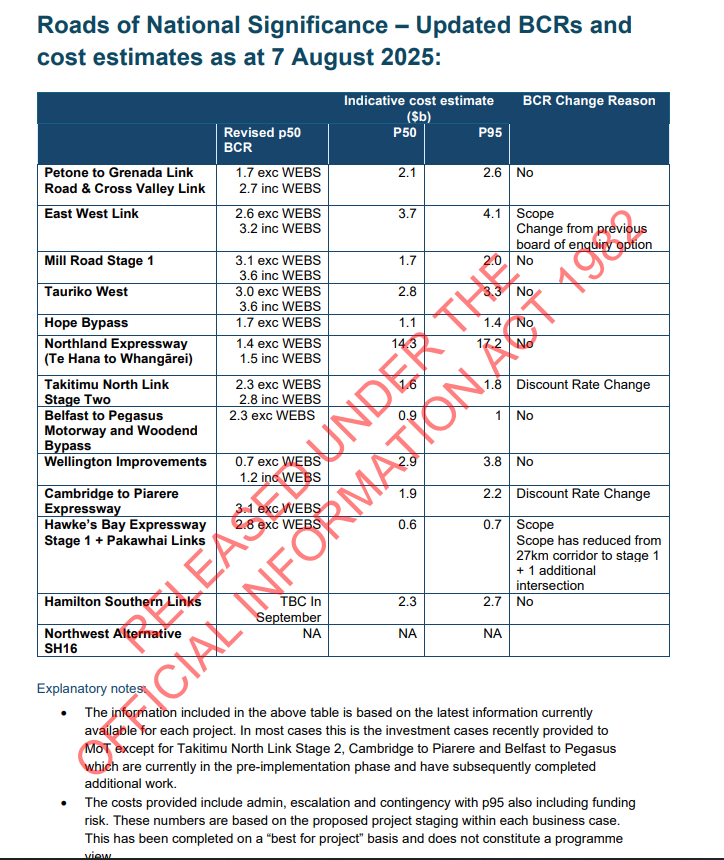
See below, for what we assume is the MoT’s $49 billion list of unfunded transport spending referred to in the article. Note that it’s not listed in order of benefit-cost-ratio or ticket price, but that’s the work of a moment.
Regardless, you can see at a glance that – if you wanted to fund and build any of these projects, as currently scoped – you could do a bunch of them for just half of one (1) Warkworth to Te Hana. (Including even the East-West Link, famously costed – almost a decade ago – as the most expensive road in the world per km).
So, even before digging into questions of need, scale and scope for each of these projects, and the accompanying financial challenges as outlined above, this fact alone should be raising questions – and eyebrows.

 Processing...
It’s so obvious, but how do you tackle the ideology that seems to override any logic?
“Auto Shenanigans” has a great short video on a section of privately funded (DBFO) motorway in the U.K. that cost 128 Million to build, it will return its owners 700 million less maintenance over the contract period before handover to U.K. Govt, and would have cost ~285 million if govt had just borrowed and built in the first place. This is our future…
A1M – The Secret TOLL Road That You Didn’t Know You PAY – EVERY TIME YOU DRIVE IT!
https://youtu.be/BkZKVl8iCqc?si=iEVeTcpeAL2yhpUn
One aspect of a bold urban revitalisation plan for Levin is moving the current railway station to the town centre to create a modern transport hub. The current station is run down and is in the wrong part of town. New hybrid trains are arriving before the decade but, apparently, we cannot afford to build the new station. Yet, billions have been found to build the highway extension to Levin. Levin has plans to grow significantly in terms of population over the next couple of decades, new trains are coming, but an unbalanced transport budget means the benefit of these trains to the district will not be fully realised https://thefutureisrail.org/transit-oriented-development-a-new-levin-railway-station-as-a-key-to-urban-revitalisation
I believe the plan with Levin is to go from one service a day to two per day. Better than most of the rest of the country I suppose, but still insulting to suggest that there’s demand for 6 lanes of motorway but only 2 train services per day on an ancient single track.
Levin railway station would be better up near Queen Street level crossing. As several comments have remarked the present building is not fit for purpose.
I used the CC from Wellington to Levin a while back. When I walked out on the street there were no taxis around, so I had to walk about nearly two kilometres to my motel at the northern end of town.
The railway is right behind the motel at that point!
I think it is essential that all the stations that will be served by the new trains after 2029 should be fit for purpose, in the right location to the town they serve, and modern and inviting. Nothing worse than alighting from public transport to find you are in a badly lit part of town when travelling after dark.
Following World War Two we were invaded by Military Constructors, who gave us our motorways and highways, and enforced car dependency upon us.
We now know the damage that emissions do to our lungs, and our planet; that car tyres do to our coastline, and that cars are excellent for isolation.
Eighty years down this path and we are suffering the consequences.
Loneliness is a particularly New Zealand disease. It particularly affects young people. Lack of action on climate change gives young people nothing to believe in.
I was once a young person in this place, and I too lost belief, refinding it through voyaging to other parts of the world, like our ancestors.
But now we need more people in our lands, we are a shrinking population, like so many other wealthy countries, and it seems strange that sovereign wealth makes most people unhappy.
Trains, buses, ferries and bikes give socialising possibilities, and build friendships. Cars cannot do this. Highways cannot do this.
More rail, less roads!
Bah humbug
Totally agree.
Management:
Let the Infrastructure Commission determine the actual govt infrastructure pipeline & ranking (not just transport) based on the BCR ranking inclusive of consideration of any non-monetised benefits or dis-benefits in the appraisal summary, and the actual realistic funding envelope.
Governance:
The govt just governs and ensure the IC performs.
(NZ has govts that micro-mange and meddle rather than being strategic and governing. Its a major reason why there are so many unresolved strategic issues in NZ)
The increasing ferocity and frequency of storms demands that we need to make changes.
These storms are not just normal weather variations, but the consequence of our human activities putting ever increasing amounts of energy into our atmosphere.
Our climate, and weather are becoming a whole lot more energetic.
The answer is not to concentrate spending on a few big things that encourage putting ever more energy into our atmosphere, but instead pivot towards reinforcing our critical infrastructure everywhere. Moving things further from harm and making what we have already got, stronger and more resilient.
Deprioritise winning votes by just making some motoring faster, towards making us safer and more resilient in the face of a becoming hugely more energetic planet.
I genuinely think the whole fuel taxes, road user charges, NZTA and land transport funding system is not fit for purpose. The entire conceptual idea is user pays. But whole parts of the transport network, like the South Island, pays but doesn’t get any improvements. It is ridiculous.
Even worse, despite the neglect of the South Island general taxpayers need to top up the land transport fund because the cost of the political pork projects are ever increasing.
Honestly the system is broken. It is a.joke. It is a brain dead governance system that is corrupting the entire public works procurement system. Without reform it will get worse.
NZ likes to talk a good game about infrastructure. Politicians point to the good work the infrastructure commission do. They pat themselves on the back when they reach a supposed consensus. But it is all a bit meaningless when the numbers don’t add up to the tune of tens of $billion whilst the transport needs of half the geographic area of NZ is being neglected.
Not only the South Island but Te Tairāwhiti, Southern Wairarapa, the Far North, Waikato and Northern Taranaki, that have all suffered, major breaks in key access routes, some of them multiple times, within the last year.
Their worry is, are the delays getting restored their essential interegional access hours, or even days. Not the five minutes per normal trip extending to perhaps half an hour on their holiday excursions.
Who benefits from the RONs and specifically who benefits financially from Warkworth to Te Hana?
What companies would tender for the PPP? All I can guess, as I know nothing, is the same as Transmission Gully? Have they donated to the Coalition parties? I feel naive – I imagine someone must know who is bribing the govt?
Or maybe the NZTA and Simeoooon are such road fanatics that they don’t need to be bribed? Surely the Coalition wants to get back into power? There can’t be that many middle-aged and female boy racers, in the North Island only, who will vote for anyone who lets them go faster? Can there?
There were 864 people in life jackets on the Kaitiaki when it lost power in 2023 near to where the Wahine went down with the loss of 51 lives in 1968. Yet this government won’t pay $10-33 million + 6mill p.a. for an ocean going tugboat. South Island roads are a joke compared to the Golden Triangle highways. Do they think South Islanders never cross the Cook Strait?
Thank you so much for all your coverage on this issue, I think we, the public, would not have a clue what’s going on without it. Even the road lovers out there can’t deny the insanity of the RoNS. I live in Northland and we’ve had non stop road works and engineering for at least 5 years as ever year another road crumbles due to heavy rain. We do not need enormous multi-lane highways! As you always say – we need a variety of transport options, resilience against weather, and to reduce fossil fuel use. This government is so embarrassing, they are dinosaurs.
Conor they have in part heard your plea:
https://www.1news.co.nz/2026/07/09/govt-pulls-flagship-roading-projects-into-the-slow-lane/
The affected projects are Hope Bypass Stage 2, Sections 2 and 3 of the Northland Expressway (excluding the Brynderwyns section), Auckland’s East-West Link, the Alfriston to Drury section of Mill Road, and Petone to Grenada.
So while this leaves NZTA free to sign up the PPP for the first stage of the Brynderwyns, it also cancels billions of work that was well underway for execution by thousands of contractor workers in Auckland (Mill Road apart from Redoubt Road section, East-West, and Wellington (Petone) and Nelson region.
This is a far larger reversal to the contractor economy than the cancellation of IREX.
Pulling the plug on the wrong projects, as usual. The needs in those places don’t just go away and any cheaper alternative to deal with the needs has to be funded, often 50% or more by local ratepayers. Fast Track developers also don’t get asked to contribute to solving the problems that have been defunded.
Translated.
RONS are not now , and were never were, vital Government expenditure.
But they were considered by the party to be vital in securing votes and industry donations.
I believe NZ needs to implement public works reform. The only way we will get modern infrastructure. Whether that be more transit systems, a resilent road network, functional water systems, hospitals fit for purpose… is to go from being a high to low cost infrastructure builder.
We should be looking at how countries like Italy cut costs by implenting a comprehensive set of public work act reforms, such as benchmark costing.
NZ politicians should be checking this out. It would be a good use of their travel allowance. The civil service could go on a fact finding mission. It would be better value for money than spending tens of $millions on consultant reports for projects that will never be built.
In the meantime they could read reports like this.
https://transitcosts.com/wp-content/uploads/Italian_Case_Study.pdf
What’s really good is the government is charging ahead with Warkworth to Te Hana and not listening to Connor who doesn’t care about the North. Did I read they will bypass the Brynderwyns then stop the construction which is what I’ve been saying they should do for years now.
The road north of Te Hana has been moved into phase three, the last of the phases, basically little more than route protection will happen in the next 20 years.
@jezza yes but the alternative Brynderwyn Hills route has been excluded from moving to phase 3 essentially section 2A will get built while the rest of the sections won’t which I think most people are totally fine with. Bypassing Dome Valley, Kaiwaka, Wellsford, Te Hana and the Brynderwyn Hills pretty much solves all of the issues along this route chuck a median barrier down the Waipu straights let us do 110 and it’s all good.
https://www.nzta.govt.nz/assets/resources/research/reports/568/568-Travel-time-savings-and-speed-actual-and-perceived.pdf
“Fuller et al (2009) found that survey participants drastically overestimated their time savings for a given
distance when increasing their speed from 96km/h to 112km/h (60mph to 70mph). The mean estimate of time savings was 346 seconds, compared with an actual time saving of 86 seconds. Similarly, participants estimated a mean time loss of 415 seconds when reducing speed from 96km/h to 80km/h (60mph to
50mph), compared with an actual time loss of only 120 seconds.”
So spending more to fuel up more often for a paltry few seconds saved is “all good” to you then, eh, James?
@Burrower yes seconds matter to me and many readers of this blog. Remember people moaning about the train doors taking a few seconds longer to shut than they should.
86 seconds is a significant amount of time even 5 seconds is.
Keep chasing that rainbow if you like, the pot of gold doesn’t ever get within your grasp. Maybe a cheaper , smaller solution that actually gets built would be more use than fantasies.
Saving time on road trips.
I generally log my road trips, and have statistics going back to the 1970’s.
Whilst living in the N. Island, I found my average start to stop speed over any distance and a mix of roads was close to 80 km/h. Example: if your trip was 240km divide by 80 = 3 hours.
In the S. Island I find my average speed is closer to 75km/h so 240 km in that scenario would 3.2 hours.
When speed limits on SH6 Blenheim to Nelson was reduced to between 60 and 90km/h, there was a lot of push back, but to me an extra 5 minutes was really no problem over the 145 km.
What I call “ road dynamics “ is what can happen on any journey, so the posted speed limit is just one element in the calculation. You are likely to get caught behind a truck or several trucks before you can pass. Then you will encounter a stop/go, either lollipop or temporary traffic light, or you may have to follow a slow driver for some distance before you get past.
There are so many things that can affect your journey time.
As for the National Party claiming increased productivity with increasing speed limits, it is so laughable you wonder what they were thinking.
I have many examples and I have challenged MP’s over this, but if you follow what I have done you will see they are not on the right page.
exactly
the perception of time saved by driving faster is just that – a psychological phenomena
James why don’t you care about making existing roads more fit for purpose. Kaikoura is cut off again from the storms that you don’t care about because they don’t affect you. Your bull gold-plated motorway takes away much needed funds for the upkeep of that.
Did the tarmac huffers in power ever get those bridges in Northland fixed?
@Burrower I do care about making existing roads fit for purpose if the govt just scrapped the ETS and redirected the 18c per litre we are paying into it we could afford those too and keep building this wonderful expressway north. The existing road cannot be made fit for purpose as its speed limit is only 80kmh, time for a new road.
Hahahahaha, no you don’t. You’re a filthy anti-environmentalist. Time for taking care of the planet, not small-dicked men compensating for their insecurities via autodependancy-mental-illness
What a distraction from Brendon’s main point! One seldom made here or elsewhere:
Construction costs are too high in NZ and every other English-speaking country.
This needs to change.
Other countries have found ways to do this – they don’t speak English.
This. Like, the issue isn’t the projects in particular (although they should be more multi modal and the SI needs a bigger share), the issue is the costs have got ridiculous.
They need to go back to square 1. Re building, hiring staff @living wage mostly, so majority costing roughly $60p/h. Let’s round that up to $100p/h. Then just set them to work metre by metre.
If aggregates are too expensive, set up their own aggregate plant. The whole supply chain has become a rip off with end costs we pay having no reflection of what it costs to physically do, as a myriad of middle men and consultants have appeared.
Land is too expensive. Solutions please.
Simply build online within the existing road corridor. Sooo much money has been spent on property acquisition because NZTA has insisted on duplicating existing corridors for literally every project (and gold plating and four laning the new route…)
Land tax for central gov, and higher rates from local gov (changing general rates from general value to land value to incentivise development). Plus CGT for sale to reduce land banking. Higher costs means prices drop.
Probably they need some work on PWA other rules etc. so we don’t get a Mt Messenger situation again.
Roads aren’t built by hand anymore. It’s not modern construction methods that are the problem, it’s the margins of the financing, and the preference for oversized projects that’s killing affordability.
Also, a large part of the costs for such projects are engineered structures such as bridges, culverts etc. Are you going to build them from locally sawn wood or something? Or hand-mixed unreinforced concrete in an earthquake prone country? Sorry if I am sounding like I am mocking you or implying bad faith. But the whole “it was better back when we just got a lot of guys and just got them onto it” kind of comments really make my BS meter itch.
I’m pretty sure there are people who think the Gray & Houseman road construction vehicle actually exists.
I’m not suggesting changing modern construction methods. Plenty of staff in modern construction earn living wage or around that though, and if above not significantly more (as in if you budgeted $100 per hour average including related costs like KS, holiday pay, benefits etc. you’d be significantly ahead). This is for skilled machine operators as well as TM’s, all the way down to labourers/lollipop men (and women).
I briefly worked as a lollipop man while doing odd temping as a student (this was in the last 5 years). In one case, I was working for one labour hire agency, who hired me out to a subcontractor for the day, who was working for the contractor who had the state highways job, who was working for NZTA. Onsite, I reported half the time to a different traffic management sub contractor company, who was working for the sub contractor, who was working for the contractor, who was working for NZTA etc. This was for a simple single lane traffic management on a near deserted state highway where they were tidying up the edges of the road with a digger – 1 on the digger, 2 doing TM (should’ve been 3 so they could manage breaks but they were short).
I enjoyed it (was just for the day), was an interesting part of the country etc. and it was a little bit of extra money. I made near enough to minimum wage. There is no way between the profit margins of every single one of those companies in the chain that NZTA was charged close to minimum wage for me.
I’m not a special edge case, there is so many middle men both in labour and in material. The land/consenting/financing issues are different and require probably different solutions (mostly central gov regulation changes) vs management solutions.
When SH1S on the Kaikoura Coast area was being rebuilt after the 2016 earthquake, batching plants were set up for concrete etc.
As for aggregate there are millions of tons in rivers in the area, just taking a small amount, as has been the case, will not alter what the rivers do, as after each flush more shingle is shifted downstream.
A drive from Blenheim to Kaikoura might be an eye-opener for some. You’ll definitely notice the shingle!
What drives me wild is that the government do not care for the conditions and issues with minor roads.
State Highway 57 (Featherston-Martinborough) has been cut off multiple times this year, and this is not to mention the government will no longer subsidise the road from Martinborough to Ngawi, which puts the SWDC in a very tricky spot, that stretch of road really needs full state funding, and it would be far more useful spending to ensure the road is resilient..(new culverts, landslide protection etc.) We don’t need hundreds of kms of gold plated expressways.
Shhh shhh shhh…. you’ll trigger James and his rabid obsession with blowing $22 billion on a single highway for a single reason.
He’s so financially illiterate and spiteful that he thinks diverting money from environmental causes will cover the costs of minor road rebuilds
@Burrower I said the ETS which isn’t environmental it’s just money flowing to goodness knows where. We will save more lives diverting NZs ETS fuel revenue to safer and faster roads. Eventually all the ETS will likely get scrapped as people get fatigued of it all. No I’m not denying climate change I just know it’s too late to do anything we are in the prepare for the inevitable stage.
Prepare for the inevitable by blowing all our money on a RONS to nowhere? Great logic Einstein.
James, the inevitable stage is death. The establishment doesn’t want you to know that.
This year’s El Nino is seeing exponential growth in ocean temperatures. Mid-Atlantic oceanic currents that regulate weather in Europe, Africa, and the Americas are on the verge of collapse. Temperature increase markers that weren’t predicted to happen until midcentury are happening this decade.
Sorry, but this isn’t a “La di da, i’ll just turn up the AC and laugh” issue. This is a god damn existential crisis. Weather patterns will change faster than crops or farmers can adapt. Land will become unfarmable. Mass extinctions will increase – some predictions put pretty much every seafood that we eat going extinct as ocean temperatures and acidification rise.
There is an extremely high likelihood that half the human population is dead from famine and heatstroke by mid-century. Which I know doesn’t mean a lot to you and your disgustingly selfish “as long as I’ve got mine” attitude, but picture yourself as one of those people. Speed will no longer be your concern, but base animal survival.
Well if it’s inevitable we should have as much fun while we can. Travel see the world, go on road trips, don’t worry about speed or emissions then. If that’s inevitable I’m not going to even consider emissions in anything I do then thanks for telling me what the establishment couldn’t. I will of course keep going to beach cleanups etc as I’d like to leave the place looking neat and tidy.
Long story short no reason not to build the road.
Disgusting pig. If you’re the “democratic” representative of democracy, I’ll be glad to see the pathetic excuse that is ‘homo sapiens’ go extinct, and hopefully we’ll do so before the damage we do to the planet turns Earth into a second Venus – a 400ºC runaway greenhouse-effect wasteland.
And I hope karma gets you. Equality in suffering with the rest of us. You deserve to not only be inconvenienced, but starve and overheat and keel over in pain just like the rest of us will. If there’s a Hell, well – I hope to see you there.
In reply to James.
Even if your priorities are to speed. Including to yours and everbody else’s death, improving that particular road, ahead of others, is particularily poor value. Just improving the road north from the base of the Bryndwyns to Whangarei could deliver better safety outcomes and journey reduction times for more motorists for less money.
@DonR no my priorities aren’t to speed infact I’ve driven 100s of thousands of Ks and never had any tickets for breaking any road rules. That’s why I want the new road so my journey times are quicker.
I don’t think Greater Auckland understands we either need to engineer up a brand new road or leave the speed limit high on the old road. A very large majority of voters would not accept a permanent reduction to the safe and appropriate speed for undivided roads or 70. If you are advocating for safe speeds you are advocating for this road by stealth even if you don’t realise it.
Also Burrower is it inevitable or not I’m confused, unless of course you’re just using the climate excuse to push your slow speed agenda. Again go up and visit Kaitaia and go tell the locals they don’t need this road and see the reaction.
Lmao James, your brain is already so poisoned by petrol fumes you have the intelligence and selfishness of a toddler.
Nobody here is saying that Northland doesn’t deserve road upgrades. But we don’t think the petty whining of a brattish, selfish manchild demanding a $22+ billion, 6-lane motorway for a region that doesn’t have the population to support it and would take decades to build at any rate, who’s deluded into expecting entirely unrealistic time savings, counts as an opinion that actually has any value or is representative of the needs and concerns of Northland.
Repair the local roads, improve safety on the existing highway, get freight out of trucks and onto trains to reduce road maintenance costs, keep the existing network resilient. That’s a common-sense, beneficial, economically sound set of priorities – not a tantrumning, pyschologically damaged cager with an actual addiction to “speed” and “time savings”
Well whilst rural NZ continues it’s largely loyal support of National, the rural sticks, and their residents, will get only crumbs from big business and it’s captive National Party.
“There is an extremely high likelihood that half the human population is dead by famine and heatstroke by mid-century ” Really? Have you got some sources for that? Not remotely close in any projections I’ve heard about.
It’s not unthinkable, I’ve just driven up to Kaitaia for the long weekend boy is it depressing it needs a faster safer link to Auckland. It’ll get worse if the JNL mill closes. I’m not saying we need a 4 lane road to Kaitaia but 4 lanes till just past the Brynderwyns will shave a good 20-30 mins off the trip north. We need to induce demand to head north from Auckland Warkworth to Te Hana goes a long way to doing that.
Maybe you’re feeling depressed because driving is socially isolating, rather than the road being the problem
Craw I said Kaitaia is depressing, but your already know that you little troll. I really feel for Kaitaia if the JNL mill closes it might be a death spiral it won’t recover from then these pratts will push the slow speeds agenda meaning people won’t want to drive up north. It’ll be a double whammy.
Lmao no you don’t, James. You only care about “ugh grug me go fast” and just tack on any virtue-signalling argument pretending to care about locals you think will support your juvenile obsession.
Same old story with all car-addicts and anti-environmenalist spiteful scumbags.
Well many locals do support higher speeds funny you should mention that particularly in the north. All 3 speed reversals NZTA arrogantly ignored what the majority wanted and didn’t reverse the speeds to their originals. They have also packed a sad over having to reverse SH10 based on majority local support and hoping if they consult again they will get a different outcome. Same thing from Kawakawa to Moerewa even with the speed camera at 80kmh they wernt even getting 50% compliance so the majority of road users AND locals told NZTA to reverse the speeds which they did but then are consulting again hoping for a different outcome. Probably to improve performance of the speed camera.
So yeah there you go Burrower the locals want higher speeds too. It’s not a crazy opinion either in fact it’s popular you just like doing what’s unpopular to be a pain, now scurry off and go and argue against road upgrades for another part of the country because Northlanders like to drive fast.
Reducing travel time for drivers is the big selling point for roads because you can’t do anything else while driving except focus on the road. Speed is not as important for passenger trains because you can work / eat / sleep / socialise while travelling.
These guys are deluded about how much time roads will save them. It’s a thing proven in studies, drivers really don’t estimate their time well.
BTW it’s 52km from the end of the motorway to just past the Brynderwyns, which takes about 40 minutes. To think you can shave 20-30 minutes off is la la land thinking.