Wow, it’s already July! Enjoy some stories on all things cities and urbanism ahead of the weekend.
This Week in Greater Auckland
- On Monday we had a guest post from the esteemed Darren Davis, looking at what it would take to get passenger rail to Tauranga
- On Tuesday Connor shared Greater Auckland’s PC120 feedback to the central local boards in the Auckland Isthmus.
- On Thursday we threw back to Patricks post on what Auckland could be, after a great instagram post from comedian Chris Parker.
Today’s header image is a render of the planned Downtown development by Precinct, which is mentioned below.
Greater Auckland’s research and advocacy is powered by hundreds of hours of volunteer labour each month, and your support helps keep us going! We warmly welcome your donations, and are always open to offers of guest posts, practical help, and pro-bono expertise.
PS Another great way to back the kaupapa: Greater Auckland tees, totes, and caps! Remember, these are print-on-demand (no returns possible), so be sure to double-check sizing before ordering.

New ferries for western routes
Auckland Transport announced yesterday:
Auckland Transport (AT) has concluded its procurement and signed a contract for the provision of ferry services for the “Western Package” routes of the Auckland network for seven years from 1 July 2027.
A combined proposal from Belaire Ferries Limited and Kelsian Group’s marine division (SeaLink (Australia)) has been accepted to provide ferry services on the key routes between the Downtown Ferry Terminal and Bayswater, Birkenhead & Te Onewa (Northcote Point), West Harbour (the Western Package) along with Rakino Island.
…..
A staged renewal plan will see Belaire Ferries and Kelsian Group operate five new standardised 24-metre modern “Metro Class” ferries, that will improve reliability and reduce maintenance complexity.
“The new vessels utilise low-emission diesel engines with modular electric or hybrid retrofit capability, enabling a transition to lower or zero-emission operations as infrastructure and funding allow. This would support our Mission Electric plan to reduce emissions in our public transport fleet,” Ms van der Putten says.
The five new vessels will be progressively delivered during the contract term from 2028, and ownership will be transferred to Auckland Transport at the end of the contract in 2034.
The contract also enables the delivery of terminal improvements at West Harbour marina.
It continues to be disappointing that in 2026, AT are pushing on with buying new diesel ferries when they’ve already got some electric and hybrid options available.
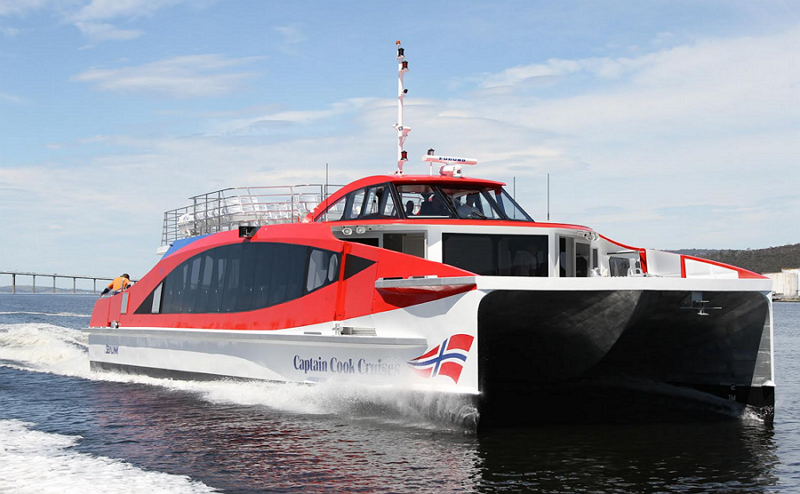
One of the ferries that will be operating in Auckland as part of the new contract.
On decreasing dependency on diesel, and slowing down to save on fuel
Related, an op-ed in The Post by the Greens transport spokesperson Julie-Anne Genter calls for the government to reverse a couple of recent decisions: canceling $56m in funding that would have supported towns and cities to electrify public transport, and declining to co-fund anything but diesel ferries for Auckland.
These decisions locked in our vulnerability to fossil fuel prices and now it’s costing us even more to operate diesel buses and ferries because of the fuel crisis. Just how much remains a mystery, as there’s an unspecified amount in this year’s Budget to help public transport authorities cover the high cost of diesel. We’re told it’s an unspecified sum due to commercial sensitivity.
…
Anyone who uses diesel machinery or drives a diesel vehicle knows how the cost has escalated. While prices have come down a little since the peak, it is still up 70% compared to before the fuel crisis. This is a massive cost for public transport operators to bear.The good news is that these problems can be solved with pragmatic policy; the kind that should be able to attract bipartisan support. The additional, undisclosed, amount of funding in the Budget to support ongoing public transport services is better than nothing but funding for electric buses, and eventually ferries, would set us up for a more economically and environmentally sustainable future. In other words, greater certainty in an increasingly uncertain world.
And, also in The Post, Tom Pullar-Strecker reports on a key detail of Phase 4 of the Government’s fuel crisis response plan:
Speed limits on the open road would be reduced to 80 kilometres an hour for all vehicles if the Government had to implement “Phase 4” restrictions on fuel use, Transport Minister Chris Bishop says.
The Government drew up a four-phase plan to conserve fuel as a precaution in May, at a time when concerns over the possible fall-out of the Middle East conflict were closer to their peak.
However, it did not draw attention to the proposed speed restrictions in a fact sheet issued at the time and that element of the fuel plan appeared to go unrecorded.
…
Documents recently released by the Transport Ministry noted that vehicles were generally more fuel efficient when driving at 80kph or 90kph than at 100kph or 110kph.Officials also assessed cutting the limit to 90kph, before recommending the tougher control, and indicated new limits could be imposed with or without road signage.
It is understood initial modelling suggested savings of about 34 million litres of petrol and 50 million litres of diesel could be achieved over six months with an 80kph limit, cutting the use of the fuels by 2.3% and 2.9% respectively.
Which raises the obvious question: if this approach would not only save lives (and, for those more concerned about the bottom line, also reduce the costs of emergency responses and hospitalisations and disruption to traffic and so on), but also save fuel… why not do it anyway??
Trucking lobby outraged New Zealanders aren’t subsidising them more
Related: in a rare move, the government listened to evidence and didn’t bow to the trucking lobby who want to be allowed to run even heavier trucks on the roads – and their lobby isn’t happy.
The trucking lobby has expressed outrage after Transport Minister Chris Bishop rejected its wish to carry heavier loads, accusing him of not understanding the problem.
Bishop on Friday told Transporting New Zealand’s conference he would not ease truck weight restrictions, saying it would wreck roads and cost too much to fix.
While the organisation has long called for the move, pressure has amped up during the fuel crisis, with the industry arguing it would mean they took fewer trips and used less fuel.
Speech notes provided to media suggested Bishop had intended to lay down a hard line.
“I want to be very clear about the Government’s position: we are not in the business of subsidising the freight sector,” the notes said.
…..
RNZ put the original wording to Transporting New Zealand chief executive Dom Kalasih.
“That’s just a gross misunderstanding of how bloody productivity works,” he exclaimed.
“That’s a shocking position to take.”
…..
Bishop told the conference allowing trucks to carry more weight would cause $150 million in infrastructure damage over six months and only save 1.5 days’ worth of diesel.
Kalasih questioned that.
“We would like to see the officials’ analysis, because I don’t believe they’re correct in saying the benefit cost doesn’t stack up,” he said.
…..
“I actually disagree with that completely, because those trucks are paying road user charges, so if they’re heavier, they pay a higher charge, right?” Kalasih said.
“I just don’t get the logic of holding off till further down the track.”
Kalasih believed the Transport Agency needed to shift its mindset.
“The road is there to connect communities and get freight between it, the road is a consumable asset.
“They shouldn’t be so worried about trying to just keep it forever.”
This really is saying the quiet part out loud: the trucking lobby thinks the roads we all pay for are theirs to destroy?? Many of the problems we already have with damage to our roads (and the ever-increasing costs to maintain them) can be tied back to when the government allowed heavier trucks, more than a decade ago. Allowing even heavier trucks again would only make that worse.
And, if only there were alternatives for moving freight around the country without putting extra wear and tear on the roads…
Some more common sense from the government
There must be something in the water. Transport Minister Chris Bishop is going to complete what Labour proposed but then got too scared to implement – delivering a series of small common sense rule changes to how we move around.
Children will legally be able to ride bikes on footpaths with a grown up alongside them, and e-scooters will be allowed in cycle lanes, under a package of practical transport rule changes agreed by the Government, Transport Minister Chris Bishop says.
“Earlier year we asked New Zealanders for their views on a range of changes designed to make our transport rules safer, simpler, and better suited to the way people travel today,” Mr Bishop says.
“More than 6,000 people took the time to have their say. We’ve listened carefully to that feedback and, in some cases, changed our proposals as a result.
“One of the strongest messages we heard was that allowing children to ride on footpaths only solves half the problem if the grown up riding with them still has to use the road.
“That’s why we’ve adapted the proposal to allow parents and caregivers to ride alongside children on the footpath.
…..
Following feedback from road users, the Government has also simplified the new mandatory overtaking-gap rule for vehicles passing cyclists, horse riders and other road users.
“Instead of different distances in different circumstances, drivers will be required to leave a minimum gap of 1.5 metres when overtaking. That’s clearer for drivers and safer for everyone.”
Other agreed changes include:
- People will be able to ride e-scooters in cycle lanes.
- Drivers will have to give way to buses leaving bus stops in areas where speed limits are 60km/h or less.
- Minor and technical changes relating to traffic control devices, including road signs, signals and markings.
…..
The new rules are expected to come into effect before the end of the year following Orders in Council.
What is going on with Auckland Council’s planning department?
Thomas Manch has two stories this week about how council planners appear to be living in their own world, one that’s radically detached from Auckland’s strategic direction.
First up, the Northwest Busway.
A fast-track application for the $4.9 billion Northwest Busway project has been halted by the transport agency as it clashes with the Auckland Council over consenting issues.
Senior staff and external lawyers for both organisations held a third day of facilitated discussions on Tuesday afternoon to resolve the dispute, with the New Zealand Transport Agency (NZTA) alleging that council planners are not aligned with council leadership.
The impasse arose at the beginning of June when the Auckland Council issued a 74-page memo on the proposed 18km busway from Whenuapai to the city centre, which NZTA plans to begin building in 2027 and estimates could cost $4.9b.
Council planners raised numerous issues in the memo, including NZTA’s proposal to avoid imposing “Condition 1” – a requirement that construction be carried out in accordance with the plans submitted with the application – on the 25-year consent being sought.
NZTA strongly contested the council’s position and was granted a suspension of the fast-track application to resolve the dispute.
Senior NZTA and council leaders have since written a joint letter professing their support for the project, and NZTA has told the fast-track expert panel it hopes to resume the application at the end of the week if the impasse can be resolved.
And yesterday it was revealed that Council’s planners also oppose the towers planned for the former downtown carpark site.
Auckland Council planners say the 227-metre and 162m towers that Precinct Properties plans for the Downtown Carpark site are “inappropriate development”.
The lack of support for the project from council planners, as set out in a memorandum to the fast-track panel considering Precinct Properties’ application, comes despite the council selling the land to Precinct and being heavily involved in developing the harbour-edge site.
Though the council planners told the fast-track panel it could not recommend the proposal in a May memorandum, Auckland Council chief executive Phil Wilson wrote a letter weeks later to inform the panel that “Auckland Council supports the re-development of the Downtown Carpark site”.
Wilson, in a statement to BusinessDesk on Wednesday, said the council was wearing “a number of hats”.
“In this case, the council is a regulator, a landowner and a facilitator of growth and development.
“The views identified are the professional views of staff reviewing the application under the fast-track regime.”
…..
“The proposal fails … owing to the proposed tower heights representing inappropriate development that does not preserve the natural character of the coastal environment to meet the [Resource Management Act]’s purpose,” planners wrote.
Wilson said in the statement that the council executive did not sign off on the planners’ memorandum before it was sent to the fast-track panel.
Part of the problem here is the planners seem to forget that planning is policy-making, and not a science.
 The proposed towers for the Downtown site, by Precinct Properties.
Wayne Brown finally admits rate changes aren’t all due to the CRL?
Auckland Mayor Wayne Brown says underestimated disaster recovery costs are partly to blame for Auckland Council setting higher rates this year.
A partnership with central government to help Auckland rebuild after severe weather events in 2023, costing $2 billion, wrapped up this week.
More importantly:
Brown said with severe weather becoming more frequent, the government and the insurance industry needed to be prepared to take on more of the cost.
“Ratepayers are not insurers and shouldn’t bear the burden of the cost of major weather events,” he said.
“With ongoing budget pressures and the possibility of rates caps, councils simply do not have the financial capacity to absorb events of this scale.
“This is not unique to Auckland. We need a sustainable national approach in place before the next major disaster strikes. This is a nationwide issue that requires a coordinated government and insurance industry response.”
He has called for a “nationally-led funding model”.
… and we all know what’s coming – so why aren’t we doing more about it?
Related, the Herald reports on the latest State/ NZI climate poll:
Kiwis are bracing for a future of more floods, fiercer storms and rising seas, but have little faith the country is ready to face the challenge, a new survey finds.
And New Zealanders are saying everyone needs to take responsibility for reducing the impact of those events.
Now in its ninth year, the 2026 AMI, State and NZI climate poll shows most New Zealanders expect that climate hazards will worsen.
Reflecting the growth in weather events reported in the most recent Wild Weather Tracker (one storm every eight days), New Zealanders expect more frequent and extreme floods (92%), storms (90%) and coastal inundation from sea-level rise (91%).
“They are seeing that not enough is being done about it, and they want that to change,” Bryce Davies, executive manager corporate relations at IAG, told the Herald.
Regardless, we need more trees
Trees alone won’t stop climate hazards, but they can certainly help improve the resilience of our urban areas, and make them cooler in every way.
Our cities are losing their greenery, even as research continues to find that mature trees are crucial to cooling urban spaces, reducing air pollution, improving city-dwellers’ physical, mental and cultural health – and even potentially reducing crime rates.
Thirty percent of Auckland’s green space vanished between 1980 and 2016, along with at least 12,879 trees, while Hamilton lost 20 percent of its green area over the same timeframe. Christchurch lost about 15 percent of its urban canopy between 2016 and 2021.
Each of these cities also has a plan to increase the numbers of urban trees. Christchurch and Hamilton are aiming for 40 percent canopy cover (currently 23 percent and 15 percent respectively). Auckland’s urban forest strategy is targeting 30 percent canopy – it’s currently 18 percent and unevenly distributed around the city’s suburbs. Research by data journalist Kate Newton found that in Auckland, the leafy suburbs are aptly named. The city’s less privileged suburbs have far fewer trees.
Māngere, a suburb where PhD candidate in sociology Justine Skilling lives, sits well below the Auckland average for leafiness with only 8 percent tree cover. Her research examined what it would take to re-green Māngere. She found that it took far more than digging holes and planting trees. Redressing the balance, found Skilling, takes the whole community.
The article goes on to note the wider considerations to think about when planting new trees.
More traffic = more crime?
Add another reason as to why we should try and give people more ways to get around, thereby reducing traffic in our cities – maybe the parties that love to campaign on law and order might take notice of this angle?
The work, led by Professor Jose Pina-Sánchez and Dr Toby Davies from the University of Leeds School of Law, shows that levels of street crime go up if motor traffic increases – and there is a corresponding drop if traffic levels fall.
The researchers analysed data from tens of thousands of households across England, Scotland and Wales to examine how changes in traffic levels relate to how safe people feel in their communities.
Professor Pina-Sánchez said: “We found that when heavy motor traffic arrives in a neighbourhood, residents’ perceptions of street crime go up, and the two appear to be causally linked, not just coincidentally correlated.”
Perceptions of crime give a more representative picture of a neighbourhood, capturing people’s real experiences rather than relying on police figures, which are known to be inconsistent and under-report the true extent of crime, he added.
…..
Professor Pina-Sánchez added: “Our findings suggest two potential explanations. Most importantly, traffic erodes community ties – neighbours talk less, trust each other less, look out for each other less, and feel less ownership of shared spaces. This is known as collective efficacy, and its absence is one of the strongest predictors of street crime.”
Wake up, sunshine! Solar could be saving us billions
An average home could save thousands of dollars a year by switching to solar, electric appliances and vehicles, a new report says.
Nationwide, the country could be saving $9 billion a year by 2040, while also cutting greenhouse gas emissions and becoming less reliant on imported fuel.
The organisation behind the report said there was already a climate change argument for electrifying households, but now there is also a strong economic argument.
Rewiring Aotearoa first published a report in 2024 that modelled the household economics of switching a fossil-fuelled home, with average energy use, to electric.
Back then, the annual savings were $1500 if gas heating, cooking and hot water were replaced with electric equivalents, a petrol car was swapped out for an electric one, and solar panels were installed.
The organisation has now updated its model – and said those savings had doubled.
Even taking into account the upfront costs, households could now save up to $3000 a year over 15 years – a total net saving of $45,000.
Removing those upfront costs, the savings on bills were $7600 a year.
“This is not just a climate argument anymore, this is actually an economic prosperity argument and it’s a cost of living argument,” Rewiring chief executive Mike Casey said.
The week in housing policy (and “nice, left-wing” Nimbyism)
Hayden Donnell at the Spinoff took a close look at this week’s discussions around where to put new housing, including an opinion piece by Helen Clark. He detects a fresh flavour of not-in-my-back-yard sentiment, focused on “character housing” in areas closest to the central city.
As Donnell points out, these former “workers’ cottages” are now out of reach of all but the most wealthy.
As for the idea that we should be putting more of our houses out in the south and west, we’ve already done that for the better part of a century. Auckland’s special character villas started out as cottages for mostly Māori and Pacific workers. They were clustered close to the city, in places like Grey Lynn and Ponsonby. As the desirability of those suburbs increased, the council cut off development. Demand went up, supply stayed the same, and predictably the areas gentrified, with most workers either being forced out by rent rises or selling to new moneyed owners.
The same pattern has been enforced in dozens of council documents across the decades. Even the Unitary Plan established a “donut city” where housing is allowed in Henderson but not Herne Bay. It’s a self-reinforcing cycle. Commentators like Clark now perversely use the inner suburbs’ high house prices, which were caused by development restrictions, as an argument against more development, saying most poor families couldn’t afford apartments in them now anyway.
Shout-out to Albert-Eden Local Board, who opted for Option B, to bring more housing than the bare legal minimum to their rohe. As RNZ reports, amongst a preponderance of contrary voices, Greater Auckland’s Connor Sharp was there to make the case for the more generous option.
This may be the first time we’ve been described as neoliberal! Especially funny as Connor’s masters’ thesis was a critique of neoliberal housing policy.
John Burns had a crack at Greater Auckland, which supported the more intensive option B.
“You’ll hear later from a speaker for Greater Auckland. He will put forward the neoliberal theory that more zoning equals more housing and more affordable housing,” he said.
“He will say this solution is to zone more land. He is wrong. Auckland already has more than enough zoned land to last it many years into the future.”
That speaker was Connor Sharp, who made the case for supporting more intensification that would result from option B.
“In sort of talking about density done well we actually have some excellent examples in Auckland, notably Point Chevalier,” he said. Long-time Albert-Eden resident Reuben Cato also made the case for further intensification.
“The question I have to pose to a lot of people who have presented today is, where are all the young people?” he said.
“We are losing people at an extraordinary rate … and look at the median house price compared to the median household income. Now that’s not just a New Zealand thing that’s a global thing, but to pretend we don’t have a problem that needs addressing is really concerning to me.”
Upcoming Matariki celebrations across the city
With the nights getting both colder and clearer (have you seen that moon!), Matariki is on the rise. Check out the a full programme of city centre activations (see also this overview story), and here’s the programme of Auckland-wide Matariki events to brighten up the dark midwinter.
We’re especially looking forward to Karangahape Road opening to people, given how many people showed up in 2024.
Event Details: Te Karanga-a-Hape
Thursday 9 July 2026 5pm–10pm
Karangahape Road, Tāmaki Makaurau Auckland
Admission: Free and open to all ages.
Programme Highlights:
- Karangahape Road closure for free programme
- Performances from Ladi6, Halfqueen, MA and more
- Hosted by comedian Janaye Henry
- Kapa haka, spoken word and storytelling
- Large-scale Matariki art installations down the road
- Fire pits and community gathering spaces
- Crafting areas and interactive art
- Afterparty at Double Whammy, Public Bar & Whammy (Details to come)
https://www.karangahaperoad.com/
Supported by Ngāti Whātua Ōrākei, Karangahape Road Business Association, Auckland Council and Abstract Hotel
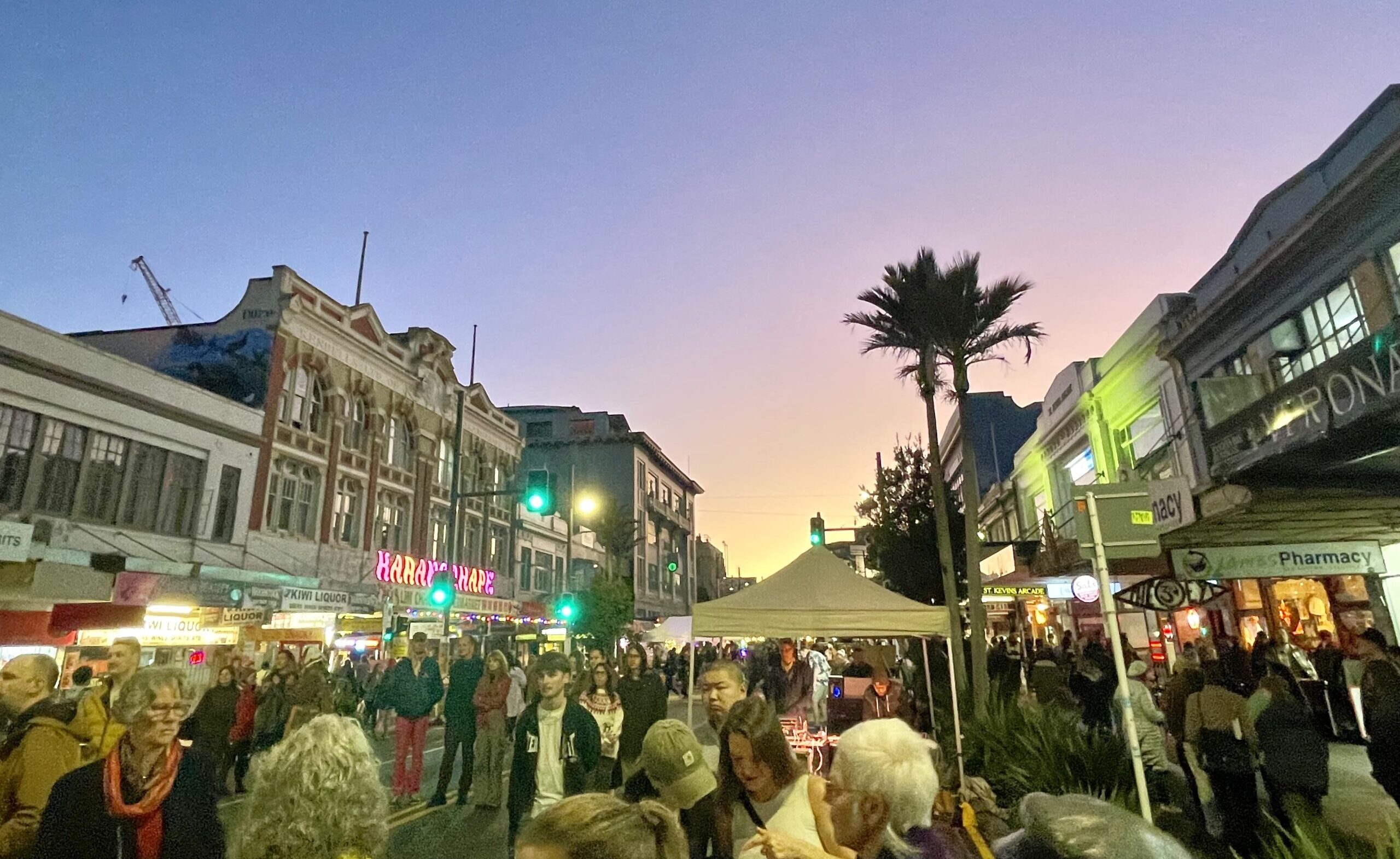
Sunset sky over Karangahape Road, Matariki 2024. Image: Jolisa Gracewood
Videos to watch
For those who like city-builder games, this might interest you.
The justice system and dangerous drivers:
Switching away from a car-centric system?
From the socials
Councillor Richard Hills sharing some great before and after images of different places in the City Centre:
View this post on Instagram
Interesting framing around speeds:
View this post on Instagram
The ultimate “thank you, driver!”
View this post on Instagram
That’s it from us this week, we hope you all are keeping warm!

 Processing...
The planner opposing the Precinct Properties downtown carpark proposal sounds like they are taking advice from an overly conservative council landscape architect. Preserving the natural character of the coastal environment is a landscape architecture matter, and but this is hardly a highly natural location on the harbour. In fact it might be a struggle to find somewhere more modified. With landscape assessment context is everything and I think they might be forgetting where this site is actually located.
Agree – trying to preserve the “natural character of the coastal environment” at this spot is big ask. I would presume that would also mean to get rid of all marinas, Browny’s Pool and Princes Wharf and Hobson Wharf, right? The towers would be next to 5 other high rises…
Yes. There is literally no natural coastline there – this site is way out in the water, from the “natural coastline”.
I look forward to their recommendation that sand be restored to Beach Road.
I’d love to see a strand on The Strand! A bay in Freemans Bay?
Make Fort street Fore street again!!
+1, that is a wild take. The current environment is high rise mixed use buildings clustered around walkable streets. The proposal perfectly matches the surrounding environment. If the area was supposed to be a natural coastline it would be zoned for unlimited heights.
Don’t go giving that Minister Bishop too much praise for finally signing off on some amendments to the Land Transport Rules.
Yes it is great that traffic will have to give way to buses pulling out of bus stops and give some space when passing vulnerable road users.
BUT he has completely whimped out by not going ahead with the simple measure to clarify that it is illegal to park on a grass berm even if there isn’t a sign. Everyone who does this knows they aren’t meant to, but the selfish entitled arrogant types also know they can get away with it so don’t mind breaking that law. If Bishop wasn’t a simp he could have made it possible to give people parking tickets for it – heck it would even raise a bunch of cash for transport projects.
I’m also divided on the idea of letting kids cycle on the footpath – I know it scares my disabled low vision mother – and with good reason. A primary school friend crashing into an elderly woman on the footpath lead to her death with complications from her broken hips. But promoting cycling is a good thing and so many of our drivers are bad enough that the roads aren’t really a great place for kids to be cycling.
Almost getting hit by someone on a bike isn’t fun, biking on the road next to cars passing at deadly speeds isn’t fun either
Agreed, berm and footpath parking denies safe space to people walking and now cycling with their kids.
What does it say about speeds and driving competence that people are scared to leave a car parked at the roadside?
I’m off to drop a skip in a motorway lane…
Re: e-scooters being allowed in bike lanes. I had no idea that they were not allowed in bike lanes. What was the rationale for that restriction?
Also, regarding the scooters, why are they not speed limited?
My e-bike is legally limited to a motor of max 300W and also speed limited in that the motor automatically switches off if I exceed 30kmh, yet I regularly observe scooters doing 50 and often with riders who are not wearing a helmet.
Cycle lanes only allow cyclists. E-scooters were defined as wheeled recreational devices (scooters and skateboards). It was never intended to ban them from cycle lanes, just a hangover from the old rules.
E scooters are already limited to a set wattage, but there is 0 enforcement. If an e-scooter is doing more than about 40km/h on the flat, it’s definitely illegal.
Fyi: The assist on your bike is not required to cut out at 30km/h
Interesting. The cut out is built into the software I think. I’ve never found a way to override it.
Those transport rule changes are great, glad that got through.
“This may be the first time we’ve been described as neoliberal!”
Nope – “Bomber” Bradbury and the late unlamented Penny Bright were describing urbanism as a neoliberal plot ten years ago, and I’m pretty sure Mike Lee would still use those words. Old Lefties will call you neoliberal if you acknowledge that the housing market responds to supply as well as demand, or if you support any development somewhere where old Lefties own millions of dollars of gentrified property.
http://fightbackarchive.blog/2016/10/19/aucklands-no-choice-elections-blue-greens-and-conservative-leftists/
But the position you guys take kind of is ‘neoliberalism’, in that you believe that deregulation and freeing up the market will result in ‘trickle down’ benefits in terms of housing affordability.
I have sympathy for your view, but I also think it’s one that is overly simplistic.
Btw urbanist Richard Florida got a lot of stick too for being a bourgeois urban liberal, and rightly so. Credit to him that he recognised sone of the errors of his ways, and adjusted his views.
The article I link to was written in a Marxist magazine from a Marxist perspective, and Zohran Mamdani is a YIMBY lol
Once again: give it a good read, it’s still valid https://fightbackarchive.blog/2016/10/19/aucklands-no-choice-elections-blue-greens-and-conservative-leftists/
The problem is, radical intensification ultimately does little for true housing affordability. That article alludes to that.
It provides an out for governments to not do the things that they really need to do to address the issue.
The harbourside tower? Meh. Just another corporate high rise, feathering the nest of wealthy developers.
Better than what’s there now and (hoping the flyover comes down) is an overall improvement at street level.
Is it really? Council have raised valid concerns about wind tunnel effects. And what will be at ground level anyway? Corporate foyers?
Its still sounding better.
80 km per hour on the open road, yeah right. We are building four lane motorways so we can do 120 km per hour. Warkworth to Te Hana is on!
nothing’s stopping you from going 120+km/h on the existing roads, mate. You just have to risk getting caught by the cops for it.
What would Warkworth to Te Hana look like if designed for safe, efficient travel at 80 km/h? Would it have to tear down forests and carve through hills at huge cost to economy and environment?
Goggle gives 2:30 hrs to 3:30 hrs from Port Rd. Wnangārei to Langley Rd Wiri leaving mid Monday morning., allowing for truck a bit slower than car.
Warkworth to Te Hana is about 20 km. From 110 to 80 km/h adds 4 minutes to this truck trip. Makes a real difference to a truck driver’s shift, doesn’t it?
Given that Dome Valley needs a better, more resilient road, what should be its design parameters to make economic sense?
Carl doesn’t care about economic sense. None of these petrol huffing lead-and-CO2-poisoned fools do. They’re just base-instinct wanting to ‘go faster’.
Absoulutely. The faster the better. The motorway is on!
If you really believe speed is king, then you would support railways. The 3ft 6in gauge can support train speeds of 160km/h much safer than any motorway ever could.
Motorway off – trains on!
I don’t think Mr Trucking Lobby knows what a “consumable asset” typically is. He clearly hasn’t done his own analysis on benefit-cost, either.