We’re at the final Friday of June, meaning we’re now about halfway through the year. Check out this roundup of stories to cap off your week!
This Week in Greater Auckland
- On Monday we ran another guest post by Nicolas Reid, answering some frequently asked questions on his Waitematā Harbour Bridge Proposal
- On Wednesday Connor covered our presentation to Council about Nicolas’s bridge proposal.
- On Thursday we called for everyone to speak up for more housing in the right places!
Greater Auckland’s research and advocacy is powered by hundreds of hours of volunteer labour each month, and your support helps keep us going! We warmly welcome your donations, and are always open to offers of guest posts, practical help, and pro-bono expertise.
PS Another great way to back the kaupapa: Greater Auckland tees, totes, and (new!) caps! Remember, these are print-on-demand (no returns possible), so be sure to double-check sizing before ordering.
Greater Auckland in the news
Our bridge presentation on Tuesday, at Auckland Council’s Transport and Infrastructure Delivery Committee, gained further attention from the media. Jonathan Killick covered it in depth, for The Post:
Greater Auckland’s Patrick Reynolds and Connor Sharp pitched an idea for a 12-lane bridge system at the council’s Transport and Infrastructure Delivery Committee on Tuesday, outlining several advantages it would have over a tunnel.It would include four motorway lanes, and two “local traffic” and bus lanes each way, for a total of 12 vehicle lanes as well as lanes for bikes and pedestrians.The proposal would include a new six lane bridge that would run from a breakwater at Westhaven Marina and connect with Northcote Point next to the existing Harbour Bridge.Sharp said the project would cost $4 billion to $6b whereas a tunnel might cost $15b or $20b.Reynolds, a former director of NZTA, told The Post he was expecting the transport agency would be imminently recommending a six-lane tunnel with no public transport or cycle lanes.
And RNZ followed up, with John Campbell speaking to Patrick, and to North Shore Councillor (and Planning and Policy Committee Chair) Richard Hills.
An Auckland Councillor is frustrated the council has been left out of discussions about a second harbour crossing in the city.
Transport advocacy group Greater Auckland pitched its idea for a bridge next to the current Harbour Bridge, with four motorway lanes, two rapid transit lanes, and walking and cycling paths to the council on Tuesday.
North Shore ward councillor Richard Hills told Morning Report he understood the Transport Agency would be making a proposal to Cabinet soon.
Then on yesterday’s RNZ Morning Report, John Campbell spoke with Minister of Transport Chris Bishop about where things are at for the harbour crossing. The Minister said he is “hopeful that we will be able to announce a pathway in the next few months”.
He emphasised that government is still “pondering” the next steps, and that he doesn’t want to “rush this”, given over the last twenty years there’s been announcement after announcement, “and then nothing, all kinds of nothing”:
We haven’t made a decision. This will be one of the most significant decisions that any government makes around infrastructure in New Zealand, and we haven’t actually made a decision yet, and we are just pondering what the next steps are.
And an investment case is not the same as a Detailed Business Case to implement it. Because it’s a multi-billion dollar project, right? And so we wanna get it right.
…
We’re intending to engage with the opposition around this as well. Now, they’ve been briefed, they’ve had a couple of briefings around it, and we want to make sure we do it in a consensus way, because whatever happens, if it’s a National government or a Labour-led government or whatever, different composition, the build – and a loan – will be multiple parliaments.
So this is something we’ve got to get right, in the national interest.
…
I want to make sure we do this in a proper, considered way, and that involves dealing with Auckland Council, and talking to the Mayor and key elected officials like Councillor Hills, and there are others as well, I wanna talk to the opposition, and I would hope that if the government changes at the election they would extend us the same courtesy as well.
And we’ll do it in a proper way so we can act in the national interest.
Sounds… rational, and promising?
Time to give feedback on Local Board Plans
It’s that time of year again, where you can give feedback on what your local board is planning to do over the next three years.
This is super important, as what’s in the plan is a lot more likely to happen!
Have your say on the draft local board plan for your area.
Local board plans set out what each local board wants to achieve for its area over the next three years.
You can give feedback on the draft plan for the area where you live, work or often visit.
CBRE report on CRL’s real estate impact
Great new report by Tamba Carleton, Directer of Research at CBRE, on the impact of City Rail Link on the real estate market.
Approaching opening after a decade of construction and a build cost of $5.5 billion, the City Rail Link will do more than move people faster. It has the potential to reshape land use, property values and development patterns across Auckland, with the strongest impacts expected around the new CBD stations, at Maungawhau, and in station catchments where planning and feasibility allow improved accessibility to translate into real property change.
The central real estate effect is straightforward: better access expands the catchment of labour, customers and amenity that can be reached from a site, changing how occupiers, developers and investors assess value.
This report draws on global evidence from comparable rail investments, the Auckland market evidence accumulated during the build, and CBRE’s sector-by-sector analysis of what the decade ahead could mean for office, retail, housing and investment markets.
The last big rail closure before the CRL?
In two weeks we’ll be celebrating Matariki and with it comes hopefully the last major rail shutdown as well as another City Rail Link test.
Rail infrastructure upgrades and a network-wide dress rehearsal will enable the City Rail Link to progress faster. The work will be carried out while Auckland’s rail network is closed over Matariki weekend, including the day prior, Thursday 9 July.
The closures, from Thursday 9 July to Sunday 12 July 2026, will see KiwiRail and Auckland Transport progress rail infrastructure upgrades to support City Rail Link’s opening and progress on safer level crossings. They include works on three new station bridges to replace level crossings, track renewals and progress on three new Drury Stations.
The closures also include one day of trialling Day 1 CRL operations and the future Monday to Friday timetable – the standard weekday service our rail network will be operating on when the City Rail Link opens. The trial incorporates all the systems and programmes that will need to work together for the City Rail Link to work smoothly, integrating new systems with old and all the complexities associated with that.
…..
What is happening during the CRL timetable dress rehearsal?
The 9 July dress rehearsal will give our train drivers, managers, and controllers – the people who operate the network the opportunity to become more practiced with the future network.
April’s test gave us confidence we can run the planned timetables reliably. It confirmed the plan to open with a temporary timetable and then build to full frequency within six months is the right one to ensure reliable services – common practice on major rail projects worldwide.
We will now take the learnings and decisions made from April’s timetable testing and apply them for the 9 July dress rehearsal. We’ll be making sure that timetable data is feeding into customer information displays correctly, and Journey Planning tools are integrated into network operations. This includes over 200+ screens across train stations, and the AT mobile app.
For the Thursday shutdown there’s a range of rail bus options, including peak time express rail buses. There’s more information here.

A train on the platform at Karanga-a-hape Station – photo from our recent tour, more here!
Speaking of the CRL, it’s great to see that those most responsible for approving it have been given a proper VIP tour!
View this post on Instagram
Matariki celebration on Karangahape Road
Karangahape Road will be opening to people this Matariki! It should be great, given how many people showed up in 2024.
Event Details: Te Karanga-a-Hape
Thursday 9 July 2026 5pm–10pm
Karangahape Road, Tāmaki Makaurau Auckland
Admission: Free and open to all ages.
Programme Highlights:
- Karangahape Road closure for free programme
- Performances from Ladi6, Halfqueen, MA and more
- Hosted by comedian Janaye Henry
- Kapa haka, spoken word and storytelling
- Large-scale Matariki art installations down the road
- Fire pits and community gathering spaces
- Crafting areas and interactive art
- Afterparty at Double Whammy, Public Bar & Whammy (Details to come)
https://www.karangahaperoad.com/
Supported by Ngāti Whātua Ōrākei, Karangahape Road Business Association, Auckland Council and Abstract Hotel
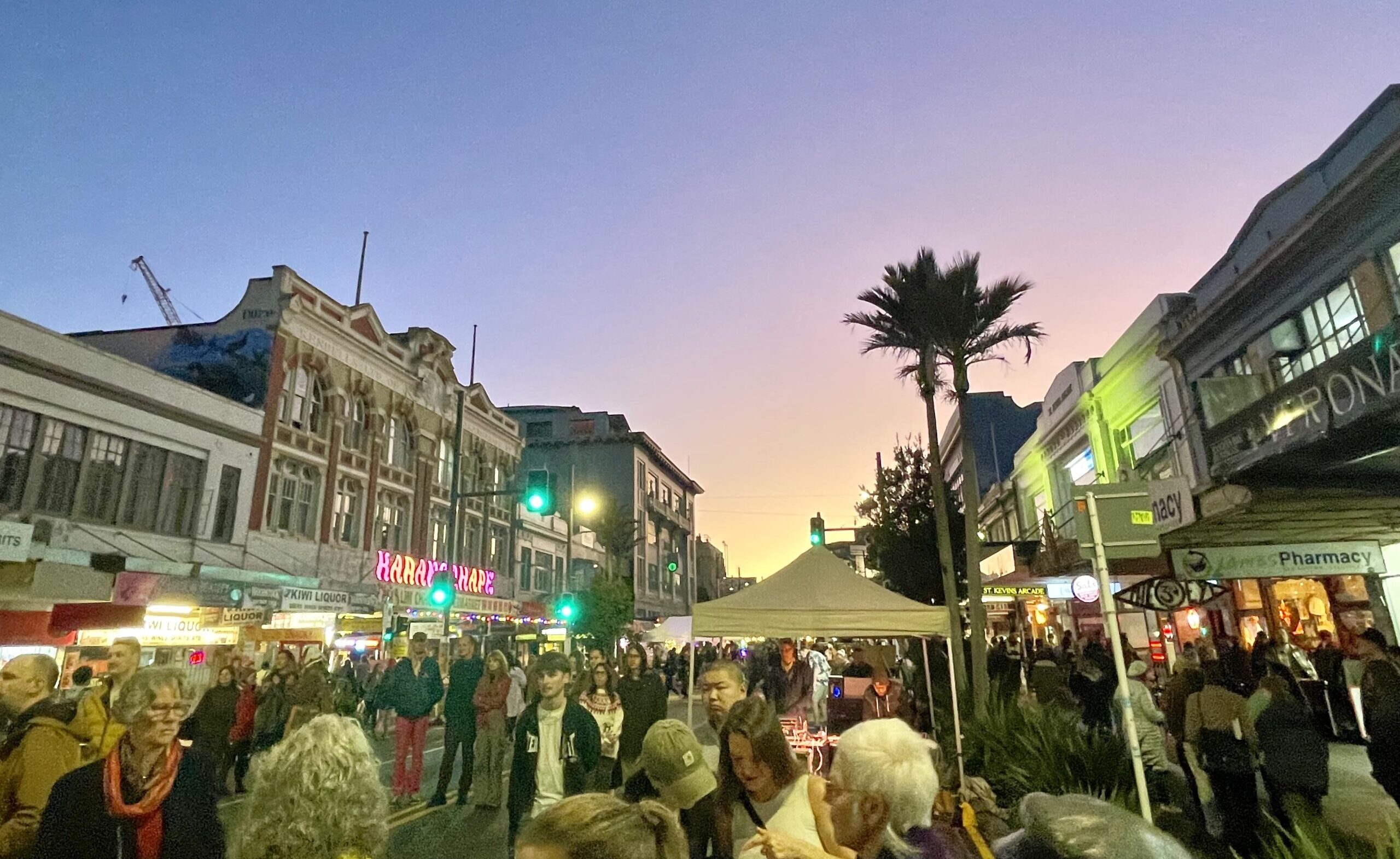
Sunset sky over Karangahape Road, Matariki 2024. Image: Jolisa Gracewood
Check out the full programme of city centre Matariki activations (see also this overview story), some of which is already up and running, like the Taurima installation in Elliott St featuring the colourful vision of Lissy and Rudi Robinson-Cole.
And here’s the programme of Auckland-wide Matariki events brightening up the dark midwinter.
New slogan for Auckland?
Stuff is asking if Auckland needs a new slogan. City of Rails anyone?
Busiest May in a decade for Auckland’s bike counters
We recently covered how cycling was tracking up through to April, and now Auckland Transport is celebrating even more records.
Auckland is fast becoming the cycling mecca of the South Pacific, with a huge surge in people jumping on their bikes on both weekdays and weekends.
Following a 20.3% increase in cycling trips counted in April when compared to last year, May saw a 14.4% increase. Strikingly, cycling trips in May recorded their highest number in a decade.
AT’s Head of Active Modes, Tania Loveridge, says it’s fantastic to have seen the significant cycle counts over the last couple of months, and the ongoing year on year growth.
“Aucklanders now have more cycleways to enjoy than ever before and are also looking to get access to bikes in record numbers.
“It’s the perfect time for people to consider getting out on their bike – it offers significant cost saving and many time saving and health benefits.”
Has the fuel crisis encouraged more Aucklanders to get on their bikes?
“Our research shows us that providing safe, protected cycleways is critical to getting more people on bikes. As is having access to bikes – with 67% of people telling us they’d consider cycling if they had access to a bike. The distance to be travelled and convenience are also a key factor,” says Loveridge.
“The cost of fuel is likely to be a motivation for people to get on their bikes.
“People will consider other options for travel including using public transport, cycling, or even walking. The increase we’re seeing with cycling is being mirrored with the increase in public transport usage.
And here’s a nice RNZ interview with Auckland Transport’s head of active modes, Tania Loveridge:
One thing to always point out when mentioning Auckland Transport’s official bike counts is they come from counters that only capture a fraction of the actual everyday cycling across our city. Most trips to school, to local shops, and other daily errands don’t go anywhere near an automatic counter. And yet, they count!
Interestingly, Te Whau Pathway – which only just recently opened, and isn’t in AT’s publicly released data yet – topped the list of counters as more than 50,000 people flocked to check it out.
As anyone who rides the Northwestern Path of a morning will have spotted, Te Whau is not just a weekend leisure destination – it’s being well used by school kids heading from Te Atatū South to Rutherford College on the peninsula.
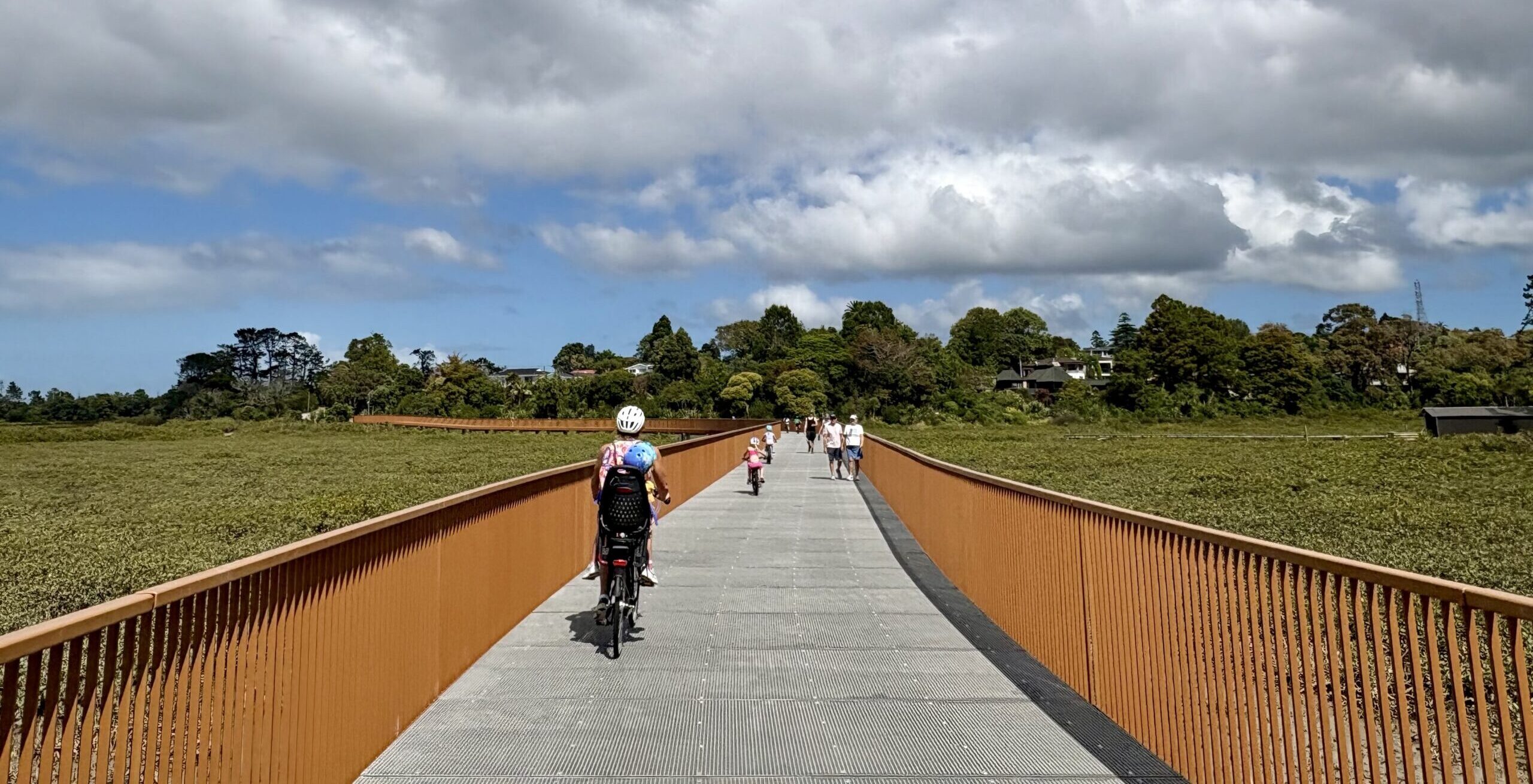
Te Whau Pathway 28 March 2026. Image: Jolisa Gracewood
Why Wellington’s air is getting worse
Report finds the air quality in Wellington is getting worse, especially in the Golden Mile.
The report stated that the region “should have some of the best urban air quality in the world” as it was bordered on three sides by coastlines exposed by constant sea breezes and strong westerlies.
It found that air pollution was of particular concern in the Golden Mile – a busy transport and retail corridor in the capital – where improvements were being reversed.
The amount of black carbon in the air on Manners Street has risen by 15 percent between 2023 and 2025.
The report cited an increase in diesel buses along the route, following higher passenger demand, as the cause.
Businesses along the Golden Mile were exposed every day.
“I think about air quality all the time,” Unity Books manager Susanna Andrew said.
“I bike in every morning, so I do fill my lungs up with some good air, and it’s an amazing city to bike in around that waterfront.
“But when I get here into Lambton Quay […] it’s a heavy dollop of diesel fume when there’s a lot of buses coming in.”
Several out-of-towners walking down the Golden Mile told RNZ they could noticeably feel the air quality in the city was not as good as outside of it.
Sounds like Wellington needs more electric buses, and fewer cars! If only there were a plan to do exactly that…
Transport electrification lagging behind
Business use of fossil fuels has peaked in New Zealand according to the Energy Efficiency and Conservation Authority, but a lot of transport is still fossil-fuel driven.
“Transport is the biggest energy user – it accounts for about 39 percent of the country’s energy consumption and it’s still around 96 percent fossil‑fuel driven,” Pelenur says.
Just 4 percent of road transport energy came from electric vehicles. Most of that was from conventional, non‑plug‑in hybrid vehicles, which still rely on fossil fuels, alongside smaller contributions from plug‑in hybrids and battery‑electric vehicles.
But there’s been some more progress on the public transport front:
Napier and Hastings will have an all-electric urban bus fleet starting in 2027, marking a major step toward cleaner, quieter public transport for the region.
Hawke’s Bay Regional Council has awarded New Zealand family-owned Tranzit Group a new nine-year contract to deliver the urban bus services that will support the 2027 Public Transport Network. The contract is expected to start on 1 August 2027, following a transition and implementation period.
HBRC Chair Sophie Siers said the all-electric fleet would be a significant step for public transport in Hawke’s Bay.
One thing that doesn’t help, there’s a bit of anti-electrification going on out there with thieves stealing copper from both the Auckland and Wellington rail networks.
An Auckland train line has been targeted overnight by thieves looking to make an easy profit from copper cable-lined railways, as authorities tie the booming scrap metal market to an increasing number of theft attempts.
Auckland Transport (AT) warned passengers that Eastern Line trains would run at a reduced frequency “due to a track infrastructure issue between Meadowbank and Ōrākei” in a notice just before 6am.
Liverpool City’s big investment in PT, walking and cycling
Something for Auckland to take note from?
Mayor Steve Rotheram today revealed plans for a record-breaking £1.6bn investment in Liverpool City Region’s public transport including new railway stations, rapid transit links and smart ticketing across the entire network.
The city region’s biggest ever public transport investment is designed to better connect communities, including major new housing developments, while boosting productivity, driving economic growth and unlocking regeneration.
From the socials
How escalators are tested for CRL:
View this post on Instagram
How access for disabled people has been tested for CRL (featuring Vivian Naylor)
View this post on Instagram
Mayor Mamdani getting things done:
View this post on Instagram
That’s it from us until Monday, have a good weekend!

 Processing...
People who foam at the mouth about transit stations having names in the indigenous language are not restricted to Tāmaki Makarau – here’s a similar character in Baile Átha Cliath/Dublin (where the whole map is available in Irish as well as English) https://www.reddit.com/r/ireland/comments/1ufmizx/completely_useless_sign_on_the_dart/
Those are not place names. They explain to locals that that station was paid for by tax money ripped off from Australia, the next by taxes ripped off from New Zealand etc. Even the system of national accounting had to be modified because of the way Ireland is used as a tax haven by international business to evade taxes in the countries they earned the money in.
Miffy, in an era when we’re actually getting transit improvements, your “Better Things Aren’t Possible” shtick is tiresome
How is life going in one of the oldest residential areas in Welington. Descriptively named, and in English, but about 150 years ago, Newtown?
We are complaining, justifiably, about having to tolerate too much poor quality Wellington decision making. But Wellingtonians have to endure that to a whole new level their local level. This as well as the consequential broken pipes and unreliable connections to the south. Unreliable, even without the frequent crap weather.
The key point in that Liverpool transport plan and budget is it is the result of a city deal with their central government. The 1.6b British Pounds is from central govt but is controlled by the region. Is all going to public and active transport.
A city deal with no money, is not a deal, is just an agreement to talk but with decisions made in Wellington. City deals in the UK have been transformational, because they bring new money to invest locally and not on projects imposed on the city by central govt.
Here we have central government imposing their big roads agenda onto the Regional Transport Plan, sucking up all the available investment. No deal, but a diktat.
The height of central government arrogance is that local government’s ability to have conversations with central government over issues common to both of them, now require to operate under a formal agreement.
Time in November for Aucklanders to reject this obscene level of Central Government subjugation and lack of respect. We are 1/3 of NZ’s people and power.
We need to remember that we live in what was originally a very Maaori area, and that we are lucky that Ngaati Whatua emerged from the 1970s struggles to be a relatively powerful Iwi. Naming things Maaori is a fantastic method to celebrate our place in the world, Pakeha English is after all, an entirely imported reo, and I would rather be here than England, any day of the week, month of the year etc.
Remembering that the Central Rail Link is our biggest infrastructure investments ever, it is only logical that any other infrastructure investments in Tamaaki Auckland should take advantage of this investment in our rail network.
We need to connect the North Shore, Mount Roskill, and Maangere. Surface Light Rail still makes the most sense, in any direction; a new bridge would allow that to be a possibility.
We know how expensive tunnelling is, and how many businesses have suffered from the CRL construction phase. Bridges are works of art, they become architectural aspects celebrating a city, tunnels become flood risks (recalling what happened in Waterview when the sky fell in a few years ago here).
bah humbug
Liverpool investing in PT and active modes? Bah humbug, we need a 4 lane motorway between Warkworth and Te Hana (population 120) much more. We also need 6 car lanes tunnelled directly into the CBD across the Waitemata…not sure where they will park once they get there but that’s just detail.
PT and active modes can wait till 2050 when we actually need them
The Reality of Everything Symposium on in Wellington today had some good transport mentions, particularly from Professor Robert McLachlan, but I think almost all speakers touched on it. We have an enormous transport overhaul task awaiting us.
Also of note was Professor Alistair Woodward characteristically quiet and polite (but equally steely) dismantling of Wayne Brown’s climate misconceptions
“Communist!”
“It’s pronounced Cyclist.”
Lolol. Love it. He’s quick on his feet.
Bring on the bridge !
Key question im looking for answers to – when can we get a cycle over the harbour.
Pretty sure the wellington solution will be loaded with language along the lines of – once the new connection is constructed, we’ll be able to use the old bridge for walking and cycling. Thats the no walking or cycling til 2040 answer.
With Australia’s roof top solar at 33% and New Zealand at 3%, how low must we aim on basic mobility like walking and cycling across our city. Fix the network.
Thanks GA, Connor and Patrick, you may have redefined Aucklands next 100y ! or at least defined the next 100 days of protest against car only infrastructure.