It is now over three months since the fuel crisis started as a result of the Straight of Hormuz being closed. And, while petrol prices have largely disappeared from the headlines, the data shows we’re definitely seeing what you might call a “Trump Bump” in public transport and cycling numbers.
Public Transport
After PT ridership stagnated somewhat in 2025, in early 2026 we were seeing some small signs of growth with usage tracking slightly up before the Iran war started at the end of February.
It took until mid-March before fuel prices started to rise but while there was some immediate impact on PT use, it wasn’t until April that it became clearly visible. It’s worth noting that late March ridership was dampened in part due to a significant rain event on Thursday 26 March, which reduced PT use on that day by at least 100,000 trips.
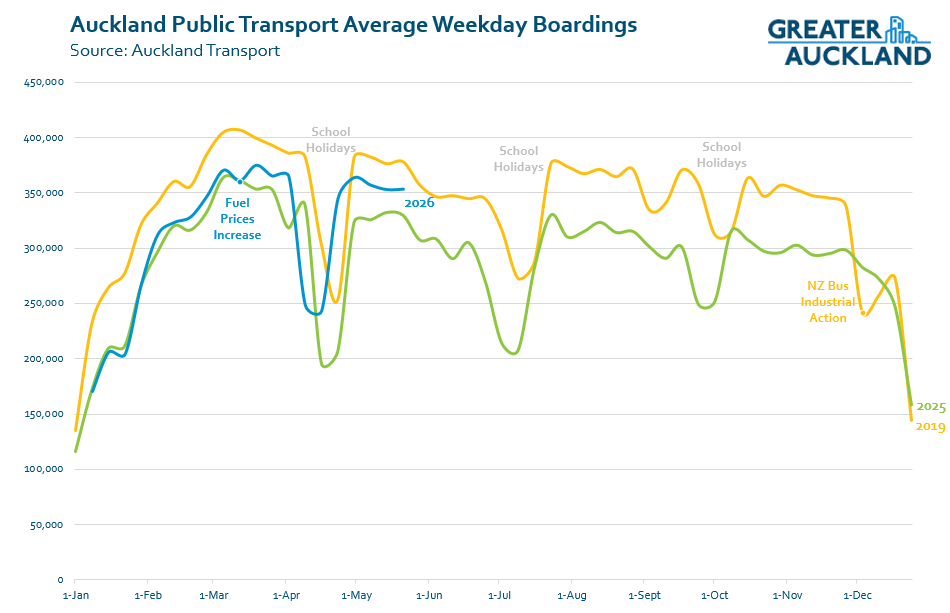
You can see the impact on this chart below, which tracks average weekday usage. (I’ve removed the Thursday mentioned above from the data.) Prior to the fuel crisis, ridership was tracking around 86% of pre-COVID levels. Now it’s more like 94%.
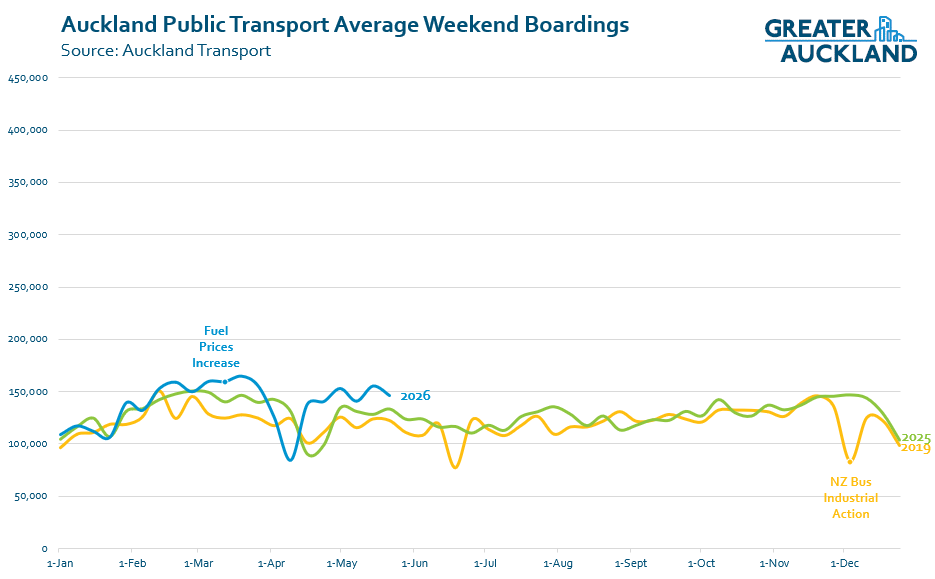
The rise is even more significant on weekends, where usage had already been tracking above pre-COVID levels for a few years. Now, since fuel prices increased, ridership gone up another level to reach record highs –and is now around 24% up on 2019 numbers.
While weekend usage is still only a fraction of weekday use (around 40% at the moment), it is a good indicator that people are starting to use PT for a wider range of trips.
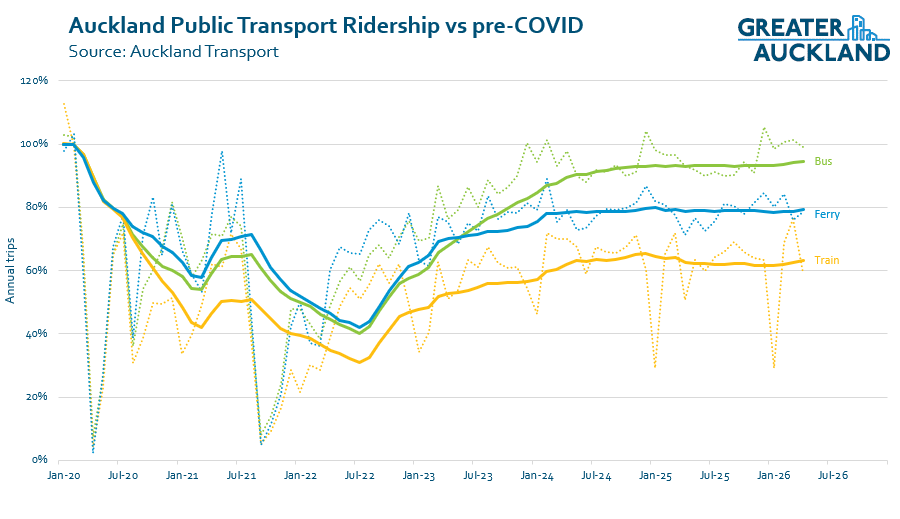
Combined public transport use (bus, train, ferry) is getting close to those pre-COVID levels, which is most evident when we look at usage by mode.
In both February and March 2026, bus usage exceeded pre-COVID levels. March was the highest level of bus usage on record, with over 7.5 million trips – and as mentioned above, it would have been over 7.6 million had it not been for that major rain event. By comparison, the previous record for bus usage was March 2019, with 7.4 million trips.

With annual bus usage sitting at 71.1 million, we’re still a little bit behind the February 2020 peak of 75.3 million – but if current trends continue, we could see that reached later this year or early next year.
Auckland Transport has provided some more insights into where the usage is coming from, in this piece by 1News.
The agency says students and weekend travellers are driving much of the growth, with bus use up 6% compared to the same time last year.
“Particularly buses and it’s students actually that are using it more and more now,” Auckland Transport interim chief executive Stacey van der Putten said.
“We’ve seen a 35% increase year on year of use of that tertiary concession.”
…..
Auckland Transport said one of the biggest increases was being seen on weekends as more people return to the city centre for shopping, events and social activities.
As we’ve highlighted before, the mode that is perhaps holding Auckland back the most is rail. That’s because for the last six years, patronage has continued to suffer due to significant disruption from the rebuild works and more recently CRL testing.
As such, ridership is sitting at just under 14 million trips annual, which is around 63% of pre-COVID levels (22 million).
To give an idea of the scale of that reduction: if rail was back to say 90-95% of pre-COVID levels, which it may have been if not for the disruption, that would be adding an extra 6-7 million trips to annual ridership figures.
March was one of the few months with little disruption on the lines, and usage did reach a post-COVID high of 1.6 million trips, or about 76% of what was seen in March 2019. Since the disruption over April we’re now more regularly seeing weekly data in the 75% range. This gives some hope that once the disruption truly ends, we could see usage quickly get back to what we’ve seen before – and then actually begin to grow as a result of the CRL.
These numbers suggest there might be at least a million more trips being taken on public transport at the moment than there would have been had current world events not happened. That’s a significant amount, and likely provides a lot more fare revenue for Auckland Transport to help off-set costs. I wonder how much higher ridership might be, had the government actually tried to encourage – or even taken active steps to enable – more people to use public transport?
Cycling
Cycling numbers are a bit trickier to assess, when it comes to the story of who’s actually riding in Auckland, and where.
There are now over 80 counters on on cycleways all around the region, and more keep getting added – but even so, they’ll never pick up every trip (especially all the local trips to schools and shops). And some trips may be picked up on multiple counters (which is also true for almost every driving trip).
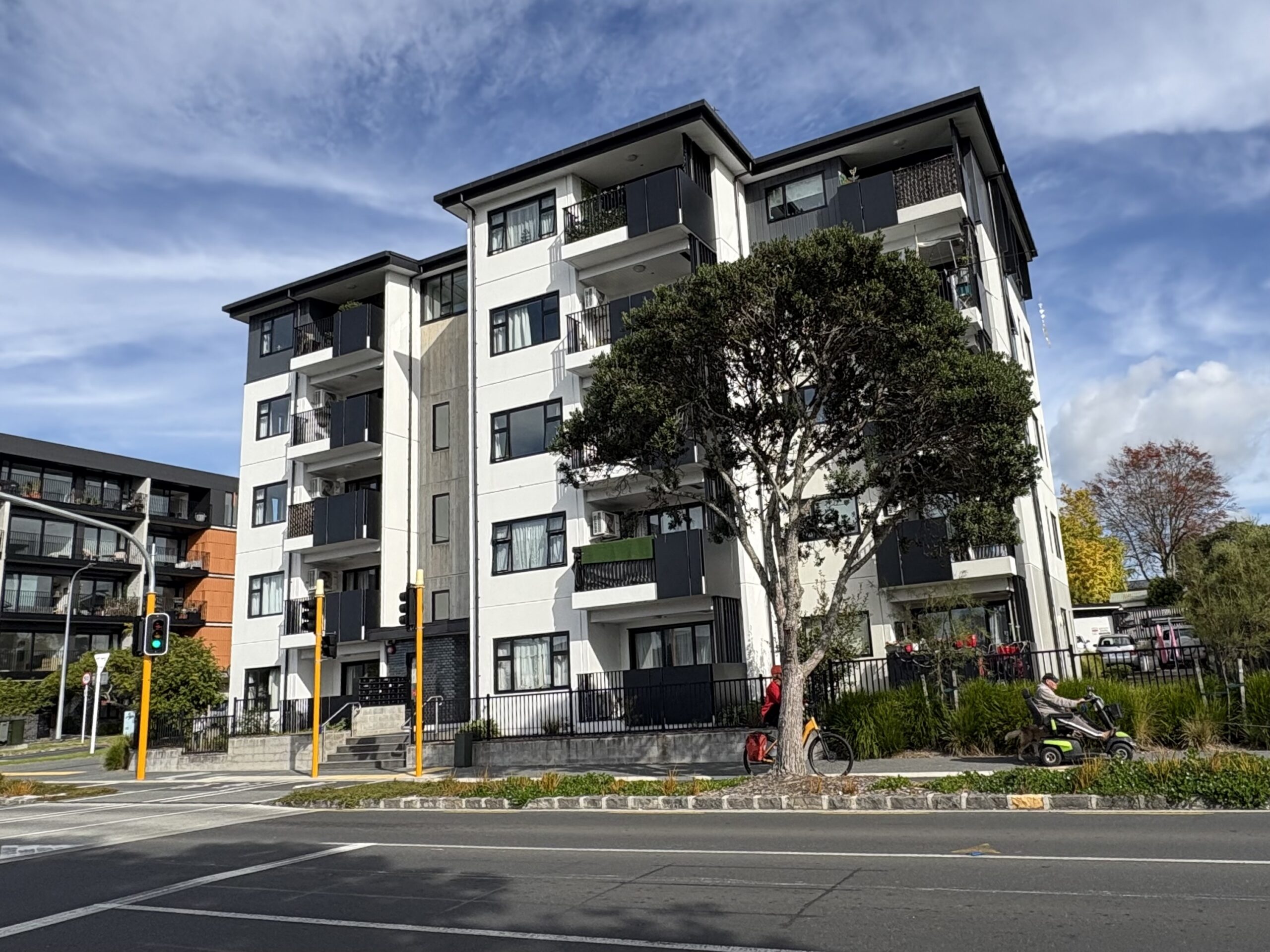
Spot the wheeled mobility enabled by street design that won’t be picked up by official cycle counters, because there aren’t any on this street. Image: Jolisa Gracewood
In its reporting, Auckland Transport typically refers to a subset of 26 counters for which they have the most history. Those 26 are in a variety of places, including leisure routes in suburbs, but a tighter “city cordon” subset of these can also be used to home on on trips to the city centre.
Both the 26 counter measure and the city centre cordon counts show that March numbers were very slightly down on March 2025. This was also impacted by that severe weather event in late March, with many of the bigger counters, such as the Northwestern Cycleway, Quay St and Tamaki Drive all down by 1k to 1.5k trips.
However that changed completely in April: ridership was up significantly, with the 26-counter metric increasing by 20% on the same time last year.
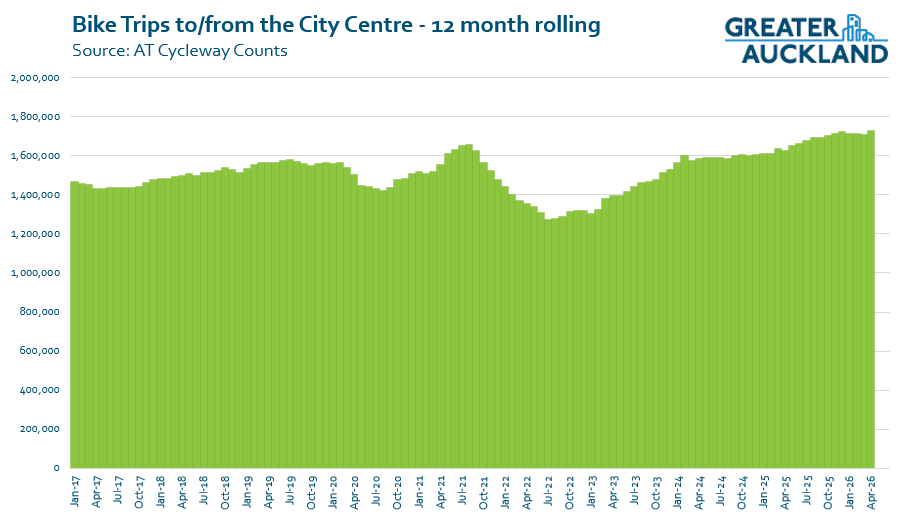
Also in April, some cycleways saw very significant increases, such as Karangahape Rd which was up 32% in April compared to last year – likely as a result of Gt North Rd being completed. And Quay St, which was already the busiest counter, increased by 29% compared to April last year.
Note: Another useful place to keep an eye on cycleway data is Dr Tim Welch’s dashboard here, and MRCagney also runs a walking and cycling dashboard. Both use the Auckland Transport counters.
There’s certainly some interesting trends emerging, and it will be fascinating to see how they continue in the weeks and months ahead.

 Processing...
The weather has been pretty good heading towards winter with my observations of cyclist numbers holding. This week has been different thou, cycling to work in the rain is often a more solitary workout, at least until I get closer to the city. E-bikes become scarce especially on the 2nd day of rain. The proportion of us left on analogue bikes soldiering on becomes much higher.
I wonder how much of that is because if you’re using an ebike you are more likely not have a change of clothes. When I cycled in on my regular bike I would always need a change of clothes regardless of weather.
One of the cycleways that seems to have exploded in usage is Whangaparaoa, 24.8% over this time last year. Pretty incredible for a cycleway which doesn’t seem to connect to anything yet!
I’m sure AT are also tracking weekend reliability data on some of the key frequent bus services.
Often Saturday traffic is as bad as week traffic, with longer, more spread out peaks.
Would be interesting to know how many of the routes that have bus lanes, will have them open on Saturday/Sundays. I know there’s a few in Newmarket, but there must be some other prime locations (Dominion, Mt Eden, Manukau Roads etc).
Conspiracy Theory:
The War by That Orangey Thing besmirching the White House on Women Life Freedom, Hormuz, IRAN, is because JAFAtown Taamaki Auckland needs better public transport!
We already have good Feminism, reasonably good life, and Freedom for many of our Ladies; so the most important thing for a city the size of Los Angeles, with the population of a tiny town in Nowheresville USA, is a good way to move about; without the need for a private automobile, or car, as we have simplified its name.
There is a claim that automobiles gave an independence to womenfolk, when they had less liberty. I, as a person with a boomer father, and feminist mother, understand how important my mother’s car independence has been, and is, since she gained this.
However, as we are those who ride bikes, walk around, and utilise public transport services whenever possible, we know more than any other person, from any political party, any generation, and any degree of neo liberal anarchist tendencies.
So as the world is dominated by disgusting old men, who are spending their retirements trying to control a world that they never understood, the unbelievable stupidity and shortsightedness of their actions has resulted in the greatest civilisation ever known…Persia, gifted the ability to inflict it’s curse upon us, and demand that we enjoy our freedom: by wasting time on our bikes, walking around, catching ferries, trains and buses.
Because really, it doesn’t feel like time is being wasted when you are not in control of a tankesque vehicle that could squash you at any time. Far better to be inside something slightly larger than the Remuera etc. “BIG CAR BIG WHEELS” (CCTV Band quote) ; which is offered by our public transport network.
Also please don’t forget that Women in the “Middle East” are the true warriors ,that we hope will one day find the freedom that they deserve.
bah humbug
Making the best out of the Blitz is never about condoning horrible acts. But learning how to live better for everyone is valuable, whatever has led to the change. Making Auckland a better place should go hand in hand with making the world a better place.
I think it was bikes that gave women freedom to travel. The evidence is that many first wave feminists were keen cyclists.
You are right – although its interesting to note some other inventions that also contributed to expanding women’s freedom.
One overlooked development was the invention of the loo (specifcally, women’s loos).
Before they were invented, women’s ability to travel would be curtalied by their ability to ‘hold it in’.
Its still a relative issue today (men have a biological advantage in this regard – both in respect of vulnerability and the pragmatic ease of sending a cable down the side of a tree).
I fail to understand why the transport engineers designing Aotearoa’s infrastructure are so allergic to the idea of building electric railways, while also insisting we need more electric vehicles and more mass transit
Its probably more to do with the rules that transport engineers have to apply when carrying out their functions – these rules will balance the interests of different types of people (the balance is off, sure).
I say ‘probably’ as there is also a culture among engineers at play as well.
(My biased point) A fact compounded by their tendencies to place their egg-headed foreheads too close to the problems they try to solve without pulling back a bit to take in the bigger picture.
I’m sure there are plenty of engineers at large in NZ who would love the chance to develop mass transit solutions such as electric railways.
AT has done well to dig out and strengthen stretches of New North Rd beside Western Springs. They have also resealed other parts of the road at Kingsland.
Those many large potholes were hard on busses and passengers.
Agreed – very nice & smooth to ride a bike on too.
Although they seem to have run out of steam (& asphalt?) on Gt Nth Rd citybound side formerly know as Chinaman’s Hill. Roadmaking equipment has been parked up for over a week now and the transition from old to new surface cuts quite dangerously across the citybound lane, with lots of loose gravel swept into the bus/bike lane. Not sure what’s happened there but will be lovely once done!
Bicycle mechanic here – can confirm a definite Trump Bump in March & April. May was about average, as is June so far…
Give the old ratchets a spin for all of us won’t you.
Good to see these figures pick up. They certainly will improve if we don’t have another pandemic, the CRL opens and more cycleways are connected together.
Based on the cuts in the surface on the North Western cycleway I believe one of the counters is near the Nixon Park carpark. As it’s quite a busy point, and it looks like it is probably just one sensor across the whole width, I wonder how accurate it is when you’ve got cyclists close together in a bunch or passing there? Are the counters sensitive enough to figure out each wheel or just a flash of 1 or more bikes?
Given the numbers moving closer to pre-covid levels, I’d be really interested to understand the number of unique travellers (breakdown by Hop card and cash/card). Pre-covid I would be travelling in 5 days p/w by train. Now I travel in 2 days p/w. That’s a reduction from 10 to 4 trips per week. I’m sure I’m not the only one still WFH, so the increase is even more impressive and suggests public transport is becoming more accessible and more used by more people.