On Tuesday 9th June, Auckland Council’s Policy, Planning and Development Committee voted on housing policy options to send to local boards and iwi authorities for consultation and engagement.
Narrowly, the vote saw two out of four options proceed: Option A and Option B. While Option C & D may have had merit, they are essentially out of the political debate now.
That means A and B are now with local boards to consider.
And you have the opportunity to shape what comes next!
In our view, there is enormous risk if Option A proceeds. Option A represents the ‘do minimum’ option. It would only do what is legally required by the most recent central government dictates.
Notably, Option A fails to upzone around major transport corridors and many walkable catchments for public transport.That would represent an enormous missed opportunity to allow more housing in the right places.
Option B, in comparison, would be truly beneficial for Auckland.
Option B would upzone the highest priority locations: town centres and local centres, the busiest frequent bus routes, and stations on all the rail lines that will benefit from CRL.
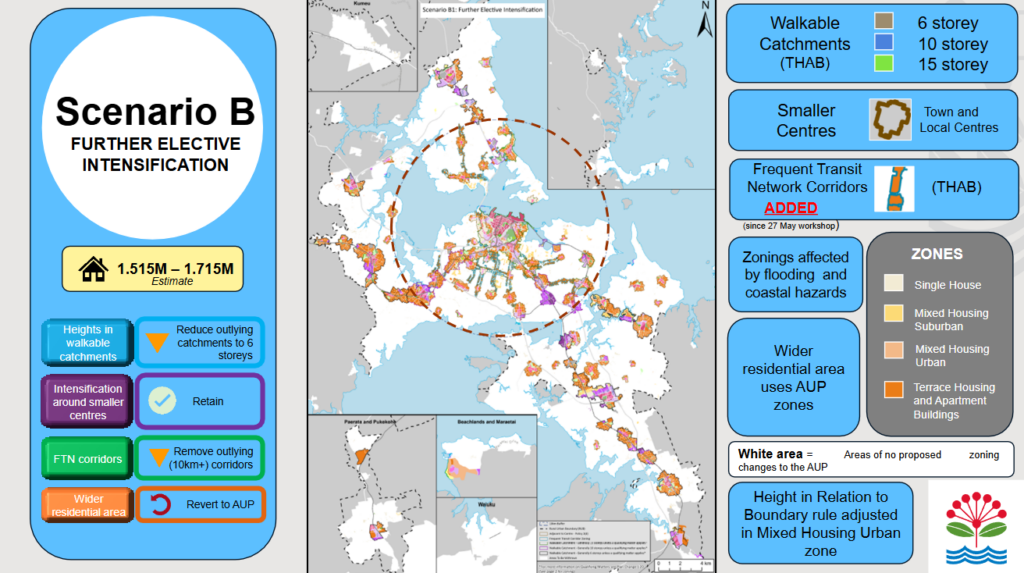
Under Option B, upzoning will happen in the places best suited to density, with easy access to amenities and lots of transport options: the central isthmus, town centres and local hubs.
And, maximising the value of CRL, all inner city stations will be upzoned to 10-15 stories, out to New Lynn, Sylvia Park, and Penrose – enabling way more smart transit-oriented development than the minimum specified under law (that’d be just Maungawhau, and stations out to Mt Albert).
It’s important to note that Option B has been improved since this 27 May Auckland Council workshop, with frequent transport lines added to the proposal as recommended by Council staff at the 9 June meeting.
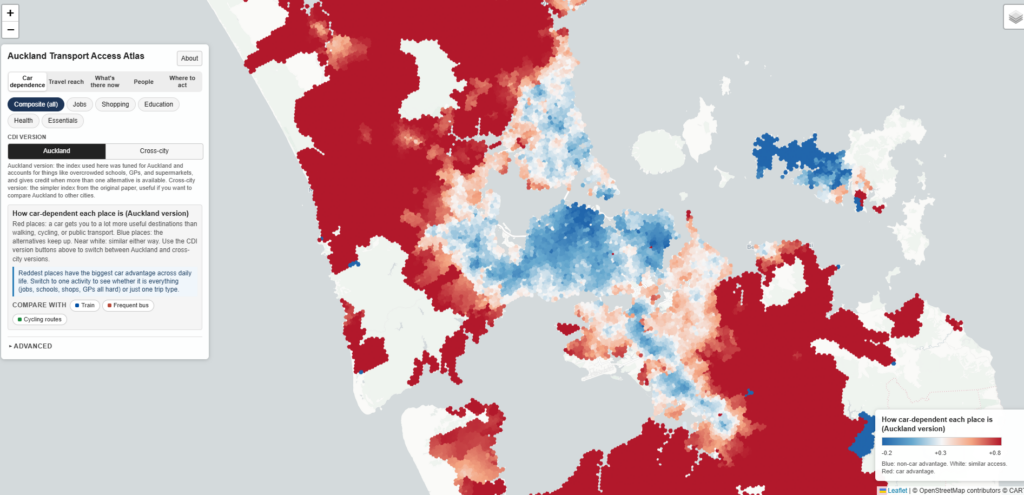
Basically, Option B aligns housing with places where you don’t need a car for everyday life – as you can see if you compare the proposed upzoning with Tim Welch’s map showing areas of Auckland with greatest car dependency.
Option B will mean more affordable housing where people want to live, with great access to great transport options, meaning fewer emissions, more efficient use of existing infrastructure, lower impact on rates for every household, and lots more!
You can check out more detail on the options in the documents here.
After local boards and iwi give feedback, Council will sign off their preferences in July, which will then be sent to the Independent Hearings Panel for their consideration over the next 12 months, where submissions will open again. But which option is endorsed by Council in July will be extremely important, which means this is a pivotal moment.
Greater Auckland’s view is that for Auckland to truly develop into a compact, dense and liveable city, Option B is the way to go here. And you can help us achieve this.
Keen to use your power to get more housing in the right places in Auckland? Contact your local board and let them know!
A guide to giving feedback
Everyone can have a say on this topic. What happens next determines the shape of the whole city as well as things like future rates bills, where you and your kids can afford to live, and so on.
First, it’s important to contact the local board for where you live: here’s how to find and contact your local board.
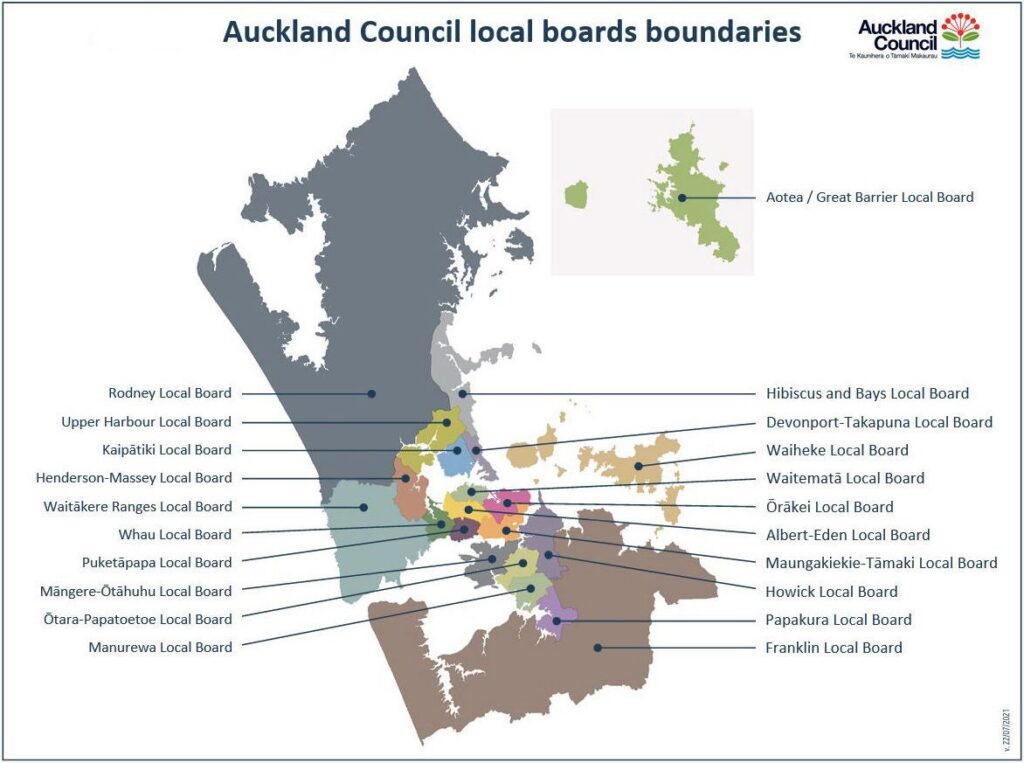
Each local board will be discussing this topic on different days. Check here to see when your local board is meeting (or has already met) – note that the meetings for PC120 feedback are categorised as “extraordinary meetings”.
Manurewa and Ōrākei have meetings today, Thursday 25 June – and the rest are likely to meet very soon, so act now. And even if your board has already met (that would be Henderson-Massey, Devonport-Takapuna, and Māngere-Ōtāhuhu), it’s still worth sending an email – boards will be in discussion with Councillors right up until the vote in July.
It’s even more important to speak up if you live in the local board areas that are within 10km of the city centre and have good frequent transport connections. Here are the easy links to click on/copy for those boards:
If you’re keen, you can also ask about giving a public input (or “deputation”) at the relevant local board meeting – an opportunity to speak concisely to the issue, and share your thoughts.
What to say?
As always, be as polite and clear as you can – especially as the people reading your feedback may well agree with you!
Above all, be sure to explicitly state your support for Option B – even if there are also amendments you might want to make.
Another good thing to advocate for is increasing the 6-storey limits to 8-storey, which makes it more economical to build affordable residential developments than a 4-6 storey limit.
The rest is up to you, but you could mention the importance and value of things like:
- More affordable housing
- Younger generations being able to afford to live centrally in Auckland
- Older people being able to downsize and keep living in their community
- Walkable neighbourhoods close to shops and around town centres
- Housing that’s close to great transport options
- Reducing emissions by keeping the city compact and connected
- Lowering the rates burden by maximising existing infrastructure and investment
You may also like to refer to the following reports/analysis:
- Economic analysis showing the areas of Auckland with most development potential
- Watercare’s report on Auckland-wide infrastructure capacity
- Tim Welch’s map outlining which areas are not dependent on cars and thus best suited for higher density (in blue)
And of course, feel free to ask elected officials to go further, e.g. by adding more density in given areas and filling in the missing transport links. You may, for example, want to advocate for:
- even higher density in more central areas
- reductions to “special character” areas, while protecting genuine heritage
Referring to evidence is great, but equally powerful is talking about your own experiences of – and aspirations for – your community. For example, describing how it would benefit you (or, would have benefited you) to have more housing in a particular area, close to shops and key transport links. That might include economic benefits – like, what you might save in travel costs – as well as intangibles, like your kids being able to walk to see their grandparents!
Describe the future you want for yourself, your friends, your kids, your parents. Elected representatives play an important role in steering us towards that future, and it helps when they can picture who they’re working for.
Lastly, your feedback doesn’t have to be long, or perfect – just, done! Even a simple paragraph saying you live in the area and you support Option B is great! Thanks for speaking up.
Greater Auckland’s work is made possible by generous donations from our readers and fans. Support our work by joining our circle of supporters here and setting up a reoccurring donation.

 Processing...
With regards to ‘special character.’ I agree that we don’t need to keep every single villa, but it’d make sense to have a designated “historical district” like in some other cities in which could also serve as a tourist attraction in future decades/centuries (providing those villas are maintained). Perhaps a street or two in ponsonby.
The problem is that this gives a licence to print money/seek rent to people who happen to own property in that street.
The logical answer is for the Council or the Government to buy that whole street out and make it a proper historical park.
And then let the houses out to the people of Auckland for holidays, like the historic baches on Rangitoto and the old houses in public parks.
That way, everyone has a chance to properly enjoy the “historic character” from the inside, not just the street. Anything else is facadism – might as well preserve the flat-fronts, like a movie set.
(NB only historically accurate plumbing allowed though, if we’re being consistent! And no cars in the street, just bikes and horses.)
Only on the condition that owners who have made extensive recent renovations need to restore the property back to a historically accurate form. Not sure how people can claim special character and then slam a great big modern extension on the side/back/wherever.
valid – these days probably close 3/4 of villas in Devonport are just facades. If keeping special character restrictions for tourism and culture, you would need only keep a handful of streets. Probably 80% of the suburb is never seen by tourists and could be developed into a far more liveable place for significantly more people. With enough density you could almost justify another harbour crossing!
Yee, so true Phil. Should be all non-insulated and really historic lol.
I think when you look at all the areas which have been excluded from increased development because of flooding, there will be plenty of villas left.
Wherever it is is fine, but the idea is to ensure a whole preserved historic street with housing from a specific era, rather than just random patchwork. For something like this I’d also seek to not have housing from other eras mixed in. I chose ponsonby since it has an interesting history of being an old working-class suburb so has a lot of villas still there, and seems largely excluded in existing and future plans (but as some people mentioned special character doesn’t truly = historic street designation, people have done extensive renovations).
By deciding where our historic ‘museum’ is we can focus on upzoning everywhere else whilst still preserving villas in a sensible way for future generations and historical tourism
Option D is still available as a path for which to advocate (or Option C). City staff only had time to fully flesh out Options A and B, but Council didn’t take the other options off the table.
Option D (basically the original Plan 120 change) generates the greatest economic and climate benefit. Why not advocate for it?
It’s personally my preferred option, but while it’s technically ‘on the table’, the political reality is it’s a complete no go after the Policy and Planning Committee vote.
So now it’s between Option A and B, and imo energy is best spent advocating for B, including improvements and encouragement to do more!
Surely there’s also the risk that having only Options A and B in front of the public will lead to further alienation and disengagement?
It’s tricky, but there is power in advocating for something actually cohesive and intelligent. It’s too easy for advocacy effort to lead to very little. Option B hasn’t inspired me to write to anyone, yet, and I would normally consider myself one of the more engaged. Hopefully I will write, but there are other things to do, too…
To me it’s a massive mistake that the side streets-off Ponsonby road well within the NPS-UD CBD catchment and right next to a massive frequent bus / commercial are nearly all single housing zone under all PC120 options. It would only be a very small amount of heritage housing. It’s a massive mistake not to upzone this area… like dominion road or mount eden road etc like even 150m down each one would to THAB would massively support the vitality of the road and allow more people to live there.
One of the biggest risks to a compact, sustainable Auckland is the fringe developments that have been pushed through by the fast track process. Council has opposed them all, and the Panel has approved them anyway. These out of centre developments will never cover their own costs in terms of development contributions or rates, and that burden will fall on the rest of the city. Some, like Sunfields, are on a floodplain, on peat, and with no infrastructure. If we don’t address this issue Auckland is in massive trouble. Great article, and I’ll be supporting Option B, but it would be awesome if Greater Auckland could lobby on this issue too. Again.