How many people have been killed or seriously injured because of a myopic focus on over-scoped highways?
This isn’t a rhetorical question.
The Roads of National Significance (RoNS) – the name of which is a political slogan – are a number of State Highway projects first proposed in 2009, by then National Party Minister of Transport Steven Joyce.
Joyce identified the first seven RoNS as:
- Puhoi to Wellsford – SH1
- Completion of the Auckland Western Ring Route – SH20/16/18
- Auckland Victoria Park bottleneck – SH1
- Waikato Expressway – SH1
- Tauranga Eastern Corridor – SH2
- Wellington Northern Corridor (Levin to Wellington) – SH1
- Christchurch motorway projects
They have largely been scoped as four-lane dual carriageway expressways. The National Party has expanded on this initial list in subsequent elections with additional projects they’ve also dubbed “Roads of National Significance”.
As of 2026, while some of the proposed RoNS have been constructed, many have not – including the Warkworth to Wellsford (now to Te Hana) section of the Puhoi to Wellsford RoNS.
Meanwhile, what the RoNS have done is warp the transport funding landscape for 17 years, sucking up billions into progressing large four lane expressways, and leading to the bankrupting of the National Land Transport Fund.
As another consequence, the singular focus on RoNS has mean countless, cheap, normal-sized improvements have been delayed, cancelled, or not even looked at, because of the fantasy pushed by politicians, lobby groups, and NZTA, that these large projects were going to happen in any reasonable amount of time.
You just have to look at the claims right back in 2009, to see the fantastical thinking on display. Joyce said these RoNS were “seven of our most essential routes as a country, that require work to reduce congestion, improve safety and support economic growth.” (Emphasis added)
Essential to improving safety. That means urgent.
So how does that urgency actually play out, on one of these so-called essential projects?
For this, let’s take a closer look at the Puhoi to Wellsford corridor, otherwise dubbed the “Holiday Highway”.
[Note: I will be referring to it as the “Puhoi to Te Hana corridor” throughout the rest of this post, as in the current plan it extends to Te Hana.]
The Road Toll of Puhoi to Te Hana
Safety has long been a serious concern between Puhoi and Te Hana.
From 2000 to 2008, 48 people were killed and 155 people were seriously injured on SH1 between Puhoi and Te Hana. That’s an average of 5-6 deaths a year, and seventeen life-changing injuries.
Way back in 2010, The Auckland Regional Council (ARC) received information from advocates about Puhoi to Wellsford, calling for smaller, cheaper, and quicker to deliver solutions. The ARC supported this call, saying:
“The safety record on State Highway 1, between Puhoi and Wellsford, is tragic and costly with lives lost, harm done and delays encountered. Safety should be the most significant consideration in the NZTA’s planning,” says Councillor Christine Rose, chair of the committee.
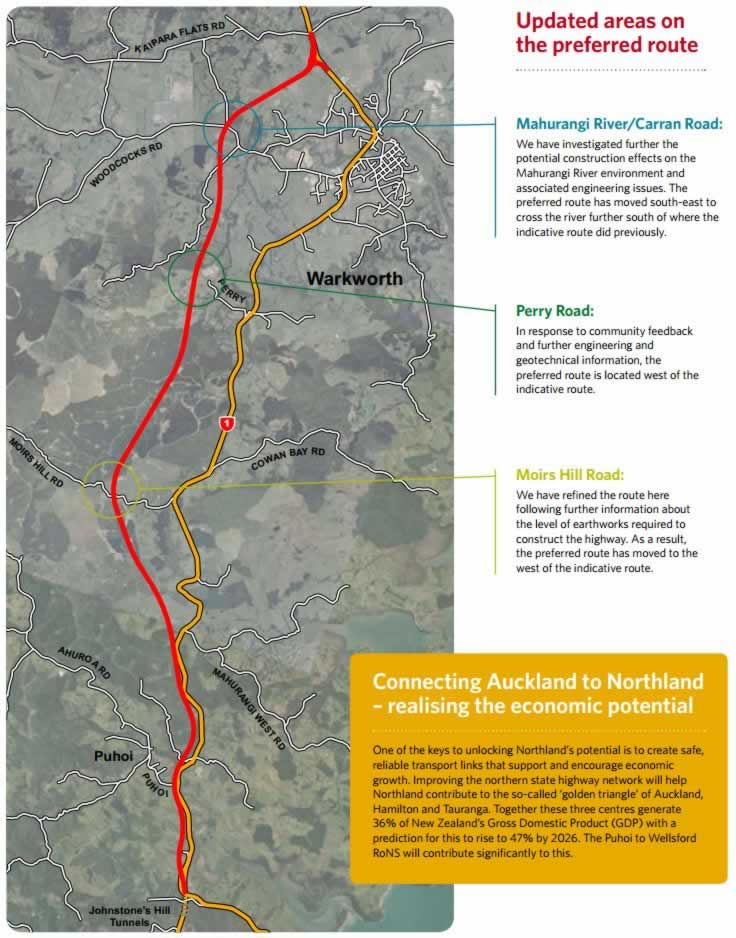
Despite this unanimity on the urgency of safety improvements, over the next two years (2010 to 2012) under the then National-led government, NZTA pushed forward instead on planning the Puhoi to Te Hana RoNS project, a four-lane dual-carriage expressway, rather than more immediately deliverable smaller scale safety improvements.
From 2009 to 2012, 17 people were killed, and 52 people seriously injured on State Highway 1 between Puhoi and Te Hana.
Source: NZTA
This would not happen.
Meanwhile, in 2014, a solution to the bottleneck on the notorious Hill Street Intersection, which causes significant congestion on the route, would be delayed by NZTA, who claimed nothing could be done until the four-lane expressway was finished between Puhoi and Warkworth.
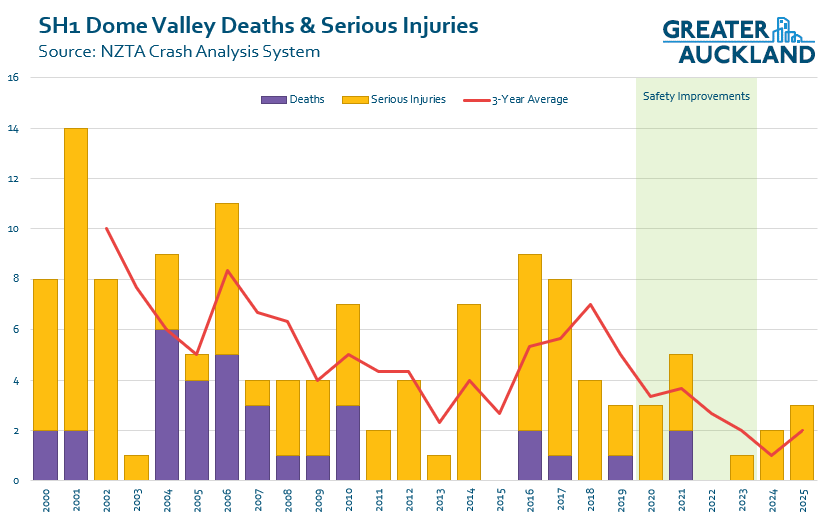
There was one positive exception to the ongoing delay in delivering safety on this stretch. Between 2009-2015, there was a notable reduction in Deaths and Serious Injuries (DSI) on the notorious Dome Valley section of State Highway 1. This was because NZTA has installed chip seal to reduce skidding, and in 2009 lowered the speed limit from 100km/h to 80km/h. However, the road as a whole remained dangerous, as it lacked significant safety measures, such as median barriers.
Early works on Puhoi to Warkworth finally began in 2016 – seven years after Joyce had first announced the Roads of National Significance.
From 2013 to 2016, 11 people were killed, and 45 people were seriously injured, on State Highway 1 between Puhoi and Te Hana.

Then-Minister of Transport Simon Bridges, then-Prime Minister Bill English, and former Minister of Transport Steven Joyce, 2017 Photo / Mark Mitchell
In 2017, main construction would finally begin on the Puhoi to Warkworth section of SH1, eight years after Joyce’s original announcement.
Meanwhile, Warkworth to Te Hana section was mired in ongoing geotechnical issues, with NZTA only announcing an indicative route. (At the time, Greater Auckland called the project a “boondoggle”).
In April 2017, after a two-car crash claimed yet another life in Dome Valley (closing the road for hours), NZTA announced they were looking to install safety barriers and widen shoulders, where possible.
2017 also saw the political winds change, with the election of a new Labour-led government.
In 2018, the new government would launch a review of the Roads of National Significance, and also looked to progress smaller scale targeted improvements, including in the Dome Valley.
In 2019, construction would begin on these smaller scale safety improvements in the Dome Valley.
Meanwhile, construction continued on the Puhoi to Warkworth section of SH1.
From 2017 to 2020, 8 people were killed, and 54 were seriously injured, on State Highway 1 between Puhoi and Te Hana.
Despite the government looking to review whether these RoNS were even good value for money let alone the best plan, NZTA would continue work on progressing a four-lane expressway for Warkworth to Te Hana, and in 2020 they began the process to lodge consent.
NZTA predicted it would cost $87million to secure properties on this route, saying that construction was not expected to start until 2030, and claiming it would take 5-7 years to build.
Enter 2020, which saw many construction projects delayed due to the Covid-19 pandemic. Throughout, work was continuing on the Puhoi to Warkworth section, and the SH1 Dome Valley safety improvements.
Both of these projects would be completed in 2023.
From 2021 to 2023, 8 people were killed, and 26 were seriously injured, on State Highway 1 between Puhoi and Te Hana.
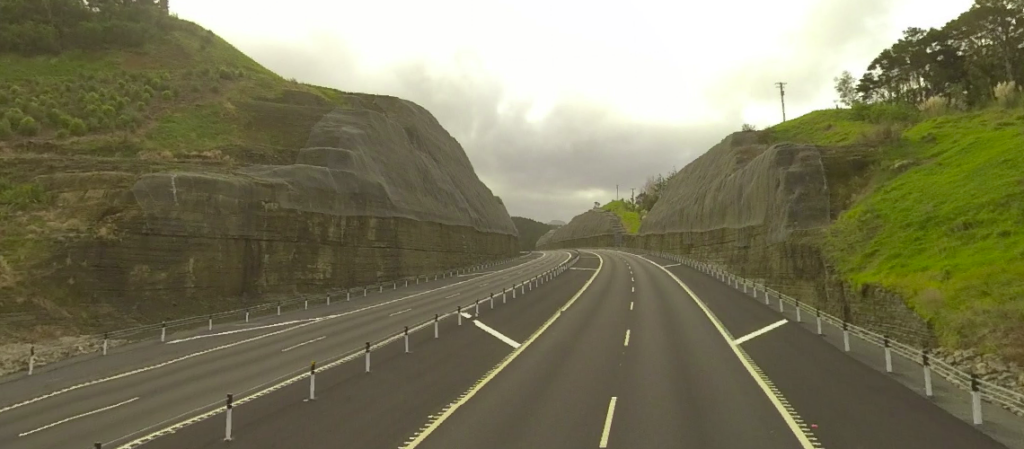
In June 2023, the Puhoi to Warkworth expressway officially opened – seven years since early works got under way in 2016, and 14 years since Steven Joyce’s 2009 announcement. The project came in at $880 million for 18.5km, or $47,570,000 per km.
As far as I’ve found, there has been no significant works on the old State Highway 1 between Puhoi and Warkworth since the 2009 announcement.
From 2009 to 2023, 18 people were killed, and 59 people were seriously injured, on State Highway 1 between Puhoi and Warkworth.
The SH1 Dome Valley safety improvements took four years after construction began in 2019. The project cost $80m for 15km of improvements, or $5,330,000 per km.
From 2009 to 2023, 26 people were killed, and 118 people were seriously injured, on State Highway 1 between Warkworth and Te Hana.
In total, from 2009 to 2023, 44 people were killed, and 177 people were seriously injured, on State Highway 1 between Puhoi and Te Hana.
The return of the RoNS Doctrine
The end of 2023 would see a new National-led government incoming, with Simeon Brown as Minister of Transport. Brown continued to push for the Roads of National Significance, and in his 2024 Government Policy (GPS) for Land Transport mandated that any RoNS had to be four-lane dual-carriage expressways.
That same GPS would suck billions of dollars away from multiple smaller-sized road projects, safety projects, walking and cycling projects, and public transport, pouring it into the RoNS and State Highway budget instead.
As a direct result of Simeon Brown’s GPS, NZTA did not fund the long-awaited community-led improvements to the Hill Street intersection in Warkworth, which would have cost $19.1million (50% of which was funded from Auckland Council). Why? Because the design included – with community support – raised crossings and separated cycleways.
This was a decade after the previous proposed improvements to this area were scrapped by NZTA, who claimed at the time that Puhoi to Warkworth needed to be built first.
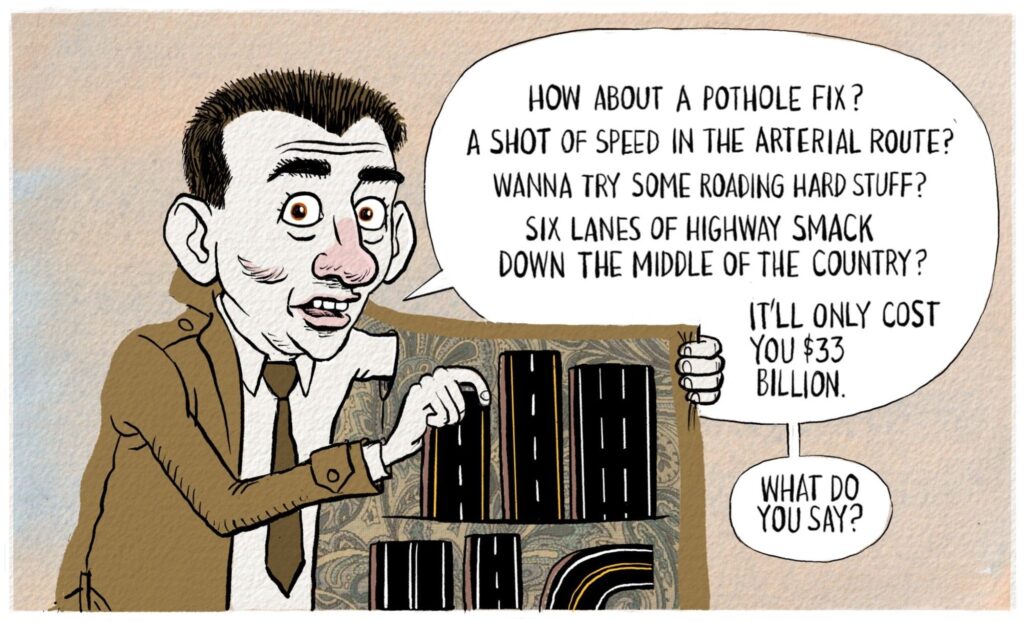
Sharon Murdoch cartoon 2024 Simeon Brown Transport Minister
As of 2026, Warkworth to Te Hana – the most progressed of the current crop of RoNS – has not yet been publicly confirmed as going ahead, but indications are that the government intends to sign a Public-Private Partnership by July 2026. (Those expressed intentions pre-date the current fuel crisis, however).
NZTA’s current plan consists of 26km of four-lane dual-carriageway, essentially duplicating the route of the current SH1, resulting in 6 total road lanes – a tripling of capacity along this stretch.
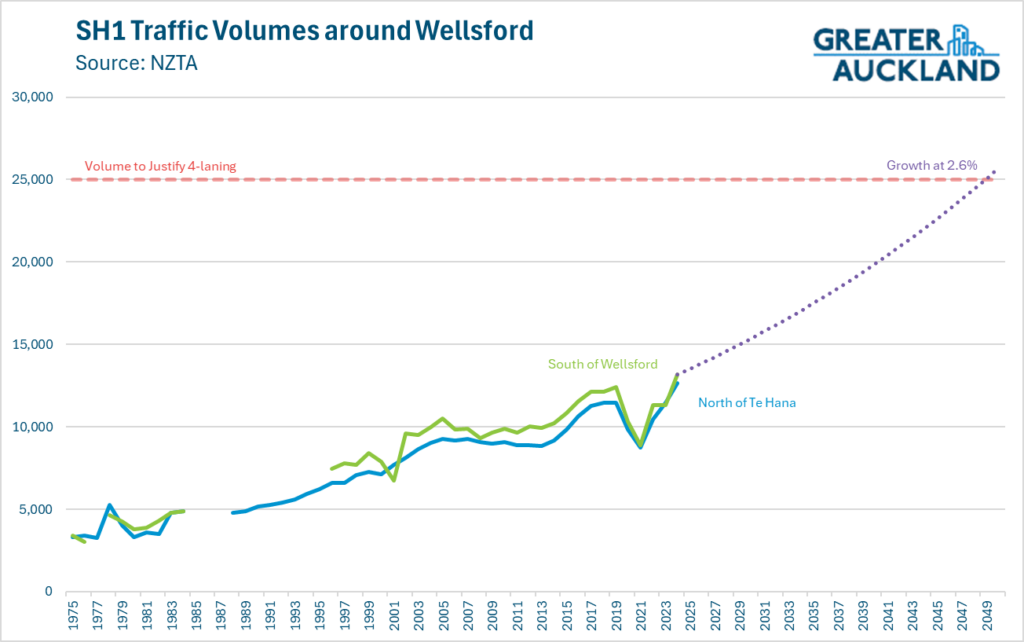
And yet the traffic volumes on this route are nowhere near meeting the threshold specified in NZTA’s own Detailed Business Case, that would justify building this level of capacity.
The projected cost for the Warkworth to Te Hana section is in the realm of $3.5-4 billion dollars, which works out to between $135,000,000 to $154,000,000 per km.
Of course, as a Public-Private Partnership, the overall cost will likely be higher, as debt will be sourced by private entities in the private market, which has higher borrowing costs than government, and a premium will be paid to the private entities through annual unitary charges over decades.
Moreover, Warkworth to Te Hana is a far more technically difficult undertaking than the Puhoi to Warkworth section, and would likely not finish construction until at least the mid 2030s.
In 2024 and 2025, 1 person was killed, and 14 were seriously injured on State Highway 1 between Warkworth and Te Hana.
This was lower than prior years, in large part due to the lower-cost normal-sized safety improvements to Dome Valley, as shown in the graph below.
Warkworth to Te Hana is also now the first section of the projected ‘Northern Expressway’, a $22,000,000,000 road corridor to Whangārei.
If this corridor is to be built as a four-lane dual carriageway, as planned and required by the 2024 GPS, then it will consume 10% of the whole country’s entire infrastructure spending for the next 25 years. That’s 10% of the funding we need to cover not just all of our roads, existing and new, but also schools, hospitals, and more – leaving aside the question of rebuilding existing infrastructure damaged by extreme weather and other natural disasters.
As of now, there are no set dates for starting the Northern Corridor, let alone finishing it. But billions are already being spent on planning, consenting, and acquiring tracts of land required to build it – along with the rest of the Roads of National Significance Programme.
This speculative “investment” has come at the expense of missed opportunities to deliver countless smaller, focused, normal-sized projects all over the country, effectively destroying the transport infrastructure pipeline while postponing “essential work” that would have gone a long way to “reduce congestion, improve safety and support economic growth” (to reinvoke the original RoNS rationale, as expressed in 2009)
In total, from 2009 to 2025, 46 people were killed, and 192 people were seriously injured on the original State Highway 1 between Puhoi and Te Hana.
I have the following questions for every politician, lobby group, decision maker in NZTA, and anyone else who has pushed this Road of National Significance juggernaut along, while missing multiple opportunities to deliver real and meaningful change:
- How many of the 177 people who were seriously injured and 44 people who died on the road from Puhoi and Te Hana between 2009 and 2023, might still be alive today, if you had progressed normal-sized safety works?
- If Warkworth to Te Hana goes ahead, how many more will be killed or seriously injured as we wait for the most expensive road New Zealand has ever built to be completed?
- How many people will still be killed or seriously injured on the old SH1 between Warkworth and Te Hana, especially as the new road will be tolled, which will logically divert significant amounts of traffic to the old route?
- How many people have been killed or seriously injured on the old SH1 between Puhoi and Warkworth, to date?
- How many will be killed and seriously injured on the rest of Northland’s roads, while billions are sucked towards this Road of National Significance?
- By the way, how much has it cost us so far, in the way of extended road closures to pick up the pieces up after every crash (and to repair damage from flooding, slips, etc)?
Finally. What is a better use of $4,000,000,000?
A gold-plated four-lane expressway between Warkworth and Te Hana?
Or right-sized Dome Valley-style safety improvements (and while we’re at it, maybe even a few more resilient bridges) across at least 750km of Northland’s roads?
Now apply that to every single other Road of National Significance being put forward as an “essential” solution to safety, and congestion, and economic growth.
Greater Auckland’s work is made possible by generous donations from our readers and fans. Support our work by joining our circle of supporters here and setting up a reoccurring donation.

 Processing...
RONs are not want the country needs.
They are what the consultants, contractors, plant providers, and now, financiers want to build.
RONs require a huge displacement of labour in, at the beginning of each project and then out, at completion, causing disruption to hosting communities at both ends of the project cycle.
Spreading the same spend on smaller upgrade projects throughout the motu, whould also spread the benifits through out the motu. And spreading ongoing upgrade work on the roading network would provide greater employment stability in the industry, and local communities.
Remember that by voting for a new RONs in one area, you are voting for the retention of substandard and unsafe roads in the rest of the country. And depriving the rest of the country of stable local employment, and valuable local knowledge that continual local highway projects could provide.
There still is case for ongoing new route deviations but not at the frequency and scale of current RONs thinking.
Excellent post.
The RoNS kill even more people than the figures you’ve given:
They induce traffic. This induced traffic isn’t restricted to the RoNS; it starts and ends on local streets, and uses other regional roads. That traffic also kills people.
And the induced traffic increases transport emissions and climate change. This is killing people too.
Induced traffic translates to increased profitability for one very influential segment of our commerce.
Here though there is a divergence between profitability and productivity.
People saving a bit of time as part of their recreation, holiday making journeys etc, does little for productivity.
Roads of National (Party) Significance – RoNPS. You left out one important word.
Has anybody analysed the nationwide impact of Julie-Anne Genter’s $600m road safety programme? The Dome Valley measures seem like a good spend.
When the govt wax lyrical about ‘road safety’, what they really mean is the roads need to be safe for car users ONLY.
Interesting to note that all the comments in the article and subsequent comment, relate only to safety, but there are other aspects of building better roads, such as increased productivity. For those who don’t care about economics, or don’t understand the benefits of increased productivity, may I suggest you expand your knowledge of basic economics, even if it is only by reading Adam Smith’s ‘An inquiry into the nature and causes of the Wealth of Nations’. Even though it was first published in 1759, the principles on which his findings are based, still hold good today.
Interesting to note that you all the comments discussing road safety relate to the article, which is also discussing road safety.
The argument being put forward in the article is largely economic.
RoNS suck up funding that could otherwise benefit the wider network, tying it into decade long projects and disruption.
The benefits are a distant promise; it is a great example of opportunity cost.
Reframing it in car brain, it’s the difference between an engine with one gigantic piston operating at one power stroke every 10 seconds, or a bank of much smaller pistons smashing out thousands of power strokes in the same time.
Guess which is more fun to drive?
They built Transmission Gully to ‘increase productivity’ and now most heavy trucks avoid it going along the coastal highway. Now they have two roads to repair from the damage trucks cause.
Exactly – this was a criticism projected at T Gully road while they were planning it. The Eye of the Fish (local blog http://www.eyeofthefish.org) repeatedly noted that due to the height of the hill that the trucks had to climb over (as steep an incline as Ngauranga Gorge, but three times the length) would cause greatly increased wear and tear on the engines and transmissions of heavy hauling trucks. This is exactly what has happened – and yes, many trucks just continue to use the (dead flat) Coast road, as it is now without annoying cars and their daily traffic jams. Predictable, and so: predicted.
The hilarious thing is that electric truck are well suited to T-Gully. They use lots of ergs up the hill and achieve the climb far faster and more easily than diesel, then get a large chunk of those ergs back again from regen down the other side. T-Gully’s time will come, just not in the way it’s justification was cooked up.
In an ordinary world yes, building better roads with taxes raised from the population should be a productivity booster. However things have progressed to the point where that isn’t the case.
1) the costs are so phenomenally bad, nearly world leading, in a solidly nowhere near world leading economy.
2) the benefits aren’t that great because the road only carries 10k vehicles a day.
So we are going to tax the rest of the productive economy more than the road will generate. We are taxing and discouraging driving in canterbury and shifting that funding up north. We are taxing working or investing in productive enterprise elsewhere in the economy, making it less attractive and less productive, in order to destroy that value at a rate of 150 million a kilometer.
You would also make the country much more productive by buying everyone personal helicopters, think of the travel time reductions!
There is an obvious flaw in that plan, just as there is spending 75% of the government’s long-term ivnestment capital budget in MOAR ROADS
Someone who is building a road is being ‘productive’, i.e. they are building a ‘product’. That doesn’t tell you whether we needed the road in the first place or whether that person could be doing something better with their time.
Perhaps an economist could explain what the potential in northland is that requires so much investment. When I drive up there I’m not seeing it.
I would argue that some of the roads of National significance are being built not because of the current need, but because of the investment in the future these roads may bring
Warkworth is growing significantly and it probably has some part to do with the the new puhoi to warkworth section.
I’m just wondering what the impact will be once it extends to whangarei to places like bream bay and Waipu. Also considering that the port at Marsden point is probably going to get bigger soon, meaning more traffic is sure to be on this roads.
If we don’t do this now it’ll just get more expensive to construct, and future generations will question why not prepare for the inevitable?
I don’t know just a thought.
The future generations reliant on such roads as the Awakino Gorge and the Waioeka Gorge might not appreciate all of the money being chewed up by a motorway to Whangarei.
That would be a fair argument if it wasn’t sooooo far in excess of current need (and available budget). This is the govt that complains endlessly about “gold plated cycleways” which never came to more than 2% of the transport budget. But motorways? Platinum-plating is fine and dandy!
I would prefer we reserved the land to build such projects making sure they dont get excessively expensive to build, and then let the future generations decide.
Rather than signing them up for an underused road and a mountain of of debt and say, “you’d better be grateful”
I think you can acknowledge those benefits, and it still doesn’t seem worth it though.
Puhoi to Warkworth cost $877m, and in 2023 had a population of 6,675. Even if the population doubled solely due to the improved access, that’s $130,000 per new resident.
And that part was relatively cheap/easy. For the full $22B to Whangarei, lets say Bream Bay and Waipu multiply their population 10 times over (34,470 new residents). That’s $640,000 per new resident.
I know there are other benefits, but it’s just really hard to justify spending $22B on almost anything in NZ. Its a massive, massive investment for the country.
Lets build it!
The NZTA planners need to be controlled to save huge costs in RONS builds we are not a wealthy country so need to reduce the spend At Waipu entrance there is a crazy extra cost proposed to change the road from where it is now to slightly west to reduce a slight curve make it go through the best farmland with a new four lane bridge All not needed an example of unsupervised costly planning
In defense of the nzta planners, once the ministry prescribes a 4 lane 110km/h expressway,they have no choice but to realign the road and create bridges for interchanges
The Nuremberg defense
So called free thinkers when you ask them to please stop building big dumb motorways all over the place
This framing is disingenuous without also calculating (1) whether the new roads induced more traffic, and (2) the rate of death and serious injury on the roads that travellers would otherwise have used.
They may well have been a huge waste of money, which is sufficient as an argument and more straightforward to make the case for.
“If Warkworth to Te Hana goes ahead, how many more will be killed or seriously injured as we wait for the most expensive road New Zealand has ever built to be completed?“
Well according to the graph about 2-3 serious injuries per year for just the dome alone. Like I’ve mentioned before the dome is not suitable as an interegional connector the camber is all off and the speed limit is too low and it’s too steep for trucks with even less passing opportunities and the one passing lane there is always a mobile speed camera on it so it pisses drivers off and they say “if only there was an expressway here”
This will be expensive but it’s needed once the Redvale tip is full and all the Garbos head to the dome to tip our waste people will get increasingly frustrated and travel times will take even longer eventually the public is going to demand the whole road be bypassed.
What I’m trying to say is yes the road is gold plated and expensive. Yet despite me knowing that I just want to see this get built and then a cheaper Brynderwyns bypass be done I think if you asked most travellers what are their annoyances between Auckland to Whangarei they will say Dome Valley, Wellsford, Te Hana, Brynderwyn Hills. The one road covers 3 of those in one go.
If you think the Dome is a poor inter-regional connector then come and have a look at the Awakino Gorge. Just don’t bother coming to check it out during the day as it’s only open to convoys at night at the moment.
If Warkworth to Te Hana does go ahead there won’t be any money left for even a cheaper alternative to the Brynderwyns.