Six months ago I lodged a complaint with the Ombudsman, appealing a refusal by the New Zealand Transport Agency (NZTA) and the Ministry of Transport (MoT) to release information related to the Warkworth to Te Hana Road of National Significance project.
This week I received the Ombudsman’s final opinion on the matter. They agree with NZTA and the MOT that this information should be immune from any public scrutiny, until after decisions are made.
“Nothing to see here, move along.”
A disappointing response. But it came with a startling bonus. Hiding in plain sight, right in the middle of the reasoning for why they say they can’t tell us anything, is an implication of what we’ve long suspected:
This project is such a dog – in terms of benefits compared to costs – that saying so out loud would be the death of it.
For further coverage of this breaking story, see: Thomas Coughlan in the NZ Herald and Justin Hu from 1news.
What was I seeking, and what is a Benefit Cost Ratio?
All I wanted to know was the rough cost envelope for the project, to confirm what can be deduced from public information so far, and to allow accurate discussions of this project in the public sphere. I even offered a middle ground – no need to specify an exact dollar cost, a potential range would be fine.
I also asked for – and fully expected to receive – the project’s Benefit Cost Ratio (BCR). The BCR is of the key measures of viability of a project. It tells us nothing about the price tag, and as such has no commercial value. It simply measures the relative value to us all of a proposed investment.
As NZTA itself says, a BCR “enables different projects to be compared with each other” and is used (along with other tools) “to assess proposed investments.”
It’s a bit like the basic nutritional info of a given food. It tells you, per dollar (or per gram), how good is this for you, on the whole, which allows you to confirm whether it’s worth buying in general, and lets you compare it with other options.
Basically, it tells us how much value we’ll get back for every dollar we put in. Here’s an example, a local bike project with a BCR of 3.4, meaning for every dollar invested, society gains $3.40 of value.
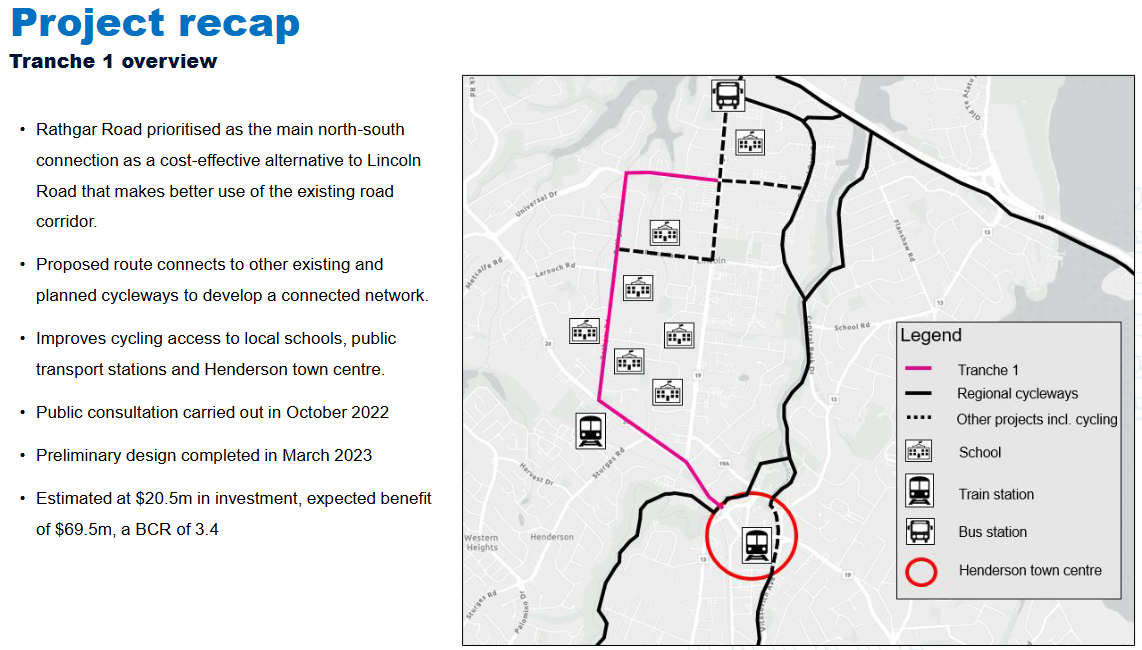
Auckland Transport is looking at restarting the Henderson bike connections: a $20.5m project, with a BCR of 3.4, so an estimated lifetime benefit to the community of $69.5m. On the face of it, a solid investment.
Why would the BCR be such a state secret?
In the Ombudsman’s reply, they say NZTA opposed releasing the Benefit Cost Ratio on these grounds:
NZTA’s position as the procuring entity remains that release of the BCR information at this time would unfairly disadvantage the commercial activities of the Crown during the PPP procurement process, and undermine the ability to maintain value for money for the Crown.
This raises the question: how would sharing the BCR “unfairly disadvantage the commercial activities of the Crown during the PPP procurement process”? Either this project clears the basic bar for investment, giving the government confidence to go to market… or it doesn’t.
But wait, there’s more! NZTA and MoT then appear to say that the very act of releasing the BCR would risk the government not going forward with the project at all:
Releasing the BCR information during this process would be likely unreasonably to prejudice those commercial conversations with the respective bidders. This could create uncertainty amongst respondents if it brings into question the Government’s decision to proceed to procurement, and as such could undermine the competition amongst bidders and/or quality of bids – for example, if they no longer consider it is worth committing time and resource to as they believe a decision may be taken to no longer proceed with the project.
Let’s sit with this for a moment.
Logically, the only reason a private bidder might be concerned that the government might not proceed to procurement… is if the value of the project was so bad that the government couldn’t justify proceeding. Right?
I’m open to other explanations – but what other explanation is there?
We already knew the BCR was bad
Back in 2019, the BCR of Warkworth to Te Hana was already less than 1. As in, for every dollar invested, you’d not even get back a dollar in societal benefits. Barring extraordinary circumstances, a BCR of less than 1 basically means the game’s not worth the candle.
And this was before the huge inflation of construction costs. So all signs now point to the current BCR for this project being catastrophically lower than that, given the project has significantly increased in cost.
But NZTA and MoT are saying that we, the public, don’t need to worry our pretty little heads about this – while they run full speed ahead, damn the torpedoes, towards locking in a contract to build this thing.
What did NZTA and the MoT say to the Ombudsman?
That’s not a run-up to a joke, it’s a genuine question – if you’re as baffled as I am by the Ombudsman’s conclusion. The second point made in the Ombudsman’s reply to me provides a clue as to what NZTA may have told them:
Release of a BCR infers the internal rate of return that is the perceived profitability (or marginal value for the Crown), and this therefore weakens the Crown’s commercial value for money as the private sector could see opportunities to increase their return at the expense of the Crown’s value.
Frankly, I find NZTA’s reasoning here absolutely bonkers, to use a technical term. To repeat: in the transport investment realm, Benefit Cost Ratios are not some absolute commercial metric of ‘profit’ – they’re just a ratio that weighs the benefits compared to the cost.
They’re used to compare options to find a solution. As a yardstick to see if a solution is even worth it, and whether a given option is good value for money.
So there is great public interest in knowing the BCR of any project, especially one on this scale. It’s a clear way of confirming whether an investment is prudent, or unjustifiable. A helpful check – not just for us, but for any government aiming to secure social license, and to be seen to be well above-board in its decision-making.
And if a given project has a BCR of less than one – i.e. it will generate less value than it costs to build – well, that’s a perfect example of why BCRs should be made public.
Moreover, I’m flummoxed by the claim that the private sector might use BCRs to increase their return. The private sector will already know the BCR. They have substantial knowledge of upcoming projects and the expertise to figure out the BCR – assuming they haven’t already been provided that information as part of the process.
So why hide the BCR?
If the BCR is actually good, say over 3, then releasing it is a good way to justify the project, right? And prove my concerns wrong?
Or is NZTA afraid that the BCR they have is unjustifiable, either because it’s so low their chosen solution doesn’t make sense, or because they are cooking the numbers to get what they have?
The only practical benefit of hiding the BCR is to remove any public transparency regarding the value of the project, and to obscure how NZTA operates as an organisation.
The bigger the investment, the more transparency we need… unless it’s a Public Private Partnership apparently
Warkworth to Te Hana are set to be delivered as Public Private Partnerships (PPP), an arrangement that front-loads the financing onto a private partner, leaving the country to pay it off over a set term. Like any hire-purchase agreement, or a mortgage, you wind up paying a lot more than if you bought it out of your own pocket to start with.
Yet it seems NZTA and the MOT believe the PPP context means the whole process should be extra secret, in order to secure a good deal:
[T]he … costings in the Investment Case represent the expected costs of traditional procurement and would have the greatest potential to impact ongoing negotiations. For example, a $10m difference in availability payments equates to $250m over the life of the contract, which can be quite impactful. On balance, for this and the reasons outlined above, we considered there was good reason to withhold the information until Financial Close, at which point the information could be released.
But here’s the thing. Compared to a standard procurement, a PPP effectively triples the overall cost to the public across time (based on other PPPs such as Transmission Gully, or Warkworth to Puhoi as examples). That is due to the way annual availability payments work.
Traditional procurement fronts the cost for the government (and the public), whereas PPPs spread them out over the terms of the deal – but these payments stay the same.
Which means overall, the lifetime cost is significantly higher. Couple that with private financing being more expensive than the public, and the cost skyrockets.
It’s kind of like a payday loan, but for billion-dollar projects funded from public money.

An example of a PPP payment profile
What this means is that this one road in Northland will potentially swallow $12bn of public money over a generation.
(And yes: PPPs also come with all sorts of other issues around speed and quality of delivery, and long-term maintenance and repair, but that’s a whole other story.)
Going by current numbers, this would suck up a huge chunk of discretionary funding from the National Land Transport Fund (NLTF) from now to the 2050s.
“Discretionary funding,” as the name suggests, is money you can choose to spend as needs arise. It’s your wiggle-room. Which is important, because there’s an endless stream of competing needs all over the motu, and extreme weather events are taking a rising toll on our transport networks. Plus, the NLTF (made up of fuel taxes + road user charges) is already a shrinking pot.
So if the government signs this contract, it is committing us in advance to spending a generation’s worth of rainy-day transport funding on one stretch of motorway that will end in the middle of the countryside, Te Hana (pop. 120).
(And no, tolling it wouldn’t even touch the sides – if anything, it’d reduce usage.)
So we really deserve to know if this project stacks up. Which is why I asked for the BCR.
What’s the official point of the Official Information Act?
My original request in October 2025 was simple. I just wanted to understand the thinking behind the $40-50 billion Roads of National Significance programme. Yet the Ministry of Transport and NZTA withheld even the titles of documents.
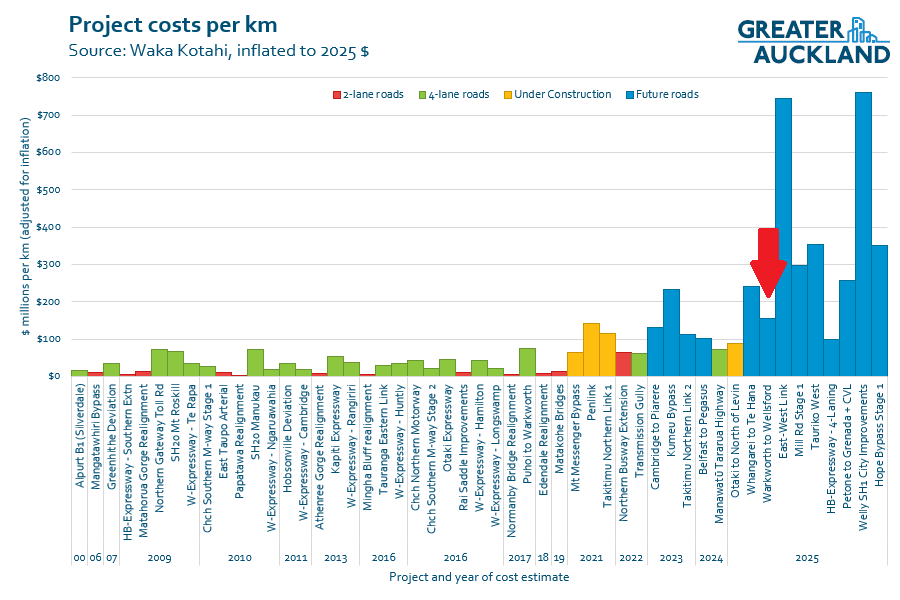
So to the Ombudsman I went. After my complaint, certain information was released, including about the $22bn four-lane motorway to Whāngarei. However, other information remained redacted, regarding what’s projected to be the most expensive new road yet built in New Zealand, the $4bn section between Warkworth and Te Hana, which is itself just one stage of a $22bn motorway all the way to Whāngarei.
Hence my complaint remained, and hence the final response this week.
I still do not understand how the Official Information Act does not enable the release of basic, non-commercial information regarding Warkworth to Te Hana.
My request was made on the grounds of public interest. If the most expensive roading project ever agreed to in New Zealand doesn’t meet the threshold of public interest… what does?
And while the goal of the Official Information Act is laudable, its shortcomings become apparent when organisations are operating in partial faith, or outright bad faith.
Late last year Te Waihanga, the NZ Infrastructure Commission has called for more transparency in large projects. That’s backed up by international studies such as the Transit Cost Project, which argues that itemised costings of major infrastructure should be transparent and public. And in just the last week we’ve seen similar calls for clarity around the almost-finished CRL – a project that’s been far, far more transparent than Warkworth to Te Hana.
The point is, whatever the merits of individual projects, there’s public consensus that we need to be able to have full confidence in the process.
Warkworth to Te Hana is the perfect example of why transparency is essential. It’s a low-value, over-scoped, gold-plated project – and the organisation in charge of procuring and delivering it is refusing to publicly justify why they’ve prioritised it, and whether the numbers back it up.
The key conclusion to be drawn from this whole process is that the reason NZTA and the MoT have dug in to the extent they have, is because – as they seem to have admitted in their correspondence to the Ombudsman – they know this project doesn’t wash its own face.
And this is also why we suck at doing big infrastructure projects in New Zealand. We will never get better at it if the zone is flooded with outdated numbers and unscrutinisable claims from agencies, politicians and lobbyists, while billions of dollars of public money are quietly funnelled into bad projects with zero opportunity for public oversight.
What next?
Currently, the government appears bent on signing a contract for this ridiculous road as fast as it can. Potentially, within the next month. This would lock us into a gold-plated zombie motorway project that will lumber onward into the 2050s, hoovering up an enormous chunk of the nation’s discretionary transport funding as it goes.
If this goes ahead, what are our options – aside from enormous break-fees to end the project before it begins? Our only other out may be to wish for ridiculous levels of inflation, which might eat away at the “value” of the annual payments we’d be shovelling towards whichever private entity wins this contract.
That’s… really not a sustainable plan, by any measure.
Meanwhile, despite the Official Information Act, the public is not allowed to see any official information about the scale of this nonsense, until after the signatures are on the dotted line!
Who benefits from secrecy, amirite?
That said, the scale of this debacle wouldn’t remain secret for long – and it will be a very uncomfortable political epitaph for whomever gave it the green light.
A glimmer of hope and rationality
Ironically, even though my appeal for information was turned down, we now know one thing for sure: there’s significant official concern that the government will hit pause on Warkworth to Te Hana, if basic details like the BCR were to be made public.
Next week is Budget Week, and all the advance talk is about cutting costs. You’d assume a prudent parliament would promptly put a pin in this particular project.
Especially given the Minister of Transport has already signalled an urgent need to re-scope and/or re-stage the RoNS programme.
And besides, who’d want this multi-billion-dollar millstone around their neck in perpetuity, let alone in an election year?
The government knows what to do. Will they?
Support Greater Auckland’s work by joining our circle of supporters here and setting up a monthly donation.
Our work is only made possible by generous donations from our readers and fans.

 Processing...
Oh great work getting this story out in the mainstream media.
Did it get picked up?
It’s protest worthy, it’s that opaque and corrupt.
Shocking and this proves the forum and its champions are worth every penny. Donate!
Connor, can you briefly steelman a scenario where the Ombudsman’s actions would be objectively wise, in order to distinguish between what they’re doing here and what they normally do as part of their legitimate role?
I guess my best steel man would be:
– Theoretically, you could use a benefit cost ratio to reverse engineer what NZTA are expected to pay in order to get the exact amount of the project, giving bidders an advantage in contract negotiations.
– Hence why the reticence to release exact costings as well.
– And with Public Private Partnerships, small changes in the annual Availability Payments, have massive lifetime costs, meaning more cost for the public (so why do PPPs then???)
-so to get ‘good value’ of public money, you need commercial secrecy during negotiation periods
The issue is this falls over because:
– You can release cost ranges, and BCRs that are not attached to costings
– Countries overseas, with far cheaper construction costs, have far higher levels of transparency to allow scrutiny
– if the BCR is bad enough that publicly releasing it would kill the project, then the project shouldn’t happen
-BCRs are yardsticks to compare and contrast projects and options, not some objective profit measure
– Odds are, the bidding teams are well resourced and full of experts, so they likely already have a good idea esp as prior information is already public, and so they can probs reverse engineer NZTAs position
– If there is good competition in the bidding process, unless they collude it shouldn’t really be an undue influence
-public interest component should override everything else regardless, when we are talking about this much funding
I don’t know if I entirely fault the Ombudsman here, it looks like whatever NZTA/MoT were arguing obfuscated what BCRs are. Either the OIA needs changes, or the Ombudsman needs more resources/NZTA needs to not act in bad faith (imo)
I find you are arguing for arguments sake. If the BCR is 2.0 to pluck a number from thin air, releasing that gives bidders room to push their costs up because they can work out they can squeeze 20% more, with the government still inclined to bite due to sunken costs and still reasonable but less appealing BCR. Saying it has no commercial value is so disingenuous.
Your missing the bigger point. If releasing the BCR info turns the project from one which is less than 1, to a more affordable option that gives you the benefits anyways, even if you overpay by bidders boosting the cost it’ll still be a better use of money.
And also, if keeping this info is so needed to get ‘good value’, why do countries all over Europe, with far less infrastructure construction costs, have way better transparency?
https://transitcosts.com/transit-costs-study-final-report/
Why has the New Zealand Infrastructure Commission consistently called for more transparency?
https://tewaihanga.govt.nz/our-work/research-insights/transparency-within-large-publicly-funded-new-zealand-infrastructure-projects
I would rather slightly overpay for a good project, with an amazing BCR, than have overscoped horrible projects happen
But the other bidders might not raise their price, and I would therefore lose the contract, therefore I cant raise my price.
Ie, it doesn’t remove any competitive pressure.
How are the public supposed to gain any understanding of if a project is worthwhile or not?
Commercial sensitivity arguments are way more relevant when it comes to looking at things like value capture, or buying land for projects.
As information about routes could mean landbanking etc etc. But even then, if you want to build up public support, and design the best project, you need to be open about what the options are!
Transport projects (esp State Highway projects) in this country have operated under a veil of secrecy for decades, and we have gotten terrible value. Try get any info on Transmission Gully, it always gets denied under ‘commercial sensitivity’ despite being an absolute rort of public money.
Yes, when you’re negotiating with a single other party that is a fair consideration. But for a competitive tender process???
Stonewalling info about historic projects is another level again.
Any published BCR below 1 sends a signal to the bidders that the Government want to get this done, regardless of the return on investment. A BCR of 0.8:1 or 0.6:1 is neither here-nor-there, as they are both dogs. So, I guess if we’re being generous, you could make the ‘commercial’ case that the Government don’t want to publish because it show they are desperate and an easy mark.
No serious bidder is going to push a >1 BCR to below 1, because they know they’ll tank the whole project… But pushing a dog to a worse-dog is just good business.
“releasing that gives bidders room to push their costs up because”
You are assuming there is no competitive bidding?
In which case, why even go through the charade of RFI/RFP and tender discussions, and just hire a team of experienced civil engineer who have built roads like this before to design and plan, and only tender competitive subcontractors for components of the build
Last year the Ombudsman investigated Health New Zealand for refusing an OIA request, and decided against HNZ; it seemed to be a reasonably similar situation (commercial sensitivity, prejudice to negotiations) but the outcome was different.
https://www.world-today-journal.com/health-nz-apology-to-nurses-union-following-ombudsmans-report/
“– If there is good competition in the bidding process, unless they collude it shouldn’t really be an undue influence”
This the core point IMO. Nobody has given a compelling reason that in a competitive market, why additional information for bidders would raise prices. Except like you say it’s such a dog that it’ll get cancelled and they have to price extra risk in.
Their competition is with other bidders. Without phoning up the other guys and all agreeing to raise prices then there is zero mechanism for the NZTA’s expected costs to influence bids. If you come up with a way of building it which is much more cost effective and much lower than the competition and expected cost, well then you’d win wouldn’t you? If you decide to bid just under the expected cost, then you might lose to someone else who was more aggressive with value engineering and pricing.
“it’s such a dog that it’ll get cancelled and they have to price extra risk in”
I would assume any tender response has some eye watering high break fees baked in.
If I was submitting a tender, I know that it would be very possible for the government to change before any progress on the ground, and highly likely for the project to be descoped or cancelled even if the government didn’t change
In a scenario with really HIGH BCR (let’s say 10) that was published, public bidders could be tempted to raise their prices as the BCR would still be pretty good. That would obviously be worse for the Crown’s finances.
It might even come to a point that the project could not be built due to the high up-front cost despite a very good BCR.
However, the contractors could just not increase their price as much.
So, yeah, I assume BCR currently sits well below 1.
The secrecy is widespread now. The Future is Rail asked the MoT for the term of reference for a study they are doing on the economics of rail freight. They refused. So we went to the Ombudsman and they released it but with sections redacted. We also asked for information on who they were consulting with. That is still being withheld. Great work Connor in your attempts to shine a light on poor decision making.
These agencies work for us (the people). We pay for them and use the services they create. We have all the power as a collective, but limited power individually (you are the exception – thank you 100X).
How can we get these agencies back in line?
Pity the poor pricks pondering putting a pause on this PPP
Perfect
What would be the best plan going forward, within the tight timeframe of a possible deal signing, of putting as much (public) pressure on the Government and NZTA as possible to get this boondoggle put out to pasture?
6 months to the election, why not wait and get a mandate from electors ? I would note Grant Robinson did not dfund the IREX ferries because it was close to an election , but neither did they put it to the voters to have an option.
Because they’re afraid they’ll get turfed after 3 awful years in power and the next gov’t will justifiably cancel the whole thing.
And they just put a potential Labour government in a really shit situation:
1) Cancel it and people will complain that nothing ever gets build/the current road is too bad (I disagree, but here we go)
2) Commit to it fully and be criticised for spending too much by both the public AND the opposition (suggesting they would have achieved a better deal, just watch!). That would also severely limit funding for other projects.
3) Commit to it partly, i.e. safety upgrades, and people will criticise every single project for one reason or another and it will still take resources (money and workers) away from other projects.
If they stay in office, they can just go ahead, not care about the eventual cost in 10 years, cut services and make everything a little/lot worse but car can go wroom, so their voters are happy.
One motorway can’t be the only thing that voters decide on. It is poor democracy to claim a mandate to do any one particular thing when there are many that voters weigh before deciding.
Let’s see what the deal is before signing it and have a referendum on it, aside from choosing a government.
Common practice = poor democracy, apparently.
In my view 3-year term limits are a big reason for this chopping and changing, as the newly elected government cancels projects started by the previous lot to try and create proof that they are the ones making all the cool and useful projects happen.
Yes, i think the big infrastructure should either be decided by something like the infrastructure commission , or require something like a super majority, so that the next government has had a say in the starting of a multiterm project, and less likely to can it .
It is exactly this sort of shenanigans by ‘public servants’ that feeds the deep distrust that the people have developed in the Wellington bureaucracy and why we go ‘ho-hum’ to Nicki No Boats’ proposal to lay half of you off. I’ve been laid off myself and know it’s a shattering experience and don’t wish it upon anyone. So if, as a body, you want the people on your side to fight what Nicky’s planning you’d better get on the people’s side and fight this sort of bullshit. That’s starting with the Ombudsman up and down! You are ‘public servants’ not the ‘politican’s servants’.
Appreciate what you are getting at but I think we all know in these cuts to public servants it is not those who are the ‘layer of clay” ( think AT) who will lose their jobs.
Ironically, NZTA is being restructured right now, and that includes the team in charge of delivering the RoNS:
https://www.rnz.co.nz/news/political/595249/morale-at-nzta-at-rock-bottom-after-latest-round-of-proposed-job-cuts
Restructured under Gliddon, this time, instead of restructured by others for Gliddon.
What could possibly go wrong?
Public listed companies are required to publish an annual report every year. Shareholders get a copy and are invited to the annual meeting. I read several annual reports and go to the mostly poorly attended meetings.The Chairman and CEO speak about the companies goals, sustainability, investments or divestments, the financials and profit, the staff and diversity and salary bands. They give updates of projected sales sometimes 3 or 4 times a year. At the AGM shareholders can ask questions, meet the staff and get a feeling of how well the company is performing decide whether to increase their investment in the company. However in many government projects taxpayers have no idea of the BCR and when things go wrong and there are huge cost over runs the taxpayers will always cover those costs. There are millions of taxpayers, more are born every day and we will always pay off the debts.
BCR…Benefit versus Cost
Benefit of better bike routes that are safer from traffic: Health, fitness, life expectancy, pressure off our overloaded health infrastructure etc.
Cost…almost nothing compared to any Highway of Irrational Non Importance
Building an electrified and underground in parts urban and suburban train network post Y2K:
(also post 2025 fully electrification of regional routes to ensure connectivity for the provinces to our great city that is far more important than anywhere else in this little motu):
Benefit: less need to cars, less need for buses, faster public transport travel times, health as per bike route upgrades.
Cost: PATIENCE
If time is money, then money is time and so PATIENCE is extremely expensive…but also an excellent character trait for a human.
So…when is our goddamned motherfucking shiny new Central Rail Link opening?!?!?!?!?!?!?
Second half of 2026? How many times have you been told?
The irony:
a) Govt – we have no extra taxpayer money for the budget. No lollies this year.
b) Govt – but we are willing to waste billions of road user (almost all of whom are taxpayers) funds to bring forward an over-scoped project with no socioeconomic return the country can’t afford under traditional procurement let alone afford the hire purchase fees for.
Imagine the billions of taxpayer dollars that could be saved by building this road with Chat GPT
The government have dug themselves such a huge hole with this project by promising it to the electorate while all the while knowing it never stacked up. Bishop was handed a hospital pass by Simeon Brown when taking over the GPS. It’s almost like they hope to lose the election now so the incoming government will be either saddled with it or have to back out at huge cost like the Ferry debacle. What is also not discussed is potentially the bidders not borrowing all the money themselves but getting the government to put up say the first $1b anyway.
Thanks again Connor
Where are the opposition parties on this? Waiting for the ink to dry before engaging. You are very much doing the role of the opposition who are AWOL on this. Or complicit.
If NZTA and the govt are struggling to deliver a number, what chance do they have if delivering even a single km.
Greens Julie Anne Genter has comments in the NZ Herald piece:
https://www.nzherald.co.nz/nz/politics/ombudsman-sides-with-government-to-keep-expensive-northland-highway-costs-under-wraps/TMBKUILRTBH2BHRX76LMFLWSMA/
Not sure what Labours position is, but its worth sending an email to their transport spokesperson:
https://www.labour.org.nz/our-team/tangi-utikere/
(and emailing Chris Bishop, politely, might also be useful)
Once again a road project doesn’t face nearly the same amount of scrutiny that transit and cycling projects do on a regular basis.
Case in point: the whinging about CRL or about Te Ara Tupua immediately after opening (even though that one is really a seawall to protect the motorway and railway with a bike path put on top of it).
In a comment above, Connor says, “I don’t know if I entirely fault the Ombudsman here, it looks like whatever NZTA/MoT were arguing obfuscated what BCRs are. Either the OIA needs changes, or the Ombudsman needs more resources/NZTA needs to not act in bad faith (imo)”
Well, the Ombudsman should not fall prey to NZTA acting in bad faith. And BCRs are not a particularly challenging topic, in comparison to all the areas the Ombudsman has to cover.
Question: Who holds the Ombudsman to account? Academia? The wider legal profession? The public? Or is there a specific mechanism?
I, too, wouldn’t want to point my finger immediately at the Ombudsman, who may have made a correct decision according to the law. But if so, the law doesn’t support the level of transparency required to serve the public interest.
We must try to avoid the position of Ombudsman becoming political, so any legal critique should be robust, and ideally happen within existing structures. But it certainly *seems* the Ombudsman has accepted shallow rationale from NZTA/MoT without due scepticism.
So what are the options here?
I don’t buy the argument that the Ombudsman doesn’t know what BCRs are, how they are calculated and their role in commercial negotiations as they are part of nearly every infrastructure project and must have been OIA’d on multiple times.
Maybe the Ombudsman just doesn’t want to expend his limited political capital on fighting NZTA?MoT on this one.
Why don’t large contracts need to be ratified by parliament like free trade agreements? They could agree terms subject to parliament approval and then opposition parties would need to front up one way or the other.
I think NZ should have reference price points for the individual components of infrastructure projects as a more important goal than BCR transparency. This was a key component of the Italian 1990s Public Work Reforms which improved transparency and public trust in Italian public works. NZ if it ever wants to get control of inflated infrastructure costs will need to go through a similar reform process.
https://transitcosts.com/wp-content/uploads/Italian_Case_Study.pdf
Time to get the Warkworth to Te Hana motorway done. Melborne has Freeways for two hours outside the city. Auckland is nearly at 2 million people, lets do it!
the aliens will sure be fascinated by the crumbling, landslide-strewn remains of your golden idol highway when they visit after our pollution renders Earth uninhabitable and drives us to extinction
hope you live long enough to see (and feel the effects of) the coming famines and collapse of agriculture!
If earth is going to become uninhabitable may as well enjoy it as much as possible while it lasts then! Let’s build the highway so the rest of us can do 120 on the way to Whangarei!
why wait for them to build the highway, mate? go on, i dare you. do 120 on the road you got right now.