It’s mid May already – and here are many more stories of all things cities and transport for your Friday reading.
This week in Greater Auckland
- On Monday, we asked for your support to help us keep raising our game.
- On Tuesday, Connor laid out the human cost of (one) Road of National Significance – especially compared to a programme of quick and normal-sized safety improvements to many many roads, which would have saved lives and limbs.
- And speaking of costs: on Wednesday, Matt examined the claim that CRL could have been built for less. As anyone who’s ever done any home-based projects knows, cheap isn’t always better, let alone actually cheaper.
This roundup, like all our work, is brought to you by the Greater Auckland crew and made possible by generous donations from our readers and fans.
To support our work by setting up a monthly donation, you can join our circle of supporters here. We’re now a registered charity, so your donations are tax-deductible.
To get our posts straight to your inbox, sign up to our email list here.
What we’ve been up to recently…
Auckland Transport has released a report on public feedback on its plans for Green Lane West, including a note about coverage by Greater Auckland.
Good to see coverage in Te Wahanui (the AUT student paper) of the Queen St access “trial” which we’ve also been extensively covering. More on that soon.
Despite or perhaps because of the narrow “productivity” focus of Simeon Brown’s Speed Rule, councils around the country continue to work on reducing speeds to save lives in their communities,
And last week, Connor was at the Road Safety Conversations conference, held by the Australasian College of Road Safety (ACRS) NZ Chapter and the Yellow Ribbon Road Safety Alliance.

Along with a great discussion on Road Safety leadership, Sergeant Geoff Sutherland, from the NZ Police in Invercargill, was awarded the 2026 Yellow Ribbon Professional Road Safety Hero Award for his long term work on road safety, along with Olivia Aide for the youth category, and Michelle Nell from Marlborough Primary School who won the community category.
Smart contributions to the safety conversation
A harrowing story from Christchurch about a bike vs pedestrian crash on a shared path (content warning, the photos are intense) unfolds into a really constructive conversation. These people, and the journalist, are to be commended for telling a stronger and more nuanced story than we often get.
Despite her injuries, Sally said she didn’t want to frame her experience as criticism of cyclists, but rather a call for reflection on how shared spaces should be designed and used.
“Just look after people and keep them safe. There’s room for everyone to be safe. I want everyone to enjoy what they love doing, but safely.”
…
Christopher R Bennett is a Kiwi ultra-endurance cyclist who suffered a brain injury in a crash during the 2018 Tour Aotearoa event.
He has also worked on road safety and infrastructure management in 24 countries, including 17 years as lead transport specialist for the World Bank.
Bennett told Stuff the core principle in managing shared spaces is to protect all vulnerable users.
“In an ideal world, you would have separate lanes for everyone. That is the gold standard, which we should always aim for,” he said.
But he said in New Zealand, where there is so much negativity about cycleways, the idea of allocating space to separate cyclists and pedestrians from cars, and then separate pedestrians from cyclists is rarely viable.
“You have cars typically travelling at 50kph interacting with cyclists… or you have cyclists interacting with pedestrians. Neither of those are desirable situations,” he said.
He said the risk profile changes depending on who is sharing space, but in most cases, collisions involving motor vehicles carry a much higher likelihood of death or serious injury than collisions between a cyclist and a pedestrian.
“There’s no simple answer… The ideal solution is for proper designs that allocate road space between vulnerable users and traffic in the safest way.”
Also related to safety, this data from Ottawa. I wonder if there’s similar data and examples here, following Simeon Brown’s forced speed increases?
The City of Ottawa posted the raw speed data from before and after Doug Ford banned speed cameras and the effect is so obvious it's not even necessary put a line marking when that happened.This chart shows the percentage of drivers going 15km/h or more over the posted limit.
— It's Jamie (@sjamieit.bsky.social) 2026-05-11T13:45:53.246Z
Compare the cost of cycling and driving
Check out this neat tool made by Adrien, where you can compare the savings of commuting by bike instead of car!

The joys of cycling
A Wellington-based poet weighs in on the joy of getting around by e-bike:
Hooning is just better on a bike. Something about the feel of the wind and the way your body is fully engaged in corner, in pedalling. Now that I’m in the habit of moving my body I cannot imagine how I lived any other way.
Speaking of, joyful group ride-outs in various parts of Auckland have been attracting attention and headlines. We liked this relatively open-hearted coverage by RNZ:
[BikeLife’s Kimami Ngaluafe] said he was trying to do something positive for young people – and the event went “pretty good” despite the arrests and tickets being handed out.
The negative attention came from riders wearing balaclavas – which the public didn’t accept the image of, he said.
“If they can ride around in tights, why can’t we ride around in balaclavas?”[…]
He said many of the riders did not wear helmets because they could not afford them.The point of the ride was to get youth out of the house as there were more benefits to being outside than sitting at home on devices.After Sunday’s ride, Ngaluafe said he believed they had the support of the community and would see their biggest ride out ever.There would be a safety briefing before the ride, to remind participants to wear helmets, keep left, let traffic flow and not take up both lanes.
The rides make a brilliant case for regular ciclovias, as Tim Adriaansen points out here. They’re also basically reenacting a great mid-20th century Kiwi tradition, the “mystery bike hike”, which saw hundreds of people – mostly youths – heading out on weekend rides to explore their cities.
Indeed, here’s an Auckland “mystery bike hike” from March 1940 which covered pretty much the same ground as last weekend’s ride.
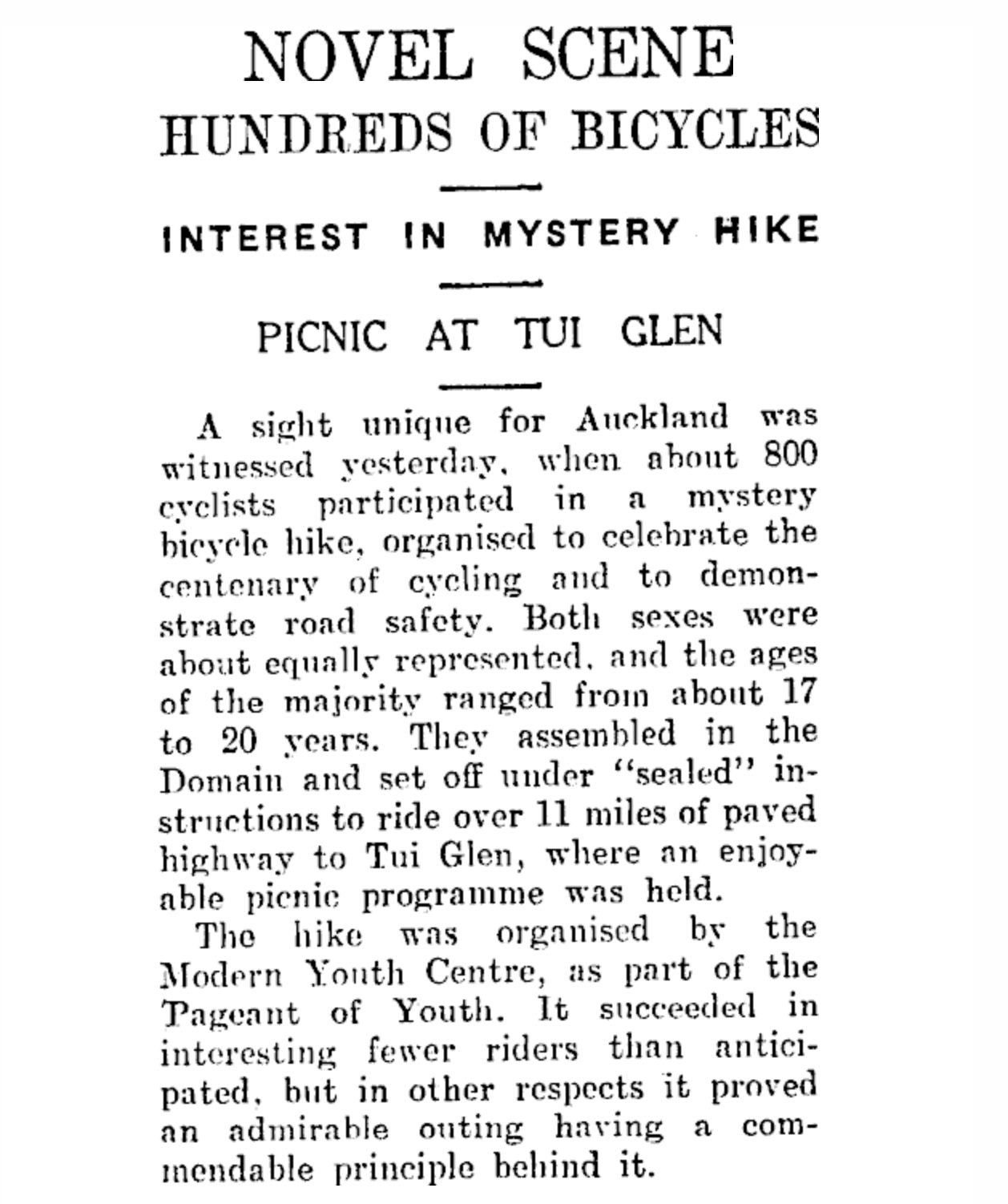
Hundreds of youths, just living in the moment – what’s not to love? And like the current ride-outs, it would have been an incredible sight to see:
The riders set off in groups of about 200 each, headed by two members of the amateur and professional cycling clubs. There was an appreciable gap between each group, and they were marshalled by members of the Auckland Motor-cycle Club.
Traffic experienced no great difficulty in passing the cyclists, even when they began to close into one group near New Lynn on account of the grades and the slackening of the pace.
All the riders had reached Tui Glen before mid-day, and the entrance to the picnic grounds was strangely transformed bv the appearance of tho hundreds of parked bicycles.
By the way, Auckland Transport’s cycle counter data for April is out. On the longest-running 26 count sites alone (which, as we all know, only capture a fraction of everyday bike trips in our city), ridership in April 2026 was up 20.3% on last April. Not bad!
Morale low at Waka Kotahi/NZTA over cuts
A large restructure is happening at Waka Kotahi/NZTA, with a lot of jobs on the line. Interestingly, the area of NZTA in charge of the RoNS is being cut. RNZ reports:
PSA national secretary Duane Leo told RNZ workers were in a state of confusion and shock after the proposed cuts were put to them.“Morale is zero, it’s rock bottom at the moment, and there’s real insecurity out there.”The restructure was especially disruptive, because it came just three weeks after another restructure that affected more than 250 roles in NZTA’s regulatory group.He pointed out the latest round of changes marked the second major restructure at NZTA since the beginning of the coalition government’s term.“Restructure after restructure – it’s taken a huge toll on the workers and their families.”Workers were particularly confused by the cuts to the transport services group, because it was responsible for some of the government’s most critical infrastructure projects, Leo said.“The transport services group has been given plans to deliver some huge capital transformation programmes, including Roads of National Significance.“What they’re doing is actually cutting the people who will build their flagship projects.”
Dirty scrubbers: Cruise ship pollution
Concern in Alaska over cruise ship pollution, including how exhaust scrubbers operate, has also raised questions about the impact of cruise pollution in Auckland. As the NZ Herald reports:
Dr Timothy Welch, professor of urban planning at the University of Auckland, describes scrubbers as a “loophole”.
“It just takes the sulphur out of the exhaust and dumps it in the water. We’ve basically replaced what’s in the atmosphere and was blocking the sunlight and condensed it down and just started dropping it into the water itself.”
And there potentially isn’t a lot of value for New Zealand in these visits, anyway:
In a typical year, more than 25 cruise ships visit New Zealand’s coast.
Welch believes the public should be concerned about the industry’s impact on the environment.
“They have a significant impact on the environment, whether it’s water or air.”
He also plays down the often-touted impact on the economy.
“What we do hear a lot about is their contribution to tourism dollars here but … [it’s a] very small impact except for very localised areas overall on our economy, versus the environmental impact that they have nationwide.”
A 2024 study published by the Department of Conservation on the economic and environmental impact of cruise ships on the Milford Sound, a Unesco World Heritage site, confirmed Welch’s views.
It found that the cruise ship industry was a “niche tourism market in New Zealand, accounting for around 1% of total tourism expenditure”, while the environmental impact and costs were “significant”.
“International research casts considerable doubt upon the economic impacts of cruise tourism and its wider contributions to national and local economies,” it concluded.
“Managing the impacts of cruise tourism can not rely on voluntary commitments and self-reporting. Third-party independent reporting is required to ensure that measurement and mitigation is transparent and publicly reported.”
Is Seascape cursed, and what to do with it?
A bunch of folks from The Spinoff had some ideas with what to do with the abandoned Seascape tower. From a new home for Parliament, to a giant road cone, to yet another Wilson’s Parking, or – as Hayden Donnell proposed – a wicked hydroslide:
New home for the Waiwera Hot Pools’ hydroslides. We’re still mourning the demise of the popular water park, which entertained 350,000 people a year in its heyday. The altitude of the Seascape tower could provide not just a new home for The Black Hole, Twister and Speedslide, but an adrenaline-surging increase in elevation that would be definitely 100% safe and family friendly. “Waiwera Hot Pools had a slide called Bob’s Mistake, named after a design error which saw its tube terminating a metre or two above the pool below,” notes hydroslide aficionado Hayden Donnell. “The Seascape Tower offers a unique opportunity to expand that much-missed mistake to 150 metres or more.” Although where those famous Waiwera slides are now remains to be seen. The park was abandoned by its billionaire owner – not unlike Seascape – with new owners planning a wellness complex (think reflexology rather than hydroslides).
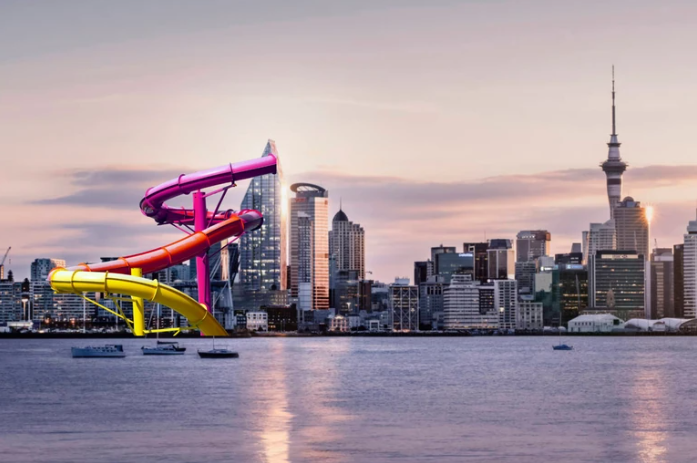
Hydro slide from Seascape building (Composite by The Spinoff. Image: Peddlethorp)
Which way The Others Way?
Alas… tragic news when it comes to the independent music festival, The Others Way, which after a ten-year run has announced it will no longer be able to operate. The end was due to funding issues and instability, as RNZ reported on Wednesday:
The annual festival has been held on Karangahape Road, in central Auckland, since 2015. The November 2025 party was its last.
The call to can it comes after years of mounting financial pressure, industry costs and an increasingly unstable live music and funding landscape, Banished wrote.
“The magnificent joy received from delivering The Others Way is outweighed by the sheer financial strain and emotional toll it takes on us to deliver,” said Banished, who took over the festival in 2023.
“Rising costs across every aspect of the entertainment industry, combined with ongoing uncertainty in the sponsorship and funding landscape, and people just doing it too tough out there to commit to buying gig tickets have created significant pressure.”
But wait… as Lyric Waiwiri-Smith reported for the Spinoff that same day, Auckland Central MP Chlöe Swarbrick might have something to say about that:
But just as fans of The Others Way came to terms with the news, a small glimmer of hope appeared this afternoon in the form of Auckland Central MP Chlöe Swarbrick, who told The Spinoff she was already working to “revive” the festival.
“I’ve actually been heavily involved with this over the last few days,” Swarbrick said from parliament. “I have been engaged with the mayor’s office and directly with Reuben [Bonner], who’s behind the festival.” The situation was “actively evolving”, Swarbrick said. The mayor’s office has confirmed to The Spinoff that Swarbrick’s office had been in touch.
Would you like to see The Others Way saved?
CRL safety testing continues
RNZ reports on the ongoing CRL safety tests, which have been checking that the system can handle various issues, including “unruly passengers.”
This prompts us to ask our urbane readers, many of whom will have enjoyed rapid transit all over the world: what “real-life scenarios” have you witnessed, that you reckon need testing here?
The tests involved around 400 people and lasted for around three hours. A large part of the testing was around evacuating passengers from inside the CRL’s tunnel network, which is 45 metres underground at its deepest point.
“We have some actors in the crowd as well, such as unruly passengers, or people with prams which really make it a real-life scenario for our staff.”
Videos to check out
Berlin looks to ban cars…
Ride the D Line in LA!
And Brad Lander, who ran for NYC Mayor and has been a supportive presence for the successful candidate, Zohran Mamdani, is now looking to extend his progressive influence via other political channels:
From the socials
A great new map and analytic tool that highlights what access really means in Auckland, from University of Auckland professor Tim Welch:
Most transport maps show where infrastructure is.I wanted to show what that infrastructure actually lets people reach.I’ve been building the Auckland Transport Access Atlas: an interactive map of car dependency, accessibility, equity, and planner priorities across Auckland.ataa.tfwelch.com
That’s it from us this week, take care!

 Processing...
On the others way demise, here’s a short on how important events have been for the San Francisco city centre post-covid recovery:
https://youtube.com/shorts/5TAjCQLmCA4?si=5CB0rIxliw3ws57R
We should not let this die.
Anybody who has ever used the Metropolitan or Hammersmith Lines in London will be aware of the ever present danger of annoying gypsy bands shuffling through the carriages playing awful music and then expecting money for it.
That Christchurch cycle crash shows how important a back berm can be for safety. AT’s TDM has a Practice Note for vehicle crossing design. The sight distances for vehicles can be adapted for pedestrians exiting a property, by adjusting the observer setback.
It hardly needs saying that separating bikes and footpath users provides room to see cyclists approaching, even if someone is crossing from a property.
Good weekend reading: mass transit in Jakarta, the world’s biggest city.
https://indevelopmentmag.com/jakarta-transit-transformation/
Jakarta is the largest Urban Agglomeration, not the most populous City Proper. In Jakarta the population in 2025 was 11,010,514 as per census. Compared to 1.7 million in Auckland Council.
New and longest for Finland – Helsinki bridge active and light rail only. It can be done, what we need here for Auckland.
https://youtu.be/psQFA_i3qDA?si=n7HrUWutdP3IbsTx