Almost two years after leaving as chief executive of City Rail Link Ltd to deliver Dublin’s MetroLink, Dr Sean Sweeny is back. And back in the news, critiquing the cost of the project he once headed.
While I get the points he’s making, and agree with some of them, his comments suggest he’s perhaps too focused on the individual project, at the expense of the massive benefits it delivers to the wider network. A case of not being able to see the rail forest for the CRL trees.
Here’s the whole interview with Katie Bradford.
The CRL-specific comments start from just after five minutes in.
Sweeney: I do believe we’re not very good at specifying the scope and I do believe in New Zealand we’re over-specifying jobs and it’s making them too expensive which means we do less of them.
Bradford: So are you saying that you think the City Rail Link was over-specified, overengineered, too expensive, basically?
Sweeney: Well, I’m not going to make any friends for saying this, but in a nutshell, yes. Uh, I’ve spent the last nearly two years spending a lot of time in Europe. I’ve spent a lot of time with the people who built the Copenhagen metros. They have been brutally disciplined about how they’ve specified scope and they’ve built very small, very affordable stations all through Copenhagen at a quarter of the cost of CRL.
Bradford: How much cheaper do you think we could have had the CRL?
Sweeney: I think we could have delivered this for half the cost, but it would have looked different.
Bradford: What would it have looked like?
Sweeney: The stations would have looked quite industrial, and they they would have been smaller, and they wouldn’t have had anywhere near the extra facilities in them.
Bradford: You were the CEO. Could you not see that those costs were too expensive? Should you have stepped in and stopped that?
Sweeney: I probably didn’t have the experience in building metro stations. Then we asked before we got re-funded. We were asked by government to look at any places we could save [and] KiwiRail were asked and they came back and said they couldn’t find anywhere to save money and I didn’t have the expertise or the background to challenge them.
If that was me now, I would I would have reacted quite differently to it. But you really need to get in when the designs are being done. When I turned up the designs were done.
This is all in the scope and the specification, and that’s with the designers and most designers like to do their last job and most of the metro people on City Rail Link, their last job was London Underground. Okay. Australia, England, Hong Kong, Singapore build the most expensive metros in the world and all those people are in the same ecosystem and we use those people.
Bradford: Why are ours so much more expensive?
Sweeney: There’s a number of things. One [is] the size: CRL has gone for nine-car trains. Copenhagen, they have three-car trains. They have uh three cars, stations 60m long. Our stations [are] 200m long. They have two escalators, one up, one down. Uh, we have between six and eight escalators depending on where you’re at.
I remember talking to one of the lead guys who designed their stations. I went to their station, said, “Where’s the toilets?” He said, “There are none.” I said, ‘Why not?’ He said, “Sean, we run trains every minute and a half. Why should we provide a toilet when you’re going to be here less than 80 seconds?
They have … a really stripped down, lean version of what you need for a metro and as a result, it’s cost a quarter of what we pay for ours.”
Bradford: So, that decision to go to the nine-car platform station, were you CEO when that decision was made? Yes. Why did you approve that decision?
Sweeney: Well, there was a bunch of work done before I arrived. It was a decision that was on the table when I arrived, but all the recommendations were nine-car. To be fair, everyone was terrified of another Auckland Harbor Bridge, and they were terrified of within two years the whole railway being over capacity and that was a genuine concern at the time. So, the decision was made to go nine-car. I now know that nine-car versus three-car probably doubles the cost. The decision really needed to be made at the beginning. It was too late when we’d done a lot of the work then.
I would now say, okay the the trains will be full at capacity. We’ll just run them more regularly. That would have been my answer now.
Bradford: So it was about future-proofing the stations. Right. Yeah that’s what it was. And so in 20 years, 30 years time, maybe people will thank you for that decision.
Sweeney: Well, okay, the flip[side] of that too is, every metro that’s successful gets too crowded. Because I’ve spent the last two years going around Europe. When your metros are super-crowded, you build more metros. That’s simply what they do.
Every metro that’s successful is busy and overcrowded, then they add more lines.
Bradford: And so, but … again, does that come back to our lack of experience here in New Zealand, because we have never built something like this before?
Sweeney: Well, as I think I said, the people who designed CRL basically based it off previous metros they done – probably Sydney, London, Singapore, Hong Kong. These are all expensive metros. We just happen to have bought an expensive metro.
From what we’ve seen via images and footage of tours currently being granted to various stakeholders (CRL/AT: call us!), the stations look fantastic. It would be useful to clarify exactly how much the artwork added to the bottom line cost of the stations. While every little bit adds up, of course, my guess is the artwork – which is spectacular – probably isn’t the part that led to the total cost being $5.5 billion.
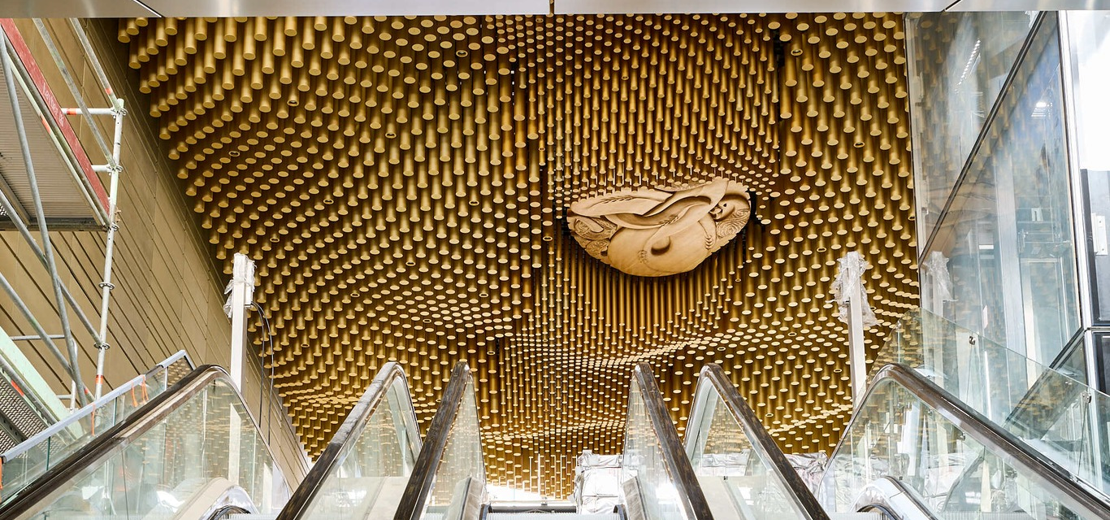
So it seems the main cost savings Sweeny is now musing about, would have to have come from having smaller stations. He mentions Copenhagen as a model. So the question becomes: yes, small (automated) metros with high train frequencies – like Copenhagen’s – are great, but could that have worked here, and more importantly, would it have cost less?
Currently, at peak times each of Auckland’s three main lines sees a train in each direction every 10 minutes, or 6 trains an hour. When CRL opens, we’ll have…. exactly the same, but Auckland Transport says that within six months, it wants to raise this to 8 trains an hour. Almost all trains will be 6-car trains.
Now, picture a world in which CRL was built only to accommodate three-car trains. In that world, running the same level of capacity would require 12 trains per hour now, and 16 trains per hour within six months of opening. And remember, that’s on each of three lines.
So all up, you’d be needing to run 32 trains an hour through the CRL, in each direction. Just to maintain current and promised levels of service.
Would this have been possible for Auckland? Four thoughts here:
- To achieve those levels of frequency, you’d need to upgrade the signalling system. It has previously been said that the CRL will be able to handle up to 24 trains per hour per direction, so enabling even higher would require a completely new system. I don’t know how much that would cost but it’d be at least in the hundreds of millions.
- Next: the testing in January saw around 20 trains an hour running through the CRL. And as we know, it quickly suffered from congestion, especially at key points around the network. AT has since cut some of the complexity out of their immediate plans, but that experience highlights that to achieve even moderately higher frequencies than now, would require things like grade-separating the Westfield and Wiri junctions. Which would add a few more hundreds of millions to the bill, at the very least.
- Then we have the ongoing issue of level crossings. AT was initially going to run fewer trains out west, simply to avoid putting more trains through the level crossings that exist. So, going to 16 trains per hour per direction would probably mean the barrier arms would be down for so much of the time that the level crossings might as well be closed. For some crossings, that would be fine – but many others will need grade separation to maintain access, so that’s immediately a few billion more that’s needed.
- And there’s also the issue of freight. Put simply, at the kinds of frequencies suggested there would be no room for freight trains. So you’d need to further extend the third main line, and likely delivering at least some of the fourth main would have been required – which adds another few billion added to the tab.
So, sure: perhaps we might have been able to save a few billion on construction costs of this one project by building smaller platforms for the CRL stations.
But to compensate for the inevitable impacts, we’d have needed to spend far more than that upgrading the wider network. (Note: those projects are needed eventually, but having to spend that money upfront is a massive opportunity cost, and may even have been prohibitive to the whole project getting off the ground.)
Lastly: even if you tried the Copenhagen model, there simply wouldn’t even be much additional capacity in the system. Some of the best metros have managed to get down to a train about every 90 seconds – or 40 trains an hour – which is not much more than the 32 per hour that would needed just to run the timetable we’ll have shortly after opening.
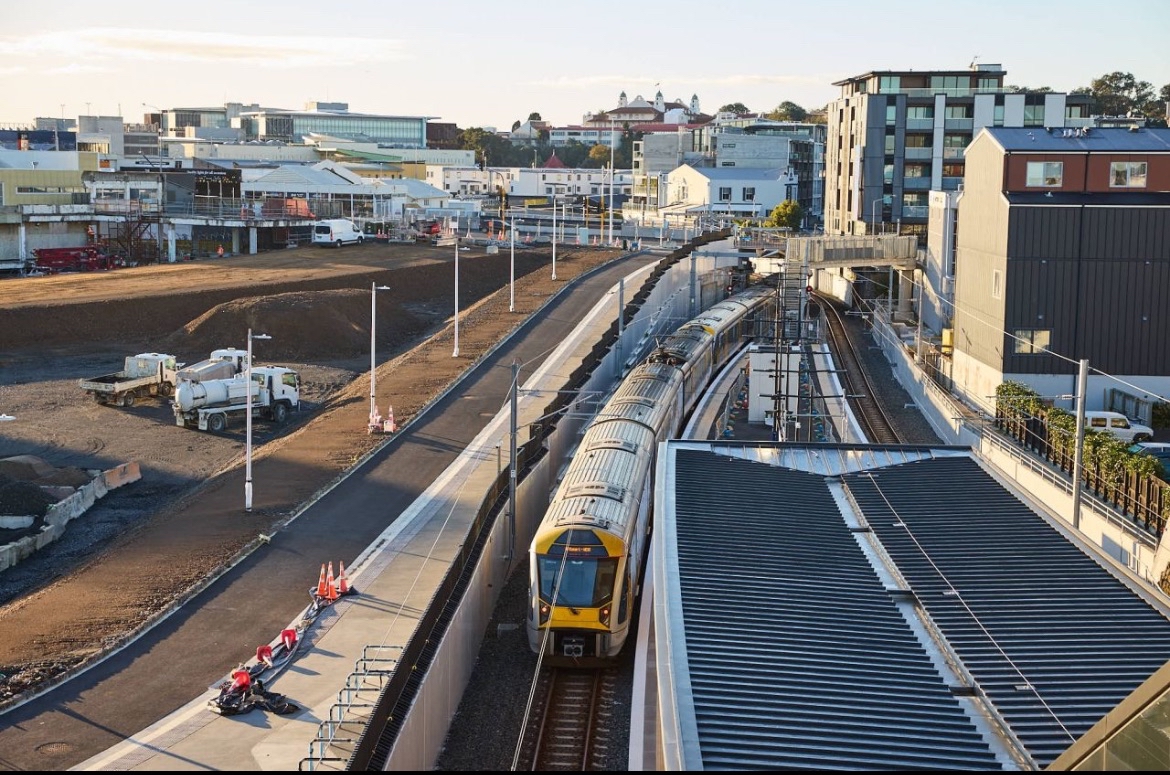
How much could have been saved by not rebuilding the old western line platforms at Maungawhau?
What about future-proofing for 9-cars?
While I think that the idea of only building the CRL for 3-car trains wouldn’t work – or at least, would have cost far more – the future-proofing question is perhaps a more interesting discussion point.
In the future, if more capacity is needed I would certainly rather AT focused on adding that by way of more frequency before making trains longer. But that doesn’t necessarily mean it was the wrong decision to future-proof for 9-car trains.
As Sweeny himself notes in the interview, back when the design was changed to enable 9-car trains, the fear was that the capacity being added by the project wouldn’t be enough long-term. That’s because back then the rail network was growing significantly following electrification, and crucially, was exceeding ridership expectations.
What is not clear is just how much that future-proofing has cost. Back when it was announced in 2019, CRL said it would add $250 million to the cost of the project. The project subsequently increased in cost by about another billion dollars, to $5.5 billion – mostly due to the impacts of COVID. We don’t know what proportion of that additional billion is due to the future-proofing .
What we do know is it wasn’t just about 9-car trains. The future-proofing included funding the Beresford Square entrance for Karanga-a-Hape station – something that should have been part of the project all along, and will likely be the most popular (and iconic!) entrance for that station.
Where Sweeny makes sense
While I don’t agree with his comments about the CRL specifically, I do think he’s correct about how Aotearoa approaches major infrastructure projects in general.
Perhaps the best example (aside from the RoNS) is Auckland Light Rail, where a workable and essentially shovel-ready plan for surface light rail somehow blew up into building one mega underground light metro line. For the same budget, we could have had – and might already have been enjoying! – two or three surface light rail lines. Which we can all see would have been a better overall outcome for Auckland, and for the country.
I also think Sweeny’s comments about how the more escalators you have at a station, the more it will cost more to run long-term (because of maintenance, etc), are relevant to some other stations around the network. In particular, the new stations between Papakura and Pukekohe.
A glaring inconsistency
At numerous moments in the interview, Sweeney notes that we as a country only have a limited budget to be able to build things, so we need to get more out of that budget. For example:
Sweeney: I think there is there is an acknowledgement within some in the industry that we have a tendency to gold-plate projects. I’m not the only one using the word gold-plating by the way. Yeah. It’s out there.
Bradford: And and so how do we now turn around and say let’s stop gold-plating projects? Let’s go back to basics?
Sweeney: Well, it’s complicated. I mean I I’ll use the example of two stadiums. the Dunedin Stadium and the new Christchurch Stadium. The Dunedin Stadium cost a quarter of the new Christchurch Stadium. Everyone in Christchurch is incredibly proud of the new stadium. Did they need all of that for four times the cost?
I think New Zealand, where it is in the world at the moment, needs to do more Dunedin stadiums and less Christchurch. Now, everyone in Christchurch is going to hate me for saying that, but we’re not an infinitely wealthy country. It’s about spending our money wisely to do more with less.
Which is striking, because then when he’s asked about a harbour crossing, he opts for far and away the most exorbitantly expensive option.
Bradford: Do you think … based on your experience, do you have a preferred, you know, should it be a tunnel should it be a bridge?
Sweeney: So, I’ve done no detailed engineering work on this… my view is it should be a tunnel. What I’ve learned … in my last eight years [is] tunneling is getting cheaper and cheaper and safer and better, and I think we could we could do a very good solution with tunnels.
It seems at least in part as a result of Sweeney’s comments, Transport Minister Chris Bishop has launched a review of the CRL.
Bishop said in a statement to 1News on Thursday he had “a lot of respect” for former CRL boss Sean Sweeney and took his views “seriously”.
“Like everyone, I’m unhappy at the cost of CRL,” Bishop said.
“I am determined to do a post-completion full review of the project, which is something not often done in New Zealand.
“This review needs to look at the history of the project, along with the business case(s), and costings. It also needs to look at missed opportunities.
“I’ve been open about how CRL was only really ever envisaged as a transport project when it is so much more than that.”
Logically, shouldn’t we also expect an advance value-for-money review of ideas for the next harbour crossing – and the Roads of National Significance as well?

 Processing...
Exactly.
To run smaller trains at the required frequencies would pretty much require quad-tracking the entire legacy network. This is because of the need to accommodate freight and Intercity services, and because of the large amount of interlining on our little network.
As Matt says this would be great, but in no way would it be cheaper.
What we now have is, on balance, a compromise between optimising the CRL and upgrading the legacy network, and is pretty much at the cheaper end.
Covid and associated inflation in the civil sector hit every infra project. I still maintain we are super lucky we started CRL when we did. Would be many many more billions if begun now.
This will never be regretted.
I respect Sweeney and think he did a very good job as CRLL CEO, but this is simply a pitch to get the Harbour Crossing job, and feels a little clumsy and unnecessary, to be honest.
Additionally, crappier stations with fewer access points would end up costing us in expensive retro-fits.
Plus, the art and design budget is trivial in the scheme of things.
We’ve done something well for once – invaluable!
I notice some anti-CRL readers on social media are already pushing the narrative that this was too gold-plated. Including the usual “populist ‘financially conservative’” suspects.
It is gold plated although I support it because trains are cool (vibes trump evidence). I think the artwork looks quite nice and we probably overpaid for it but it’s nice for tourists to see. My only complaint is Te Wai Horitu or is it Waihoritu anyway it’s a stupid name Aotea was way better yeah Britomart to Waitemata was also dumb and definitely wasn’t free but at least it’s still a relatively short name much like Maungawhau. Why change a nice name like Aotea? Seriously it’s a lovely Maori word but I guess it didn’t sound Maori enough so it was changed? It’s just going to make life more difficult for travellers. Oh and while I don’t mind having the Maori word for everything underneath AT has gone the woke route on the stations and its website putting the Maori words first it’s actually really frustrating trying to read the drop down menu on their website as your brain looks at the bold letters then thinks that is something else only once you realise you have to look at the fine print. But yeah I see Greg Fleming said the thing is only WEEKS AWAY from opening so exciting !!!!!!
I don’t think naming the central station after the Maori name for Great Barrier Island made a lot of sense.
The station was named after Aotea Square, as the Wellesley St entrance is essentially touching the square. Practical name describing the location.
I agree that Aotea Square Station would have been appropriate. However, people new to the city would not know where that is, either. Now people have to “learn” half a station name (“Te Wai… station”) and where it is (central) and all is well. In the meantime, we have all learned that there used to be a stream under Queen Street which is cool.
Re the stream, I learnt that in school (went to school in my last 3 years in the CBD), and it’s a waste of a good name naming something near the top of a hill after a stream that ran along the bottom. The name should’ve been saved for either stream daylighting (really a fake stream park) or something along Queen St.
Freddy – it is also the name of the semi-cycleway thing that runs down Queen Street: Waihorotiu Path
Yep – I read / heard his comments as purely a pitch for
*hey, I’m back in the country, let’s get going with another gold plated, but not gold plated project please*
Isn’t he a builder/engineer, he’s not a planner right? This is the problem with having project managers having opinions on this type of thing, they can be great at solving thorny construction and civil engineering solutions but aren’t necessarily competent in transport planning outcomes. Experienced this many times, where civil engineer delivery PM’s would value engineer a design to the point it didn’t deliver the outcome. One even value engineered the cycleway out of a cycleway project and turned it into better signals for general traffic and a lighting upgrade, and tried to present it as the preferred affordable solution.
From a project perspective, it’s good practice to do a full review of the implementation of the CRL with an aim of improving future large-scale transport projects. The stations are going to be something Aucklanders (and visitors from other parts of NZ) can be proud of. I hope the review clearly outlines the cost of the aesthetic elements as I suspect that aspect is being blown out of proportion in the 5.5Bn cost.
Lastly, I can’t believe you folk haven’t been invited on one of the station tours! Outrageous.
Big difference between a metro and a underground extension to a suburban railway network. A metro the trains just follow each other with no timetable, if there’s an outside problem , they just que up .
I think eventually the 9 platform trains will come into their own , not with 9 car trains , but allowing more than one 3 car train at a platform at a time . With different destinations (same direction).
This will never happen
No, it’s about as plausible as electric cars.
I think the amount of inner city travel on the crl will be higher than expected . I.e between stations on the link itself , and out to Newmarket , Kingsland , panmure way . The demand for more frequent service will mean shorter trains more often will make sense , at least on the inner lines.
Yes, I agree that there will be quite a lot of short trips, however I’ve never seen what you describe on any metro in the world. Even with high quality signalling the 2nd train at the platform would need to wait at least 90 seconds after the 1st train departs.
If there are more frequent services on the inner part of the network they will more likely run between say Mt Roskill and Panmure and probably still be 6 car trains to handle Eastern busway patronage.
I was already noticing a regular reader comment on the Herald’s Facebook page already pushing the “I know the horse has bolted, [but the whole project should have never got off the ground in the first place]” narrative.
But a $22bn road between Northland and Auckland?
“We’ll need it eventually and it will never be cheaper than now”.
Yep, lets build it.
lmao nope. $22 billion for a programme of major public transport improvements for Tāmaki Makaurau, Te Whanganui-a-Tara, Ōtautahi, Kirikiriroa, Ōtepoti, and Tauranga? Now we’re talking!
Such people will likely be pushing up daisies soon (I’m allowed to say that because I’m close to 80) and should be ignored. I live well away from Auckland, but am an occasional visitor, and believe the CRL will be the making of the city in allowing residents and visitors to actually live in city. No serious city anywhere survives without a metro system. As one commenter has noted, Auckland’s is more a development of the suburban system, than a true metro – where each line is a dedicated route and trains can almost be crammed end-to-end, but hey it’s real progress. I recently had the privilege of spending a reasonable time in Paris. The Metro is a legacy system with some lines dating from the Victorian era, but about half the system is now “automatique” – where driver-less trains run at about 90-second headways. The trains are full and fast, night and day. Remaining legacy lines are in the process of being upgraded to become “automatique”, which will boost capacity.
The people in the Facebook comments and on Reddit have already latched on to Sweeney’s comments – every time CRL or AT try to post about progress they get almost as much as “TWO BILLION WASTE OF MONEY” as they do “no-one goes to the CBD”, “where’s the North Shore line”, and “where’s Te Wai Horotiu”.
The way you can tell that this is a culture war issue rather than anything real is that they are all blaming the station artwork for the cost overrun, riffing of Wayne Brown’s comment about “cathedrals”. The thing about blaming the artwork is that artists (in particular Māori artists) are a perfect target for NZ First-style woke-bashing.
There is an agenda here to damage the brand as much as possible so that opening is a damp squib and there will never be another transformative PT project in Auckland (actually surprises me that the journo responsible is Sue Bradford’s daughter).
I usually point this out to people overseas and say that even much of the New Zealand Green-left (almost every person that is active on Reddit’s /r/newzealand is a Green supporter) supports driving 😀
r/newzealand is full of people who keep saying zero immigration now! That’s not Green policy
I couldn’t care less what people on Reddit say.
The opening of Britomart was hardly a roaring success. From memory the mayor was there to cut the ribbon and the 1st train was seven minutes late, and the station looked like an empty white elephant for the first couple of years.
However, it didn’t stop it being a huge success and driving further improvements on the network. What will determine that with CRL will be how much growth there is in train patronage, not how succesful day one is.
My read on this was basically Sweeney saying “I was out of my depth leading this project, but I’ll answer my phone if you have any bigger projects going”.
Gotta say that is a very bold and risky pitch!
Pretty much, especially when he oversaw many of these expenses. Given he thinks there are too many entrances at K Road is he also open to a harbour tunnel that only has an entrance at one end if he gets the project?
I got that vibe as well
I didn’t know what I was doing with the CRL, but after it was completed well over budget, I looked at smaller systems overseas and figured out I could have saved a bunch of money
Now please give me a much larger bridge/tunnel project that I also don’t know what I am doing
Sure it will work OK this time
Hmm, I concur. This puts an onus on NO more of the HR that don’t bring in the right foreign talent to manage. We paid goldplated salaries for these managers and Dr Sweeney is stating that the selection was good enough. Thats a major concern because its the same private companies that again will be asked to identify the leaders for our next goldplated projects (tunnel across to the shore, the roads of national significance and eventually, touch wood some light rail down Mt Eden or Dominion Rd etc.
How much understanding did these companies really have of International HRM (answer is little to none). So, perhaps next time we need to start by having an HR and agency that actually can bring the right candidates to the plate and an HR that spends sufficient time leading the search. Not contracting agencies that has never done the work before and use headhunters without international experience. Seems like a prudent start.
Nah, I think it shows an appreciation of being able to objectively and critically evaluate his performance after being presented with new/better information, sometimes when you’re in the middle of the doing you can’t see your blind spots. I consider this a massive strength in someone who will be leading these types of projects. I don’t agree with his conclusions but he will be aware of his limitations for other projects and is much more likely to ask for and be open to challenges. Compare it to say someone like Simeon Brown who would never admit he’s wrong despite huge amount of evidence. This self-reflection is a strength.
Be interesting to see how a review of CRL informs the future Hamilton Central Station development, which needs to be added to the Government’s infrastructure prioritisation process (if it isn’t already on the list)
With regards to numbers of escalators/lifts what is the comparative depth of the Tamaki and Copenhagen stations- I assume the deeper you are the more egress routes you would require?
It’s amazing. I wouldn’t change much and no-one will regret it being build to an elevated spec – like Britomart once it opened.
But – they do need to make the most of the big capital investment.
Sort the level crossings out.
Confine freight to night time or build a full quad route, including Avondale/Southdown diversion.
Sort out the dwells – a unit could probably do an extra round trip or two in a day if this was fixed aggresively
And yes, proper signalling to support at least 12tph on each of the three lines, each direction.
“no-one will regret it being build to an elevated spec” – only because they won’t be thinking of what we could have had instead.
If they could have built a basic CRL for $3 billion, they could have also built LR to Mt Roskill and maybe to the airport. Imagine if both of those were opening this year! I think that is what Sweeney is saying – build more things basic, rather than less things top spec.
It’s not that high spec. The station finishing is not really the cost, it’s just the aesthetically easy part to attack.
And why shouldn’t NZ have world-class infrastructure for once, instead of looking like a developing country. Again – Britomart seemed over-specced and criticized, and quickly became the pride of the network.
It’s a straw man to say ‘what else could we have bought’ – do things well or not at all – and you’ll save in the long run. Do we half-spec and half-ass roads to afford other roads?
Gun for Hire interview. Very much agree with not letting the project run away with the scope (ALR, AWHC, RoNS, RoNS, RoNS) but completely missing the difference between Auckland commuters plus freight rail system and Copenhagen Metro (just build some more Metro lines).
Google The Madness of Sweeny for some reflections on this.
This has to be one of the most obvious cases of sour grapes I have ever heard….. At last a project in Auckland has been semi future proofed and then someone has to start questioning why spend so much.
Is this not why we have clip ons to our Harbour crossing and no rail link across the bridge.
Auckland IS BIG it does not need to think big. Auckland will grow with or without planning. Auckland needs rail and more of it. Maybe we “All New Zealanders” need to accept that we need to prove that we can get one city right. Links still need to be made. And we are now looking for the next big project trying to go back to budget bargin priced service that will be outdated before its finished.
Transit (and cycling) projects always seem to get this intense scrutiny (“why did we pay to make it so NICE??”) that other roading projects never get.
I think Sweeney is right. Not necessarily about 3 car trains if he did imply that, but there would be plenty of nice to haves that added very little real value, it could have cost a lot less.
For example I wonder how much Karangahape station cost? Maybe 2 billion? At that time we could have built LR to Mt Roskill for that, people could have transferred at Mt Eden or Aotea for K Road.
As for the visuals, it won’t be just the artwork but the architecture that would ratchet up the cost vs something basic. In saying that, good architecture is very rarely regretted.
On the plus side we now have a functional station at K Road. I doubt even if the money had instead been allocated to surface light rail to Mt Roskill it would have been built.
I suspect the sweet spot is roughly half way between the “bare minimum” and the “gold plated”. But I also suspect its very hard to find that sweet spot compared to the bare minimum (always say “no”) and the gold plated (always say “yes”).
It is interesting that GA want a budget friendly surface level LR instead of tunnels, but when it comes to the CRL they like gold plates.
I just saw a Monday Morning Quarterback pitching for a new job as the voice of reason.
Complain about CRL cost, don’t mention the RoNS and then pick the most expensive harbour option?
The eternal problem with Karanga-a-Hape station, is that growth around it is severely curtailed by the viewshafts.
I’m sure the Beresford entrance is going to be very cool. But it’s surrounded by 2 and 3 story buildings. Not the 20 story buildings like it needs to be to get any appreciable use.
I don’t know, K-Road is pretty busy and attracts people from all over the city as it is.
K Rd. would be even busier if the motorway was capped. With a park allowing easy access to the southern area there would be incentive to regenerate the area with multilevel commercial/residential development. As the area is lower than the ridge building height would be less of an issue.
*When the motorway gets capped 🙂 (circa 20-50 years)
I think Karanga-a-Hape station is a classic example of what Sweeney is talking about. At any point was a business case done on that station alone? It obviously cost a lot of money as it is so deep, and it will cost a lot to maintain and run, can it provide anywhere near enough benefit to be justified? Maybe someone did the analysis, but I suspect it was built just because it seemed like the obvious thing to do.
Is the issue that the CRL was over-designed or is it that New Zealand doesn’t invest in and value design thinking early enough, when it matters most and costs least.
CABE and others looked at whole-life costing framework for civic projects. They put design at 1, construction at 10, and lifetime operating costs at 200. Getting design right early isn’t gold-plating it’s the cheapest intervention available if done early enough. And it generates value: CABE’s research consistently showed that good design increases economic viability, commands higher returns, and delivers social value that persists across the lifetime of a place.
Sweeney himself concedes the stations will be seen around the world. That’s not a cost — that’s an asset. By his own admission, the real failure was that the designs were locked in before serious design leadership was in the room. Auckland and New Zealand keeps making that mistake. The harbour crossing is the next opportunity to get it right.
It is a cultural issue I think. Look at Hong Kong’s infrastructure in the last two decades of British administration from the 1970s to 1997. There was less grumbling about gold-plated. Everyone believed in do it properly the first time round.
I think the CRL is perfectly timed to address this current energy shock. We should all be grateful that our biggest city will soon have more transport choices that can sidestep the Iran War oil shock. I say that as a Cantabrian who hopes one day Christchurch we will get a mass rapid transit system that delivers transport choice to us, too.
Absolutely. A missed opportunity presided over by Billy Bunter.
I don’t see this as an argument on whether the CRL should have been built or not, its about whether it needed to be as expensive as it was.
Likewise it seems we need another harbour crossing. If the current bridge can last indefinitely without heavy traffic, then the obvious solution to me is a parallel 2 or 4 lane bridge just for heavy traffic, buses, and walking/cycling, maybe a billion or so. Yet they will probably build a gold plated solution for $30 billion or more.
The NZ process seems to be wait until a politician gets on board, then build the best thing you can imagine.
Even simpler than that would be to have heavy traffic go via SH16, then no need to build another bridge.
As long as a full double-decker bus doesn’t count as heavy traffic!
no toliets?!?! must be taking the piss
Been to these overseas and they can be pretty bad; no seats, no toilets, stripped down stops
You really need super fast frequencies as you otherwise go down, through the gates and find the next train is 5 minutes away and you need to go to the loo.
Had a few drinking sessions overseas that almost ended in embarrassment
There’s no WCs anywhere on London’s Underground stations – just saying.
Copenhagen’s Metro is very different in form and function from Auckland’s CRL. It’s great – I used it in October to get to the airport to fly to London. But before the Metro, Copenhagen already had and still has a huge suburban and regional train network as well as trains to all parts of Denmark and into Germany and Sweden.
Many cities in Europe and elsewhere – Sydney for example – have a variety of rail modes – Copenhagen is unusual in not having trams in the mix. Sean Sweeney would know that the Dublin Metro that he was working on was adding to the mix in that city, which already has suburban heavy rail – DART – and light rail – LUAS. Driverless light metro like the Copenhagen Metro, Vancouver Skytrain and London’s DLR is a technology that I believe could have a place in Auckland, but it wouldn’t have been appropriate for the CRL, which is about increasing the usefulness of the existing suburban heavy rail network. A metro here could make sense in a corridor that doesn’t have heavy rail – across the harbour on an stunning green bridge, maybe – or elevated above the median of the northwestern motorway to avoid widening the already-too-wide causeway …
Copenhagen has a light rail line, with 29 stations, they expect 15m riders by 2030. So Metro, S-Tog and Light Rail. Between the Metro and S-tog they had 235m passengers in 2025, all from a population of 1.4m, makes you wonder why we need 9 car trains in Auckland.
To save money the stations could have been paid for by developers of adjacent properties, which would also provide additional entrances.
Things like moving the bluestone wall, and fitting skylights into Aotea station are added cost.
Mt Eden has platforms on the wrong tracks, as running patterns were not confirmed until recently.
This is Hong Kong’s MTR and also Japan’s private rail operators (Major [Private] Railway Companies, in Japanese 大手私鉄 Ōte Shitetsu)’s business model: using property developments to subsidise railway infrastructure projects and operations.
“Mt Eden has platforms on the wrong tracks, as running patterns were not confirmed until recently” – that’s why the Germans say paper before concrete: define your ultimate deliverable (i.e. in this case the train timetable to be operated) before you build anything.
This was also how Copenhagens metro was built.
I like the idea of three car trains running at a greater frequency but it’s never going to work on our network. It might work through the tunnel but that’s not the network. So he is comparing with . Also imagine 12 trains per hour leaving Pukekohe some would be completely empty. However I do worry about oversized stations Pukekohe is one Otahuhu another. I often watch passenger trying to make up their minds between climbing the stairs or taking the lift especially at Otahuhu where the lifts are situated at one end of the platform. I actually believe
The distances you need to walk between buses, trains and ferries is a major disincentives to gaining more passengers and huge stations won’t help.
I recall the artworks budget at the start was a truly miserable $1m.
Unless that changed it amounts to a whopping 0.0182% of the total budget.
In other words making more miserable stations would save absolutely nothing, but reduce value significantly.
The covid inflation impact added around $1b. This would have impacted any design underway at the time, and Sweeney knows this.
Faustbuch warriors can whinge all they like… give them no attention.
Interesting and related content:
https://youtu.be/V_BhfJsevrU?si=0B4G4I2RNFxvHs48
Unfortunately, some people will never be satisfied unless the stations are akin to a bus stop in a sewer. As you say, they should ignored. When the stations open, I imagine people will be wowed by it.
Here in the UK, while the cost over run on the Elizabeth Line/Crossrail was eye watering, that has been forgotten as people take to it like ducks on water and passenger number have exceeded expectations. In contrast, the emasculation of High Speed 2 has done nothing to reduce costs and will result in a bit of a rubbish service.
The New York subway is very functional but a lot of stations are absolutely awful places to stand. Hotter than hell in August.
Try living beside HS2. What a nightmare.
Near me on Bucks they have built and then unbuilt two significant bridges for absolutely no reason whatsoever within the space of 3km alone.
Easily the world’s biggest waste of cash and with likely high levels of corporate corruption included.
so $5.5B of economic activity into Auckland.
If it wasnt spent – What would the city look like today. Whats the GST on $5.5B
Question is why do we get so few km’s so few stations for what is a very large amount of money. For that money, could they throw in a footpath across the harbour bridge, probably without impacting the $5.5B headline number.
On that note – whats the deal with bikes on the trains – I assume the station caters for wheel chair/bike access.
Yes
The whole Anglosphere has a problem with cost of infrastructure ballooning way beyond anywhere else in the world right now.
The wonderful thing about our suburban rail system over the last three decades has been it’s incremental scalability. But there remains upper limits to service frequency possible, on basically just a double tracked system. Especially one with at grade rail junctions and at grade road crossings. So the current most viable way of increasing future capacity is increasing train lengths. Providing for future nine carriage trains on the underground section was really only be practically achievable during the initial build. Any subsequent lengthening of the platforms would require very lengthy total line closures and be comparable in cost to building and equipping the entire original stations. Lengthening surface station platforms is a relitive doddle.
I take it the existing Auckland trains can couple and uncouple on the move? Which would allow trains to more than one destination to be combined into nine-car sets as they cross the most heavily-used part of the network? (Yes, I know this would be a novelty here.)
I was told some time ago that coupling with passengers on board was conary to (someones ??? ) rules.
The only places where you usually see train sets being split/combined is at end of the line stations. Primarily in the transition between peak and off-peak services. A six car service arriving at the end of a peak will be decoupled with one three car set running the off peak service and the other three car set being driven to a depot/storage area.
I’m unaware of such a thing happening anywhere. No signalling system would allow it, anywhere.
This happens in Japan, at least. When you board the train you have to make sure you’re in the right half, otherwise when it splits you will end up who knows where…
Happens in Bristol Temple Meads and elsewhere in the UK but only on intercity trains, not suburban ones.
In 1970s England splitting and joining trains en route was quite common
For example, the half hourly Waterloo to Windsor and Weybridge split at Staines. The half hourly Waterloo to Camberley and Reading via Staines split at Ascot.
They don’t do this any more. Not sure when it stopped.
Apart from the Onehunga branch, all other lines will sustain high to very peak frequencies without any additional complexities.
Complexities come at the cost of reliability.
“I take it the existing Auckland trains can couple and uncouple on the move?” – abslolutely not, not possible with signalling and safety rules.
“I was told some time ago that coupling with passengers on board was conary to (someones ??? ) rules” – happens at stations on many systems, including long distance trains across Europe and in the US; and on suburban trains in Britain. No problem.
I don’t really have an issue with what Sweeny said (be it right or be it wrong); I do have an issue with the credulous and uncritical reporting of it by most of NZ’s media. It isn’t due to a lack of critical thinking ability (although its tempting to imagine that it is); its because they want to present the story in as charged a manner as possible. Their revenue depends on this ‘engagement’ and highlights the bottom-feeding nature of a once honourable profession.
The CRL, which links the rail lines in Auckland through the City Centre is more akin to an S-bahn (s-train) system, rather than a metro. It is important to understand the difference. Its a pity that the former CEO of the CRL lacks this understanding. If you are going to make a comparison to Copenhagan, compare it to the S-tog system (train is tog in Danish).
If you look at CRL as a whole, its look like it about right, time will tell. In respect to entrances two are required at each station, although I note there is only one for Maungawhai and the eastern entrance to Waitemata is underwhelming and not fit for purpose. Having two entrances at Te Waihoroto and Karanga-a-hape was critical.
What I don’t think the platform length was thought through. Auckland needs better trains that has level boarding on all doors and three doors per carriage per side. A better internal layout like the Perth c-car series trains does provide more capacity. There was a need to look at a practical platform length for the future. This require more thought than rinse and repeat adding another 3-car to the exising trains. Thats a platform length of 225 metres to accomodate 3×3-car set using current roĺling stock. Looking at the rest of the network constraints, roĺling stock design, internal layout, etc, I suspect platform lengths of about 200 metres would most likely been a better scale for the future.
What is needed now is to remove the flat junction at Quay Park and Westfield, quad tracking the southern line so that freight (and long distance passenger trains) can be separated from the Auckland S-trains, and car level crossing removal.
In a timely letter in the Guardian today, Liverpool Professor Lewis Lindsay wrote: “In March, Create Streets, Freewheeling and the Campaign for Better Transport, supported by the RAC Foundation, published the report Towns and Trams, advocating the use of trams to unblock city congestion, as in Vienna. Sadly, the tram scheme for Leeds is on ice until the late 2030s.
“Trams give 90% of the benefits of metros at 10% of the cost. For the cost of the Elizabeth line, London could have a world-class tramway over 1,000km long, more than twice the length of the tube network.
“Even in London, bus use has been declining by about 1.5% a year, despite efforts to attract more trips. Department for Transport data shows that 25% of tram passengers have left a car at home.”
Two comments?
* The Elizabeth Line handles over 240m passengers per year (>800,000 per day), so I’m not sure that a surface light rail line could handle anywhere near that level of demand without a near-total level of grade separation.
* More on Leeds: https://www.politicshome.com/news/article/leeds-tram-nista-review-west-yorkshire-mass-transit-tracy-brabin
The Elizabeth Line went a long way to mitigating the fundemental shortcomings of the multiple disconnected rail terminals in London.
Now a significant number of rail journeys across the city can be accomplished without the previous two, or more rail changes to and from the tube. And vastly more can be accomplished with just a single change. from or to, the Elizabeth Line. So a completly different customer base then potential tram customers.
Trams/surface light rail are very largely a very frequency bus service alternative, where coupled multiples carriages can carry more people more reliably, and with less general traffic disruption then bus caterpillars
Presumably the marginal cost of building stations for nine-car trains is not much on building for six-car trains?
I am still unsure, from one or two recent visits to Auckland, how much of the CRL traffic will be into or out of the CBD.
I also wonder how much money would have been saved by building stations for six carriages, rather than nine. I’ve been on underground systems (such as Montreal’s blue line) where the stations were built for 9 carriages, but no trains have ever been more than 6 carriages.
And then you have events at Eden Park and can just sub in a 9-car train and everyone is happy.
Same if demand increases due to developments/fuel prices/…
I don’t think the rest of the network is future proofed for 9-car trains. Currently I don’t think they can run 9 car trains to all stations.
The network is nowhere near ready for 9-car trains, it was a simple case of future proofing two stations that would be extremely expensive to go back and extend.
Why are we so backwards with everything here? Hindsight? We did not build our metro in the 1970s when we should have, so it has cost more. But to compare our little isles to Europe is ridiculous. We are a volcano ridden town, and we need to be careful of various natural disaster realities. There is a dodgy Chinese building on our waterfront that proves that building here is not as easy as other more continental areas of the world.
Every person returns to Aotearoa with some magical story about the genius of some other city, or state.
I just read a review of Hong Kong from 1983, they had a comparable public transport network then, to what we have now, on a much smaller land area.
The CRL will be the spark that lights the promise of a shiny city, apartments will become loved by all, and we will be able to stop driving around like idiots.
The sooner we can all divorce our silly little motorcars, the sooner we can be a grown up city.
Some other old man telling us we could do it cheaper is not we need, we are a first world country and we should be building infrastructure to the highest quality and maximum funcionality while honouring our Tiriti obligations, as is reflected in the magnificent artwork incorporated in the CRL.
I don’t want to live in a frigid Scandinavian country where the average male gets drunk, wanders into the snow and never returns. I want to live here, with the suicide machines, and our horrific isolation induced suicidal society.
Trains are fun, escalators are fun, for young and old. We just need some travelators on some of those extensive flat areas to reduce some walking excesses.
bah humbug
Dr Sean Sweeny places himself in a precarious position. Either he is cynically trying to leverage controversy to his own benefit or he is professing his own incompetence at running CRL and more generally about the purpose of the CRL. Given he was running CRL it should be obvious why the Copenhagen metro (or any other number of metro systems around the world) is a poor comparison against the Auckland rail network. Or does he look at a photo of a horse and a photo of an elephant and just go “Yup, four legged mammal – must be the same!”.
Stadium comparison was pointless too. It was not 4x the cost, and they were completed 15yrs apart in which time we have had numerous global factors that have caused the cost of construction to explode.
“The Empire State Building cost only $24million to build, and the much shorter Seascape costs $300million. Why do we gold-plate buildings so much in this country???”
Yes I would’ve taken three car trains with double the frequency but looks like that was near impossible for the foreseeable future.
Go the trains ,the more the better .When in Brisbane we found them a great way to entertain bored kids .Jump on a train and jump off and explore some part of the city we had never been to .
Do you know what costs more than future-proofing? Retrofitting.
This comes across as attention-seeking to me.
You mean like building a 2+1 lane road and then making it 4 lanes?
Let’s not knock the man for being honest and saying “I probably didn’t have the experience in building metro stations.” We want more honesty from our leaders, especially politicians.
In my experience I think there are two ways of dealing with cost blowouts on infrastructure projects.
1) Assign a specific budget at the start with a suitable contingency and when it’s gone it’s gone. Have the solution designed down to that budget and if it can’t be done move on to the next project.
2) Employ proven low cost designers/builders to do the whole job. One of McSwenney’s complaints is that many of those involved came from prior “gold plated” builds.
So what does that look like for Warkworth to Wellsford slated to cost $2-$4B.
1) Tell NZTA that they are going to get only $1B and the project must deliver the desired productivity and safety improvements. I’m sure the solution will be quite different and just as effective and with a little intestinal fortitude come in under $1B.
2) Do an exhaustive study of the cost of similar infra projects world wide and pick the three lowest cost providers to bid. I’m sure it will all be contractors out of Asia.
If we really want low cost solutions we need to get over our prejudices about non-anglophile solutions.
Good comment regarding Sweeney admitting to his own shortcomings. No wonder politicians refuse to admit when they are wrong, because they know they’ll be dragged through the mud for their efforts.
For construction costs, experience begets efficiency. We aren’t very good at building railways in Aotearoa because our industry has been hyper-focused on road construction for the last X decades so there will be many inefficiencies as we learn how to build modern rail infrastructure. That, and much of our existing railway infrastructure is ancient which there is no cheap and easy fix for.
I’m not sure we’re any better at road building judging by the amount of remedial work done on the Walkato Expressway and Transmission Gully. There would be hell to pay for those two if we were a European or North American nation.
PPP to blame? The Aussie contractor on TG scarpered after Covid having done a crap job, and said basically: sort your own sh*t out, we’re done. And then NZTA has to both pay for ongoing repairs itself and still pay the PPP for decades to come.
Perhaps we are just really bad at writing contracts?
Yes there are some bad contracts out there, but the reality is that often the engaging party only has a couple of contractors to choose from who are capable of actually doing the work, as the jobs need expensive and specialist equipment, design and construction services.
Then there is the problem that our roading network is massive – a lot bigger than it used to be, and a bigger network requires more maintenance, sucking up money / resources / materials / etc.
Then you have the other problem, which is that water infrastructure needs maintenance too (from a limited batch of specialised civil contractors), and for the most part this infrastructure is located under the roads.
So, it makes a lot of sense to select contractors who are capable of doing this specialist work, right? And it would make a lot of sense to lock the contracts in for a longer term, to take advantage of long-term cost saving efficiencies and benefits, right?
Unless you were to have a massive price shock from some crisis or another.
The CRL is not a ‘metro’ or ‘subway’ in the true sense but a short 3 station under ground section of 2 track line linking two major rail lines to increase frequencies of Metro train services through the central business district.
I do agree the artwork at the new new under ground stations could have have been scaled back but since construction is now completed it is time to get the CRL open and operational.
Future proofing for 9 carriage train sets was a good move.
“I do agree the artwork at the new under ground stations could have have been scaled back”
At 0.0185% of the cost, why? Spend your time looking for something that moves the needle.
This is a great piece thank you Matt. I’m very appreciative of Sean Sweeney regardless of his recent interview delivering a project of scale should be comended. But you’ve hit the nail on the head so many times Matt and you wish that Katie Bradford would ask better questions and test her interviewee even the slightest. I can’t believe people take simple Simeon or that joke in the Herald osman seriously but you’ve got several lies being unchallenged about the project in general. Station design caused billions of cost/auckland rates are going up and are going up and being blamed on the operational cost of CRL. The review seems like it will be a political hit job not a lesson in best practices….
One point that you have all overlooked so far (apart from Steve M) is that Sweeney notes that A) our stations are very expensive and B) we get our expertise from places like the UK.
I’ve said it before: get the design / engineering / construction advice from places that have done it well and done it cheaply. Spain. Korea. Amazingly good Metros. Astonishingly cheap by comparison to schemes like Edinburgh or HS2. There is something malignant in the British culture that has destroyed the ability to do big projects at sensible costs.
I am no expert but I am a commuter. Every decision made needs to based around people like me. Like many I have traveled on subways throughout the world and I have done so because it is convenient.
For me the idea that I could travel then transfer (if needed) then walk a few steps to my destination was key. Does the vision for fewer but longer platforms to take longer trains fit with that model. It appears to me that unless I work downtown or around the town hall or at K Road then I am walking a long way to/from my office or place I want to visit. Maybe CRL can invest in a few umbrella stands as they will be needed.
+1 “While I don’t agree with his comments about the CRL specifically, I do think he’s correct about how Aotearoa approaches major infrastructure projects in general.”
The infrastructure commission said effectively the same – NZ gets poor return on investment.
The Crown needs to stop meddling and stop funding transport projects (mainly RONS) over and above the NLTF.
The project prioritisation for nationally significant projects needs to be left to the IA with the govt playing a governance role.
IA can then ensure the projects are appropriately scoped and affordable.
During the planning phase for the CRL they should have done an options analysis of large stations with low frequency trains vs small stations with high frequency trains. $2 billion savings for small stations would have bought a lot of signalling upgrades.
He seems not to appreciate the difference between a subway network like those in London or Paris and a short extension to increase the utility of your existing mainline surface railways.
“When your metros are super-crowded, you build more metros. That’s simply what they do.”
I guess he’s thinking about the way other cities have added to their subway networks over time to manage growth. But in the Auckland context the comment is absurd. The size and population density of Auckland would in no way support the extreme cost of building new subway lines.
Lille, Toulouse (and soon Rennes) metros manage up to 55 trains per hour using fully automated trainsets, with fairly short trains (26m or 52m) and very compact station designs. However, as other commentators have noted, this is only achievable on a metro system with no level crossings, no branches, and platform screen doors at every stop.
CRL is about maximizing the current network capacity, not being a metro of its own.
This is not necessarily just a New Zealand issue:
https://www.bbc.co.uk/news/articles/c936xeeye41o
At the time the project was first thought of, they needed more capacity into downtown London, which “conventional” rail could have delivered quite economically. Instead, someone thought, “Oh, let’s spent a *little* bit more and make it high-speed rail”. Guess what happened next.
[to clarify, this is a story about HS2]