Here’s our weekly roundup of things that caught our eye this week. We’ve had a busy week ourselves, with some big posts attracting wider coverage – on brand for March Madness!
This week in Greater Auckland
- On Monday Patrick laid out why CRL should be a transformational metro – and why this requires a different approach to the network
- On Tuesday, we had Connor’s deep dive into the $22,000,000,000 Northern Expressway.
- For ‘We told you so Wednesday’, we delved back into our archives, for our posts on the first National Infrastructure Plan in the early 2010s (in which we sounded the alarm about unaffordable RoNS…)
- And on Thursday, Matt went into detail on our concerns about the proposed timetable and network for CRL from Day One.
This roundup, like all our work, is brought to you by the Greater Auckland crew and made possible by generous donations from our readers and fans.
We’re now a registered charity, so your donations are tax-deductible. If you’d like to support our work you can join our circle of supporters here.
Greater Auckland in the news
We’ve also been popping up in the media a fair bit the last week! On Tuesday, Connor spoke with Bernard Hickey on a special midday Hoon, about the unaffordable Northland RoNS.
Thomas Manch at Business Desk has followed up on information in the documents we OIA’d, about the proposed Public Private Partnership to build Warkworth to Te Hana,
Transport Minister Chris Bishop on Wednesday confirmed the Crown would be providing capital for the arrangement because of debt market constraints, after a previously Budget-sensitive Cabinet paper on the issues was published by the blog Greater Auckland. “Cabinet has agreed to provide a construction capital contribution as part of the Warkworth to Te Hana project,” Bishop said, in a statement.
Matt spoke to RNZ about ‘March Madness’, and why Auckland suddenly gets a lot busier:
It may be a couple months into the new year, but between the confluence of universities, schools and the last stragglers from holiday getaways all returning, it always puts a strain on transport systems.
“It’s basically the highest level of transport demand that exists,” director of transport advocacy website Greater Auckland Matt Lowrie told Nine to Noon recently.
“One of the things that happens is that we get lulled into a false sense of security of how easy it is when the traffic is low and during those school holidays.”
Connor was also interviewed for this 1News piece, about successfully adding City Centre to Māngere Rapid Transit into the Infrastructure Commission’s National Infrastructure Plan.
Transport advocate Connor Sharp compiled a decade’s worth of business case work to submit to the commission’s process — an attempt to revive the idea of a cheaper form of surface light rail through the Auckland isthmus.
“There’s a problem there, and nobody’s working on this — nobody’s directly working on a solution to this, and that is an issue in itself,” he said after the report’s release.
“They endorsed this from an individual. They said there’s a nationally significant problem here, but there’s no work being done on a solution.”
Sharp’s proposal called for surface light rail from the CBD to Mt Roskill along Dominion Rd as a first stage, followed by a second stage to Māngere – and potentially to the airport.
A stage one endorsement from the Infrastructure Commission is the first rung of a three-stage ladder — it means officials recognise an infrastructure problem exists and is worth solving, but stops well short of endorsing any particular solution to that problem.
The proposal came from a single, unaffiliated individual — not from Auckland Council, Auckland Transport or any government agency, a commission spokesperson said.
And Russell Brown’s column in the Listener asks, why more RoNS – following the same line of enquiry we’ve been pursuing.
The benefits of CRL
A nice list from Auckland Council of fourteen benefits we can expect to enjoy when CRL opens. Yes, and – we’d say that many of these benefits will only be achieved if AT can run services properly to take advantage of the infrastructure. (See Matt’s Thursday post for more)
NZ Infrastructure Commission boss talking tolls, and new projects
Head of Te Waihanga/NZ Infrastructure Commission, Geoff Cooper had an extended interview with The Post, about the National Infrastructure Plan ($$$).
The plan is unequivocal on this in all major cities. Before you get to a world of doing big capital works, you should really exhaust the demand management tools you have first and then ask the question, you know, do we need this? Do we need this asset?” Cooper said.
He said concerns about the fairness of charging people had to be balanced with the fairness of building unneeded infrastructure.
We would like a word with the government about a certain road. Scratch that, certain roads, plural.
And seems the Infrastructure Commission might not be super happy about the RoNS either:
The commission’s plan comes as the Government faces renewed pressure over the affordability of its huge programme of Roads of National Significance (RoNS).The plan pours cold water on the real need for several of these “RoNS”.Indeed it suggests six of them in the programme might not even be needed within the scope of its plan – which runs until 2055.It suggests that one road the Government is putting through a fast-track consenting process and has already put tens of millions of dollars into – stage 2 of the Takitimu Northern Link – won’t be needed until at the very earliest 2035, with its central estimate suggesting it won’t be needed until 2045.
Low-stress cycling
Local research indicates one of the things still suppressing widespread uptake of everyday cycling, is that the existing network is still too disconnected. The study talks about how ‘low stress’ segments, are separated by ‘high stress’ sections, creating “islands of low stress connectivity”. Well worth a read.
This study does not only offer important empirical evidence for local authorities and transport planners aiming to increase cycling ridership, but a transferable methodology for evaluating the effectiveness of their cycling networks.
We find that the LTS [Level of Traffic Stress] framework can explain cycling uptake for commuting in NZ. The modelling also reveals that the percentage of low stress infrastructure at both the city and the neighbourhood level is the only significant variable for increasing bicycle commuting levels.
Further, this variable is expressed stronger at the city level than the neighbourhood level, indicating that new low stress infrastructure is likely to increase cycling uptake regardless of where it is located. While these results are generated from cities in NZ, they are likely transferable to other cities.
And this “low stress infrastructure” doesn’t have to be protected bike lanes, either.
Altogether, we find that any new low stress infrastructure regardless of its location is likely to increase bicycle ridership, and, critically, this infrastructure need not be composed of solely dedicated bicycling facilities. Traffic calming through speed limit reductions and removal of traffic lanes can equally cultivate low stress environments. [emphasis added]
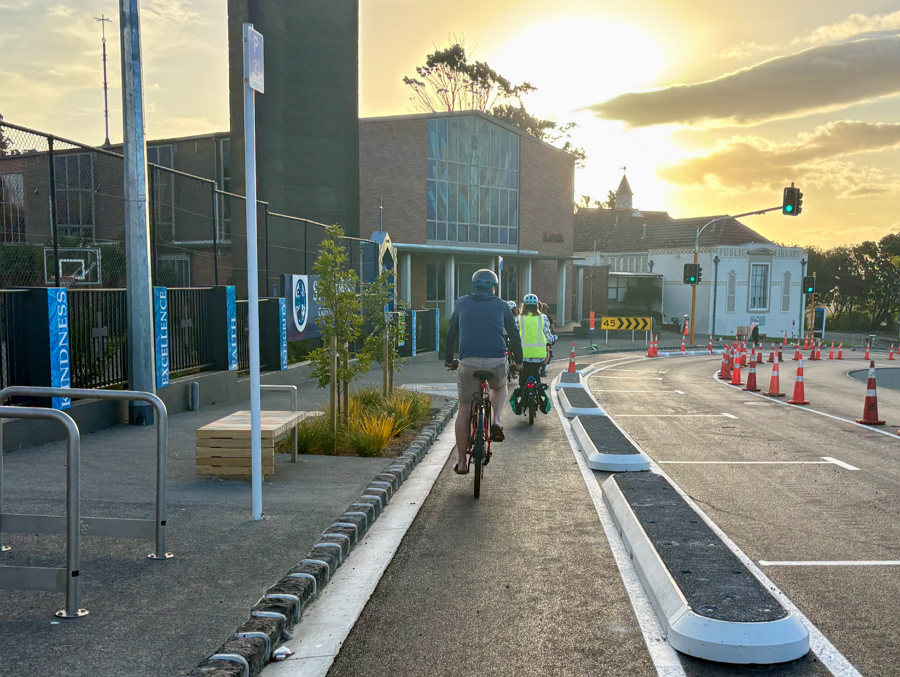
Low stress riding on Great North Road!
Time to bring back Road to Zero?
Ditching an evidence-based approach to safety – as Simeon Brown did with the 2024 GPS, including reductions in funding – means lost opportunities to fix easily fixable issues on the network.
This week, the Coroner determined that a tragic 2024 crash on Auckland’s Southern Motorway would have been preventable with modern median barriers. However, NZTA says they lack the funds to replace 5.5km of demonstrably unsafe barriers on the state highway network.
Modern median barriers have been able to successfully prevent heavy laden trucks from crossing into oncoming traffic, the coroner said, adding that it was “highly likely” that higher performing barriers would have prevented the truck from crossing over.
New Zealand Transport Agency Waka Kotahi advised there were 5533m of legacy barriers on the state highway network which did not meet current safety standards. NZTA said the “funding constrained environment” had led to longer wait times for the barriers to be replaced.
This is also another reason not to launch into building new state highway projects, when there is still a crying need for improvements on the existing network.
NZ drivers most aggro to cyclists?
A father-son duo cycling around the world have said that NZ has the most aggressive drivers when it comes to cyclists.
“Everyone’s aware that the drivers here aren’t as courteous to cyclists as they have been in other countries,” he continued.
It’s an attitude trend the family have seen predominantly in Western countries, including Australia and their British Isles home.
“As a Western society, it’s so go go go that as soon as something crops up delaying them by even thirty seconds, they get annoyed,” Joshua said.
“The instant reaction is to get angry instead of being patient and chill.
“Whereas in Asia and Turkey, the culture seems to be more laid-back. When a cyclist is in their way, they don’t really care. They just sit behind and overtake when they can.”
George added that, with the stunning scenery here, he expected people would take more time while they’re travelling, to enjoy it. He said the views always lifted their mood.
What has been your experience if you ride on our roads?
What’s your dream neighbourhood?
“Flowers of Proximity” is a pretty awesome survey, based in Munich, which is gathering data to help urban planners. It asks people to imagine how you’d actually like to get around, rather than how you currently do. Check it out here.
Many people find it difficult or unpleasant to reach the places they need or want to go, especially by sustainable options like walking or cycling. Despite this, urban and transport planning often gets stuck in the status quo, repeating past mistakes instead of adapting to the evolving needs of residents.
One way forward is through accessibility planning. By focusing less on actual trips and more on potential ones, it emphasizes the range of options people have and how easily they can reach them. This makes it well-suited for reimagining cities.
The flowers are a planning tool that invites participants to look beyond their current travel routines by imagining instead how they would like to get around. This perspective grounds accessibility planning in people’s needs and desires, helping make cities more livable, sustainable, and fair.
Australia’s new fuel efficiency scheme
Australia is seeing the first results of its new fuel efficiency scheme, including the beginnings of a carbon market. Some brands are stacking up credits, and standards are supposed to become a lot tighter in the next couple of years. What is the probable result?
Most likely, carmakers accruing debts under the scheme will pass the cost on to consumers, making cars from higher-polluting brands more expensive. Companies in surplus can sell credits, using the proceeds to lower prices and attract more customers.
Think of it as a stealth subsidy. Every time someone buys a less efficient car from a struggling brand, they could be making someone else’s new electric vehicle cheaper.
For the first time in Australia, fuel efficiency is rewarded and waste penalised. This means cleaner models are now a better business decision for carmakers. Volume of sales alone now isn’t enough for success in Australia’s highly competitive market. Model range and choice of technologies have become increasingly important.

And what does this mean for air quality, which has a huge impact on public health? (Nothing that in New Zealand, traffic pollution kills ten times as many people as road crashes do).
Overall, new cars sold from July to December beat their emissions targets by 21%, emitting 114g of CO₂ per km on average against a target of 144g/km.
Light commercial vehicles also cleared the bar – though only just – averaging 199g/km against a target of 214g/km. Without a rapid influx of hybrid or electric utes, the sector could hit a compliance wall as early as next year, when targets tighten sharply.
In total, I estimate the new cleaner vehicles will stop between 190,000 and 220,000 tonnes of CO₂ entering the atmosphere every year they remain on the road. That’s the equivalent of taking 100,000 older, dirtier cars off the roads.
With new targets set to be a lot lower, cars will likely become a lot cleaner in Australia. The question is, will New Zealand follow and reverse the watering-down of the clean emissions standards? Or will we become a dumping ground for dirty vehicles – given our government is considering removing the clean car standard entirely…
Videos to check out
From the socials
Have you encountered the ‘hill of hysteria’ lately?
https://bsky.app/profile/mzdt.bsky.social/post/3mg7oxy26v22b
View this post on Instagram
View this post on Instagram
That’s it from us for the week – as always, drop your links in the comments, and enjoy your weekend!

 Processing...
Thanks for a busy week of posts, appreciate your work. Surprised there has been no mention of the Government potentially rolling back all clean car requirements for NZ. Also haven’t heard much about the back and forth between Auckland and Government over Plan Change 120..Wayne Brown has been really winding up Seymour which is fun to watch.
NZ drivers most aggro to cyclists?
I find them really nice (almost too nice) in the central suburbs.
Depends on the bike for my anecdata. Riding my ebike to work there is less difference in speed between cars and bike, reducing the amount opportunities for conflict arising from sharing the same space. In the past if I rode my road bike, in my work clothes, there were more issues due to being slower, especially when starting from a stop at an intersection. Disappointingly, if I rode my road bike, at the same time, but in lycra, the issues were significantly worse in frequency and intensity. I typically go months without a drama on my morning commute with an ebike, but if I put on lycra and ride the road bike I won’t get to the end of the 9.5km without someone taking exception to sharing the same space. I stopped riding the road bike in NZ, the negatives became too great.
I spend about 10-12 hours a week riding around, both commuting and training for races. I’ve predominantly had good experiences with drivers in urban and semi-rural settings. Generally state highways are far worse in my experience, and I wonder if these travellers had some nasty encounters when they were riding on main routes like SH1, 3, 5, etc? I’m not sure what exactly changes (maybe traffic volume, though it could be more than this) but these roads tend to be a terrifying experience on a bike.
Drivers desperate to get their journey times down on long distances along inadequate highways. Better to arrive late than become ‘late’. Plan more time and include rest stops is good advice, but can you get where you’re going in your day’s travel? And this affects other road users, include truck drivers and especially cyclists.
I’m not defending the poor attitude of driver’s towards cyclists but the father & son chose a terrible route in the South Island. They went up the West Coast and complained all traffic was “funnelled up one narrow road”. I think they were shocked at how much traffic there was, because they had roads to themselves in Australia.
They did have a scary encounter in the South Island when a vehicle towing a caravan overtook them on a blind corner and a car coming the other way had to take evasive action. The son filmed himself confronting the bad drivers and uploaded it to Instagram, which is not necessary.
It is a shame they were so aggressive about it and decided to attention w***e on social media. Everyone who rides knows a cyclist who is a militant and seems to have far more ‘bad luck’ than others. If you want to play the victim it is easy to go looking for incidents and drivers who make mistakes. For the most part, I have found drivers to be apologetic when having been in the wrong. We all share the roads and make mistakes from time to time. I try to remind myself that-especially when on my road bike- I’m going much faster than people expect for a cyclist (40-45km/h if the wind is good) and am far smaller than a car in terms of being seen.
It is a minority who are out there just to be aggressive. You have to learn to ride defensively, and because NZ has pretty average infrastructure in general, unfortunately that extends to road/route choice as well.
Are electric car subsidies an efficient use of public funds?
The price for fuel only ever seems to go up anyway, why not let the invisible fist of the free market do it jobs and wait for Kiwis to make rational decisions about car purchases?
If there is public money saved, we could plough it into a more efficient means of reducing CO2 emmissions (or just leave it in kiwi’s pockets).
“Why not let the invisible fist of the free market do it jobs and wait for Kiwis to make rational decisions about car purchases?”
That would be good, except this government has done the opposite. A vehicle that produces emissions & pollution, burns imported fuel and oil, like your average Toyota Aqua doesn’t pay RUCs as would the zero emission EV version. So there is implicit market forces against EVs
If all vehicles paid the same RUCs, and ICE vehicle paid the full cost for fuel and externalities, then yes, I believe the free market would see more consumers opt for lower emission vehicles
I am not an economist, but I believe that it is accepted that people are also not always that rational in decisions, so the Government also has a role in leadership and doing things like curbing smoking, planning for long term change and resilience; so putting in infrastructure like UFB, roads, rail, grid power. That same approach could help with things like increased public fast charger infrastructure; another ball dropped by National
I’m being slightly tongue-in-cheek about the all-conquering-all-powerfull free market (and the intellectual purity of homo-economicus) but good point re: RUC. I agree with you on the need for better infrastructure (and the need for more balanced delivery across modes).
Our free market is far from free of government set, rules and charging and tax regimes.
Regimes that very considerably tilt “rational” investments even to the point of total overall irrationality.
Case in point our RONS. Tilting these tables are what keep our lobbiests employed. And maintain the flow of investment monies into our political parties.
Monies we euphamistically call “donations”
I agree that electric car subsidies are bad policy, but that’s that’s because I think that getting everyone into electric vehicles isn’t quite the right goal.
If we reduce the goal to be something like “improve NZ’s transport emissions”, then we would get wayyyyyyyyyyyyy more bang for buck on that with something like e-bike subsidies, or even just a good marketing campaign for micro-mobility. The problem is that is our stated goal, we might come up with some subversive policy solutions like attempting to reduce vehicle kms travelled, which is repulsive to the electorate.
I’m ok with the previous government’s levels of subsidies on hybrids and EV’s. It helps with our balance of trade in terms of fuel import reduction.
We share a fair overlap with Australian vehicle market – brands, models, regulation
The simple fact that they are encouraging growth in low/no emission vehicles, including novated leases that encourages EVs, while we are doing the reverse, is one of the clearest signs we have worse governance.
National have an easy option; follow the same rules as Australia, or even take the lead to encourage introduction of zero emission vehicles. Which given current events in the middle east, would also help reduce our dependency on imports.
Talking about ‘Low Stress Cycling’, it is now 2026, so thought I would look back at my favorite example of a critical gap in the network, to see if there has been any progress at all from AT. And of course, another year or two has gone by and zero progress.
AI tells me: “The Upper Harbour Drive/Albany Highway intersection is considered one of Auckland’s most hazardous for cyclists, featuring high-speed traffic, 3+ lanes, and complex, unprotected, or poorly designed turning movements. Key safety issues include dangerous concrete separators, limited infrastructure, and a critical gap at the northern end
Looking back, I reported it to AT in 2021, and discussion has been going for years. This was on Reddit years ago:
https://www.reddit.com/r/auckland/comments/1eh2iau/how_the_heck_are_you_meant_to_bike_through_here/
Why does everybody just put this into the ‘too hard basket’?
Doesn’t somebody have a job to improve road safety in Auckland? Because seems to me they are taking a salary and not doing their job
No, Albany Highway is in “Let’s get on with it”.
And AI surfing the net doesn’t spot the difference between separated cycleway on UHD and ‘to be continued’ on Albany Highway.
AI got it 100% right though; I was impressed, as I just did a Google search to see if there was any news about the intersection, and the AI summary picked that ‘Upper Harbour Drive/Albany Highway intersection’ and not the general UHD cycleway
Cycling from Hobsonville is easy; right up until that intersection
There were plans to improve Albany Highway between the Upper Harbour Motorway and Sunset Rd intersection that got indefinitely postponed because “not enough money”:
– Signalised intersections with Upper Harbour Dr and Unsworth Dr
– Speed limit reduction to 50km/h
– 3m wide shared path on east side of the road
– 2m wide footpath on west side of the road
– 1.8m wide cycle lanes on both sides of the road
– 2 traffic lanes each way
– Pedestrian crossing outside Westminster Christian School
There is enough money; it is just a choice of where, when and how to spend the funds.
NCI interchange was $700m which is a huge amount of money. While it was a lot of work, and did improve PT, it added one north -> west motorway lane which seems underwhelming.
Sadly I think it will need deaths/serious injury for people to fix the Upper Harbour Drive/Albany Highway intersection
I hate seeing families trying to cross a fast moving arterial road to drop kids at that Westminster school, so entire area needs to fixed; and surely it is high priority
The Flowers of Proximity survey is a very handy presentation for input into Neighbourhood Design. Look at AT’s Urban Street and Road Design Guide Chapter 2 and page 53, published so long ago we’ve all forgotten when. It’ll be good when developers have managed to read that far through the Guide. Seems they are too busy, or not very good at reading.
Daniel Newman wrote a paywalled NZH opinion piece called: Chaos and the risk of endlessly declining property values – https://www.nzherald.co.nz/nz/chaos-and-the-risk-of-endlessly-declining-property-values-daniel-newman/premium/ZABTLCDXBZBVJESOJZCP3LNFGE/
In the article Newman disputes that more housing will make housing more affordable, argues that a housing crisis exists when the price of housing goes down, and calls for the reintroduction of parking minimums. Newman is a National Party member and has been identified as having a strong chance of being the next National Party candidate for Papakura.
Yet again a war on the otherside of the world is exposing our economy’s over reliance on fossil fuels.
The answer is not Shane Jone’s, We need to drill more.
The easy to find stuff has already been found, and is now exhausted.
Any remaining finds, are likely to be only small, and as such, will only be able to offer temporary relief. In fact by doing so may well be detrimental in delaying the required structural changes.
It is a disgrace to our current energy and transport policies that NZ, far from top of income per capita, has the highest rate of cat ownership in the world. (Excepting a few tiny city states such as Monaco)
We need structural changes in how we move people and goods around our country.
Big changes and urgently.
The obvious ones:
We need to facilitate public transport uptake. More bus priority on existing routes.
Extend the coverage, and increase the frequency.
We need to encourage more freight on to rail. Here same wagon service between islands will become even more crucial. Here thanks is due to Winston.
A Marsden Point Rail terminal is far more important, and billions cheaper then a motorway to Whangarei.
The heavily used freight rail lines South of Auckland to Hamilton and Mt Maunganui need to be electrified connecting to the existing NI electrification south of Hamilton.
7 day a week, multi daily service regional passenger rail needs to be established between Auckland and Tauranga via Hamilton and both north and south of Christchurch akin to the upgraded regional rail to be introduced out of Wellington.
Micromobility needs to be enhanced, more cycleways, a reversal of current retrograde steps.
Urban speed limits once again need lowering, to reduce fuel consumption, to increase overall safety, and to encourage the uptake of non car travel.
Impediments to increasing housing density where demands on car transportation are lessened should be further relaxed, not preserved, as in recent government flip flops.
There should be absolutely no fossil fuel price relief measures implemented.
We must not waste this externally initiated economic incentive to do what we should have been doing anyway to increase the resilience of of society, and reduce our dependence on overseas fossil fuels.
I had to read the sentence about “cat ownership” multiple times. I was like “sure, that’s not great for resources and wildlife, but is that really the issue here?!” 😀
I blame it on auto correct. But even auto correct tried to change that to autocorrelation!
Add to my list above;
Introduce Road User Charges on Petrol powered vehicles urgently.
Thus removing the current pricing disincentive to migrate from petrol power to EV’s, or even alternative transport options.
National at this time seem very intent to go forward into the next election promising policies intent on preserving, status quos
Status quo including in maintaining car privilege, inner suburban privilege, and middle age privilege, regardless, that these were already unsustainable before these latest geopolitical ructions.
This is the opportunity for Labour and Greens to announce policies that reflects that continuing a huge reliance fossil fuel burning, and private cars for near all of our private and freight transport needs is simply unsustainable at current rates.
For an easy start just kill any proposal for a CNG terminal.
A proposal entirely just to reinforce existing status quos.