The opening of City Rail Link later this year should be a momentous occasion for Auckland and as we’ve highlighted many times before, one that should help transform Auckland. But increasingly, we’re worried that Auckland Transport are about to clutch defeat from the jaws of victory.
Last week the Council’s Transport and Infrastructure Delivery Committee met for the first time this year and as has been regular at these meetings in recent times, one of the topics has been an update on the City Rail Link.
The good news is that the infrastructure side of things is looking good, for example:
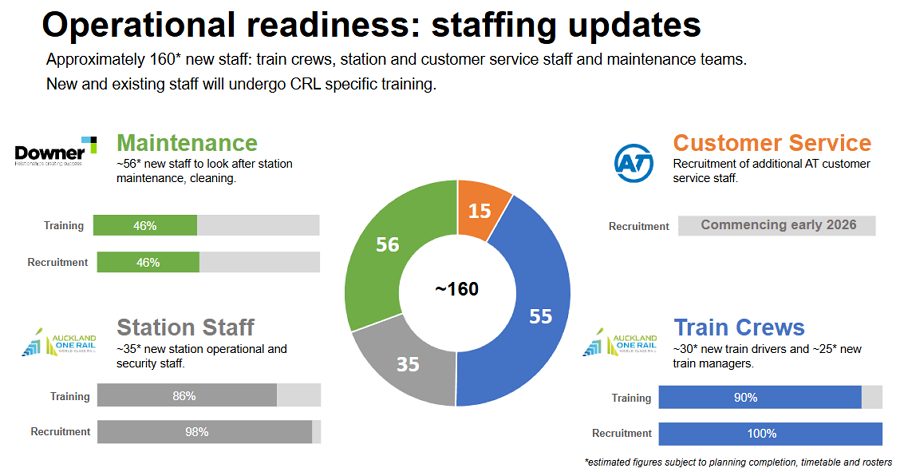
- Testing of all of the hardware and systems in the tunnels and stations appears to be on track with no major issues identified yet
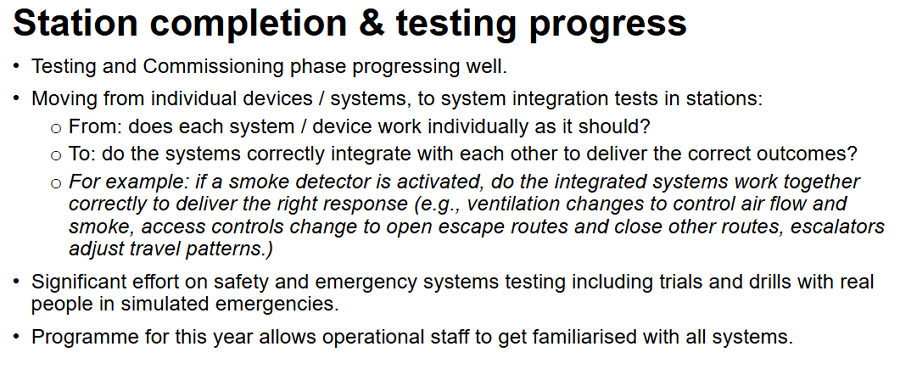
- KiwiRail have completed the bulk of the major network upgrades and are moving to a new way to keep the network maintained.
- All of the 23 new trains are here and training drivers is nearly complete
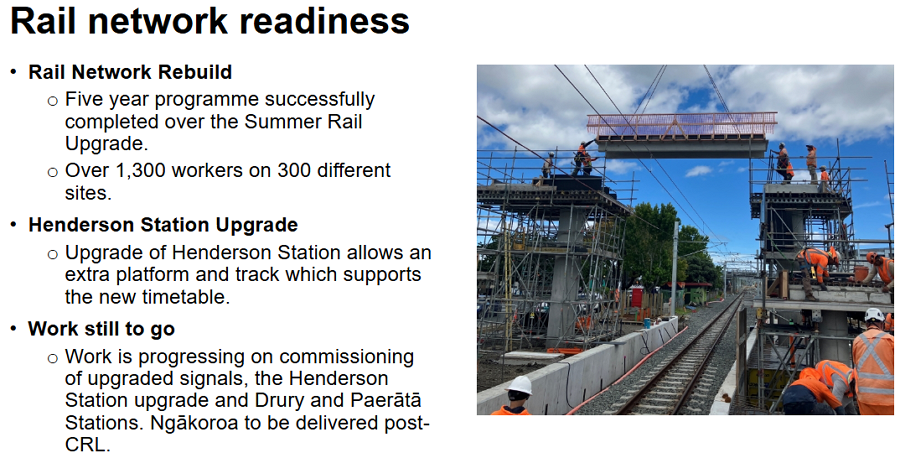
- The staffing and training for running and maintaining the stations is on track
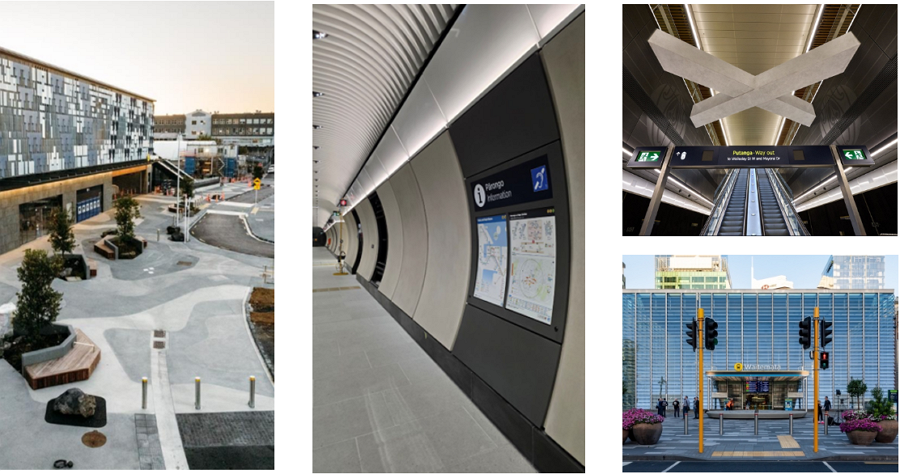
- Most of the street-level improvements are now complete or will be soon – Waitematā was completed in January and Karanga-a-Hape last week. The Wellesley St bus improvements are due for completion either later this month or in April.
Where things seem to be going off the rails is how the trains will actually run.
Last year AT revealed their new network map giving us our first real view of how they plan to run services – and we immediately raised concerns about it.
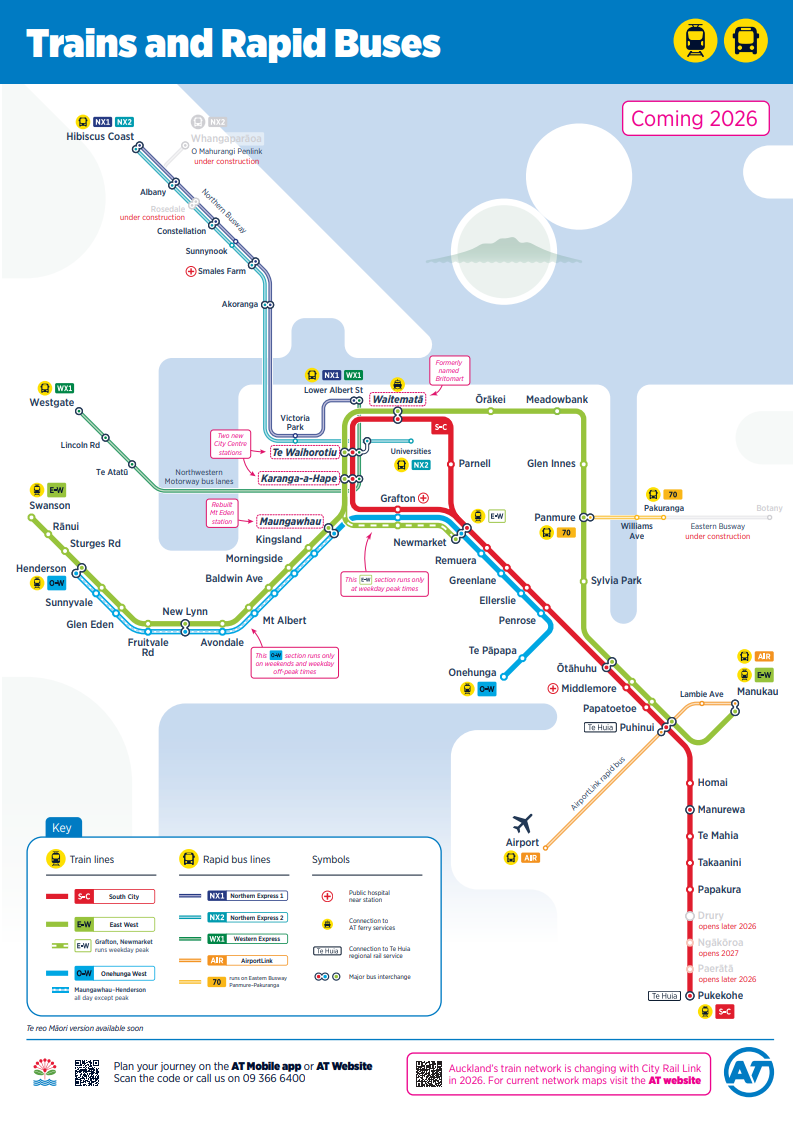
AT the end of January AT spent two days conducting a full systemwide test of proposed timetable, noting:
Years of planning and modelling have gone into developing the new timetable, but real-world testing often throws up variables we can’t predict.
As we know, some of those unpredicted things happened, with AT later stating:
“The testing was a valuable learning curve”, Ms van der Putten says.
“It highlighted several challenges, particularly around network congestion, which our teams are now working through. We’ll tweak a few things before we run the simulation again in the April school holidays, to help us finalise a robust timetable and provide reliable services from day one.”
AT provided a bit more detail on the outcome of the testing at the meeting. Below is a transcript of comments from Mark Lambert who is heading up the CRL related stuff for AT.
We tested the new route structure which Joel has just put up on a slide — the east-west, the south-city, and the Onehunga west services. We tested improved peak, off-peak, and weekend frequencies as well, shifting from the current three trains per hour to four trains per hour, moving to a 15-minute base timetable.
As I said, we also stress-tested on the existing network — not through the CRL, because that’s already been tested at a high frequency of 18 trains per hour. We tested up to 20 trains per hour on the existing network through some key junctions.
I guess the whole point of the trial was to find out what worked and what didn’t work. The test achieved its purpose, which was to identify any issues with the integrated systems, particularly around the customer communication systems; to identify the pressure points on the existing rail network around theoretical higher-frequency operation; and also to contribute to the day-one integrated, graduated design.
We’ve always said that we would expect to have a transition timetable for day one which would be less than ultimately where we’d like to get to, in order to manage and de-risk operations on day one. So the purpose of the January test was also to input into that.
The key actions that have come out of the January test are that we do need to look at the maximum peak frequencies going through some of the highly congested points on the existing network — in particular at the junction between Wiri, Ōtāhuhu, and Westfield. That’s where the highest congestion on the network occurs. You’ve got freight, you’ve got inter-regional services, and we tested up to 20 trains per hour going through that part of the network. We do need to look at that, and we will be testing a reduced operation for that in April.
Through AO [Auckland One Rail], we also need to look at improved flexibility of crew rosters. The crewing wasn’t flexible enough to respond to some unplanned disruptions that were planned to be tested, so that will be looked at in April as well.
We’ve recognised that there’s a need for improved control-room communications and faster decision-making when there are disruptions to the services. There were also some errors around the information displays on the public information displays, which the train drivers also use for operational management.
We believe that the January test achieved what we wanted to achieve. It tested the systems, it tested the highest frequencies that we wanted to put onto the existing network, and it’s given us some very valuable insight into the next test scheduled for April.
What we intend to test in April as a result — and we’re just finalising the detail around that right now, because we do have to communicate that to staff and crews around six weeks in advance — is that we will be testing the new route structure again. That is being preserved and we’re confident that that’s right. It will include improved journey times that the business case and CRL has promised. It will include improved frequencies, particularly in the off-peak and weekend services, and it will offer greater capacity through the CRL and through the rest of the network.
The final thing, which we haven’t quite bottomed out the detail on yet, is that not only will we test the proposed de-risked transition timetable for day one in April, but we’ll also test what the step-up would look like within three to six months of going live — so what additional services we want to overlay onto that. We intend to test that in April as well, although that detail is still being worked through.
The purpose of testing is to find issues, so in that sense it was a valuable. Some of the things they found, like crew flexibility, communications and passenger displays feel like the kinds of things that can absolutely be worked on and improved before the CRL opens. But a few other things stood out.
Junctions
It seems a lot of the issues experienced might have been focused around some of the junctions on the network.
Some the biggest constraints we have on Auckland’s rail network are the many flat junctions – that is railway junctions where trains may have to cross over the path of trains travelling in a different direction. We’ve got five on the metro network – Quay Park, Newmarket, Penrose, Westfield and Wiri.
When frequencies are low, this isn’t too much of an issue. But as they go up, just creating a timetable to get trains through them all without causing delays can get pretty tricky. However, things don’t always work perfectly with trains exactly on time. A delayed train at arriving at one junction can cause delays to other services and those delays can potentially cascade across the network. We see this already when disruption on one line results in delays and cancellations on other lines of the network. Avoiding adding to the junction problem was one of the reasons for dropping the Newton station from the CRL – which created enough space to grade separate the junction.
Grade separating some of our existing flat junctions would help to remove conflicts thereby increasing the reliability and capacity of the network. Some of our existing junctions, especially Quay Park and Newmarket, are likely near impossible to separate, or at least will be prohibitively expensive. The junctions at Westfield and Wiri offer the best opportunity for grade separation and there’s a fast track application to grade separate Westfield along with four-tracking the rail corridor from there to Pukekohe – it’s unclear if Wiri would be done as part of that too. One of the problems is that the Westfield junction is considered the last part of that project to be delivered.
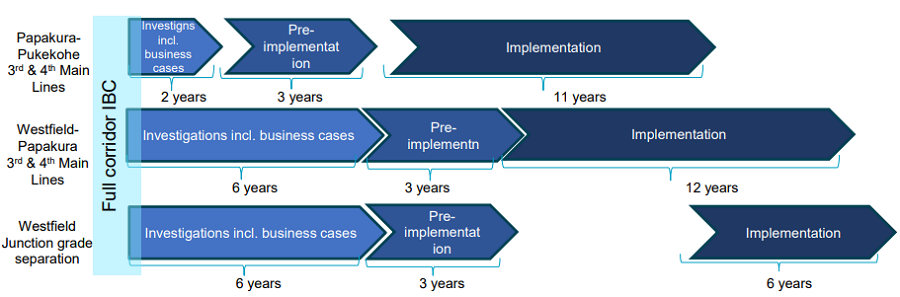
I’d suggest they are likely going to need the grade separation to go up the priority order quite a bit.
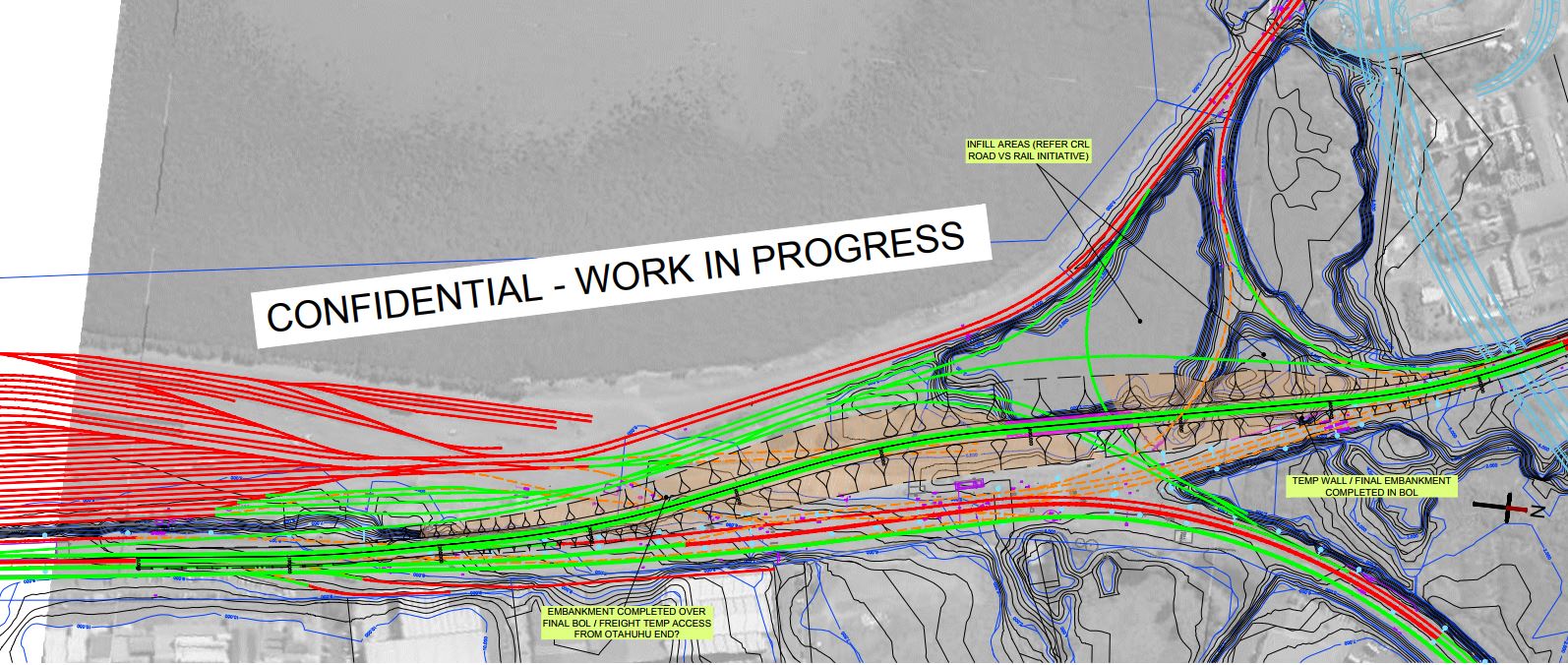
A design from KiwiRail for a grade separated junction at Westfield.
These junctions have been known constraints for a long time. I wonder if any time in the last decade that the CRL has been under construction that AT could have tested running more trains through it to ensure the network would work?
Notably our preferred network design – with the Southern Line running through the CRL and out on the Eastern Line to Otahuhu – might have helped here because there are now three tracks from the Eastern Line through the junction and to Otahuhu. This could mean that at last some terminating trains could have effectively bypassed the junction. Unfortunately. AT seem very wedded to their plan.
Day One Timetable
AT are now saying:
We’ve always said that we would expect to have a transition timetable for day one which would be less than ultimately where we’d like to get to, in order to manage and de-risk operations on day one.
A slower roll-out to a change like the CRL is not uncommon – Melbourne just went though it with their new metro tunnel – but AT hasn’t been saying this before. For example, when they announced the new map they said:
Trains will run more frequently – at peak times up to every four minutes through the central city, with more trains than today at stops on the Western, Eastern and Southern Lines.
The had been some rumours that some of the limited stop trains were being dropped but that the core of the new timetable would operate. We’ve been hearing rumours from multiple sources now suggesting even this might not be the case. This needs to be taken with a grain of salt, but what we’re hearing is:
- On the S-C line – trains from the South generally run up to Newmarket, around the CRL then back out to Otahuhu via Newmarket. They also do the opposite movement. This gives quite a bit of frequency through the inner-southern line. We’re hearing that the Day One plan is still to run trains up an through the city but then to terminate at Newmarket. This is not a terrible outcome and will still deliver more trains on the southern than today but does mean not quite as many trains for people at stations like Ellerslie.
- On the E-W line – the plan was to run four trains per hour from Swanson and an additional four at peak times, so eight trains an hour total at peak. We’re hearing that the plan is now to drop two of the peak-hour trains meaning the Western Line will still be at six-trains an hour, same as it is today. Only it will be worse than today because they’ll still be using the same timing pattern as if there were eight trains. So instead of having trains evenly spaced every 10 minutes, there’ll be times in the middle of the peak with 15 minute gaps.
It’s incredible to me that we’ve spent all this money on the CRL and the line set to benefit the most from it will potentially have a worse timetable than it has today.
In response to an information request about the testing, AT noted that even between the two days of testing they were able to make operational improvements. They do have more testing planned, with the next round during the school holidays in April – so hopefully further refinement will help them to iron out some of the issues and enable better outcomes and more services. It’s something we’ll certainly be keeping a close eye on, because we really need the CRL to succeed.
Greater Auckland’s work is kept running thanks to generous donations from our readers and fans. We’re a registered charity, so your donations are tax-deductible. If you’re keen, you can join our circle of supporters here. Cheers!

 Processing...
Laughable
And still nothing done about the dwell times
This is really a shared responsibility thing. It’s not just AT. Council, KiwiRail and Design Teams have all been involved. Sounds like making the O-W line the O-C line would help a lot. Stop it at Maungawhau. O-C sounds better anyway.
I think ETCS level 2 is already funded. Should help with dwell times.
But wait… The level crossings. There we are, stuck in a bind waiting for U troughs
Just close a bunch of them, eg Jude St and use the existing bridge across the line. Not good fun for me as I live around there, but it would work, and Chalmers Street, the next alone doesn’t need to stay open either.
So we spent $5 billion dollars and potentially the timetable will get worse. The incompetence of AT and Kiwirail at times is truly astounding. That’s in addition to the seemingly endless problems we seem to have in general operation. I’m curious if anyone at AT actually tracks how many days of significant train disruption we’ve had because we’re just over two months into the year and more or less one month of that we had no trains running and I’d guess we’ve had more than 10 days of major disruption to add to that. It’s no wonder train usage is considerably below 2019 levels.
The decade so far has been horrific for disruptions. But it was all going to be worth it for the CRL….
Years of testing and planning should be sufficient for day one service increase and a beta testing round with objectively worse services.
I intend to list train disruptions in a spreadsheet. I think 5 March may have been ok but wake up on 6 March to news Eastern Line is running at a 20 minute frequency due to a train breakdown. Lots of train breakdowns this year, are the older train models failing already?
Think of how many roading projects we undertake in this country any one time, compared to how many rail projects we undertake.
NZ has deferred maintenance on its railways to the point where any renewals or upgrades on existing lines require significant capital, and we will also need to put a lot of money into equipment, materials, facilities, training, developing standards, etc. for our workforce to be able to rebuild the lines in a cost-effective way.
It’s demolition by neglect, and then Kiwirail is still facing budget cuts all the while being called incompetent for the few projects they can get support and funding for. Kiwirail have their problems, but blaming them for the sad state of our transport infrastructure is pure delusion
I wonder if they ever built a model of the network. Would that have helped? Some of those enthusiasts have all their garage laid out and use sophisticated systems.
Great question, and im sure a tiny percentage of the $B funding must have been modelling this.
Guessing the modelling was all via consultants running each scenario virtually and reporting via detailed reporting and reports. Few well defined scenarios’ but no over view of kiwirail/freight interactions.
Nothing quite as intuitive as physical (model) trains running on physical tracks.
Re Garage laid out, our network is more a corner of the garage im thinking.
My thoughts exactly. Or if not a real model (like they’d almost certainly have built if CRL was a 20th century project) then there are literally hundreds of railway sim progs anyone can download to build a complex virtual layout with crossovers, tunnels, switches etc etc. To hear this news at this late stage is absolute madness.
When, or if, a new harbour crossing is decided on we should expext to see a scale model of where all those cars coming into the city will go.
I remember Matt L writing a post about the rail network 2 or 3 years ago and questioning the planned directions of trains at Maungawhau Station. Unfortunately CRL managers don’t read or comment on stories on our GA. When all those engineers ride on our trains they must have noticed the regular hold ups at the intersection cross overs and wonder about the problem!.
It’s disappointing that the CRL is not transparent and won’t communicate with GA and the result might be at great cost.
Does this mean western line we are going from 10 minutes each way at peak to 15 minutes both ways peak at worse times…?
Oh my god
Hilarious. I walk out my door, walk for 1 minute, get on a bus on Birkenhead Ave which comes at most every 7 minutes and I whizz down a bus lane all the way to Town in about 15-20 minutes…and it took no new infrastructure. We aren’t a proper country.
Force all the AT staff & their managers to use the CRL trains to arrive & leave from work daily. Bet the dwell times, frequencies & timetables will be improved & fixed in no time.
Love to. What times do the trains depart from Birkenhead?
You tell us mate.
Excellent Proposition..
Let the Planners experience ‘real time’..
Rather than round table chatter..
Incredible.
Compromising the line most improved by CRL for no good reason.
Interesting – are we on the homeward straight – opening day is …
The following caught my eye, yep – testing catches these issues but it seems a hint at something a bit bigger.
“There were also some errors around the information displays on the public information displays, which the train drivers also use for operational management.”
aka “Hey – turns out we’re going to Pukekohe !” – but im guessing not that sort of info.
Great having a single source of truth, a benefit is the train drivers going to the same place as the public, which this sentence suggests was not where the network/schedule was expecting them to be. Guess it depends upon what info the drivers were relying upon, most likely it resulted in delays as the drivers had to query inconsistent instructions. I would prefer if the drivers had their own displays (source of truth) and used the public information to validate it being consistent.
AT Transport and Infrastructure Delivery Committee meeting – Video with Powerpoint presentations on CRL etc
https://www.youtube.com/watch?v=Cb75mPjFUPo last week (24/2/26)
I watched all this, and some of it more than once. Was a good insight into what is going on.
Rage. The CRL only adding two trains per hour out west for peak was pathetic… but now even that is too much to ask for?
Well having senior staff at AT saying things like ” our first job is to get out of Horrenderson” or ” it doesnt really matter its only West Auckland ha ha ha” over the years might tell us why this is the case.
I guess this is the transport agency that ran private shuttles for its staff.
Absolutely shocking that running an incredibly complex pattern is difficult and susceptible to tiny delays cascading across the network. /sarc
This sort of issue is exactly why we should be running a simpler pattern.
Do you think they’re resisting it because they don’t want to adopt GA’s network idea?
I don’t like to jump to the conclusion that someone’s being belligerent, but if there are good reasons, I would have thought the committee meeting was the ideal venue and time for giving them.
I have no insight into AT’s team, but the whole network proposal reeks of something developed by railway engineers, not public transport planners. The resistance/beligerence comes from those engineers not understanding the planners and not wanting to acquiesce. You get exactly the same with buses, too.
feels vaguely similar to how the PTUA-type older heavy rail advocates treated heavy rail or tram-train extensions and branching with the various Airport proposals or whatever the hell John Tamihere’s rail plan for his mayoral campaign was. Complexity for the sake of single seat rides, keeping everything the same transit mode, and treating rail capacity the same as road capacity
I think you two (5th March comments) have hit the nail on the head.
Time to bite the bullet. Focus on 10-min all day frequencies and (temporarily) drop the higher (but complex and asymmetric) peak frequencies. The junctions and (supposedly) Western level crossings rule it out.
– East-west – every 10 mins all day
– South-Newmarket-Grafton-Parnell-Newmarket – every 10 mins all day
– Onehunga-Maungawhau – every 20 mins all day (timed connection at Maungawhau with every second E-W).
– Southern express to Britomart bay platforms – every 20 mins.
Simple. Legible. Saves face by having genuine turn up and go off peak frequencies and major Western line to CBD travel time savings.
My only questions about the feasibility of the above, on which grateful for any answers from those in the know:
– is it feasible to turn trains around every 10mins at Newmarket to and from Parnell as proposed (given the single platform and crossovers in the approach)? (NB to be conflict-free it would require use of platform 4 for the terminators despite the junction having been reconfigured to use platform 4 for Grafton to South through services.)
– is it possible, at a stretch, to run Onehunga line every 20mins as proposed? That would have super legibility and frequency advantages. With proper dwell times, it should be.
Basically, bite the bullet (for now) and move to 10/20min base operating pattern rather than 7.5/15/30min.
The massive – and relatively low-cost – infrastructure oversight is not building the third platform at Puhinui for the Southern expresses. Genuinely baffling.
On the above pattern Henderson would not have regular terminators at the new platform. But that will still provide very useful latency/recovery and staffing functions. Again, bite the bullet.
As discussed many times previously, the preferred Greater Auckland operating pattern is not operationally feasible either through Westfield junction. It tries to run three instead of two high-frequency services through that junction and gives an unacceptably poor frequency return at Panmure on the Eastern Busway investment. I don’t think one could realistically use the third main to run Otahuhu terminators from East every 10 or even 15 mins so unsustainable conflicts on the two main lines are introduced.
Most of that plan looks good. Maybe don’t need the express trains all day.
However, last I checked, Onehunga line can only handle one train per 30 mins. I believes its currently around 22 minutes from Penrose Junction, to Onehunga, and back.
Interesting – thanks. Feels like that turnaround could be quicker. Agree expresses not needed all day.
Expresses cannot operate properly with too many other frequent trains. Unless theres full 3rd main all the way and that would conflict with freight anyway so expresses arent ever really express they will get held up by an all stops making it pointless.
Agree they are lowest priority. However, with a Puhinui third main platform, they could gain 7-8 mins Papakura to Ōtāhuhu without conflict assuming 10 min frequencies, and then a bit more on the Eastern once through Westfield junction. But main thing is having the paths. Maybe only every 30mins to account for freight, which should really avoid the peaks anyway. L
ATs plan runs three high frequency lines through Westfield also. The southern line goes through twice each way.
Yes, and it doesn’t work either.
If the Auckland Rapid Transit Network 1974 had been built? The Northcote, Takapuna, Wirau, Sunnynook & Albany planned train stations would cover the North Shore suburbs. And including the Airport to Papatoetoe proposed train line would have served the Auckland region.
Ahh yes the we must run everything through waitemata chestnut. Simple planning would tell you that west to south direct via newmarket should happen. And also loop south through east and out via crl. Run some south through crl west. But no they are fixated on waitemata as the be all and end all since its inception. Think outside the box look at passenger trip data and make the trips as needed not as they foresee it. Crl is a loop track from west to south or via east south or to manukau. Are there really that many people wanting to go to the city that all trains must run there?
If you catch the train in the morning you’ll see most people are getting off in the city, so the answer is that yes most people are wanting to go to the city.
But equally, people might get off in the city because they can’t go to where they actually WANT to go to. Currently, when I come into Auckland by train, I get off at Britomart / Waitemata, and then have to find a way to get up the hill to where I want to go to – which is the University. I find it extraordinary that no one ever seems to have figured out that the Auckland Uni / AUT nexus is actually the single biggest source/destination of people in the entire city, and yet is being ignored. Anyway: no trains to Uni, and no Light Rail to Uni, and occasionally, a Bus to Symonds St. But they never seem to be going from where I am.
A lot of people going to AU/AUT get off at Grafton to avoid going up hill. In any case, that is addressed by the new CRL station at Aotea square which is very close to the universities. My point was that Bob is very mistaken in thinking that the people are not going to the city.
” I find it extraordinary that no one ever seems to have figured out that the Auckland Uni / AUT nexus is actually the single biggest source/destination of people in the entire city, and yet is being ignored”
I’m sure they have the HOP data and know this very well. March madness is highly influenced by it too. It’s one of the very reasons for the frequent 25/70/75 etc buses that pass right by it. Other ones nearby as well. There is also the Parnell station that may work for some.
We have just spent/spending $5.5 billion on the CRL, which has been planned for decades in some form, partly to have a mid-town station – ie near the Universities!
Passenger trip data has consistently shown Waitematā is by far the busiest station on the network, FYI.
Yes.
I love catastrophising as much as the next guy, but train frequencies can be adjusted. At the end of the day all the work done on the new CBD line, network rebuild, southern line electrification and new stations can’t be understated
I don’t have an issue with running a lighter timetable more like we have at the moment on day 1 but having random gaps between services on the Western and Eastern line would be crazy.
Dudes will have opinions like this and then think building a new busway is a good public transport investment
are you saying consistent headways between public transport services are a bad thing? I’m confused as to what point you’re trying to make
Buses don’t have consistent headways despite the money we pour into them and the infrastructure to run them on yet we hold our underfunded railways to a much higher standard
seems like you’re putting words in Jezza’s mouth. Nothing in his comment suggested he was saying uneven headways for buses was fine and dandy. And this blog has called out bus bunching in the past and suggested more extensive bus priority and cutting the loop out of the OuterLINK to improve reliability and consistent headways
so yeah, it seems like you’re tilting at windmills there
All this complaining about about train frequencies, at least Auckland has passenger rail unlike 90% of the country. Forgive me if I’m unsympathetic
then you’ll forgive us for wanting Auckland’s trains and buses to run on time and not be overcrowded, won’t you?
Dreams are free, just be realistic about how much work is still needed to get the railways to a state where consistent service is a given
Fingers crossed that E-W line rumour is just that, not sure my brain will handle it otherwise.
This should be a nail in the coffin for any alternate rail operating suggestions that involve looping the Western line all around the CRL and Parnell before returning the way it came. If at-grade junctions are the single point of failure when it comes to disruption and delays, throwing more trains through the Newmarket Junction on all 3 sides of the triangle would be a recipe for disaster.
Extraordinary that only now, after a decade of construction, someone has figured out that the “flat junctions” are going to be a problem. “Quay Park, Newmarket, Penrose, Westfield and Wiri.” Hopefully at least someone will have installed a dedicated, ultra-fast series of points at these 5 junctions, to enable quick switching between lines? And please tell me that a permanent line for the 3rd side of the Newmarket Triangle is in hand?!?
If you think Wiri is bad, check out Richmond junction in Melbourne
Not sure what your point is.
There are no conflicting train movements at Richmond.
It’s a junction in the sense of a major passenger interchange station.
It’s where two track pairs heading east *diverge*, with no conflict, from three track pairs heading south
This. It’s 10 tracks splitting into 6 and 4, with dedicated tracks for each line feeding into Flinders Street station
Wiri junction is 2 passenger tracks splitting into 2 tracks to Manukau and 2 tracks further south. Trains are, to use car parlance, ‘merging’ into the same lanes and crossing oncoming traffic.
Not really making a point just an interesting comparison, being a ‘flat’ junction in one of the highest traffic areas of Melbourne’s network. No clue what you’d do to improve Auckland’s flat junctions, probably a flyover or two at Newmarket
there’s not a snowball’s chance in hell you’re fitting grade separation into Newmarket, not without demolishing buildings and likely having to close both the station and the lines for rebuilding
More probably would be expanding Newmarket from 3 to 4 tracks, and triple-tracking south to Westfield – essentially giving trains coming from either Parnell or Grafton more ‘merging’ opportunities. Ditto with Quay Park.
Westfield Junction, as the article mentions, has plans for a viable grade-separated junction. Wiri is also presumably straightforward, or at least there’s a decent amount of railway land at and around the junction for a flying junction (only needed for 1 track, too).
Penrose, if operated as a shuttle line or if the OBL were converted to light rail in the future, would not be such a concern. As with Newmarket, it would be space-prohibitive to grade separate the current junction and such an endeavour would probably involve the closure of the Southern Line between Ellerslie and Otahuhu.
If by some miracle the duplication of the Onehunga Branch Line is needed, it might be more viable to build a flying junction further south, and route an elevated line across the Mt Smart Stadium northern carparking, to join with the current OBL alignment at Te Papapa. The OBL would need closure to be rebuilt, double-tracked, and grade separated at any rate – the 2016 SMART reports on airport rail identified that.
I wonder if Kiwirail could package improvements to the Penrose junction as part of the Onehunga-Southdown works
*Avondale-Southdown corridor development is what I meant to say
Not sure they would since the current plan is for the Avondale–Southdown to tie into Westfield Junction (i.e. meeting up with the tracks at the Southdown Metroport freight centre). They don’t seem to be planning to actually connect to the Onehunga branch
Seems like a missed opportunity since the Avondale-Southdown corridor crosses over the OBL
Past plans to run at least the passenger tracks of the Avondale-Southdown Line along the north side of SH20 between Hillsborough and Onehunga, instead of inland via the existing ASL designation, would have tied passenger service on the Onehunga line and Avondale-Southdown line together; but this comes with the additional challenges and costs of a rail viaduct capable of dropping 60 metres in less than 2km, and something would have to be done about station location in Onehunga, presumably some sort of trenched New Lynn type deal.
*and* the Onehunga branch would still likely require double-tracking and grade separation to run 15 minute headways
“ rail viaduct capable of dropping 60 metres in less than 2km, and something would have to be done about station location in Onehunga”
Trivial for light rail, hence why it was proposed.
Interesting, and the main benefits of the new corridor will be the NIMT bypassing the central city and new stations along the route so I guess connecting to the branch adds a lot of complexity and cost for not much benefit
@Burrower, That 60m drop is as it stands.
You can almost guarantee that the section past Hillsborough Rd will be trenched. Could probably trench by about 20m easily and not too expensive (the topography drops away on both sides albeit less on the Western side).
So we’re down to 40m over 2km (1:50 2% gradient). That’s still steepish for freight but totally acceptable for EMU.
It is looking good for Greater Auckland’s preferred network design, with the tweak that the Western Line is an alternating loop line i.e. Councillor Turner’s Option 2.
Whatever service pattern is chosen it appears that 8 TPHPD will be the standard frequency at peak.
For Option 2, 8 TPHPD on the Southern-Eastern linked lines and the Western Line looping would result in a total of 28 trains per hours in all directions through Newmarket Station, with the 8 Western Line trains reversing at Newmarket. That is as manageable as the current 28 trains per hour at peak through Newmarket, but with 12 of them reversing.
Option 2 best meets AT’s 3 network design principles; that South, East and West customers all have access to the key inner city stations in one trip without transferring, that the service pattern is operationally efficient and that the priorities of current passengers are met.
lol, literally the opposite of what I was saying. All silly “loop” routings around the city centre are poor decisions in terms of commuter service, and clearly also poor decisions in operation and logistics.
Option 2 would in fact make the situation at Newmarket *worse* than the AT plan and the GA preferred option by introducing westnorth train movements to the Newmarket triangle The insistence on trains running from Grafton to Parnell, or from Grafton to Newmarket and then changing direction to get to Parnell, adds unneeded complexity and conflicts between train directions, that clearly is an issue when AT seems to have given up on doubling up the Southern Line between Newmarket and Otahuhu.
Simplicity rules, for ease of passengers and for ease of operations. Neither the Southern nor Western Line should be looping back on themselves.
I would strongly advise you and Councillor Turner give up this loopy loop and instead pursue alternatives for increasing train frequency on the Western Line – such as combatting AT’s train frequency limitations at level crossings or boosting CRL frequency to handle an additional 4TPH each way (20TPH total each way) at peak hours.
If the CRL’s 16-18TPH each way is a hard capacity limit, then perhaps the Henderson–Newmarket services are the only present way to increase capacity at peak, if 12TPH on the middle and inner Western lines is needed for capacity reasons.
If it isn’t – coupling 2TPH supplementary Western Line peak overlays to peak hour Southern Line limited stop services could be a plain-to-understand operational way of adding these extra services to the map without introducing a whole new line on maps.
There was also Matt B’s 2022 unorthodox proposal of:
– 6TPH Swanson–CRL–Papakura
– 6TPH Swanson–CRL–Manukau
– 6TPH Pukekohe–CRL–Manukau
– 3TPH Maungawhau–Newmarket–Onehunga
with the Southern, Western, and Eastern Lines retaining their present names and colours, and train destination boards combining the two lines the service is running on (e.g. “Western & Southern, Western & Eastern, Southern & Eastern”). This would be capable of delivering 12TPH on the Western Line at peak times
Also re. Newmarket junction
Of 28 trains per hour passing through Newmarket, Option 2 would have 16 trains per hour crossing each other’s tracks as they moved through the junction – and in the case of the “loop” trains reversing out of Newmarket, they would cross the junction twice whether they are headed to Grafton or to Parnell. And with 4 different service patterns (Southern Line via Grafton, Western Line clockwise city loop, Western Line anticlockwise city loop, Onehunga line) more services are prone to be delayed and disrupted if anything goes wrong at your single point of failure at-grade junction
For GA’s preferred option, the only conflicting service patterns crossing each other’s paths would be the southbound Southern & Otahuhu Line trains coming from the CRL and Grafton, and the northbound Western & Manukau line trains coming from Remuera. This simplifies matters, and can be easily accommodated by switching trains to available tracks/platforms at Newmarket station; something further helped by the lack of needing to stop trains and change cabs for inefficient doglegs
“train destination boards combining the two lines the service is running on (e.g. “Western & Southern, Western & Eastern, Southern & Eastern”)” – that raises the question of what line information will be displayed on trains. I don’t travel on Auckland trains very often, and the last time I did I wanted to travel from Otahuhu to Newmarket. At the platform a train was waiting, and all that its displays said was Waitemata – no line or routing information at all.
It will be interesting to see how the train displays cope with whatever the new service pattern turns out to be.
Are there seats in the new underground stations ? The photo above is not showing anywhere to sit.
Whilst the Option 2 operating configuration is the optimum option, it requires a new station to be built at Kingdon Street.
In the interim in order to get a better operating configuration from day 1 of the CRL being opened, another option would be to go with a modified version of the Greater Auckland recommended operating configuration, with instead running Southern Line services from Pukekohe via Panmure through the CRL and terminate at Newmarket, with some 3 car services running onwards south to Onehunga. The Western Line services could run via the CRL, then south via Parnell to Manukau. This would at least have Western Line trains running through Newmarket.
Operationally, it would be much simpler with just two lines across the network.
If the Avondale-Southdown Line gets built, a new direct west-south service could be established between Henderson and Otahuhu via this line.
If the Onehunga Branch line were to be extended to Auckland Airport, the tail end of all Southern Line services could continue onwards south from Newmarket to the airport via Onehunga.
What you have suggested as an “interim” operation would make far more sense than Ken Turner’s Option 2.
Option 2 is the optimum configuration and can operate without Newmarket West being reinstated and with it if it is reinstated.
Just saying: when I worked at London Underground, all the staff were in one building, with no parking. Over a 1000 staff arrived for work each day by Underground, no drama, no cars, no delays. Right from the lowest paid worker to the person at the top, we all arrived by Tube, Bus, or on foot. That’s the mantra that AT should be working towards.
The whole project gives me the impression that the powers-that-be were treating the completed tunnel as the key deliverable, when it fact it is the timetable that the tunnel enables – that’s what delivers to project’s objectives, as outlined at in 2012 at https://at.govt.nz/media/imported/4601/crl-july2012-factsheet.pdf, and still apparently current.
So all discussion about service patterns should have been had way back then, together with the implications for other infrastructure (junctions, level crossings, etc.) and the work needed on them in support of the tunnel scheme to deliver that timetable.
But seems not to have happened in a timely fashion, with the proposed service pattern not being revealed until over a decade after those objectives had been published, and then revised (and perhaps to be revised again).
The Germans have a saying that paper comes before concrete – as far as possible, decisions are made before construction happens. Has that happened in this case?
They did have discussions about service patterns back then, and it’s constantly evolved
In 2013-2015 it seemed like they were copying the original CFN’s rail plan, which was to have a Mt Roskill branch (the west half of the Avondale-Southdown line) and the Onehunga branch extended to the Airport, with the following operating pattern:
1.Pukekohe–Newmarket–CRL–Panmure
2. Swanson–CRL–Newmarket–Onehunga–Airport
3. Mt Roskill–CRL–Panmure–Manukau
Then in 2015/2016 the Mt Roskill spur was dropped from plans in favour of Dominion Rd and Sandringham Rd light rail, and the Crosstown heavy rail service was introduced:
1. Pukekohe–Newmarket–CRL–Panmure–Manukau
2. Swanson–CRL–Newmarket–Onehunga–Airport
3. Henderson–Newmarket–Otahuhu
Then in 2016/2017 the Airport extension of the OBL was dropped in favour of light rail to the airport, and double tracking to Onehunga seemed to have been dropped too.
1. Pukekohe–Newmarket–CRL–Panmure–Manukau
2. Swanson–CRL–Newmarket–Onehunga (most services terminate at Newmarket, only half-hourly service to Onehunga)
3. Henderson–Newmarket–Otahuhu
And from there, sometime between 2019 and 2022, the Onehunga service and Crosstown service were paired together, and we got the network AT announced and now might be having second thoughts about:
1. Pukekohe–Newmarket–CRL–Parnell–Newmarket–Otahuhu
2. Swanson–CRL–Panmure–Manukau
3. Henderson–Newmarket–Otahuhu
Not sure what your point is.
There are no conflicting train movements at Richmond.
It’s a junction in the sense of a major passenger interchange station.
It’s where two track pairs heading east *diverge*, with no conflict, from three track pairs heading south
The above is a reply to a comment further up the thread, mistakenly reposted here.
With ATs loop plan for Pukekohe, is the idea that all trains run clockwise, or all trains run anticlockwise, or a bit of both?
The “bit of both” option would be particularly stupid. Like Melbourne’s reversing underground loops – total confusion for non-expert users.
It’s a Pukekohe–Newmarket–Grafton–CRL–Parnell–Newmarket–Otahuhu routing.
Trains from Pukekohe would run into the CRL via Newmarket & Grafton, run clockwise through it, and return south via Parnell, but short-terminating at Otahuhu, before returning back the way they came.
AT’s just causing confusion with poor transit map design, which is weird because just a few years before this they had hit on transit diagrams that showed this ‘looping back on itself only as far as Otahuhu’ reasonably clearly. https://www.mapametro.com/wp-content/uploads/2024/05/auckland-city-rail-link-underground-map-2024.png
If the peak service is 8 per hour each way on the red line and the green line (16 per hour each way in total through the city), that would be 16 per hour each way on the red line between Newmarket and Otahuhu.
Surely that’s much more than would be needed for passengers?
Why wouldn’t you just turn back the clockwise red trains at the centre platform at Newmarket?
ah now here is where even that diagram isn’t exactly incorrect, and you’d have to go somewhere else to find the operational diagram (pages 131, 133, 135 here https://www.kiwirail.co.nz/assets/Uploads/Our-Regions/Auckland-Metro/Strategic-Rail-Programme-PBC/Documents-Appendices/AppendixH_Options-Development-Report-Part-2-REDACTED.pdf)
Half of the Southern Line peak overlay services loop back to terminate at… I think Newmarket? But it might be inexplicably services ending at Parnell. The other 2TPH turn into a Pukekohe-bound limited stops service via Panmure.
In short, I believe the c.2030 operational plan is
Southern Line All-Day = 4TPH Pukekohe–Newmarket–Grafton–CRL–Parnell–Newmarket–Otahuhu
Southern Line Peak Overlay 1 = 2TPH Papakura–Newmarket–Grafton–CRL–Parnell–Newmarket
Southern Line Peak Overlay 2 + Pukekohe Express = 2TPH Papakura–Newmarket–Grafton–CRL–Panmure–Otahuhu–Pukekohe
East-West Line = 4TPH off-peak, 8TPH at peak, Swanson–CRL–Panmure–Manukau
Onehunga & Crosstown All Day = 2TPH Henderson–Newmarket–Onehunga
Crosstown Peak Overlay = 2TPH Henderson–Newmarket
Is 16 per hour each way just the initial operating pattern, or is it the actual capacity of the line?
If the latter, why is it so low?
A bog standard fixed block signalling system, of the sort that they’ve had in Sydney and Melbourne for 100 years, should be able to manage at least 20.
Initial capacity of the CRL is 18 trains per hour each way I believe, and 2 slots just aren’t being used up for some reason. They said 24TPH would be the eventual capacity but it seems in doubt they’ll even use it to that extent in the current long-range plans.
Some of it is down to capacity constraints on the rest of the network, though. Level crossings “restrict” the Western Line to 12 trains per hour each way (an artificial constraint partly due to Auckland Transport not wanting to prioritise trains over cars)
Is it 12tph each way or 12tph overall? The latter seems very restrictive
I think initially 12tph overall when the CRL opens, then (supposedly in 2028) 12tph in each direction and maintaining that limit wherever there are level crossings into the 2050s. Not sure why, as the Western Line level crossing removal
12tph each direction is pretty good tbh, if they can get that sorted ASAP, we are not going to get much higher than that anyway, without ATO in the tunnel and lots of crosstown line traffic?
Once the level crossings as far as Woodward Rd are removed it seems the operational plans then call for 16TPH as far as Mount Albert… which somehow only coincides with an increase of frequency in the CRL itself to 20TPH each way at peak.
Penrose to Onehunga takes 6 minutes. It could be a four per hour each way shuttle service without the need for duplication or an intermediate crossing loop; however it would need two platforms at each end – one train arrives and the other leaves a minute or two later, giving a layover at each end of 16 to 17 minutes (a layover of 1-2 minutes would be too short to be reliable)
Building an extra platform at each end would be straightforward.
That removes the flat junction at Penrose.
my thinking was that building a loop and second platform at Te Papapa might be less resource-intensive. Two EMUs running back and forth, crossing in the middle, sort of like how the Wellington Cable Car/funicular operates.
With a 6 minute trip each way and a 4-6 minute dwell they could just maybe manage a 10-12 minute timetable all day – though 12 to 15 minutes might be a more realistic aim
Comment on the supposed limited capacity of the western line because level crossings:
I’ve always been mystified by the irrational attitudes that people have towards level crossing closures.
At *any* major light controlled intersection with a four part cycle, the road is closed in the direction that you want to go for two thirds to three quarters of the time.
This is perfectly normal.
A well managed level crossing** with 16 trains per hour is closed for up to one third of the time.
This is supposed to be an intolerable imposition.
It makes no sense at all.
** A well managed level crossing away from a station or with a platform on the downstream side should have a closure of no more than 50 seconds.
If there’s a platform on the upstream side the time stopped at the station (since the train has probably already tripped the crossing) adds directly to the closure, so that could be up to 90 seconds in total – which is *still* less than the usual closure at a major intersection with a two-minute cycle that has four parts.
(I don’t know what typical actual level crossing closures in Auckland are. Depends on whether they’re well managed to minimise delay.)
Ok four trains per hour each way between Henderson and Onehunga except only two run into Onehunga the other two terminate at platform three at Penrose. This frees up Newmarket for trains to reverse back on themselves and travel back anticlockwise around the loop or travel down to the Strand where they can lay until they are needed again presumably in the afternoon peak.From the Strand they will bee able to either proceed back up bypassing Newmarket then around the loop then onto the eastern line alternatively they can run into Britomart then through the loop then onto the Western line I think this will give them more flexibility.
I think we can be pretty sure that reversals en route at Newmarket are not on AT’s agenda, and likely never will be. As Cr Turner says of his Option 2, “The current configuration of Newmarket Station creates an inefficient kink in a western loop line”, with which Michael van Drogenbroek agrees: “Western Line trains reversing at Newmarket post CRL would be a rail operational nightmare and materially reduce CRL benefits” – very true.
Cr Turner suggests that “this could be addressed over time by reinstating the abandoned Newmarket West station at minimal cost”. That station would indeed be a nice to have, but “at minimal cost”? No way, unfortunately – and in the meantime the whole CRL operation would be running at either reduced reliability or reduced capacity (or both), a very high price to pay.
Similarly, AT is not going to put any great resources into the Onehunga line, which is basically a peripheral issue. Perhaps long term that will change, but in the short or medium term there are much better ways of spending limited resources on issues that affect the core CRL operation.
Well if there are no reversals at Newmarket then just miss it out and run around the third leg of the triangle Because when trains terminate they don’t die and go to heaven there bodies have to go somewhere. This is why I suspect they will go down to the Strand.
The Newmarket West station can be reinstated at some stage after the CRL opens, for the amount of money that rail stations in Auckland cost, without the whole CRL operation running at reduced reliability and or capacity. It is not the case that once the CRL opens no major station works can take place without such effects. At some stage after the CRL opens all but the few station platforms already long enough will be increased in length from six cars to nine cars, including Parnell, Newmarket and Grafton, without reducing the reliability and/or capacity of the network.
Once the CRL opens AT will run lines at a base maximum of 8 TPH for a number of years. Under Option 2 that would result in a maximum of 28 trains per hours in all directions through Newmarket Station, with the 8 Western Line trains reversing at Newmarket. That is as manageable as the current 28 trains per hour at peak through Newmarket, but with 12 of them reversing.
Option 2 is the only configuration that meets AT’s three network design principles; that South, East and West customers all have access to the key inner-city stations in one trip without transferring, that the service pattern is operationally efficient and that the priorities of current passengers are met.
Will, noone is saying it’s impossible to build any new stations once the CRL is open. We’re saying building a new Kingdon Street station is not a good idea, and would be a liability and suboptimal as would any operating pattern looping around the City Rail Link.
Greater Auckland’s preferred operating pattern also meets your requirement of one-seat rides to the city centre for the Western, Southern, and Eastern lines. Parnell does not count as a city centre station, and its usage is low (thanks to Mike Lee’s questionable bias for a ‘museum’ station located further south with poorer walking access to Parnell shopping street, Carlaw Park businesses, and the University of Auckland. It is logical to prioritise the higher-use stations.
And once again, as proven with DATA which you are CHOOSING TO IGNORE, only 10% of Western Line trips are to Grafton and 1% to Parnell. There is zero point in disadvantaging the vast majority of passengers bound for downtown, and the passengers who will soon be able to travel directly to midtown and uptown too. Yes, that includes the Grafton passengers who get off at Grafton, walk/cycle/bus to the universities, and then continue downhill to Waitematā/Britomart to catch their homeward bound train. A quarter to a third of Grafton station disembarkations ‘downhill’ to Waitematā, so Grafton Station’s share of Western Line patronage will certainly drop from 10%, not just to 7.5% or 6.7%, but possibly to 5% as the Te Waihorotiu and Karanga-a-hape stations add their patronage to the dataset.
In an ideal world, direct Onehunga–City trips would already be catered for by light rail, and hopefully the sane transport minds in politics will prevail with a 1435mm gauge surface light rail line from the city centre via Dominion Road to Mt Roskill, Onehunga, and the Airport, as was sensibly and originally planned by AT in 2016. Chris Bishop seems to be open to such a low cost solution for the CC2M corridor now that the isthmus bus capacity issues and lack of rapid transit for Mangere are rearing their head again.
Until that happens, optimising the Onehunga line as a simple Penrose–Onehunga shuttle service, with a crossing loop in the middle to enable 15 minute service headways, will greatly benefit Onehunga residents through higher frequency service with better transfer opportunities to city-centre services at Penrose. At the point when Onehunga has a direct to city centre rapid transit service again, the old branch would be well suited for conversion to crosstown light rail to support an Avondale–Mt Roskill–Onehunga–Penrose orbital rapid transit corridor.
To get light rail from the CBD to the airport we’d probably have to lay over 20km of tracks, which won’t be cheap. Excessive scope is what keeps getting the project cancelled, so IMO you’d be much better off starting with a 2-3km central city loop and then slowly building your way out toward the airport (if that is to be the destination).
Y’all love to talk about enabling urban sprawl, the CC2M route won’t serve any of the inner suburbs in favour of making light rail a glorified airport shuttle bus
WTF is the point of a “central city loop”
Universities, Dominion Road, St Lukes, Western Springs, Ponsonby, Wynyard Quarter
I think you have highlighted the problem.
That is that that any prime problem to be solved by light rail has not been defined and then agreed upon.
Sure a better airport bus would be great, and would have a wide appeal to our visitors.
But surely the bigger problem for us Aucklanders, is that the roads in the central isthmus are at capacity for getting people on their daily trips, to and from work, or school or whatever. And there is very little remaining capacity on those roads, and in the inner city, for any increase in demand. Demands caused by the inevitable intensification in these suburbs. There is little remaining road capacity for more busses. And bus stops suddenly become very inefficient once swamped with too many buses. Thus blocking all traffic and contributing to overall inefficiency.
Airport access is literally a side show.
The main show, is just providing more capacity for a larger population in the isthmus suburbs to go about their daily commutes.
My bad that’s a lot bigger than a 2-3km loop, but you get my point. Lots of potential central city destinations that make more sense to pick over the airport, cleaning up St Lukes traffic problems makes a compelling case on its own
geez… That’s why one proposal for the first stage of light rail is Queen Street -> Dominion Road -> Mt Roskill.
That would introduce a lot of capacity taking people into the city centre. You could then continue to Mangere and, potentially, to the airport. You might also find that once you have built to Mt Roskill or Mangere, another line would make more sense (replace the very busy 70 bus, for example, or something more across town).
Mount Roskill and Onehunga will get passenger rail stations with the Avondale-Southdown corridor. Do enough people commute from Mangere to the city centre to justify light rail, or could a bus route be added without needing all the new infrastructure
The wonderful thing about surface light rail to Mangere and the Airport via Mt Roskill is that it could be staged as just a Mt Roskill line first, replacing the 25B/25L buses and slashing bus volumes on Upper Symonds St by 20%
Also, surface light rail would be vastly cheaper ($3–4 billion) than the alternatives (heavy rail via Onehunga $6-10 billion, heavy rail via Avondale-Southdown $10-15 billion, light metro $10-15 billion).
Also the proposed crosstown service KiwiRail/AT seem to want to operate on the Avondale-Southdown line – a Henderson–Avondale–Onehunga–Glen Innes service every 15 minutes – was very much designed to compliment a higher frequency direct-to-city line for Mt Roskill
And that’s great for people who live in Mt Roskill, but it ignores the rest of the isthmus. What kind of passenger volumes are expected from Mangere / the airport?
And where are you getting this $3-4 billion number from? Estimates I’ve heard are -$5 million per km (I think based on the Christchurch tram extension)
NZTA gave out estimated costs per km for light rail, light metro, and heavy rail on page 52 of this document: https://fyi.org.nz/request/18392/response/70939/attach/5/Auckland%20Rapid%20Transit%20Plan%20Stage%201%203%20Summary%20Report.pdf
Light rail should be $100M per km for a surface alignment, $200M per km elevated, and $300-500M tunnelled, so for a 24km line from Wynyard Quarter to the Airport via Dominion Rd and Onehunga that’s mostly at-grade but has elevated sections along SH20/SH20A, $3-4 billion seems like a reasonable estimate with wiggle room for contingencies
The modelling in the Auckland Light Rail appendices expected just under half of peak hour demand for the CC2M routing coming from south of Onehunga
(page 5 here: https://www.lightrail.co.nz/media/34roit0a/appendix-010-transport-assessment-redacted.pdf)
That’s a pretty huge variation in cost… We have a reasonably detailed estimate from 2002 as an appendix to a Whanganui tramways extension feasibility study (1.4km track length and a small shed for stabling, no new stations).
– Earthworks: ~$100,000
– Tram track: ~$800,000
– Power supply and catenary system: ~$190,000
– Utilities and service alterations: ~$50,000
– Buildings: ~$240,000
– Misc: ~$380,000
Even accounting for inflation, Auckland real-estate prices, added track length, new stations, larger stabling facilities, and new vehicles, I don’t see how that pushes the price into the billions…
How much did the Dockline tramline cost?
$8 million, raises the same question about where all this additional cost is coming from. Is it the new stations, stabling and vehicles? https://www.greaterauckland.org.nz/2015/01/20/the-cost-of-restoring-the-tram-network/
Light Rail = not a tram.
What is the difference then Riccardo, please do explain
…anon, why do you keep conflating vintage trams to modern light rail. they may be in a broad technicality the same mode but they are very different in terms of speed, passenger capacity, axle loads and purpose.
Would you call a transit service with 66m long, 400 passenger articulated trainsets running at up to 90km/h alongside motorways and 50km/h in a dedicated, grass-tracked, kerb-protected median along a main street, with traffic light preemption at every intersection, running at frequencies of every 3-4 minutes a “tram” in the same sense the MOTAT tram line and the Wynyard tram loop are?
Modern light rail has cost as little as $30-60 million NZD per km in cities like Tampere, Finland and Canberra, Australia – that is the realistic lower end benchmark.
Also I am not going to make the foolhardy mistake of dogmatic advocates for heavy rail, tram-train, or “trackless tram” by claiming wildly unrealistic low costs and fast travel times.
The $9 billion figure ALR came up with for surface light rail in 2022 seems to stem from property acquisition costs and the carbrained mentality that organisation had to widen roads (presumably to maintain the same space for cars and carparking)
That’s an additional $22-52 million per kilometer, where does that extra cost come from
probably because a rapid transit light rail service is more intensive in operation than a dinky little heritage tramway built for lower frequencies and smaller trams
where does that extra cost come from?
a) building two-thirds of the route as entirely grade separated light railway alongside the motorway, including new bridges, portals, underpasses and a lot of retaining walls.
b) building one-third of the route as fully dedicated raised street median, which requires service relocations and rebuilding every metre of the street length, and rebuilding every intersection.
You can stick tram tracks in the traffic lanes for a lot cheaper, if you want a tram in traffic lanes. But they had light rail planned, which takes a lot more work and delivers a lot more capacity, speed and reliability.
Why are we still talking about light rail all the way to the airport?
Although the airport may well be the eventual terminus of a light rail line from the CBD, the first priority should only as far as Mt Roskill.
By the time that is completed, building other light rail routes may well be more logical, like a commencement of the conversion of the northern or north-western busways to light rail. Who knows?
But costing the whole route as the first stage of a process is a sure way of reducing the chances of any light rail in the foreseeable future.
Bit like costing heavy passenger services all the way to Tauranga when making a case for enhancing Te Huia.
Indeed, Don.
The airport is one of only (I think) 17 stations on the LRT line but for some reason, it gets all the press about whether the project is feasible or not. Many, many more people will be collectively getting on and off at those other stations than will ever go to/from the airport.
If I remember rightly, the business case was weaker south of Onehunga anyway. Build to MR first. Yes, MR will have stations on the A2S HR line too, but plenty of other stations have access to two or more lines, no? While we are on that topic:
https://www.greaterauckland.org.nz/2013/11/01/the-mt-roskill-spur/
Dinky little trams is great description but the heritage vehicles still weigh like 3 tonnes. It wouldn’t be physically possible to grade separate a tramway all the way from the CBD to the airport, and one of the main benefits of trams is that you can retrofit them into existing streets so it would be stupid to do that anyway
Of course, that’s why surface light rail along Dominion Road would get put in its own lanes with kerbs separating them from car traffic. A slightly elevated median, or green-tracked corridor that can double as natural stormwater drainage and treatment, also aids with keeping cars out.
How do you propose we separate the trams from the cars at intersections
Traffic lights with priority and automatic preemption for the light rail.
Minor intersections would become left-in left-out only
Option 2 can operate at AT’s desired post CRL opening train frequency without Newmarket West and at higher frequencies with Newmarket West reinstated.
Option 2 is the only configuration that meets AT’s three network design principles (Council meeting 24/2/26); that South, East and West customers all have access to the key inner city stations (Karanga-a-Hape, Te Waihorotiu, Waitematā, Newmarket and Grafton) in one trip without transferring, that the service pattern is operationally efficient and that the priorities of current passengers are accommodated.
A Western Line service to Newmarket via Karanga-a-Hape, Te Waihorotiu, Waitematā and Parnell stations, and not serving Grafton, would not meet the priorities of current passengers.
“That station (Newmarket West) would be a nice to have…” We?
Will you seem to have reading comprehension issues, either that or you are purposefully ignoring the hard facts about how many passengers from the Western Line are actually using Grafton or Parnell stations, and how many passengers get off at Grafton to go to CBD destinations closer to Karanga-a-hape and Te Waihorotiu. These will objectively be busier stations, so the needs of the many outweigh the needs of the few or the one.
Option 2 disadvantages passengers bound for Te Waihorotiu and Karanga-a-hape stations if the 8TPH on the Western Line are split half-and-half alternating clockwise and anticlockwise. You completely discount that untapped market of Western Line passengers who will want to go to midtown and uptown in your absolute single-minded hyperfixation on single-seat rides to Grafton, Newmarket, and Parnell.
There is no way to run 16TPH on the inner Western Line, so the only possible full frequency version of Option 2 would have clockwise trains terminating at Maungawhau’s crosstown platforms and then reversing back to Grafton, Newmarket, Parnell, and anticlockwise through the CRL.
Your bias is so obvious when you claim that the Southern Line looping back on itself is “operationally inefficient” but yet make the Western Line out to be somehow immune when you and Councillor Turner want it to do the exact same thing.
Give the guy a break. Clearly never lived anywhere that has good transit, so is working with what he understands… trying to make a version of bad transit but bigger and betterer.
A one seat ride from the west to Grafton after riding around the whole CRL, through Quay park junction and curves, then through Parnell and doubling back through Newmarket junction… that’s no good to anyone.
Not sure who at council was demanding one seat rides (but I can guess), but it’s nothing to do with ATs network design principles. The New Network is 100% based on a connective network of high frequency routes. Low frequency indirect loopers to avoid connections… that’s completely the opposite of ATs network principles.
think Will is somehow hoping for a bidirectional western line loop around the CRL and Quay Park-Newmarket-Maungawhau, to retain the ‘direct to Grafton, Newmarket, and Parnell’ services for the minority of Western Line passengers who currently get off at those stations.
If it’s bidirectional that means half go one way and half the other… which means only a train every half hour going each way around.
Still not consistent with the frequent connective network model.
Will M, I’ve looked through the papers for AC’s Transport and Infrastructure Committee meeting on 24 February https://aucklandcouncil.resolve.red/portal/meeting/10261 (I presume that this is the meeting to which you refer), and I couldn’t find any reference to the three network design principles that you mention. Can you help, please?
But I’m not sure how seriously we should take them, given that
– AT’s own proposals do not provide one-seat access to all those stations from either the east or the west;
– interchanges are a fundamental part of AT’s wider network planning;
– AT’s proposals do provide simple one-transfer cross-platform interchange to all those stations from all lines;
– when constuction is finshed is far too late to adopt any such principles that are not inegral to the design.
It is also worth noting that option 2 does not satisfy the operational efficiency criterion in that it introduces en-route reversals, which take time, add distance, add conflicting movements, require extra resources, reduce capacity and create operational risk – not desirable outcomes from a multi-billion dollar project.
Mark Lambert, AT Project Lead, describes the service design principles at the 17:45 minute mark of the recording of the meeting linked to below.
https://www.youtube.com/watch?v=Cb75mPjFUPo
The principle of providing one seat rides to the key inner-city stations is of primary importance as many passengers will have transferred once to get to their rail station of origin; having to transfer a second time to get to their destination will many times be the difference between using public transport or not.
Some would like to see all three lines looping, however this would be inefficient. AT, with input from WSP, have decided that one line looping and two through running provides sufficient efficiency. 8 TPH reversing at Newmarket, down from the current 12, is also sufficiently efficient. At a future stage the reinstatement of Newmarket West would remove the need for reversing at Newmarket and allow for higher frequencies.
The third service design principle is meeting the priorities of current customers.
AT’s service design principles are well chosen; unfortunately AT’s Option 1 only meets its second service design principle. Option 2 meets all three service design principles.
The CRL will result in, European terms, an S-Bahn like system (of which Europe has around 30) rather than a Metro like system.
https://en.wikipedia.org/wiki/S-Bahn
“In general, S-Bahn systems link suburbs with the city centre at moderate speeds, while continuing across the urban core over a central high-frequency corridor where multiple lines converge…” (usually via flat junctions)
The “central high-frequency corridor” is often called the “Stammstrecke”, in English the trunk line, from which the branches spread. The CRL will be Auckland’s stammstrecke.
Will, please explain why in simple terms why the travel patterns of existing users must somehow take priority over the significant untapped market of new commuters the City Rail Link is meant to enable to travel by rail to the major central city destinations of midtown and Karangahape Road? Especially if said untapped market has a larger population?
“8 TPH reversing at Newmarket, down from the current 12, is also sufficiently efficient” – it’s certainly more efficient, but that’s not saying a lot; and who says it’s “sufficiently” efficient? AT’s proposed network doesn’t include this, so they don’t seem to think so.
A basic railway operating principle – avoid both conflicting moves and reversals, with their complexities, delays and risks, if there’s a reasonable alternative (as at Newmarket) – says the opposite. Railways all over the world spend fortunes to eliminate them, and the suggestion here is that having spent billions to avoid such conflicting moves we retain many of them anyway.
There are also frequency and legibility issues with the Newmarket reversal on the Western line. By my reading, that would mean that the 4tph direct to the CRL stations would become 2tph, hardly worth two dedicated platforms on a largely tunnelled link with grade sparation at both ends. And as for turn-up-and-go, someone doing that at a western line station for a faster journey into the city centre (the most common destination) would find that they’d have a 50% chance of their train following exactly the same slow, circuitous route as today. What an achievement!
Agreed that the S-Bahn model is appropriate (though the norm is generally to have dedicated tracks), so could you provide a Newmarket-like example on such a network of a high-frequency route requiring reversal at an otherwise well-served station, when that reversal (with all its undeniable issues) could be eliminated by using a short adjacent direct route?
There will frequency and legibility issues on all lines whatever service pattern is used. It will be a train every 7.5 minutes, turn up and go adjacent at many stations at peak times, but at many stations for much of the week there will be a train every 15 minutes.
The Western Line has the disbenefit of 15 level crossings, a disbenefit that would be balanced by the Western Line serving all six CRL Loop stations and being separated from the complications, disruptions and conflicting demands on the Southern and Eastern Lines which includes freight trains, the port, two inland ports, two branch lines, express trains and regional trains. Left to its own devices the Western Line would be a reliable servant to the west, as it has been for over 140 years.
Under Option 2 on the Western Line 8 TPH could be maintained in off peak times to give 4TPH in both directions around the CRL Loop. 4TPH off peak could see 6 car trains decoupling at Kingsland, going separate ways around the loop, then recoupling at Kingsland for the return trip to Swanson.
If you are making up things like 8tph off peak or decoupling and recoupling trains, then why stop there? Why not make up 12tph instead, and 9 car trains that split three ways?
Splitting and recombining trains is an operational nightmare, did you not get the hint that their schedule is too complex already and it’s being cut back, not make worse.
You’ve got four trains an hour to work with off peak, perhaps six from Henderson if you want to roll in the crosstown line. anything more is fantasy.
The Munich, Stuttgart and Rhine-Ruhr S-Bahns all use splitting/joining because it serves a purpose on those systems. It would serve a purpose on the Western Line, so no reason why it shouldn’t be considered.
The schedule is already very complex on the Southern and Eastern Lines. The Western Line can be kept out of that with a simple service pattern that would meet current and future demand.
Newmarket and Grafton are as key to millions of passengers’ travel as the underground CRL stations. Newmarket is the second most used station at the moment, and could be the third most used station once the CRL opens.
“ Newmarket and Grafton are as key to millions of passengers’ travel as the underground CRL stations.
Hahahahahahahahahahaha… you could put that on a Tui beer ad Will. Good one.
As per the pre-pandemic station boarding stats, Newmarket saw 4x fewer boardings than Waitematā/Britomart. Grafton only saw 9% of the boardings of Waitematā, and Parnell only 3%. Those stations are not going to be as significant as Te Waihorotiu and Karanga-a-hape, no chance.
https://www.greaterauckland.org.nz/2019/09/11/2019-rail-station-boardings/
Will, “so no reason why it [splitting/joining en route] shouldn’t be considered” – you yourself have posted the link in which AT clearly gives a very good reason why not – why don’t you listen to it? If you already have, what part of “de-risk”, the stated and repeated immediate priority, do you not understand?
As for those German S-bahnen, it’s true that some of the routes split but I don’t think the trains do (just like bus routes split but buses don’t). It does occur on some GB suburban services, but either at junction stations to serve two separate destinations; or to split into fast and slow services along the same route. Splitting to serve exactly the same stations but in a different order would, I think, be unique – and for very good reason!
Those German S bahns do the Flügeln splitting at the ends of routes to serve minor branch lines to little villages, and they take around five minutes to do so.
They don’t do it at the most congested junctions and platforms that throttle the core of the network.
closest comparison I can think of is the Northern tube line in London, how it splits in two branches under the heart of London, and how TfL want to split it into two seperate lines in the long run to fix that.
Except at least in that case both branches have dense central urban catchment, unlike the Quay Park–Newmarket Line and Parnell Station.
Northern line doesn’t split trains though, it has multiple service patterns.
It’s effectively two entirely separate lines, except for some infrastructure limitations at Camden Town station which requires the overlapping branches to continue.
Another comment, having just watched Mark Lambert’s presentation at the beginning of that YouTube link. I didn’t hear him say anything in his presentation about operating principles (perhaps that was just in questions after his presentation), but I did hear him mention several times the importance of de-risking. As previously noted Newmarket reversals would increase operational risk, so the chances of AT implementing that change must be very slim indeed.
One other significant point was discussion about congestion between Westfield and Wiri, the most congested part of the network, and it will be interesting to see what changes AT make in the April test to address that. He said that he timetable for that test needs to be ready six weeks in advance.
Mark Lambert, AT Project Lead, describes the service design principles at the 17:45 minute mark of the recording of the meeting linked to below.
https://www.youtube.com/watch?v=Cb75mPjFUPo
Chat GPT says: There are some modern high-frequency passenger rail services where trains routinely reverse direction with passengers still on board. These are interesting because the reversals occur every few minutes as part of normal operations, often on busy commuter or metro networks.
The Tokyo Metro Marunouchi Line has a branch to Hōnanchō.
Operation
• Some trains terminate at Nakano Sakaue Station.
• The driver changes ends and the train departs toward the branch.
This occurs within a very high-frequency metro service.
Shanghai Metro Line 11.
Mark Lambert refers to direct service to “key city centre stations”.
He is talking about Karangahape, Waihorotiu and Waitematā.
Grafton, Newmarket and Parnell are not in the city centre, and therefore are specifically not covered by that principle of direct service. Exactly why their network requires some people to transfer to get to them, like the majority of stations across the network.
If you’re relying on a phoney, hallucinating, hugely environmentally damaging computer program to give you the answers you want to hear, you cannot expect those with rational and critical thinking to take you seriously.
(@ Will)
Will M, you appear to have been misled by ChatGPT. If you checked against original documentation, you would find that in both cases the branch is in a facing direction for trains on the main line from the city centre, so there is no general need for reversal. But delve even further, and you would indeed find that while there are some such in-service reversals on the Tokyo line (on which I have had the pleasure of travelling), they *do not* occur every few minutes as part of normal operations. There are just a handful at the end of the day’s service, when the effects of operational risk are minimal – and they are done for operational convenience (depot access), not inconvenience (as you propose at Newmarket).
Anyway, comparing the precision of Japanese operation of a full metro (where even on the main line one-minute connections are advertised and achieved, as I’ve experienced) with an NZ railway that has mixed traffic and is not fully segregated is a pretty long stretch.
Listen to Mark Lambert’s presentation, and it’s hard to miss his emphasis on de-risking the network. Option 2 does the opposite, and splitting/joining trains at Kingsland (or anywhere else) in service goes beyond that – apart from anything else, it would make your precious western journeys to/from Newmarket longer (because such operations take time), less reliable (because of the introduced complexity) and more costly (because of the above, plus the additional staff required) than now. Try selling that to the good people of west Auckland!
The more that you continue to advocate proposals that increase risk, against the clear evidence of what decision makers require, the less credible any proposals will be.
Or not.
One way to go about things is to try to tell off course, unreasonably risk phobic bureaucrats what you think they want to hear in the vain hope of extracting some trifling concession at some point.
Another way is to advocate strongly for the optimal solution.
As below, the Long Island Rail Road runs services on most of its branches to different destinations, X number to its long time terminus of Penn Station, and Y to its new terminus deep under Grand Central Terminus. For the large majority of journeys on the LIRR, New Yorkers get on the train that takes them all the way to where they want to go without having to change trains. The remainder of journeys require a change of trains, usually at Jamacia Station, and changing trains does not involve doubling back.
If a direct West-Newmarket service is your desire Will, then perhaps you should advocate more strongly for the currently planned Henderson–Newmarket–Onehunga pattern instead.
The designers of the CRL decided some time ago that one of the things the CRL is meant to do is to meet the travel patterns of existing users, not give priority to them, but accommodate those long established travel patterns. Fair enough. With Option 2 existing and new commuters on the Western Line would be able to travel to the new destinations of Karanga-a-hape and Te Waihorotiu and to Grafton and Newmarket which Western Line passengers have been travelling to for over 140 years. Existing and new travel patterns accommodated.
If, as planned, the Southern Line is the loop line, every second train on the Southern Line would run via Parnell, when the very great majority of Southern Line passengers would want to travel via Grafton and Karang-a-Hape.
AT, with WSPs assistance, has decided that one of the Eastern, Southern or Western Lines is to loop. The Western Line is the obvious choice.
No it isn’t. I don’t think any of the lines should loop but if one has to then at least with the Southern line both directions reach Te Wai Horotiu at similar times.
With the Western line this would not be the case, with the difference likely to be around 8 mins. That would put a lot of pressure on those trains that are getting to the centre quicker.
+1
It will be faster to transfer from the western line to the southern line at Karangahape to get to Grafton, than it would be to wait for the half hourly western line train going the wrong way around under your option.
And maybe you didn’t catch the news but AT are cutting the alternating southern line thing after the network test failed.
Will really talks like there is no way to get from the Western Line to Grafton/Newmarket/Parnell if you can’t get there by a loopy single-seat train ride, when if anything there will be a BUFFET of alternatives under the current plan.
– Changing (cross-platform interchange) to the southbound Southern Line at Karanga-a-hape, to get to Grafton and Newmarket
– Changing (cross-platform interchange) to the Onehunga Line at Maungawhau
– Single-seat ride on the Henderson–Newmarket–Onehunga Line(?)
– Changing (same platform interchange) to the clockwise Southern Line at Te Waihorotiu or Waitematā to get to Parnell and Newmarket
– Changing to the 64 bus at Kingsland to get to Newmarket
– Changing to the anticlockwise InnerLINK, or the 866/966 at Karanga-a-hape to get to Grafton and Newmarket
– Changing to the clockwise OuterLINK at Te Waihorotiu to get to Parnell and Newmarket
– Changing to the 75, 30, or 309 at Te Waihorotiu to get to Grafton and Newmarket
– Changing to the clockwise InnerLINK at Waitematā to get to Parnell and Newmarket
I’d say that more than adequately covers the 1% of Western Line passengers who currently travel to Parnell, the 6–7% who travel to Grafton and aren’t downhilling to the Universities or City Centre, and the 10% who travel to Newmarket
Good points about the interconnected network smorgasbord, but a minor correction: at Maungawhau the Western and Onehunga lines have separate platforms, so transfer there would not be cross-platform.
point taken, though the connection between the platforms will i believe be enclosed within the station building, which i think counts for something?
Under Option 1 trains on the Southern Line would loop through the CRL alternatively clockwise and anti-clockwise and the Western Line would through run with the Eastern Line.
Under Option 2 trains on the Western Line would loop through the CRL alternatively clockwise and anti-clockwise and the Southern Line would through run with the Eastern Line.
Under either option, people will know when the trains of their preference are leaving their local station and will usually get themselves on one of them. Under either option if people find themselves on a train that isn’t their preference, they can check their phone and see which is quicker, getting off at an intermediatory station and catching the next train or transferring somewhere else to train or bus.
The choice is not between the Western Line looping and no line looping; the choice is between the Western Line looping and the Southern Line looping.
A key advantage of the Western Line looping is that all trains would stop at all six CRL Loop stations (with the exception of Southern-Eastern Line trains not stopping at Parnell) so that 95% plus of passengers can use the CRL Loop station of their choice without having to transfer, a second transfer for many trips.
If the Southern Line loops all Eastern and Western Line passengers would only be able to use the three underground station without transferring, and would have to transfer to use the key inner city stations at Grafton and Newmarket, and the little used Parnell Station.
Have not heard that AT had dropped its plan to loop the Southern Line.
oh for goodness sake Will, stop being a broken record.
You are a rank hypocrite if you think it is fine and dandy for passengers to change trains if they end up going round the wrong way on your Western Line Option 2 loop, but talk like it is the most horrible thing in the world for a MINORITY (less than 20%) of Western Line passengers to change at Karanga-a-hape to get to Grafton and Newmarket, or wait for a half-hourly crosstown service from Henderson.
The majority of Western Line passengers WILL want to go to the central city via Karanga-a-hape, Te Waihorotiu, and Waitematā. Waitematā presently is the destination for a third of all Western Line trips, and the addition of Karanga-a-hape and Te Waihorotiu to the system will see the share of Western Line passengers bound for the century rise greatly. I would not be surprised if 50% or more of Western Line passengers will be bound for those three central city stations.
There are options for CRL operations that eliminate this silly loop concept and have greater operational efficiency and legibility for commuters old and new. GreaterAuckland’s preferred system with trains running Pukekohe–Newmarket–CRL–Panmure–Otahuhu, and Swanson–CRL–Newmarket–Manukau, is one of them.
The City Rail Link was originally conceived when it was assumed the Onehunga Branch Line would be extended to the Airport and the western half of the Avondale–Southdown Line would be built as a Mount Roskill branch line. It was assumed that there would be four or six radial lines through-routed together into two or three service patterns, such as that in the original Congestion Free Network v1. https://www.greaterauckland.org.nz/wp-content/uploads/2013/07/CFN-2030A.jpg
Parnell is not a City Rail Link station because it is not in the City Rail Link tunnel built between Waitemata and Maungawhau. The only City Rail Link stations are Waitematā, Te Waihorotiu, Karanga-a-hape, and Maungawhau. Grafton and Newmarket are both outside the city centre too, and located on the North Auckland Line and Auckland–Newmarket Line, not the City Rail Link tunnel. This should be an easy concept to understand, unless you are just trying to obfuscate with legalese.
The speculation that AT is going to break the Southern Line Loop is based on the comments made and rumours overheard about the troubles with the timetable test runs, in particular with conflicts at flat junctions like Newmarket and Westfield.
“The designers of the CRL decided some time ago that one of the things the CRL is meant to do is meet the travel patterns of existing users”
This is a nothing basis for the indirect, confusing, and inoperable service you advocate.
It is entirely obvious that existing users needs should be met, in suitable ways, but it does not follow that that means the current service patterns are inalterable. That is plainly absurd, especially as we have just spent $5.5b in order to be able to offer them and everyone else whole new options.
Furthermore your obsession with this claim fails to balance with the fact that the current system has lost nearly half its previous ridership while running on the old pattern. We have not made this investment for the paltry ~11m annual rides currently taken. This number is absolutely tiny compared to the potential market, and to pervert the best service pattern potential of the transformed network to privilege an imagined minor preference for a small group (even if we assume they won’t prefer new options) is a very very poor strategy
There’s this consistent pattern where heavy rail diehards/dogmatists refuse to acknowledge any flaws with the current network and depict the best case scenario for their dream extensions/service patterns – the fastest travel times, the lowest construction costs, the greatest reliability – even in the face of evidence
Option 2 is a direct, simple and legible service pattern that would serve all lines optimally well if adopted. It would be of particular benefit to the Western and Eastern Lines which under the current proposal would only have direct access to three of the five key inner city stations i.e. no direct access to Grafton and no direct access to Newmarket.
As reported by TVNZ 24/3/2026 under the “transitional” timetable “where commuters currently get a (Western Line) train consistently every 10 minutes, the spacing under the transitional timetable would be uneven — with some waits of 15 minutes during the peak — due to the need to time services to run through to the Eastern Line.” The post transitional timetable will also see the Western Line adversely effected with irregular timings caused by the “need to time services to run through to the Eastern Line”.
Unlike the Western Line, the Southern and Eastern Lines have; frequent freight trains, a port, two inland ports, freight sidings, express trains from Pukekohe, express trains from Hamilton, two branch lines, the capacity strained Westfield Junction and there is a programme of major changes on the Southern and Eastern Lines that will be slowly implemented over the coming 20 to 30 years. Through running the Western Line with the Eastern Line, which interlines with the Southern Line south of Westfield Junction, would condemn the Western Line to ongoing irregular timings, disruptions, interruptions and regular changes. Having all three lines so closely interlinked means that if something goes wrong somewhere, something will go wrong everywhere.
However, Option 2 would allow the Western Line to operate with minimal adverse effects from problems occurring on the Eastern and Southern Lines. Without those interferences the Western Line would run, initially, a consistent every 7.5 minutes service alternating clockwise and anticlockwise through the CRL Loop. The more popular clockwise service could run with 6 carriage trains and the anti-clockwise service with 3 carriage trains. The Western Line would run like clockwork; the Eastern and Southern Lines would fit around it.
Grafton, Newmarket and Waitemata have many thousands of long established users and Karanga-a-Hape and Te Wharihoto will attract many thousands more. These five key inner-city stations will vary in use in relation to each other over the generations as new housing and commercial developments are built around them and around suburban stations.
At present Waitemata is the only station in Auckland that has all three lines stopping at it. If Option 1 is adopted, Karanga-a-Hape and Te Wharihoto would also have three lines stopping at them but, Newmarket Station, currently Auckland second most used station, would only have ONE of Auckland’s three train lines stopping at it. Unacceptable.
Whatever service pattern is adopted once the CRL opens, Grafton’s role will be of critical importance for Southern Line passengers who will have access to the hospital station for the first time, and will use Grafton to access the Maungawhau Station / Uptown development precinct because Southern Line trains will not be able to stop at Maungawhau as a platform was not built for them to stop at.
If Option 2 is adopted all five key inner-city stations would have all three lines stopping at them. That would increase use of Newmarket, which currently has the Southern and Western Lines stopping at it and would particularly increase use of Grafton / Hospital which currently only has the Western Line stopping at it. Grafton is a particularly well set up station with FOUR entrances/exits, one on each side of Park Road and one on each side of Khyber Pass Road.
With all three lines stopping at all of them there would be a more balanced use across the five key stations, an estimate is: Waitematā 35%; Te Waihorotiu 30%; Karanga-a-Hape 10%; Grafton 10%; Newmarket 15%. By 2040, with intensification enabled by current plan changes, there may be a small decrease in the Waitemata – Te Waihorotiu – Karanga-a-Hape percentage share and a slight increase in the Grafton – Newmarket share, from around 75-25 to around 70-30.
It is an excellent strategy to have every train on every line stop at all five key inner-city stations to maximise the scope and scale of the usefulness of the network to the travelling public so that ridership can build from the 11 million today, to 20 million, to 40 million and more.
An example of massively expensive passenger rail infrastructure being built to provide access to much desired new destinations, but operated in a way that retains the existing service to existing destinations, is the Long Island Rail Road, New York.
In 2023 a gobsmackingly expensive second LIRR terminal was opened on the east side of Manhattan, 17 floors below Grand Central Terminal, to complement the west side terminal, Penn Station, in operation since 1910. At a cost of around NZ$ 20 billion GCT Madison was an Auckland Light Rail magnitude spend.
How does the 11 branch, 126 station LIRR serve customers now that it has a second terminal?
One way would be to allocate each branch to either Penn or GCT. This would result in the highest frequency service for one destination and the highest legibility of service as every train on every branch would make the same trip every time. The great majority of trains headed for Manhattan stop at Jamacia Station. Passengers on a Penn branch wanting to go to and from GCT would have to change trains at Jamacia twice a day to one of the frequent services to and from GCT. The same would be the case for all passengers on every return trip on a GCT branch wanting to go to and from Penn.
Another way would be to, on most lines, have X number of trains go to Penn and Y number go to GCT. That would mean reducing the frequency of trains going to and from a particular terminal and decreasing the legibility of the service as not every train on every platform would go to the same destination. The upside would be that all passengers on every line for every trip would have the option of timing their trip to catch the train going to their destination of choice, or of just catching the next train that arrives and Z percent of the time having to change trains at Jamacia. The terminals are only a mile apart so a fortunate percentage of passengers are OK with ending up at either terminal.
The Metropolitan Transportation Authority chose the second option for 7 of the 11 LIRR branch lines; 4 lines go to Penn only for operational reasons e.g. diesel hauled. Coming up 200 years of passenger rail in New York has shown that people, even if they never read a timetable, after a few months of living in an area get to know how their local train service operates and get to know how to get on the train that takes them to where they want to go. Changing at Jamacia is relatively easy, if things are not too busy, as there are six main island platforms, around a thousand trains a day and many of the changes are cross platform. However, given the choice, people prefer not to change trains mid journey and make the effort to avoid it. The two terminal service pattern is a massive hit. 2025 ridership increased 42% on 2022.
that’s a lot of words to say you’re just sticking your fingers in your ears and going “LALALALA” whenever anyone brings up the very real flaws in your so-called “optimal” proposal.
Parnell is a very minor station, by historic and current ridership, and potential ridership. It was moved to a poor location by a headstrong fool who preferenced personal whims over ridership-maximising analysis.
It is not a CRL station, it is less than minor, one of the weakest stations on the whole system. It is more than appropriate for it to be served at half the rate of the CRL stations.
I do hope it performs significantly better post-CRL, but will only do so if we design the best possible system maximising network, not by obsessing on obscure and unlikely-to-scale running patterns.
To argue its centrality to the whole system is beyond unsupportable.
The Inner and Outer LINK buses do a better job at dropping people off right on the Parnell shopping strip than the trains do setting people down with a steep climb up the side of a valley to get either to Parnell or to the distant Museum.