Every summer for the last 20 years some, if not all of Auckland’s rail network has been shut down for weeks on end as major upgrades take place – upgrades such as double tracking, electrification, new stations, major station upgrades, City Rail Link and most recently the work to rebuild much of the network from the foundations up.
With trains now back on the tracks, that era is finally over. The most recent shutdown is the last of the big summer rail shutdowns, for work that combined with the City Rail Link is expected to deliver us a “modern, more reliable metro system“.
But will Auckland Transport deliver us a corresponding modern, metro timetable?
Last week, Auckland’s trains finally returned to the tracks after more than a month of being shut down for maintenance/upgrade works, followed by Auckland Transport testing their planned timetable for the City Rail Link. While there are still future shutdowns planned – including once again this long Waitangi Day weekend – KiwiRail say they’ve now completed ther five-year Rail Network Rebuild (RNR) programme and are shifting to proactive maintenance:
Auckland’s rail network is one major step closer to a modern, more reliable metro system with the completion of the final large-scale pre-City Rail Link works, Rail Minister Winston Peters, Transport Minister Chris Bishop and Auckland Mayor Wayne Brown say.
“The last few weeks of hard graft represent a major achievement for public transport and freight in Auckland,” Rail Minister Winston Peters says.
“After five years of sustained, weeks-long disruptions, rail work will increasingly be delivered in short, targeted closures timed for periods of lower demand that bring Auckland into line with how modern networks are maintained overseas.
“That sustained disruption has strengthened the network ahead of the City Rail Link to handle more frequent trains and builds on major completed upgrades such as extending electrification to Pukekohe and delivering a third main line through the busiest rail junction – work we started in 2020.
While there’s been a variety of different projects that have resulted in rail shutdowns over the last 20 years, those over the last five and half years have been the most disruptive and challenging to endure – in some cases with lines shut down for many months on end.
As a result, the shutdowns of recent years have significantly damaged confidence in the rail network, as is borne out in ridership numbers. Usage of all public transport in Auckland has been impacted by changes to work and commuting patterns brought about by COVID-19, but the ongoing rail disruption has added another layer to that.
As you can see from the chart below, after initially recovering at a similar rate to buses, things diverged after the Rolling Contact Fatigue issues and assocated repairs. Between the completion of that work and and the start of the rail network rebuild, train ridership recovery tracks that of buses more closely again – but then the pattern really changes.
Now, while usage of buses is back to 93% of pre-COVID levels, trains are still only back to 62% and lower than they were a year ago (65%).
(Note: Green is bus ridership, and yellow is trains. The dotted lines track monthly numbers, while the continuous lines track change on an annual basis.)
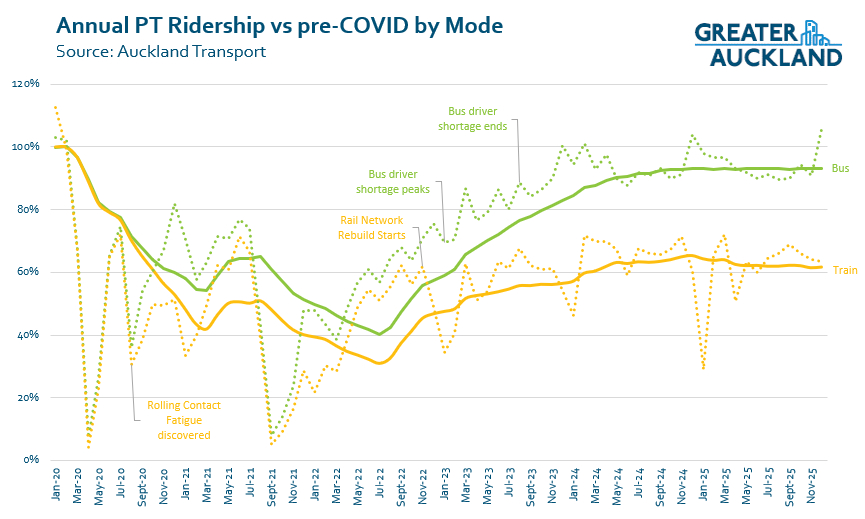
Put another way, in early 2020 just prior to COVID, there were 22 million trips on the Auckland rail network over a 12-month period. As of the end of December 2025, just 13.6 million trips had been taken that year – about what ridership used to be, prior to the electric trains being fully rolled out.
I hope that Auckland Transport have a plan to give the public greater confidence the network will now be reliable, and to encourage people back towards using the trains – and won’t just be relying on the CRL opening to drive regrowth.
Importantly, here’s KiwiRail on how they’re changing the way they maintain the network:
KiwiRail is transitioning to a proactive maintenance schedule that will increase our productivity and use of valuable time on the rail network, limiting full closures.
Our Metro Maintenance Plan identifies what assets (for example, track, signals, foundations) within the rail network require repair, replacement, or upgrade. We’re moving to a preventative maintenance approach which will schedule the proactive maintenance and renewal of assets to support a more resilient, reliable, sustainable rail network with reduced disruption. This works on a cyclical basis rotating around the network.
…..
We are dividing the network into 36 zones, each of which will be self-contained enough to allow maintenance work to occur while trains continue to operate around the work zone. This has not been possible before.
We are also introducing more frequent automated track inspection technology and strengthening performance requirements.
…..
We will still require long weekends and shorter periods of time over the Summer to deliver intensive often more invasive work, but it will be targeted and forward forecasted. Segments of the network will close for short periods, and single line running may be needed in some areas, but the rest of the network will stay open for trains.
This should mean, for example, that people celebrating New Year’s Eve in the city should be able to watch the fireworks from Victoria St, then head into the entrance to Te Waihorotiu station and catch a train home, happily avoiding the vehicular traffic trying to get out of the city centre.
(Ed: it would also be great to see the services keep running over long holiday weekends, a prime time for families and people unfamiliar with the network to give trains a go and see how they work.)
Will Auckland Transport run a metro timetable?
Say you’re a council planner, and you’ve had a hard day at work. The government has just changed the rules on where houses are allowed for the fourth time this month, after a new group of residents in a wealthy suburb complained following the success of similar groups in neighbouring suburbs, meaning you’ve got to rewrite housing plans once more.
The impact has meant you’re running late and you need to get home to Ellerslie to pick up your child from daycare before it closes.
You exit the council building, and it only takes you a few minutes to cross the road and enter the new Te Waihorotiu station. As you get to the platform you see a train arriving on Platform 1 (northbound), so you look at the display and see it’s a S-C Line train that will take you to Ellerslie.
However, you also see that there’s another S-C line train due to arrive on Platform 2 in two minutes. What should you do?
This might be a hypothetical scenario, but it is likely the kind of thing passengers will need to think about due to AT’s current network design.
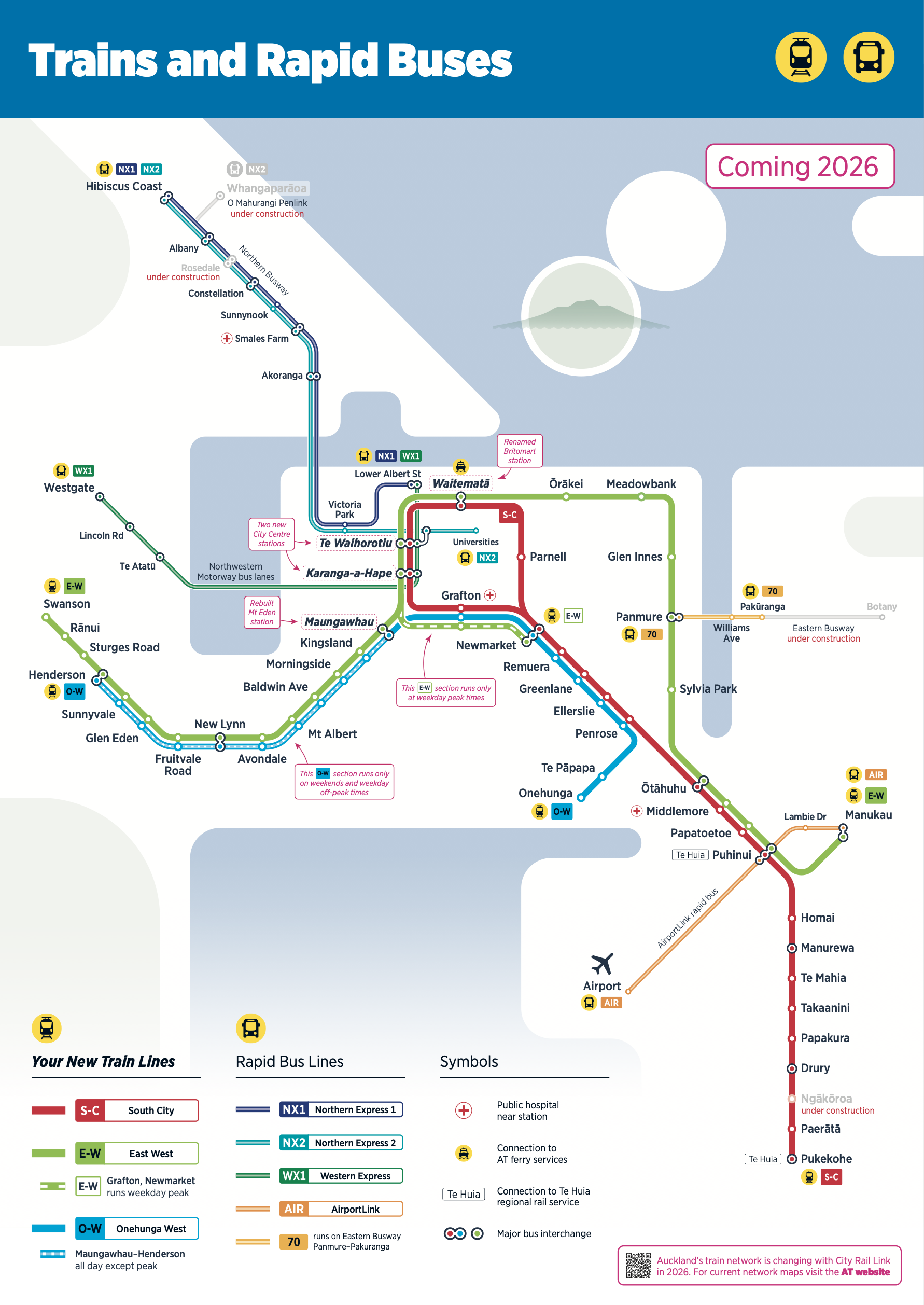
The network might look relatively simple at first glance – but information we’ve seen in the past, plus glimpses of the timetable seen during the testing, reveal there’s a lot of complexity underneath it.
The two notes “This E-W section runs only at weekday peak times” and “This O-W section runs only on weekends and weekday off-peak times” hint at perplexing complexity, even before taking into account the limited stops, alternating directions and triple terminii of the S-C line.
I could be wrong – but from what I can tell, there are up to 16 different service patterns planned across the three-line network (if you include both directions of a line as a separate pattern).
In announcing the testing, AT noted:
“Years of planning and modelling have gone into developing the new timetable, but real-world testing often throws up variables we can’t predict. Seeing it put into practice will be extremely exciting and a little nerve-wracking.”
“We’re also aiming to simulate real operations including peak and off-peak timetables and how AT trains will operate alongside KiwiRail freight trains. Carrying out these tests now gives us time to resolve any issues before we open the CRL and launch our new network later this year,” says van der Putten.
My worry is while timetable might look good in a model, and on average trains will be more frequent, in the real world they might not be as easy to use due to things like different patterns at peak hours, limited stop services, and for the S-C line, running in two different directions around the city centre.
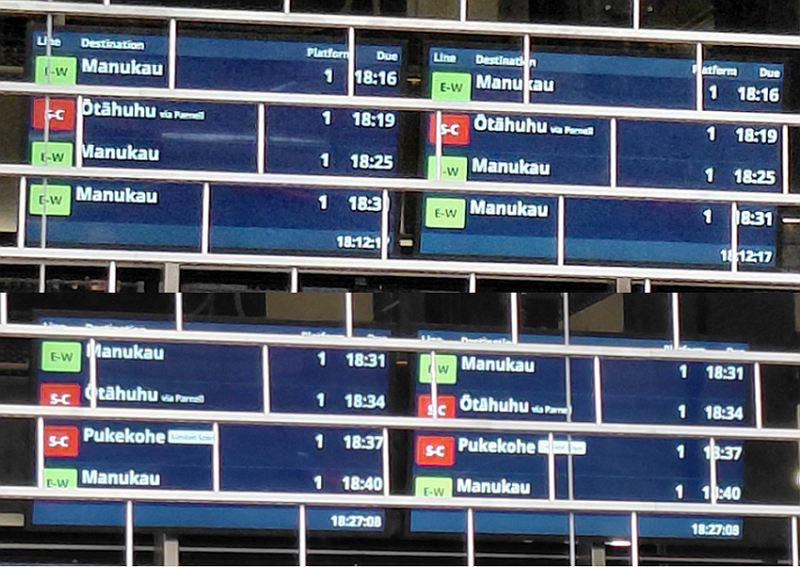
Here are some of the images I’ve seen of the display boards for the timetable testing runs, which help highlight some of that complexity.
First up, this photo was taken at Karanga-a-Hape and highlights that we haven’t got nice even spacing between services even on the same line. For example: the E-W line has gaps of 9 and 6 minutes between services. Meanwhile, there’s a 15-minute gap on the S-C line plus a limited stop service – which I believe is travelling via the Eastern Line.
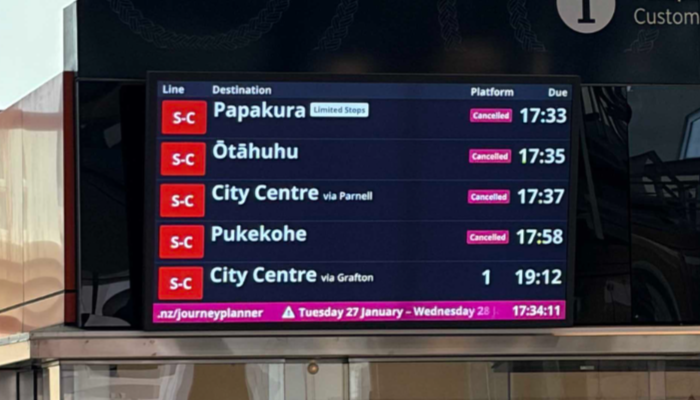
Next, at Newmarket: you can see there are five different services all showing. This was taken on the Tuesday 27th January, and it also suggests there might have been some issues during the testing.
Finally, from Waitematā Station (fka Britomart), you can see two different services travelling to Pukekohe – heading in different directions, and setting off just minutes apart.
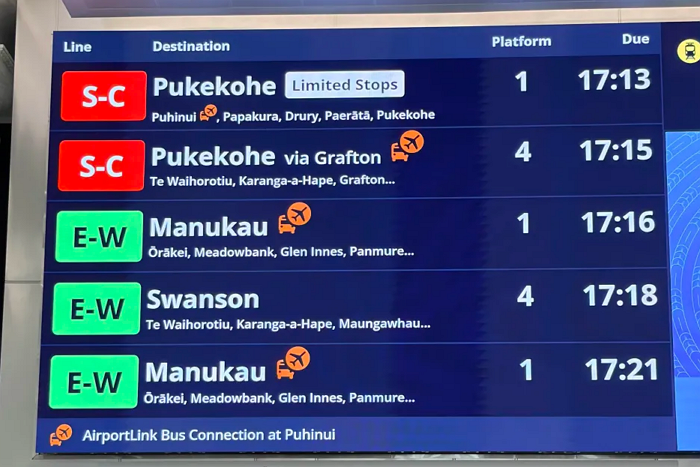
Those limited-stop services in particular seem like they will use up a lot of resources for the benefit of passengers heading to just a handful of stations, two of which don’t even have many homes around them yet and won’t for years.
It seems that AT have disregarded their wildly effective “new network” concept, which is based around simple, consistent and regular routes, and ended up with something unnecessarily complex, inconsistent and irregular instead.
So, while the timetable might work for moving trains around, will it work for passengers? Or more to the point, will it attract non-passengers to start taking rail, and help grow patronage back out of the doldrums?
It reminds me a bit of a story I’ve heard about the opening of Britomart Station.
Prior to Britomart, trains arrived and departed only from the very edge of the city centre, at the old Beach Road station. This, combined with the way the lines were run through from east to south, meant the majority of users from the Eastern Line only actually went as far as Newmarket.
The rail planners (and their model) considered that this must be a very important journey that needed to be maintained. So, despite opening a brand-new central city station in the heart of downtown, they diverted about a third of the trains away from it to continue to serve those Newmarket trips.
Months later, they finally figured out that demand for that journey, while previously the biggest share, was tiny compared to all of the new users who started using the train and wanted to get to Britomart.
They eventually realised that those mostly-empty peak trains were wasted on veering away from the city at the last minute, and that it was better to use the resource to serve where most people wanted to go to from the Eastern Line, with the rest able to easily transfer to get to Newmarket. From then on, all trains went to Britomart.
The point here is that with CRL, there’s a good chance the model won’t be able to predict the change in usage for such a fundamental change to the network. In some ways, it appears that AT have tried hard to over-optimise the network before actually understanding how it will be used by people.
Barring any glaring issues, it’s likely the timetable that was tested is close to what will be rolled out. So it would be good for AT to start releasing some more details about it.
Greater Auckland’s work is made possible by generous donations from our readers and fans. We’re now a registered charity, so your donations are tax-deductible. If you’d like to support our work you can join our circle of supporters here.

 Processing...
The proposed timetable is so complex. Complex timetables are really hard to make resilient: if a train is supposed to run a very specific skip stop pattern but starts late, then it has a cascading effect on every train that has to wait to keep the express slot open.
This network would be so much better as three lines e-w, w-s, s-e
I suggested to Auckland Transport years ago when I was on Howick local Board a better no cost alternative was to have a terminal at Newmarket for the southern and western lines with a continuous shuttle in and out to Britomart cost almost zero $
I was told that commuters would not like changing trains
They obviously have not traveled overseas much
I think it should be a requirement for anyone who has any say on our public transport should have lived and commuted in a country that has a decent public transport system.
I think it’s weird that we have multiple lines using the same tracks. The Western line should just go to Maungawhau, the Southern should just go to Newmarket. Eastern should go between the old Auckland Strand station and Otahuhu. Then the CRL can be it’s own line, with trains every few minutes at peak and new platforms/stations at Newmarket and Auckland Strand to link them all up.
This suggests you aren’t one of those people who has “lived and commuted in a country that has a decent public transport system”, since multiple lines sharing the same tracks is pretty universal everywhere.
Admittedly, outside of Auckland, I’ve only lived in London, and that was over 20 years ago. However, other than the Circle and District lines, I don’t recall the majority of the lines sharing tracks. And I’d often change trains a couple of times to get to work without any issue.
I don’t remember any of the lines in modern Asian cities like Tokyo, Seoul or Singapore sharing lines. The only city I can recall sharing tracks between lines extensively would be New York, and I found their metro quite complicated to work out.
@ Nick:
The overground lines, Jubilee Line, Metropolitan line and many lines to Buckinghamshire all share paths in NW London which is why they connect with the Elizabeth line and HS2 whenever that white elephant opens.
The northern line will eventually be two separate lines as well sharing the same tracks.
Modern purpose-built ‘metro’ systems are usually designed with completely individual lines which criss-cross and dont share tracks. The logical purpose behind this is that if one line is delayed or cancelled, this does not affect any other lines.
Legacy suburban rail systems will almost always have sections of track shared by multiple ‘lines’, usually converging on a central hub or ‘core’ (like the CRL). This is because these networks are just running on a bunch of tracks built over the span of 100+ years to carry freight, long-distance passenger and suburban passenger services all at once. This is simply a case of ‘using what you got’ rather than having to build a complete but separate parallel network.
Auckland is part of the second category, as are most lines in Australian cities (excluding Sydney metro). Also included here would be London Overground, German S-Bahn systems, Paris RER. There are also plenty of lines in Tokyo that fit this bill.
Most Asian cities are part of the 1st category as in many cases there were few or no useful existing rail lines to build their service around as these cities became developed enough to afford a metro, so they had to start from scratch. They followed best practice and built most of their system as brand-new standalone lines.
As Auckland has already invested in our legacy rail system, it is unlikely we will ever get any fully stand-alone metro style lines unless a future administration decides to go down the tunneled light rail route.
NickD – that’s not a pattern I’ve seen anywhere in the world. The idea of a number of lines converging on a city but not going into it and instead having everyone transfer to a small loop is absurd.
Certainly not very dyslexia friendly!
Can we start few of services from south auckland at 5am so that we can get onto jobs using public transport rather then cars.. it will reduce so much of chaos on motorway..
To be perfectly honest, I have been weaned off Auckland trains. What was once meant to be a reliable public transport system has turned into an unreliable and unusable mess. The trains are never running when you actually need them, they’re painfully slow, and increasingly feel dangerous to ride due to the rise in violent crime.
The rail network in Auckland — and frankly across New Zealand — is a disgrace and a global embarrassment. And let’s not forget the world’s most expensive siding into a main hub that clearly wasn’t designed correctly in the first place.
I could go on, but I refuse to waste any more of my time on this subject when I’m already wasting enough of my hard-earned money paying for this absolute crap.
Wow, when was the last time you tried to use one? I’ve found it’s got safer with more stations been gated as time had gone on and other measures.
Great to see some sort of express service to the Southern stations. I wonder how much time it will actually save. We moved to Pukekohe a year ago with the expectation that my partner would use the train to get to the city 3x a week, though it quickly became apparent that sitting in rush hour traffic was still significantly faster than the bus + train + walk combo needed to get from home to the office. ~10 minutes shaved off the journey time + 10 minutes saved by being able to get off at Te Waihorotiu should make a convincing difference to residents of Southern Auckland.
Te huia is already about 15 mins quicker from Pukekohe than southern line, and much more comfortable/ can reasonably work on a laptop at a table.
They have a bike carriage for an easy connection along the cycleway into midtown, or you can get a weekly subscription to a scooter share
How full is this cycle carriage usually? I’ve wanted to use te huia for day trips to Hamilton but I don’t want to risk not being able to get back with the bike in the evening and the website makes it feel like there are only 3-4 bike spaces…
We discussed with staff, once, how not being sure there’d be a space created an (offputting) risk. They indicated that they’ll always make space… I’ve never seen people turned away, but I’m only an occasional traveller. The one time we were put on a rail replacement bus (which was an AT Metro bus) the staff made sure our bikes could come with us without us having to say anything. That seemed to support the general idea that they are committed to making sure the bikes get on.
Others will have seen more than I have… Any stories or data, anyone?
However, you’ll want to check out the timetable… Trips to Hamilton are better as overnights or weekends. A day trip in that direction is possible (on weekdays only) but won’t give you much time in Hamilton.
(It’s great that Te Huia has increased the number of services, including limited services on Saturday and Sunday. However, they do have to focus on serving the trips taken by residents within the Council that is financially and politically supporting the service.)
I don’t see why an all stops following a limited stops is a problem. Express services are desperately needed to get travel times show the advantage of trains. This tedious insistence that all southern line trains have to stop at Greenlane and Remuera to cater for a handful of passengers is over thankfully.
Remuera I can understand, but with the proximity of a town centre + TCAB zoning, a hospital, and what is now a major frequent crosstown bus route (the 65), Greenlane seems like a station that *should* be all-stops if the potential for transit oriented development around it can be cultivated.
The “express” services are a sick joke. One PM one is scheduled to take 39mins from PAP to NMT, 49mins to AOT, 51mins to BRT. It stops at every station to Otahuhu then skips to Newmarket and every stop from there. The one in the other direction is 2mins longer. The Eastern one is 46mins BRT-PAP. IF there are no delays!
Note they aren’t calling them express. Apparently they realized they were any faster which is why they’re just called limited stops.
Why have separate services at all if they are no faster?
They are faster.
Phew
Seems odd but apparently the idea is to not stop as some of the inner stations so that there’s more space on the train from the outer stations.
They can’t be more than a couple minutes faster from not stopping because they’ll just catch up to the train in front. And the signals keep things in blocks four minutes apart so the few minutes saving you might scrape together on the schedule will be lost waiting for the slot at each junction anyway.
As more new subdivisions open up around Franklin, im certain the train will get relatively faster than the rush hour traffic.
Better still will be big employment centers being opened up also, removing the commute to the city as a requirement.
Live Work Play, is the area’s tagline.
Great to hear they are building more workplaces too. It’s what the West seriously lacks. Manukau did a great job of building industrial capacity.
Manukau has the advantage of being:
a) Flat and thus ideal for industry, warehousing and distribution
b) En-route to the rest of the North Island by road and rail
West Auckland is hilly and has comparatively lousy connections. Why would a developer/investor go to the trouble of developing industry in the west if they can get a better, cheaper site to the south?
Our future work is not in factories.
@ Sasha: there will always be a need for light industry. It’s better for our economy long term, then depending on the polluting industries of tourism and intersive agriculture that NZ is far too heavily invested in.
AT should have extensive data on PT travel start and end (based on tag on/off).
and ultimately where people travel.
It would be really interesting to see the “…planning and modelling have gone into developing the new timetable”.
Present it as a time-lapse heatmap.
Yes they do, they used to give us boarding and alighting info for trains and is definitely interesting.
Issue is that it’s going to be somewhat meaningless post CRL, especially for the West.
Is bizarre that they’ve spent so much additional frequency from the south and barely any from the west when it’s the west that gets the most benefit due to way shorter trip times. Yes some of it is due to level crossings but some is bias from AT. Some of the modeling (I still need to post about) shows almost no growth in usage from west but puts the new Drury stations as some of the busiest on the network – hence the focus on lots of service and limited stop patterns etc. It’s dumb
Biased alright. Remind us how long AT worked from the Henderson building they were given during the regional supercity amalgamation before mostly escaping into the city centre? Then putting on a private shuttle service rather than using the Westie trains 100m away at either end.
Their hands are tied by the regulator who won’t allow them to run any more trains out West until level crossings are closed. Hence they are going from 6 up and 6 down, to 8 peak and 4 non-peak direction once CRL opens (adding to timetable complexity). AT would love to up capacity out west but need to find a few more billion dollars to be allowed to do it.
They haven’t even asked the regulator (they told us that), they’ve just assumed that it they won’t agree to it.
The concern is people not following crossing bells/gates etc. If they really wanted to, they could add a massive enforcement programme (automated cameras) or even just post security guards (or pay police) to improve compliance and remove the risk
Thanks Matt. That’s outrageous.
No. AT don’t want more trains to mess up their roading nextwork.
AT’s south bias ? Thats a concept i’ve never seen expressed before.
What was the reason they gave for prioritising removal of the Southern line crossings over any of the Western line ones?
Easier?
When it comes to the trains the west has always been treated as the poor cousin e.g. always the last to get service improvements, if there’s ever a potential conflict, the South or Eastern line trains will always get priority e.g. I’ve arrived at Newmarket many times and had western line trains held for 10-15 minutes to let a southern line service through.
Reason for southern crossings is there are fewer that need removing to deliver a fully separated line – I think there has also been more safety issues there too with higher non-compliance with barrier arms etc
Also more freight goes through southern line would be a reason. Ie more train’s altogether and longer level crossing waits. Oh and not to forget Te Huia and Northern Explorer.
Some western persecution antics here. The Southern line situation is clear. Dozens of freight trains, Te Huia, Northern Explorer and interleaving with the Manukau and Onehunga branches. Westfield depot, freight sidings in Otahuhu, Southdown and Penrose. The load on the Southern line is far more challenging than the others. The Western line has a fraction of that to deal with. Not only are there fewer crossings to eliminate, they’re relatively easy ones and they payoffs are much greater. You can thank the government sabotage of light rail for a lot more than any perceived cardinal bias.
The light loco movements between Otahuhu and Wiri seem a waste of train slots to me. Couldn’t the drivers park up the loco and come back for smoko on a passing passenger train while the containers are off loaded and the train reloaded. Maybe Westfield station shouldn’t have being demolished. The other thing that’s pretty wasteful is the use of the third main as a test track for emu’s. And why there isn’t a third platform at Puhinui is the most scandalous of all
Yeah I wondered if it might be mainly about freight slots.
“This should mean that people celebrating New Years should be able to watch the fireworks from Victoria, head into entrance to Te Waihorotiu and catch a train home, happily avoiding the traffic trying to get out of the city centre.”
Catching trains past midnight? Sorry, “Late evening” is usually around 7pm…
Yeah. Buses too. I saw the AT ads at bus stops about night buses, and thought it might be worth an article congratulating them. Unfortunately when I looked at the actual timetables I had to wonder what they are crowing about. AT’s night buses are better than a poke in the eye with a blunt stick, but you can’t say much more; the night bus timetable is nowhere near what’s needed in a modern city.
With average intervals of less than 10 minutes, do timetables even matter? It’s just turn up and go
If you can work out where it is going. A city that only has 2 train lines should be fairly simple to use, but AT seem to be trying to make it as difficult as possible.
I still hate the line names. When you only have 3 lines, why use names that are difficult to say and read. Sure if we were Tokyo they might want to go with two letters, but Auckland will never be Tokyo.
They will end up getting called the red, green and blue line by the users I hope. Or maybe the eww, the ow, and the sick.
I’m sure you will get over it.
I am sure I will.
Having boffins design a system around efficiencies rather then usability normally leads to a substandard system in any type of engineering, and in this case there could be a significant hidden cost to making the system less usable. Naming train lines with hard to say acronyms that don’t really mean much is a missed opportunity to make the system easy to use.
I like the idea of colours because there will also be a map with the line on it in that colour, it couldn’t get any easier. Sure it limits the number of lines you can have, but in Auckland it doesn’t matter.
The line names are truly appalling. They are a barrier to use, especially by new users. The world uses letters, numbers, and/or colours, or in older systems full words, for good reason- legibility, memorability.
Now with this over complicated proposed service pattern, I fear there is a lack of strategic leadership reigning in the technocrats stuck in their own problem solving detatched from the actual purpose.
So what is the clear strategic idea that service design and public facing comms should always be checked against? Metroisation.
Meaning turn-up-and-go, regular services, clearly and simply identified and communicated in a way the average bear, unused to the system, half awake, thinking of other things, can just easily use, again, and again.
Clear, frequent, simple, reliable.
This does not look like what we are getting.
I do understand the constraints of our little interlined network, with details that are too much for a comment here, but this in fact reinforces the argument for a simpler, clearer, system.
AT do it with their buses well, but rail – seems like it is stuck in a silo.
There’s a lot at stake here, there’s a lot of trust and appeal to rebuild…
I understand EW someone vomited and OW I cut myself on the broken glass. But SC? Scary? SCux? SCody?
I’m referring to the new lines by their colours for this reason as someone who makes videos on Auckland’s Urban Planning. Easier to understand for viewers and I don’t have to say East-West or South-City multiple times in a 10-15 minute video.
“East-West”, “South-City”, etc. are much more indicative for someone who isn’t already familiar with Auckland’s system, as it at least tells you vaguely where the line is going.
If you aren’t familiar with Auckland’s system, you would probably look at a map and see the coloured lines rather than guess where the train goes based on the acronym.
And E-W and S-C doesn’t mean a whole lot unless you happen to get the acronyms. If they really wanted to include the general direction, why not use actual names, they are probably easier to say than the shorthand anyway:
East-West
Southern
Onehunga
You lads have just seen an iceberg in the distance from the deck of the SS ATitanic. Here in the bridge the crew are looking at charts for an ocean that doesn’t exist and the captain is looking out the wrong porthole.
That is 100% how it feels after dynamic testing. I can’t go into detail, but it went badly enough to hope that this timetable may never make it to opening day.
The good news is that the hardware worked perfectly. It’s the plan, the choices, the decision-making, the moving goalposts.
I would prefer fewer services and more speed rather than trying to cram extra trains in an attempt to meet timetable targets. There still isn’t enough track capacity, they haven’t even finished the third main platform at Puhinui. While spending hundreds of millions on stations in the middle of nowhere.
Thank you. I hope it was bad enough that they have no choice but to make the service design simpler.
Surely that the purpose of “dynamic testing”. Great to hear the hardware worked – thats a win.
Im hoping to see some updates from AT – apart from near a week ago
“Stacey Van Der Putten, Auckland Transport Director of Public Transport and Active Modes says the testing is going well.”
It would be a great opportunity to bring along the PT nerds for the journey instead of hidden under the cityscape.
Or maybe they did and i missed something
Yes. It is the point, and AT have enough good thinkers to make a new plan.
Fingers crossed, eh?
And she may get to be more of a decider soon.
Interesting post from Councilor Ken Turner. Of interest is that Councilor Turner’s suggestion would advantage Eastern Line passengers as much as Western Line passengers. If the Eastern Line is linked to the Southern Line as Councilor Turner proposes, every train on the Eastern Line would stop at the three underground CRL stations and Grafton and Newmarket.
https://www.facebook.com/share/v/1DYznWh9ML/
And what proportion of Eastern Line passengers are travelling to Newmarket or Grafton? I should like to see data on that, but I would suspect a higher portion of Western Line passengers are still looking to travel to Grafton and Newmarket than passengers from stations between Orakei and Sylvia Park are looking to travel to Newmarket or Grafton by train – remember that the bus route 70 exists for Panmure residents to go straight to Newmarket and the Hospital
I am also entirely unconvinced that inflicting the same alternating clockwise/anticlockwise the Southern line will have on the Western Line is a good idea. The biggest advantage of the City Rail Link was to eliminate the Newmarket dogleg and cut ~8 minutes off the travel time to Waitematā/Downtown. Councillor Turner’s proposal would cut that benefit to only half of the Western Line trains, and force passengers wanting to get to midtown or uptown Auckland to wait longer for a direct train, or spend longer on a train going the long way round the CRL-Newmarket route, or get inflicted with the transfers you seem to abhor so much. And I daresay that the number of Western Line passengers wanting to travel directly to midtown or uptown will rise with the City Rail Link enabling that access, and will reduce Western Line demand to Grafton (data shows more ppl get off at Grafton to “downhill” into the universities or the central city, then would get on a train at Waitematā to return home)
It seems you have fallen for the anti-CRL propaganda of last decade that claimed the City Rail Link was nothing more than a loop. Auckland is not Melbourne; the CRL was always meant to be more like the Metro Tunnel and not the City Loop.
The same benefits you & Councillor Turner tout can be had with Nicolas Reid’s proposed network revision. Inner Eastern Line stations get that link to the Southern Line, and Grafton & Newmarket. Manukau is linked directly to Newmarket. Extending the Onehunga shuttle line back into a crosstown-onehunga routing would provide additional capacity on the Western Line and maintain a service from west to Grafton and Newmarket without inconveniencing central city-bound commuters.
https://www.greaterauckland.org.nz/wp-content/uploads/2024/11/CRL-Map-JC.png
Yes. agree with you and Patrick below. A fast frequent transfer at K’rd won’t be an issue. If they did an alternating loop half the time people would just transfer at K’rd anyway to get to Newmarket etc
The proportion of Eastern Line passengers travelling to Newmarket and Grafton won’t be known until that service has been in place for several years. As in the article, when the service on the Eastern Line went to Newmarket via the old Auckland railway station, a lot of people got off at Newmarket.
The service pattern proposed by Councillor Turner is for the Western Line to loop alternately INSTEAD of the Southern Line looping. If, as AT has decided, one line is going to loop the Western Line is the best option for a number of reasons.
If the Western Line is the loop line it would run at twice the frequency it currently does, so passengers would get the same frequency of service as at the moment for direct to Newmarket, and an equally frequent new service direct to the central city. There will be plenty to capacity to catch the next train if a passenger decides to do that.
The CRL will transform Auckland when it opens. It could be used as a link only, as a loop only or as both. AT has decided to use is as both.
The option proposed by Nicolas Reid would through run the Eastern Line with the Southern Line as Ken Turner’s option does, and through run the Western Line with the Southern Line terminating at Manukau. That is a better service pattern than AT’s proposal, but would still not provide the direct to Grafton and Newmarket service that has been the defining feature of the Western Line for over 140 years.
The Onehunga Branch Line is single track and can only accommodate 1 train every 30 minutes so would not provide a useful shuttle service. There will be available slots in the CRL so it would be a good option to run every Onehunga service through the CRL, clockwise only.
Is the O’Line well used? Or are we just using it because its there and the easiest (least disruptive) option is a shuttle to Newmarket or Penrose.
“If the Western Line is the loop line it would run at twice the frequency it currently does” so you are suggesting the Western Line would run with a 4TPH all-day service pattern and a 2TPH peak overlay?
Which then runs us into the same legibility problem that the Southern Line loop has on maps and diagrams that Nicolas Reid’s article pointed out. A good transit line should be completely understandable at a glance, and a line that merges back into itself with no indicators of which way it goes around the loop is not easily understandable. Councillor Turner’s diagram should have accordingly shown the Western Line doubling back on itself, not merging back into itself; that would emphasise the doubled frequency.
I also have strong doubts about the usefulness of reopening the Kingdon Street temporary station, as it is a ~5 minutes walk to the nearest bus stops in any direction and a near 10 minute walk to Newmarket station proper for any transfers to Southern Line or Onehunga Line trains. This is not an interconnected network, same as the Avondale-Southdown proposal to have a new Onehunga North station sited far from the existing town centre, train station, and bus interchange.
You have not refuted my point that a good chunk of train passengers alighting at Grafton are travelling to the university/city centre instead of the hospital or Grafton surrounds, and will accordingly be more likely to get off at Karanga-a-hape or Te Waihorotiu once the CRL opens. This stubborn adherence to “that’s the way it was, that’s the way it should always be” is entirely inflexible and based in anecdote not evidence. If a current 20-25% of Western Line ridership is to Grafton and Newmarket combined, then Grafton and Newmarket do NOT need to be directly served by half of all Western Line services; only a quarter or a fifth; and therein comes the question of whether waiting for a direct train service is actually quicker than a higher-frequency, fewer-line network with a convenient cross-platform transfer at Karanga-a-Hape
I believe there has been talk of utilising a half-built passing loop near Te Papapa station on the Onehunga branch line to enable increased frequencies, though this would be easier to manage timetable-wise if the OBL was run as a Penrose to Onehunga shuttle service. The current plan to eventually run 4TPH from Henderson to Newmarket, with only 2TPH carrying onto Onehunga, could also apply without the passing loop measures, and would scale better to present demand for Western Line trips to Grafton and Newmarket.
We have just spent $5.5b so that western line trains do not have to go to Newmarket. That they all had to go there before we made this investment is no argument for them to continue to.
Western line capacity is strictly limited by rules around level crossings (car priority) and KR’s imaginary freight trains. What capacity remains should clearly first serve the dominant and highest value direction, with as frequent, regular and legible service as possible. You know, the one we have just spent so much money on.
Once we have secured a minimum all day turn-up-and-go pattern, ie at least 6tph, then overlays as required for peak demand should be applied.
With a similarly frequent and regular southern line pattern transferring at K Rd will always be quicker than waiting for an infrequent short runner for a one seat ride.
Other issues, like what to do with Onehunga line, a higher frequency shuttle is a good option, though that does require some investment, or running it through the CRL are good options.
Saving embarrassment about idle Maungawhau NAL platforms, in my view, could be solved by terminating Te Huia there. Though that would also require AC/AT to contribute to the opex of that service. As others have pointed out here, it can perform a partial express role too, for Puhinui (airport) and Pukekohe.
I catch the 75 bus, and a number of people get off the train at Grafton and then get on the bus to stops in the city or on to Wynyard Quarter.
I used to catch a train from Newmarket to the city and I’d jump on either the Western or Southern line train. There were significant numbers of people getting off both trains in Newmarket.
Sue – agree, a lot of people get off the Western line trains and catch buses from Grafton into the city.
This will likely dry up once the CRL opens as the train will be a much more direct route. It’s the perfect example of why decisions shouldn’t be made just with existing data when a significant change is about to be made.
Turner’s plan is garbage. Unfortunately a lot of convincing sounding people have been touting the idea of reviving Kingdon St ever since it closed, but it’s a trash idea by people who don’t understand how rail really works. Same with dumping out full trains at Newmarket and expecting those passengers to squeeze on to an already full train from somewhere else to get to the city center. That’s not how it works.
The simple and obvious answer that for some reason has disappeared from the public discourse along with ideas of airport rail is that the Onehunga branch CAN and SHOULD be double tracked and made fit for 6-9 car trains. It’s a remarkably simple way to balance the network and that it isn’t discussed is suspicious. Recent boosting of the Avondale to Southdown line probably explains any reluctance to invest in the Onehunga branch. They would be in each others way.
@JimT it would be costly, though
using the NZTA’s cost projections per km for heavy rail (from page 52 of this https://fyi.org.nz/request/18392/response/70939/attach/5/Auckland%20Rapid%20Transit%20Plan%20Stage%201%203%20Summary%20Report.pdf )l it would be:
– 3.6km from Penrose to Onehunga double-tracked and elevated or trenched at $400-900M per km: $1.4B to $3.3B
– 7.6km from Onehunga to The Landing (where it would need to tunnel under the second runway), elevated at $400M per km: $3.0B
– 2.0km from The Landing to the Airpor terminal station, tunnelled at $900M-$1B per km: $1.8B to $2B
all up cost of $6.2B to $8.3B, not including enhanced bus, BRT, or LRT for Dominion Rd and Mt Roskill mass transit improvements; and not factoring in inflation or cost overruns
Yeah nah, councillor Turner’s suggestion is the old 1960s commuter only model that both Sydney and Melbourne are spending billions in order to undo.
Why build a through-route, then don’t use it?
AT’s apparent proposed service pattern looks flawed, but this would be worse.
Again, lacks strategic coherence. This is commuter rail not a metro pattern.
However it is clear that the huge opportunity from the CRL for the west is not being is not being capitalised on.
For the west the key issue (accepting that level crossings are not going away soon enough) are KR’s unused freight slots. These are the barrier to an all day higher frequency regular service pattern.
Random West-South services are a side-show. AKL PT successfully runs on a transfer model. K Rd offers an all weather cross platform transfer. So long as frequent all day regular patterns are delivered.
These (freight slots) need to be in play, there is little freight traffic on the NAL and what there is can work around a better metro pattern.
Freight can wait.
This situation shows why it is suboptimal to have a logistics SOE in control of access to critical infrastructure, but that’s another matter…
On the freight issue, maybe AT are playing political and trying to get funding for Avondale-Southdown?
FReight slots Western line? I live in the North west (where we have 0 service even though we have experience ridiculous growth without any infrastructure), lucky if 1 freight train goes through a day when they are running. Why have a route, then don’t use it? & yeah we know all the excuses, they have been debunked.
Exactly, but because KR controls the rail network it reserves ghost freight slots everyday regardless of actual need.
It is time this practice was stopped.
Imagine how outraged people would be if NZTA blocked off whole motorways reserving times for possible future road freight traffic that isn’t there? Not exactly most efficient use of public resource is it?
Pretty obvious people would say we should be able to use this public asset at least until such a time as there is a more pressing use.
Again- let’s get strategic alignment sorted on the rail system.
I am sure I read $230 million annually
Why would they put 10 years?
They would not know a 10 year cost now ?
The operating contracts run for for about ten years, so they’re talking about the contract cost.
The Herald loves to quietly slip out figures like that with little or no clarification, because they love big numbers being ‘wasted’ by council because it enrages their subscriber base.
That $5.5 billion was originally $2.6 billion
And will be over $7 billion when completed
Running cost $230 million annually or nearly $1 million each day for what?
To save 15 minutes??
What a waste of money
That’s 230 million over ten years as has been reported elsewhere, not an annual opex.
Wait till he hears about the cost of motorways these days that will get a fraction of the usage of the CRL.
If we were still honouring Key & Joyce’s requirement that AKL city rail needs to get to 20M annual passengers before they will support building the CRL – we need to stop now.
‘We will still require long weekends and shorter periods of time over the Summer to deliver intensive often more invasive work…’ oh no, my worst fear confirmed. Seems Kiwirail will still plan to shut down all Auckland rail over the long weekends and Xmas/New years…unacceptable for a modern city. I think it’s high time the mayor steps in and sorts this out. If you think taking the ‘ew’ train isn’t cool, imagine taking the ‘ew’ bus replacing train ;0
Yes, they need to be told to just suck it up and work overnight etc like real cities do.
Even huge cities still shut down sections of line for periods of time to do major works, but what they’re suggesting is that now the network is better up to spec, they can just shut short sections, perhaps in a single direction so trains can keep running, albeit possibly at reduced frequency.
There’s some clearer and better comments from Kiwirail’s Dave Gordon in here
https://www.1news.co.nz/2026/02/02/dead-and-gone-aucklanders-promised-end-of-train-network-shutdowns/
Tell that to Te Huia, which will have service closures on 17 out of 181 over the next 6 months (Feb to Jul).
It’s possible some of those closures are due to work outside of Auckland, but I suspect they’re getting shafted by the Auckland maintenance schedule.
—
https://www.tehuiatrain.co.nz/timetables/
3 days Friday 6 – Sunday 8 February
1 day Sunday 8 March
4 days Friday 3 – Monday 6 April
3 days Saturday 25 – Monday 27 April
3 days Saturday 30 May – Monday 1 June
3 days Friday 10 – Sunday 12 July
I get that this sucks, but those days correspond to full closures of the network, don’t they?
Te Huia requires intact and safe tracks to run on too, you know.
Those huge cities shut down one or two lines at a time to work on a section of the network, but they have a dozen or more so most of the system keeps running at any given time.
Auckland only has two lines with a loop and a couple branches, it’s only one section comprising the whole network.
> those days correspond to full closures of the network, don’t they?
@JohnBGoode – my point is it’s not good enough that there’s “full closure of the network” on 17 of 181 days.
Do the work overnight or do it on just a single track.
Also, I doubt there’s no freight travelling on those days. My suspicion is they’ve cancelled passenger service because it’s easier than trying to work around.
I agree with you but I could not tell from the phrasing with the 36 zones whether they plan to shut down the complete network or just some parts of the network.
It’s clear to me it will better (more likely to be small segments of network shutdown and or single line running):
“We will still require long weekends and shorter periods of time over the Summer to deliver intensive often more invasive work, but it will be targeted and forward forecasted. Segments of the network will close for short periods, and single line running may be needed in some areas, but the rest of the network will stay open for trains.”
I often wonder if long shutdowns are encouraged because it’s cheaper to run rail buses than trains
I would say you are probably correct.
Did you see the cost to run the CRL will be $230 million annually
or almost $1 million a day, in my humble opinion a total waste of money.
The remaining stores in Queen st. will have few customers as
workers who walked up and down Queen st. will now travel
underground and not past the shops
That’s 230 million over ten years as has been reported elsewhere, not an annual opex.
That is mis-reporting.
Projected CRL operational costs are $64m, less revenue of $44m – so a net $20m.
The balance of the reported figure is depreciation and interest.
Interest is really a function of capital cost, not a cost to operate.
Depreciation is a book keeping entry, not an actual budget line.
$20m per year is a bargain for doubling the passenger network’s capacity and effectively shifting whole suburbs. That tunnel is magic.
It’s not cheaper to run rail replacement buses. Not by a long shot. The rail service is bought and paid for whether they’re running or shut down. The less disruption there is, the less fare income they lose. Rail replacement services absolutely smash fare income and cost a lot more per passenger.
Long shutdown is encouraged because assembling equipment, materials and staff once for a long job beats the hell out of doing it night after night and only getting 2 or 3 hours of work done each night before they have to vacate the line for the first services of the day.
KISS. Keep it simple stupid.
EW is fine. Their screw up with missing platforms at Mt Eden really makes life harder, retrofitting will be doable but not that likely rn.
Onehunga should be to Mt Eden and back (if they don’t have points under Mt Eden Rd they should add them so turning services around on the unused platforms don’t affect the rest of the network). If they can’t make that work, just turn it into a shuttle to/from Penrose – will hurt Onehunga line, but you can sell it by saying “we’re doubling frequency” with that small double tracking in the middle.
Southern Line needs to be A Southern and C Southern. A Southern starts @Otahuhu and ends @Pukekohe going anticlockwise via the CRL. C Southern starts @Pukekohe and ends @Otahuhu going clockwise via the CRL.
Passengers wishing to go East-West change @K Rd, or @K Rd and @Mt Eden if they manage to get Onehunga to Mt Eden. Tbh they should just turn Onehunga into a shuttle though, as the frequency harm to the Southern of having it on the Southern tracks is too high.
No express services, that’s what Te Huia exists for, and the time savings for a few people who choose to live far away doesn’t outweigh the time costs for everyone else. Plus complexity.
The people commuting to Newmarket from West will have a small time increase changing @K Rd, but by increasing the frequency on the EW and Southern lines that should be averaged to a time reduction instead.
If Te Huia is providing a de facto express service for Auckland commuters, then even more reason AC/AT front up with some cash to support it.
There’s nothing inherently wrong with express services, provided they give a decent time saving (ideally from using separate tracks) and are consistent.
What is proposed from day one with express services doesn’t make a lot of sense to me.
So time to quad track the main trunk line?
Certainly extent the third main at least.
yeah third to Papakura at same time as grade separation works.
I’m also very keen on a longish relief line (3rd) where it is cheaper and easier on the eastern, up on the ‘plateau’, ie south of the tunnel, bypassing GI, and as far as possible to Panmure, if not past that station too.
There’s another kilometre by the boat club on Hobson Bay that looks simple too- KR land, a short bridge where the current 3rd ends, then to the end of the reclamation.
Expedite port freight.
The sun moves anti-clockwise in the southern hemisphere. But we get used to that.
If it changed direction every other Wednesday, or went half-way and then back again, it might be harder to cope with.
It looks like trains aren’t able to do something simple and repeatable. If so, the important questions are: which platform do I go to and which train do I catch there? I need names, colours, signs, departure boards all to give an easy-to-follow, Journey Planner experience. Naming needs to be easy to remember, say and read. Or else there will be job opportunities for “Give me a dollar and I’ll take you to the right train.”
And, of course, after a month of maintenance, there were delays and cancelled services today on the Eastern and Southern lines because of an overhead cable fault.
It’s like the movie “Groundhog Day.’
Came here to complain about this very thing. First time I bothered to head into the office since before Christmas, maybe I should have given them a chance to work out how badly kiwirail did their work.
A complete shambles this afternoon with overloaded buses and passengers being told to take an Uber to get home.
Amateur hour once again with AT.
I believe from memory it was a year ago they replaced all the tracks and then closed
the system down again to replace the ballast or sleepers underneath the tracks.
The West is being ignored. Now no direct peak time services to Grafton or Newmarket. You will have to cahnge at Karangahaape. Yet Grafton in particular with the school kids is a busy station, likewise Hospital Staff, and nearby workers are not going to have a direct connection. Yet the Southern end from Manukau will at peak times come to grafton and Newmarket. Any sane person from Manukau will go one stop to Puhinui, change and get stright into town without going the long around Panmure.
Also the Grafton services off peak between Henderson and Onehunga will only be 3 car trains! Great until we want to go to the Domain for a Concert (Synthony in March).
The West has been totally ignored again and after 70 odd years of direct connection to Grafton & Newmarket it is now deemed not necessary. Wait until the general public finally find out about all this!
The West was very much thought of with a direct ride now to the city centre without having to reverse in, wait 2 mins or so and then go out of Newmarket. Going to Grafton/Newmarket will be easy with a world class station underground/sheltered and transfer.
A lot of the Grafton activity are people transferring to a bus service from the Western line for that very reason, to get to the city centre/Universities quicker than via Newmarket.
This is where the example of the Eastern line immediately after the opening of Britomart is useful. Yes lots of people currently catch trains from the west to Grafton and Newmarket (including my wife) but that will be a much smaller proportion after the CRL.
Even if direct trains existed, there wouldn’t be many of them as the demand for that pattern is already met so while sometimes it would be faster to catch a direct train, they’ll never be frequent and it would still usually be faster to catch a train to K Rd and transfer easily there.
One guaranteed way to improve the timetable is more lanes
I always thought that the CRL was too complicated for its own good.I was even abused for suggesting alternatives back in the day. Now it looks like the chickens are coming back to squawk and some of the main sprikers are running around with no heads. I cant imagine the collective amount of brain anguish passengers will face when deciding between alternative routes. I expect it will take years to bed this thing in and I believe it will need to be detuned to make it work. By detuned I mean less frequent. Then there will be major pushback because there aren’t enough passengers to justify the expense. Sorry I can’t be more optimistic.
The chickens are definitely squawking but maybe withhold final judgement until the thing opens
It’s not that the CRL is complicated, it’s the people at AT coming up with trying to run overly complicated service patterns through it.
Ok so all western line passengers will need to change at mount Eden to get to Newmarket and Grafton and Parnell it wouldn’t bother me. I can’t say I am looking forward to deciding whether I should take the clockwise or anticlockwise southern train though have you got a fix for that
There’s no perfect pattern but as we’ve written before, this seems to be a much option to be using.
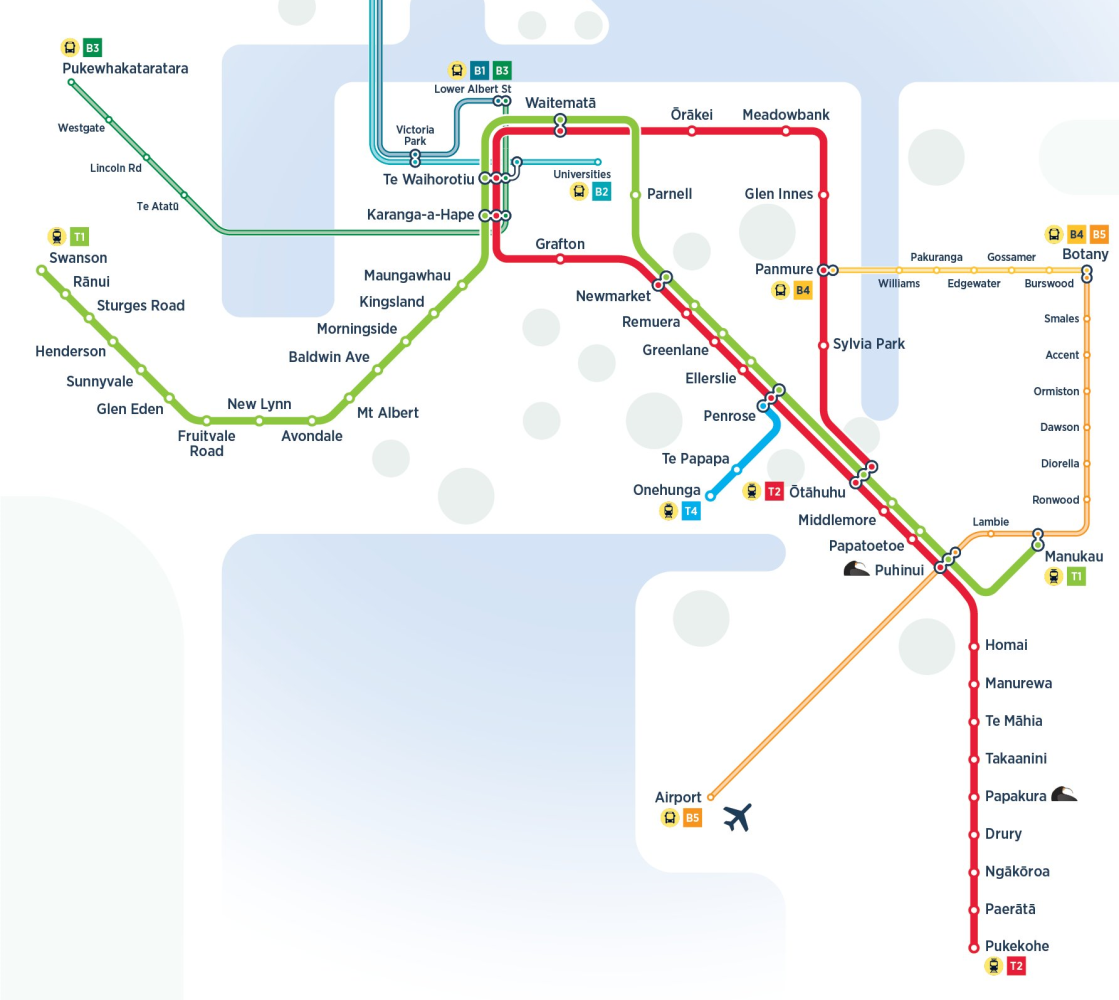
How good is that B5 line (Airport to Botany) going to be for East Auckland when it opens……in 2040 (funding permitting)
Yes I have seen this before it seems the most logical solution.. One of my original ideas was to have the tunnel replaced with light rail between Britomart and Mount Eden.I was called a dumb arse for my effort. But anyway here we are. This has some distance to run.
That does look like a better map. And the blue line should be LR, it felt like there was enough room for bi-directional LR last time I caught it.
I think that map has too much capacity through Remuera and not enough through Panmure, which will get even busier when the full Eastern busway opens.
However, I agree there is no perfect pattern.
Jezza that’s more an illusion of the map and is actually a feature, not a bug.
Yes there is more frequency though those inner southern stations but the trains should hopefully be relatively full so actual capacity is not what it seems.
By comparison, the trains departing Otahuhu on the Eastern will be fairly empty by the time they reach Panmure having only picked up some from Otahuhu and Sylvia Park, meaning almost the entire capacity is free for busway users. There’d be more capacity available on the trains at that point than the busway could deliver
Matt – that’s a fair point. I do think frequency is important through Panmure though, if there is one part of the network that would benefit the most from having two lines travelling on it, it would be Panmure.
Having a very frequent bus connecting with a very frequent train will really help maximise the benefit of this busway.
So seems the all stops South – City / Red line will loop the CRL/city all the way to and from Pukekohe but some short run to Otahuhu but I see a Papakura limited stops one on the display as well. Not sure if some would start from Otahuhu or just terminate there then run out of service to start from Pukekohe or some some city end (Strand/Newmarket) again? Once you start thinking of actual train movements it gets even more complicated.
The recent timetable testing undertaken by AOR for two days last week went disastrously. The ‘Option 1’ timetable that AT have opted to go with is not going to be reliable and makes the Auckland rail system more complicated to use than it could otherwise be with the CRL.
Under the option 1 operating configuration in particular, Western Line passengers who travel in large numbers to Grafton and Newmarket for work and schools, are going to be disadvantaged with no longer having a direct service, as the planned Onehunga-Henderson service route will not run to Henderson during peak periods – when it is most needed.
AT would be better to go with introducing the ‘Option 2’ timetable, but with also reintroducing a station at Kingdon Street to avoid the need for Western Line services to have to reverse at Newmarket. AOR should trial the option 2 timetable.
The planned Onehunga-Henderson service could run via the Avondale-Southdown Line if it gets built.
See Option 1 and Option 2 operating configurations in this post:
https://www.facebook.com/share/v/1CFUBDZLoc/
Did enough people with influence see that it won’t be reliable, do you reckon?
Is there any evidence Option 2 would work any better? It looks to me like it would have the same complexity as Option 1, but with the additional problems introduced by trains reversing in and out of Newmarket.
If 75 – 80 % of users are going to be heading to the city it’s hard to understand why anyone would put forward a proposal that has half the trains heading the long way through Newmarket.
Honestly, I’m not really a fan of their PIDs. They look so odd with the new lines and timetables. And the information seems so cluttered in one area and the sizing is off in my opinion.
Surely the obvious simple service pattern is from Swanson and Onehunga clockwise through the city to Pukekohe and Glen Innes/ Manukau and vice versa.
That would do pretty well, two lines each side running through the city tunnel in the middle.
The problem is the Onehunga line is limited to two trains an hour, and short trains at that. While the eastern and southern lines that you’d pair it too need six or eight trains an hour, and full length.
In other words you need to run a lot more lines/more trains to the south/east half of the network than you can run on the west/onehunga half.
Can they not double track a tiny section in the middle of the branch and then run shuttles every 15 mins, like a cable car?
Just a comment on the idea that the western line can’t take more trains because level crossings.
People have such irrational attitudes to level crossing delay.
At *any* major light controlled intersection with a four part cycle, the road is closed in the direction that you want to go for at least two thirds of the time. This is perfectly normal and passes without comment.
A level crossing with say a 90 second closure** once every five minutes is closed for less than one third of the time. Yet that is supposed to be a terrible imposition.
Work that out if you can.
** 90 second closure is worst case. A well managed level crossing with a platform on the downstream side should need no more than 60 seconds. Platforms on the upstream side are more problematic, as the time stopped at the platform adds to the delay if the train has already tripped the crossing.
Yes, crazy attitude to level crossings. It’s the chance they could save time, a spur of the moment decision sometimes of zipping through before the barriers are properly down as “I know it gives me plenty of time to get through.”
> (Ed: it would also be great to see the services keep running over long holiday weekends, a prime time for families and people unfamiliar with the network to give trains a go and see how they work.)
This needs more attention.
Here are the planned service closures for Te Huia due to maintenance from 1st Feb to 31st Jul 2026:
WAITANGI WEEKEND – THREE DAY CLOSURE
CLOSED Friday 6 – Sunday 8 February
MARCH – ONE DAY CLOSURE
CLOSED Sunday 8 March
EASTER WEEKEND – FOUR DAY CLOSURE
CLOSED Friday 3 – Monday 6 April
APRIL – THREE DAY CLOSURE
CLOSED Saturday 25 – Monday 27 April
KING’S BIRTHDAY WEEKEND – THREE DAY CLOSURE
CLOSED Saturday 30 May – Monday 1 June
MATARIKI WEEKEND – THREE DAY CLOSURE
CLOSED Friday 10 – Sunday 12 July
Which means, in that 181 days period, there are 17 days that the service is closed – 9.4% of the time.
People aren’t going to rely on a service if there’s a 1 in 11 chance that it’s not running.
And for weekend travellers, that’s 6 out of 26 weekends – nearly a quarter – where there’s some kind of disruption.