Kia ora and welcome to our regular roundup of stories that caught our eye this week.
Today’s header image: art and nature together on a moody day on the Waterview shared path. Hopefully the weekend brings more settled weather after a wet week! Photo courtesy of Jolisa Gracewood.
This Week in Greater Auckland
- Monday’s post by Matt took a more detailed look at the options for time of use charging on our roads, and made a case for better highlighting the benefits of a more comprehensive scheme.
- On Tuesday we unveiled a refreshed website with new tools for taking action, empowering Greater Auckland and our supporters to take positive action for Auckland, together…
- … and we weren’t kidding about action, with our first new campaign debuting yesterday: a call for Government and Council to consider Nicolas Reid’s brilliant bridge proposal for an additional Waitematā crossing. You can sign our petition directly here.
Greater Auckland in the news
While we wait to see the shape of an incoming or returning Government, our campaign director Connor Sharp laid down a wero in The Post on Monday (paywalled) for whoever ultimately comes out on top: “Are you ready to listen to Auckland, especially when it comes to transport and infrastructure?”
Another op-ed in the newspaper (we’ll share it here next week, as per our arrangement with The Post).
Greater Auckland’s research and advocacy is powered by hundreds of hours of work each month, and your support helps keep us going! We warmly welcome your donations, and are always open to offers of guest posts, practical help, and pro-bono expertise.
Five weeks until Christmas, just saying… another great way to support the kaupapa is Greater Auckland merch. Allow a week for delivery. Note these items are print-on-demand (no returns), so double-check your sizing before ordering!
Looking ahead on flood risk and resilience
Property firm Cotality made headlines this week with the release of a nationwide flood risk index for New Zealand properties, featuring some sobering numbers region by region, and noting insurers and lenders are already moving to reduce their financial exposure ahead of government measures.
The analysis, based on detailed third-party data already used by some banks and insurers, assigned every property in New Zealand a score of zero to five, based on its combined risk from river, coastal and surface flooding.
… Although places like Wairoa and Buller had higher concentrations of flood-exposed homes, they were relatively small housing markets.
“We’re not downplaying it for those individual homeowners in those areas or potential homebuyers in those areas, [Cotality’s Kelvin Davidson says,] but … the bigger concentrations in terms of scale are Christchurch, Wellington, Auckland.”
Cotality’s data for the major centres shows around one in seven Christchurch properties facing higher risk. Being a larger city, Auckland has a lower proportion but a higher absolute number of properties in the same category, with Davidson outlining quite different risk factors between the two centres:
“You think about parts of Christchurch, like South New Brighton. They’re right at sea level, and they’re vulnerable to tsunami, coastal flooding and just general sea-level rise. But also, Christchurch has got a couple of rivers running through it.
“In contrast, in Auckland the big risk is the surface flooding. You look at some of those coastal suburbs where there’ve been landslides in the last few years. It wasn’t necessarily the sea that rose up and took away those cliffs. It was the surface flooding and water under the ground.”
Coincidentally, Auckland Council’s Making Space for Water programme announced the completion of its first major flood resilience project this week, centred on Te Ara Rata stream in Mangere. (Lots of fascinating detail in that piece on the practicalities of designing risk out, and welcoming nature back in.)
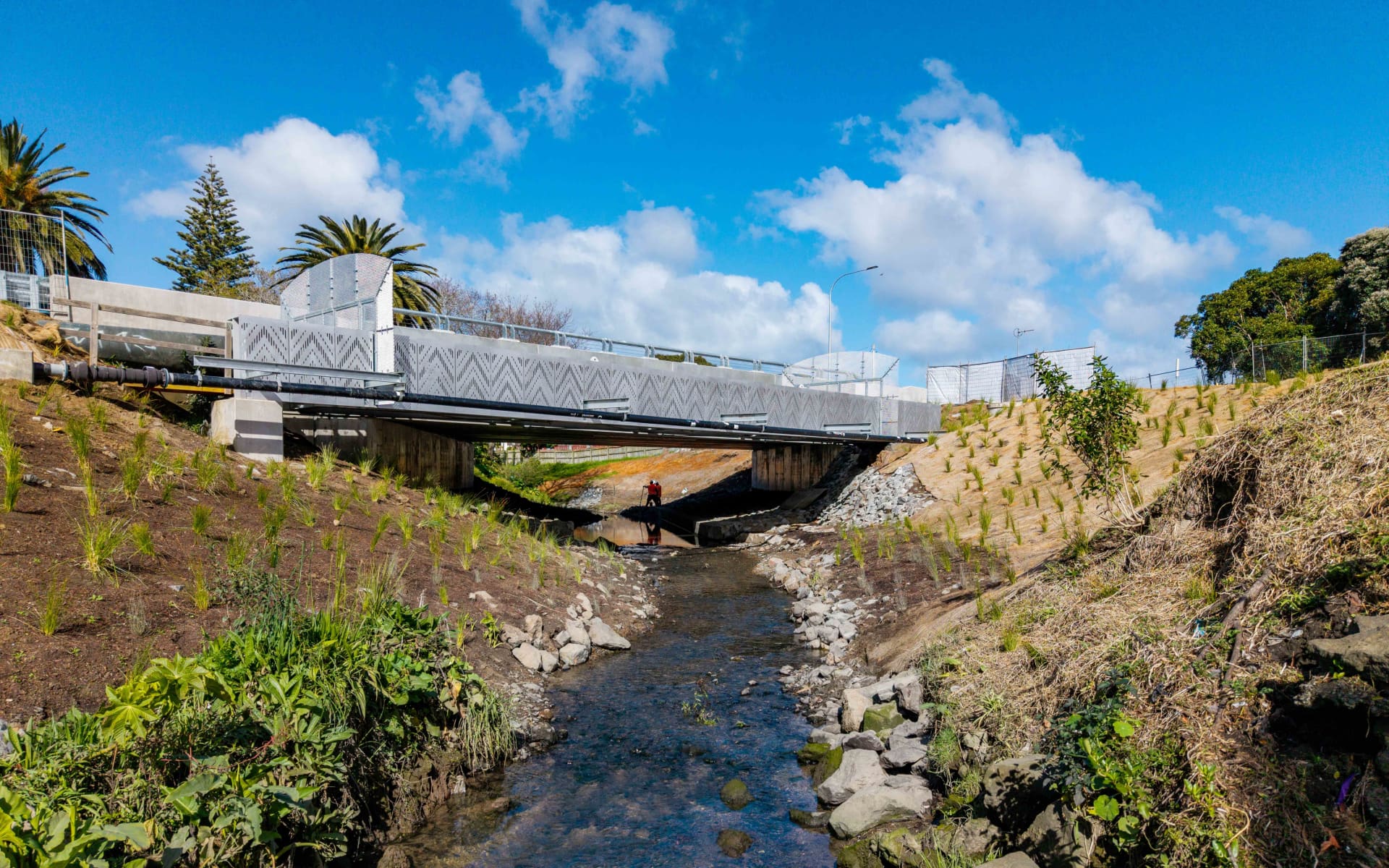
A newly restored and planted Te Ara Rata stream running beneath a new bridge on Walmsley Road in Māngere. Image credit: Auckland Council.
Making Space for Water has a 30-year project horizon, so there’s lots more to do, and hopefully the mayor’s recent call for central government to ‘step up’ on climate adaptation support in his pre-election manifesto will help us collectively keep up with the challenges to come.
Active modes rewarding investment – with patience
Following years of contentious discussion over its cost it’s great to see that Wellington’s Te Ara Tupua shared path, linking the capital with Lower Hutt, has seen heartening uptake in its first six months. Notably, this is over winter:
More than 250,000 pedestrians and cyclists have used the new shared path between Petone and Ngauranga in Wellington in its first six months.
Figures released on Wednesday by the New Zealand Transport Agency Waka Kotahi (NZTA) show 116,575 pedestrians and 133,572 cyclists have travelled along the route since it opened in May.
Built atop a seawall protecting State Highway 2 and the rail corridor, the 4.5km Ngā Ūranga ki Pito-One section of Te Ara Tupua cost the government and local councils $348.7 million, forming part of the 70km Great Harbour Way/Te Aranui o Pōneke.
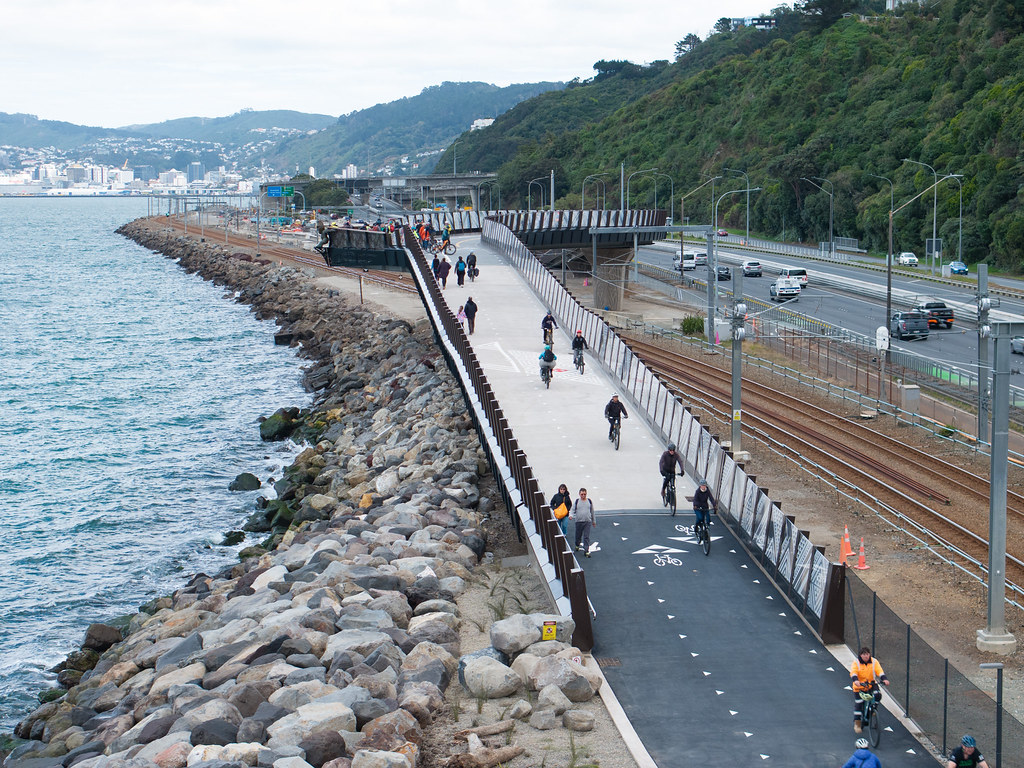
Opening day of Te Ara Tupua, Wellington, 16 May 2026. Image credit: Waka Kotahi/ NZTA
You’d think maximising the value of major projects like Te Ara Tupua by plugging them into a safe urban network would be a slam-dunk in cost-conscious times. So it’s unfortunate that some Wellington councillors and Mayor Little are actually moving to downgrade and disconnect existing cycleways, as highlighted by Cycle Wellington.
Culture war has also temporarily gotten the better of common sense in New Plymouth, with district councillors voting to demolish a near-new on-road cycleway. NZTA, which paid $3.8 million to build the cycleway in the first place, has to approve any removal but very understandably won’t be funding it. Which means that if this goes ahead, New Plymouth ratepayers will be on the hook for an extra $300,000 outside current budgets – and potentially another $1.6 million for resealing the road if it’s damaged in the process. Let’s give the last word on this one to a local:
[North Taranaki Cycling Advocates Group member Scott McWilliams] said the councillors would have to have “rocks in their heads” if they voted to pull out functioning infrastructure and risked making New Plymouth a laughing stock.
Meanwhile… we’re seeing the value of staying the course in Auckland, with impressive numbers of people riding into and out of the central city this year. This is likely encouraged by fuel prices, but certainly not possible without safe and connected infrastructure. Of course, there’s still more we can do across the region – better, faster and cheaper – as Auckland Council takes up the reins on cycling improvements from AT this year and next.
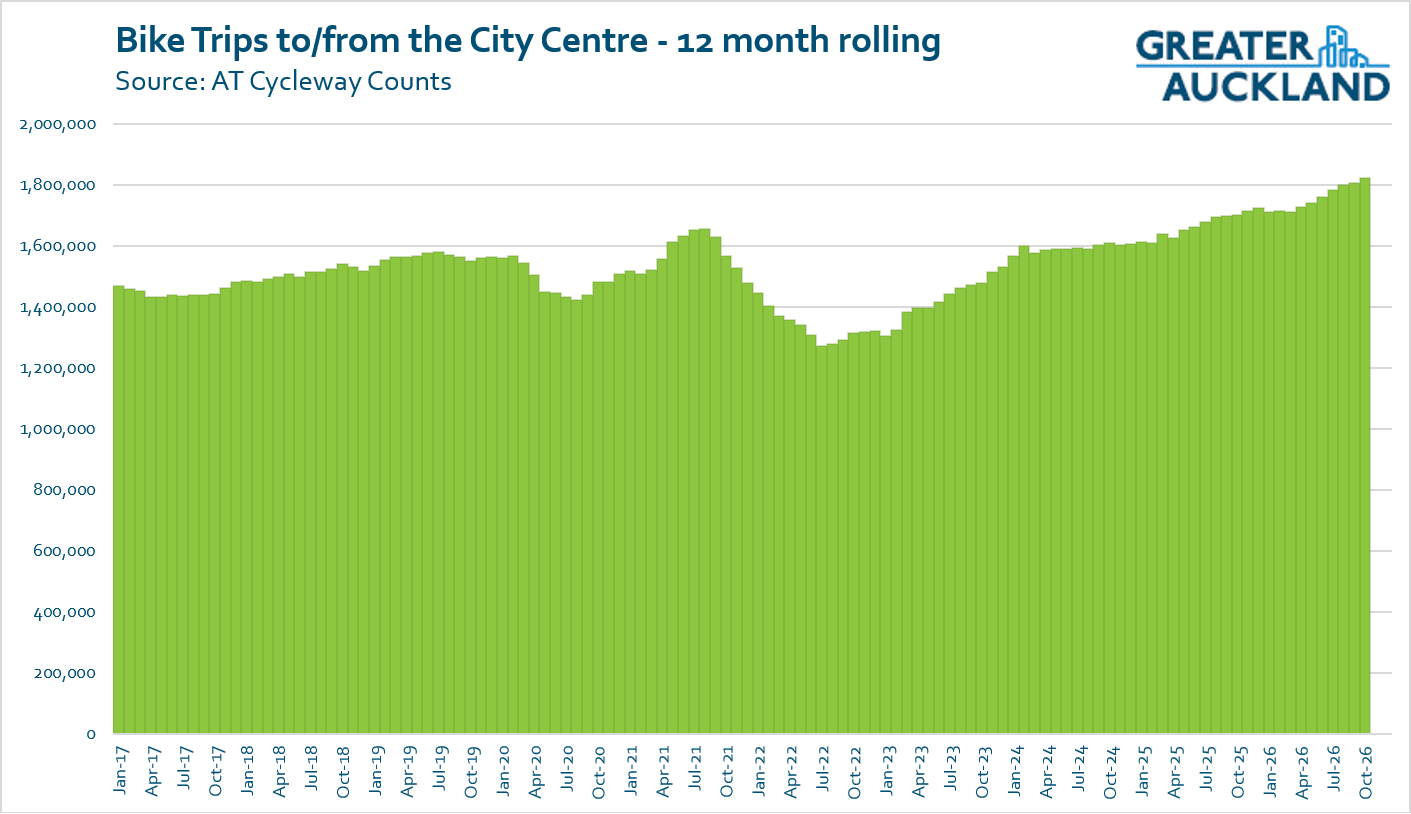
On the up and up, more than ever before! Stats by Auckland Transport, chart by Greater Auckland.
A trans-Tasman take on the CRL
We shared an analysis of Sydney’s new metro system last week, and turnabout’s fair play with this video examining our own City Rail Link, highly endorsed by Patrick Reynolds:
“A very very good history, summary, and analysis by a visiting Australian rail tuber, even down to the pronunciation. Useful feedback too for Auckland Transport. Always good to get an outside view. Respect.”
Nobody’s a winner in parking standoff
The Spinoff’s Hayden Donnell presents a fascinating look at an unhappy situation for two businesses sharing a carpark in Manukau. It’s all the more poignant for the lack of usual neighbours-at-war animosity, with everyone involved coming together to paying the costs of autodependency and the brutal maths of car storage:
It felt like [Tile Deals co-owner Maha Deep] should just sell the supermarket some of his unneeded parks. But he wasn’t keen on that solution. He was experiencing visions of an ever-encroaching tide; an endless stream of cars from which there would be no relief. “Even if I sell them five parks, they will take 10. There’s no limit. Five is not going to help them. They need the whole site,” he said.
Instead he’s left paying people to stand outside his store every single hour it’s open, telling supermarket customers to go away. He’s put up signs in every available location; at both park entrances, outside his store, by the parks themselves. The supermarket is doing the same to avoid upsetting its neighbours. Fifty car parks, endless expenses. Everyone unhappy, together.
This could be us: light rail edition
Timely food for thought as we ponder what’s next for Auckland, post-CRL: Helsinki has added two new lines to its 122-kilometre urban light rail network. Not only were they completed ahead of schedule, the big points of excitement are (drumroll) public transit and pedestrian-only bridges:
A very long tramway and pedestrian bridge, with 1.2 km the longest in Finland, has been open to the public (pedestrians) already since April 2026. It is just 155 meters longer than the previous longest bridge in Finland, the Raippaluoto bridge on Korsholm close to Vaasa. Private cars are banned, but emergency vehicles can use the bridges. The three new bridges combined stretch is 1.93 km.
… The event attracted huge interest from locals and visitors alike; the crown bridges connection has been marketed as the most beautiful tram route in the world. It is indeed very scenic, as it travels on the bridges and shores towards the islands. It is believed to attract tourists as well.
We bet it does.
In Copenhagen they’re also celebrating the return of light rail to their metropolitan area after 50 years’ absence – drink it all in with this video tour of their new network, opened in August:
This could be us: NYC takes cars off Broadway
From Architectural Digest on YouTube, reclaiming one of the busiest streets in New York City for people:
Architect Michael Wyetzner takes Architectural Digest on a walking tour of Broadway, exploring how New York City is making one of its busiest streets more walkable by prioritizing pedestrians over cars. From traffic calming around Times Square to pedestrian plazas in Herald Square, discover all the ways NYC is reclaiming space for people on foot.
Solving severance beyond people
When it comes to highways, the struggle to get over it is universal – and now recognised on monumental scale with the world’s largest wildlife overpass opening in California:
The sounds of birds provided fresh evidence that creatures are already utilizing the structure—which crosses U.S. 101 and an adjacent frontage road around 35 miles (56 kilometers) northwest of downtown Los Angeles—prior to its formal Dec. 2 opening ceremony.
Only two weeks prior, motion-sensor cameras recorded a single coyote, thought to be the first mammal making a safe passage. Shortly after, three young coyotes were filmed playing under the 10-foot (3-meter) sound walls lining the span.
“They don’t care about ribbon cuttings,” joked Pratt, president of the nonprofit Wildlife Crossing Fund.
On the smaller but no less essential end of the infrastructure scale, enjoy this wonderfully ambient video replay of Christmas Island’s annual red crab migration earlier this week. Inspiration for cracking on with Auckland’s level crossing solutions?
And for a more tailored, individual approach to all-species traffic management, Tasmanian authorities dealing with the annual disruptions and damage caused by increasingly confident social media star Neil the Seal have issued a cross-agency Neil the Seal Management Plan:
Neil, a male southern elephant seal born in southern Tasmania in 2020, has become a well-known presence through his regular haul outs in residential and recreational areas. His recurring interactions with communities have highlighted the need for a coordinated, transparent and consistent management approach.
This Management Plan provides a framework for managing Neil during his residency periods in Tasmania. While developed specifically for Neil, the principles, governance arrangements and management approaches may also inform the management of other resident or long-stay elephant seals where appropriate.
Lighting up the weekend
Ready for the run-up to Christmas? Fight any early signs of bah humbug with this Saturday’s light-up ceremony for Te Manaaki, the already iconic downtown Auckland Christmas tree.
The festivities commence from 7.30pm in Te Komititanga on Lower Queen Street (outside Waitematā Station). Bic Runga will headline the musical magic as Te Manaaki is illuminated. A lovely way to cap off a day or afternoon in the city.
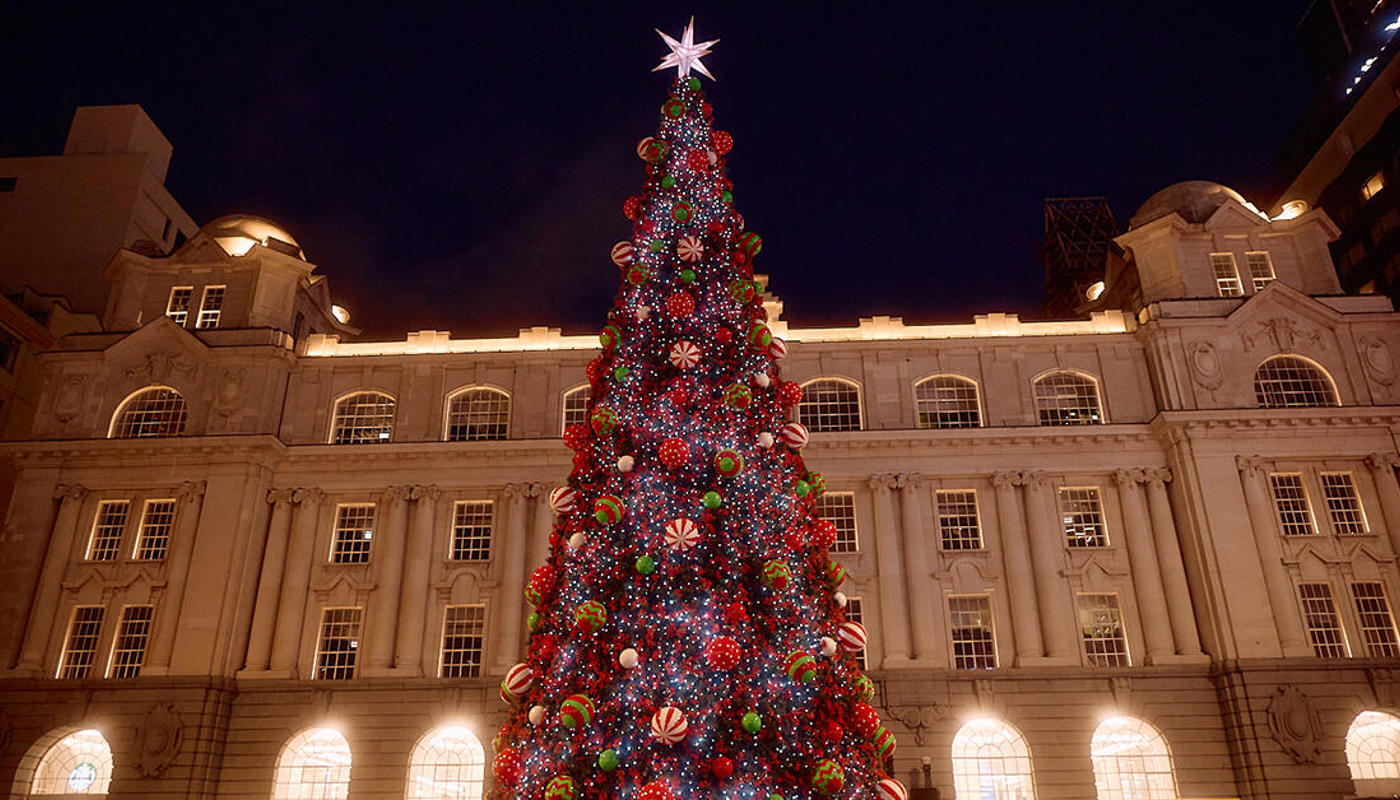
Coming soon to Te Komititanga. Image credit: Discover Auckland
That’s it for us this week – have a great weekend and see you next week!

 Processing...