Just as voting began in the general election, Mayor Wayne Brown issued an updated Manifesto for Auckland, setting out his expectations for the city’s relationship with the next government, whatever form it might take.
After an initial flurry of coverage, the manifesto got lost in the clamour. But now – in the wake of an inconclusive outcome at the polls – there’s plenty of time for all parties to chew over the Mayor’s proposition, at their leisure.
We have least three weeks while we wait for the special votes to be counted, and then likely several more weeks beyond that while negotiations take place.
So it’s a prime moment to shine a light on hopes for Aotearoa’s largest city. Which, as the Mayor likes to remind people, is home to a third of the population, and has given him more votes than any member of Parliament.
A bit of background
Brown issued a previous manifesto in 2023, days before that year’s general election. It covered similar territory, building towards a call for an “Auckland Deal”, looking to codify something more like a partnership of equals between the supercity and Wellington. (Notwithstanding that “Wellington” is often represented by Auckland-based MPs.)
The inaugural Auckland Deal, for what it’s worth, arrived at last in April this year. We say “for what it’s worth” for two reasons:
- Crucially, unlike overseas examples of city deals, the Auckland Deal comes with no money from central government, nor a clear and agreed-upon devolution of powers to the local level.
- The deal was swiftly followed by election-year moves from the capital that overrode the spirit of the arrangement, which the Mayor rightly continues to call out.
So, this fresh manifesto is a stake in the ground – albeit a largely rhetorical one, frustrated by a lack of budget and decision-making power.
The key point of the manifesto – and the Mayor is clear on this – is that Auckland Council must push back against the power imbalance with central government, especially when it comes to urban form and transport.
And it’s fair to say that no Mayor has fought more firmly on the supercity’s behalf against (to use the vernacular) dumb sprawl and even dumber motorways.
So, we commend his fresh manifesto for putting these two crucial issues at its heart, a statement of what matters for Auckland heading into the second quarter of the twenty-first century.
Are there a few omissions and Mayoral quirks in the document? Of course. But overall, it sets a strong tone and a clear framework for discussions with whatever flavour of government we get. Let’s take a look at the key sections.
The vision for Auckland
What’s good for Auckland is good for the country, says the Mayor in his introduction to the manifesto, and he praises life in the supercity:
When Auckland succeeds, New Zealand succeeds. We make up around 40 per cent of the country’s economy; we generate the most ideas and hold the most capital, we welcome the most international visitors, and connect New Zealand to the world through our airport, port, universities and businesses. We do all this in the backdrop of some of the world’s most stunning harbours, ranges and coastlines; we’re the best place to live, work and enjoy life.
There’s a quick victory lap on Council’s recent work, sharing credit with central government…
Over the past two terms, the council and I have shown what can be achieved when the government works with us. We’ve taken back control of Auckland Transport, protected our water infrastructure, delivered a $2 billion storm recovery package that removed unsafe homes and built physical resilience directly into our critical infrastructure through our Making Space for Water programme, removed transit visas for Chinese nationals, fixed earthquake and construction liability rules, established the Auckland Future Fund, secured the New Zealand Institute of Advanced Technology in the heart of Wynyard Quarter, Auckland’s innovation precinct, built our first of many Browny’s harbour pools and signed New Zealand’s first Regional Deal. We have been busy.
…followed by the call to action:
Now we need the next government to get on board as Auckland takes the next step.
So, asks Brown, how do we get ready for two million Aucklanders? He wants central government to come to the table on maximising transport investment, supporting growth in the right places (with costs fairly shared), and growing the economy. And this requires a newer – and better – Auckland Deal:
Currently, Auckland is still governed as if it were just another council and too many decisions that affect our city are made in Wellington, or in an election campaign, despite the Auckland Deal. That’s why honouring and improving the Auckland Deal and funding its priorities is a bottom line for me. It will also be of great benefit to any incoming government.
1. ‘Build a better, faster, cheaper transport system’
The Mayor’s priorities start with transport, because how our city moves shapes so much of what else happens. The public success of City Rail Link has rapidly shifted the debate towards “what’s next?”
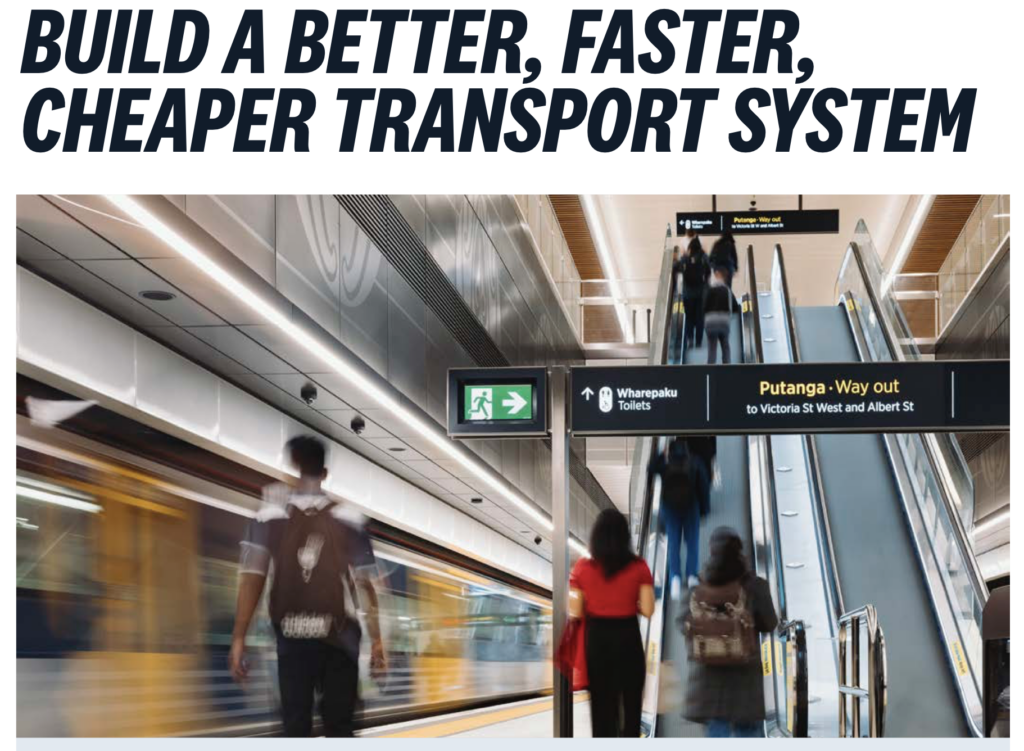
So what’s on the Mayor’s menu?
Rail
To get more benefit, more quickly, from the rail system, the Mayor calls for more government co-investment in additional trains, station upgrades and level-crossing removals. He also calls for a review of KiwiRail’s track access charges ,which “have risen from $25 million to $96 million since 2017 [ – ] this is unsustainable.”
Roads
How to get more out of the roading network? The Mayor’s favoured strategy of “time-of-use charging” (decongestion charging) returns from the 2023 manifesto. The ask: it’s time to finally get on with it.
Decision-making
Brown’s concerns over transport focus on empowering Auckland further, under the Auckland Regional Transport Committee set up under the Auckland Deal in April.
In particular, he wants to see more teeth for the Committee’s 30-year plans, backed by funding; plus oversight of ‘megaprojects’ and ultimately the entire regional network of roading, motorways and rail.
- Commit to investment that makes the most of CRL by co-investing in new trains, upgraded stations, and level crossing removals.
- Progressively shift state highways and the rail network to Auckland Council as one single point of control of the region’s transport network.
- Build on the new Auckland Regional Transport Committee model by cutting the apron strings and move towards central government bulk funding of transport in Auckland, rather than the cumbersome National Land Transport Fund process.
- Work with Auckland not against us – involve Auckland meaningfully in key infrastructure decisions.
- Say no to more government megaprojects without Auckland Council in the room – the future of the additional Harbour Crossing, the Roads of National Significance and the Avondale Southdown rail link must be decided by the 30- year plan.
The Mayor’s call to rein in megaprojects and give Council a seat at the table includes this unequivocal statement:
We will no longer accept a government agency or party committing to roading projects that come with an unreasonable cost for little benefit to Auckland.
The example offered is a bugbear of the Mayor’s (and ours) – the blown-out and escalating cost of the Warkworth to Te Hana motorway project. The Manifesto calls the project’s cost outright unacceptable in exchange for a seven-minute travel time reduction for users, a theme the Mayor repeated on air with RNZ’s John Campbell.
Given we believe there’s much worse news to come on that project, we firmly agree.
We also agree re beefing up Council’s role in regional transport decision-making. In April, we flagged concerns that the Auckland Deal didn’t include funding commitments, and its transport provisions – headlined by the Mayor as ‘taking back control’ – actually ceded more control to central government.
The new Manifesto acknowledges this reality.
But will the next government be receptive to a call to devolve more transport funding to Auckland? Especially if it includes the kind of billion-dollar projects that tend to be prestige exercises and/or election promises for central government?
What’s not in the picture?
Despite falling under the Mayor’s ‘better, faster, cheaper’ rubric by virtue of their strong cost-benefit ratio, cycling and active modes don’t get a look-in.
Seeking support on this from the 2023-2026 coalition government might have felt futile. But governments change, and what’s a manifesto for, if not keeping your eyes on the prize?
It’s a notable omission for a Mayor who’s otherwise a loud champion of commonsense, affordable solutions for Aucklanders. As we always point out:
- The citywide cycle network is the cheapest network to complete to minimum viable standard
- Combining this with road renewals is a brilliant opportunity for efficiency and value-for-money
- Once the minimum viable network is in place, it offers real cost-of-life savings for more residents
- And it’s only by investing in viable alternatives to driving, along with more compact land-use, that the city can meaningfully address congestion for drivers – and what congestion is costing us.
A transport manifesto that doesn’t make space and budget for bikes is doing a major disservice to rate-payers and to everyone who drives. The Mayor should be looking towards peer cities (and their city-deals) on this one.
2. ‘Support growth in the right places’
Sprawl is firmly in the Mayor’s sights here, which is good. He reiterates his 2025 reelection refrain: we need to “build a quality, compact city rather than the country’s biggest suburb”.
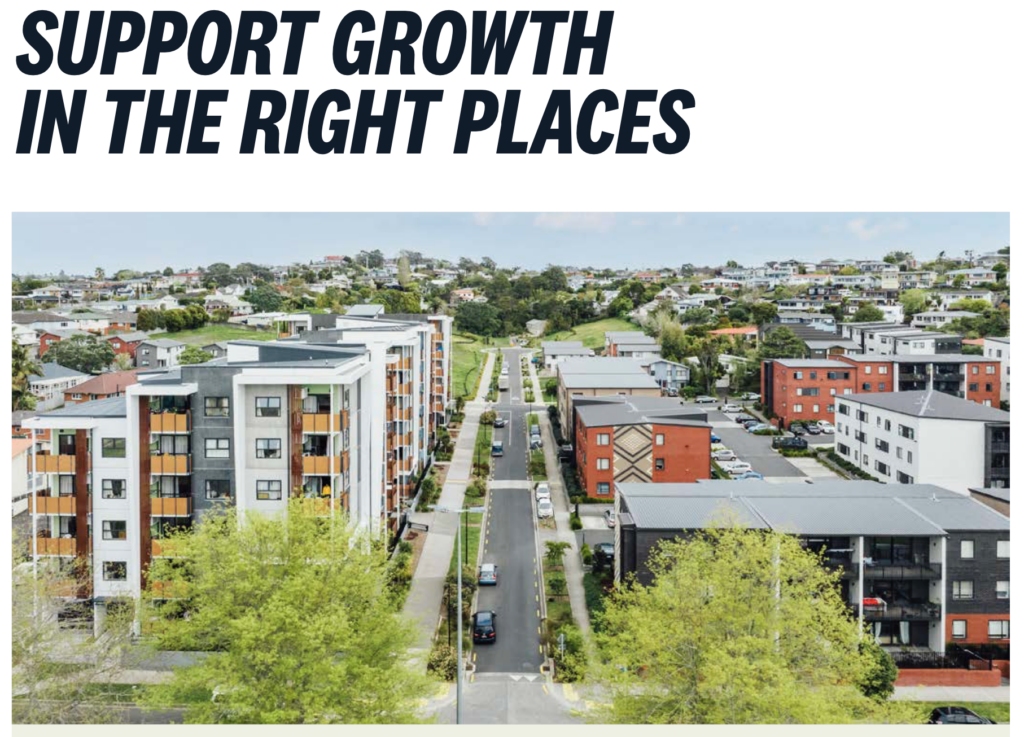
Some of the solutions the Mayor offers:
- Match Auckland’s commitment dollar-for-dollar to assemble land in priority development precincts like Maungawhau to Morningside and the city centre.
- Give Auckland greater powers under the Urban Development Act and Public Works Act to fund, finance, and deliver urban renewal.
- Remove greenfield housing projects from the fast-track system, commit to no ratepayer subsidies for unplanned greenfield developments, and ensure growth pays for all the costs it creates.
- Make private water and wastewater systems subject to regulation the same way that public systems are through Taumata Arowai and the Commerce Commission.
- Agree to integrate Plan Change 120 (once finalised) into the new planning system, rather than making Auckland start a completely new plan all over again.
- Commit to no more forced plan changes during your time in government.
The focus is on giving the city more powers to rationalise land use, and more resources to get cracking on urban renewal – as well as ways to ensure developers shoulder their fair share of costs.
Removing greenfields from the fast-track system is a clear nod to the stoush over the Delmore housing development at Ōrewa, which requires wastewater to be trucked away. (That project was approved over the objections of Council and Watercare, prompting the Mayor to call for a pause on fast-track greenfields projects back in August.)
3. ‘Support Auckland’s global economic drive’
Boosting tourism and tech innovation feature in this section, with calls for central government to adjust fiscal, investment and immigration settings to help generate more local jobs.
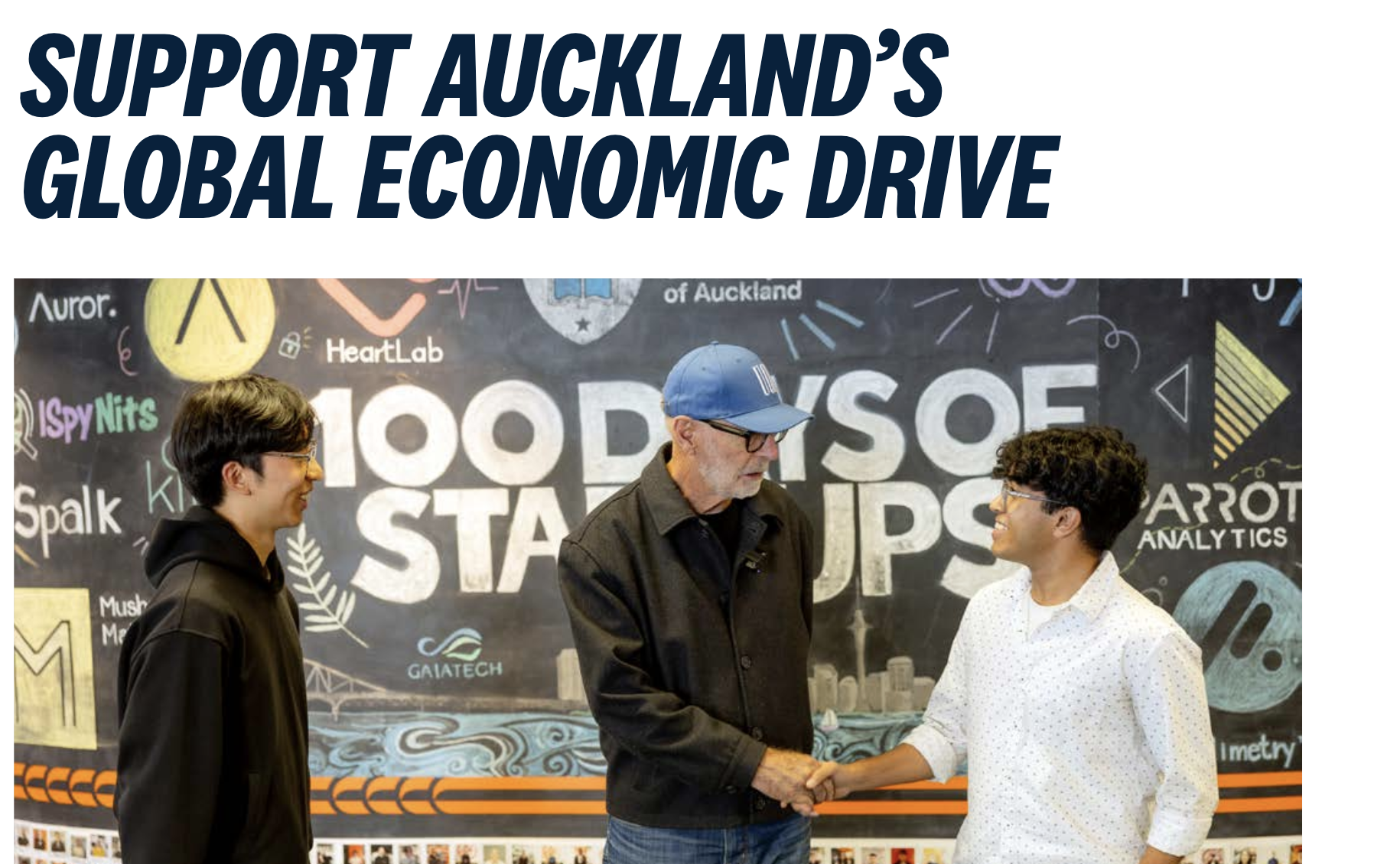
The most immediate request is for ‘an enduring and sufficient visitor levy or tourism dividend’ for Auckland, effectively a rebirth of the proposed ‘bed night’ tax which was knocked back by central government last year, in place of tweaks to distribution of the nationwide International Visitor Levy.
The Mayor also wants nationwide changes to how short-term rentals (AirBnB and the like) are recorded and registered, so councils can set and collect appropriate rates.
There are also calls for “special economic zones” (SEZs) (a la Shenzhen?) to be investigated in target areas “e.g. Wynyard Quarter, Newmarket, Henderson, East Tāmaki, Grafton-Parnell, Manukau, Drury and Glenbrook”.
Plus, a call to get on board with an Auckland plan to boost the city centre population – and crucially, to ensure it’s well provided with parks, facilities, affordable apartments, and schooling, with a city centre school as an immediate priority for Auckland Council to lead on.
4.‘Keep cutting stupid rules’
Here, the Mayor leans into his public image as a ‘friendly grump’ focused on commonsense fixes, and gets his scissors out for red tape.
 It’s a grab-bag of topics – pushback on the proposed rates cap is particularly important.
- Make sure consenting focuses on building good buildings, not arguing over urban design and landscape architecture.
- Sort out FENZ and the overzealous fire safety rules that make it harder to build things in the city centre.
- Fix the Dog Control Act to help Auckland manage the significant roaming dogs problem to keep our communities safe.
- Remove government exemptions from paying rates so Wellington pays its way like every other property owner in the city.
- Should a rates cap become legislation, provide greater flexibility for councils to deliver what their communities need and provide exemptions which sit outside normal council operations for items such as applied, local targeted rates (including those collected for BIDS), funding for regional amenities and all other legislated costs which councils have no control over.
- Modernise the costly and unpredictable revaluation process overseen by the Valuer General and make appropriate legislative changes.
- Let Auckland set its own parking fines – national consistency doesn’t work for us because we’re not Horowhenua (wherever that is).
- Amend or repeal the Auckland Regional Amenities Funding Act and outdated cultural legislation which was established long before Auckland Council and replace with a sustainable and fairer model to fund these organisations and facilities of national significance.
- Sort out the mess of legislation that governs traffic control by creating one single comprehensive legislative framework to make it easier for Auckland to manage traffic signs, regulations and signals.
5.‘Don’t forget about resilience and the environment’
Rounding out the document, the Mayor’s prescriptions for the environment feature some worthy and timely requests, including: bans on bottom-trawling in the Gulf, protection for harbours and waterways, and predator management.
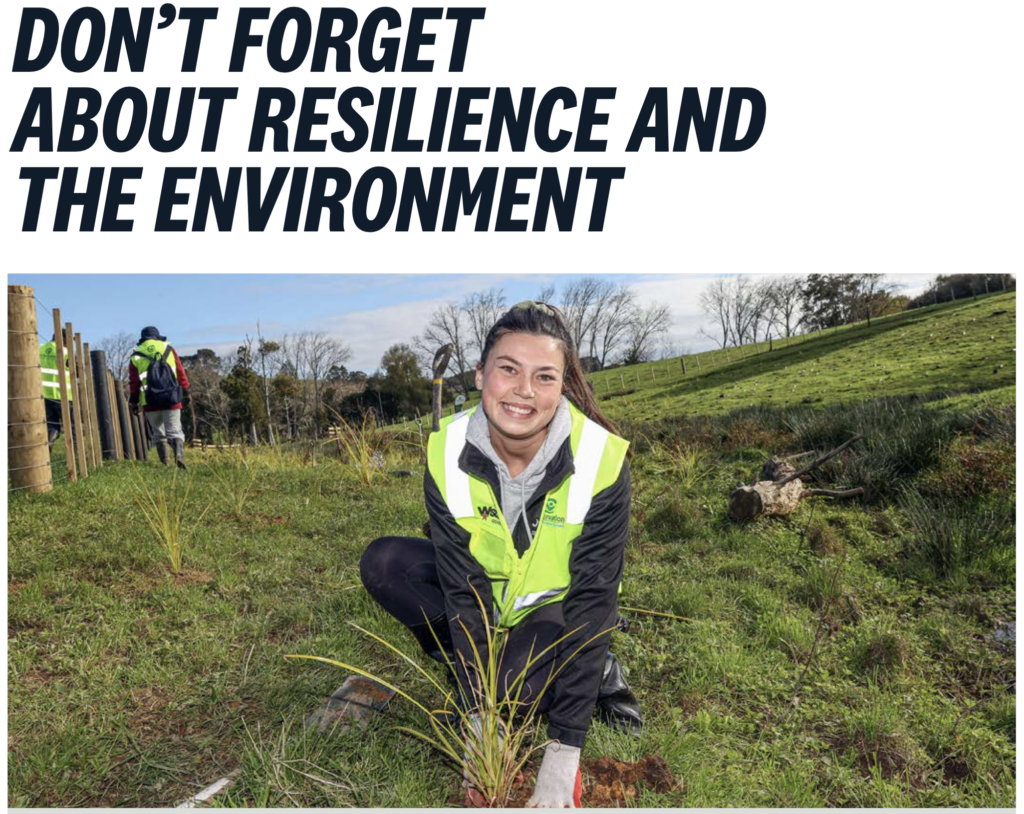
Support for climate adaptation is the biggest call, with a request that central government ‘stand with Auckland’ on managing costs. That includes ‘[developing] a real National Adaptation Plan with funding arrangements that ensure ratepayers are not the last insurer for when the worst happens.’
The fast-track gets another serve, with a request to halt any projects being rapidly approved in flood-prone areas.
There’s also a mention of AI, with a request for a ‘cross-party response to the AI boom’ – specifically in terms of Auckland’s vulnerability to the costs associated with AI data centres.
There is no mention of emissions; striking from a Mayor who generally takes pride in telling it like it is.
Political responses so far
The manifesto was clearly timed to draw responses (and ideally, support) from political parties on the campaign trail.
The Greens responded quickly and positively, noting ‘an enormous amount of alignment on the key issues’.
New Zealand First responded with a focus on ‘wresting control’ of the rail network in Auckland, an idea they say was theirs to begin with.
ACT’s David Seymour reportedly commented that the Mayor should ‘just do his job and keep our rates down’.
Other parties looked to be keeping their powder dry, likely anticipating coalition negotiations before engaging with the Mayor on what’s next for Auckland.
Our take
When it comes to leadership, Auckland has a structural problem. Currently, the Mayor proposes and government disposes. A Mayor can only offer ideas, given that central government controls so much of the process and pretty much all of the funding.
And what little is left to the leader of our city to actually lead on then has to be got through Council.
As we noted at the beginning: in the absence of fiscal commitments, the ‘Auckland Deal’ isn’t much of a deal.
Add in central government moves like the proposed rates cap, the delays to fuel taxes (profoundly impacting transport funding), the refusal of a bed levy, and little tangible progress towards time-of-use charging… and you can see how the supercity struggles to set and fund its own priorities.
The manifesto helps to (re)set a shared vision, even if it’s not clear how much input Councillors had, or how much intentional alignment there is with existing council plans and strategies.
To give just one example, the Transport Emissions Reduction Pathway increasingly looks like a set of sensible and overdue cost-of-living strategies, not just worthy climate action. A logical thing to champion in a wero to central government, in this economy.
In any case, it’s good to see our Mayor setting out strong, clear expectations of central government. Whatever the shape of the incoming administration, may they rise to the Mayor’s challenges and his ‘faster, better, cheaper’ approach, to deliver as much good stuff as possible, for as many Aucklanders as possible, as soon as possible.
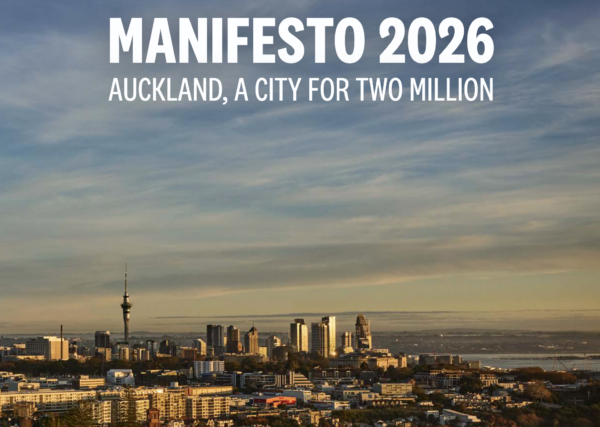
To read the manifesto, go here or click the image below.

 Processing...