The idea of charging to use roads at certain times of the day as a way to reduce the impacts of congestion has been slowly moving forward. Back at the end of September, we looked at early indications of how the scheme might work.
Now, as noted in our Weekly Roundup on Friday, Auckland Council has begun a public consultation on three options for Time of Use Charging (ToU) – also sometimes known as congestion pricing or road pricing.
The consultation runs until Friday 11 December, and asks people what they think of three options:
- Option A, a simple city centre cordon;
- Option B, a wider area also covering the city fringe areas of Eden Terrace and Newmarket, as well as possibly Parnell and Ponsonby.
- Option C, a combination of one of the options above plus the core of the motorway network.
By way of introduction to the consultation, here’s how Council describes the situation:
Time of use charging is used in cities around the world to reduce traffic congestion and improve travel times.
It is a charge to use certain roads when they are busiest. As a result, some people choose to use public transport, carpool or travel at a different time of day.
For those who can’t change their plans, they get a quicker, more reliable journey and time back in their day.
That small change in the number of vehicles on the road can deliver meaningful improvements in travel time.
They also note the costs of congestion: personal, social and economic:
It’s estimated that Auckland’s regular commuters lose an average of 66 hours each per year sitting in traffic. That’s almost three full days away from friends, whānau and the things that matter. Without intervention, this is predicted to get worse in coming years.
Those impacts are felt across the region. Aucklanders collectively lose around 29 million hours to traffic every year. Congestion makes it harder for people to get to jobs, for businesses to move goods efficiently, limits business growth and job opportunities. The cost of congestion to Auckland’s economy is estimated at $2.6 billion.
And there’s a nice video summarising things:
Before getting into the detail, I have one overarching frustration with this consultation. It’s that while there has been on-again, off-again discussion on this idea for around a decade now, there doesn’t seem to have been any real strategic communications undertaken to help inform the public of how we got to this point, why some kind of charging scheme is needed – and, crucially, the benefits it will bring.
Which is frustrating, because there is a good clear story to tell here. The key benefits of congestion charging – as proven in cities around the world where it’s a normal part of the daily picture – are twofold:
- By reducing traffic at peak times and in particularly congested places, it reduces the negative impacts of traffic for everyone, and makes life easier for those who have little or no choice of alternatives for these journeys, AND
- It also generates some revenue, which can (ideally) be invested into improving those alternatives, like public transport and active transport.
A consistent feed of communication about these two points would have helped set the stage for this consultation.
As it is, I suspect for many people this consultation on the options will seem like it has largely come out of nowhere. And that may increase opposition and general resistance to the concept.
Case in point: a couple of councillors are suggesting people treat this consultation on options as a chance to say no to congestion charging altogether – with one even saying “free or close to free public transport is probably the best alternative,” without explaining where the funding would come from for that.
(Perhaps an early example of how Council’s new self-assumed role of leading transport policy is at risk of devolving into the same old political-reckons-based chicken-egg debates?)
It’s surprising that the current consultation doesn’t even have a “how did we get here” section highlighting all of the work up to this point – including all of the other options considered so far, the Select Committee inquiry, and a deliberative democracy process. The latter, a citizens’ assembly-style representative panel, concluded:
Aucklanders are open to the idea of congestion pricing, and are ready for a constructive, pragmatic conversation about the form a scheme in their city might take.
And their recommendations included:
- Initial geographic boundary for charging zone must not be too complex
- Clear communication of benefits, particularly de-congestion benefits
Anyway, let’s take a look at the three options out for consideration and your feedback.
Option A – City Centre Cordon
As previously covered, this is the smallest and simplest proposal, and would see a cordon put around the city centre.
The city centre – especially now, with the City Rail Link – has the best public transport access in the region. However, the narrow area of focus means that charging people to enter this zone would have the least overall impact on regional congestion. Council estimates that only around 3.5% of AM peak trips would end up paying the charge.
Still, encouraging some people to change their travel options is a start, and a further 28% of trips are expected to benefit from faster and more reliable trips, says Council.
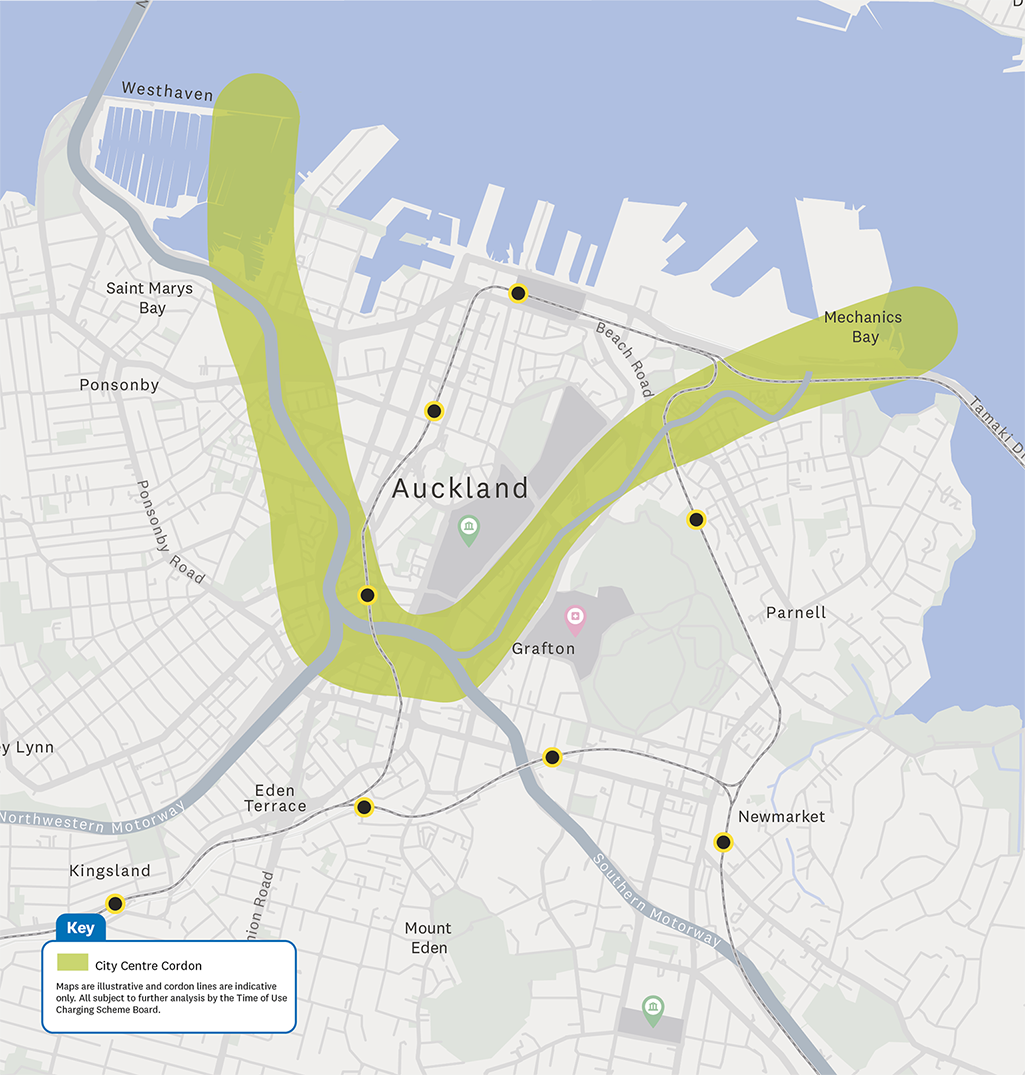
Because so few people are paying the charge, the returns are minimal:
Option A is currently forecast to provide limited net revenue. As a result, additional public transport improvements would likely be focused on providing additional capacity on routes that may become crowded due to the increase in public transport patronage.
The corridors below are where PT improvements are expected as a result.
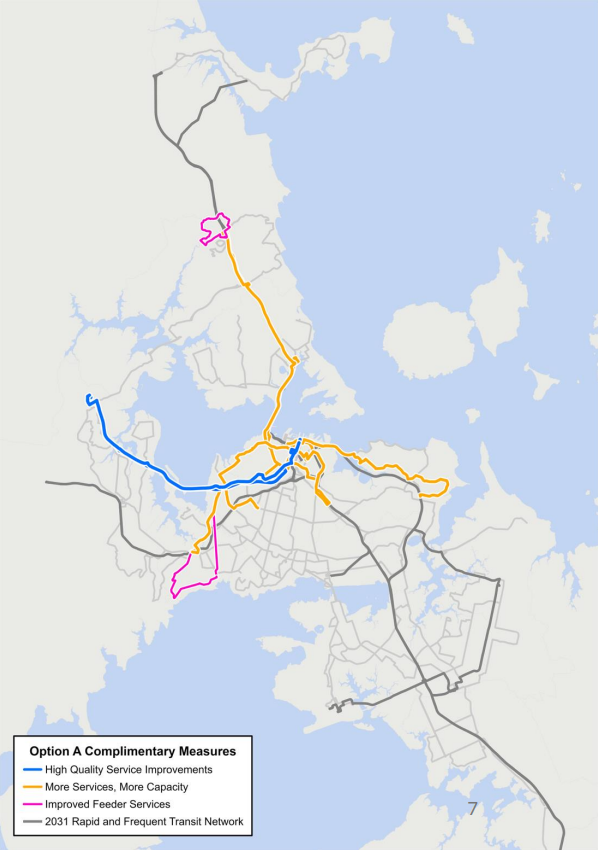 There’s some additional detail on the impacts and outcomes here.
Option B – City Fringe
This option expands on the city centre scheme to include city fringe areas. It would cost more to build and operate the system but Council says it also provides “significantly better performance than Option A“.
The number of people paying the charge is expected to increase to about 5.5%, which is expected to deliver about a 50% improvement in congestion in the isthmus and lower North Shore, with an overall 6% reduction in congestion.
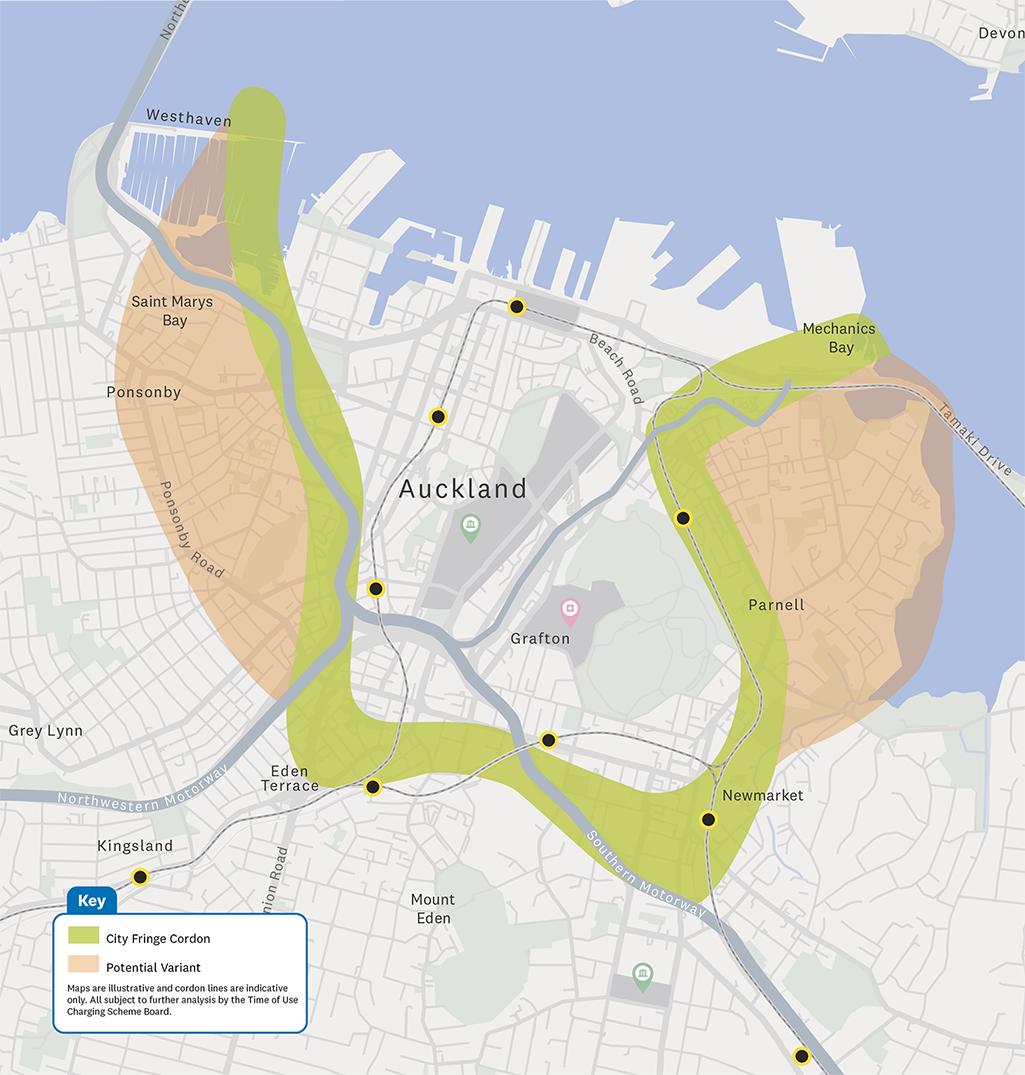
There are already murmurings from some city centre businesses that a city-centre-only cordon would be unfair to them, and so Option B would help address that.
The increased revenue from a larger scheme means even greater public transport improvements can be provided. The map below shows the “complementary measures” that could be funded via Option B.
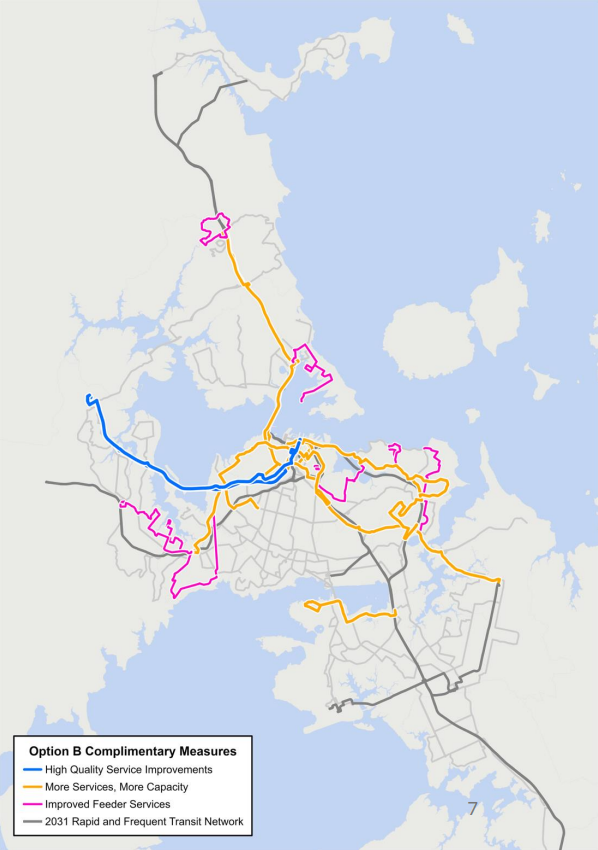
See additional information for Option B here.
Option C – City Centre and Motorways
The third and most ambitious – and effective – option for discussion takes one of the two options above, and adds in the core central motorway network to the scheme.
This would increase the number of people paying a charge in the morning peak to about 8.5%. The impact is significant, with council saying this is expected to result travel outcomes even better than we usually see in the school holidays – delivering around a 28% reduction in congestion across the isthmus and lower North Shore.
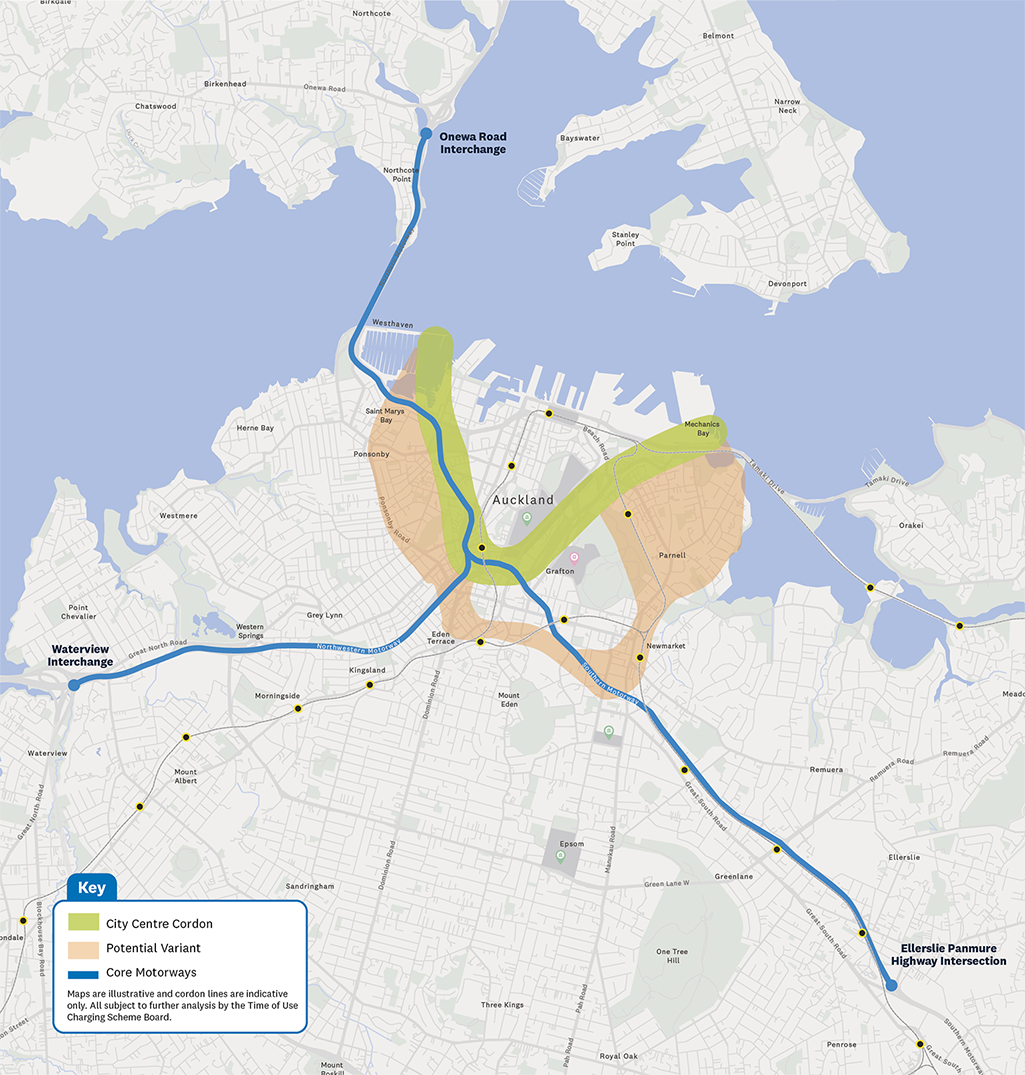
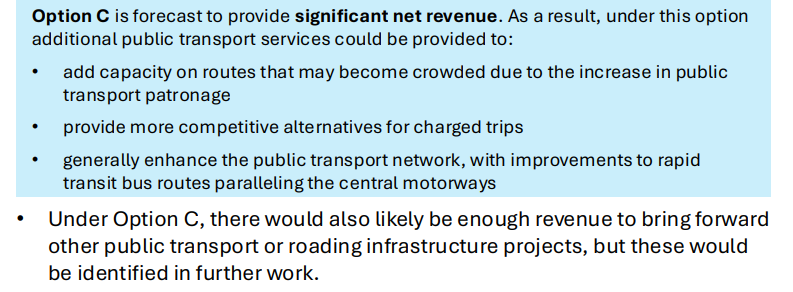
While raising revenue isn’t the main purpose of Time of Use Charging, it is part of the picture. Only Option C is expected to bring in enough revenue to deliver wider enhancements to public transit across the whole Auckland region.
This means there’s the potential to offer some really visible and aspirational results – exciting, even – in return for the coming bunfight that implementing any scheme will involve.
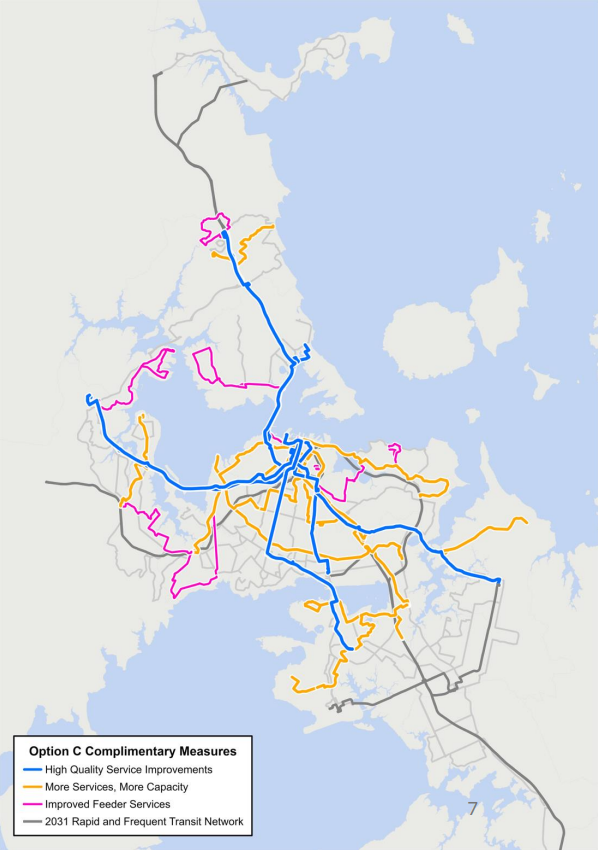
Here are the public transport network improvements that would come with Option C. As you can see, there’s more of something for everyone.
I do think Council should have made these public transport alternatives much more prominent in the discussion – especially remembering these are improvements on top of the upgraded services we already have.
While it’s not part of this proposal, we can see two additional potential benefits of Option C that should absolutely be part of the discussion:
- It could free up enough traffic on the core inner section of the motorway to allow for creating the NW Busway by reallocating existing lane space (better, faster, cheaper!), rather than having to fund, build and squeeze in a whole new busway structure alongside the motorway.
- Likewise, it could also help reduce the demand on a new harbour crossing – allowing for a smaller and more nimble design, that’s easier to fund and deliver.
Each of these outcomes alone could potentially save us (Auckland and the country as a whole) billions of dollars. Which would certainly be one way to help sell people on the merits of a wider scheme.
The additional information for Option C is here.
Comparing the Options
In the consultation materials, there’s a comparison of the key stats of each of the options. As you can see, Option C’s congestion reduction impacts are significant compared to the other two, and it also provides the most economic benefit.
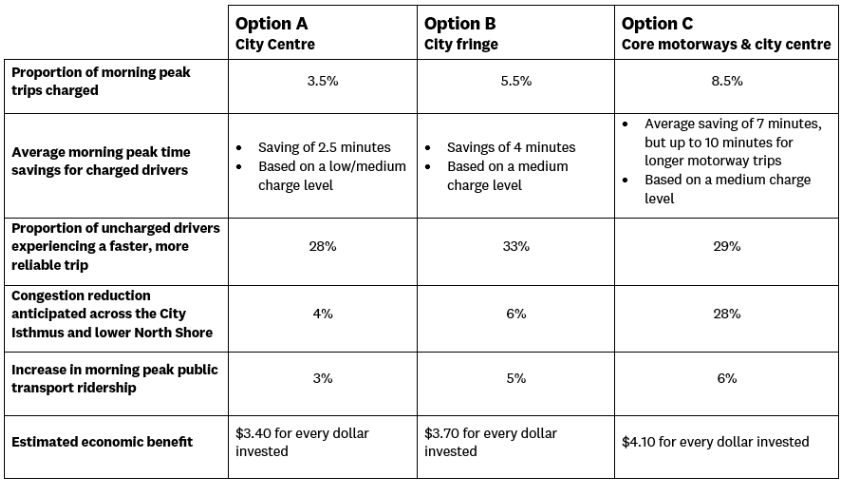 If things go as planned, Council hope to make a decision on a preferred option in March next year – which will then lead to more rounds of investigation and consultation. As such, charging of any kind isn’t expected to to start till 2030 or later.
Here’s the link to the consultation – open for feedback until Friday 11 December.
(And in case it’s not clear, we think Option C is the best one to push for at this stage – go relatively big, or go home.)

 Processing...
C is the only option that makes sense to me. But it needs to be preceded by parking and road design changes to avoid negative side effects to surrounding suburbs E.g. inducing rat runners to drive to Glen Innes and then park in surrounding streets and switching to train or bus. Our suburb is not your Park n Ride. If they mitigate this before, I will support. Otherwise I will oppose. That includes any weak promises of “we will change things in future”, “we have a plan” etc. Make the changes before the problems start.
Likewise they say option C still allows people to use the WRR for free. Won’t that just shift the congestion to the WRR, particularly the 2 lane part south of Walmsley Road which is already hammered? Will it create less reliable airport trips?
If they are going to do any part of the motorway I feel like they have to do it all. And of course that will push traffic onto arterials instead.
And in some cases Local Connector roads like Tripoli Rd. After AMETI changes lots of city bound traffic was diverted through this local road, which has around 6 schools and childcares on it. Was never part of the formal AMETI plan but was entirely predictable. Only response has been a suggestion that it should upgraded to being an Arterial itself!
They have solutions but haven’t defined the problem:
– Are they trying to fix motorway congestion or just city centre congestion?
– Are they trying to raise revenue for alternatives or reduce demand through pricing?
And then there are the flow on effects such as:
– If it is city centre only, would that make more businesses exit the CBD?
– If it is motorway too, will that create more rat running?
If it is CBD only, I feel like a much easier solution would be to add a special rate on carparks in the CBD and prevent through traffic.
Yea don’t Sydney and Melbourne have special CBD parking levies that discourage them being built into downtown office buildings?
Given the modelled congestion reduction, option C really does seem like the best option. It will also be the one with the most pushback and I am sceptical that Council members will want to spend the political capital to implement it. The value from the ring-fenced funding will take time to disperse out into PT improvements that regular people will benefit from, while the pain to commuters will be felt immediately.
If they have any desire to see this through, AC need to sell the benefits pretty hard.
“It will also be the one with the most pushback” – I think this is why city centre congestion charges tend to be chosen over a more comprehensive approach; it only shafts a small percentage of people instead of everyone.
Covids Flattening the curve + Evidence based policies crashes into “no new taxes”
Auckland cant get a bike across a bridge, NZ voted for more of the same. We have little chance of convincing the public.
This needs autocracy, not consultation.
I’m supportive of option C especially as the revenue generated will help plug the hole left by the removal of the Auckland Fuel Levy/Tax. Only problem is that if central government doesn’t like Auckland generating more money they can control, they’ll just decrease public transport funding from general taxation / NLTF to the council.
It seems a little disingenuous to me to charge for the congestion of using the motorway when there is really no alternative. For someone heading south, coming over the bridge, they’re on the motorway system and they can’t get off – unless they use Shelley Beach Road offramp, which would then clog that road up instead. Or do they want the traffic to go the long way round via SH16 ?
Busway, train, ferry
“No alternatives” lol
I guess the complicating factor is through traffic. None of those are alternatives for people passing between Waikato and Northland. It’s complicated when you have a state highway but are trying to solve a local problem.
Maybe the solution to charging for motorway use needs to involve an on/off ramp system, eg no charge if you join and exit the motorway outside of the region, and a lesser charge if joining out of the region but leaving within it?
Good thing we spent billions building a motorway bypass for Waikato and Northland traffic to use, called the Western Ring Route if they happen to drive through Auckland during peak.
Also let’s be honest, their trips are either worth enough for them to pay a few bucks, or not, but just because they’re from outside the region doesn’t give them more of a justification to use road space, if anything it gives less of a reason.
my bad I didn’t look closely at the picture – I thought the charge was going to be for the entire motorway network. If it leaves the Western ring route then there is no problem for out of region trips.
Of course another alternative would be a levy on fuel in Auckland, but this time 50c a litre or more. It would reduce congestion everywhere and pay for public transport projects, with virtually no cost to collect it.
All of the chosen solutions only tackle a tiny fraction of Auckland’s congestion.
I think the ship as sailed on fuel levies, as the vehicle fleet slowly becomes more electric the levy will pick up less and less vehicle movements.
True that.
Another approach could be having camera’s all over the place and anyone driving in congestion time gets a bill. I don’t see why the camera needs to be anything special, AI can easily process the video and find number plates. If you happen to avoid the cameras then good luck to you.
I feel like only charging for congestion in particular places will probably achieve worse outcomes.
We should have levies on fuel, but that shouldn’t be for transport, instead it should be for health.
Fair point Kraut, they could take the ferry, although that is a doubtful option for people outside Devonport. There is no train option north of the bridge – but I guess they are hoping for a massive push for people to instead take the bus. But if you are a tradie in a Ranger, trying to get to your new-build townhouse in a southern suburb, the bus or the ferry or the non-existent train are all not really options. Either it means leaving for the project at 5am instead of 7am, or (more likely) paying the congestion charge and on-charging that to the project, which does not therefore reduce any congestion, but does rain revenue.
When London introduced their Congestion charge, the immediate result was that lots of people kept off the main (inner) roads and took to the back streets (outer routes) instead. I’m just not sure that would be an option here.
That trade could take the Western ring route or pay the charge and enjoy getting to work 10 minutes earlier than today.
I still however think option B is the fairest.
A North Shore based tradesman working on a South Auckland construction site is pretty much the target market for a congestion charge.
If it drove a bit of behaviour change and made the presumably large number of tradesmen living south of the bridge and closer to the site more competitive pricewise that would be a good thing.
The idea is that they sit in traffic less. So add x NZD for congestion charge, but subtract y NZD because your commute is shorter.
I also have seen tradies on a bus. Not everybody needs to bring all their heavy tools to a large construction site every single day.
I picked B, C is terrible as it will push for rat running. I’d be fine with C if they pushed the boundary for fringe up to include the Pt Chev side of the motorway, given there is only Newton, Bond, Mountain View, St Luke’s, Carrington and GNR crossing the motorway boundary it probably is cheaper to do the big area.
The motorway boundary and local road boundary should roughly align, so for south and west the motorway boundary should be brought in to roughly match the local road boundary. As they’d still get the benefits as Spaghetti Junction would still be charged regardless.
Otherwise they’re adding more cars to local streets, E.g. if someone commutes from west to Grey Lynn, rn they’d exit at St Luke’s, while with the congestion charge they’d exit at Waterview, drive through Pt Chev, directly past the St Luke’s exit they would have taken, then onto their destination as that’s free for them.
B seems like the weirdest option to me. It feels like a punishment to people that live in certain areas just to get a bit more income from it.
Everyone that lives in Parnell gets charged to drive down the road, yet someone that drives from Drury to Albany through the CMJ doesn’t pay a cent.
Perhaps it goes beyond this feedback document, but more needs to be said about how diverting traffic via NW motorway will serve to ring extra life out of the bridge (less wear and tear; plus keeping inter-regional traffic out of central auckland).