Last week, late on Thursday afternoon, Minister of Transport Chris Bishop announced that the government had signed the contract for a Public Private Partnership for Warkworth to Te Hana.
This answers our long-running question: are they seriously going to go ahead with this?
It also leaves many more questions, which are only just beginning to be asked more widely, and answered in any kind of detail.
What will Warkworth to Te Hana cost us?
The announcement put the sticker price for the project at $3.649 billion. However, we do not yet know the total cost for the project, as there has been no mention of what the annual PPP payments will be.
As the minister said:
“A PPP is like getting a mortgage to buy a house. Rather than paying the full cost upfront, it is spread over a longer period and repaid over time.”
And, just as with a mortgage – and as we have seen with Transmission Gully, where the final bill is likely around triple the initial named price – the total cost to the public over the lifetime of a PPP will be much higher than the initial number. So, every journalist reporting on this project needs to ask what those annual repayments will be.
One number we do know: the government has provided a Crown Loan to NZTA of $1.6 billion, which leaves around $2 billion that will be financed by the contract winners.
This means if Warkworth to Te Hana tracks similarly to Transmission Gully, we could be looking at three times that $2 billion over the total contract of the PPP.
In other words, the public could be stumping up anywhere up to $7.6 billion for this road over the 25-year term. But we don’t know exactly, as the government has said nothing, and NZTA has redacted any information about the PPP financing numbers.
What’s the claim about “savings”?
In Thursday’s announcement, the Minister said the project “represents good value for taxpayers”, pointing to the “$3.9 billion Public Sector Comparator approved by Cabinet in March last year.” That’s an estimate of what the price would have been “under traditional public sector procurement”, i.e. if the government were to cover financing for all costs itself – a highly theoretical situation in any case, as the intention has always been to procure through a PPP.
So, now with the PPP price tag of $3.649 billion, the government is claiming a “savings” of $251 million.
But the thing is, because they’ve signed a PPP committing us to decades of repayments, they will almost certainly be spending billions more to achieve that claimed “savings” of millions.
It’s like purchasing a Bentley on a payment plan, then crowing about getting a wee discount on the car stereo. Not a great look for a government that’s telling everyone else to cut costs and tighten their belts.
What new information do we now have about the costs?
Funding questions aside, one of our other long-running questions was: what makes this project such a top priority that this government wants to pour all of our collective transport funding for new projects into it, for the foreseeable?
NZTA has now released a bunch of information about the implementation plan, including an Investment Case dated January 2025. Throughout, key figures and numbers have been redacted – mainly relating to anything to do with what the PPP might actually cost. For example:
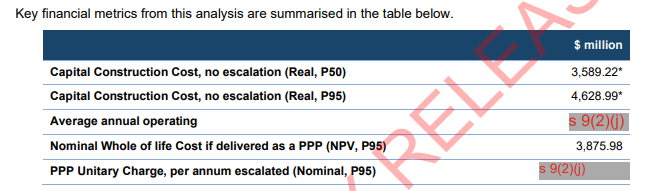
The lines in the table above were redacted under section 9(2)(j) of the Official Information Act, which is normally used to:
enable a Minister of the Crown or any public service agency or organisation holding the information to carry on, without prejudice or disadvantage, negotiations (including commercial and industrial negotiations); or
But considering the contract has now been signed, these redactions hardly make a lick of sense?
How has the project met the stated thresholds for greenlighting?
The next thing to catch the eye in the January 2025 Investment Case is that NZTA says that two of the trigger points for proceeding with the this project have been met – one being safety and related road closures; the other being traffic volumes:
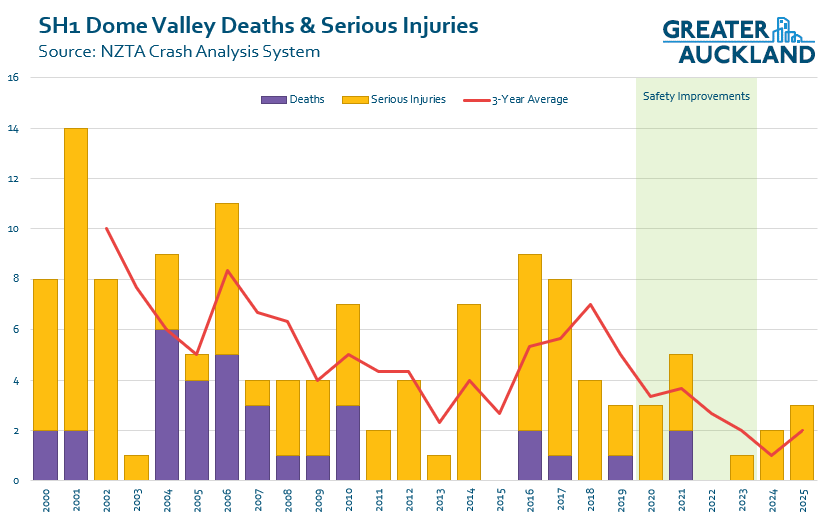
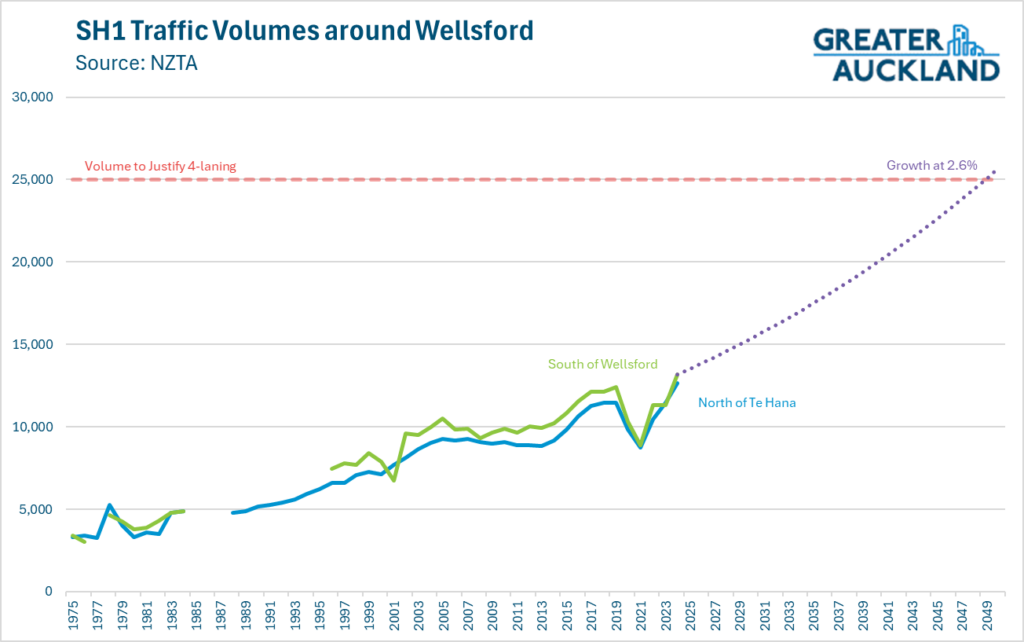
These triggers for implementation have been met, with the forecast Dome Valley DSI savings (down to zero) already exceeded in the first 18 months and the number of unplanned closures well above 100% higher than 2018 levels. Whilst current traffic volumes are not in excess of 25,000 AADT, forecasts indicate this being reached in the long term.
Let’s start with safety. Wait, so the Dome Valley safety improvements to SH1 were supposed to reduce Deaths and Serious Injuries down to zero?
Isn’t it interesting how Vision Zero can suddenly re-enter the chat, when you least expect it.
In fact, those safety fixes – carried out under the previous government between 2019 – 2022 – have dramatically improved safety, and are saving lives, as you can see on the graph below. All for the bargain price of around $90 million (less than half what’s been spent on property acquisitions for Warkworth to Te Hana, at $190 million).
However, apparently because some serious crashes are still occurring along the Dome Valley stretch, that’s a “trigger” to spend 40x as much on the safety fixes to carve 26km of an entirely duplicate new four-lane highway through the landscape.
NZTA also says the claimed trigger for reliability has been hit (i.e. how many times the road is unexpectedly closed). This is surely due largely to the impacts of extreme weather, which particularly impacts the Brynderwyns where there are very real, urgent and costly problems with frequent slips and closures. So, another question:
Why then proceed with a brand new project that, by encouraging more driving, will increase climate-changing emissions, thus increasing the likelihood and impact of said extreme weather events? Especially when the brand new four-lane expressway from Warkworth to Te Hana doesn’t even touch the Brynderwyns?
Indeed, before the 2023 election, National explicitly called out proactive resilience improvements as crucial for this part of the road network. Spending (a minimum of) $3.649 billion on an entirely new stretch of road that stops short of the truly vulnerable section is a very costly and roundabout way to (not) solve those reliability issues.
Lastly, NZTA couldn’t claim to have met the traffic volume threshold of 25,000 vehicles per day. That’s because this won’t happen until 2050, even assuming a heroic growth in traffic volumes.
So by every measure, it still makes no sense to urgently commit to spending all this money on Warkworth to Te Hana as currently designed.
And yet NZTA and the government have chosen to do so.
Running costs are the least of it
And yet it should be noted that this stretch of four-lane expressway will continue to cost us (the nation as a whole) a minimum $15 million a year to maintain and operate, forever.
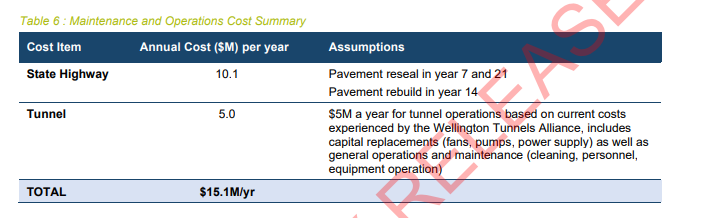
Meanwhile, the old SH1 through Dome Valley will most likely revert to Auckland Council, meaning Aucklanders will shoulder (i.e. pay for) maintenance and renewal and deal with all the issues that extreme weather damage will bring to that toll-free alternative route, in perpetuity:
No substantive upgrades to the existing SH1 are proposed between Warkworth and Te Hana due to the recently completed Dome Valley safety improvements, however given recent resilience challenges in this part of the network, additional maintenance and repairs have been allowed for in the Do Minimum costings (at $60M, and we note that the recent works following the Auckland Anniversary weekend floods was in the order of $20M).
So what about those Costs and Benefits?
The 2025 document also reveals the Benefit-Cost Ratio. Remember, this is the top secret number that NZTA and the Minister of Transport had argued could not be released, lest it put into question the government’s ability to commit to the project.
How bad could it be?
1.4
As in, for every dollar invested, this road will return a dollar forty. Not much more than break-even.
That’s 1.4 excluding Wider Economic Benefits (WEBs); rising to 1.6 if you include WEBs.
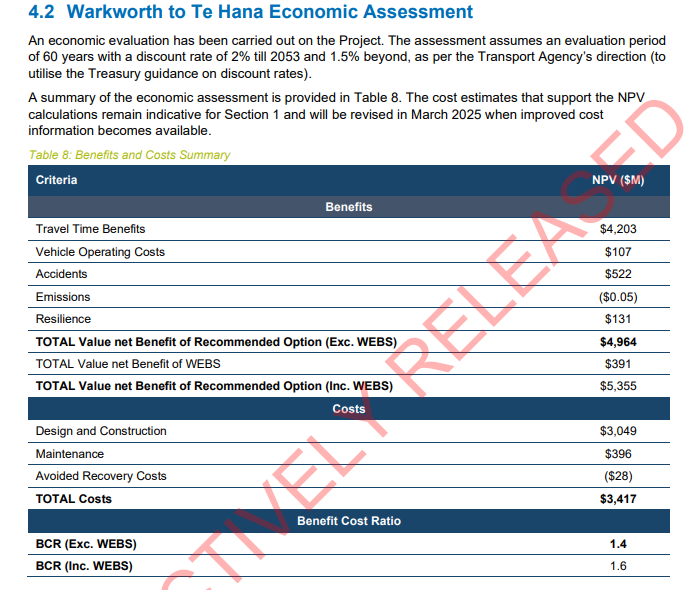
What’s striking about this calculation is that the BCR has now doubled since the 2019 business case, where it was 0.7 – even though the project has doubled in cost in the meantime.
How is this possible? It’s down to a change of calculus. A new method lowers the discount rate applied to benefits over years. We “value” more immediate benefits, and reduce their value over time through a discount rate. And in short, NZTA has changed the way it measures projects, so that more “benefits” can be claimed as time passes by reducing their “value” less over time.
This was intended to better capture the longterm benefits of investment; it’s not clear that’s what’s actually happening, nor that the full range of benefits and disbenefits are in the picture (induced demand, anyone?).
Regardless, to be effective, this method really needs to apply to all projects and options on the table… which this wasn’t.
We can also see what the BCR might look like with higher discount rates: i.e. if it were more aligned with the way projects were previously measured, claiming fewer “benefits” over time. Basically, under the old approach, the project always struggled to get its head above water, even with “Wider Economic Benefits” folded in. Thumbs on the scale?
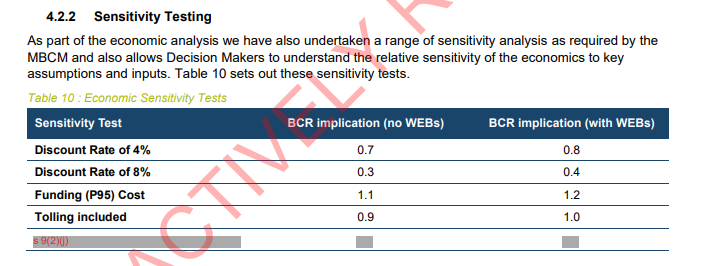
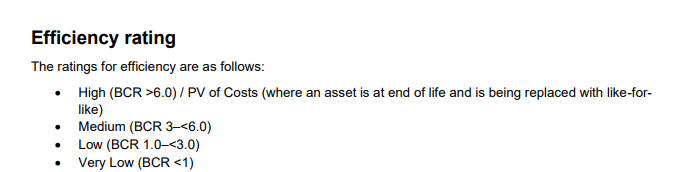
This is really not good. Remember that a BCR of less than 3 is considered low:
And note that even if you include tolling (which, as Matt noted, wouldn’t even touch the sides in terms of covering the cost of the road), the BCR for this project still appears to be under 1.
As in: a losing bet. A waste of money. The game is not worth the candle. We do not get back as much benefit as we spend.
By the way: note the last line on the image, redacted under the same reasoning as the PPP data.
Is it what the BCR would be if you took into account the enormously more expensive approach of a PPP, perhaps?
This recalls a stark point the Ministry of Transport made about the RoNS in August 2025. We can’t see what’s been redacted, but the document states plainly that the cost to deliver projects is usually higher – and the benefits lower – than forecast by business cases, meaning “a BCR of 1 may not represent value for money, if costs increase and benefits decrease.”
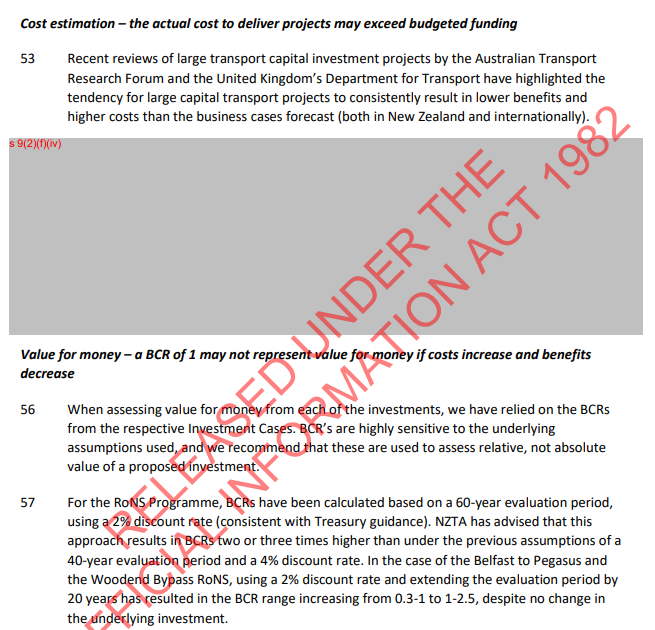
From a Ministry of Transport advice document to Chris Bishop (27 August 2025) regarding the Road of National Significance Programme
Presumably this advice fed into the decision to “reprioritise” the RoNS. But was it applied to Warkworth to Te Hana?
Because, if the cost of delivering this expressway rose above $3.65 billion and/or the benefits were lower than expected, the BCR would be less than 1, and the absurdity of using so much of our collective resources on it would be immediately clear.
Is this why there has been no transparency when it comes to the total cost of the project under the PPP? Is the government worried if they reveal how much funding is being blown on this, that the case for the project becomes untenable to the public?
The road-building juggernaut vs the government of the day: who wins?
It’s important to note that a low BCR doesn’t necessarily tank a project. It just means you’d need other factors in order to “prioritise” it – like, for example, political cover by listing it in the Government Policy Statement.
And even with a dog of a project (no offense to actual dogs), prioritising it might be understandable, if there was overriding and long-running bipartisan political will to deliver it. Maybe?
Except that in 2019, when NZTA was progressing this project – including seeking consent – it seems highly likely that they outright ignored the direction of the 2018 Government Policy Statement on Land Transport, which had an explicit strategic focus on safety, emissions reduction, value for money, and mode shift.
How can we be sure if NZTA overrode direction? It’s a strong inference, based on the Investment Quality Assurance advice re Warkworth to Wellsford from that period, which I’ve acquired under the OIA:
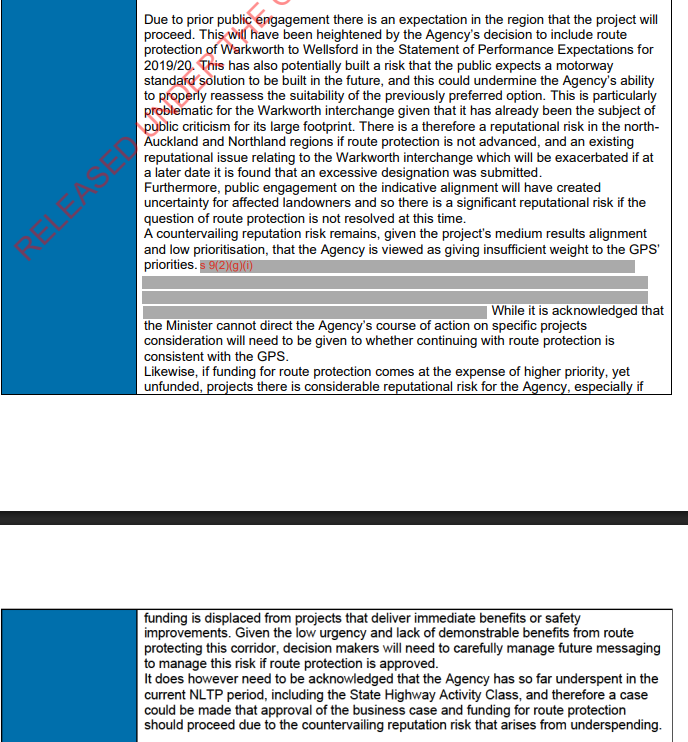
The section above says (emphasis added):
A countervailing reputation risk remains, given the project’s medium results alignment and low prioritisation, that the Agency is viewed as giving insufficient weight to the GPS’ priorities.
[REDACTED]
While it is acknowledged that the Minister cannot direct the Agency’s course of action on specific projects[,] consideration will need to be given to whether continuing with route protection is consistent with the GPS.
Want to guess what’s redacted?
The core point here is that despite political direction asking NZTA to reconsider these enormous wasteful projects, NZTA continued developing this project – for which the BCR at the time was just 0.7.
Serious questions should be asked about the actions of decision-makers over this time. Why was the political direction to reconsider low-value motorways seemingly ignored in order to continue prioritising this project, until suddenly it could be accelerated when the political winds changed?
Why this road, why now?
The question remains: how on earth did this project rise to the top of the to-do list?
Is expediency – and an upcoming election – the reason? It’s a reasonable guess: Cambridge to Piarere aside, Warkworth to Te Hana was likely the only one of the RoNS from National’s 2023 election campaign that was not just a fantasy.
But the point of a BCR as a tool is that it lets you compare options and priorities, to determine the best use of finite resources – not just money, but time, workforce, and foregone opportunities.
So, logically, a “reprioritisation” exercise of the proposed Roads of National Significance, carried out while publicly conceding that the programme as a whole is simply unaffordable and is “keeping you up at night” – would look extremely hard at that angle.
And if you compared the BCR of Warkworth to Te Hana to the other RoNS (flawed as all these projects as proposed may be), you can see it would be nowhere near the ‘best’ one to progress:
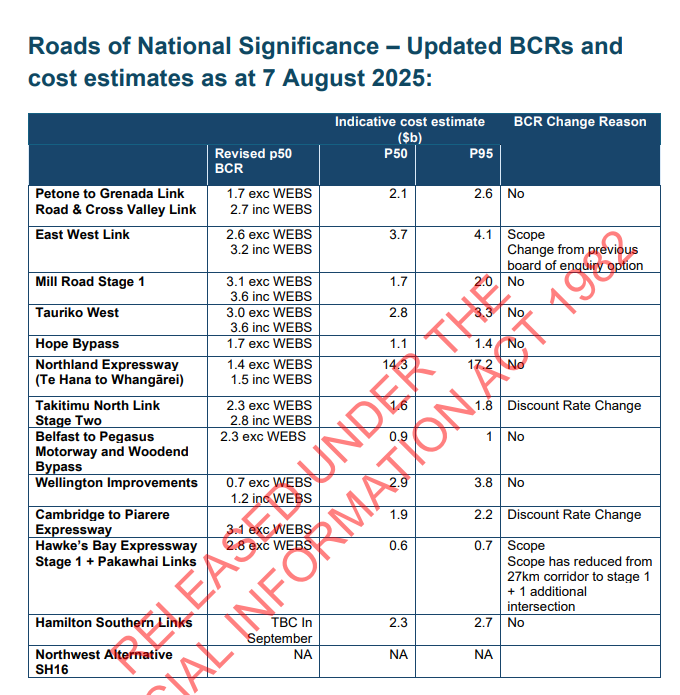
Note, this isn’t to justify the other RoNS. These projects as designed are neither affordable nor a priority as currently designed – which is why Chris Bishop has effectively cancelled most of them.
For Thomas Coughlan's article on Roads of National Significance:www.nzherald.co.nz/nz/politics/…
— Guy Body (@bodycartoon.bsky.social) 2026-07-10T23:26:39.717Z
And for a proper cost-benefit comparison and “reprioritisation”, you’d be sure to compare options and stages within each proposed project. So that, if you found a number of lower-cost options offered more bang for buck, you could choose to do a bunch of those – maybe across multiple locations – instead of committing to One Giant Project.
That’s certainly how you’d approach a household renovation, to borrow a favourite metaphor of this government – especially when working with a limited budget in a gloomy economy and uncertain climate.
You’d be looking very hard at leveraging your opportunities to future-proof any of your expenditure, the equivalent of putting in solar panels when fixing your leaky roof. And you’d absolutely want to double-check your fundamental assumptions behind proceeding with One Giant Project, versus all the other things you could do with that time and money. Right?
So, looking at the claimed upsides of Warkworth to Te Hana, the vast majority of the projected economic benefits of this investment (85%) come in the form of ‘travel time benefits’. (Meanwhile, emissions are 0%, funny that, except that this is no laughing matter.)
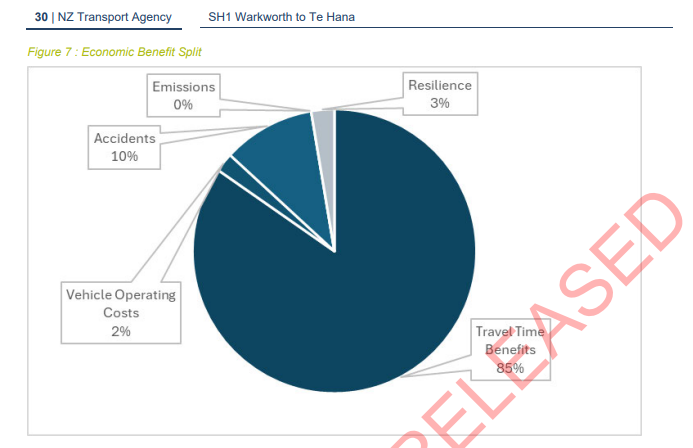
This is the part that feels like a joke. We haven’t even met the volume of traffic to trigger this project – and won’t for another 25 years, even taking at face value the heroic assumptions of NZTA. But evidently the need for thousands of ghost drivers to save a few minutes somehow seals the case that Aotearoa needs to urgently build this particular road, right now?
The opportunity costs are incalculable – but let’s try
None of this makes sense at all.
Especially when you know how much more you could achieve for road safety, resilience, and yes even travel time savings, all over the country, for $3.649 billion (and more over time).
Well, going by the sticker price, ignoring PPP cost escalations, at $140 million per km of Warkworth to Te Hana, here are a few options we could have for a fraction of a RoNS:
- 540 metres would fund the scrapped Marsden Fund for a year ($76m)
- 4.1km would fund Te Huia train service for 100 years ($5.82m per year)
- 920m would fund the entire country’s walking and cycling budget under the 2024 GPS ($130m)
- 190m would restore the recently cut arts funding for the next four years ($27m – noting that investment in live performance has a BCR of 3.2)
- 270m would fund the Auckland City Mission for an entire year ($38.8m)
- 64m would fill NZTA’s share for the community led fixes to the Hill Street intersection in Warkworth ($9m)
It’s also striking to see many folks doing similar calculations – measuring things of great value in metres of RoNS. What’s your favourite example?
My take on all this: Warkworth to Te Hana will go down as one of the worst deals a government has ever signed.
It is a badly chosen project, vastly over-scoped, and procured via one of the most expensive ways of doing it – in this economy, and in this climate. And it does precisely nothing to solve the actual urgent problems with keeping Northland connected, safe and productive.
That is, even assuming everything goes well with construction – and given the Dome Valley’s geotechnical issues, we can expect it will not be smooth sailing.
Even by this government’s own stated values, it misses the mark; and we will all be counting the cost for years to come.

 Processing...
Final question is; what would it cost the next government (if there is a change in November) to get us out of the deal?
If you really wanted to pull the middle finger on the PPP brigade, you could do what the 1st Labour government did with state housing: They used Reserve Bank credit – often called “printing money” – to fund it.
They did that in a period of deflation during the Great Depression (it’s an inflationary method of funding).
Unfortunately, as the blog points out, the project isn’t important enough for that; and there is going to be a lot of externally-driven inflation for the foreseeable future.
Still, I would love to the tears and gnashing of teeth…
Also, the construction industry in this country can’t even cost- effectively build the beloved roads, now.
A future government should look to fix that.
You would love to print money and cause inflation – hurting the poorest the most.
Are you psychotic?
Nah, that’s you James/Colah/Fassifern with your wish for this country to waste $22 billion on your personal black carpet
Probably about the same as the cost of Nicky No Boats cancelling the i-Rex Ferries via text message. To rub it in I suggest the next Minister of Finance cancel this PPP exactly the same way.
Does seem to be strong parallels, project cost has blown out to over $3.6 billion with an over-engineered scheme to future proof for traffic that wont exist for decades. The government has only funded just over half of it and left it to future governments to somehow pay off the rest from the over-stretched NLTF that has other higher priorities it should be being spent on.
Seems fair enough for the next Finance Minister and Transport Minister to apply the Willis precedent.
It is going ahead because it is more ready to start than other projects, the govt desperately want something they can use to say they are the parties of delivery in advance of the election (to balance all the things they’ve cancelled- inter island ferries etc).
Not because it is more valuable or more urgent.
A note on BCRs – these are always speculative, informed guesses, like all economics projections are founded on all sorts of assumptions, exclusions, and rules of thumb.
Much can be wrong in these foundations, and much can change over time, swans of many colours can turn up to fly through these numbers.
So just getting to 1 or there abouts is little solace. Even if we set aside both the heroic changes to the discount rates and periods (which means a project achieving 1 now is like a one at 0.3 previously), and the significant pressure on the team is under to find a helpful number (optimism bias), wise governors know the risk is too high with such a fragile BCR.
The first “price adjustment” will be fatal to such a low number. And price adjustments there will be. It will rain, materials will inflate, geology will turn out to be worse, and that’s not even getting into bigger force majueres: quakes, 100 year storms, pandemics, and these are just the known unknowns…. (All happened to Transmission gully)
Remember with this mortgage, we are borrowing the principal too – this is a 100% leveraged bet, with low to fanciful chances of working out. No financial advisor would recommend buying this asset under these terms, with these chances of coming out ahead.
I am not against investing in major infrastructure, or borrowing to do so, but especially when doing the later certainty of returning net value needs to be way way higher.
Amazing work GA but I can’t help but feel disgusted and upset when I read this. I’m from Whangarei and drive there regularly but this in no way the solution to better connecting and supporting the Northland economy. I too am puzzled how the government has reached this point.
The Brynderwyns are the problem. The trucks are the problem. Carbon emissions and fuel prices are the problem. Etc
How is saving a few minutes of travel time the problem!? And one worth billions of dollars and opportunity cost.
I guess we can go out and vote. But I’m not sure if the other political parties have expressed pushback to this road and would cancel it if elected. It would be another scrapped billion-dollar infrastructure project if they did, continuing the cycle of wasting taxpayer money with nothing to show for it 🙁
Labour has explicitly said they will not cancel any already-contracted projects. To reassure ‘the market’.
Unless there is a full 30 to 40 minutes of time saved driving from Central Auckland to Whangarei with this road going ahead, then the money should be spent elsewhere to improve the areas in need.
As a taxpayer, and living on the mainland, not only will my taxes help pay for this road, I will never see or drive on it.
Some days it will be 30-40 mins saved so there you go problem solved. Quite conveniently one of those days will be very close to the election to critiquing the road will be a bad idea.
more like 30–40 years to construct, hopefully
also by then billions of people will have died of famine, pollution, and climate change-induced natural disasters, the global economy will have collapsed, so ♀️ i doubt a society faced with apocalypse will care much about building ugly 6 lane monstrosities soon enough
Bruh the road is only 26kms long you’d have to drive over 200kph to save 30-40 mins
My bad I can’t read and also can’t delete comment
lol all good craw we all have those moments (I’m dyslexic too), next time I’ll refer directly to public holidays to make it easier
My next question is what will NZTA do about their funding shortfall because Rego has gone up, fuel keeps going up, RUCs going up, congestion charging is likely for Auckland, a toll will be needed, and they still need to fund the harbour crossing, and I kind of want to see the return of regional passenger trains within my lifetime.
And I don’t like to drive because of a not so irrational fear of crashing.
Oh, and rates keep going up because Council road maintenance bills are massive in [current year], because we now have massive road networks to maintain.
@craw: simple. No trains, no other road improvements, more potholes, less petrol tax (???), but higher RUC. Then hope for the best, have Labour raise taxes to fund anything else, blame them for higher cost of living, get voted back in, rinse, repeat.
Why is the National party ideologically opposed to railways? It was a National led government that sold NZ Railway Corporation for parts
I don’t know, but it is not a big stretch to assume that other (public) transport projects have to be killed (‘postponed indefinitely’) because there is no money left. Plus privatising everything from transport to health care and education seems to be their thing.
Maybe it’s because they don’t like mingling with the plebs and would prefer to travel in a private air-conditioned chamber
Source: trust me bro
Labour and Greens responded to our open letter, but feel free to email their Transport spokespeople and ask for their parties view as well if they would consider cancelling
https://www.greaterauckland.org.nz/2026/06/18/urgent-call-to-rescope-warkworth-to-te-hana/
Oscar, if you really travel regularly from the North you’ll know it’ll be more than just a few mins of travel time this will be game changing it’ll save at least 10 mins possibly more if you get stuck behind a truck in the dome which happens on 70% of the journeys I take through it. Anyone knows if you do an OSCar journey (Outer Suburban Car) the faster you go the more time you save given this expressway will be a 110 possibly 120 limit with 115 probably being the cruise speed regardless of the limit it’ll be a hell of a lot quicker. The current cruise speed through the dome is about 70ish so this will be a huge improvement.
Also you’re right Labour will not cancel this road as that’s political suicide they will never get anymore votes from the North or Aucklanders stuck in Labour weekend traffic the week before the election. Very smart by the government 🙂
“James” citing Sydney Trains terminology for a joke is another piece of evidence they are Fassifern/Mt Colah/Insert Aussie Suburb Here back to promote idiocracy and selfish environmental destruction
Clearly they need to get the CRL people involved in this to lift the Wider Economic Benefits while simultaneously under estimating the total cost. That is how you get a project started.
lol
If it’s fantastical WEBS and cost underestimates you’re looking for, the ALR people are probably still looking for work…
Travel time benefits account for 85% of economic benefits, for an average time saving of 7-10 minutes. At $364,900,000 per minute saved, seems the only people benefiting from increased productivity will be the road builders
Auckland Transport could probably optimise a single set of traffic lights to save 1 minute for the same number of journeys. If they spent $100k doing so it would have a BCR of 3649.
Or maybe compare it to the overpass on Ian McKinnon Drive. On paper you could say that overpass has saved millions of people 1 minute of waiting at traffic lights, so it has improved the NZ economy by $364 million over the years. But in reality it quite obviously has not improved the NZ economy by $364 million, and it has prevented lots of housing and made the whole area pretty inaccessible to walking and cycling. Its like a big waste land right near the CBD, saving a minute off the drive hasn’t been worth it.
Note that the “overpass on Ian Mckinnon Drive” was built almost half a century ago by Auckland City Council in anticipation of an 8 lane (sic) motorway through the central isthmus parallel to Dominion Road. Ironically, that motorway was cancelled a couple of years after the Dominion Road interchange was completed leaving it somewhat “orphaned”. It appears that Auckland Council (as successor to the old ACC) is now actively investigating the removal of the flying overpass as part of a potential major urban redevelopment project under the working title of Dominion Junction, replacing a bleak low value commercial area with a mixed-use precinct housing thousands of residents and thousands of jobs. This has been talked about for over a decade – perhaps it may happen over the next decade.
Keep in mind driving time is lost time and involves some stress. Compare 7-10 minutes driving time (85% of benefits in the BCR) saved to a few hours saved if there was a viable passenger rail alternative. Today you could run a basic passenger train service between Auckland to Whangarei with on-board wifi and save passengers lost time they would’ve spent operating a vehicle, as they could work online while on the train. Train takes longer than car (a result of our own previous road-based investment decisions), but time spent on the train can actually be productive.
While some people on this forum may not like this project, the reality is that the Government campaigned on this road, was elected, and has now signed a contract to build it.
Not everyone will agree with that, but at least they are delivering on something they promised. Labour was very good at talking about ALR and 100k homes, but after six years in government, including three with an outright majority, they never delivered on many of their flagship infrastructure promises.
This Government isn’t perfect, but at least it’s getting some of these major projects moving and into construction.
If anything we’ll wish this government never delivered in the future when we’re still paying for a handful of Aucklanders to save 30 seconds on their weekend away.
Oi it’ll be like 30 MINUTES not 30 seconds. Enough with the lies spurted in this comment section most days it’ll be a 10min saving but on public holidays you’ll find it saves more like. 30 mins possibly an hour depending on the time you choose to travel.
Also well said Andrew it was the same with the speed reversals the blog keeps lying about even though in most instances a clear majority wanted faster. The government campaigned on reversing speeds they were elected they reversed the speeds. Labour is pathetic they asked NZTA to not change the speed limits rather than just changing the law ultimately leading to Kieran McAnulty losing his seat.
what’s pathetic is a bunch of so-called “great” apes gunning for policies that will result in the collapse of their society and ecosystem.
By all right, higher intelligence aliens should be coming down to lock your kind in some intergalactic zoo until you evolve to be intelligent, compassionate, and responsible
Back in 1981 i was writing articles for the National Business Review about the then National government’s Think Big projects. Many of them. notably the synethetic fuel plant, were costly, required government support, and overall made no sense. One might have thought we would learn from those mistakes. But apparently not with this RoNS and the LNG plant still loaming overr us. The main project that did make sense was electrification of the middle part of the main trunk line. Pity we did not complete the job and take it across to Tauranga after that.
For me the opportunity cost of this RoNS project is it signals that the NLTF and NZTA will never fund a mass rapid network for Christchurch. I doubt they will even do the spatial planning and land acquisition required. What this analysis shows is for decades into the future the available transport funding sources have been spent on a few very expensive roads – mostly in the North Island.
This is despite Canterbury being the fastest growing region in NZ for the last few years. Both in terms of population and GDP. And Canterbury plus many of the other South Island regions consistently not getting back the funding they provide to the NLTF in road user charges and fuel taxes.
The principle that growth pays for infrastructure is complete BS when it comes to the NZTA.
In theory regions are meant to be able submit transport projects to NZTA for consideration. But given the money has already been spent, that process is pointless.
All in all I think the way we fund transport has completely lost its social license. In the coming decades when high road user charges and tolls in some places delivers fewer and fewer actual benefits to fewer and fewer regions the opportunity costs will become more obvious. It will take time but I believe the public will come to realise how broken our transport delivery system is.
Central gov just doesn’t care enough about Chch. Public service cares about Wellington, Auckland then Chch. Politicians care about Auckland, Wellington then Chch. Both should care about Auckland, Chch then Wellington.
Hopefully combining councils might give Chch a stronger voice? The token “South Island” minister is purely lip service.
Source on the money not coming back to the SI though? Last stats I saw (was total gov funding rather than exclusively transport) was the only region net positive being Auckland, the rest took more than contributed.
It is ridiculous that NZ’s second city. Greater Christchurch is fast approaching 3/4 million people in the coming decades. Already it is the largest city in Australaisia that doesn’t have a transit network. The city is in a region which is a net contributor to the countries major transport funding mechanism. Yet given the internal political dysfunction of this mechanism there is no foreseeable way transit can be funded for Greater Christchurch. All this is happening in the context that it is widely acknowledged that the country made a huge mistake in its late delivery of a rapid transit network to its first city – Auckland!
Agree this is heart-breaking and appalling. The opportunity to better shape growth where it is already happening is an urgent one to grasp.
This politically-driven boondoggle road is therefore already keeping us poorer.
“doesn’t have a transit network” – Christchurch does have quite a good bus network though, and is quite bikeable too. And a toy / historic tram.
Doesn’t have a rapid transit network. Yes I know, AKL is only just getting its, and Wellington’s still painfully stops on one edge of the city. But both these conditions are better than none.
Cities just cannot city well without a decent RTN. They will remain at the low end of the productivity scale without it.
Christchurch deserves and needs to start on there’s, better time would have been after the quakes. Right-of-ways could have been identified and reserved in the rebuild plan, but Brownlee. Ah well.
Trams = light rail? Why doesn’t CCC just get some new LRVs for the network from Melbourne or somewhere
The tram tracks in Christchurch serve no transport utility. Its a fairground ride, which is cool, but the old trams make a better fairground ride.
Wrong, you can get on a tram in one location and get off in another, and at $100 for an annual pass it’s probably the cheapest public transport in NZ. You lot say you love light rail and want more of it built, well guess what Christchurch has light rail. The reason Melbourne has such an extensive tram network is because they kept and upgraded their original system unlike many other cities that removed them (Auckland, Gisborne, Whanganui, Dunedin, etc.)
Spend everything on travelling between Te Hana and Auckland and nothing on travelling anywhere in Northland, including the Brynderwyns. Why are Northlanders so eager to sell their future for this one bowl of soup*? *Jacob and Esau
Forget Roads of National Significance, this is National’s road to insignificance
@Streetguy it’s the most we’ve ever gotten for a road for connecting the north. We need more people to head north from Auckland to stimulate the economy.
I lived up north for a little while this road will be a game changer!
Pretty hard to argue that it will be a game changer for anything but possibly the housing market in Warkworth…
However it is also hard to argue that this is a standalone motorway. It is not, its a continuation of the Northland – Auckland motorway. While on its own it does not see sufficient return of investment, its proponents argue that this is a continued project that eventually will reach Whangarei and should be seen as such. It is part 1 of 3 not a standalone motorway between point A and B. It is stated that when the motorway reaches Whangarei it will revitalise the Northland economy and bring the region closer to the economic powerhouse that is Auckland. Right or wrong, time will tell, personally I am in the wrong camp, but I also see advantages to the Northland economy. And lets not forget that Northland is our poorest region and a region in desperate need of economic stimuli. Currently its transport infrastructure does not allow Northland to capitalise on its proximity to Auckland and motorway proponents will argue that by building this road Northland can.
It should be noted that we don’t break out specific parts of the Waikato expressway and look for its RoI, instead we acknowledge that the route is between Auckland to Cambridge and it was built in stages so we could afford the investment. However the goal was always to provide better connections/ integrated market between Waikato and Auckland. Whether Auckland and Northland can achieve the same regional integration of its markets remains to be seen, but the Auckland to Waikato has worked well and has provided economic stimulation to the Waikato region so proponents can argue with some confidence that it will help increase both the Auckland market and improve Northlands economy. This funding should be seen in that light.
100%. Personally I think it’ll work (not saving Northland, but allowing Whangarei to become big and bad enough to subsidise the rest of Northland).
The trick they’re missing is not doing a rail corridor beside (even if just putting the land aside beside it so it can duplicate SH1 down to Silverdale). As if they believe it’ll sort out Northland they’ll need the bulk capacity on the more direct route, and if they don’t believe it’ll work they shouldn’t do the project.
If Northland’s economy could be boosted by a $3.6b investment, I doubt a duplicate road from Auckland would be the answer. The future is not about carting kumara and logs to another city.
Think you’ve hit the nail on the head that this is the real blind spot this project suffers from, the government is investigating new Waitematā harbour crossing(s), and building a rail line to the North shore changes the equation of extending the Northland expressway.
The obvious question if this is going to be a game changer then why haven’t the extensions from Orewa to Warkworth been game changers for Northland?
They have been game changing jezza they shave a SIGNIFICANT amount of time off of the trip north. I know it’s not a cycle lane or a bus but this will be good for Northland.
I think we’ve talked about this before but it’s this or nothing for Northland so I’m glad they picked the gold plated option rather than nothing.
Sure, but the Northland economy has grown at the same rate as the rest of the country. I would not call that game changing.
The roads have enabled an enormous amount of sprawl, and so will Penlink. Everybody will be stuck in the same bottle necks around Silverdale, Constellation and the lower Shore and lose hours of travel time, potentially every week.
It’s had negligible impact on Northland’s economy though, which suggests the speed of the road connection to Auckland is not that important in the bigger picture.
What really gave some actual Whangārei-Auckland time saving was putting three passing lanes along the Ruakaka Flats over twenty years ago. Instead of using the $ to maintain and upgrade Northland roads from Whangārei to Dargaville and Whangārei north it all gets wasted on poor value roans of national party significance.
Exactly, Andrew.
James here would probably save a few seconds off his hypothetical commute with expanded passing lanes. It might not have the cognitive distortion of perceived speed that a bloated overbuilt motorway gives, but materially and objectively? Cheaper, better, can be spread across not just SH1 but other state highways and local roads across Northland. It’s just common sense, which NACT1, the trucking lobby, and carbrains in general lack.
Our businesses that employ most NZers must be frustrated. They pay the taxes and create jobs. They want the country to increase its productivity, cut debt, waste and make smart, not poor low return, business decisions.
From NZH today, A New Zealand manufacturing boss who has voted for National all his life says the party has lost its way and he will not be voting for them in the upcoming election
I really question someone who blindly votes the same way for 40yrs. Surely, at some point during that time, National was not the best option for the country. It must have happened at least once. Same for Labour voters who have done the same thing.
But hey, maybe he has finally seen the light and is now going to choose his vote more wisely from now on.
In other news, it is now less than 42 days to September 13 – so that’s that CRL opening date gone as well
September 27th now the next possible date? It goes in 2 week increments for some reason I think ?
Two-week increments because that’s how long a staff roster lasts.
September 27 not possible because that’s daylight savings.
It really looks like delay until after the election – maybe even to 2027.
I doubt when they say “six weeks” they mean exactly 42 days; could easily announce Sep 13 this week.
I have seen one source say that Sep 13 could be announced tomorrow (Wednesday), subject to resolving a minor issue with FENZ.
And The Post today is reporting that sources have told them that September 13 is the expected date with a final announcement due later this week and that last week several key stakeholders were quietly given the heads up.
https://www.thepost.co.nz/nz-news/361056207/revealed-sources-say-crl-opening-date-chosen
I believe NZ needs to rethink our infrastructure funding mechanisms, especially for transport. The current system dates back to the 1920s. It was primarily designed to build out a state highway network connecting our regional primary producers to ports. In no way was it configured to fund or deliver city-shaping networks for our cities. Yet in the absence of other tools it has had a major influence on the growth and shape of our cities.
In recent times NZ’s understanding of urban economics has improved markedly. We understand how important are the agglomeration connections between people’s in our urban environments. How that is a driver of productivity. We also understand the disagglomeration costs of congestion and excessive house and land prices. In my opinion we need better structures that incentivise us to correctly tradeoff agglomeration versus disagglomeration for our cities.
I think YIMBY movements are good starting points for that discussion. I fortunately was able to contribute to such a discussion, here.
https://open.spotify.com/episode/4sLxWqywOJRWpFJAkuEvmf?si=5ssnxszTS-uxfXwqLfvH2A&utm_source=copy-link&sci=spotify%3Acard-config%3A51HwkwOmcyWQq52wJrbOgu
While we’re on the subject of tarmac money pits, get a load of the revised Mill Road Stage 2 route. Instead of the previously “preferred” route through east Papakura down existing roads, it appears they’ve decided to run it around the dubious Sunfields development through some of the most expensive lifestyle properties in the district at Heard Rd and climb over 120m in elevation and perhaps even through the remnant crater of Red Hill, before descending on what would need to be a substantial viaduct down towards Drury. The most absurd of the options they previously considered and rejected is, according to a local politician “already locked in”.
The Notice of Requirement documents show the changed Stage 2 route ending at Heard Rd, from where the “over the hill” routes would then continue.
Relevance to this discussion: that’s another multi-billion project being progressed in secret that can’t possibly pay for itself.
https://www.aucklandcouncil.govt.nz/en/plans-policies-bylaws-reports-projects/our-plans-strategies/unitary-plan/auckland-unitary-plan-modifications/notices-of-requirement-to-designate-land/nor-designate-land-for-mill-road-stage-2.html
Glad the project has been green lit, and that it also has a positive BCR. Ideally they’d be putting aside land for an eventual rapid transit/heavy rail corridor, but that’s like 50+ years away so highly unlikely. I agree with them moving the discount rates, as prior was nuts. Being a PPP is dumb and it still costs vastly too much, but eh.
Re the either or, this is one off billions in the context of tens of billions a year, means testing super would allow all of this articles alternatives along with a bunch of other priorities. Taxing wealth properly and using it for a tax free bracket would allow even more infra to be funded.
Hopefully NZTA gets their ducks in line consenting wise etc. so they can get started on the next section immediately rather than stop starting like most big infra in NZ.
This is a terrible project. It will bankrupt us and needs to go. Who in the other parties will campaign to end it? Labour-led coalition with a Green transport minister perhaps? or TOP? We need leadership here, and an alternative vision to fund other things so sorely lacking.
Labour has explicitly said they will not cancel any already-contracted projects.
Labour have learnt their lessons from their last time in power as they made multiple mistakes that made the public very angry. They won’t cancel RONS projects as we actually could be nearly opening Warkworth to Te Hana within a year or two had they not butted in around 2017-18 now it’s going to cost us more than it would’ve.
Their other mistake was to allow RCAs to set speed limits in line with international best practice and evidence and safety when it should’ve always been a vibes based approach. NZTA didn’t help their case threatening to cut the Northland highway network down to 80 which ironically would’ve only bolstered calls for the expressway they cancelled.
Then pouring money into light rail no one really asked for (except for us nerds on this blog) and lets be honest if it didn’t run out to the airport if 2020 was a normal election Labour would’ve lost.
Transitman the gravy train for evidence based good PT projects has departed the station and politicians are making quite big decisions based purely on public perception and vibes. They are doing what they need to do to get as many votes as possible hence why Labour went for a cheaper PT but not a big better PT package with actual service improvements.
Oh and bonus point making Micheal Wood transport minister was another mistake given how that ended.
It’s noted also that the announcement of the contract falls within the usual 3 month period before an election where major decisions are generally not taken…not that I’d for a minute suggest our current collection of misanthropic goons don’t pay due attention to process…
They had until 9 August. Squeaked in.
Surely there is some fraud in there which is why it got rushed through. Someone needs to dig in and find it. Put some people in prison and get it cancelled without penalty.
RUSHED???? It’s been talked about for about the past 15+ years. It hasn’t been rushed at all it’s about a decade late starting.
and i hope it takes 15+ years to build lol. The longer the better. May you never drive from Whangarei to Auckland on your precious gold plated bullcrap
I just hope the greens gets the transport ministry to end all the roads of National insignificance
I think this project itself will end RoNs. It is going to be sucking significant amounts of either RUCs or general tax for the next three decades.
The government’s quiet press release on Thursday for the countries’ biggest ever road project says all you need to know about how the penny has dropped for the wider public regarding infrastructure costs.
I think it was telling that Bishop excluded transport projects from the future National Infrastructure Commission process.
So I would never rule out future RoNS. That’s why I think he did it. They’d never get built otherwise.
NZTA and some people here are definitely not connecting the dots. Almost all populations in the western world are in decline and only being propped up by immigration; NZ Included. This project’s BCR which has barely scraped over 1.0 is justified largely on time savings from ANTICIPATED TRAFFIC GROWTH. To squeeze traffic growth from a declining population means we’re all going to have to live in our cars and be put on a roster that drives us back and forth between Auckland & Te Hana.
Many of the above comments are projecting forward the western world’s growth of the last century not the population degrowth and aging we are currently facing. Why else do you think Winnie is proposing a baby bonus and funding superannuation is a big election issue?
I’m with everyone else who would love a nice easy fast drive to Whangarei and would support that goal if it stacked up. It doesn’t stack up on today’s traffic volumes north of Wellsford and NZ’s demographic trends are NOT going in the direction to make it so in the future.
There are many more infrastructure projects in NZ calling out for funds NOW that are cognisant of demographic change principally hospitals and passenger rail because the double whammy is that the population is aging as well as shrinking. Older people have greater health needs. They also still aspire to travel and visit family and friends but drive less so passenger rail has plenty of growth potential.
Hard agree.
I wonder too about the inverse of Wider Economic Benefits; loss of productive farmland for one.
But especially the likelihood of poor out of sequence ribbon development taking place further out but focused on Auckland. Displacing more efficiently located development within existing city limits and rural town growth?
Wider Economic Dis-benefits.
What a really good point re passenger rail. Alternatively, this super-road might carry the odd occasional coach full of pensioners. On a more serious note, the progressive construction of passenger rail up the east coast to Whangārei would be an amazing long-term goal, but would also require some serious engineering in terms of tunnels and viaducts through steep bits like the Dome Valley: some of which might in fact be undertaken in the course of building this roadway. So, is NZTA going to reserve a strip for rail in the median and a wide enough gap for rail tunnels between the one-way road tunnels? Especially so, given that such a stretch could join the existing railway lines from Waitākere to Whangārei at Te Hana, as Stage One of the long-term goal?
I take a sliver of hope from international law increasingly supporting the voiding of these contracts where there was evidence of corruption.
In a few years it could be that the SFO scores us a free highway 🙂
If the government were being honest, this is just another holiday highway – to Mangawhai rather than Matakana this time.
Otherwise, you’d fix the Brynderwyns first.
Yes, although the holiday aspect doesn’t really stack up either as Matakana is already reached by the existing Warkworth extension. It’s pretty much just Mangawhai.
It’s not really that meaningful re: Mangawhai. 1 hr 10 mins from Central Auckland rather than 1 hr 20 mins??..??
Reliability, for a small group of people.
In Rosslyn Noonan’s ‘By Design’ (1975), a reflective mid-century Ministry of Works engineer is quoted as saying that a partly-completed Historical Atlas of New Zealand, initiated under the FIrst Labour Government but scrapped by the strongly pro-roads 1950s National Party government that came to power in 1949, could have been completed for the cost, quoting from memory, of “a few chains of motorway” (a chain being one-tenth of a furlong, if you are old enough to remember those sorts of arcane measurements.) So, there’s nothing new about the metric of valuing opportunity cost by length of motorway foregone, nor National Party governments that see motorways as the higher priority than some cultural product! We are, as it seems, living in the fifties still.
The Minister is correct, a PPP is like mortgaging our future.
Only the banks win from our property based economic reality, only the fossil fuel creators benefit from our highways; meanwhile only certain politicians have beach houses in Omaha.
The “Holiday Highways” are back, but this time not hidden by “National Importance”. Just mixed up with other highway projects that have been discussed for the past few decades. Of course we cannot dedicate so much of our future fiduciary imagination to every silly highway project, so the most responsible economic decision is to only fund one silly highway project.
Climate change realities: our highway network is going to cost us a lot with the constant weather extremities. A rail network would be more resilient. A rail network could be hardwired electric, like our city’s network, giving it greater potential resilience. We could spend our money on rail, using NZ produced steel. Using NZ produced electricity. We could “Think Big”, remembering the lessons of Muldoon.
But no, we live in a back to the future, 1970s dejavu. The Iranian “Revolution” messed up the petroleum world back then, and the Iranian Situation proves where real power lies.
If we can disconnect from fossil fuels, we can disconnect from the fossil fuel producing cartel.
In Mexico, a cartel is not a nice thing. But OPEC is a CARTEL, it is in their moniker. Why is it ok for oil producers to be a cartel, but not for cocaine transporters?
What is the difference between the drugs we put into our bodies, and the air we inhale from exhaust pipes? Both hurt our cerebral function, both reduce our life expectancy.
If illicit drugs are bad, big oil companies are worse.
Let us all de-wheel. The Wheel was the worst invention of early humanity, when we take it away, life seems a little less stressful. This is a philosophical thought experiment. No wheels, no bikes, no cars, no scooters: very limited movement. Comparable to Amazonian Tribes, African Tribes, Aboriginal Dream times etc.
We cannot uninvent the wheel, but it is worthwhile to imagine a wheel free world.
bah humbug
The govt has to get out of “managing” (meddling) and start governing.
The infrastructure pipeline including transport should sit with the Infrastructure Commission.
That would allow projects to be compared against each other and ranked taking into account BCR, FYRR etc, logical construction sequencing and mutual dependencies with other projects (that may not necessarily be infrastructure projects in the same list. As needed projects could retain separate investment buckets and be separately ranked given travel times typically swamp other factors (safety, PT, active transport).
The government can then provide governance and make sure the IC sticks to its knitting.
NZ Inc needs to get the best bang for each $.
Economic benefits are not financial benefits i.e. they don’t necessarily equate to more money in the hand for anyone. Saving in travel time is a classic, if someone gets to do a journey faster, there is a benefit to them but it doesn’t mean that there will be any financial gains, especially if they are on a fixed salary. They may just start the journey later, have a coffee if they get where they are going earlier etc. It doesn’t hold true for truck journey’s either unless they are somehow saving enough time to do another trip.
I don’t want to defend the overall decision to go through with this, but I do think this article is being unfair and misrepresenting the costs associated with a PPP. To be clear, the ‘sticker price’ mentioned in the beehive press release says:
“The final project cost has a net present value (NPV) of $3.649 billion, around $251 million below the $3.9 billion Public Sector Comparator approved by Cabinet in March last year”
Comparing things on a net present value basis is totally legitimate. If we funded it entirely from the crown, that would end up on the government’s balance sheet too and cost us interest/crowd out other investment.
“It’s like purchasing a Bentley on a payment plan, then crowing about getting a wee discount on the car stereo. ”
No. Bad analogy Connor. It’s more like purchasing a Bentley on a payment plan instead of a credit card, and crowing that it works out cheaper that way.
Again, since they haven’t released the numbers, we can’t really assess whether their claim is accurate. But if the NPV is genuinely lower under the PPP model, then that is a true saving for NZ.
Using NPV only for the PPP model is incredibly dishonest. With both the PPP or the traditional financing, you accept the full liability on day 1 and pay down the loan over time. The only difference is that traditional procurement has debt from day one and the PPP has contract liability. The overall cost is higher for the PPP
My impression was they are both NPV figures, but maybe I’m wrong and if so yes the quoted savings are meaningless.
PPPs can be effective, it really depends on the project, type of PPP, and contracting. The liabilities ARE different-government doesn’t accept full liability on day one, because in theory, if the builder is liable for road operations long term and it fails (due to poor construction or maintenance), the government can legally withhold payment.
A big issue is that there is a strong temptation for government to use the more complex financing structure to obscure the true cost and funding of a project. Which I fully agree is likely the case here – PPPs do not change the underlying economics of a bad project.
I disagree about PPPs:
a) Numerous PPPs have gone bankrupt leaving govts still holding the can.
b) Some end up with monopoly providers extracting rentier profits. The govt/users still end up paying. Sydney toll roads and the Airtrain in Brisbane are good examples. (Transmission Gully – payment for keeping the infrastructure open is probably the best PPP model, but it still had issues with construction defects)
c) Risk transfer is a mirage. Transfer all the risk to the contractor and they will simply load it on their bid price.
d) It is always cheaper for developed country govts to borrow the funding by issuing bonds. Developed countries do the PPP mirage to keep the debt off the govt books.
e) The only real market for PPPs are poor countries that cant issue more bonds and cant access loans in foreign currencies.
https://www.stuff.co.nz/politics/361016919/no-more-four-lane-highways-politicians-sound-alarm-funding-infrastructure
Apparently those in government don’t want any more four-lane highways…
““This country is nowhere near wealthy enough to deliver gold-plated everywhere, we need value for money, fiscally prudent responses to our infrastructure challenge,” [Chris Bishop] said.”
Bwahahaha
On the other hand, they set themselves up nicely to condemn every infrastructure dollar the next government wants to spend, be it hospitals, roads, or public transport.
If they are re-elected, they can play the “fiscally responsible” card that right-wing parties hold for some reason and blame every cost blowout on Covid, Labour or completely unforeseeable external factors (fossil fuels becoming more expensive? Another once-in-a-hundred-years flood? Who knew?!)
So wouldn’t it be interesting to know what the CBR of the cancelled ferry project would have been before and after the declared blow-out in costs. Even more so, such a comparison including the declared discount rates by which the ferry project was assessed. It may be that the ferries component would, due to the economic life of a ship, accrue a higher discount rate but the port facilities, which I understand was where the blowout occured would presumably have a much longer life and could justify a lower “social discount rate”. This, especially since the high cost was at least in part due to the costs involved in making earthquake resiliant that critical piece of infrastructure!!
As an Aucklander I’d actually prefer my tax dollars go towards building a full-on metro system for Christchurch than a small bit of motorway in Auckland that saves some weekend holiday goers 30 seconds, but alas we have one of the worst national governments in history to thank for burning cash we don’t have.
If motorists’ travel-time savings of a few minutes are worth so incredibly much, it is incumbent on motorists to RUN, not walk, from where they park their cars to their actual destinations. The minute or two saved by running instead of walking from car to desk, could save the economy MILLIONS using the same logic as that of driving-time savings. And as for the sheer economic wastage of taking 15-min coffee-breaks instead of 5-min, shortening these accordingly would easily match the time-saving benefits claimed for this $3.649 billion highway.
Food for thought, over your 10-minute lunch break.
Thank you for highlighting the “imputence” of econometrics.
Cars save a lot of time if you ignore time spent paying for the car, trips to the mechanic, time spent paying for registration, time spent at the petrol station, time in traffic, time buying and selling the vehicles, etc.
I understand people like cars but they shouldn’t be compulsory