On Friday, the government and the Mayor of Auckland celebrated the signing of a ‘City Deal’ for Auckland, the first such arrangement in the country. But is it really that much of a deal for our city, or just another empty handshake?
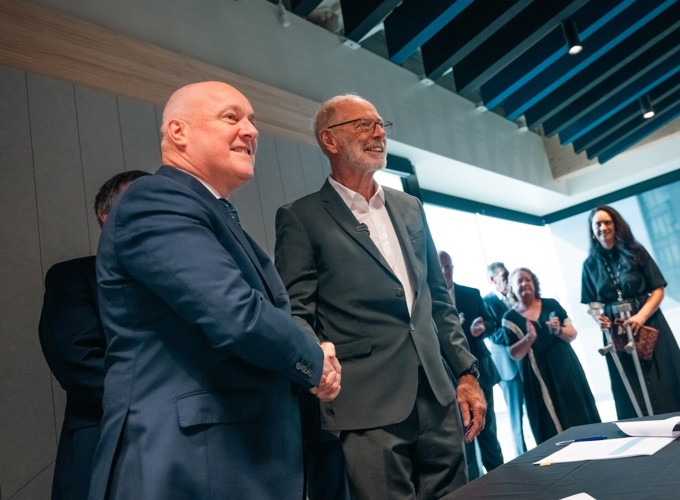 The Government’s media release is headlined ‘Landmark Auckland deal to unlock city’s potential’, and the Mayor strikes a strong tone about this ‘major win’:
The Deal sets out how Government and Auckland Council will work together to unlock our biggest city’s potential, boosting economic growth and improving living standards across New Zealand.
Prime Minister Christopher Luxon says Auckland has huge potential for growth that the whole country can benefit from.
“Auckland is New Zealand’s economic engine room. This Deal is about getting that engine room firing on all cylinders so that we can lift incomes, create more jobs and make Auckland, and therefore New Zealand, more prosperous.”
Auckland Mayor Wayne Brown says it’s another major win for Auckland.
“This is a new way of working that establishes shared accountability, recognising the size and significance of Auckland – we are more like an Australian state than any other local authority in New Zealand,” says Mayor Brown.
“The Deal better reflects Auckland’s contribution to the national economy. It’s clear; when Auckland does well, New Zealand does well.”
And:
The Government already has a range of tools and groups that interact with local government, such as NZTA co-funding for local roads, Urban Growth Partnerships and Crown funding for significant projects.
“So, this Deal isn’t about reinventing the wheel and creating another layer of bureaucracy. It’s about coordinating across Government into one place so that it’s easier to work together and invest together to get stuff done. The new Ministry of Cities, Environment, Regions and Transport will play a key role here.”
Key commitments of the Auckland City Deal include:
- Establishing a long-term partnership between Government and Auckland Council, including regular meetings between the Prime Minister, Ministers and the Mayor. There will also be a senior official from both Government and Council who will be accountable for delivering on the Deal.
- Reviewing Eden Park’s ownership and operating model, recognising Eden Park as the national stadium, and contributing $5 million each toward relocating Auckland Cricket to Colin Maiden Park.
- Investing in the redevelopment and roofing of the Auckland Tennis Centre to support international events.
- Developing a strategy for innovation precincts in areas such as the Fisher and Paykel precinct and around University of Auckland’s flagship innovation centre in Newmarket (including MedTech-iQ); and strengthening Auckland’s global trade and investment links.
- Jointly developing a destination and major events strategy to grow tourism, events, and hospitality in Auckland.
- Establishing a coordinated 30-year transport strategy for Auckland, with priority projects reflected in the Government Policy Statement on Land Transport 2027 including the North-West Rapid Transit project, Botany to Airport public transport, Mill Road, and CRL level crossings.
- Working together on the additional Waitematā Harbour crossing project, time-of-use charging, and more efficient transport network management.
- Introducing a new Crown uplift funding tool for mutually-agreed, high-priority projects. The Crown will consider contributing funding for projects where the Council raises new funding significantly above current Long-Term Plan and BAU funding levels (e.g., from council asset recycling or targeted rates).
- Working together on Predator Free 2050, Pest-Free Auckland, the Auckland Indigenous Biodiversity Strategy, and restoring the biodiversity of the Hauraki Gulf.
Mr Bishop says [the] Deal highlights four particular growth areas where the Government and Council will work together to drive jobs and growth.
“In Drury, Government and Council will work with private developers on coordinated infrastructure planning to support major housing growth, including new schools and a hospital alongside local infrastructure investment.
“In the Maungawhau–Kingsland–Morningside corridor, Government and Council will collaborate on zoning changes, infrastructure planning and urban development opportunities associated with the CRL.
“In the city centre, a revitalisation plan will open up opportunities for housing and business growth, including further residential upzoning and a potential new primary school.
“At the Airport, Government and Council will work with Auckland Airport on a plan to improve surface access to this major trade, freight and employment hub.”
The Deal contains no funding commitments, and most of the things included in it are either things that should be happening already, or things the government says it will simply consider supporting. A plan to get a plan.
So where’s the value?
Perhaps even more concerning is that – despite the Mayor’s relentless protestations about ‘Wellington’ meddling in local matters – it appears this Deal gives central government even more of a say in how Auckland develops. This is a continuation of what we saw with the Auckland Transport reforms.
The Summary of Commitments contains some good examples of this.
Under a section called ‘Partnership for Growth’, it notes:
To ensure a long-term, integrated partnership between the public and private sector and long-term planning that is robust and stable, the following commitments form the basis of the Deal:
- At least three meetings per year between the Prime Minister and the Mayor.
- Regular meetings between the Mayor and senior Ministers to share views on policy settings for matters that affect Auckland (with each minister determining cadence between monthly to biannually).
So the Prime Minister will only commit to a meeting once every four months with the mayor who represents a third of the population of the country and leads the nation’s “economic engine room”?
And meanwhile, ministers get to individually set the cadence they want (which could go either way)? That hardly sounds like a ‘partnership’.
When it comes to transport, we get the following commitments:
Joint Commitments
Auckland Council and Central Government will use the new legislative transport planning and decision-making mechanisms to jointly determine the nature of the transport priorities for Auckland. This will be achieved via the first iteration of a 30-year transport strategy, that contains a 10-year indicative investment programme.
Both Auckland Council and Central Government agree that the Deal transport priorities are:
- Level Crossing removals.
- To progress the delivery of Auckland’s Rapid Transit Network, including as initial priorities progressing the Northwest Busway and Botany-to-Airport.
- Smaller-scale initiatives to reduce congestion and make the transport system more efficient (including dynamic lanes).
- Freight and trade connections to the Airport and Port.
- NZTA will progress route protection and securing of the designation for the Mill Road corridor Stages 2 and 3.
Central Government will work closely with Auckland Council on other major transport projects in the Auckland region, including:
- Waitematā Harbour Connections project.
Central Government will work with Auckland Council to explore Auckland specific settings for key mode and behaviour tools, such as parking charging, Express lanes, dynamic lanes, and priority bus lanes and tolling. Central Government will work with Auckland Council on appropriate Central Government oversight to ensure such charges are not excessive given this may include a right to tax.
Central Government will work with Auckland Council to consider better integration of the operation and delivery of the city’s transport network, including local roads, state highways, Auckland Airport and the rail network. For example, coordinated control and operation of traffic signals between council and NZTA roads. This includes seeking to clarify roles and responsibilities.
Auckland Council Commitments
- Lead delivery of targeted interventions that improve network performance quickly and cost-effectively.
- Auckland Council will partner with the Crown on funding for transport through funding sources including rates, IFFA, targeted rates and developer levies.
Central Government Commitments
- In GPS 2027 the Crown will reflect the agreements in the CRD including the priority transport projects (North-West Rapid Transit project, CRL grade separation level crossings, Botany to Airport public transit and Mill Road) unless changed by the jointly agreed 30-year transport plan with the indicative 10-year investment plan or the NLTF prioritisation process. The NZTA Board will be responsible for approving funding from the NLTF.
- Central Government and Auckland Council will agree to the allocation of net revenue raised from time of use charging to be used for transport projects and activities jointly agreed by Central Government and Auckland Council in line with legislative requirements.
- Central Government will continue to progress legislation to support greater use of tolling. All new roads, including the Auckland roads of national significance, will be assessed for tolling to support investment in their construction and maintenance. Auckland Council will be consulted on each relevant tolling proposal in line with statutory requirements for public consultation.
There’s nothing in there that is new, which is fine. But what is concerning is there is no guarantee of any funding for any of those projects that are considered a priority. The ‘priorities’ will be included in the next Government Policy Statement – but with funding decisions left up to the NZTA.
In other words, this is exactly what we’ve had before with the Auckland Transport Alignment Project (ATAP). You may recall that through the various iterations of ATAP, projects became priorities, funding commitments were made by the government of the day, and those commitments were included in the GPS of the time – but were then never delivered on by the NZTA.
It’s hard to see how this will be any different, especially given how vague these priorities are.
Perhaps some of the most interesting parts of the deal are those that relate to Eden Park and the City Centre. Both are part of what is labelled a ‘Place Based Partnership’.
Eden Park
The Eden Park aspect sits within the Maungawhau-Kingsland-Mornside CRL Growth Corridor. It includes this commitment:
Auckland Council and Central Government will develop a coordinated urban development programme for the Maungawhau–Kingsland–Morningside CRL Growth Corridor, enabling a shared vision for the area. This will include considering sequencing of level crossing removal.
As part of the agreement on housing changes, the government has required the Council to provide even more housing in this general area. But I think this is the first time I think it’s been made clear that the government will get to be involved in coming up with an urban development programme for the area.
For Eden Park, the commitments include looking to change how the stadium is governed and developing the No. 2 ground.

Looking to develop the No. 2 ground is included in the agreement
City Centre
There have been suggestions for a while of a ‘refresh’ of the City Centre Masterplan. We were already concerned – based on comments from the mayor – that this would see a bigger focus on making it easier to drive to and through the city. Now, it seems central government will get a greater say in how our city centre develops:
Auckland Council will work with Central Government to prepare a revised city centre action plan that provides a single consolidated plan for investment in the city centre, including specific initiatives for further investment and clear points of collaboration between Central Government and Auckland Council.
On the positive side, perhaps the city centre will finally get a school, something definitely needed to support the growing city population. And reading between the lines, perhaps a new central library too.
Central Government (Ministry of Education) will work with Auckland Council on the potential feasibility of a primary school in the City Centre. This will:
- Include Auckland Council investigating potential suitable buildings (including building that it owns, such as the central library).
- Outline what property or other support Auckland Council may be able to contribute.
This work will occur following an updated analysis of need and an assessment of whether the need indicates a requirement for a new primary school and/or for further investment in the current school network. This assessment will include the city centre, city fringe and the CRL stations of Maungawhau and Kingsland.
In short, less of a deal, more of a disappointment. Economist Shamubeel Eaqub expresses pretty similar thoughts in a fairly scathing LinkedIn post with a very eloquent image attached [emphasis added, image below]:
The Auckland Deal is centralisation dressed up as devolution. Auckland is the only region that contributes more tax than it receives in central government spending. A fiscal and economic powerhouse. And yet the Deal treats local governance as if it barely matters.
Devolution must be built on a shared purpose: better outcomes through reach, responsiveness, performance. Three levers to devolve: political, fiscal, administrative. Extent ranges from shared jurisdiction to paternalistic control.
The Auckland Deal agrees to projects that would have happened anyway, forces meetings that should have happened anyway, and makes it easier for central government to practice new policies on Auckland before rolling them out nationally.
…..
Devolving responsibility without power or funding is a recipe for failure. When delivery falls short, the losers will push back, and the Council will carry the blame. Wellington washes its hands. A familiar and irresponsible approach that has led us to this local democracy cul-de-sac.
This Deal sets a precedent: a poor model of devolution for the strongest council. Every other council will be offered the same template with less leverage.

Spot the ‘economic engine room’ of the nation. What would a fair City Deal actually look like? Image via Shamubeel Eaqub/ LinkedIn.
What’s your take on this City Deal? The deal of the century, vapid disappointment, or something in between?
Today’s header image is from Auckland Council’s article about the City Deal in Our Auckland.
Greater Auckland’s work is made possible by generous donations from our readers and fans. We’re now a registered charity, so your donations are tax-deductible. If you’d like to support our work you can join our circle of supporters here.

 Processing...
The thought of Eden Park continuing to be a “national stadium” is a farce. It’s a nightmare for locals, and unfit for purpose as a cricket ground.
Best thing they can do with the site is turn it into community housing.
It’s not going to be a cricket ground.
It’s the only realistic option based on location, cost and transport links.
Well, if they get their funding for “Eden Park 2.0”, we’ll likely see plenty of white ball cricket there. The redevelopment plans include retractable seating for the lower tier of a new North Stand, allowing for a full oval in that mode.
Hopefully no red ball cricket though. But Colin Maiden isn’t an option for tests, so who knows….
My dream is Victoria Park.
Mine too. Replicate Hagley Oval.
It’s a flood basin, it’s never going to be turned into housing, it would become a reserve if it were ever abandoned as a stadium.
If they are talking about turning Eden Park No. 2 in the “development” plans, how can we interpret that apart from turning it into housing?
Hotel. With increased events it makes sense to have accommodation right there.
This is a good point. I never considered that when I keep saying it should be made into housing. Yes, just keep it going, upgrade with central government financial support it will be fine.
Cricket to that Glen Innes location.
I see in that article Stephen D links to below that Auckland Rugby going to exit Eden Park though, so OK using it for other big things more.
What stood out for me, from the aerial picture, was just how big the houses and sections around it are. There are only like 15 houses along each side of the stadium. That is mind blowing to me, I never realised just how low density this part of Auckland was.
Thus P120 v1.0
“National stadium” … hilarious that they’ve fallen for Nick Saunter’s propaganda. Every statement he’s made since he took over as CEO of Eden Park has pushed this made-up concept.
Any stadium anywhere is going to be a “nightmare for locals”. We can choose to simply ignore them. Not sure why cricket is relevant.
Cos it’s my passion. Auckland is the largest city in the country, by far. With the largest population of Indians, Pakistanis, Sri Lankans, and Bangladeshis, not to mention, South Africans, POMs, and Aussies. Yet no test Venue. I’m surprised Wayne B hasn’t cottened on to the missed opportunities.
https://www.nzherald.co.nz/sport/cricket/colin-maiden-park-gets-10-million-upgrade-as-new-home-of-auckland-cricket/CW23W4Z3M5F4TBVKQMJ3DAYOBQ/
“ A new deal for the management of Eden Park means Auckland Cricket and Auckland Rugby will exit from the country’s biggest stadium.
Auckland Cricket is relocating to Colin Maiden Park, while Auckland Rugby is looking for a new “fit-for-purpose” regional facility.”
So what good is it? Robbie Williams!?
Wonder if Mr Brown is still pushing his Meola Reef bridge idea
Eden Park has always had an unextinguishable appetite for taxpayer and ratepayer money. It will need a shedload of both to relocate the No 2 Ground and develop yet more entertainment spaces on the site. It already sits on a floodplain “Cabbage Tree Swamp” as does the majority of the land around it. Like a lot of the parks in the area it is only there because the ground was judged too wet for housing when the city development began to extend into that area. If Eden Park is going to expand to that sort of extent, there will have to be serious consideration of maximising the land value of the surrounding housing area to encourage other forms of land use more suitable to the dominant feature.
Im struggling with this one. South Auckland infrastructure spend has been clipped, eg “Developing a strategy for innovation precincts in areas such as the Fisher and Paykel precinct and …”
Southern Growth Initative included an “Active Mode Corridor” linking Drury and Pukekohe which the new Fisher&Paykel Health campus is being developed. Removal of 3/4 laning on the train corridor and removal of the path along the rail corridor would suggest sticking to the original strategy for growing our innovation centers.
Waitemata harbour crossing – Great time to get active modes across the harbour, the future bridge design specifically excludes active modes. (yes – was there but removed from the design)
This “regional deal” really is about funding. Removal of the regional fuel tax in June 2024 left Auckland wholly dependent on the goodwill of Wellington on which projects to progress or cancel, this is a bone thrown back to the mayor to get with the program.
The list of “key commitments” reads like the outcome of a divorce, or post highly dysfunctional relationship, eg agreeing to work together for predator free 2050, agreeing to work together for GPS projects being delivered in Auckland…
For the good of the kids (voters)
Legally Auckland Council is not able to NOT follow parliaments direction.
Argh – clearly they’ve identified there is a problem. clearly, this is not a solution.
SAR is correct, this does read like a divorce settlement. If Labour would recommit to the regional fuel tax plus a tweak for EVs OR getting congestion charging in place asap they could make this divorce settlement irrelevant – Auckland funds its own thing, does its own thing.
No reason they couldn’t do a congestion charge and a regional fuel tax. As congestion charge is for all vehicles to manage peak traffic, while regional fuel tax is aimed at pollution.
Couple of questions – What happened to the position created by a former government of a “Minister for Auckland”? Is that still there? Or has it gone? If so, why did it go? Did it not work?
Secondly – “Prime Minister Christopher Luxon says Auckland has huge potential for growth that the whole country can benefit from.” – we all now understand that building a major city on a really narrow isthmus of land with 2 major harbours hemming it in, and non-touchable kauri forests on another side – I think that we have reached the point where we can acknowledge that AKL does in fact NOT have major growth potential, without mass destruction of existing housing and rebuilding in a form 10x denser. Does Luxon not understand the natural limits to growth?
I didn’t think he was talking land area. More about the economy.
Knocking down existing housing and rebuilding 10x denser is done on individual sites all the time. A 5-10x uplift can be done by going from a single house to 3 story apartments or townhouses. Ideally the uplift would be much more, going from single family houses to 6-8 story apartments. Especially in rail station catchments.
It’s quite feasible, and is a natural process of city building and intensification. Unless an authority bans it and locks up areas in amber of course.
The opportunity that comes with identifying areas rather than individual sites also means we are able to build amenity into the plans – pocket parks, walkways etc
Auckland has loads of potential for housing growth. Think of all the at-grade and multi-storey carparks that need to be removed anyway to help reduce VKT. These should be developed into high-density housing and green infrastructure.
Then there’s the suburbs. Each original house in my street could have easily been developed into 10 apartments at the street, with a large garden behind, were regulations not preventing it. I’m not sure why you’ve made 10x as the goal, but we could get there eventually, site by site, if we wanted it. With no sprawl. The development contributions could help Council buy more pocket parks, walkway connections and so on.
Luxon’s idea of growth isn’t this, of course. Growth has a few distinct meanings.
There is far too much ugly, low rise, light industrial properties within a stones throw of the city center. Those can go, over time.
Heidi if there’s one thing I learnt from the fuel price spike is that people want to get around in their cars even if it costs them significantly more. The truth is Auckland does not have great weather so people will always choose the dry / convenient option over cycling in the wind and rain. Those cars should have places to park off the street in fact people should have to prove they have off street parking to own a vehicle but that’s another matter. Quite frankly I’m sick of going through suburbs that used to have clear roads and now it’s just cars parked the entire length on both sides because someone wanted to get rid of “parking minimums” all for what? Are people in houses without parking spaces driving less (spoiler no) they just leave their three cars on the road now instead of on their own property. Who are we building all these new houses for anyway, we both know no new sprawl or intensification would be needed if National and Labour weren’t so hellbent on Mass immigration to push house prices up and to make the magic GDP figure go up. You can try and respond with data showing cycle counters at record numbers which is great and btw I am supportive of cycleways but at the end of the day people who chose to drive a car even when there is very decent alternatives are still going to be more than 50% of trips in Auckland and they need somewhere to park I think a majority of the population would agree with this. And until you change the majority of people’s minds in NZ cars will remain dominant as that’s what people want as we live in a democracy and time and time again it’s been shown voters overwhelmingly pick pro car policy’s over ones that restrict them may as well leave them off our streets so the rest of us can enjoy them :).
Shame it has to be a Trumpesk deal vs an agreement. As Trump deals typically favour him the one for Ak favours the government.
Yes. Now the word deal means a short-lived agreement.
What does our city need? Light Rail. Apartments.
What does Eden Park provide? Entertainment.
Is entertainment important? Yes
But not just big stadium sports and rock n roll. Theatre is important, live local rock venues are important, small community theatres are important. We don’t need Robbie Williams.
We need to encourage our local scene.
Also we need Light Rail and Apartments
bah humbug
We vote in general elections for national policy.
We vote in local government elections for local policy.
Central government override on how how our local government rates are spent, or even now, how they are even raised, is dangerous overreach in our increasingly stressed democracy.
The ongoing depowering of local authority powers will be self reinforcing downward spiral in both voting turnout and candidate quality.
We need to ensure that we change to getting the local back into Local Government this November.
.
+1000
voter turnout for auckland local body elections was 28%
that was before thousands of special votes were discarded due to having “occupation” field blank.
So no, we dont vote in local government elections for local policy.
Low turnout is a symptom of voters feeling disempowered.
That their votes, and views, won’t make any difference.
Under the present regimes there is considerable justification for such cynicism.
We have had expensive, ratepayer funded consultations with commendably high participation rates, that have actually secured the bulk of local support, increasingly in this government’s term, overidden by arbitary Trump like edicts from a Crown Minister. Completly degrading local influence in local decisions.
The fact that a deal has to be made in Auckland is nothing to celebrate.
It is a demonstration that Central Government is attempting to further disempower local communities in favour of Trump, or Orban like dictatorial overrides.
Now is the time for Hipkins to spell out how Labour intends to define the boundaries between Local and Central Government jurisdictions.
I await.
All of the big regions should have their GST or most of return to it’s residents. Even the GST on our land tax (rates), ie a tax on a tax, should be returned. ie for Auckland, Wellington, Christchurch, Hamilton. Perhaps also Tauranga, Dunedin (& Lower Hutt?). The rule could be any urban area greater than 100,0000 residents. This would have the added benefit of encouraging areas to create more housing to get to that target. Could make for interesting politics.