The following is an op-ed which ran in the Sunday Star Times and online in The Post on July 12th 2026.
You can find more information about the bridge proposal here.
The way we routinely approach big transport problems is broken. A top-down, secretive, insider-controlled process repeatedly leads to over-scaled unaffordable projects presented to the public as the only option.
This was true with Auckland Light Rail, which led to its wasteful cancellation. It is certainly true of the entirely unfundable and therefore fanciful plan for $55 billion worth of highways.
And it is happening again, across the Waitematā Harbour.
Instead, we need a more open and public process, leading to a popularly accepted and enduring plan – one that can be started, sustained, and ardently championed by the people paying for it. Which is all of us.
Auckland’s current harbour bridge is the city’s only crossing, at a critical point. It not only carries State Highway 1, but is a vital local link between the growing North Shore and the city centre, the nation’s biggest magnet for employment, education and entertainment.
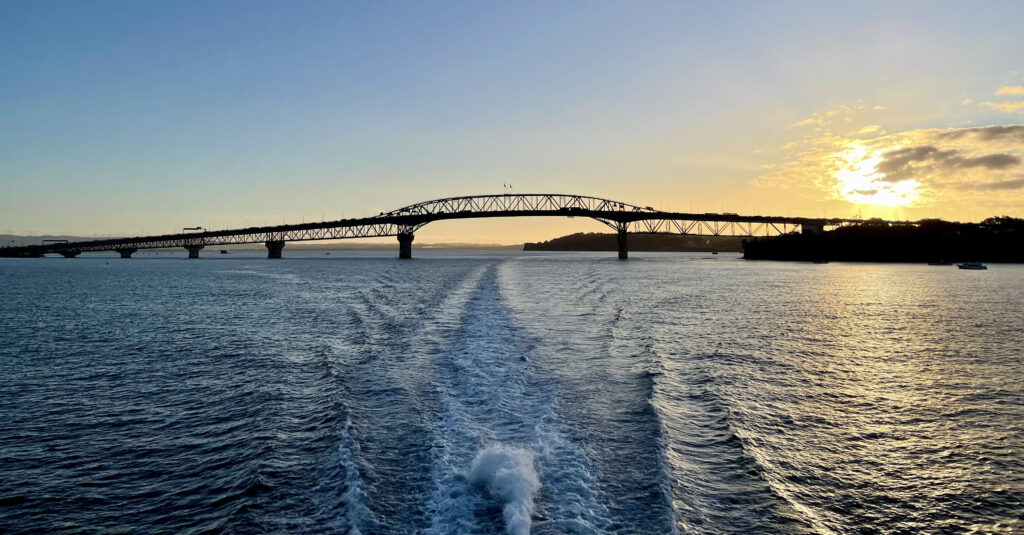
It works well, for now – but only thanks to three key workarounds.
First, the clever tidal traffic-lanes, which allow five lanes at peak. Then there’s SH18 and the Upper Harbour Bridge, offering a bypass around the harbour for more inter-regional trips. To the city the most efficient workaround is the buses, which carry up to 50% of people crossing the bridge at peak times, even without their own lanes on the bridge.
But three glaring deficiencies are there for all to see. First, the bridge has only ever accommodated one mode, vehicle traffic – restricting choice, and limiting capacity and efficiency. Secondly, it’s a traffic bottleneck, with more lanes feeding into it than it carries.
Thirdly, it’s a single point of failure. Approaching seventy, it needs major renewal work so it can keep serving us for decades more to come.
Which brings us to a fourth major issue: affordability.
Governments of all kinds want Auckland to pay for the next crossing, via a combination of tolls, levies and other charges. To secure enduring agreement, whatever is next must above all be as cost-effective and commonsense as possible – or there will be a powerful revolt.
This creates a huge opportunity. It will be a city-defining project, so it can and must add value beyond its core transport tasks. It could and should be beautiful, gracing our sparkling harbour and enhancing our city’s international standing, a visible sign of value for the people it serves, and who’ve paid for it.
That’s why Greater Auckland is advocating for the best proposal we have seen that best addresses all of these points. Leading international transport planner Nicolas Reid proposes a new bridge, cityside of the old one. It would connect directly to the Victoria Park Viaduct, sail above Westhaven Marina (clearing it by 30m), and land at the old toll plaza past Northcote Point, leaving the headland untouched.
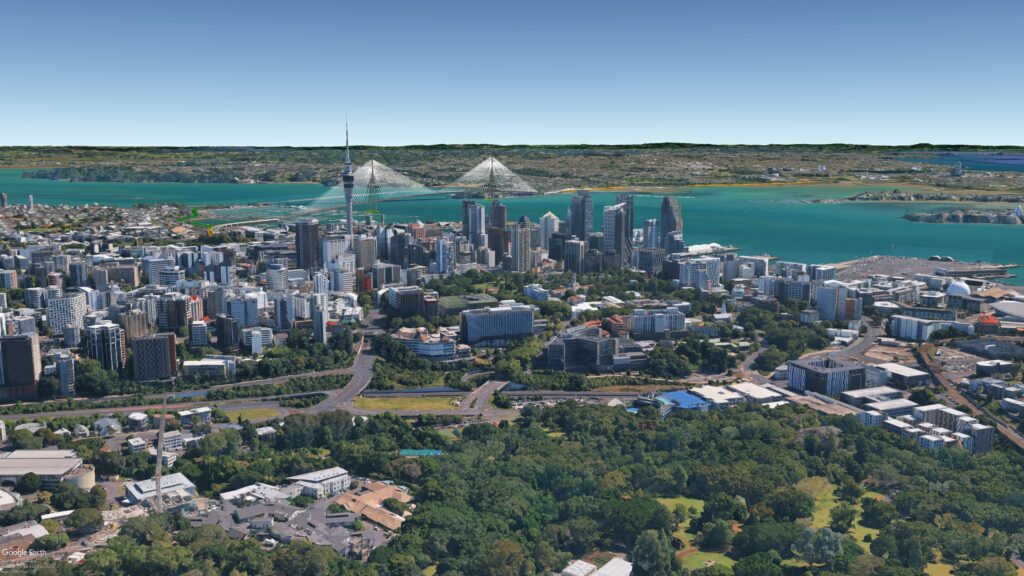
Across the city
The bridge would carry four new southbound traffic lanes, connecting above street level into the viaduct and the existing motorway. On the western side: a pair of rapid transit lanes carrying buses from the busway, future-proofed for rail of whatever kind. On the eastern side, paths for cycling and walking – safe, separated, with sweeping views.
The current bridge could then be renewed in phases while still carrying all the northbound lanes from the existing Victoria Park Tunnel, the city and Ponsonby, as well as two local southbound traffic and local bus lanes. Reid’s design resolves the traffic integration elegantly and efficiently, on both sides.
The new bridge has the same clearance as the current bridge, but is 25% less steep, and touches each landing very lightly. It can be constructed with remarkably little disruption, much of it assembled in the harbour through prefabrication – like the first bridge, in an excitingly public way – without disturbing the operation of the current bridge.
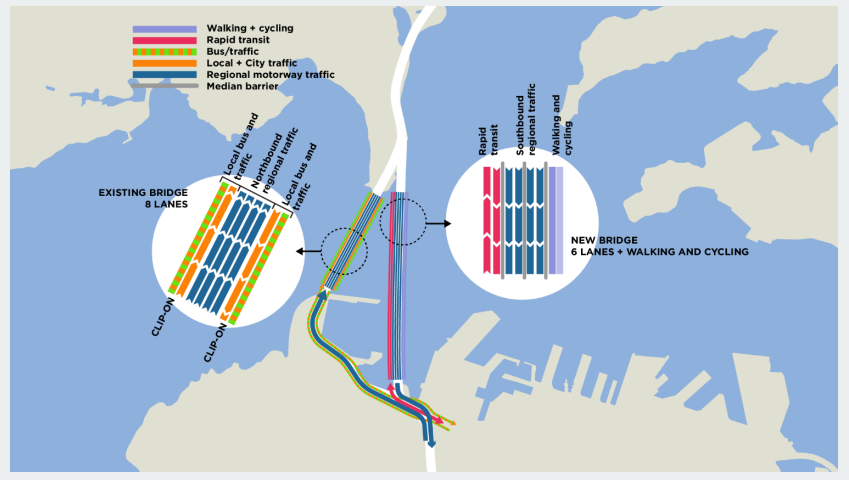
The network plan for state highway lanes, city traffic, buses and rapid transit across the existing and new harbour bridges
Bridges are not only cheaper to build and operate than tunnels, they also support all modes, including people under their own power, to cross the harbour safely and freely. However you travel, a bridge offers a better, more uplifting experience.
We’re long overdue for rapid public transit across the harbour, connecting the North Shore into the growing high-quality transit network on the isthmus. Settling for $10-20 billion car-only tunnels (the government’s rumoured “preferred design”) would be madness, when we could have an all-modes beautiful bridge for well under half that.
Far smarter, as well as far more affordable, to build a beautiful cable-stayed bridge, soaring above the stunning Waitematā, meeting every need, with artful design expressing our highest aspirations. An iconic new structure for our city; a 21st century Golden Gate.
Best of all, it is one we can actually afford to build and experience sooner.
Greater Auckland presented the bridge proposal to Auckland Council on the 23rd June 2026.
Greater Auckland’s work is made possible by generous donations from our readers and fans. We’re a registered charity, so your donations are tax-deductible. If you’d like to support our work you can join our circle of supporters here.

 Processing...
Auckland, build this beautiful bridge!
MichaelKMair.wixsite.com/Michael
We definitely need a second bridge across the Auckland harbour ASAP.
Brilliant in conception.
Time to get building!
This project could be done in less than eight years if everyone was on the same page and focused.
We don’t need a gold plated project like CRL.
A good basic plan is what will stand the test of time.
What aspect of the CRL is gold-plated?
The Maori station names are a small additional expense that goes beyond what is needed along with translating all the text on every single sign. That all costs money and it’s not essential.
Then there’s the station artwork and things like the massive indoor waterfall that again are not essential to running the trains.
Anyone with basic knowledge knows it’s gold plated do I even need to go on?
Btw nothing wrong with gold plating projects I support the gold plated Warkworth to Te Hana as long as a majority of people want the gold plated project it’s fine. I think most voters would’ve liked the artwork but not the Maori station names for example.
There’s a big difference between a bit of gold leaf on the window frames and making the whole building out of solid gold. That is the comparison on the price schedule. Cheaper and looking better is a good result.
Apply the same to RoNS.
There is a difference between a golden plate, a massive buffet for 2 people, and a little ornamental salad on the side.
Giving a station a name is gold plating? and generalising that most ‘voters’ wouldn’t like Māori station names – this has nothing to do with gold plating of a project. Might want to check your false consensus bias.
Artwork and design features deliver economic benefits. Well-designed public spaces can make stations safer, more welcoming, easier to navigate, and more pleasant to use. They can encourage people to spend time there, support local artists, create a sense of pride, and give a city a landmark that people value for generations.
The mistake is assuming that the only worthwhile investment is one that makes the trains run. A station is built to serve people, not just trains. If a relatively small financial part of a major infrastructure project creates a place that thousands of Aucklanders feel connected to, improves the passenger experience, and reflects the community it serves, that is not gold plating, it is an investment.
There’s nothing wrong with the station names, something wrong with you though if that’s all you have to grizzle about
Paris Metro has signage in 5 languages (sacrebleu!).
They also standardized attractive entrances and clean tile back in the 1900’s, followed by an updated scheme for the expanded metro that took advantage of its scale to unify furniture and fixings.
Soft toilet paper is gold-plating and I’m glad of it every day.
Good grief, this argument is even less coherent than your one for Warkworth to Te Hana.
How on Earth is having a Maori name gold plating!?
From the guy who wants a $22,000,000,000 gold plated highway to Northland, so he can get there faster.
Ffs
The original commuter rail network was designed deemed essential by the same company the designed the motorway network in the late 50s early 60s. In the 90s I went to see the start of the tunnel into britomart being built. Now after 60 years of moaning, obstructing progress and delaying tactics from the car lobby, you think it’s using Maori and the artwork that’s cost money?
Also – with the harbour bridge they cut back on the gold plated option and a few years later had to add the clip ons to cope.
Making the system attractive for users will increase use immensely. Building some brutalist soviet-style concrete block monstrosity would almost guarantee it becomes the last choice for most people.
sorry, we’re not taking financial advice from the moron who thinks $22 billion for a motorway to a rural backwater is a “good investment”. Ō raho!
I agree that dual language signs are a waste of money, let’s stick with the original! Maori names all over.
Let’s remember that station fitouts cost less than 0.02% of the total cost. Maori place names probably a similar percentage of fitout costs. The claims are more culture war than cost-care.
Sweeney, Brown etc use the term gold-plated but never actually mention where the major savings would come, aside from vague comments on not future proofing (Brown). But adding some nice aesthetics ain’t it.
Is it over budget? Yes. But a pandemic and a construction-cost explosion after said pandemic will do that.
If they had cut out all the station name, wayfinding, public art and design it would have reduced the CRLs cost from $5.5b dollars to $5.5b dollars.
There’s no gold plate in the CRL, just a tiny amount of surface treatment.
@Ben Well said.
Laughing about all these gold plated analogies etc but think the nice touches and quality of the CRL Stations are like have a Toyota Corolla with ugly purely functional seats instead of stylish, nice coloured comfortable ones.
Some later stations like these Drury ones etc are and can be pretty much functional only. A lot of the new UK ones out in the suburbs are pretty basic but not too much so.
Just going full mask off eh?
Trains that are too long needing more time stopped, longer platforms, unnecessary toilets that double the cost of every station.
if they didn’t build the stations for 9-car trains, the CRL would have run out of capacity by the late 2030s and there would be no way to expand it.
Longer trains does not equal more time stopped, what are you talking about? Each 3-car EMU has the same number of doors. A crush load 3-car train would take the same time to disembark as a crush load 9-car train
Ok but he did make a good point about the toilets. It’s the running costs too people are forever trashing the toilets so this is a massive on-going expense. Same with the water feature I mentioned, that’s going to need significant maintenance work every quarter to be drained and scrubbed.
Also sorry did I not word my comment correctly seems to be a lot of people on here who aren’t willing to accept this is a gold plated project (which I support). The person asked what parts are gold plated I was just responding to this.
Sorry I’m right about the station names as thousands of stickers and signs and posters had to be reprinted just for the Britomart to Waitemata change alone.
And yes I support a gold plated road too so what, I get I’m not preaching to the choir but surely it’s not hard to see that Northland needs this although I suppose some selfish prats like Burrower have never actually been up to the far North.
Long story short the CRL and Warkworth to Te Hana are both gold plated but I support both of them because I don’t have to support projects based on if they make sense, I can use vibes alone.
Sure, providing toilets means ongoing cost. We do that at A LOT of public places though which is a good thing! And I would argue that toilets at 3(!) additional stations that are becoming major hubs for public transport will be well needed when people arrive after up to an hour on a train without a toilet.
If you think toilets at central train stations are “gold plating” said stations, then PLEASE let’s do some gold plating for Warkworth to Whangarei. Probably new road markings and split sealing the Brynderwyns. Might throw in a new “Nau mai, haere mai” sign for welcoming people back to the Auckland region.
+1
How about a tunnel with a beautiful mural of the Auckland skyline…
/s
I still think a rail tunnel from Point Resolution to Akoranga is a realistic option for a supplementary crossing
A tunnel thats twice as long as the CRL but doesn’t go through the city centre and ends at a busway station… not sure that’s realistic.
Key word: crossing
Huh?
The crossing(s) is the first stage, second stage is North Shore alignment
If you propose spending twice as much as the CRL on the crossing alone, you’ll never get it let alone a second stage.
Couple of differences between this route and CRL;
– Won’t be digging under skyscraper foundations, so theoretically less complex engineering requirements
– Offline construction, so minimal disruption compared to having a major CBD street excavated for years
– Possible to build without a tunnel boring machine (immersed tube tunnel)
– Simplest alignment with existing city side infrastructure for a heavy rail crossing
if you’re tunnelling from point resolution, might as well tunnel under the Devonport Peninsula to Takapuna and Smales Farm
link that all up as a North Shore–Northwestern light metro line
just not sure about resurfacing alignment point resolution side, probably need a flyover for POAL
think you’d probably have to tunnel all the way under the CBD and emerge somewhere around Western Springs or Newton Rd
or tunnel under St Heliers and emerge in Howick
Do not just focus on a second bridge.
1. Ban all freight ships unless local freight carriers.
2. Freight to Marsden Point.
3. Freight tunnel to Auckland base.
4. Freight for export to Auckland base.
5. All exports finished product.
6. Create export manufacturing at Auckland base.
7. Take finished product exports to Marsden Point.
4.
This is a great idea. Unfortunately, it’s just that…another idea while Aucklanders wait eons for anything to happen on the ground. A few things could happen overnight with some cones, green paint and signs, and if there’s political will, would solve most of the problems a new bridge is trying to address:
1. Reallocate outer bridge lanes to 2 for buses/heavy commercial vehicles and 2 for active modes, leaving the remaining 4 centre lanes for general traffic.
2. Sign all non-city centre-bound traffic to use the outer ring route instead of the harbour bridge.
3. Cone off the Spaghetti Junction to force all private car traffic to weave through the city centre streets…this reinforces the western ring route as the bypass route.
4. Paint bus lanes on every arterial CBD street that has a bus route where this hasn’t already happened (ie, Customs St). Remove all CBD kerbside parking and replace with cycle lanes where none already exist.
5. Run the frequent bus services between city and nth shore 24/7 with at least an hourly frequency.
6. Watch what happens.
I bet traffic will evaporate within a couple weeks, active mode use will skyrocket and many of our issues will forever be solved. Any government that did this would be heroes and voted back in (after the dust settles of course).
We have plenty of existing roading capacity in this city, the problem is most of it is allocated to the private car.
Just toll the bridge again. User pays. If you need to use the bridge to get to the city, ensure park n ride is cheaper than driving.
The people of Auckland are going to be the main financial contributors either way when a new crossing is built so users should start paying now.
Clearly Transitman has never worked in the service or construction industry but kerbside parking is important. Couriers? Technicians? All of them won’t have anywhere to park.
I suppose I should’ve realised they were a cooker the moment I saw that liberate the lane nonsense. Especially the stupid suggestion of making the bridge only 2 general lanes that’s literally going to cause so much congestion and make life a misery.
It’s people like Transitman that make me want to support RONS even more as they just can’t see reality it’ll be funny to see their reaction when the Warkworth to Te Hana PPP is signed in the next month hahaha.
Even if a contract gets signed, NZ is good at breaking contracts
Not ones that are front-loaded with a billion dollar deposit from the government.
aw jeez
“I saw that liberate the lane nonsense. Especially the stupid suggestion of making the bridge only 2 general lanes”
The moment I saw you summarising the Liberate the Lane proposal as “only 2 general lanes” when there would still be 7 lanes left for motor vehicles I knew you were just here for the propaganda.
Is there any coherent argument for a tunnel? I can only see 2 really:
1. Easier to deal with NIMBYs than have decades of arguments what kind of look the bridge should have
2. NZTA traffic engineers get to live their fantasy of boring an entirely new road tunnel through to the Southern Motorway so they can bypass the CBD
Is there any other possible explanation?
Same argument ALR tried to use: “if we drill a tunnel underground we won’t have to do any planning work or make any hard decisions or say anything that might upset a politician or some residents, and it definitely won’t create any new problems and the cost isn’t something we care about because affordability doesn’t matter and the BCR will be the same because we can just invent new benefits that we only attribute to tunnels.”
Wind. The closures of the bridge are due to wind and will only get more common.
That said, they haven’t really got to the point where a new vehicle crossing stacks up, only the PT bit which they could built a PT tunnel (with a wider emergency exit path for active modes) for heavy rail or light metro to Akoranga then stage it northwards, with the existing busway terminating at the start of the rail.
Building a tunnel doesn’t change the wind thing on the old bridge any more than building a new bridge does.
We don’t need a second bridge to be alongside the current one- wrong place. Try this one designed by bridge engineers.
Auckland City Council Infrastructure Committee.
Re: A bridge for Auckland Harbour.
I wish to once again present to you the reason why we should have a bridge as proposed by former bridge engineers that is a far better option than any other current proposal.
This designed bridge is already in existence in China and classified as one of their great bridges.
If we give the contract to build to China we could have the following: It will be 8 lanes (four each way) and it would have a rail line on the east side. As this rail line would be part of the main contract neither Kiwi Rail, the Council or Government would have to pay for it. It would be paid as part of the tolls.
This bridge would commence at Esmond Road on the North Shore and cross Shoal Bay a mudflat when the tide is out, it would cross over Captain Cook wharf now given back to the Council, it would have an exit at Quay Street, an exit at Customs Street, an exit at Parnel Rise, and finally at Stanley Street Road.
Stanley Street Road already has exits to Auckland University, the North West motorway, Auckland Hospital, Auckland Domain and at the top it joins onto State highway 1 just before the bridge crossing the Newmarket Town Centre.
This is by far the smartest and cheapest way of getting rail to the North Shore. At Esmond Road, the rail line could be joined to the bus lane that already has foundations built into it for heavy rail. Kiwi Rail would then just have to lay the line from Esmonde Road as far as Albany but we should extend this rail line alongside the motorway to Silverdale. This would now make a huge difference to Auckland traffic.
It would split the traffic to the east side of the city and would be a much faster route. The cost would be around $5 billion. At present traffic of 174,000 a day 10,000 of which are trucks and busses a toll of $2 per crossing cars bikes $6 for trucks busses and the train this would return about $200 million a year. Allowing $40 million to operate both bridges this would give Kiwi Bank a return of $160 million a year. A good investment for them.
Sydney built a motorway tunnel close to the harbour bridge in the 1990s. It got congested, too. Now they’re building a third crossing (second motorway tunnel, further west).
The old harbour bridge was built with a rail line but there are more than a million people north of the harbour so two tracks wasn’t enough. Recently a new metro tunnel opened.
Hopefully this will tide Sydneysiders over for the next few decades but this does make me wonder whether light rail will be sufficient for Auckland’s North Shore in the long term. Keeping with bridges not tunnels and avoiding new road projects is a good start, though.