At the end of a very busy week, here’s a bumper selection of stories about cities and urbanism for you to enjoy!
This week in Greater Auckland
- On Monday, Connor listed the top 10 politicians who made CRL happen. Number 1 may surprise you, and the others will amaze you!
- On Tuesday, Patrick laid out why Aucklanders need a real say on the next Harbour Crossing.
- On Wednesday we ran a guest post from Nicolas Reid, discussing his brilliant bridge proposal for the next Harbour Crossing.
- And on Thursday, Matt reflected on what the 2026 Budget would probably contain for transport.
Today’s header image is a render of Nicolas Reid’s proposed Waitematā Bridge – a buildable, affordable, and potentially really quite beautiful option for Auckland’s next harbour crossing.
Greater Auckland in the Media
It’s been a busy week at GA HQ, getting the word out about making our city a better place to live, move, and connect! On Tuesday, Matt spoke with RNZ about the surge in public transport patronage.
Greater Auckland transport blogger and advocate Matt Lowrie said Auckland Transport had done a lot of work to improve off-peak frequency over the last decade, with many services running every 15 minutes during evenings and weekends.
“Auckland actually has probably the best bus network in Australasia,” he said.
The weekend numbers had been increasing for a while, “and they’re getting stronger as a result of the fuel crisis as well”.
Auckland Transport should be doing more to capitalise on that.
“People just assume it’s going to be slower, and so there’s probably more that can be done around encouraging off-peak use,” he said.
Patrick also spoke to RNZ’s John Campbell about how the fuel crisis is “driving” more people try public transport.
“Bus use in Auckland is now at around 95% of the pre-Covid use … it’s returning, and this is very very good news for lots of reasons, especially for the productivity and efficiency of the city as a whole, and for the remaining drives.
You could call it a ‘Trump Bump’ … owning a car, insuring it, maintaining it and fuelling it is the second biggest expense after housing, so that’s gotta be a push factor. But also, Auckland Transport have been slowly improving the service. People who haven’t used public transport for a while will be surprised at how good it’s gotten recently.”
And The Post asked us – along with a bunch of other leading voices from around the motu – for a quick 200 words on what we did – and didn’t – want to see in yesterday’s Budget. Connor obliged:

And in case you can’t read that fine print, it says:
More transport funding should be devolved to local government, especially Auckland, and immediately directed towards improving access, safety and transport choices.
For starters: immediately reset the “Roads of National Significance” programme. Stop pouring billions away on overscoped four-lane mega-highways like Warkworth to Te Hana (a $4b folly) and other zombie projects lurching towards us.
Instead, invest in what’s nationally necessary: heaps of nimble, normal-sized safety and resilience improvements, like 2+1 roads, bypasses of towns, median barriers, safer intersections.
Skip the LNG terminal. Instead, empower New Zealanders by electrifying homes and businesses with subsidies for distributed solar and batteries. Invest in electric transport: buses, ferries, EVs and e-bikes.
Build the basics and give people fossil-fuel-free ways to get around. Deliver reliable world-class public transport for the 80% of us who live in cities: a bus or train every 10 minutes, all day, every route. Fast-track Auckland’s Northwest busway and other rapid transit like Dominion Rd light rail. Rapidly roll out full bike networks in every city for all-ages access. Revive intercity rail.
Lastly, don’t sink billions into costly car tunnels under the Waitematā! Get cracking on an iconic bridge that frees up the missing modes: walking, cycling, buses and rail.
Budget Outcomes
There were three key transport outcomes from yesterday’s Budget 2026.
As we noted yesterday, Winston Peters had signalled incoming funding for rail, and as expected, it’s for the maintenance of the network. However, while the headline trumpeted around a billion dollars for rail, a look at the details reveals most of that appears to be made up of funding that was announced last year:
The Government has committed up to $1.075 billion to KiwiRail’s planned network investments between 2027-2030, alongside $106.9 million to continue critical metropolitan rail infrastructure renewals, Rail Minister Winston Peters and Transport Minister Chris Bishop announced today.
…..
“Rail infrastructure is funded like the State Highway network thanks to our law reforms when last responsible for Rail, and this is the first time a government has fully funded a three-year programme up front to put rail on the same sure footing as many other infrastructure categories.
Here’s the figures showing the rail allocation over the last three budgets for the coming years:
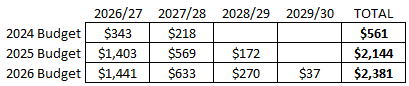
In addition to rail funding, the government are putting $400 million towards road resilience improvements at nine locations around the country (locations and likely works are in the press release). Funding to improve resilience is a good outcome.
Chris Bishop says funding of $400 million has been set aside for state highway resilience projects to help keep critical routes open during and after severe weather events.
“We know where many of the weak points on the network are. This investment allows us to strengthen them before roads fail, rather than repeatedly paying to rebuild them afterwards.
“Projects funded through the package include resilience improvements on SH2 through the Waioweka Gorge, SH3 through the Awakino Gorge, SH25 around the Coromandel, SH60 over Tākaka Hill, SH6 between Cromwell and Kingston and between Haast and Hāwea, and SH94 between Milford and Te Anau, among others.
Finally, the government has committed funding for the Cambridge to Piarere expressway. This is arguably one of the better of their RoNS projects, albeit like so many other projects it has seen a staggering price escalation in recent years.
Budget 2026 invests $1.773 billion in funding for the Cambridge to Piarere Road of National Significance, extending the Waikato Expressway which is one of New Zealand’s most strategically important transport corridors.
“State Highway 1 between Cambridge and Piarere is a critical freight and economic link connecting Auckland, Waikato and the Bay of Plenty with the central and lower North Island,” Mr Bishop says.
…..
“The Cambridge to Piarere RONS project has a benefit-cost ratio of 2.7 to 3.1, underlining the strong economic case for investment.”
The new four-lane 16-kilometre expressway will connect the end of the current Waikato Expressway to the intersection of SH1 and SH29 at Piarere.
Since the completion of the Waikato Expressway a few years ago, traffic on this section of SH1 has jumped up, with nearly 23,000 vehicles per day in 2024 and likely higher now. At Piarere, traffic volumes split, with over 40% heading up SH29 towards Tauranga. This would suggest that Piarere is a somewhat logical end to the expressway – although it probably won’t be long till we hear locals and the trucking lobby calling for further extensions.
People were quick to do the maths, noticing that the nation will be spending 65% more on a single 16km road than on the entire rail network for four years.
https://bsky.app/profile/michaelplanknz.bsky.social/post/3mmvi6hx3i22i
$1.77b: 16km of motorway extension. $1.075b: KiwiRail, four years, whole country. The Budget spends 65% more on one road than on the entire national rail network. #nzpol
— Robot Muldoom (@robot-muldoom.bsky.social) 2026-05-28T07:45:02.000Z
Connor also noted that it looks like the Crown Loan needed to enable the Private-Public Partnership for the over-scoped Warkworth to Te Hana expressway is also in the budget, although it’s hard to know the exact details.
Obfuscated in the Budget today, is the Crown Loan for the Warkworth to Te Hana expressway, I don't know how much it is exactly, but it might be apart of the $1.46 billion allocated in 2026/27.
— Connor Sharp (@connorsharp.bsky.social) 2026-05-28T05:58:26.089Z
Auckland Council appoints Transport and Infrastructure Director
Auckland Council has appointed former NZTA Regional Director Steve Mutton as the person who will lead transport within the council, once those functions are moved from Auckland Transport later this year.
Highly experienced transport and infrastructure expert Steve Mutton has been appointed as Auckland Council’s new Transport and Infrastructure Director.
Auckland Council Chief Executive Phil Wilson today announced the appointment of the newest member of the council’s executive leadership team and leader of the newly created directorate that will deliver Auckland Council’s transport outcomes.

Wayne Brown directs a review of ferry routes
On Wednesday, Auckland launched a new hybrid diesel-electric ferry, the Waitemata I. As reported by The Post, Mayor Wayne Brown took the opportunity to announce a review of ferry routes, to prioritise the best value.
Auckland Transport has been instructed to review the profitability of its routes in light of the fuel crisis and the Gulf Harbour ferry service is first in line, says mayor Wayne Brown.
…
The mayor’s office has signalled through its budget that it would be looking at “high diesel, low patronage” routes.
Brown told The Post scrapping the Gulf Harbour ferry service from Whangaparāoa to the city was “already being considered”.
“It’s not actually an island. You can get a bus,” he said.
…
Brown claimed that before the fuel crisis the council was subsidising the Gulf Harbour route by $80 per passenger per trip – and now it was more than $100.
Councillor John Watson is already pushing back on that: “he said his constituents would be ‘outraged’ to lose the Gulf Harbour ferry service after long-running consultation on the topic.” Another detail from the coverage:
Another feature the new generation of ferries don’t have compared with the classic models is a licensed bar.
“It’s built for the commuter market,” said [AT chief executive Stacey] van der Putten. “I’m not sure you ought to be drinking on board public transport.”
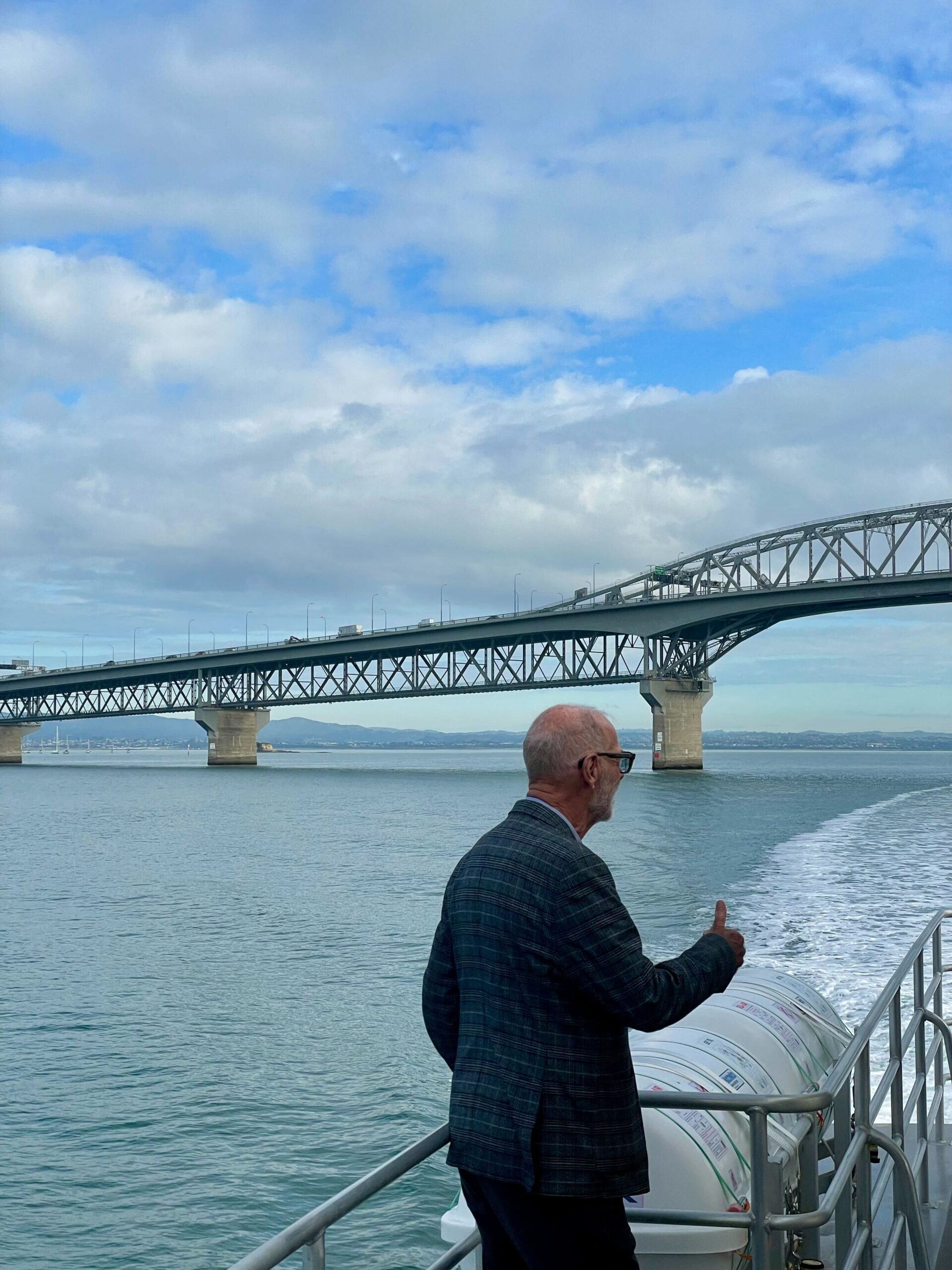
Mayor Wayne Brown on the new electric-diesel hybrid 27 May 2026. (Is he giving a thumbs up to the brilliant vision for a new bridge that we shared this week?) Image: Patrick Reynolds
Bike Trains and Bike Buses – not just for kids!
The school “bike bus” is a growing phenomenon around the world, with Coach Balto’s musical ride-alongs in Portland, Washington, a particularly joyful example.
(They’re also a well-embedded thing in Auckland, which has long-running “bike trains” in Pt Chevalier, Bayswater, Puketāpapa and Waterview... no celebrity sing-along versions yet but surely it’s only a matter of time?)
So here’s an interesting idea from Portland that Auckland could pick up as well, especially amid the cost of living/ fuel crisis: a commuter-focused bike bus. Multiple routes converge on the city centre, aimed at empowering people who are curious about biking to work but need a bit of a buddy system to get the hang of it.
 Meanwhile, from a little further north, a variation of a point we’ve long maintained: if you’re wondering where your bike network is hiding, or how to give people and trees more breathing room… just look under the cars.
"We don't have room for those things!"You always do. Just look under the cars.
— Fietser (@americanfietser.bsky.social) 2026-05-25T00:23:38.864Z
Hobsonville Rd Cycleway
A few weeks ago, AT consulted on adding a few additions to their plans for the Hobsonville Rd cycleway – which is already under construction. The feedback shows generally very strong support for the changes and they’re going ahead but also as a result of the feedback they’re also now looking to signalise the Luckens Rd intersection and are asking for feedback on that.
We’re responding to community feedback about safety at the intersection of Luckens Road with Hobsonville Road. Through engagement on the Hobsonville Road Cycleway project, the community highlighted the need for safety upgrades at this location. We plan to include Luckens Road with the new signalised intersection at Trig Road. This will improve safety for everyone.
Luckens Road and Hobsonville Road intersection
- Installing new traffic lights to improve safety for motorists turning at the intersection
- Installing sections of shared and separated footpath and off-road cycle path to help people walking and cycling move safely through the intersection
- Installing traffic light-controlled crossing facilities to give priority to those who cross the road
Additional to the safety improvements at both intersections, traffic lights can increase the efficiency of the traffic flow especially during peak times. The traffic lights at these intersections will be synchronised to work together to optimise traffic flow.
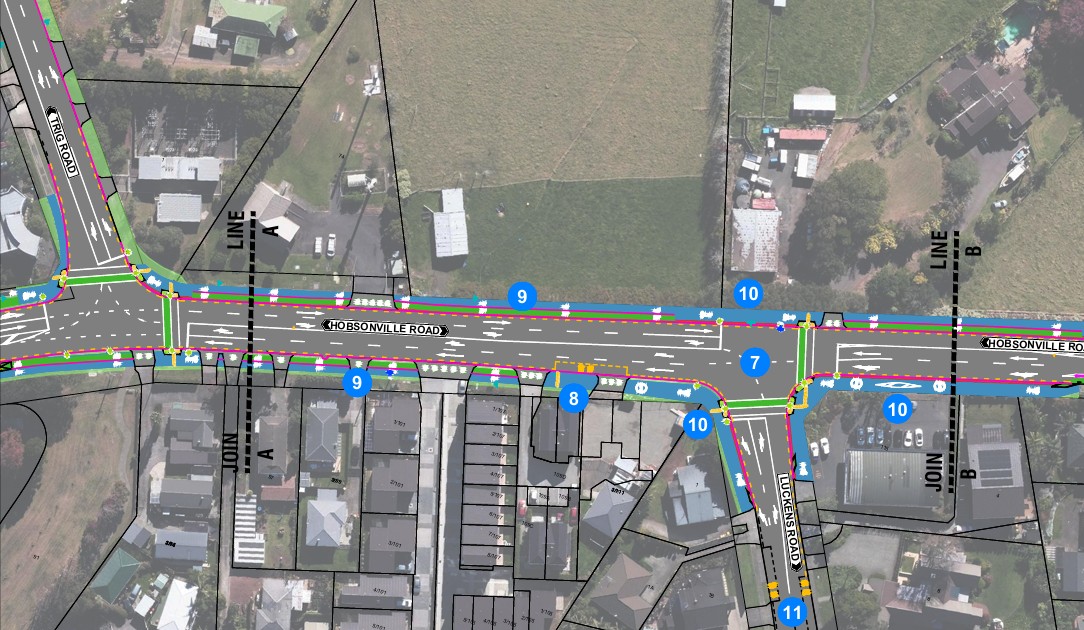 Feedback on this change is open till 17 June.
More children playing on streets across Auckland?
A successful pilot has encouraged Auckland Council to roll out community led play streets throughout Auckland:
“We want Tāmaki Makaurau to be a city where families feel connected, where children can play safely and where everyday spaces spark joy. Play streets help us create neighbourhoods that feel alive, welcoming, and enjoyable for everyone.
“They are free, council‑supported, and easy to organise, with no complex permits or traffic management plans required, all you have to do is sign up,” [Jacquelyn Collins, play portfolio lead at Auckland Council] said.
You can find out more here, and express interest in a play street here.
How does a play street work?
For 2–3 daylight hours, traffic on a suitable residential street [ideally: quiet streets or cul de sacs without heavy traffic, shops, or bus route] is temporarily restricted so neighbourhoods can come together, play freely and safely close to home.
Kids might ride bikes and scooters, draw chalk art across the asphalt, kick a ball around, build obstacle courses, or invent entirely new games on the spot. No programme, no special equipment — just simple, local fun.
A play street means residents and essential vehicles can still access the street, but at a slow, walking pace, guided by organisers.

A pilot play street under way in 2023. Image: Healthy Families Waitākere
Was Auckland the origin of the Kiwi accent?
Brooke Ross, who recently gave a public talk about this, writes for The Conversation:
If you’re a New Zealander who has spent time overseas, you’ve probably had someone comment on the way you speak: that swallowed e and flat i, the whole fush and chups thing … the rest of the world thinks we pronounce our vowels a bit funny.
Even as a researcher of the Kiwi accent, it took me a while to wrap my head around the fact that “here” and “hair” aren’t supposed to rhyme.
So where did this local form of spoken English originate, and how did we come to pronounce our vowels in such a unique way?
It’s clearly a question many people have asked, given the interest in my public talk on the subject in Auckland this week, part of a project using oral history recordings of Aucklanders born around the turn of the 20th century.
Not the good kind of NOMS: Not On My Street
From Streetsblog, a new term for people who prevent livable streets:
A new study argues that the notorious anti-development figure known as the NIMBY, for Not In My Backyard, has an equally toxic cousin in the transportation realm: the NOMS, or Not On My Street. And the researcher who coined the new term warns that U.S. communities will struggle to achieve lasting change until they reckon with the outsized influence of NOMS and their disturbing car-first ideology.
In a recent analysis of hundreds of public comments given at community meetings in Washington, D.C. across four years, researcher Ashton Rohmer found several troubling trends in the rhetoric of residents who resisted new livable streets infrastructure and policies, and what she calls the “car supremacist” attitudes that seem to underlie them.
Socials and videos to check out
Hot off the presses, New York City mayor Zohran Mamdani gave a shout-out to Auckland, in announcing housing reforms to enable more affordable housing and transport-oriented development. (The mention is at 4m 30s)
“We know from other cities the difference that thoughtful planning, careful zoning, and direct municipal financing can make. Vienna, Austin, Seattle, Minneapolis, and Auckland. Let the lessons other cities have learned guide our future. Let our size be our strength. Let us implement these policies at scale.”
Here’s a great video by Kea Kids News (Stuff’s news team by and for children) on the recent set of four BikeLife ride-outs. It’s actually awesome to see this phenomenon from a kid’s perspective. “We’re off to the city for a bike ride. A bike ride is like when heaps of bikes are going for a ride, and you want to join them.” “Better than at home playing games and all that.” “I reckon there should be more bike lanes” says one smart young cookie.
Meanwhile on Instagram, Minister of Transport Chris Bishop shared a cute letter from students at Ōwairaka District School in Auckland, about a new bike track on their school grounds. (You can see some pictures of the track here – it was delivered via the long-running Bikes in Schools programme, which gained some continuity funding late last year).
These cool kids surely deserve equally great routes to school – including the next best thing, the promised “fixing the basics” update to the rules that currently ban children from cycling on the footpath. How’s that coming along?
View this post on Instagram
Is this the next evolution of the car?
View this post on Instagram
That’s it from us this week, we hope you all enjoy your long weekend! See you in June.

 Processing...
Yes get rid of those ferry routes! $100 per passenger, that is insane, when they can get a bus like the rest of us have to.
Why not make the ferries cost price minus the average subsidy bus users get. So if it costs $100 per passenger, the passenger pays like $95 or something. Then the market can tell us if people get enough value to provide the service. Same with the trains.
Or the best outcome: get rid of all the subsidies (including those to private vehicles), and let the free market determine what services and roads make sense.
“Or the best outcome: get rid of all the subsidies (including those to private vehicles), and let the free market determine what services and roads make sense.”
I get the purity-appeal of this idea in a world where we have been brain-washed into misunderstanding how the real world works BUT is in fact super silly.
Why would we fail to make an investment where the return is much higher than the cost? This is what subsidies are (or should be) – financial investments used for unlocking economic returns.
Note the switch in that sentence from financial (cash) to economic (value).
However, you are so correct that is nowhere near the case with the Gulf Harbour Ferry!
But it never works that way. Anything run by the state sucks and/or is overpriced.
If roads had to make a genuine return on investment, it would be bloody expensive to drive a car, and private companies could provide mass transit and make a profit. Instead we subsidise cars with loss making roads and free destruction of the urban environment and free CO2 emissions, then reluctantly subsidise PT, and because PT is an operating expense rather than a capital one, it appears like the only subsidy.
“Anything run by the state sucks and/or is overpriced.”
As opposed to stuff run by the private sector? Are you serious??!?!!?
What sort of neoliberal koolaid have you drunk?
The main difference between the private and public sector is not efficiency, never has been never will be, it’s a cheap and easy sound it’s that people who want to profit. From privatisation peddle and some chumps drink the kool aid.
And where there is no bus? It would be interesting to see that formula applied to the Waiheke island ferries.
Waiheke is a profitable route for its owners (no publicly owned services)
I’m fully aware of that Patrick. It is unknown how profitable and as I commented “It would be interesting to see that formula applied to the Waiheke island ferries”
Some context: SuperGold cardholders travel free on the Whangaparāoa ferry during off-peak hours — zero farebox recovery from those users don’t help the current numbers much.
Not correct. Supergold fares are paid by the government 9am to 4pm with AT funding the evening peak fares.
Zohran Mamdani has cracked the code for real affordability. YIMBY + really putting the fear of the Lord into landlords.
And that’s just a tax, imagine what would happen if we started building guillotines again!
The mindset behind the non-inclusion of a bar on the new ferries is a puritanical one and reveals a distracting focus on morality that sits outside the purview of the role of AT chief executive.
Good thing the organisation is being put permanently on a leash then.
Ms van der Putten (Putin?) should remember that commuters are more than mere economic units.
Why shouldn’t they be able to purchase a glass of wine or a beer on their way home from a hard day’s tax paying?
If nothing else, its one way to claw back some of the needless ferry subsidies given to wealthy pensioners (if anything, we should encourage them to pickle themselves).
A sloshed OAP toppling overboard will surely keep Tangaroa happy and prevent volcanic eruptions
The new Ferries are for the Devonport run. 12mins each way. If you can get to the bar, buy your tipple and guzzle it down in that time while fighting off your fellow passengers trying to do the same thing hardly a good look. Sure the Waiheke and HMB ferries probably would allow a more sociable drinking pace so a bar makes sense.
Tangaroa must be assuaged and is not particularly fussy when it comes to virgin v non-virgin sacrifices.
You could also buy a a coffee and a pie – they removed the whole cafe module, not just the alcohol bit. That makes it pretty clear that it was done for seating/capacity reasons, not teetotaller morality.
It is a nice amenity, especially on the longer runs to Gulf Harbour and Waiheke, but it’s not as if was super useful for Devonport or Birkenhead trips – you’ve barely ordered before you arrive.
It’s probably not worth it. You need a bar manager, extra staff, stock. It’ll be purely economic. Plus you can fit more seats in.
Most definitely worth having a cafe/bar on ferries. The bar is staffed by a crew member that would otherwise not be doing much when the vessel is underway. It would seem you haven’t purchased much on a ferry.
What shall we do with the drunken sailor?
Not even the puritans at AT are suggesting that we do away with Auckland’s beloved Keel-hauling traditions.
Has anyone called it Roads of National Malignance yet?
Tim Welch opted for Roads of National Sacrifice:
https://www.rnz.co.nz/news/political/596722/as-global-fuel-risk-rises-nz-budget-2026-puts-roads-first-again
Or Roads of National Party Significance.
John Watson and his constituents are about to get the $830M Penlink bridge to speed up their road travel. It has a BCR just over 1.0 It will probably have buses on it too. I think once it’s in place it becomes much harder to justify the Gulf Harbour Ferries at a very low level of fare box contribution.
Yes it is almost as bad as CRL in terms of its B/C ratio.
i wonder what our resident miser thinks would’ve happened if we didn’t build the CRL
then again, i suppose the money-obsessed are too shortsighted and profit-minded to see things like the billions in healthcare costs caused by car dependency (air pollution, crashes, lack of physical activity etc.)
Maybe the money could have been spent on something that had a positive return instead. Or maybe the money wouldn’t have been spent at all and ratepayers could have spent the money on something that made them better off. Maybe the businesses on Albert Street wouldn’t have been screwed. Maybe we could spend money where the benefits exceed the costs.
and yet you don’t seem to have any examples on you… interesting.
i guess it’s not in the town complainer’s purview to propose solutions
Interesting, the Cost Benefit ratio for CRL was measured to be 1.6 to 1.7 back when the estimated capital cost was $2.5 billion. Does anyone know if an updated number has been released?
https://at.govt.nz/media/1770701/crl-business-case-summary.pdf
The Ministry of Transport had it between 0.6 and 0.9 back when the Government didn’t support it. (Good luck finding that report now). Then it grew once the Government did support it and each time the costs blew out the Wider Economic Benefits got re-estimated and miraculously the benefits still managed to exceed the costs.
There is video of the Government briefing their consultants on the assessment here.
https://www.youtube.com/watch?v=3M7SzS_5PlQ
The CRL website says it will deliver $11.928 billion of economic benefits.
https://www.cityraillink.co.nz/city-rail-link-benefits-and-costs
If anything it makes me question how these cost benefit ratios values are calculated, because it kinda seems like these consultants just pull the number out of their asses.
miffy won’t care about that since they are a disciple of absolute austerity and seem to think that the best form of society is huts connected by dirt roads so that no expenditure on public infrastructure is ever required
Someone OIA’d NZTA asking why it no longer publishes its board minutes on its website. The response seems to suggest over 2000 hits annually to the page with the minutes on their website and yet they just scrapped it because it was ‘too much work’. So much for transparency…
That was actually me lol, next thing I did was OIA the minutes and agendas of meetings in 2026 sooo I’m sure thats a better use of time and effort for all involved!
Oh great work! Switching off proactive release is one thing, but just before they were about to make a bunch of decisions on billions of dollars of RoNS projects…what were they thinking?!
shot
Not really sure why the mayor of NYC is name checking Auckland. Sounds cool? They already have pretty good, pro density zoning and unlike Auckland, but like Vienna, they actually help support not for profit housing development, understanding that’s the only way to deliver truly affordable housing outcomes.
Mamdani namechecked Auckland (alongside Vienna and Austin, Texas) because our sleepy little town is one of the Good Examples promoted by the YIMBY movement worldwide. Perhaps we don’t see it so much from the inside, but that’s because it was so horrible 10 years ago that we experience it as “not having gotten worse”, which is a victory in itself.
Its not just that things are less bad in Auckland, things are actually better.
Since the unitary plan became operative in 2016,house prices are up ~30%
Incomes are up 50%
General prices are up 37%
Houses cost less relative to inflation, even though interest rates are currently very low. House price growth is so low that several propert speculator organizations are running PR campaigns to try to prevent new construction. Legacy media are frequently running stories with the idea that small homes are now so *cheap* that it is ‘bad for the economy’.
Great info… any chance you could please share links to sources? Cheers!
There is a lot of building, but we’re wasting a lot of its potential by building in the wrong places. Te Atatu peninsula. Oops. Hobsonville Point. Oops. They got themselves into a pickle:
https://www.rnz.co.nz/news/education/592328/auckland-school-run-chaos-leaves-hundreds-late-to-class
If we would have built out our inner ring suburbs, a lot more people could have been walking or cycling instead of driving.
Auckland is a case of terribly restrictive planning that got slightly less terrible. Hardly the poster boy compared to Manhattan, even if Auckland Council like to pat themselves on the back.
Todays motorbike protest over the increase in ACC charges for motorbikes greater than 250cc omitted the reduction for those less than 250cc and mopeds. The charges sound OK to me.
https://nzta.govt.nz/vehicles/licensing-rego/vehicle-fees/licensing-fees/acc-levy-changes-for-motorcycles-2026
I wonder if everyone is paying more than they should for ACC because thousands rip them off?
“Thousands of ACC cases probed for misuse, but only seven prosecutions
https://www.rnz.co.nz/news/national/492602/thousands-of-acc-cases-probed-for-misuse-but-only-seven-prosecutions
Again the issue of anything state run. A few beat ups in the media and they accept any claim.
This is more war on anything not-car.
$960/yr rego/acc for 750cc+ bike means the end of an error for motorcyclists in NZ.
Good news – more utes on the road, as their costs are coming down.
*era !
Interested to see opposition budget proposals
Good vid comparing a French suburb with North American one(s).
https://youtu.be/wtdPGfB69_E?si=1oEcAzBwz9w1Vq7K