Another Friday, another roundup of stories of all things cities and transport for your reading pleasure!
This week in Greater Auckland
- On Monday, we shared an update from Auckland Transport about their planned timetables for once CRL is open.
- On Wednesday, Matt looked at Auckland Transport’s latest tweaks to plans for replacing level crossings in Takaanini
- And on Thursday, Connor asked why the public isn’t being allowed to see the Benefit-Cost Ratio of the Northland mega-motorway. Good projects don’t need to be secret, right?
This roundup, like all our work, is brought to you by the Greater Auckland crew and made possible by generous donations from our readers and fans.
To support our work by setting up a monthly donation, you can join our circle of supporters here. We’re now a registered charity, so your donations are tax-deductible.
To receive fresh posts straight to your inbox, sign up to our email list here.
Greater Auckland in the media
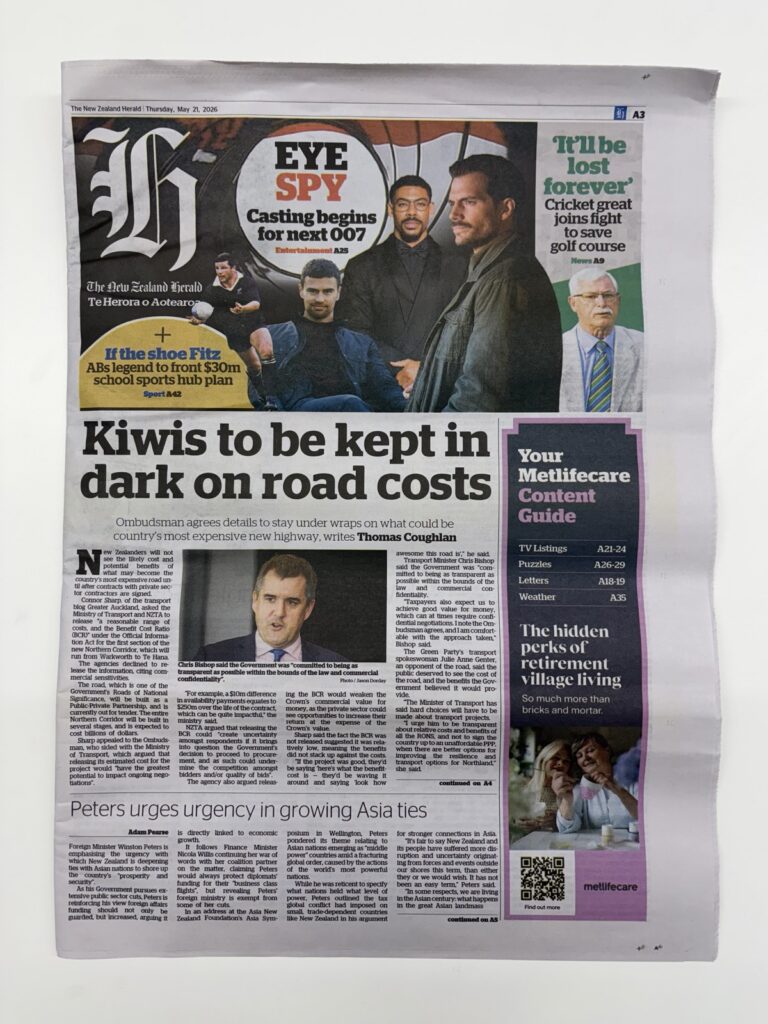
Nice to see coverage of Connor’s efforts to daylight a simple measure of investment viability.
1. Thomas Coughlan in the NZ Herald: Ombudsman sides with Government to keep expensive Northland highway costs under wraps:
Sharp said the fact the BCR was not released suggested it was relatively low, meaning the benefits did not stack up against the costs.
“If the project was good, they’d be saying ‘here’s what the benefit-cost is – they’d be waving it around and saying ‘look how awesome this road is’,” he said.
And it was the front page story in Thursday’s (analogue version of) the NZ Herald.
2. Justin Hu from 1News, Public in dark on cost of huge Northland road as Govt nears deal
Critics have suggested when finished the complete Northland expressway may become the most expensive state highway ever built in New Zealand.
Transport advocate Connor Sharp, who requested the information and received the response under the Official Information Act, opined there was only one way to read that.
“The implication is that the BCR is so bad that if it were released, it would be untenable for the Government to go forward,” he said.
Properly valuing infrastructure
New The Helen Clark Foundation report shows how New Zealand does have the tools to do infrastructure well, it’s just that we’re failing to use them. A timely read, given everything with Warkworth to Te Hana.
New Zealand has the tools to measure the costs and benefits of infrastructure project – but relevant authorities are failing to use them, a major report has found.
The Helen Clark Foundation’s report Measuring What Matters: Getting The Best Value from Infrastructure Investment looks at how Aotearoa measures that investment.
Author Kali Mercier says the country spends billions of dollars on public infrastructure every year, yet there is no mandated process to ensure those investments provide value for money.
“The main finding is that we should be using cost-benefit analysis a lot more, it’s really important that we do the economic analysis of all the projects that we’re planning to put vast sums of money into to make sure that we’re getting value for money,” Mercier told the Herald.The report found that at times, the use of urgency combined with shifting priorities has limited the role of evidence and process in investment funding decisions.
A chart from yesterday in case you missed it #nzpol"NZ used to be a world leader on asset management – the practice of looking after our existing infrastructure. Now, the OECD ranks us fourth-to-bottom in governance accountability."(we are last)newsroom.us14.list-manage.com/track/click?…
— Jason Kemp (@dialogcrm.bsky.social) 2026-05-20T22:26:38.387Z
Will CRL open sooner than we think?
Hayden Donnell investigates. Seems it could be sooner than we think!
Another top Auckland Council source has been engaged in a long-running effort to get a read from AT staff and other CRL officials on when the $5.5bn railway will open. Those staff used to start looking hopeful at the mention of September but lately that optimism has been moving up the calendar. “The vibes that used to feel Septemberish now feel Augustish,” the source says.
Bike busy-ness
Wellington’s new Te Ara Tupua pathway from the Hutt Valley to the city continues to amaze and delight. RNZ’s Phil Pennington reported on Monday’s sunrise commute in glowing terms (see also the featured image). The video is great, too.
Is this the most beautiful commute in the world?
Maybe that is going too far but for the hundreds of cyclists who for the first time on Monday morning pedalled along the new Te Ara Tupua – The Ancient Pathway – cycling and walking path between Ngauranga and Petone it might have seemed so.
…
“I’ve been actually dreaming of this,” said one rider as they prepared for their inaugural trip to work off of Petone Esplanade.
https://bsky.app/profile/whaeavee.bsky.social/post/3mmbddsecus25
In a good follow-up piece for RNZ, Phil Pennington explains (once more, and louder for those at the back) that fully three-quarters of the budget for the project went towards seawall resilience.
The Transport Agency says Wellington’s new cycleway atop a harbour wall is expected to come in under its $348 million budget.
About three quarters of the construction costs were for resilience work, and only a quarter for the path and bridge on top, it said.
However, all of NZTA’s funding for it – $261m – came out of its now shrinking ‘Walking and Cycling’ pot (or activity class) […] in the National Land Transport Fund (NLTF), a class that has had its funding cut and altered in recent years.
It does seem unfair that a massive chunk of all nationwide funding for walking and cycling was spent on protecting road and rail, albeit the path is the icing on the cake.
Here’s a great video review:
Meanwhile in Auckland, the NZ Herald ran an article about speedy two-wheelers on the Northwestern Path, identifying e-scooters as the main travellers breaking speed barriers:
… the Herald spent a weekday morning tracking riders with a speed gun on Auckland’s Northwestern Cycleway, one of the country’s busiest shared paths, during the commuter rush.
From 7am, a consistent stream of cyclists, e-bike, e-scooter riders, and the odd e-skateboard rider, began to build.
They were mixing with a scattering of dog-walkers and pedestrians.
It became clear that some electric devices were travelling faster than others, with e‑scooters rather than e-bikes recording the highest speeds.
The article (paywalled) includes compelling stories of how bikes free up people’s everyday journeys, and basically makes the case for separating wheeled travellers from walkers – something Auckland Transport has already done through the infamous Kingsland bottleneck.
A bike rider who stopped to talk said scooter riders who were speeding should be on roads, especially at the time young children were heading to school.
The woman commuted on the cycleway about three times each week and while the fast-moving e-devices were scary “zooming” by, she endorsed the cycleway. “It’s changed my life.”
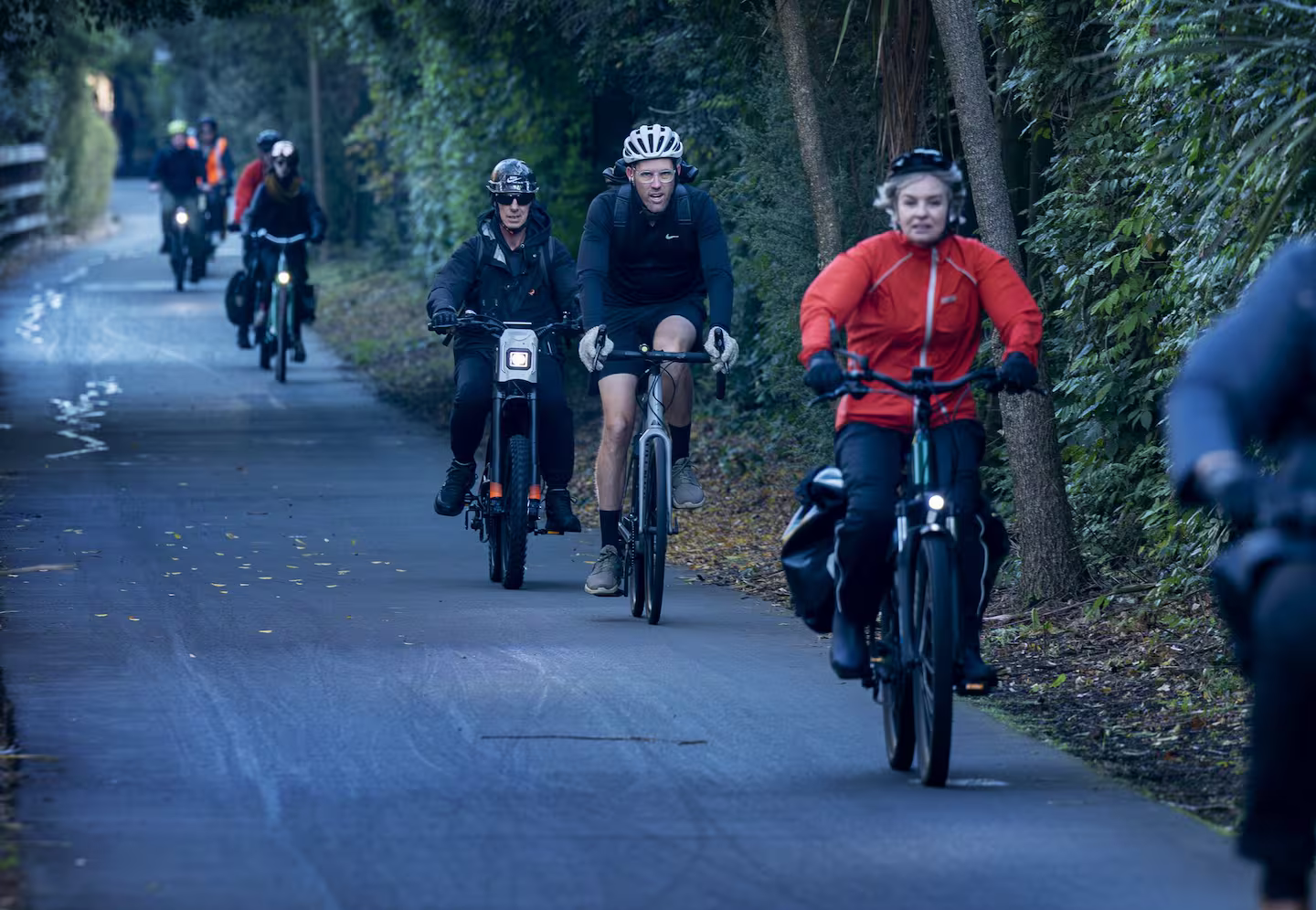
Cyclists, e-bike and e-scooter riders on the Northwestern Cycleway. Photo / Mike Scott, NZ Herald 20 May 2026
Speaking of changing people’s lives, Bike Auckland reports on a bike hub with a difference in Mt Eden:
The Chinese Conservation Education Trust (CCET), an active environmental non-profit led by the tireless Estella Lee, has officially launched the CCET Love Cycling Centre in Mt Eden, Auckland. This initiative serves as a bridge between Auckland’s growing cycling infrastructure and locals who are curious to try – or return to – cycling for transport.
Housed in a shipping container on Carmen Avenue in Mt Eden, the centre provides a welcoming space for new and experienced riders with both English and Chinese language support. Everyone is welcome.
Art for art’s sake
Amazing new Cross Street murals!
Working with Auckland Transport, Karangahape Road Business Association, property owners and their tenants, placemaking principal and creative Barbara Holloway, of the Auckland Urban Development Office (AUDO) at Auckland Council, commissioned artists to turn this eclectic little lane into a funky place to gravitate to when stepping off a train.
Funded by the city centre targeted rate, the street’s refresh reflects the city-shaping value of the City Rail Link (CRL). Auckland Council Priority Location Director for the city centre, Simon Oddie, says people will start to clearly see, from this project and others, that CRL is much more than a transport project.
“CRL is a city-shaping investment. Our new CRL station neighbourhoods have created places that connect people seamlessly to jobs, learning, culture and daily life, while supporting a more vibrant, walkable, resilient and low-carbon city centre,” he says.

Sneak peek of 3 new murals coming to Cross Street. Credit Ross Liew.
EVs: more than just vehicles
EVs could be used for more than just transport, Kate Newton reports for RNZ.
EV advocacy group Drive Electric launched its ‘State of the Nation’ report at Parliament today, calling for consistent, cross-party policies to get more battery EVs and charging infrastructure on the road.
New Zealand’s access to renewable energy gave the country a huge structural advantage, but policy changes that axed many incentives meant uptake was now lagging, the report said.
EVs should no longer be thought of as “just vehicles”, it said.
Their ability to store power made them “mobile energy assets that could reshape how New Zealand generates, stores, and uses electricity”.
…
Despite the benefits of electrifying transport, and building momentum around the world, New Zealand’s own transition had slowed.
The report pinned the blame firmly on the government’s decision to axe most incentives, including the Clean Car Discount and road user charge exemptions for EVs, along with weakening the Clean Car Standard that penalises importers for bringing in higher-emissions vehicles.
EVs fell from 27 percent of all new vehicle sales in New Zealand in 2023, to 11 percent last year, although increased to 18 percent in the first quarter of this year as a result of the fuel crisis.
Housing Issues
Neat to see New Zealand show up on the always intriguing NEVER TOO SMALL channel – with this Wellington project, in which a young architect replaces a sagging garage with a three-storey tome.
Housing is the focus of the winner of this year’s Rod Oram Memorial Essay Prize, which encourages writing “from young people campaigning for a more equitable, sustainable and compassionate world”.
The winning essay by 19 year old Angela Fang (who also has an amazing personal story) is titled “Building houses that we can call homes”, and digs into the social benefits of great affordable housing.:
Rod Oram spent his final years asking how 10 billion people could live well on this planet. That is the big question. But the smaller question, the one that keeps me awake, is how the people already here can live well in our cities, in this decade, in the only lives we have.
For my generation, the answer begins and ends with one thing: housing, as the foundation of a life. Without it, nothing else works.
…
A stable, warm, affordable home produces no export revenue. It contributes to GDP only in the most indirect way. But it is the foundation on which every other form of wealth depends. Without it, you cannot study, you cannot work reliably, you cannot raise children, you cannot participate in your community. You cannot live well.
Speaking of participating: Angela’s essay mentions the role of Kāinga Ora in building quality social housing, at scale. And this week, Dr Huhana Hickey, a housing accessibility champion, laid out the costs of Kāinga Ora’s (government-mandated?) retreat from accessibility targets.
… housing is not a luxury and accessibility is not a special feature. Our independence should not be reserved for non-disabled people. A nation reveals its values in the homes it builds and right now, New Zealand is building homes that tell disabled people that we were never expected to live here and that should shame us all.
Of course accessibility is of value to all of us, across the whole of our lifetimes, from our first wobbly steps to our last. We’re only ever one wrenched ankle away from sudden dis-ability, in and by an environment that’s not built for universal access.
Videos to watch
Why we need to change what we are doing with transport
Some interesting CRL comparisons!
That’s it from us this week, we hope you all enjoy your weekend!

 Processing...
On the NW bikeway cyclists, like me, and people on scooters want to go at a good speed. Few are riding slowly. Most of the path is ok for going fast but there are pinch points that slow us down. Small changes could be made that would encourage more people to use the path. The path should be widened in places. The traffic lights at Carrington Rd, the bikeway near Novar place, the connections to Morningside Rd and Sandringham Rd. the blind corners and narrow path near the Lincoln Rd intersection, the unsynchronised pair of lights at Makora Rd where the road is very steep and rhe stop start twice is difficult. The new bus station at Royal road will include an underpass for the bikeway but that is years away.
Ultimately the pathway needs to cater to bike users of all types. Reducing pinch points, blind corners, etc is great, but also riders/escooters need to take responsibility and cycle/scoot(?) in a safe and appropriate way.
On the Wellington Harbour Western Escarpment sea wall cost allocations.
Surely the sea wall needed a maintenance roadway on top of it regardless.
So the cost of the shared path/cycleway was sealing it, (desirable anyway to eliminate spume scouring) a toilet block, and replacing a private at grade railway crossing at Ngauranga with an overbridge.
Yeah even the half inch of asphalt arguably isn’t specific to the shared path.
And arguably the most expensive specific piece – the bridge at the southern end over the rail line, also makes maintenance access much easier, safer and no risk to train movements. Presumably the width and load design is based on maintenance vehicles and not bikes and pedestrians- they will be the “design vehicle”.
So yeah, should never have been funded entirely from the W&C activity class, and I did I question this thoroughly. But it was support that or the alternative of not funding it at all, and is so obviously a great and necessary project. I could not oppose it on funding purity grounds because of how literally murderous the existing on-motorway lanes were. Urgent to fix that permanently.
At least when the P95 came through with a fairly big increase that was funded by the Crown from the deleted Auckland Harbour crossing bridge through NZUP. I specifically sought that after that bad news came in.
So it really is the case that Wellington has got the cross harbour SkyPath that Auckland didn’t!
Now let’s fix the big missing link in Auckland, and no road tunnels are not required first.
How has the mainstream conversation even managed to become “this is a $400millon dollar bike path” when it really is a seawall resilience protection project.
I think we should lean into this and start insisting that $400m at a time be dropped into cycling projects around the motu. Let’s reframe this spend a a real win for cycling and DEMAND it be repeated throughout the country. Just think what $400M of cycling infra would do for Dunedin or The Tron. Bring it on; #BigNumbers4Bikes !!
Going by this project, that would result in a 2km highway widening with an added bike lane 🙁
Remember too that $400m from the Nation Land Transport Fund (NZTA), becomes $800m in outcome, as it is spent with matching funds from Local Govt (ie rates).
That’s a huge upgrade, would be able to actually complete most places’ whole networks.
I recall, for example, a programme for a full network for Hamilton that was $130m in total, with a BCR above 6 or similar… Would be funded 50/50 between govt and city.
But no, billions for duplicate over-scoped highways instead with BCRs below 1.
Yes, we definitely should have the active mode budget topped up with the wrong amount they have sucked out of it for that project. Quite clearly wrong.
Patrick, thanks for sharing but im shocked that Auckland has no active transport links across its main waterway, and that the “savings” from its cancellation resulted in the Petone Walkway.
Is it a model that if we cancel, say Mill rd, we can get a few Billion more upgrades in Wellington?
My thinking – (and i love whats happened for Petone-Wellington) is that the W&C activity class “owners” should have said no – not a single dollar for the coastal path. NZ would have had many years of new walking and cycling infrastructure without that huge spend.
Its a worthy project – but putting a path on an existing (newly extended) seawall is not a great expense. Building a seawall under a path costs hundreds of millions.
Great City rail Link video. A really clear succinct explanation. Circulate widely.
As to “too small”, there is an increasing media narrative that townhouses *are* too small and that we have to return to large-standalone dwellings. Example:
https://www.rnz.co.nz/news/business/595528/christchurch-townhouse-boom-seeing-half-finished-developments-across-city
https://www.stuff.co.nz/home-property/360980940/it-looks-prison-why-older-new-zealanders-wont-buy-homes-being-built-them
This narrative would be easy to dismiss if the housing market were functioning properly; if house prices/rents were falling to “clear the market”. But anecdotal evidence suggests that this is not happening; houses are remaining unoccupied for years rather than sell at a loss/drop the rent. I am going to in fact guess that bigotry is a factor here; some landlords would rather (for example) let a $1000pw rental sit empty than cut the rent to $500 and let “undesirables” move in.
For a view from the grassroots, check this Reddit thread: https://www.reddit.com/r/newzealand/comments/1tjfwj8/genuinely_perplexed_at_new_builds_where_do_you/
People are *angry* at smaller houses with less storage space. I fear we are about to see a big NIMBY backlash where the media, property developers and “average Kiwis” start demanding minimum floor space/storage space for new dwellings, probably gardens and parking as well.
I am also noticing what is a very obvious astroturf campaign to ban new housing. The campaign is gunning for minimum dwelling sizes and minimum car parking requirement and is very obviously driven by landlords to try and drive up rents long term.
That first article highlights why, in an obtuse way, a property slump can ultimately come back to bite in terms of housing supply and affordability. As it says, of course lots of building happens when prices skyrocket. Not so when they slump, or perhaps even flatline.
The storage problem IS a problem though. If you make two walls just windows, the bedroom barely 10sqm with a build in closet with sub-par shelf space and don’t have external storage space like a shed or garage, where the f$#! are you gonna keep your stuff?
You can design places better to allow for more storage options…
I can’t read the Herald article as it is pay to read, but how fast were the e-bikes and scooters going? The last time I was in Auckland with my road bike I was going 40-45kmh along the path with a bit of a tailwind.
The ABC episode is a great watch.
FYI, recently I was SH16 driving west towards St Lukes parallel to the bike path, keeping pace with an E-scooter. I was traveling at 60km/hr 🙁
That is far too fast.
It is no wonder that as cycling has increased, walkers are virtually non-existent now. Totally different when the path opened 10 years ago. Lot’s of walkers then…
Yes and what speeds did the NZH measure????
Finally figured out how to find the article via Auckland Libraries!
After a ridiculous intro declaring “many electric bikes are capable of speeds exceeding 100km/hr”, they found one e-scooter (rider in full face helmet) doing 53km/hr, most analogue bike riders doing ‘mid to high 20km/hr range’ and ebikes (and one eskateboard) doing low 30’s km/hr, and “several other scooters observed getting close to 50km/hr”.
regular “muscle” bikes speed is enough to cause carnage.
This “scooter” issue is just how does our society make space for the big/heavy/fast cars and the vulnerable road users. How do we keep our old, fail, pet on a leash owning vulnerable path users safe from high speed micromobility. Its how do we share our transport spaces. We are bad at sharing in NZ, possibly related to how we allow oil industry to donate to political parties…
We now have a cheap chinese eMoto (surron) in our family. $5700 landed to our doorstep (truck delivers large cardboard box). In the box an 8000w “bike” capable of 80kph and gets there very quickly. This is not road legal, but so cheap and easy to procure – they are now on our streets. Rego costs a fortune and is possible, but $600/yr ? is stupid and defeats the purpose.
NZ may revisit this whole issue when the diesel runs out (price goes to $6/litre) – i note we are now below our statutory limits and have been for a few days
Quite frankly if these young people do not have the mature brain to respect others on the paths,cycleways then they should be taught a lesson;ie their mode of transport taken from them for a while.Respect of others is failing dreadfully in many areas of this country.
The photo on this page shows an e-scooter rider who’s no spring chicken. Might be time to update your assumptions or you’ll get flattened by a greyhair going hell for leather.
Most of those speeding are young men. I have a disability and if I get bowled I’ll be seriously screwed. I’ve had a number of near misses walking on footpaths, usually teenagers hooning along on bikes or e-scooters. I don’t mind kids biking/scootering on the footpath, but they need to slow down and realise not all of us have the reflexes to jump out of their way.
If only the Aro Valley house was the rule and not the exception to infill housing in this country.
It’s perfect: no wasteful and polluting destruction of a perfectly good existing dwelling; access to the outdoors; thoughtful consideration for light and ventilation; and (importantly) attractive design.
Here is a copy of my letter that was sent to you about 9.am today and for some reason not published
On the NW bikeway cyclists, like me, and people on scooters want to go at a good speed. Few are riding slowly. Most of the path is ok for going fast but there are pinch points that slow us down. Small changes could be made that would encourage more people to use the path. The path should be widened in places. The traffic lights at Carrington Rd, the bikeway near Novar place, the connections to Morningside Rd and Sandringham Rd. the blind corners and narrow path near the Lincoln Rd intersection, the unsynchronised pair of lights at Makora Rd where the road is very steep and rhe stop start twice is difficult. The new bus station at Royal road will include an underpass for the bikeway but that is years away.
Good the see the new Te Ara Tupua pathway.
A bit different from the 70s – 80s when I was living in Newlands. I used to pace the traffic down Ngauranga Gorge and then it was onto the Hutt Rd into Wellington. A little bit dangerous…
I would have loved that pathway!
I enjoy the magnificent bridge that we somehow snuck through over the Manukau, where cars cannot cross. And still we are cut off from the North Shore. If we are serious, why do we let cars take up so much space on our precious Harbour Bridge?
It is high stupidity, dedicated bus lanes with a bike lane are so logical it is hard to believe how idiotic Waka Kotahi are about it. Waka Kotahi means everyone on the same boat, so why are pedestrians bikes and scooters not welcome on the post war infrastructure that contributed to the destruction of our city.
The size of Los Angeles with only one and half million persons living within it.
Embarrassing!
bah humbug
Bike Aucklands “liberate the lane” solution is cheap and fast to implement.
The reason there is no active transport across Auckland’s bridge is political not engineering or financial.
Maybe $4+ petrol / diesel (a when not if) may result in a rethink for the bridge’s owners in wellington, or more public direct action, Weekend bridge crossings would get another failed promise to open the bridge to walking/cycling.
Let’s not forget the interim solution NZTA came up with; 10min frequency bike ferries.
That went quiet quick.
So Wellington with 1/5 of Auckland’s population gets $400 million of the cycling budget. Yet spending $1 billion on a cycle crossing over the Auckland harbour was considered ridiculous.