After a recent meeting with Auckland Transport to discuss our observations, questions and concerns about the shape of the timetable once City Rail Link opens, AT reached out with an update.
We’re sharing the update as a guest post, so our readers can stay abreast of discussions – as always, feel free to add your thoughts and any questions in the comments. Thanks to Auckland Transport for engaging with us on this important (and very popular!) topic.
This is a guest post by Mark Lambert, Auckland Transport Group Manager Rail Services
City Rail Link timetable – better from day one and beyond
The City Rail Link (CRL) opening is a massive moment for Aucklanders and how they travel. Making it easier to get around everyday – whether it’s going to work, visiting family or going out to eat and drink with friends.
Beyond the immediate benefits, it should also be thought of as a foundational investment that redefines the whole region’s public transport network, supports Auckland’s growth and unlocks better transport for decades to come.
From opening day, Aucklanders will see shorter travel times, new stations, trains every 5 minutes at peak in the city centre as well as more frequent and better connected services across Tāmaki Makaurau. Perhaps most importantly, they will see more reliable services, and fewer planned closures, which we know is the number one priority for our customers.
City Rail Link is a catalyst for ongoing rapid transit improvements because it changes the fundamental constraint on Auckland’s rail network – the dead end at Waitematā Station. Over time more investment is planned to continue to ease congestion on the network and provide capacity for even more services, maximising the potential of the CRL.
At Auckland Transport, our role is to take what has been built for the City Rail Link and deliver the best possible outcomes for passengers region-wide. But, not all of the benefits can be delivered at once.
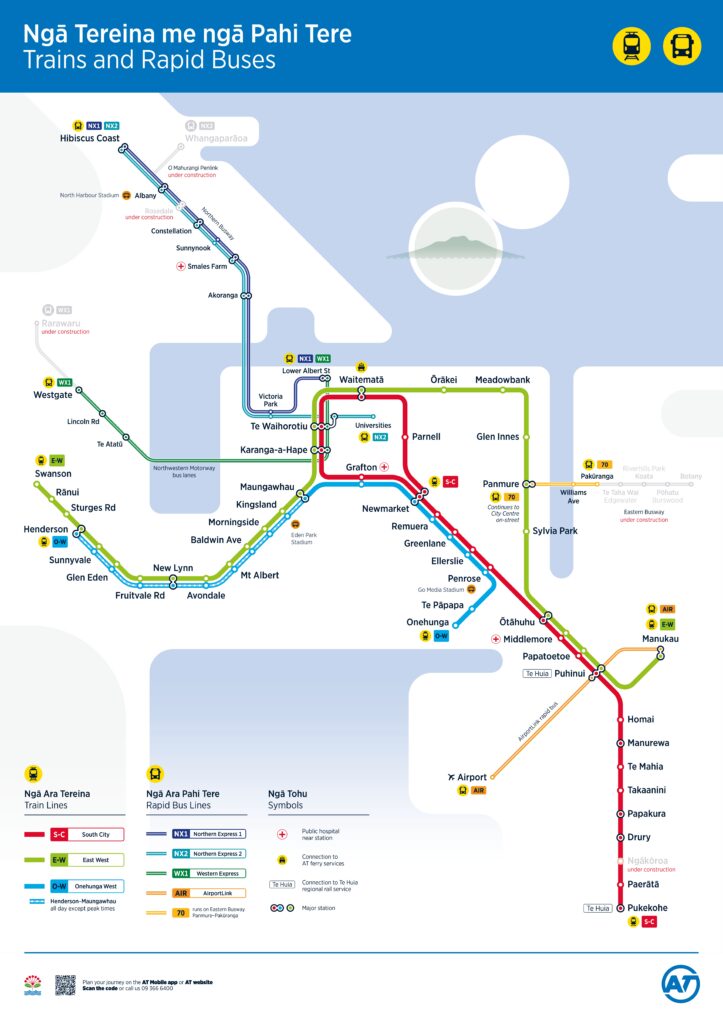
What to Expect When CRL Opens
There’s been a lot of recent discussion about what people can expect when the City Rail Link opens, so it’s worth starting there.
There’s been a significant investment in the City Rail Link infrastructure – tunnels, two new stations, the major upgrade at Maungawhau and improvements to Waitematā Station. There’s also been a lot of investment in the wider rail network and while there’s still constraints and more to be done, it is ready for a big step up to more frequent and reliable services.
When the City Rail Link opens it allows us to introduce three new lines – East West, South City and Onehunga West. Travel across the region becomes easier, more direct, and more convenient, with more one‑seat journeys and easier connections to frequent bus routes that now cover Auckland.
There have been dozens of iterations of the new rail timetable, developed over a number of years through collaboration between Auckland Transport, KiwiRail and rail operator Auckland One Rail, testing every possible way to make the network work as efficiently as possible within real world constraints.
A brand new rail network is only valuable if it’s reliable. That is our priority. It’s why we have run major network-wide tests of our new timetable before launching services to customers.
After the January testing showed congestion on busy parts of the network impacted reliability, we made some changes and in April, did further testing.
This went well, confirming the plan to open with a temporary timetable and then build more services and frequency within six months is the right one to ensure reliable services. A transitional timetable approach is common practice overseas – it’s how London’s Elizabeth Line, the Sydney Metro and many other rail lines were launched.
Services will be better from day one. Temporarily, we will start with frequencies during peak times that are a bit less than our ‘full’ plan. It still means trains every 4-5 minutes through the city centre at peak from day one.
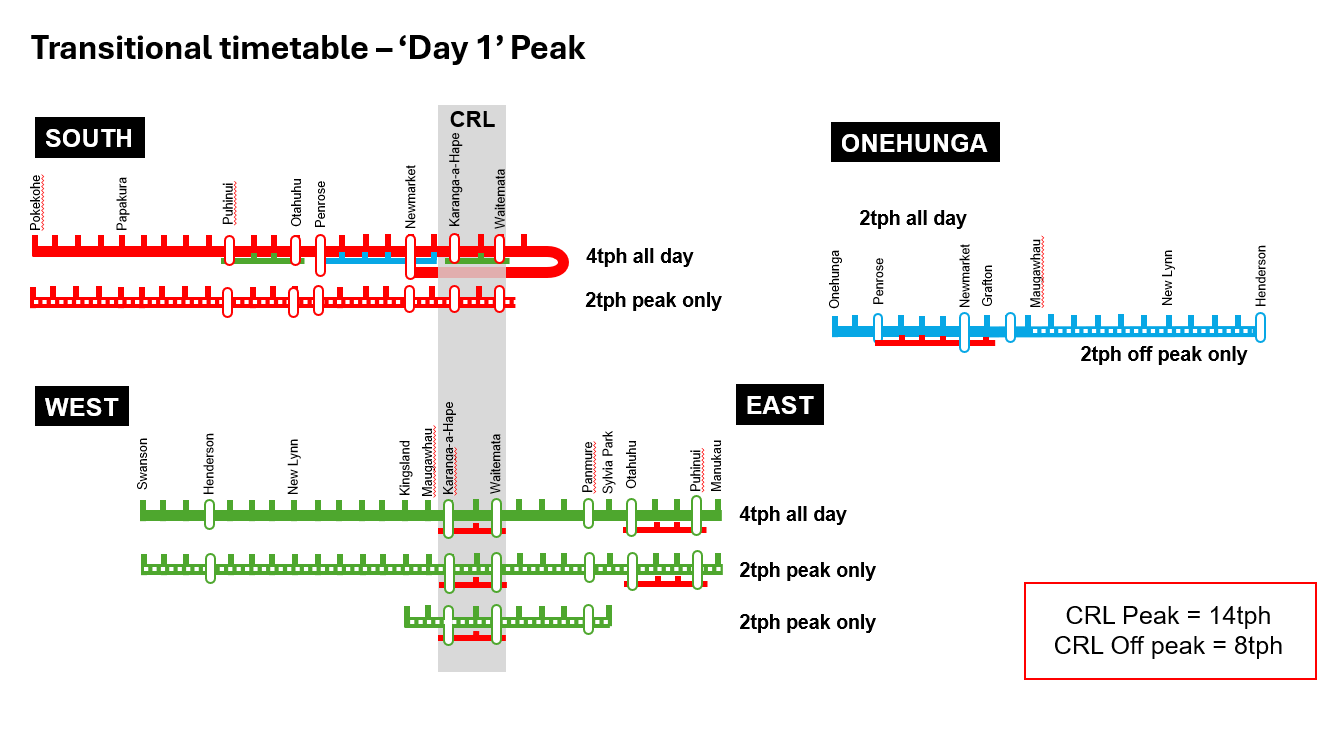
All day and on weekends a train will come at least every 15 minutes, compared to today’s 20 minutes. That means more seamless connections with buses, making it easier to get to more places. There will be big cuts in journey times, particularly from the west. And connections to new places – the East West Line means a direct train from Henderson or New Lynn to Panmure, Sylvia Park or Manukau. Along the East West Line there’s also connections to rapid bus routes such as the Northern Busway, Eastern Busway and Airport Link.
At peak times during the initial phase, the current overall level of service (trains per hour) will be maintained at 6 trains per hour across the South City Line and East West Line. Passengers will have a similar average 10-minute frequency to now, although wait times will sometimes be shorter or longer. This is because the train pattern allows 8 trains per hour, but with two ‘slots’ not used until we’re confident we’re ready for the next step.
From day one on the central section of the East West Line between Kingsland and Sylvia Park there will be 8 trains per hour at peak, about every 6-9 minutes.
Importantly, most services will run with six car trains, meaning more space for passengers and more overall capacity.
About Six Months After Opening: Frequency Increases
The good news is we expect higher peak frequencies within about six months of opening, subject to the real-world performance of the new network. First by extending the 8 trains per hour in the west to Henderson – a train every 6-9 minutes. Then by increasing trains from the south (north of Ōtāhuhu) in carefully planned steps.
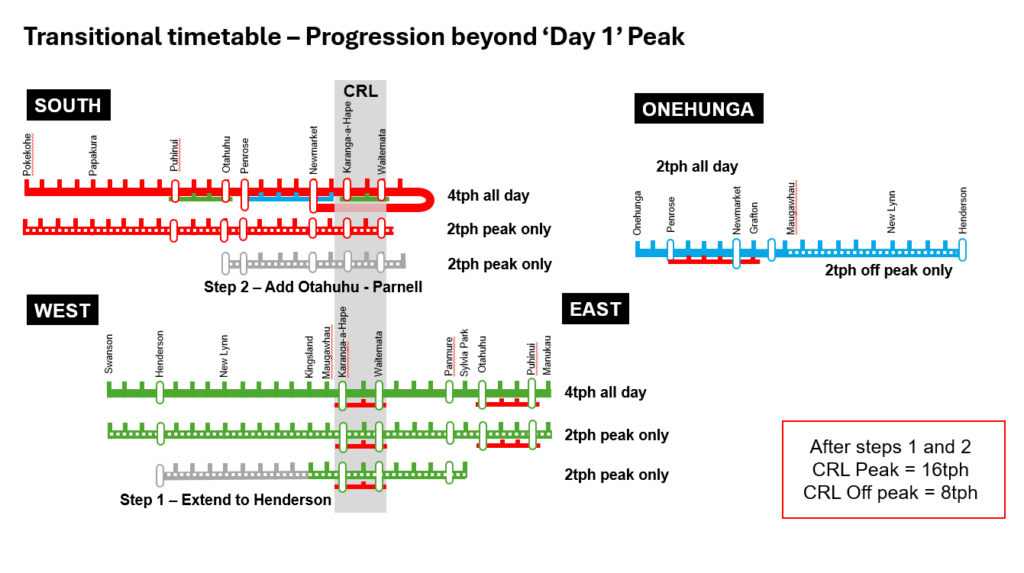
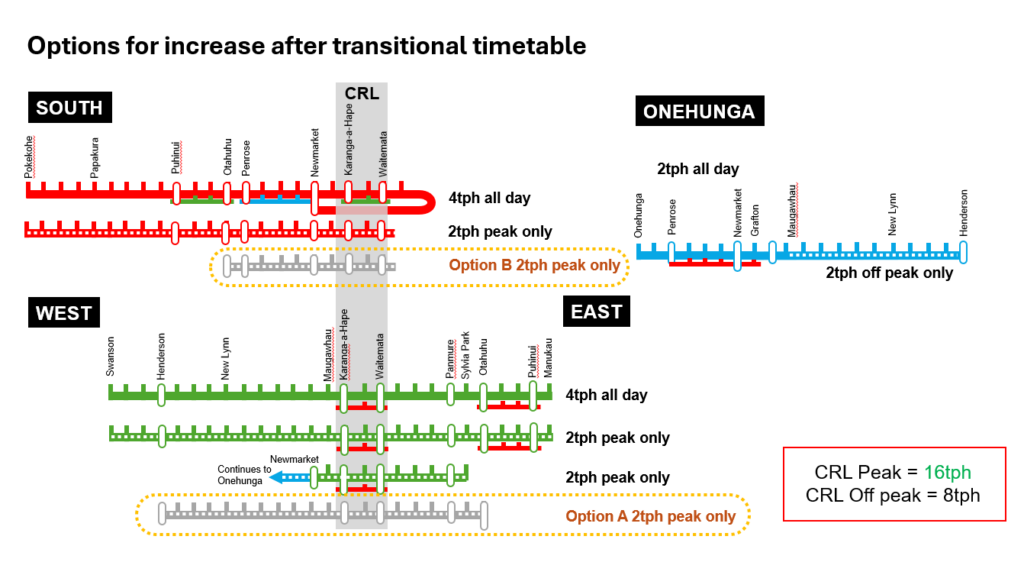
We’re excited for Aucklanders to give the train a go when the City Rail Link opens and we hope it attracts new users, as well as bringing back passengers fed up with disruption. As demand grows, and as our operating teams get used to the new network, we’ll look at further improvements we can introduce.
Longer-term, we know what is needed to unlock even more rail capacity. It involves replacing level crossings, 3-4 tracking, and upgrading stations on the network. Level crossing projects are already underway, as are upgrades to train signalling and control systems.
The good news is City Rail Link is built with the future in mind. Designed for up to 24 trains per hour in each direction and platforms for nine carriages, it is ready for the decades to come.
As Auckland grows, we’ll be ready to provide a train network which grows with it.
PS Auckland Transport is also rolling out some fresh explanations of the journeys and connections CRL will make possible, like the video below. Check out more here.
Greater Auckland’s work is made possible by generous donations from our readers and fans. Support our work by joining our circle of supporters here and setting up a reoccurring donation.

 Processing...
The names. Could we do better? Perhaps Tahi, Rua, Toru?
Having inconsistent service patterns/gaps between peak services is really totally unacceptable
And express services are totally dead then?
TBF I don’t think express services were ever possible, not until they increase the number of tracks along each line.
Our current wider network layout until more tracks are laid basically means planners are faced with “frequent or express – choose one”.
Fully agree. Increased frequencies for everyone are more valuable than improved journey times for select users at select times.
Also shows the need for additional track and junction improvements at critical locations in the near term, so both can be improved, along with greater resilience and reliability.
I dont know the first thing about train scheduling, so I always assumed an express service on the southern line would be possible (without disrupting other trains)
Leave from Pukekohe 10min after the previous train, skip a few stations between there and Puhinui, overtake the train in front on the 3rd main section when its stopped at Papatoetoe or something, then sneak onto the eastern line just ahead of the next East-West service and then run non-stop on the eastern line to slide into Britomart just before catching up to the next train in front.
Should be able to save ~ 20 minutes. And doesnt use up CRL slots because it just stops in Britomart then goes back the other way.
What am I missing?
But yes, Te Huia should also be able to do the same thing without taking any suburban units out of circulation.
Doable in theory, but it’s only a small delay away from either not being an express as it misses it’s slot or delaying other services.
Take Te Huia if you want an express.
“Passengers will have a similar average 10-minute frequency to now, although wait times will sometimes be shorter or longer.”
So it literally won’t be better for everyone day one.
You also make a point of saying there will fewer rail shut downs, how is that going to work on western line with its 20 odd rail corssings? I would assume building a trench at say St Jude street… will take the multiple months of the enitre western line from at least MT Albert being out of commission.
The New Lynn trench was built without the Western line closing down, although it resulted in a lot of weekend disruptions.
Dealing with level crossings is many years to decades away…
I think their plan is to deal with all the level crossings to Mt Albert and add a third track in the middle before Woodward – so they can run extra trains to Mt Albert (and eventually send them to Avondale-Southdown), which allows them to defer most of the level crossing removals out west apart from the ones urgently needed for safety, while still allowing the frequency increases.
For their inner west improvements – Morningside needs a big expensive solution (mostly for event crowds, the local traffic/bus routes could be rerouted pretty easily and for buses at least it’d be an improvement), but the rest can be closed and replaced with pedestrian bridges pretty easily, and there is space beside the tracks @Rossgrove/Asquith to build a short pedestrian path allowing a single bridge to replace both crossings. Woodward would also be more expensive and is part of their inner west list, but I think they don’t need that to run higher frequency to Mt Albert.
They could easily close more than half of these crossing and add pedestrian bridges. The choose not too, just like how they have decided that they wont meaningfully increase the number of trains until grade separation.
How on earth is there not a public plan about how to address this massive issue which fundamentally limits the rail network… just AT things I guess.
I think they’ll close the crossings, it’ll be far longer than it should take, but quicker than we’ll expect. My concern is more that they probably won’t be able to get a prefab pre consented pedestrian bridge, the costs for simple pedestrian bridges will become nuts, and they’ll just close the crossings, throw a token amount at local projects and tell people to walk around, like they did at Kingdon St, Lloyd Ave etc. – which sucks for the local community.
https://www.greaterauckland.org.nz/2026/04/14/at-surveying-about-western-line-level-crossings/
https://www.networkrail.co.uk/stories/how-a-flat-pack-bridge-means-better-connections-across-britain/
If that is the decision that AT have made then they should be public about it and say that the entire Western line is pretty much as good as it is going to get for decades.
The Western line has gone from prime beneficiaries to having worse day one frequencies.
No decisions have been made. There is active consultation happening. Work will be staged over 10-20 years. They can’t just increase trains on the western line overnight and create traffic chaos.
There are trade offs because of our car centric transport system. The negative attitudes you espouse – the CRL-cinda narrative isn’t helpful.
That isn’t going to happen in the near future, so it’s not worth granting consideration.
My “home” station is Glen Innes and my only option to get to it is a 20 plus minute bus ride or I can walk there in around 30mins. The buses only have a 20 min frequency so even if the train frequency increases it’s no easier to get to and from the station and still no guarantee that there won’t be long waits for the bus connection. With all the disruption to the rail I’ve started driving to the nearest 75 bus stop which is a fantastic route that goes most of the places I want to like Newmarket. So while I’ve hoped for this train line for ages I truly don’t think I will use it now as I no longer need / want to go to the city centre.
A 30 minute walk means it’s a 10 minute maximum cycle. Get a bike
No thanks,
“I want to improve my travel time”
“Here’s a way to improve your travel time”
“No.”
Classic kiwi stupidity
‘Heres a potential way to improve your experience’
“That option wont work for me because (various possibilities that really are none of your business)”
‘Youre an idiot’
Another completely sane and mature Greater Auckland discussion, well done guys…
Can I suggest a light fold up electric scooter then? It doesn’t have to be massive like the flamingos and limes. If you’re just using it to speed up a walking distance it can half that or more. I just use mine to change my 16 min walk to supermarket into a 6 min scoot to the supermarket. Plus you can just loop the shopping bag on the handle so you don’t have to carry it home.
Just inventing parts of the conversation that never happened in order to score some points online, classic internet discourse
Typical of this website. Shout people down without any context, and from an ultra -ideological position.
Who knows why Jackie doesn’t want to / can’t.
I can’t ride a bike because of a physical impairment.
Some people feel genuinely unsafe.
She’s outlining a valid point in terms of the bus service.
Glen Innes has a few bus routes that run every 10 or 15 minutes. You must be unlucky to not live near one of those routes. Also trains can’t cater for everyone.
Glen Innes also now has fantastic cycle lanes on many streets (providing people keep their wheelie bins and parked cars out of them!), making the ‘get a bike’ comment totally worth a try – and you can borrow an ebike from the GI bike hub for 2 weeks at no cost to try it out!
As population grows in Glen Innes catchment, feeder services can be improved.
So there is a bus, problem solved.
Pro tip, if you want to be a mode snob and take trains… live near a train line and station.
Hi Jackie. Sad that comments below your’s are insulting to you. ‘Get a bike’ is not something everyone can do for any number of reasons. I can’t for a medical reason! I hope you can find a solution that works for you and please ignore the rude responses you’ve received.
I agree. Pathetic.
The CRL is not going to fix all the deficiencies on the Auckland suburban rail network.
But it is one of the most significant steps in an ongoing transition of this network,
From near moribund three decades ago, when 18 two car sets of second hand diesel rail cars, all 36 carriages, were purchased to start the rejuvenation.
Since then suburban rail has returned to the city centre, the system has been extended to Pukekohe, it has fully electrified, and now operates 285 high capacity carriages in three car multiples. So a nearly ten fold increase in capacity in just over thirty years. That is huge.
May the improvements now continue with grade separating both road and rail cross overs. There is still a lot of improvement potential to be realised.
Meanwhile in regional NZ… Can we please have a crumb of passenger rail?
It’s election year…
Ah yes, I almost forgot about the erection.
Commuter rail in regional towns is overkill…Christchurch on the other hand needs rail.
Commuter airlines in regional towns is overkill, commuter rail is a no brainer
Sure and no one suggesting that public money get put into that tho are they?
Even the most compact regional towns with ideal urban layout, rail is basically fantasy. Take Nelson for example, long narrow town with a rail corridor… no chance.
Once again, NZs second city does not have passenger rail despite active rail lines and infrastructure all over the city.
Somebody must be suggesting it because public money does keep getting spent on regional air travel?
St Jude will likely be shut and traffic would have to be diverted, it’s a terrible route and will cost an insane amount to grade separate.
A lot of people on this page will probably be disappointed somewhat by this post, with the odd timing peak services… however,
What is a big improvement is that the all day frequency is now 4tph (15min) each direction instead of 3 (20min).
I personally think that the goal should be to have an all day frequency of 6tph (10min) and then services added in during the peak,
Rather than a lower baseline (4tph) with various peak iterations added in.
What I would also like to see is the post peak service timetable for Friday and saturdays. I’m hoping that this can be 6tph till at least 9pm, and ideally later.
Comparing this to Sydney’s new metro (driverless and completely separated) is like apples and oranges but I remember last year that late at night on a Friday there were services every few minutes, and the trains were full.
That’s probably not something practical or possible here but ideally they can keep as many services going on Friday and saturdays nights to keep people moving in and out of the city.
Yes in general for a service to be considered Rapid an all day 10min frequency is the minimum.
I have never understood AT’s classification system which has the same minimum 15 min frequency for both its middle and top tier service definitions, Rapid and Frequent.
It should be an aim of the new PT agency to properly redefine its top tier service as 10min minimum and aim to deliver that over time, as a key performance goal.
After all the rail network has been/is being completely rebuilt (Rapid bus services already have higher frequencies).
100%. 10 tph all day would be transformational and have more impact than more peak services.
Or 6 tph, every 10 mins.
And increase “All day” to “from 5 am to 11pm”, 7 days a week. Additional late trains until 1am city centre departure (could be only 2 or 3 tph).
CRL has been delayed because the gilding isn’t done yet. They are bringing in Trump’s man from Florida.
We can’t have nice things in public works. It must be cheap, rough, ugly, uncomfortable, and barely functional.
Executives in the public and private sector personify these frugal values with their hair shirts, sandals and infrequent bathing.
Trump’s gilding will not be real gold. Just pretend gilding, over polystyrene forms bought from Bunnings.
I do hope they are going to provide simpler graphics for the wider public to explain this as showing the same number of tph on any given line across the various transition period doesnt help get a sense of an increased frequency. Also keen to see the updated time savings- initially the CRL example used was a journey from Hendreson to Te Wai Horotiu saving about 15 mins – but this compared to the journey from Henderson to Aotea square including a 15 min walk from Waitematā -so to be consistent we should see time savings Hendo -Waitematā pre and post CRL.
I think that last point is a good one – as someone who will still be getting off at Waitemata I am keen to understand the real time savings.
It’s about an 11 minute saving for the western line to Waitemata.
Assuming you don’t miss the train and have to wait for service gap?
The planned timetable operating configuration for the rail network once the CRL opens needs to be changed as it is too complicated, not user-friendly, and is not going to be reliable. The planned later ‘additions’ will just make this worse.
There needs to be a simpler, more user-friendly timetable which involves Southern Line services running from Pukekohe via Panmure through the CRL and terminating at Newmarket, with some 3 car services running onwards south to Onehunga. Western Line services running from Swanson via the CRL, then south via Parnell to Manukau. This would at least have Western Line trains running through Newmarket.
Operationally, it would be much simpler to run with two point to point runs with less conflicting movements.
The services could simply be named after the colour of their route line, e.g. red line, green line.
New express services could be introduced on the Southern Line to take advantage of the new Third Main with peak flow express services in the morning and afternoon running between Pukekohe-Paerata-Drury-Papakura-Puhinui-Middlemore-Otahuhu-Sylvia Park-Waitemata-Te Waihorotiu-Karangahape. These express services could replace the Te Huia services north of Pukekohe, running with 9 car sets. These express stop stations would need to have their platforms lengthened to 9 cars.
Express services running to these particular stations would be very popular and would make the Te Huia services more desirable to use for Waikato passengers, particularly if new stations were to be built at the commuter towns of Pokeno and Te Kauwhata, and extending Te Huia services to Cambridge and Tauranga / Mount Maunganui.
Train services need to be extended with new diesel services on weekday peak periods between Swanson-Helensville and Pukekohe-Waiuku using refurbished former Auckland Transport SA/SD carriage trains which GVR now own, providing train services where and when they are needed.
Instead of shutting the rail network on weekends all the time, train services should stop earlier in the evenings after 9pm, to enable more time for maintenance work to be carried out overnight, which would be to the benefit of the majority of people who use trains during the daytime. Very few people use the trains after 9pm, so it is a waste of time and money running late evening trains when buses could provide adequate public transport at this hour of the day when there is no traffic congestion problem.
Pukekohe–Waiuku doesn’t seem like a viable rail service unless the speed limit on the GVR section can be raised to a consistent end-to-end 80km/h and the travel times can vastly undercut the present ~40 minute bus timetables for the 396 bus route.
I don’t think the steam trains have ever run much faster than 50km/h on the route, and they definitely all slow down to an absolute crawl through the Pukeoware yards, that would definitely hold back a peak hour commuter service.
I’d wager that expanding the current and incoming Franklin rural bus network and increasing frequencies on routes from Waiuku, Waiau Pa, Clarks Beach etc. feeding into Pukekohe, Paerātā, and Drury stations should be more of a priority – although Pukekohe–Glenbrook shuttle train services on GVR steam operating days wouldn’t go amiss.
Some regional passenger rail routes are undoubtedly a good idea,
But Regional council’s like the Waikato and Horizons
needs to lead the charge here, and be prepared to stump up cash.
A significant chunk of Aucklanders rates goes towards our suburban rail system, both the capex and opex.
Central Government is not going to do anything without very significant organised pressure.
Oh hang on, isn’t the current government intent on depowering Regional Councils?
That was meant to be in reply to Anon
My question is if the regional councils are in charge of public transport, why is the Capital Connection the only regional train service Horizons has been able to dream up?
District Councils have to fund and build the transport infrastructure (i.e. bus stops), so I assume they would also have to also find funding to build new stations? Does Kiwirail offer subsidies for this kind of infrastructure? NZTA sure as shit won’t help.
When waiting for a train, or a bus, or a ferry…a fifteen minute wait is too long, a ten minute wait feels like an hour. Until frequency is five minutes, the system is not fast enough. With trains at five minutes frequencies, ferries at twenty minutes as they are now in peak, and bus ways currently at two minutes (although all major bus routes need to evolve to light rail at five minutes intervals), the network begins to become functionally superior to the motorway.
This is the future: a city that you can move within, to anywhere, in a reasonable time period, without a private motor vehicle.
Now that is something to believe in!
bah humbug
I absolutely agree on frequency. Also because very often the trains are actually 2-5mins or even more late, just to have the next one show up 7mins later, resulting in very uneven frequency.
The impression I’m getting is that instead of a nice clock-face frequency (like we have now) we’ll get a hodgepodge of various wait times on the same line in the same direction. Which is going to make it even less ‘turn up and go’ than it is now.
The naming feels like it needs a bit more work.
International best practice tends to favour simple line numbers and colours as the primary identifier. It’s less exciting, but much easier to remember and navigate, especially for tourists, infrequent users, and people less fluent in English.
Simple corridor-based naming could then work as a secondary layer:
1 East–West
2 North–South
3 Onehunga–West
The dashes matter. They make the names read as connected corridors or movement patterns, rather than compound place names. For example, “Onehunga West” reads like the western part of Onehunga. “Onehunga–West” makes it clearer that the line connects Onehunga with the west.
The use of City in the southern line is also confusing and I suspect it doesn’t reflect how most people will actually use the network. The Southern line’s loop through Parnell feels more like a minor network connection rather than the defining feature of the service and how people perceive the line
God yes, those line names need to go.
Paris – single letters (RER) numbers (Metro)
NY – single letters and numbers
LA – single letters (enabling great marketing campaigns)
All graphically strong, combined with colours on maps and signs, incredibly clear, memorable.
How could we make a tiny 3 line network so confusing illegible?
Though of course should have a consistent system with the rest of the RT network.
That is what I read when seeing Onehunga West, west Onehunga.
Kudos where it is due: this pattern is waaaaaaaaay better than the insane proposal that was tested in January.
However, this timetable shows that someone in the decision making process simply does not understand what a metro system needs. This is needlessly complex and the short runners will be confusing and frustrating for passengers at outer stations. The routes should very obviously start at 10 minutes frequencies on their full length all day and move to 7.5 minute headway ASAP. The *only* sensible short running would be to end every other southern train at Waitemata.
All this is just a sideshow and a distraction to the most important question. When is it going to open ? Every day it is not in service costs are racking up more. There is no urgency to this, committing to an opening date and doing whatever it takes to make it happen is what is required. Currently they can just keep pushing it out, which is what is happening. Not good enough.
This proposal has some interesting innovations, like Green line short workings terminating at at Kingsland (not sure why) and Sylvia Park (presumably to keep clear of Westfield junction, at the expense of connectivity); and Red line at Waitemata and Parnell (both via the CRL, again presumably putting congestion avoidance, this time at Newmarket, ahead of connectivity). The Parnell terminators will carry a lot of fresh air to/from their terminus! All these terminating moves will require careful management, adding complication to the network.
And it’s notable that Option A in the final state is said to introduce a Henderson-Otahuhu peak service, but it actually appears to replace the Sylvia Park peak terminators, which go to Onehunga instead (but do not in appear in the relevant Onehunga diagram). If Option A doesn’t transpire, peak Green line service will appear to be reduced by 2 tph over the previous state – a strange outcome.
Whatever, it’s a brave attempt to optimise service on a complex mixed-traffic suburban railway with multiple flat junctions, a task that will never be simple. It’s just a shame that the construction of the concrete tunnels preceded the timetable design. If there’s a lesson to be learned, it’s that the focus needs to be on what infrastructure will achieve, rather than on the infrastructure itself.
I assume the short running services terminate at Kingsland and then wait up just down the road at the (non-platform) part of Morningside where there are four electrified tracks. Likewise, after Sylvia Park, trains can wait up on the triple-tracked section of the Eastern line just south of Sylvia Park. Just a guess . . .
. . . and Parnell trains will wait up at Quay Park. Waitemata has terminator platforms, so no problem there.
Yes this is the key to making the whole network run smoothly. There needs to be track to store then turn the trains around. Look at Pukekohe station or Papakura. It’s very hard to do this at Newmarket but they are going to try because they don’t have to many other options. Newmarket is complicated because it’s a junction as well. Kingsland is a obvious as it’s being designed to handle crowds after a footie match. Sylvia Park might work but using the third main for reversing and storage stops it from being used for through trains. As for Parnell I assume they will just reverse them down to Quay Park. So we are going to find out. I am thinking there is going to be extra track added somewhere.
When is CRL going to open???????? I want to book my trip to Auckland
Maybe September.
Great improvements for the Onehunga line. 30 min frequency reducing to 30 min frequency.
They can double the frequency with a short section of track in the middle. Just doesn’t look like there are any plans for that anytime soon.
i think the Onehunga line has been permanently hamstrung by the politicians of the time not having the foresight for how much work would need to be done for a proper high-frequency S-Bahn type rail network.
Mike Lee talked like it was an easy hop skip and a jump to extend the OBL to the airport but turns out the amount of grade separation, double tracking et. al required would push the cost to probably $5-8 billion
They future proofed for a single track rail under the brand new bridge but the rest of the corridor they’ve mostly prepared for double track rail extension of the Onehunga Line. I think later on they started looking at LR so the Kirkbride Rd bit has steeper gradients – but I think realistically it’d be elevated at that point as the space saved for the rail sort of ends before that.
https://nzta.govt.nz/projects/sh20-manukau-harbour-crossing
Agreed on costs if not higher – but that’s more because construction/consenting costs etc. have got insane rather than the route/mode.
yeah, if you’re after the most economical CC2M solution, surface light rail still clears the competition by the virtue of adding all that new catchment along Dominion Rd to the RTN for the same or less cost as the OBL extension
Most economical is running buses. Little to no start up infra, and opex isn’t that bad for it especially with lower volumes.
Dom Rd should have trams but they should go to Dom Rd extension and interchange with the Avondale – Southdown line, as they’re serving different markets. Plus if you were going from the city to the airport it’s faster to take the train to Puhunui.
Looking at the map there are already frequent routes that could probably do with select bus lanes and improved frequency more than CC2M is needed. Local buses being too busy should be upgraded to trams.
ALR fell into the trap of trying to do everything rather than one thing really well. The problem is there is too much demand for local buses along Dom Rd, trams along the surface stopping at the same stops are the logical conclusion.
For longer distance on the west side of SH20 they’ll have the Avondale – Southdown line taking them directly into the city. Eventually they’ll build some level of metro line but that will be decades after NW/Northern Busway both get some form of heavy rail or light metro.
Local trips – generally within an area (frequent stops, speed isn’t as crucial) start off with buses, then get bus priority/improved frequency/bigger buses, then eventually upgrade to trams/LR.
Area to area transport (speed more important due to distance, less stops) starts off with buses, then get bus priority/improved frequency/bigger buses, then eventually higher modes like light metro or heavy rail.
ALR tried to combine local and area to area trips, and we all know how it went.
Extending the OBL to the airport doesn’t sound unrealistic. Not much property acquisition required if it’s run alongside the motorway, and potential in future to add a junction with the Avondale-Southdown corridor
It will cost way more than the CRL. It isn’t as easy as it looks on a map.
How do you figure it will cost way more than CRL?
The most recent ALR proposal had a cost range of between $7.3b – $29.2b, and that was 22km of track PLUS tunneled track in the CBD, it would undoubtably be cheaper than that
https://www.treasury.govt.nz/sites/default/files/2022-03/alr-4528767.pdf
The CCFAS study estimated it at $3bn – in 2016. Think about construction costs since then.
It’s mainly due to the need to double track the existing lines and all that comes with it, grade separation at level crossings, elevated structures needed on SH20 and tunnelling at the airport.
It had a BCR of less than one and a big reason for that is that due to gradients and alignments it had less stations than LRT and for all that cost and effort, frequencies weren’t great.
“Extending the OBL to the airport doesn’t sound unrealistic.”
You can already get to AKL airport by taking the train to Puhinui Station, then transferring to one of the new fleet of electric shuttle buses that run approx every 5 to 10 minutes 7 days per week. They have built in luggage racks. The Airporter shuttle bus is free if you tag off of the train at Puhinui
Well aware this bus service exists, I have used it multiple times. Just don’t like buses
@Anon
Extending the OBL and running 8tph to Mangere and the Airport would require
1. A grade separated junction at Penrose (possibly a few hundred million dollars by itself, and possibly involving resiting the station or just eliminating it as a stop on the Onehunga/Airport line which hampers transfers)
2. Double-tracking and grade separation of the entire OBL
3. A new Māngere rail bridge, since the provision made by NZTA on the current motorway bridges would only support a 15km/h alignment single track heavy rail line cantilevered off the bridge piers.
4. Elevated track from Māngere bridge to Airport Oaks, followed by a tunnel under where the future second runway will be and possibly all the way to the airport terminal station (though the airport seem to want an elevated line per ALR documents). Also seems unlikely that stations at Favona and Ascot would be possible due to curvature/gradient limitations and heavy rail’s slower acceleration/deceleration than light rail or metro.
it would be roughly as expensive as the original AT surface light rail plan cost ($3–4 billion vs $5–9 billion), only ~5 minutes faster from midtown to Mangere or the airport, and though it would have higher capacity (8tph with 1125pax per train = 9,000pphpd versus 15tph with 450pax per LRV = 6,750pphpd) it would have nearly twice the wait time if you missed your train
Assume you’re referencing the SMART business case?
https://at.govt.nz/media/1866351/item-11-6-smart-preferred-way-forward-final.pdf
Can definitely see how double tracking & grade separation of the current line would significantly increase costs. One lesson to take from this seems to be that future proofing the Māngere Bridge for rail was pointless, which is a good lesson for those suggesting we should futureproof the busways for light rail.
I don’t understand how to read those train-line graphics.
The different add-on red and grey bits, the dots etc.
The red bits denote stations where you can change to the red line and the same for the green and blue bits.
The dots represent peak hour services and the grey the CRL section of the network, that is the three underground stations.
Commuters coming from the west to work in Grafton or Newmarket are going to get a worst service than the one we’ve got now. We’ll have to change trains at Karanga-a-Hape (up an escalator and down another?) and go back the way we came. That’s a huge number of hospital workers and school kids. Very annoying.
No escalators. The transfer is across the platform
I hope you’re right. Doesn’t look that way from the pictures I’ve seen of the inside of Karanga-a-Hape.
I haven’t found really good pictures, but in this video you can see that there are arrows pointing to platforms 1 and 2 on the same level:
https://www.youtube.com/watch?v=89TWSR7JcaA#t=30
Te Waihorotiu is an island plaform so you can change there.
Avondale Southdown is never going to happen. We can barely get a LRT branch down a street that used to have trams, suddenly we’re going to have the stones to bulldoze through an entire community?
As for the North West, there’s no need for it to be metro or heavy rail. Just more $$$ for arguably no real benefit, just like the Shore. Light Rail with rapid bus transit along SH18 to a rapid transit busway corridor also running LRT will do far more and cost far less.
If Avondale-Southdown is never going to happen then maybe NZRC should just sell the land and use the money to build more bus/motor-ways
Would be cool to see the comparison in BCR compared to Avondale Southdown being a busway compared to heavy rail. Do the 2 freight trains a day really need a 6 billion dollar bypass. is the expected usage of this line need heavy rails capacity? Probably not, especially if we can get away with one of our busiest public transport lines being buses already.
This but unironically
Appendix 7:
https://www.kiwirail.co.nz/assets/Uploads/Our-network/Our-regions/Auckland-Metro-Rail/Avondale-Southdown/SMI-AS-WS2-PRE-GEN-MCA-Assessment-Report.pdf
What is needed first of all is a meaningful rail freight terminal north of Auckland.
Build the Marsden port terminal and spur and then wait, probably a few years to see how things develop. In the meantime hang on to any designations and land to build the A to S deviation.
You know what’s a lot cheaper than a massive new branch line and trying to funnel a huge portion of the city’s freight and commercial goods movements through the most congested part of the city that has no proper rapid transit connection at all? Just not moving the port in the first place.
Do nothing is always an option
And maybe do some sort of pop-up busway between A and S in the interim, to prove the case for a rapid transit line, whatever the mode.
Perhaps take it to Onehunga where services split – Penrose and Sylvia Park, or south to the airport.
Or just bite the bullet, put in a busway and then upgrade in 20yrs time.
They already have the 67 which roughly duplicates the crosstown function albeit a lot slower. I think a big use case will be commuters from Dom Rd extension area to the CBD though, as faster to take a train to the CBD than the bus.
The reason it’ll get built is for freight though, they’ll make a big song and dance about passengers and we’ll get new stations/better passenger links etc. for it, which is great, but it isn’t KRs motivation for the project, nor the other interest groups.
Plenty of other reasons it should be built:
https://www.kiwirail.co.nz/assets/Uploads/Our-network/Our-regions/Auckland-Metro-Rail/Avondale-Southdown/SMI-AS-WS5-PRE-GEN-Network-Resilience-Study-Output-Report.pdf
I’d read the other stuff linked but not that one, thanks, was interesting. I also see it looks like KR are planning to just build the west facing junction @PnS vs the east one so AT pays for it. I’m hoping it’s grade seperated because we don’t want to be adding more constraints to the network but my guess is the plan is for a flat one.
Tbf to KiwiRail they’ve mostly got their ducks in a line for Avondale – Southdown. Bulk of it the land is bought/bulk of the route is beside the motorway.
The Onehunga bit honestly I could see being split into a Stage 2 (as Auckland gets the Dom Rd relief etc. just from the ‘easy’ part along SH20), as allows them to do the cheap easy bit first then slowly working through the tougher bits.
The crosstown + freight benefits obviously need the whole link, but end of the day pretty much everyone in that suburb moved in after the rail was planned, and the financial interests for the project outweigh a few NIMBYs in a not particularly upmarket suburb.
Agree on buses for SH18, disagree on LR, wrong mode for the use case. Trams are for local trips (generally within an area, frequent stops, speed less important) when buses don’t have the capacity (Dom Rd). China etc. shows that you want heavy rail/automated light metro for the routes that are more area to area/speed is more important/less stops – after bus priority measures have been exhausted, as is still cheaper to run a bus generally.
I was really hoping for a date to be honest.
Under their future rail program, Kiwirail don’t plan on having A2S operational till 2055. I note this report mentions “the next 15-20yrs”. It’s approved under Fastrack but doesn’t have any funding.
In some ways, it looks like it’s getting closer to fruition. In others, there is nothing concrete to suggest this is going to get built anytime soon.
Who knows – maybe the Minister of Rail has a big pre-election announcement to be made, for A2S and/or Onehunga to the Airport.
I doubt it’ll be anytime soon. Election promises are typically just words. But realistically in Auckland we’ll be getting some level crossing removals to Mt Albert and a few extra tracks in places in the short term. As like Marsden Point Branch and the Auckland – Tron electrification gap are higher up the list.
Hopefully they add less than a hundred metres of track south of Newmarket so that Newmarket junction ceases to be a constraint in the current timetable, and a passing loop in Onehunga so they can double the Onehunga line frequency. Both are in KR land so should be relatively simple.
I think they’ll start Avondale – Southdown sooner than the Kumeu freight hub though, and probably before they’ve removed the outer west level crossings. Started within a decade and complete within 2 is my guess – not because they’re planning it but because it’ll move faster than they expect.
Allows AT to balance the inner western line better (as there will be near 0 capacity constraints with Mt Eden grade split, and hopefully the new AS junction grade seperated as well, with the inner west crossings closed) with past Avondale being constrained by the self imposed crossings constraints.
Would allow their peak Sylvia Park to Kingsland initially/Mt Albert later services to go to Dom Rd (as guessing they’ll build the easy bit to Dom Rd first, open stations for passengers, then years later the Onehunga part).
Sounds realistic, Aucklanders probably need to get the bitter taste associated with CRL out of their mouths before the govt tells them they’ll be paying for another major rail project through the city
Tbh I think the CRL cost complaints will vanish (bar the ZB demographic but they’d complain regardless) once CRL opens. Pretty much happens with every project, people moan and say the sky is falling, then society gets the benefits, the people directly affected move on with their lives, and the people that complain find something more current to complain about or age out.
Personally I think the deal Auckland made sucks financially but was probably the right call given the alternative of not having CRL. Big projects sucking up budget are great for forcing other parts to do more with less.
I don’t mind Auckland paying for Auckland’s projects if we get them faster, and once congestion charging appears in a few years or so they’ll quickly be wanting to have flashy projects they can say it’s going towards.
I’m guessing it’ll end up being CBD only at first (whenever the council decides to progress it as ball is now in their court). The best options were CBD, or CBD isthmus double cordon, the motorway ones (core, hotspots etc) were dumb as it’d move traffic from where we want it (motorways) to local streets.
Cost complaints will dry up for sure, and I’m not sure CRL could have been done much cheaper given its ‘one off’ nature, ironically the A-S corridor development would be much cheaper if spades had gone in the ground as soon as CRL wrapped up with construction.
But in positive news it sounds like a good pipeline of work is developing on the horizon for our rail network, and ideally the expertise & lessons learned in Auckland will slowly spread throughout the country as workers move to settle in the regions.
Good to see an AT official blog post as such, is this the first?
I Interesting those other diagrams representing the lines and cross over of services.
The council meeting today re Transport had a CRL update and they were talking about firming up an opening date after all the testing is complete.
The gaping hole in the system is now Avondale Southdown, fill this in and IMO the benefits for people moving between east and west will be far superior to what CRL offers.
Agree with many of the comments above. Too many short runners and too much complexity.
Three main comments for the timetable six months in:
1. The Otahuhu-Parnell short runners seem the obvious candidates to continue to Onehunga. Working them as three carriage sets should be no issue in terms of capacity. Simplifies the whole operation. Gives Parnell and Onehunga better service. Still have it as the blue line. If sticking with the silly naming conventions, call it Onehunga-City. Some doubling back reduces legibility, but overall that is manageable given the different endpoints.
2. It surely must be possible to achieve 8tph on the Eastern line all the way to Manukau (fine, even if not ideal, for some to terminate at Henderson). Otherwise, if the position is that Wiri-Westfield can achieve no more than the present 12tph, that is a catastrophically bad outcome for the CRL investment. Surely 14 tph is possible at both junctions (with the additional 2tph to today using the third main – see 3 below) and just requires some pushing (like 8tph was achievable once that was properly pressed out West).
3. Turn the two peak-only southern services into express services via Eastern line, to Waitemata bay platforms. Non-stop from Homai using third main (until third platform is built at Puhinui – still crazy there isn’t one). Even if the time savings are limited, it gives a sweetener to the outer south (who overall gain no peak frequency increase to now) and is not needed to achieve 8tph on inner south (given 1 above).
Big catch to the above is that apart from the southern expresses, it should run off peak too to achieve the necessary south-west transfer frequency at Karangahape and achieve blue line legibility.
Fixed, no? Requires no further infrastructure, and basically avoids all short runners.
As someone who lives in swanson, kinda worried now that i realize theyve split the western line into E-W and O-W, purely for how it effects trains per hour.
Atm we at least have trains every 10min at peak from swanson, but i have a feeling the focus is on the inner city trains p/h and that might mean worse frequency than what we currently have from ranui/swanson as they might be counting both lines for TPH for people coming from west.
Im glad to hear that the goal is 24 trains per hour though, although like clearly we’re at baby steps if we’re overextending to even just reach 10 TPH.
My personal opinion on the level crossings is screw the cars, close the roads with concrete blocks in all but very essential 3-4 out west and immediately start funding the change for those.
Let the cars adapt to different routes, and put some pressure into making the train more attractive than traffic.
(Also i remember when they completely re-did avondale station – thats like already sloping down a hill, real missed opportunity to have made an overpass back then)
I wonder how much the existing central platforms at Waitemata can be used as a “safety valve”.
If trains are stacked up , terminate some at Waitemata, for a cross platform transfer to a train a couple of minutes behind.
To add to 1 above: if it instead needed to be a peak only operating pattern, at least to begin with, the blue line could be depicted as running Onehunga to Newmarket during peak. People would know that it continues around the CRL via Parnell as a red line service.
This is unfortunate but also predictable. We always knew AT & Kiwirail were going to ruin the infrastructure by hamstringing frequencies.
Does anyone know how to find out how long on average the level crossing arms are down at Glenview Rd, Glen Eden station, each time a train travels through? Need road bridge or road trench so Glen Eden is not cut in half, particularly as housing density is growing at pace.
OWL seems like a great upgrade, until you realize it’s only “Off-peak”. They couldn’t alternate trains between OWL and EWL? seems like west Auckland commuters headed to Grafton/Newmarket are worse off. The entire OWL line seems pointless if it does not serve commuters at peak times.