Another Friday, and here are the latest stories about cities to tide you over the long weekend.
This week in Greater Auckland
- On Monday, Matt examined the claims that freight could use bus lanes.
- On Tuesday, we had a guest post from Darren Davis, celebrating the improved bus network in Whanganui
- On Wednesday, Matt took a look at how reality may finally be setting in about the Northland RoNS.
This roundup, like all our work, is brought to you by the Greater Auckland crew and made possible by generous donations from our readers and fans.
To support our work by setting up a monthly donation, you can join our circle of supporters here. We’re now a registered charity, so your donations are tax-deductible.
Wellesley St Stage One complete
The first stage of the Wellesley Street bus improvements opened on Sunday.
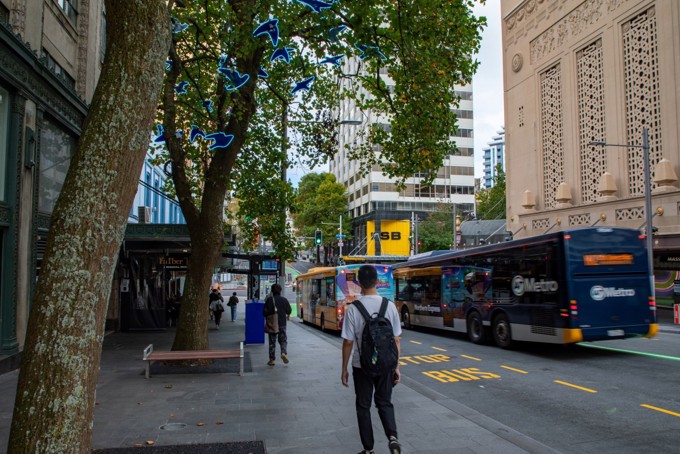
The latest evolution of Auckland’s city centre is here, with the completion of the first stage of the Wellesley Street Bus Improvements Project.
Ngāti Whātua Ōrākei, accompanied by Ngāti Tamaoho, conducted a dawn blessing ceremony to mark the completion of the project, with buses starting to use the new transport hub from yesterday, Sunday 19 April.
With thousands of people expected to use Te Waihorotiu Station daily after City Rail Link opens, Wellesley Street is set to become a key transport hub, and new gateway to the city, connecting high-frequency buses, trains, and walking and cycling routes.
This is part of Auckland Transport’s City Centre Bus Plan, which identifies Wellesley Street as a key east-west bus route. By 2032, Wellesley St will see 2,200 buses per day using the corridor, up from 1,300 per day currently. It connects university campuses, key city centre destinations including major venues like the Aotea Centre, the New Zealand International Convention Centre, workplaces, hotels, bars and restaurants, and Victoria Quarter, making it a vital part of Auckland’s transport network.
…..
“Traversing Wellesley St can currently be quite a painful experience for people on buses or on foot. With Te Waihorotiu station set to become the busiest bus & train interchange in Auckland, it is vital that we provide a better experience for people moving in the area” says Mr Moth.
“This project will provide additional bus priority, wider footpaths and better-quality waiting environments and bus shelters for passengers, right outside the fantastic new Te Waihorotiu station.
“This project is the first stage of AT and Council’s longer-term vision for Wellesley St, which will ultimately provide better journey experiences along the whole 2.2km corridor.
“We want to give a massive thanks to local businesses, residents and others for their patience during construction.”
Some features of the newly improved Wellesley Street between Albert and Queen Streets include:
- new bus shelters and wider footpaths
- improved pedestrian crossings
- new paving, seating, and street lighting
- amenities in public spaces around the new station
- better priority for buses heading eastbound along Wellesley St
And here’s an AT video with Cr Richard Hills explaining what’s new:
View this post on Instagram
In related news, the Midtown Trial which brings cars back on the Queen Street AVO and implements a 7am-7pm bus lane on Wellesley Street has started. You can register interest to give feedback on this page.
Minor cracking issue with CAF trains
BusinessDesk reports that there have been some minor issues with most of our trains
Auckland Transport has confirmed more than 70 trains have developed a small cracking issue, prompting repairs under warranty.
A spokesperson for Auckland Transport (AT) said small cracks had been discovered near air conditioning units on the stainless-steel roofs of the 72 existing trains that currently operate on the city’s network.
“This minor, non-structural issue is isolated to the section of the train roof where air‑conditioning units are installed and has not led to any safety or performance issues for the train fleet,” the spokesperson said, in a written statement.
“The cracks are very small, and there are no safety concerns. Trains will continue to operate in service while the issue is addressed.”
…..
To repair the issue, the air-conditioning units and the corners of the cut-outs for the units are being reinforced.
“This work is expected to take around one week per train and we don’t anticipate any service disruptions as a result,” the AT spokesperson said.
Interim Auckland Transport CEO
An interim CEO for Auckland Transport has been appointed.
The Auckland Transport Board has appointed Stacey van der Putten as its interim chief executive.
Stacey begins in her new role on 1 May 2026, for an 18-month period. This includes the six-month transition period as signalled by legislative change, and as the establishment chief executive for the new transport CCO following transition.
Stacey is the organisation’s current Director of Public Transport and Active Modes, and AT Board Chair Andrew Ritchie says the appointment brings a wealth of institutional knowledge through a time of change and significant delivery.
“The board and I are thrilled Stacey has accepted the role, which comes at a critical moment as we prepare for upcoming changes to transport governance in Auckland,” Mr Ritchie says.
“Stacey is a highly respected transport leader who has served in a number of roles at Auckland Transport since 2017.

Cities with women in charge are sharing more public space with people
Interesting piece on rethinking cities around the people who live there – and how women are spearheading that change, in a number of places:
Given the challenges that city dwellers face, what’s needed is an unprecedented shift in how governments approach infrastructure and policy. But in the vast majority of cities, small pockets of vested interests are digging in to loudly defend a system that works for them. Many city or local politicians mistake the volume of defiance as being representative of the larger community and fall back on empty rhetoric, and ultimately inaction.
But a minority of elected officials have demonstrated that opposition rarely reflects the true popularity of more inclusive urban transformation measures. In many cases, female leaders are spearheading change. Through their own experiences navigating the world as girls and women, as carers, and through decades of being invisible in the planning process, they often understand best that the status quo is not working.
Such as in Barcelona:
In Barcelona, during Ada Colau’s recent mayoralty, the administration reclaimed a million square metres of pedestrian space, using solutions like the “superblock”, a revelatory intervention that swaps the city’s asphalt expanses for neighbourhood plazas with paint, planters and political will. Over an eight-year period, she tripled the length of cycle lanes to 273km (170 miles), putting 90% of the population within 300 metres of at least one route. The results have been quite dramatic, with city officials citing the creation of 80 new hectares of green space, a reduction in car traffic of 50% and a cut in air pollution by 20% between 2019 and 2023.
Or Paris:
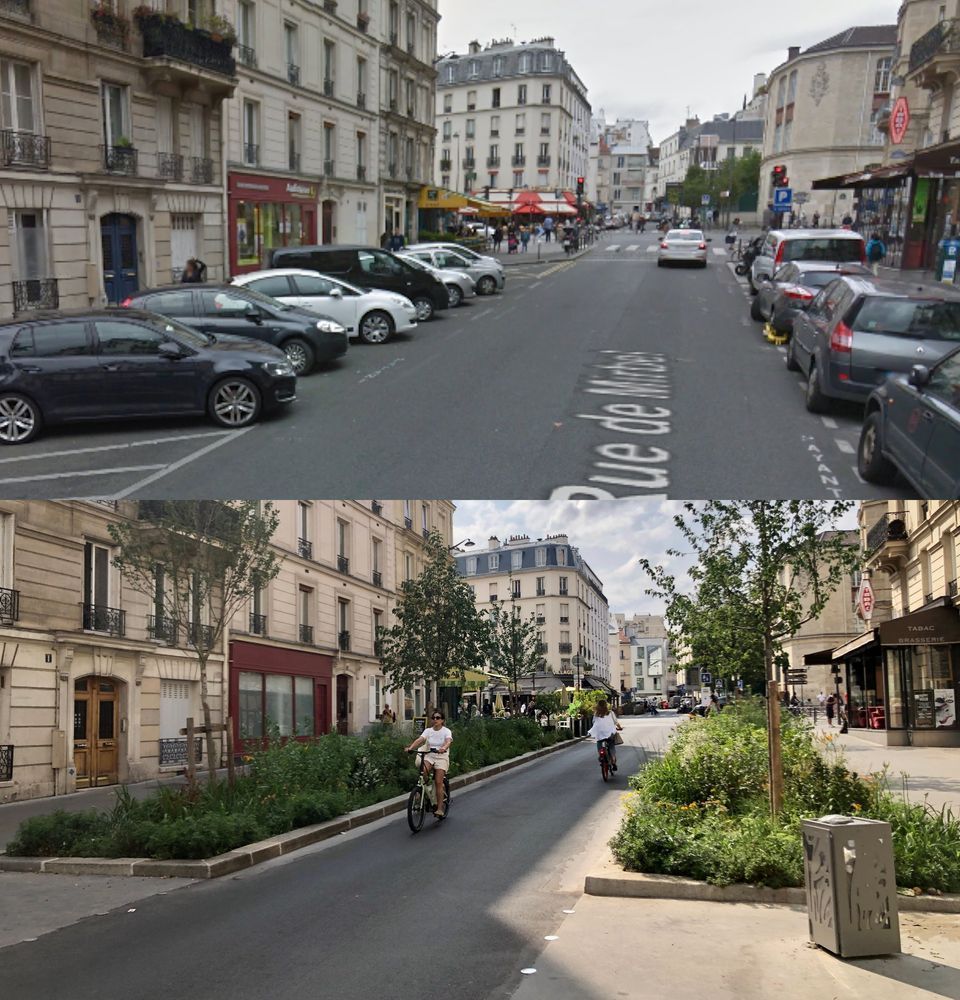
Paris’s famously car-choked streets are finding new life thanks to Anne Hidalgo who, as mayor until last month, transformed the French capital. Hidalgo faced fierce criticism but ultimately found public support for her incredibly ambitious introduction of cycling infrastructure, pedestrian streets and public transport. Investments throughout her tenure include 1,000km of cycling routes, 350 of which are protected from traffic, with a further €250m (£218m) dedicated to growth of the network. Paris is also well on its way to the realisation of 300 school streets (pedestrianising streets near schools), alongside re-greening efforts that will see the removal of 70,000 car parking spaces, and the planting of 145,000 trees and 45km of parks.
Aucklanders taking up bikes in record numbers
EcoMatters Environment Trust, which runs bike hubs across Auckland, is seeing record numbers of people visiting their nine Bike Hubs across the city:
More and more Aucklanders are turning to cycling, with environmental charity EcoMatters reporting record visitor numbers at the nine Bike Hubs it operates across Tāmaki Makaurau.
March 2026 was a milestone month. The hubs welcomed a record 4,800 visitors, fixed almost 2,000 bikes, and sold the most ever refurbished, donated bikes.
“Visitor numbers are up 25 per cent compared to the same time last year. It really shows that more and more Aucklanders want to cycle around their city,” says EcoMatters Environment Trust CEO Carla Gee.
Supported by Auckland Transport and local boards, the Bike Hubs take a hands-on approach. Team members and volunteers work alongside visitors to teach basic bike maintenance, so people have the skills to keep their bikes functioning and safe. The team also restores donated bikes for resale, keeping them out of landfill.
“While rising fuel costs have certainly sparked new interest in cycling, these record numbers are also part of a longer-term pattern of growth,” says EcoMatters Bike Hubs manager Brent Bielby.
There’s also been an increase in the e-bike loan scheme:
EcoMatters Bike Hubs also provide local safe cycling guidance around their neighbourhoods and seven hubs run a scheme where people can borrow ebikes for a free two week loan.“That’s the difference between a lap around a car park and actually discovering how an ebike could work for your commute, your school run or your weekend. For a lot of people that’s the moment everything clicks,” says Bielby.Demand for the ebike loan scheme is also very high at the moment.“We’re grateful to our long-term funders, our dedicated team and volunteers, everyone who has donated a bike, and every single person who has walked through our doors for helping get these hubs to where they are today,” says Gee.
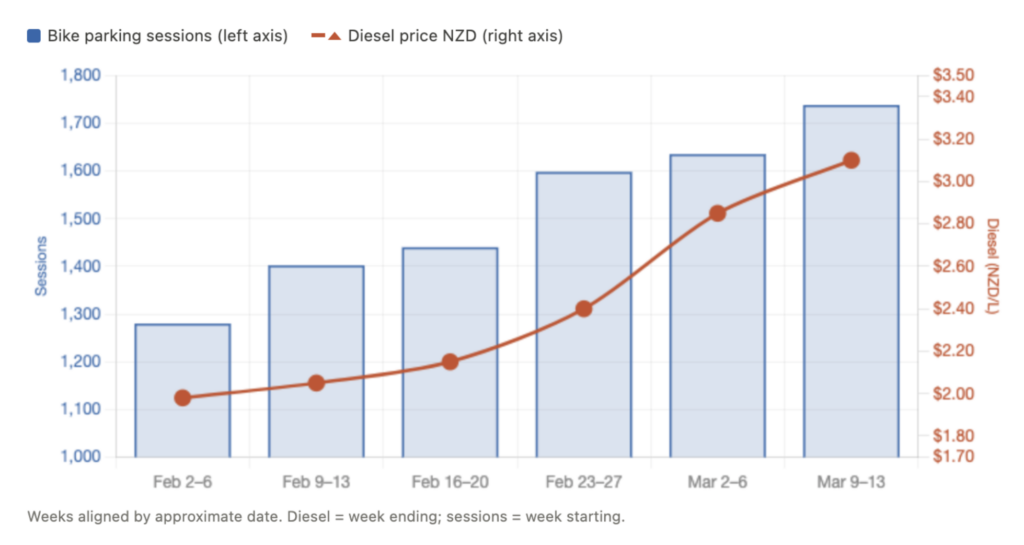
Locky Dock is also seeing a big increase in bike parking usage:
Whanganui bus improvements – one new route credited to Pūtiki kaumātua and kuia
One part of the new Whanganui bus network has been credited to the advocacy of kaumātua and kuia in Pūtiki:
People power – or should that be Pūtiki power – is being credited for the creation of a new bus route in Whanganui.
Championed by the kaumātua and kuia of Pūtiki Marae, it’s the first time the riverside area of the city has had a public bus service in living memory.
Tow buses were required to pick up a crowd of enthusiastic locals keen to try out the first ever Pūtiki loop service.
Witerina Cooper, a member of the Pūtiki Emergency Response Group, said the drive for a bus service came out of a desire to be more resilient after floods in 2015.
“We were mindful that Pūtiki had never had a bus service, never. We only had a school run years ago when Kanui my son was small and that was the only bus we’ve ever know of that came into Pūtiki.
Build-to-rent fills up fast
Simplicity Living’s new built-to-rent apartment block is filling up fast, with longer term rentals that are cheaper than nearby builds.
More than half of the units in the country’s largest build-to-rent apartment block have been tenanted ahead of its official opening.
Te Reiputa, which means the shark’s-tooth pendant, is based in Auckland’s Mt Wellington.
For hundreds of Aucklanders, it could also mean safe, fit-for-purpose, well-built, long-term rental accommodation on a… site where more than 700 people could soon be living.
Tenants of New Zealand’s biggest build-to-rent project (two units larger than the nearby Resido) are being offered contracts up to a decade long, giving them stability – or they can sign a more flexible periodic contract with no end date.
…
Brealey said rents could be kept lower at Te Reiputa due to developing exactly what people needed without adding luxuries he’s seen overseas, such as dog-washing stations.“No gym and no swimming pool,” Brealey said.Such features increase project prices but don’t necessarily add benefit for residents.Yet it does have shared areas, as well as 222 car parks and a security application for residents to get access to secure parking, their own units and common areas.
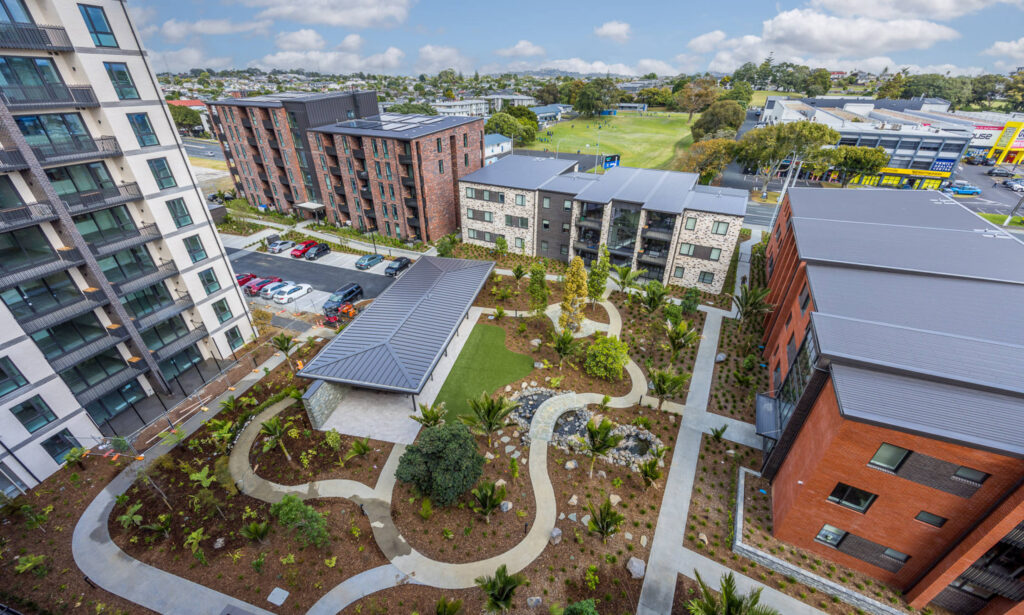
Te Reiputa Apartments – Simplicity Living
Not mentioned in the article is that the apartment is a short walk to Panmure station and interchange, so there’s also great access to public transport!
Lots of submissions on reversing the speed reversal
After community pushback, NZTA has been consulting on reversing the blanket speed reversals made under Simeon Brown’s 2024 Speed Rule. One State Highway near Levin has had almost 800 submissions.
Transport officials are combing through hundreds of submissions about proposals for a full handbrake turn on state highway speed limits near Levin.
…
The drop to 80km/h was reversed last year, as the current government upped speeds on many sections of highway that were previously lowered.
Now, the NZ Transport Agency has undertaken public consultation on a reversal to 80km/h for the roads near Levin, saying it was doing so due to community concerns.
Consultation closed on 9 April and transport agency regional relationships director Linda Stewart said it received about 800 submissions for the proposed SH57 change and 600 for the proposed SH1 change, between Ōhau and Manakau.
Goes to shows the power of community organising!
[Large retirement village Speldhurst]’s residents committee chairman Roger Parton said many of the submissions about SH57 might have come from the village’s 720 residents.
“I’ve been whipping them along,” he said.
There had been one fatal crash on the stretch of highway since speed limits went back up, after there were none in the five years of the lower speed limit.
Parton said there were also several near misses, making residents entering or leaving the village nervous. Some waiting to turn right into the driveway had even reported getting overtaken by fast-moving vehicles.
“They go out there with some trepidation, because they don’t know what’s coming.”
Videos to check out
A good take from Melbourne on the question of elevated rail vs trenching, for level crossing removal.
A great explainer of how modal filters and low traffic neighbourhoods work.
What’s the consequence of driverless cars?
And another about the densest country in Europe: what do you think?
And, some local research on why safe streets are vital for children’s health:
That’s it from us. Lastly – you can check here for tomorrow’s Anzac Day services around Auckland.

 Processing...
The elevated vs trenching video was interesting, I wonder if there is anywhere this could be applied in Auckland though? I suspect that the Western line track corridor is too narrow in many places to allow without significant land acquisition.
Melbourne’s new elevated rail routes are fabulous, especially for the new public realm beneath, and the removal of severance.
Melbourne is flat, the Western Line is not, there’s pretty much nowhere I can see where elevating that line would work.
The place in Auckland that is well suited to a new elevated line however is Mangere. Is flat, swampy (expensive and difficult to trench or tunnel), and already suffers from terrible community severance from thoughtlessly planned motorways. The still urgently needed CC2M line would ideally be elevated where not in the existing motorway corridor.
Elevated stations are really easy to integrate with walk, bike, and bus and fun to on, in flat places, is great to get a view (I do dislike the new fashion in excessive screening that comes from neurotic community feedback- evident in Melbourne too).
What
How do you justify building an expensive elevated tramway to the airport during a fuel crisis
Mangere is a place with people living in it. The airport is just one employment centre, and a good anchor for a missing RT line. The people of Mangere deserve good quality connectivity as much as everyone else, and they currently live in a transit shadow, with, as I mention above, terrible severance from the motorways ploughed through their communities.
Airport derangement syndrome seems to still dog this missing link. Airports employ a lot of people, PT is for them, more than for passengers. Workers, using transit daily ,are a much bigger market than occasional travellers, though of course every line should be planned and operated to serve all markets.
Has anyone done a good multi-criteria assessment on why Mangere is the preferred destination over other options in Auckland?
You can provide most of the service with just buses, signs and paint? No need for real rapid transit when there are routes far more crucial.
Maybe people havent noticed but everything between Mangere and the airport is now one of NZ’ busiest light industrial and commercail zones, massive logistics and distribution hubs, hotels. Accoring to Ak Airport the zone has 25,000 workers. Mangere is being densified and residential areas growing rapidly. All serviced by the 38 bus which meanders from the airport to Onehunga taking about 50 mins! Honestly I bike faster taking the scenic Ambury farm pathway. All those workers basically are currently locked into driving.
I think that you are reading a bit too much into that comment.
I don’t think subsidising and reinforcing reliance on air travel is a good use of public funds, just my 2c
Clearly the government disagrees: https://www.beehive.govt.nz/release/regional-airlines-supported-rif-funding
I think buses are becoming good enough (or should I say electric enough!) that we no longer need trains to provide a nice PT experience. So the only real advantage of trains is capacity, at the expense of frequency, build cost and operating cost.
If buses have enough capacity for the NEX, they are probably good enough for almost everywhere in Auckland, at least for the next few decades.
Just build a busway along SH20 / Dominion Road / Queen Street, nothing else will ever see the light of day…
What planet are you living on Jimbo. I don’t see people celebrating whenever they have to use a rail replacement bus, quite the opposite
Unless you were being sarcastic in which case yes let’s build a busway along Queen St and Dominion Rd
I thought buses NOT having enough capacity was the reason for this entire Dominion light rail project in the first place.
I don’t get this assumption Mangere doesn’t deserve effective transit. My starting point is every part of the city of a certain scale does.
Maybe there’s a word for this…?
The airport precinct is home to 25,000 workers. Those are the people to serve with rapid transit. Air travellers are just a bonus.
And if the Northern Busway is such a success, why not a viable option for the Isthmus? Airport to Avondale via Onehunga, up SH20, and on to Constellation. Lack of space for a growing bus fleet is an issue for the CBD, not the either end of this route.
Also new really wide boardwalk pathway connecting to Parnell station seems to be open. Massive upgrade to access for North East of station.
Rosedale Busway Station to finally get underway mid this year:
https://at.govt.nz/media/1978024/nzta-rosedale-station-newsletter-september-2018.pdf
https://at.govt.nz/projects-and-initiatives/rosedale-bus-station
I used the Wellesley St bus stops this morning. Ghastly winter weather and the stops under the shelters were rather exposed, but the covered arcade behind them along the shopfronts may have been the most comfortable street in Auckland. And not at all ‘shut in’ behind the hit-and-miss shelter glazing.
Still a few after-7am cars going straight through to Queen St, and a couple pausing before realising they need to turn down Elliot St. Time limit must be confusing for people….
Hmm, the build took more than a year and spruced up the street nicely. BUT value for money, no way. 18 months of construction (90% of it nothing done – just the site being cornered off waiting for other projects to finish) is complete madness and a symptom of why things are so expensive to fix here. Not impressed (and no the sewage/waste water fixes were on the other side of Queen Street so that was not the issue). Just poor project plans that maximises inconvenience for business.
However a giant plus to the thai or viet paving contractors, they come first, leave last and delivers at a speed I haven’t seen a single kiwi tradie get close to. Fantastic work and effort. If we had staff like those, the entire project would have been completed in three months. Instead we had the 1 man work, 4 stands and looks for most of the time. Another plus they seemed to like a pint after work at the Irish bar so they spent some of their earnings in CBD too.
With that said, lets hope they enforce the busway, too many cars have been driving there. Need cameras up right away. We also need a sign at Mayoral Dr/Wellesley St informing drivers that no throughfare.
I wish they’d sort the Mayoral Dr to ideally Hobson St (or Federal) so we can make use of the shared space that is Federal St and the recent upgrades to Mayoral Dr, Federal St and Hobson St. With both a convention centre, several key buildings (Cathedral and casino etc) this area does not need much to become a destination. Improving this missing link on Wellesley would provide an opportunity for business to create an experience and make real use of the upgrades. Its important to be holistic and with the new station at Aotea (whatever difficult name that wont catch on they choose to call it) the area is beaming with potential.
I’ve used the new bus stops two days this week. The bus stop near the corner of Queen Street (7021D) is close to a bar and with people smoking outside it wasn’t that pleasant. It is good there are a range of seating options in the vacinity. With winter coming fast it will be interesting to see how they go in a range of weather situations.
On the uptick in bike use, I have no numbers, but I’ve noticed mobile bike servicing vans visiting residential properties a few times in recent weeks. It’s not something I’ve actually seen on the ground before, although I did know they existed. Perhaps it’s a sign people are brushing their old bikes off and getting active.
Also a sign that we need more bike shops if people are willing to pay for that kind of extravagance
Sounds like the opposite to me. There is not enough people who ride bicycles to maintain a bike shop in a fixed position. It is like having a grocery truck visiting very thinly populated areas that can’t sustain grocery stores.
I had a look through the feedback on the bus lane trial and it opens up stating the clear majority support the proposal to have reduced bus lane hours.
Then it lists who they approached and they contacted directly, which includes all the individual businesses, plus the property owners, plus the business associations, plus Total Mobility service providers, road-user groups, food distributors and parking providers. So 3x multiplication of nearby commercial rate payers plus a few other heavily vested-interest groups.
But it doesn’t say a single bus passenger, cyclist, pedestrian or bus driver was surveyed. Nor any nearby residents who are going to have to put up with the influx of late night boy racers (the 1000s of residents are bundled under a residents group single ‘vote’).
Is this for real?
Yeeeep, all real. From my understanding decision was made to do reduced bus lane hours last year, and a whole bunch has been done to ‘justify it’…
have been putting in a huge amount of time and energy trying to stop/change this… but a lot more to come on this whole thing so stay tuned