This is a guest post by Darren Davis. It originally appeared on his excellent blog, Adventures in Transitland, which we encourage you to check out. It is shared by kind permission.
Introduction
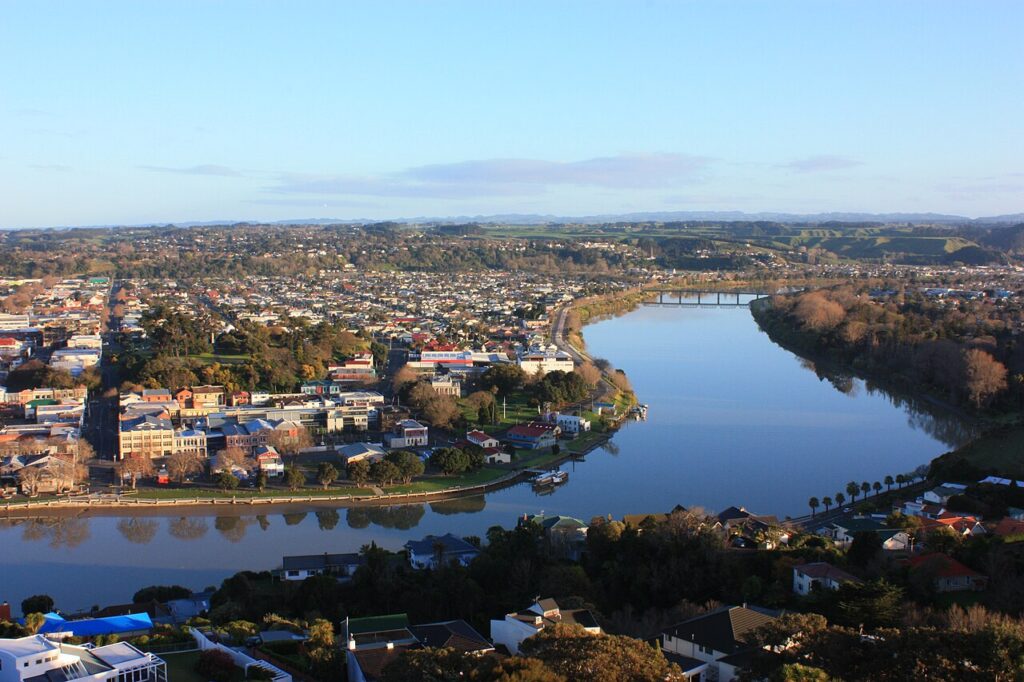
Photo by Ang Wickham Flickr: Whanganui River to Dublin Street Bridge, CC BY 2.0
[Editorial note from Darren: Many thanks to Anthonie Thonnon for his tireless advocacy on behalf of Whanganui and for much of the material included in this post.]
The power of a precursor
Whanganui’s New Network builds on the earlier success of Te Ngaru | The Wave. In 2023, Horizons and Whanganui District Council teamed up to trial a ridership-focused service, Te Ngaru | The Tide – a more direct, 20 minute frequency route aimed at ridership. Apart from Te Ngaru | The Tide, bus services in Whanganui up to the New Network were one-way loops operating every two hours or worse on a very limited span of service. Unsurprisingly, apart from Te Ngaru | The Tide service, patronage was sparse and declining.
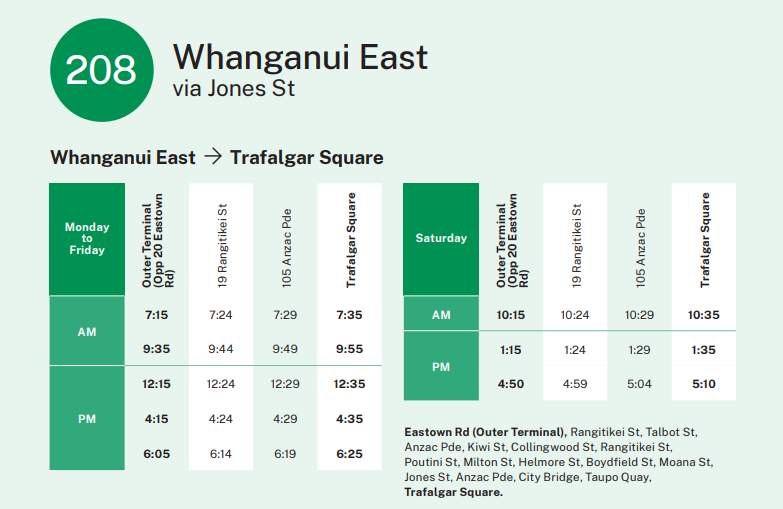
A typical pre-new network Whanganui bus timetable. Image source: Horizons
According to Horizons Regional Council, the public transport authority for Whanganui:
“We saw a huge increase in patronage across the Whanganui network in 2023 with over 163,000 passenger trips, 70,000 more than in 2022. This figure grew to 193,940 passenger trips in 2025. The main driver of these increases was the introduction of the high-frequency Te Ngaru | The Tide service, which now accounts for more than half of all patronage across the network.”
What is the New Network?
Key elements of Whanganui’s New Network are:
- Two new routes operating every 20 minutes between 8am to 6pm, with extended services 6-8am and 6-8pm on weekdays and later services on Friday and Saturday evenings. One of these is the original Te Ngaru | The Tide service and the second one is the second Te Ngaru | The Tide service
- Three new routes operating every hour 7am – 6pm Monday to Saturday, and 9am-3pm on Sundays
- Service to some areas not currently covered, such as Pūtiki.
- Buses running seven days a week
- More frequent services past or near schools, replacing the current once-a-day school services Horizons provides in the Whanganui urban area

Whanganui New Network Map. Image source: Horizons website
This will simplify Whanganui’s network from over a dozen very infrequent routes, to five simple routes – two 20 minute frequency and three hourly – designed to work together and make travel possible anywhere in the city. Buses will also join the Durie Hill Elevator and offer Sunday services for the first time in decades.
The new network has been possible despite reduced availability of funding for public transport. In consultation last year, Whanganui residents strongly supported going ahead with a modestly reduced version of a new network, despite a lack of New Zealand Transport Agency/ Waka Kotahi co-funding support from central government in this round.
The New Network is free for the first month which, by fortuitous coincidence, coincides with a fuel crisis with a concomitant big increase in petrol costs.
Let’s be clear that this isn’t a perfect network but we need to avoid perfection being the enemy of merely very good. And it’s an enormous improvement on the sort of service shown in the screenshot above. People will not choose to use that sort of level of “service” unless they have absolutely no choice.
The Power of One Plus
And it’s a story of tireless advocacy, in particular by Anthonie Tonnon, a long time public transport advocate, who represents Whanganui District Council at the Horizons Passenger Transport Committee, and the operator of the Durie Hill Elevator in Whanganui East, Aotearoa/ New Zealand’s only fare-paying public transport elevator (and the only elevator with a elevator replacement bus when it’s not running).
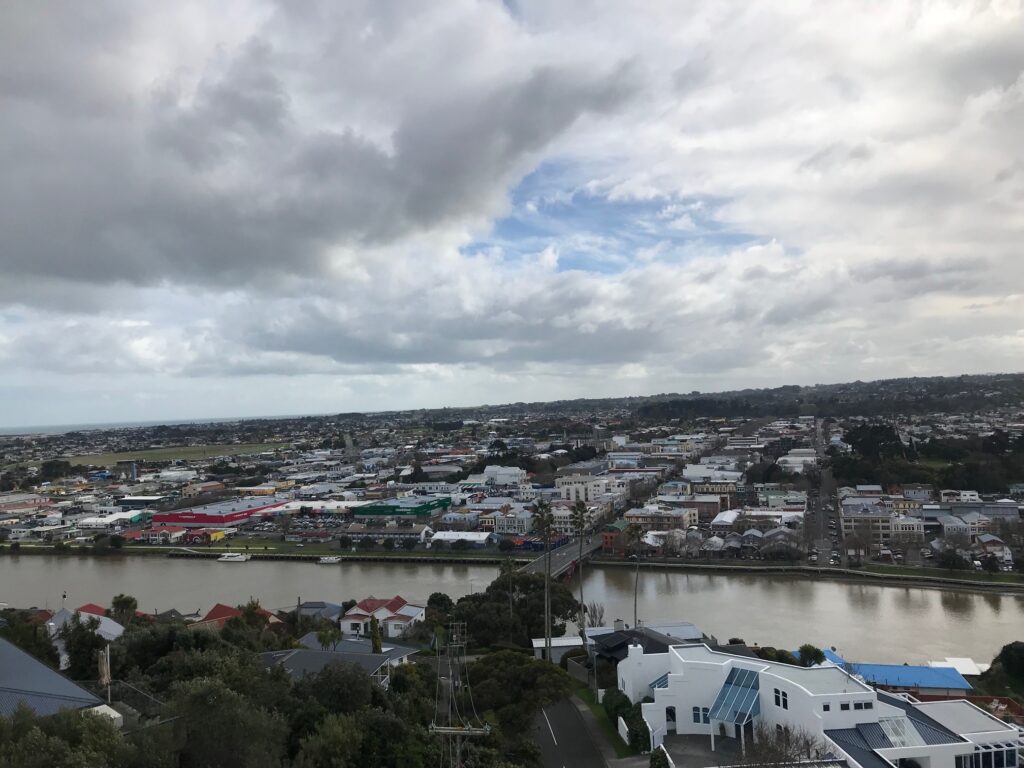
View from the top of the Durie Hill Elevator over Whanganui City Centre. Photo credit: Darren Davis
While there’s a “power of one” element in Anthonie’s ongoing advocacy, it’s also a team effort and Anthonie is keen to acknowledge the contributions of others to making Whanganui’s New Network happen, including the great work by the Connect team at Horizons, particularly Whanganui lead planner Jayme Thorby, and Transport Manager for Horizons Mark Read. The team have also had great advice from the team at MRCagney (Nicolas Reid, Lewis Thorwaldson, and Pippa Mitchell), and over the years a number of people in the industry have generously offered advice, including Nicolas Reid, Sam van der Weerden, Patrick Reynolds, and Anthony Cross.
Local politicians of both Horizons and Whanganui District Council have championed the project and made it possible, particularly former Horizons councillor and Passenger Transport Committee Chair Sam Ferguson, Horizons councillor Alan Taylor, Whanganui Mayor Andrew Tripe and Whanganui councillor Charlotte Melser.
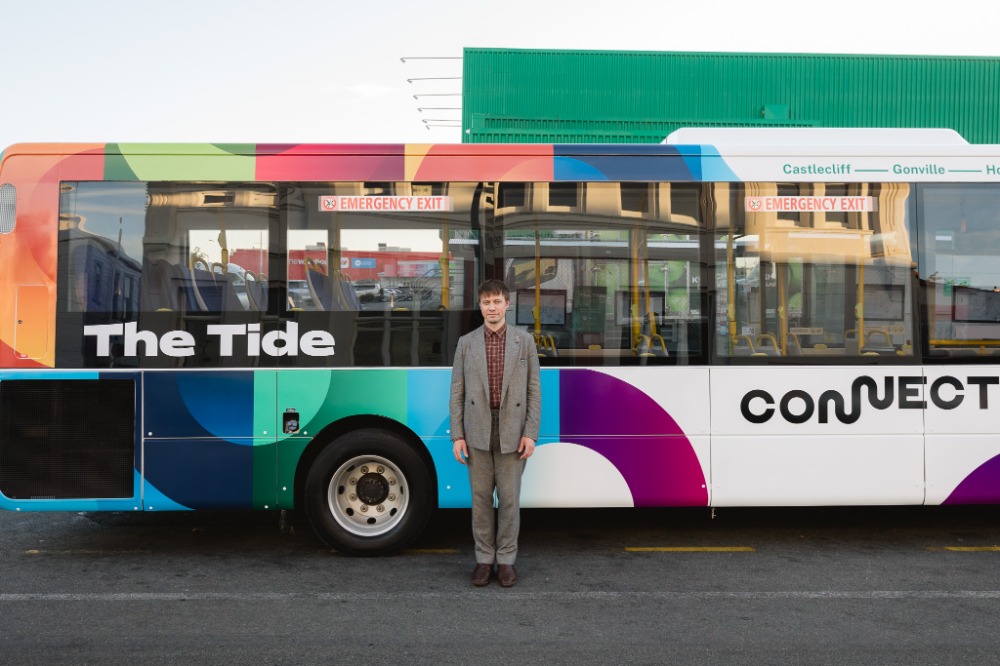
Anthonie Tonnon in front of a Te Ngaru | The Tide bus
Final thoughts
Really four final thoughts:
- Small cities such as Whanganui can do great things with public transport.
- The power of precursors such as the first Te Ngaru | The Tide service to test latent demand and to make the case for bigger investments.
- The power of advocates to make a real difference by working to influence the key decision makers, not working in isolation shouting from the rooftops.
- Don’t let perfect be the enemy of very good. Every place has to start somewhere and Whanganui has made a very good start to building better public transport.
Greater Auckland’s work is made possible by generous donations from our readers and fans. If you’d like to support our work you can join our circle of supporters here.

 Processing...
Unrelated: Has Greater Auckland done a stadium article recently? From what I can tell Cricket has been abandoned. International matches will be at Eden Park, but NZ Cricket seem reluctant to host anything other than the odd 20/20 there. We won’t have a test match venue, how ridiculous. I thought Western Springs was the plan for cricket?
https://www.stuff.co.nz/nz-news/360967254/where-are-we-aucklands-stadium-jigsaw-puzzle
It is telling that amongst all the talk of Auckland cricket moving to Colin Maiden Park, test cricket is not mentioned as following suit.
A part time option, like Hagley, is all thats needed. The Victoria Park proposal, please.
“Whanganui is the second largest city in the Manawatū/ Whanganui region”
A fair bit of Rank “Glazing” going on there,
Last time I looked there were only two cities in the Manawatū/ Whanganui region… 🙂
Like coming second in a boxing match?
Thanks Darren.
It’s so cool that Whanganui didn’t let the central government ruin it all.
As a tourist there, the loop buses did help us cover a lot of ground quickly, but the infrequency meant the timetable dictated the whole day. The New Network clearly serves locals much better, but I’m also keen to try it out as a tourist.
To actually be able to get off somewhere to look at something, knowing there will be another bus to pick us up should be a basic characteristic, but this has not been possible until the New Network.
It’s sad funding has been so thin for public transport that this has taken many years of advocacy to achieve.
But it makes Anthonie and team’s success all the more admirable.
I hope someone will present the story to the WK Board and ask them what could be done to speed it up for the many places in NZ that need a similar network.
Being born and bred in Whanganui (or Won-ga-new-ee as we used to pronounce it) I’ve followed the decline of the city’s PT closely. I’d long tried to imagine what a transformation might achieve. So far, the results of just the Te Ngaru service have been spectacular, and I hope the new services will be likewise great. Quite by chance I find myself in Whanganui right now and will keenly observe it all first-hand.
But kudos in particular to Anthonie Tonnon for his efforts – not only as a tireless advocate for the buses, but also as proprietor of what must be an absolute rarity in world terms – the Durie Hill elevator, an integral part of the city’s public transport system. Growing up, we didn’t recognise how special it was – we just used it. About 18 months ago on a visit, I asked the operator about Anthonie’s role and she absolutely gushed with enthusiasm for his efforts to bring PT back into the mainstream. So take a bow, Anthonie Tonnon.
And just for clarity, the Durie Hill elevator is not, as Darren suggests, in Whanganui East. The Durie Hill elevator is in . . . Durie Hill, which just happens to be on the east side of the river. Sorry to be picky . . .
Haha, yes, as someone who grew up across the street from the DH tower. Many memories of taking the bike up and down the elevator to and from intermediate and high school in town. Antonie also sells some nice merch for the tower and it was great to grab a DH Tower tee when last in town a couple of years ago. I must say, great to see the new network. Will have to try when next visiting. However, the other thing I would emphasise about Whanganui is that despite the hills, it’s a great place to bike and walk around too.
Busting the myth that smaller cities don’t have the size or densiry to do good PT.
A great read and good to hear.
Interesting to note, while Horizons Regional Council is in charge of public transport in Whanganui (buses only), the majority of regional bus services are privately operated.
Also I remember getting lambasted by someone on this site for having opinions about Auckland despite not living there, how the turn tables…
So dissapointing that here in New Plymouth our new network was basically a rehash of the old one with a couple of services removed and some routes changed.
Wasn’t it because the gov cut the funding drastically at the same time?
Yes, what they originally had planned looked really good until the government pulled the funding.
Really outstanding radial route design, with only small route-end loops.
You might compare https://www.firstbus.co.uk/uploads/maps/Lowestoft_Local_Services_Map.pdf
for a town with 72,000 people.
Congratulations, Whanganui!
It looks great. For now focus should be just on improving frequency/operating hours as funds allow. Eventually there might be a case for outer circuit routes, but for now frequency is probably the best option.
Hopefully they improve Feilding’s abysmally infrequent bus service to palmy. It is in the top three for patronage in manawatu, even though it has hour and a half frequency. Imagine the increase in patronage with a better frequency.
Thank you for great article – i intend to get down and try the services soon , – have taken visitors onthe Tide and they like it ,