Letting trucks use bus lanes – currently being proposed as a fuel crisis measure – might sound like a sensible solution, but it risks undermining broader goals around our transport system.
At the end of last week saw a few interesting comments from Mainfreight CEO Don Braid, and a swift response from Mayor Wayne Brown.
Mainfreight’s chief executive says he is “frustrated” at KiwiRail and Auckland Transport, and that the agencies could be doing more as the Middle East conflict sends fuel prices up.
…..
Don Braid told Morning Report moving freight via rail was more efficient than by truck, “yet we haven’t seen KiwiRail stand up to offer additional services”.
“They’re missing in action at the moment, and we would like to see them stand up to help the industry.”
…..
Mainfreight had been speaking to KiwiRail but was failing to get action, he said.
“We are trying, but [we’re] frustrated to be perfectly honest.”
KiwiRail chief executive Peter Reidy said in a statement to RNZ: “KiwiRail is sharply focused on helping New Zealand get through this.
“We are working around the clock to save fuel and working with our customers every day, sometimes multiple times a day, to take some of their volume where we have capacity.
“We’ve already made 100s of containers available, representing 1000s of cubic metres, and are confident we can do more.”
I agree with Braid that now is exactly the time we should be putting more freight onto trains. It’s good that KiwiRail has added some additional capacity, but I wonder if we’re seeing a couple of issues combining here:
- One of the consequences of decades of trying to force rail to operate as a commercial entity rather than valuing the wider economic impact it provides is that KiwiRail probably doesn’t have a lot of capacity just sitting idle that they can turn to, whether that be that locomotives, wagons or staff to operate them.
- I could be reading it wrong, but the comment from Reidy that they’re “working around the clock to save fuel” suggests that KiwiRail is focused on managing their own costs – which is understandable. But I wonder if this is one of the consequences of the current government’s hands-off, let’s-pretend-nothing’s-wrong approach to this fuel crisis. It’s better for NZ as a whole if we shift more freight to rail to move it more efficiently – but doing so means KiwiRail might have to run more trains, which means their fuel costs would go up. A more hands-on government might require – or at least assist with – better industry coordination, so rail can more quickly play a bigger part in mitigating the impacts of fuel supply interruptions.
Braid also has aimed at Auckland Transport, which Mayor Wayne Brown quickly responded to:
Braid said other organisations, like Auckland Transport, also needed to make adjustments to make diesel usage more efficient.
It should reconsider its position on the idea of allowing freight vehicles to use bus lanes, Braid said.
“Think about the amount of diesel idling that goes on because we can’t use a bus lane.
But Auckland Mayor Wayne Brown was not fond of the idea, saying it would just cause more congestion.
He told Nine to Noon a better alternative would be to have trucks operating at night.
“Get the trucks on the road at night … it’s a lot cheaper to pick up a container at night than the daytime,” Brown said.
He said the warehouse companies were obstructing that change, and that if truck companies passed on their increased fuel costs to the storage companies, they would start opening at night.
Brown said crowded bus lanes were already a problem.
“We already have trouble with buses crowding themselves … the buses have to stop, and the next thing will be the truck will be stuck behind the bus idling.”
The mayor is right that many of the bus lanes, especially those closest to the city centre, are already very crowded. Solving this ‘bus sausage’ problem is of course the original reason why light rail was proposed, particularly through the heart of the isthmus.

An example of ‘bus sausage’ just before 5 pm on a Wednesday at Stop A, Westfield Newmarket (between Mortimer St and Morrow St).
However, even putting that aside, the issue isn’t just the potential for trucks to hold up buses, but the reverse applies too. Adding other vehicles to bus lanes increases the chances that a bus (or truck) will be in a queue such that they will miss the green phase on a traffic light, with knock-on and cumulative delays across everyone’s timetables.
There are also issues for other road users too. Many of our bus lanes are the only place to cycle on the busy arterials that are the most direct route, for example. And it’s not particularly pleasant for people standing waiting for a bus to have even large trucks passing close by, especially at 50kmh which is the speed limit on many of the arterials with bus lanes.
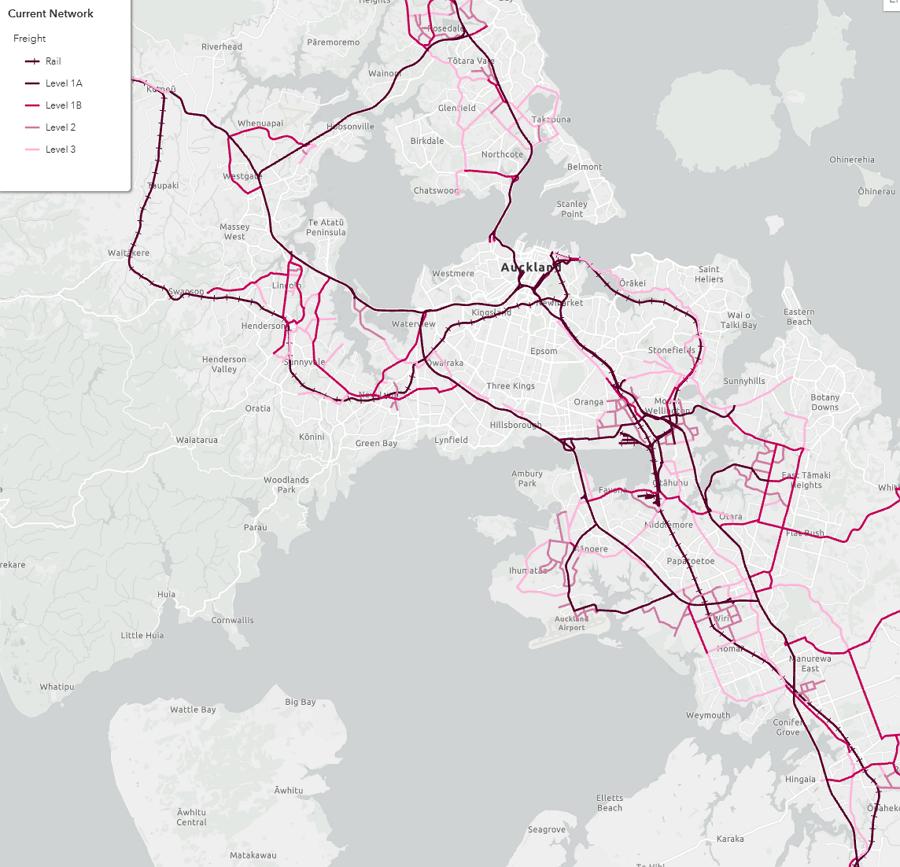
Perhaps an even bigger problem with the suggestion is there simply isn’t much of an overlap between key freight routes and dedicated bus lanes. Below is what Auckland Transport have determined as their Strategic Freight Network:
 Now compare that to the network of bus and transit lanes:
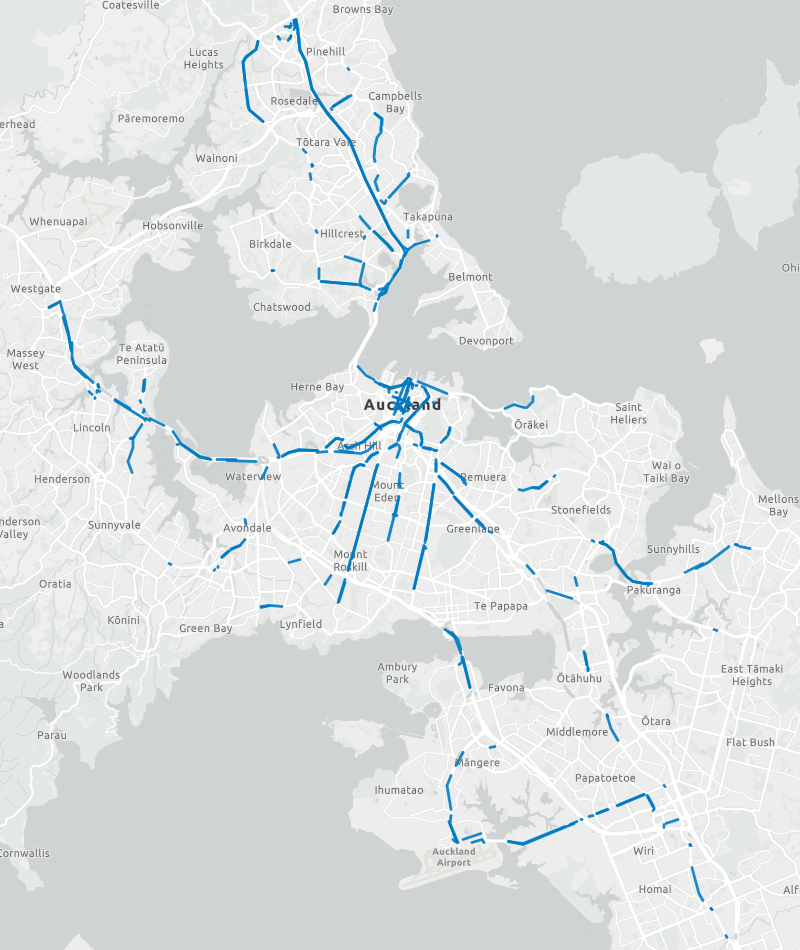 As you can see, other than the state highways, there’s really just not that much cross-over between the two.
That said, perhaps there is an opportunity here: not for using existing bus lanes, but for setting up new bus and truck lanes to improve travel through the areas that currently don’t have any bus priority.
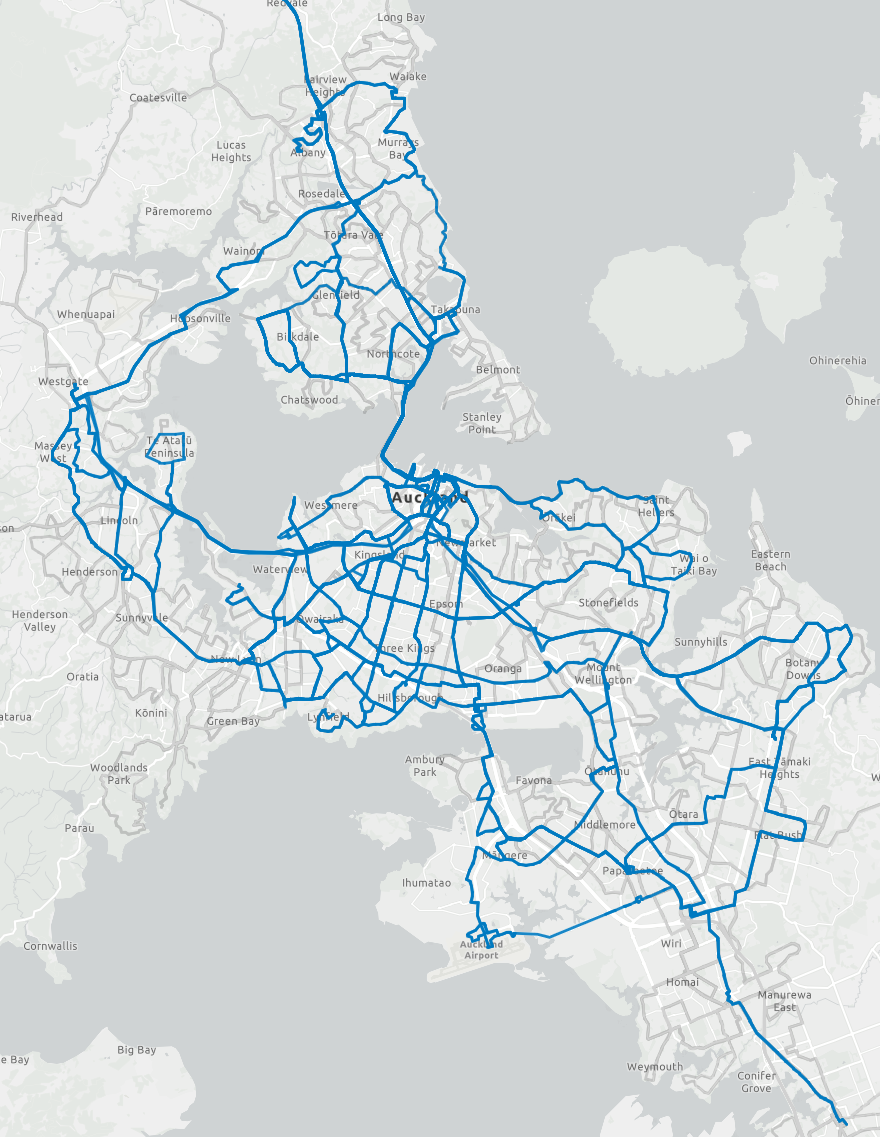
The map below shows all current frequent bus routes. As you can see, the existing bus lanes cover only a small proportion of them. So perhaps AT could quickly expand the network of dedicated lanes, firstly to make buses faster and more reliable (especially now a lot more people are seeking to use the bus for daily travels), and let trucks use these new bus lanes too, as a trade-off for quick implementation.
Mayor Brown had a few other interesting comments on his Nine to Noon interview. When asked about the possibility of ramping up the frequency of services he responded:
I think we need to ramp up occupancy most of all. The frequency is pretty good and we’ve also got City Rail Link starting later this year which will also have an impact of this.
We will not let the fuel price crisis opportunity pass without big strong moves to make better use of our public transport … it’s a good service you know.
He was also critical of the government giving some families $50 a week to keep driving, when for the same price they could get unlimited public transport travel.
We’ve steadily been having a huge investment in electric buses for a long long time and that’s good, now we want to get more people on them ….. you don’t encourage that by giving people $50 a week to keep driving on the motorway.
….
Any time costs go up it forces people to think how do you reduce your costs and get more income, so we want more people on everything, more people on public transport, so you want anything to make it less attractive. I think the government’s $50 to keep people driving down the motorway is just a dumb idea.
In typically frank fashion, he added:
Public transport options are getting better and better, we just got to encourage New Zealanders to make that terrific step of getting out of the car, subsidising the buggers to stay in there is not clever.
On the concerning side, he noted that AT’s fuel bill is likely to go up by around $50 million as a result of the current fuel prices, adding:
“Most of our diesel is in the ferries actually. The ferry situation is going to come under a severely close look. Some of those over-subsidised ferry services are under threat really – they were marginal as it stood.”
He then went on to say that many of the ferry routes go to places that can be served by bus, and people might have to learn to do that shortly.
Finally, he had a few comments on government priorities and the new City Deal, which he says requires the government to talk to Auckland before making big calls.
So some of their pet projects might die on the vine, because they just don’t make economic sense, you can only do what you can afford sensibly. There’s pressure on us, we don’t want to keep increasing rates, but the surest way to increase rates is to promise things you can’t fund.
The silliness we’ve got now, we’ve got people rushing around thinking oh shit, this road will get me elected so that goes on the list. That’s not a way to do it.
Beware of simplistic answers to complicated questions.
Greater Auckland’s work is made possible by generous donations from our readers and fans. If you’d like to support our work you can join our circle of supporters here.

 Processing...
Is it time for AT to do a Nicola and cancel the two diesel ferries on order and replace them with Electric ones?
Any idea how much that would cost?
As we’ve found, cancelling major procurement contracts without a legal basis can be extremely expensive.
Every dollar counts in a crisis.
Oh the irony.
You know what you’re saying, but hoping some readers won’t, I suppose.
Let’s not presume bad faith without a track record of it.
Actually four ferries!
Possibly they may be able to be converted to electric, hybrid or hydrogen at some later date there’s actually four new ones on order and you can’t cancel them the country already has a bad name over the Cook Strait fiasco
It was a dumb decision from day 1. It was the logical call like a decade ago when electric ferries weren’t the majority, now most new ferries are electric.
To repeat the usual history that most people prefer to forget…for some reason after the second world war we decided light rail was bad for the city, so we ripped it all up and built motorways.
Since then we have wasted billions of dollars on congestion.
We need to return light rail to the priority list, instead of bus lanes. Buses cannot carry enough people to make them economical, and apparently we actively import bus drivers then disrespect them like the Dawn Raids disrespected our Pasifika Whanau. So let us put light rail back on the map.
Maungauwhau the mountain will soon have three train stations! The CIty Centre of Taamaki will soon have three stations. Maangere Mountain has zero! The postcode lottery in full force. Perhaps we could at least offer light rail to the people of Maangere? Maybe connect Onehunga to the airport while serving the workers of Maangere? Also ensure public transport is free for all, not just gold card possessors, but all of us. I am tired of older people saying nothing is for free when clearly they had a free education.
Everything could be for free it is just that neo liberal brain (stupidest cerebral function ever invented) says must pay for everything.
bah humbug
I thought buses had a reasonably low break even point in terms of passengers? Especially with the electric change the fuel cost is dropping too.
Just in regard to the bus and transit lanes it should also be noted many still only operate for a couple of hours per day.
Terp
Terp
Terp
We’ve done and paid for the legwork.
Terp
Terp
Just do it
Terp
Terp
Identify and turf out the blockers.
Why is this so hard!
Yes, the TERP.
It’s so hard because AT engineers and leaders were too scared to own up to the fact that they’ve been doing everything wrong, and because enough of our councillors have been past their best-by date, or fundamentally visionless and spineless.
I recall it being “too expensive”…
The North Shore doesn’t have nearly that many frequent routes. Beach haven to Glenfield to Takapuna isn’t frequent (even though it probably should be), and neither are all the routes north of Glenfield, and Beach Road north of Milford.
917 -> 91 & 923 -> 92 would be so good. Remembering the old 555 bus that took years to get to Albany from Highbury. Would be good to have that frequent connection
To improve all networks, we need to reduce traffic. There are so many levers not being used.
https://www.greaterauckland.org.nz/wp-content/uploads/2020/02/Levers-for-Reducing-Traffic.png
None of these characters (supposed ‘leaders’) are making the decisions they need to make.
Yes. We have built a lavish “Strategic Road Freight Network”, as it is described in all official documents. The State Highway Network. But in cities, especially AKL, it is clogged with cars.
Price it properly and invest every penny of that into delivering equally lavish “Strategic Public Transport Networks” in and between cities. This will enable Freight Lanes on every urban motorway, massively lifting the efficiency of road freight.
Set up a Crown Enterprise to finance (not fund) and deliver a network of fast truck chargers, on the model of the broadband rollout.
Also understand the wider economic benefits of the “Strategic Rail Network” better, and fund and operate that accordingly. Including executing KR’s electrification plan. Which is actually very good.
Levy vehicle imports by carbon emissions and weight on a sliding scale. To align incentives with outcomes. You feel the need to drive a fume belching, child crushing, tarmac destroying Ford Genocide?, you should and pay and pay. But otherwise feel free…
If your idea of a ‘Strategic Public Transport Network between cities’ is more electric inter-city buses, then no thank you.
Patrick also advocates for rapid regional rail. As you’ve been told before. https://www.greaterauckland.org.nz/2026/03/16/what-should-we-do/#comment-726973
Also, electric intercity buses would be very welcome.
Go scratch your itch elsewhere.
When?
At the top of every GA page is the Our Work bar. If you click on that there are two pages, one of which is the following. We have been for years, and still are, advocating for intercity rail throughout the country:
https://www.greaterauckland.org.nz/regional-rapid-rail/
In the very comment you replied to I advocate for the KR rail electrification plan, which is a plan to electrify the north island network with overhead lines and battery trains for both passenger and freight services:
See the “Gold Triangle Electrification Plan” in this document:
https://www.kiwirail.co.nz/assets/Carbon-Reduction_Kiwirail_FINAL.pdf
Cheers
Would be good if subsidies for regional airports could instead be allocated to rebuilding demolished or derelict passenger stations
Getting freight moved around in the off-peak has been adopted elsewhere. For example in parts of California they have tolled priority lanes on some freeways that are exempt for heavy vehicles in the dead of night. In fact I believe that some of them have a negative toll (a subsidy) for trucks in the late evening/very early morning. This is to compensate trucking operators for having to hire “graveyard shift” workers to load and unload freight in the dead of night. The logic is that the highways are thereby decongested of heavy vehicles at peak commuting times. I read about this many years ago – not sure if such measures are still in place.
It makes little sense when the big problem is excessive private vehicle use, unless accompanied by other measures such as significant reallocation of road space to public transport and cycle lanes.
We already have traffic noise levels for disadvantaged populations that are causing premature death, stress and learning disabilities. Increasing freight noise at night for these people, disrupting their sleep further, just because we’re too politically weak to free up road space by reducing traffic, is inequitable and heartless.
Thanks, Heidi. Noise at night like light at night is not a free lunch. We need to cut down on both, not increase them. I had a nightmare drive across the Desert Road from Turangi to Waiouru after midnight in which I was passed by 64 big trucks (coming off the ferry I presume) and heading up to AKL. Anyone who imagines heading them through town late at night would be a great painless solution needs their head read.
Ah yes here’s a fun fact. Trucks are allowed to, and do use their engine brakes when driving through the city centre. These are LOUD, and that is the reason why every self respecting town in New Zealand other than Auckland has engine braking bans.
Tolls are good.
No need for the public subsidy to freight companies using the lanes at night. If fuel costs are crippling, they’ll make this switch anyway. (Without needing to reward then for failing to electrify.)
Chris Bishop’s recent Q+A interview was pretty telling, the man is still bleating on about the RoNS. A national rail network rebuild campaign is too outlandish for these politicians apparently.
Problem is if you give Kiwirail to much money they will be flat out fixing up the lines then we will have rail replacement trucks, actually we already have them every time they shut the Auckland network. I expect though that more freight could be moved by train over the weekends even if they don’t have a lot of spare capacity during the week. I wonder if Mainfreight wants to consign freight on rail to regional centers like Whangarei, Tauranga, Napier and New Plymouth not just to its usual Palmerston North, Wellington, Christchurch and Dunedin.
If we give Kiwirail money they might also be able to do more projects like Dunedin’s Hillside Workshops upgrade and Palmerston North’s Rail Freight Hub.
Disruptions due to track works will be bad in the short term, sure, but line closures due to unsafe track (forgotten world line, etc), is a worse outcome in my opinion
Is a huge freight Centre in Palmerston North really the answer. Why deliver freight by rail to Palmerston North warehouses and then truck it to Napier, Hastings, Wanganui, New Plymouth, Masterton and Wellington when the rail lines go to all of these places. Seems to me that is not the way things should be done in a fuel crisis not to mention a climate one. Kiwirail must be going into their low season with the onset of winter so hopefully they can step up and carry a bit more. They are notoriously slow of the mark always have been.
Someone once posted here New Zealand rail hard to use for 150 years and nothing much has changed with the latest iteration.
I think Palmerston North rail hub makes sense as it’s the junction between Napier, Golden Triangle, SI/capital, and Taranaki. Lots of rail needs to be switched from various trains, electrified to non electrified and it’s why it’s the 3rd location for businesses.
First being Auckland to serve the whole country, sometimes they do the Tron instead (Kmart etc), then Chch to serve the SI, then Palmerston North to serve the lower NI. It’s why Foodstuffs/Toyota/bunch of inland ports etc are all set up there – Toyota even has their main hub there.
Re KR being shit, yep, completely fixable, but it’s a culture issue. It’s not a lost cause.
Ok Freddy then I suppose the only answer to reduce fuel use is to electrify the heavy trucking which service these major freight centers. Plus, all the associated diesel fueled forklifts etc. I understand the days of having an open railway station at every small to medium town are over. But think of this the Mainfreight depot in Napier doesn’t have a rail siding even though it is located right next to the line to the port so maybe Don Braid and Kiwirail need to rethink their strategy if they are really worried about fuel costs. Or maybe they think the current conditions won’t last and they will be able to go back to business as usual.
I thought forklifts were switching mostly to electric? Pretty much every warehouse I’ve been to has been electric forklifts. I think the big container forklifts are still ICE (they seem to be trialling electric ones but doesn’t seem main stream) and there are still old ICE forklifts for pallets.
Re depots etc. – I think it’s a case of “why build a rail siding when rail freight isn’t a big part of our business”. They’re wanting rail to become more of a part, but KR isn’t really being competitive enough. Not saying Mainfreight is perfect, they’ve got plenty of issues and we massively subsidise them in terms of roads.
You can look at an electric container forklift in the Reliance transport container depots at the old port in Onehunga also electric container trucks. I think they date back to the last govt days though. I read somewhere Mainfreight has largely switched their pallet sized forklift to electric. One more little nugget of information spotted riding past the old Westfield station recently is fixed curtain side wagons being loaded onto trucks presumably taking them away to be scrapped. Fair enough they were elderly however I suspect they came straight out of service having been replaced by new container wagons and 20 foot curtain side containers. No doubt these will require far less maintenance and will be more cost effective. Additionally, they will replace the fixed wagons which will no longer be able to cross the straights due to the withdrawal of the Aratere. However, with the call for capacity on the network maybe they could have been retained. Re my statement above relating to Mainfreight in Napier they do at least have the option of picking up containers arriving on rail from the port who are charged with handling containers for Kiwirail.
It’s an easy talking point for the freight industry to attempt to influence AT and let freight use bus lanes.
As the post points out – bus lanes are larger concentrated on the frequent routes on the isthmus. These aren’t freight routes, and smaller trucks using bus lanes will just be stuck being buses which stop often at bus stops. Plus where the bus lanes exist on the motorways (Mt Wellington area, Onehunga area etc) there’s too many trucks in those locations, which wouldn’t give freight any benefit as there’d be too many trucks trying to merge in and out of the bus lanes.
And if freight were allowed, there’d be couriers etc wanting to use them also.
Very good points related to Kiwirail though. They’ll be attempting to manage their own diesel costs, rather than having a strategic NZ wide benefit view of moving more trucks on to rail.
To be fair, as an SOE rather than government dept they are legally (existentially?) required to focus on managing their own costs. The system they operate within wasn’t designed for them to have “a strategic NZ wide benefit view of moving more trucks on to rail” sadly.
That’s a problem only government can fix.
But the guys need is, it is a problem government can fix.
*good news
The #22 bus into the city was full today.
I counted about 50 people and of them about 40 were women.
I guess the men like to drive.
Or women are poorer.
Data from likes of census shows women have historically been higher users of PT than men. There are probably a range of reasons for this.
Or perhaps men are more likely to:
– cycle
– work in a trade, where driving is neccessary
– drive for work (truck, courier van, taxi, etc)
in any case a bit of a strange take
edit to add – women are now the majority of students at universities (60-40 split apparently), so any bus going into the CBD in the mornings would probably reflect this as well.
Or the men don’t feel safe on public transort.
So it might encourage more women to use PT if there were women only busses and carriages.
That’s a very third-world solution to social attitudes that are not (yet) dominant in this Country.
Better instead to ensure that there were consequences for creepy behaviour.
Public transport police, a watchful public and quicker (not to mention sterner) criminal sentencing is the answer.
Cunning plan.
The main things to take home is that its very nice to have an evidence based Mayor. He doesn’t just take an ideological view of things (building ferries that cant enter port for example) but speaks common sense. The answer is more people on Public Transport. Music to my ears.
I see this fuel crisis as an opportunity. There will never be a more compelling time to argue for a continued Auckland to Palmerston Nth electrified railway. Give the Steven Joyces of this world a bone, promise to halt the Te Huia during construction…
In all seriousness, Mainfreight wants more freight on rail, we can all sympathise with it, but for Kiwirail it means higher costs and higher fuel bills. With current resources, adding capacity would be akin to the government, us, subsidising Mainfreight. Not ideal use of taxpayer money. However Mainfreight has the ear of the government, get them onboard for an electrification of AKL-Palmerston Nth and this fuel crisis brings something good.
With as bit of luck the government can provide some form of subsidy for farmers as well, get them, out of their old diesel tractors, 4-wheel drives and into electric ones. Farmers tend to get anything they want in this country so I am sure they can push for something that incentives them to build solar on their properties and electrify their vehicle park. Could be a win win, we reduce the regions reliance on fossil and make our farming industry greener all while reducing risk and costs for the hardworking country people.
And yeah lets sort those diesel ferries out. Seems like it would be a good idea to ensure that the Mayor knows the madness here. He tends to shoot straight and he has to see the folly in new diesel ferries come 2026.
Sorting out who is subsidising who, in the transport industry is a mission.
But we do know that road wear is hugely related to axle loading.
And that required bridge strength is determined by gross vehicle weight.
All of which indicates that our heaviest trucks have an inordinate effect on both initial construction costs and ongoing maintenance costs.
A fact borne out by the ongoing premature failures of newly built roads out of Wellington, which would have been absolutely fine with the trucks of two decades ago.
But are the current road user charges reflective of the maintenance and construction cost liabilities of the current high vehicle weight trucks? I very much doubt it. In fact, currently road user charges are meeting a declining portion of overall roading costs with an increasing portion having to be met from general taxation and property rates.
This is particularly evident in providing roading for timber extraction over rural roads. Roads sufficiently robust for farming operation needs but inadequate for high frequency, heavily loaded logging trucks.
So currently we a huge subsidy from general taxation, light vehicle users, and ratepayers, to the heavy road haulage industry.
Rail transport needs to be re-evaluated against the true societal costs of roading provision for high gross weight vehicles.
The Capital Connection should operate an off peak return service to Palmerston North, and some weekend services.
Capital Connection equipment is currently only used 4 hours a day, Monday to Friday.
Yes this does seem like an easy one. Any reasons why not?
It would become much more useful for a whole range of trips, including domestic ‘tourism’ and errands/ connections/ recreation for locals.
The first new bus+truck lanes can connect SH20 Onehunga to SEART/SH1 junction as well as via Sylvia Park Road to Mt Wellington.
But of course we can’t have that, as it (being 95% just paint, which is cheap) would undermine the entire business case for the East-West Link, which should very rightly die on the vine, as Wayne Brown says.
I put exactly this question to Greg Fleming and Debbie Burrows at a public meeting a little while back i.e. have you considered getting 80% of the benefits for a fraction of the price by doing some lane marking changes and enforcement cameras and adjustments to intersections? The answer from Debbie was a flat no. Unbelievable.