Welcome back to Friday. It might be a short week, but we’ve got plenty on our weekly roundup. Also: Auckland is currently under a heavy rain watch for the weekend due to the incoming cyclone, so please stay safe out there and keep an eye on the weather alerts.
This week’s header image, with thanks to the City Centre Residents’ Group, shows Gregor Kregar’s floating work “Cumulus Structure” as part of the Auckland Art Fair Sculpture Trail.
This week in Greater Auckland
- On Tuesday, Connor pointed out we already have a plan to deal with the fuel crisis – as long as our city’s leaders are inclined to use it. (Other local and national governments can feel free to adapt and use it too, of course!)
- And on Thursday, we had Connor’s op-ed explaining how the current government’s fossil-fuel folly is painting us all into a very un-strategic corner.
This roundup, like all our work, is brought to you by the Greater Auckland crew and made possible by generous donations from our readers and fans.
To support our work by setting up a monthly donation, you can join our circle of supporters here. We’re now a registered charity, so your donations are tax-deductible.
Greater Auckland in the media
Our highlighting of CRL timetable issues has led to further media coverage. Matt was quoted in BusinessDesk:
Matt Lowrie, director of advocacy group Greater Auckland, said the western line was expected to get significant time savings and the most growth in use from the new network.
But the tested timetable showed “the services are staying the same as they are now, and in fact, they’re actually worse”, because the current 10-minute timetable looks to be replaced by irregular services.
A similar problem appeared on the southern line, Lowrie said, where there were three-minute gaps between services, and then 12-minute gaps.
“If you’ve got a 15-minute gap between services … there are a lot of people standing on platforms waiting for the train to turn up. The next train that turns up is going to be incredibly busy. People will be jammed on,” Lowrie said. “Then you’ll have the next train a few minutes later, that might be quite quiet again.”
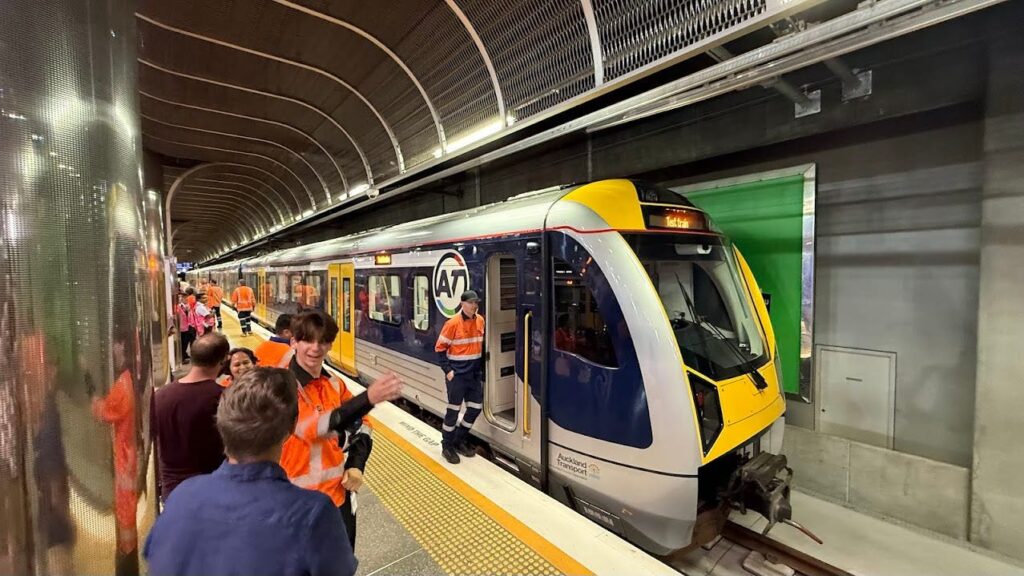
City Rail Link test train at Waitematā/ Britomart Station prior to entering the City Rail Link tunnel. Image credit: NZ Transit Buzz
And, on the question of whether Warkworth to Te Hana will even be going ahead now the government has said it won’t be raising the fuel tax, Connor was quoted in The Post:
Writer for the transport advocacy group Greater Auckland, Connor Sharp told The Post the document showed that the project was “really, really expensive”, despite the fact its actual cost was redacted.“The cost of this project is so big that if you tried to fund it just through the private market, through a public private partnership, you would have to get a crown loan to subsidise some of that.”Sharp believed it would cost billions when not even factoring in the PPP finance payments for the projects.“After a 25-year period of repayments you’d probably be looking back two to three times that initial sticker price.”
Consultation reminder: Hobsonville cycleway
We highlighted this a few weeks ago, but: AT’s consultation on upgrading additional intersections as part of the Hobsonville Cycleway project closes today, Friday 10 April. You can read some more of our thoughts about it here.
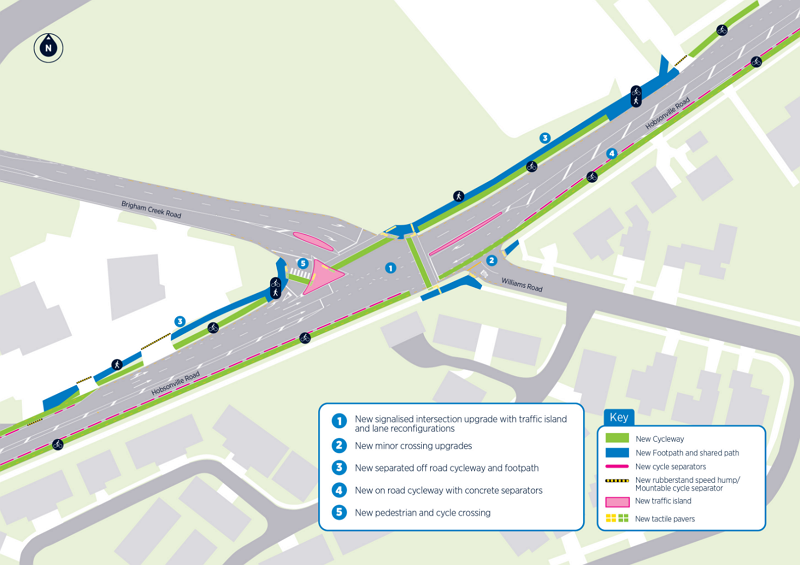
One of the intersections to be upgraded by AT to make walking and cycling safer in Hobsonville.
Which city thanks bus drivers the most?
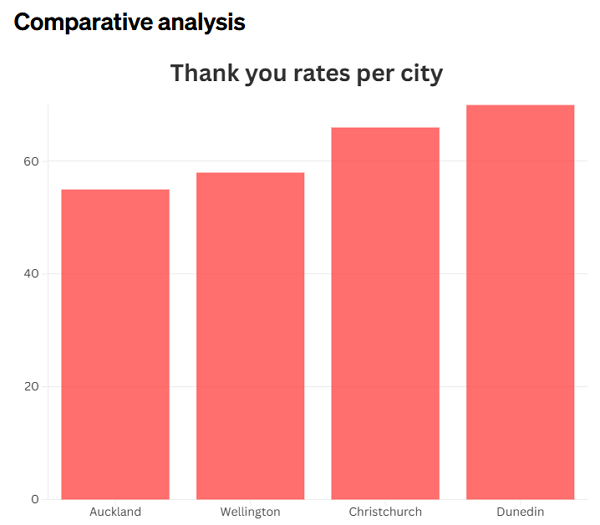
The Spinoff has been tracking who thanks bus drivers, as a vital measure of civility in these trying times. Turns out latitude correlates with attitude. C’mon Auckland, we can raise our sights!
Over the past week, The Spinoff writers have been stealthily logging thanks yous uttered on buses across the motu. Today, we present our findings.
…..
That said, there are growing concerns that saying thank you to the bus driver might be going the way of Tangy Fruits, Fair Go, and other cultural institutions now lost to the ravages of time. Over the last few years, multiple Reddit posts have queried the decline, and Reilly herself had an “internal crisis” after nobody said it at the university stops on her Auckland bus route last year. “I thought it was rude, then I was worried that I was just out-of-touch,” she says.
With the fuel crisis causing more people to take public transport across the country, The Spinoff thought this was the perfect time to get out there and see how our main centres are tracking when it comes to thanking the driver. Sending our writers out incognito in Auckland, Wellington, Christchurch and Dunedin (apologies to Hamilton and Tauranga, times are tight), we stealthily logged your thank yous, your no thank yous, and any other surprises along the way.
Adapting to the fuel crisis
Leading by example, Napier’s Mayor has switched to using an e-scooter for some of his trips:
Napier mayor Richard McGrath has switched some of his daily commuting to his e-scooter as the region’s councils monitor and plan for the possibility of fuel shortages.
McGrath, who doesn’t have a council car, said it was a good time for people to consider different forms of transport.
“I am using my e-scooter as much as possible. Napier is a very easy place to get around with a bike or scooter, and on a nice day, you can’t beat it,” McGrath said.
He said exploring the new bus routes could be a fun school holiday activity and that many council staff were carpooling, or travelling by bus or bike.
“We are good at adapting to change.”
Elsewhere, there are some creative commutes, along with the more expected options like greater use of public transport:
With fuel prices front of mind five weeks into the Iran war, more and more Kiwis have taken on alternative commutes, turning to public transport, e-vehicles and some other, more unusual, alternatives.
1News Digital Reporter Polly Wenlock asked Kiwis to share their craziest commute journeys online and some responses stood out as especially unique — paddle-boarding, half-marathon distance runs and fold-up scooter traverses among them.
One respondent said transporting a 6.1m kayak through town after an 11km commute up the Waikato River to work was challenging, especially with some co-workers not so thrilled. “The carpark attendant behind my work wasn’t a huge fan,” he said.
…..
“I work in an Manukau Operating Theatre once a week but I live in Devonport,” said one Aucklander.
“So I bike to the ferry, at the other get the Southern line to Homai Station, then bike to the Hospital. The whole trip takes just over an hour.”
Over in Sydney, lots more people are getting on their bikes:
As another oil shock caused by war in the Middle East rattles the globe, Sydneysiders are taking inspiration from the Danes and turning to bicycles to alleviate pain at the bowser.
There were 600,000 bike-sharing trips in the City of Sydney in March, a council spokesperson says – a 25% increase on the previous month. At the same time, thousands of cars have disappeared from Sydney’s roads.
“Last month, many of our bike counters recorded slight increases and their highest numbers of trips since we installed new counters six months ago,” the spokesperson says.
…..
Last Wednesday alone, more than 4,500 bike trips were recorded along Darlinghurst’s Oxford Street – the highest count since the new cycleway opened last July.
Longer term, figures provided by TfNSW show cycling rates almost doubled in the Sydney CBD last month compared with the same time last year (496,516 counts compared with 288,907) and rose in the adjacent suburbs of Paddington (26,065 compared with 17,215) and Eveleigh, where the count leapt from 15,011 to 71,15
Calls for action to navigate the fuel crisis
Across the motu, there are smart and sensible calls for what more can be done to give New Zealanders meaningful options while we’re buffetted by the international situation.
Down in Christchurch, for example, where cycling is already on a roll:
Cycling advocates are calling for a major ramp-up in Christchurch’s cycleway investment – urging city councillors to abandon slow, high-cost builds in favour of quick and cheap solutions as fuel prices prompt people to seek alternatives to driving.
Speaking at a council annual plan hearing on Tuesday, Spokes Canterbury member Anne Scott pointed to the Park Tce cycleway in the central city as a blueprint for rapid delivery, pushing for similar roll-outs in high-demand areas.

And University of Auckland Senior Lecturer Tim Welch is back with another good summary of how we got here – which chimes with Connor’s take, and others:
The problem for the current government is that nearly every one of those levers is a policy it has spent two years dismantling, defunding or disavowing.
It has pushed public transport agencies toward higher fare recovery targets and halved walking and cycling investment to $460 million (with no new funding for the 2024–27 period). It cancelled Auckland light rail.
Better urban walking and cycling infrastructure is known to shift people away from short trips by vehicle. But former Transport Minister Simeon Brown has claimed New Zealanders were “sick and tired of the amount of money going into cycleways”.
…..
Every effective oil-shock response sits in the policy lane the current government has disowned as wasteful, anti-motorist or ideologically driven. Deploying any of them now risks conceding the political point.
Meanwhile, Simon Wilson – who is back writing at The Spinoff – is as encouraging as ever about the genuine benefits of heading in a more versatile, sustainable direction:
The value of higher prices is that they force us to think harder about how we use petrol and diesel. Freight companies, for example, say they are combining loads and doing fewer runs. Excellent.
But guys: you should keep those efficiencies in place permanently. Fewer trucks on the roads is a net gain for society: it reduces traffic congestion, boosts road safety and public health and lowers carbon emissions. And because it lowers your own costs, too, it should lower ours.
…..
Also, public transport services should be funded to ensure they’re frequent and widespread.
The government should also offer carrots and sticks to businesses, to encourage not just public-transport commuting but working from home, car-pooling and walking and cycling to work. How about staff use of buses and ride-share scooters and bikes instead of cars for work-related trips across town?
Where’s the support for freight forwarders to use rail? For couriers to transition to cargo e-bikes?
As with trucking efficiencies, all these things could become permanent. The opportunity is here for a cultural reset, to establish a more resilient, healthier and, for heaven’s sake, cheaper way of living in this country.
Why is none of this on the government’s agenda?
And this op-ed by Paul Callister and Robert McLachlan looks at what the fuel crisis means for the aviation sector, and how we’re currently behind where we could be:
The previous government had begun work on decarbonising aviation. But, just as for land transport, most of that work has now been stopped or reversed. The current coalition Government has:
- Scrapped the tourism/environment task force, whose work was half-completed;
- Stacked the newly established public-private group Sustainable Aviation Aotearoa with airline industry representatives, and then mothballed it entirely;
- Cancelled the relevant parts of the first Emissions Reduction Plan, including the requirement to develop a domestic aviation decarbonisation plan and a Sustainable Aviation Fuel mandate;
- Stopped work on the State Action Plan that each country is to submit to the International Civil Aviation Organisation, describing their country’s approach to the goal of net zero aviation by 2050; and
- Rejected the Climate Change Commission’s advice to bring international aviation and shipping into our 2050 target.
Using our existing infrastructure better
Chuck Marohn from the influential US non-profit Strong Towns has been in the country, talking about our new National Infrastructure Plan. He speaks to Te Waihanga CEO Geoff Cooper about it, on the podcast.
And here’s a quick video he’s made about it. Always useful to see our issues through fresh eyes:
The infrastructure challenge isn’t going away, so it’s great to see ongoing coverage of the challenge and the opportunities. Like this piece in Newsroom by Rebekah White, featuring University of Auckland experts on the topic.
“We’ve got massive challenges with infrastructure,” says Theuns Henning, an associate professor in engineering and design at the University of Auckland. “Our assets are old and deteriorated, so there’s a huge replacement need, especially in the water sector. There’s also massive demand growth, which is, for the size of our economy, quite a big challenge.”
Fundamentally, New Zealand has the same problem as Flint – but on a different scale, and for different reasons, says Henning. “The reason why we’re so vulnerable is because we’ve got a massive asset base for a very small population and economy. In the old days, especially in the rural areas, politicians promised farmers, ‘We’re going to seal your road.’ Many of our networks have grown outside of our means to maintain it.”
Councils, he says, are biased towards creating new assets instead of maintaining existing ones. “If you’re the mayor, you want to cut red ribbons, and you cut red ribbons when you build something new.” That often means neglecting maintenance.
New Zealand cities have large footprints that are difficult for councils to maintain – not because people and industries have left, but because of the way cities have been developed. “The [lack of] density in Auckland is shocking by world standards, and it makes it very, very expensive,” says Henning. “Because if you’ve got a much denser-populated environment, it is much more cost-efficient – public transport, the length of roads you have, the length of pipe you have, all of that.”
‘Record’ parking fines in Auckland?
In 2024, the government finally updated the cost of parking fines for the first time in around 25 years. The impact of that update is now being seen in Auckland. Which makes for an eye-catching headline, but it’s primary school maths to understand that fewer tickets at a reasonable cost isn’t exactly a “record”.
If anything, the headline here is that drivers seem to be getting with the progammed and parking illegally less often…
Auckland drivers are being hit with record parking fines, even as the number of tickets being issued has dropped.
New figures obtained by RNZ via the Official Information Act show nearly $49 million worth of infringements were issued by Auckland Transport (AT) in 2025 – a sharp increase from just over $18 million in 2020.
But the rise was not driven by more enforcement. Instead, it was largely the result of higher fines set by central government, alongside a shift in how tickets were issued.
The data showed infringement numbers peaked in 2024 at more than 640,000, before dropping to 581,638 in 2025. Despite that, the total value of fines increased significantly.
According to AT, the jump reflected the first full year of higher nationally set fees, which were introduced in late 2024.
Should Auckland Council acquire the Avondale Racecourse?
The question of what to do with the Avondale Racecourse (home to the famous Avondale Markets) is on the agenda. Local enthusiasm is growing to redeploy it as a community greenspace and recreational zone, tying in with other local developments.
It’s an important part of the discussion, with a revitalised town centre on the way – known as Te Hono, the plan includes a community centre and library on the old Three Guys site – and of course the train station will come into its own with CRL.
As Sam Smith reports for Stuff:
Concerned residents want Auckland Council to buy Avondale Racecourse lest a potential sale results in the loss of green space.
Racing at the 138-year-old racecourse is due to end in July, with New Zealand Thoroughbred Racing (NZTR) consolidating racing in Auckland at Ellerslie and Pukekohe.
The Avondale Jockey Club owns the 35-hectare site, with the inner sports fields leased to Auckland Council for community sport, including rugby, football, and cricket.
The racecourse is also home to the popular Avondale Markets, which have drawn thousands every Sunday since opening in the 1970s.
However, with the land likely to be sold when racing finishes, concerns have emerged in the local community over whether some form of green space, or indeed the markets, will be retained in any future development of the site.
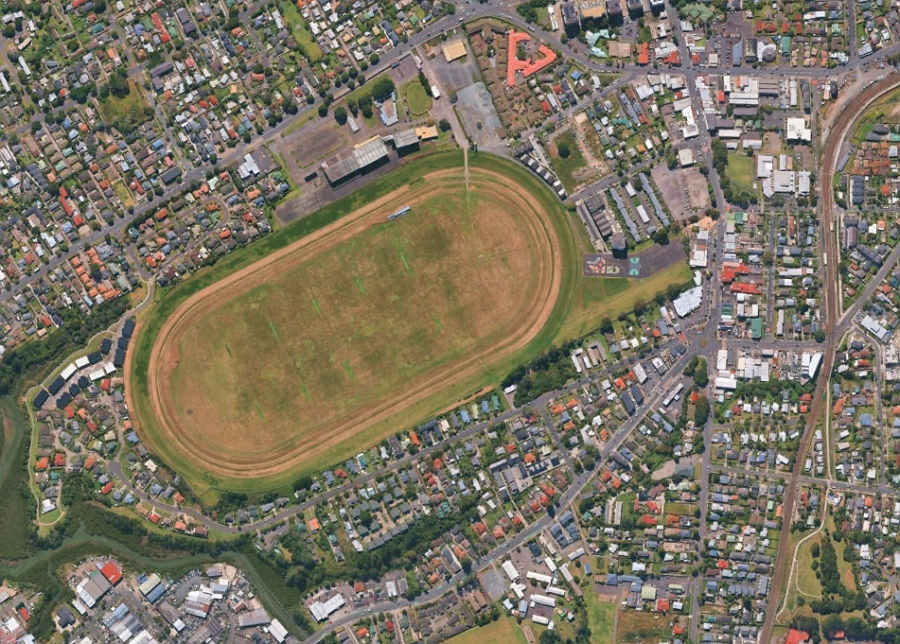
The space in question: Avondale Racecourse as seen on Google Maps, aerial view.
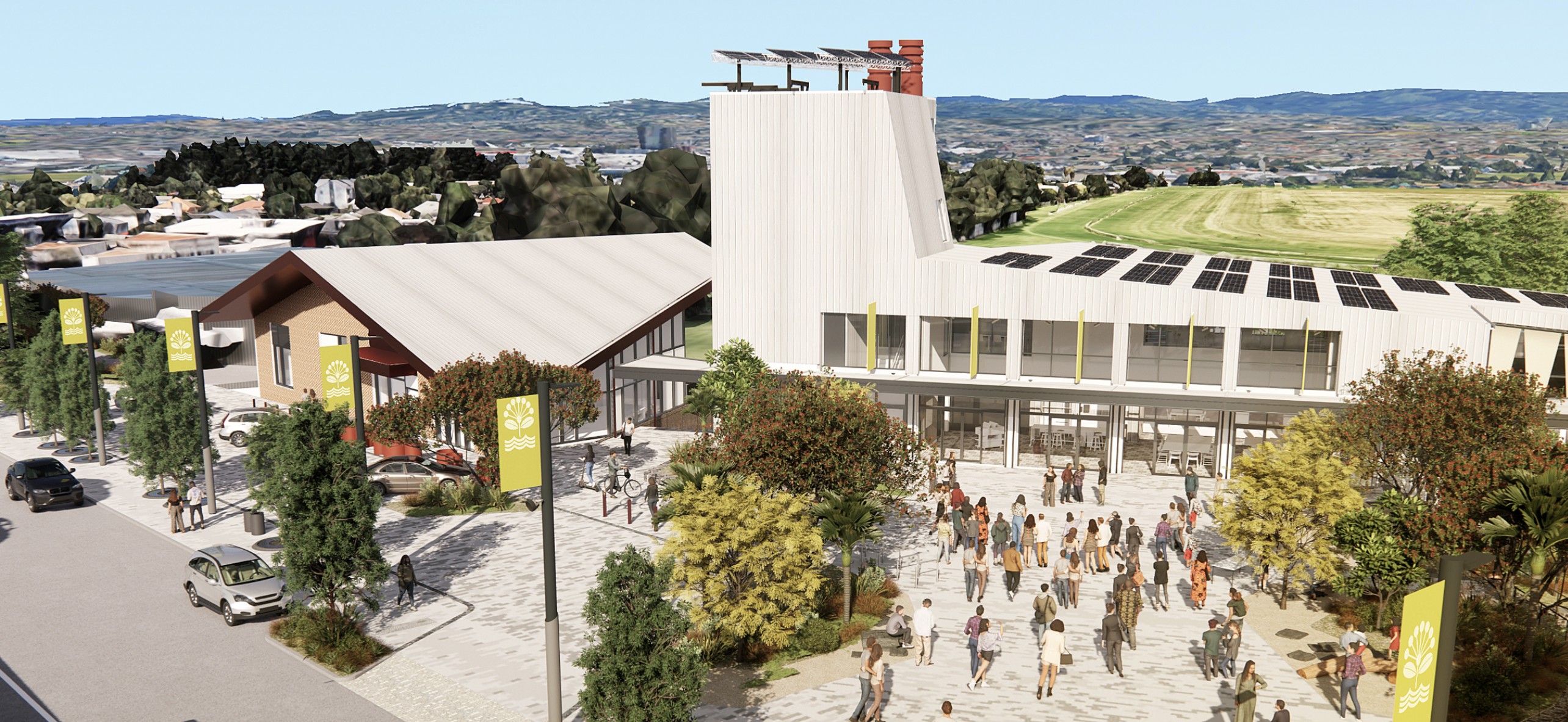
A render of the planned Te Hono community hub for Avondale, to be built on a currently empty site on Great North Road, racecourse in the background. Image: AUDO
You can find out more about the “People’s Plan” here. There’s clearly heaps of potential for enlivening the whole area.
This would surely include filling in local links to the existing bike network (including to Te Whau, the New Lynn to Avondale railside path, and the NW cycleway), and tree-lined greenways safely connecting the train station and town centre to the Rosebank peninsula and its massive student population.
DIY safety messages and crossings
We all know it can take ages for communities to get much-wanted road safety improvements and safe speeds, especially when political directives have made them harder to achieve. In Mosgiel, someone – or a group of someones – is taking the matter into their own hands, as Hamish McNeilly reports for Stuff:
Further on, the remains of what appears to be a painted-over pedestrian crossing appear, while another DIY effort, this time what appears to be a speed hump, has been painted on the street’s surface near a local park.
Mosgiel-Taieri community board chair Rebecca Shepherd told Stuff she understood why people were taking safety issues into their own hands: but “it is just not the right way to go about it”.
There was process for getting traffic management infrastructure, with the board currently working with the Dunedin City Council (DCC) to get pedestrian crossings at Bush Rd and Factory Rd.
“No doubt Murray St needs something done.”
The issues with Murray St centred around motorists speeding in an area which includes a large number of families, a local park as well as a kindergarten and childcare facility.
“The concerns are real, but I don’t think the way of going about it is right.”

We’ve heard of similar approaches in Auckland, including areas where higher speeds were re-implemented against community wishes – have you seen any?
Videos to check out
A classic, well-explained:
“Ask for forgiveness, not permission”: a quickfire retelling of how the Mayor of Seoul famously turned a highway into “a vibey canal”:
This one can be rephrased as five top tips for achieving safer streets. Spoiler: it’s never just about “cyclists”, and political support (and opposition) should have political consequences:
This is just lovely:
From the socials
In Portland, Oregon, a “Bike to Books” contest resulted in some very cute (thermoplastic) updates to the usual boring sharrows, pointing people on bikes towards their nearest library:
View this post on Instagram
Look at the buses go! That’s a whole lot of mobility, all day long.
Everyone talks of cycling transformation Paris, and some London and NYC… Berlin?Berlin is spectacular: One of five trips are done riding bicycle!! 19%NYC: 3% • London: 4.5% • Paris 11%NYC's density has gigantic potential but has failed to do citywide NETWORK protected bikelanes.bit.ly/4dQpwEH
— Gil Penalosa (@penalosag.bsky.social) 2026-04-06T21:06:02.714Z
And if you’re in the city centre over the next few weeks, check out the sculpture trail as part of the Auckland Art Fair. The fair itself is over the weekend of 30 April – 3 May, while the sculpture trail runs from today to 4 May.
(NOTE: if you’re heading out to view things this Saturday, do be aware that for example the equally cool inflatable sculpture Airship Orchestra in Aotea Square will be temporarily deflated for safety reasons, due to the incoming storm).
https://bsky.app/profile/ccrg.bsky.social/post/3mj3jis3zoc2u
That’s us for this week. As always, feel free to share links and stories in the comments – we always appreciate your eyes on the big picture. And with wild weather on the way, keep safe out there!

 Processing...
Interesting topics.
That Avondale racecourse area development is a good idea along with consolidating racing.