Welcome to another weekly roundup of all things cities and urbanism, we hope you’ve had a good week!
Our header image this week shows the installation Evanescent in Aotea Square, part of the Auckland Arts Festival. (Photo by Jolisa Gracewood)
This week in Greater Auckland
- On Monday Patrick answered the question of what should the government do about the ongoing fuel crisis.
- On Wednesday, we had a guest post from Living Streets Aotearoa, and their interview with Dr Caroline Shaw regarding recent research on who meets transport ministers.
- And on Thursday, Matt looked into the numbers behind proposed tolling of the Warkworth to Te Hana Road of National Significance.
This roundup, like all our work, is brought to you by the Greater Auckland crew and made possible by generous donations from our readers and fans.
To support our work by setting up a monthly donation, you can join our circle of supporters here. We’re now a registered charity, so your donations are tax-deductible.
The Fuel Crisis
There’s one topic that’s understandably dominated the news this week, the impacts on fuel supplies and prices as a result of the war in Iran. Here’s some.
First up, Tim Welch highlighting why NZ’s car dependence is now a strategic liability.
Every decade brings an oil shock. Each time, New Zealand could have used the crisis to create policies and plans to wean itself off over-reliance on petrol. Instead, it has waited for prices to settle and gone back to building roads and buying petrol cars.
The country now owns 815 light vehicles for every 1,000 people, one of the highest rates in the world. Road transport emissions have grown 82% since 1990.
New Zealand still has a choice, however. It already powers lights, hospitals and factories with renewable electricity. It could have powered a diverse transport system the same way, and it still can.
Every bus electrified, every cycleway built, every train funded is a direct reduction in exposure to the next crisis. The question now is whether New Zealanders begin to treat their car dependence not as a lifestyle choice but as a strategic liability.
As well as the one above, there’s been quite a few articles this week making note of the folly of things like removing the Clean Car Discount
This is from Australia, where it seems their supplies are lower than ours, looking into how the number of days available is counted. We quite liked this quote
Two kinds of panic are circulating right now. There’s the panic that comes from understanding the actual situation. And there’s the panic that comes from being told a number that doesn’t mean what you think it means — and then realising, too late, that the window to prepare calmly, at whatever scale you can manage, has quietly closed.
The second kind is worse. Because it wasn’t necessary.
This isn’t about trust. It’s about whether the information we’re being given is actually useful to us — or just useful to them.
https://bsky.app/profile/thierryaaron.bsky.social/post/3mhfgmxfl3c2f
The government are saying we don’t need to panic and that things are under control. We can only hope we’re not left in a situation where by not making smaller changes now, we’ll be in a panic with more severe implications in a few weeks’ time.
Meanwhile, some people are already making changes:
Tuesday was our busiest day on public transport since 2019 (pre covid), 7000 trips higher than the previous busiest day which was two weeks ago. This Tuesday (18 March) patronage was 7% higher than it was last Tuesday. It’s great to see more people choosing public transport and trying it out.
— Richard Hills (@richardhills.bsky.social) 2026-03-19T05:04:29.501Z
Auckland Transport is saying the current cost of fuel means public transport fares for many commutes will now be half the cost of driving:
Auckland Transport said before the Iran conflict began late last month, the cost of public transport was roughly the same as the cost of driving a vehicle with single occupancy in Auckland.
It’s now costing people nearly double to drive their own cars.
“The cost of petrol has risen at least 50 cents per litre since then, with a 15-kilometre single person commute now costing roughly 80 cents per kilometre, which is equal to about $12 for the total trip.”
AT said this did not include any parking costs.
“On public transport, that same 15-kilometre trip would typically cost $4.90 and would be a significantly faster journey due to congestion and the availability of bus lanes, frequent rail and ferry services.”
“We can confidently say that the cost of driving 15-kilometres in or out of the city is now roughly double the cost of travelling the same distance by public transport.”
AT said the first week of March was the was the busiest for the public transport network this year with 2.217 million trips on bus, train and ferry services – up from 2.174 million trips, the same time last year.
…..
Auckland Transport said despite big numbers of travellers, it has plenty of capacity across the network.
Hobsonville Rd Cycleway
Construction of the cycleway has been underway since the start of the year, and this week Auckland Transport has come out with a new consultation to further improve three key intersections along the route.
Brigham Creek Rd
This is an incredibly dangerous intersection that should have been upgraded when Hobsonville Rd was replaced as a State Highway by the motorway in 2011. It’s an intersection that has seen many crashes – Matt was hit by a car here just last year while cycling to work.
AT’s original plan had the cycleway diverting to a raised crossing 50m down Brigham Creek Rd which would have been both very inconvenient for those on bikes, and would have done nothing to address the safety issues that exist for all road users.

The original design at Brigham Creek Rd
Thankfully, their new plan addresses this by signalising the intersection.
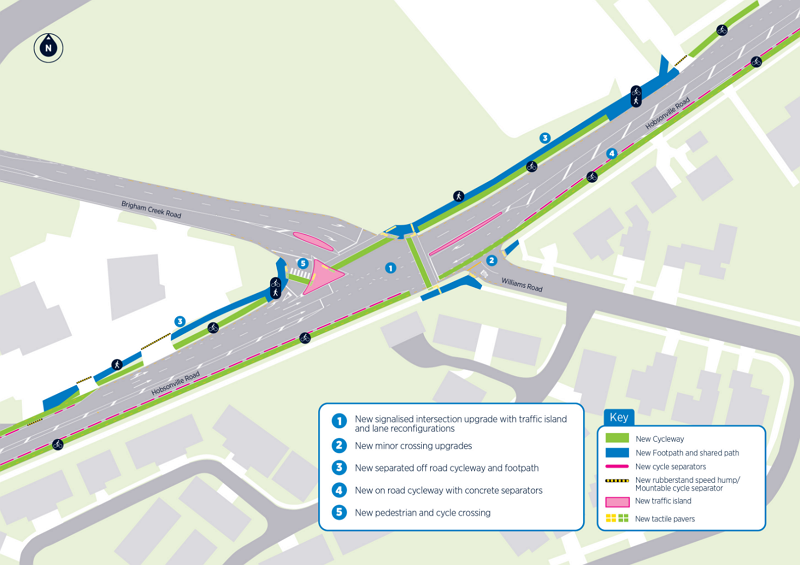
Trig Rd
Further south, another dangerous intersection – which originally involved a similar kind of approach as proposed for Brigham Creek – is also getting signalised.
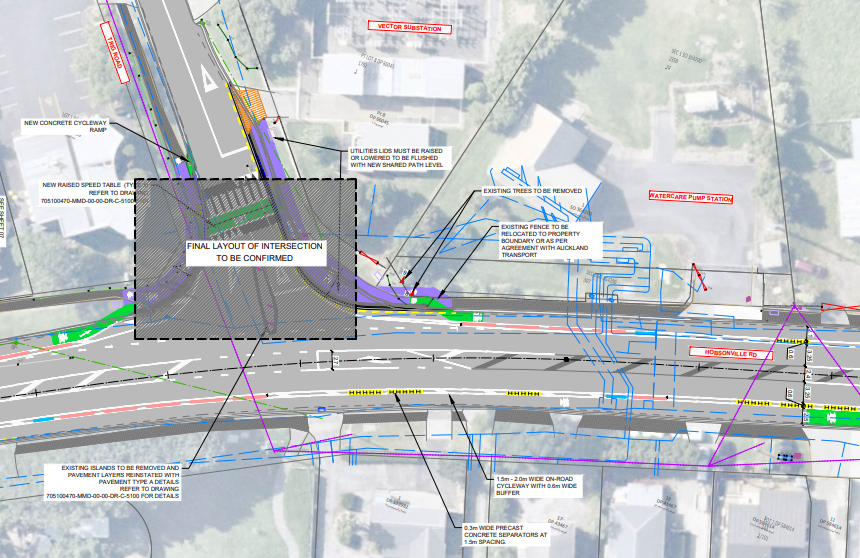
The original design at Trig Rd
It appears AT are squeezing some traffic extra lanes in, meaning the cycleway moves off the road and becomes a shared path.

Oreil Ave
If you cross from the Northwestern Cycleway over the yellow bridge at Westgate, you’ll end up at Oreil Ave – which presents a bit of a hill to climb to get up to Hobsonville Rd, and then the question of how you get to the new cycleway heading east.
AT previously said they were investigating a new crossing near here. The new proposal adds a signalised crossing, but also adds an uphill protected cycleway on Oreil Ave, as well as a raised crossing by the end of the yellow bridge, and speed cushions.
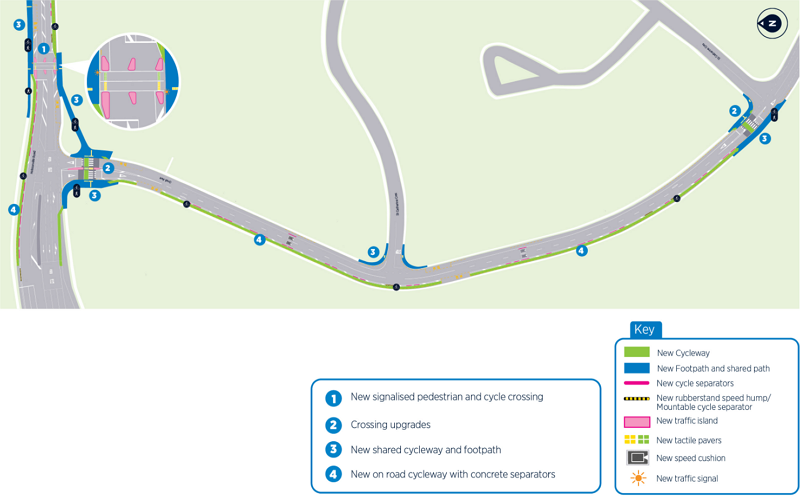
Overall these changes look positive and should be supported.
Consultation is open till April 10.
Enforcing road safety is a good thing
The number of speeding fines issued by police officers is increasing, with last year producing the highest number of fines handed out in 16 years.
New figures reveal officers issued 538,192 fines over 2025 – equivalent to just over one fine for every minute of the year.
It’s higher than 2024’s total of 461,000 fines, and 2023’s 402,000.
Last year’s fines raked in $54.2 million, with the average penalty about $100.
The figures only include fines issued by officers and not stationary or mobile speed cameras.
…..
Police say in recent years they’ve boosted enforcement.
“Speed is globally recognised as the leading contributor to crashes occurring and the severity of outcome,” Inspector Peter McKennie said.
“The messaging from police has been very clear that if you exceed the speed limit you can expect to be stopped.”
AA’s road safety spokesman Dylan Thomsen said there was a reduction in road safety enforcement in the late 2010s, which police have attempted to turn around.
“I guess you could say this has been a refocusing by the police, and they have really targeted some areas that are involved in some of the highest rates of crashes.
“The simple message for drivers in New Zealand is that the police are out in much greater force and targeting speed, so people need to be much more careful around sticking to the limit.”
Thomsen said the increased enforcement has coincided with falling road fatalities.
“It’s hard sometimes to be able to definitively prove these things, but we don’t think it’s a coincidence that we’ve had the lowest rate of road deaths, and at the same time, really high rates of enforcement.”
Meanwhile from Norway:
https://bsky.app/profile/aninehartmann.bsky.social/post/3mhbmi2fox22m
Here's the actual rule from the Norwegian version of the highway code, implemented last Friday. viewers.vegnorm.vegvesen.no/product/8600…
— Anine Hartmann (@aninehartmann.bsky.social) 2026-03-17T18:36:11.264Z
The change is meant to make streets safer for pedestrians and cyclists. Here's the full list of requirements (translated) that have to be met to post a higher speed limit than 30 km/h. To use 40 or 50 km/h, all requirements for pedestrian and cycling infrastructure have to be met.
— Anine Hartmann (@aninehartmann.bsky.social) 2026-03-17T18:36:11.265Z
Crashes cost more than previously thought
A transport consultancy firm says analysis of traffic data reveals the total cost of a crash is up to 70 percent higher that previously calculated.
The Ministry of Transport currently calculates the social cost of a road fatality at more than $15 million, which includes elements such as the road closure, emergency service response, and the social costs for the life lost.
But Abley Principal Transportation Planner Chris Blackmore told Nine to Noon data analysis shows that the impact of a crash on the overall road network is not factored into that calculation.
The other side of the safety coin
Even when roads aren’t killing us directly, they can still harm us – at an even greater scale:
Health researchers are calling for policy changes to combat air pollution in Auckland, saying traffic is silently killing locals.
More than 700 Aucklanders die every year from air pollution from traffic, compared to 2000 deaths nationally, according to a new report by the University of Auckland.
It’s similar to the number of people who die from smoking cigarettes, with almost 4000 more ending up in hospital, the report said.
Dr Jamie Hosking, a public health researcher at Waipapa Taumata Rau University of Auckland, said petrol and diesel burn produce the gas nitrogen dioxide and small particles of soot, smoke, dust and chemicals.
“Those particles are really, really fine, so we can’t see them,” Dr Hosking told Morning Report. “But because they’re so fine, they get right down into our lungs and cause damage there, and can even get through into our bloodstream and cause inflammation there and give us problems such as heart disease, strokes, lung cancer and in our kids, asthma as well.”
…..
The report outlines several solutions on both a national and city level, such as investing in better public transport, raising vehicle emission standards, improving air quality monitoring and introducing equitable congestion charges.
Dr Hosking said central cities around the world, such as London, have implemented low-emission zones, which means only the cleanest cars can come into central city areas.
“That’s been really effective at lowering air pollution and giving them cleaner air,” he said.
“That’s really good for people’s health and something that we could be putting in place in Auckland.”
The Golf Course question
Last year, Auckland Council agreed to use part of the Takapuna Golf Course for flood protection. The local board has been consulting on what to do with the rest of the land, with a decision being made next week. The golf course has now come up with their own option, which fits in with the council’s plans.
With that date looming, Takapuna Golf Course has announced a proposal to develop New Zealand’s first purpose-designed 12-hole urban golf course at the park. The proposal would also retain the driving range and café bar.
…..
Beyond golf, the concept also includes creating new public walkways around the park, opening more green space for the wider community, and relocating Eventfinda Stadium.
“We’re proud to be a public course,” Dowd said. “This isn’t about exclusivity. It’s about making sure everyone from golfers to families out for a walk can enjoy this amazing space.”
It’s the second part of opening up the area that is particularly interesting. The proposal shows a connection across the stormwater lake, along with a new crossing of the motorway to connect into the busway station.

What a deal
It gets presented as a massive hike, percentage-wise but even the proposed $114 per year is a fantastic deal for residents to get unlimited on-street parking:
Residents of Auckland’s inner suburbs are being asked for feedback on a proposal that would hike the price of a parking permit from $70 to $114.
Residential parking permits allow residents and businesses to park outside usual time restrictions in areas where they are enforced.
As part of the consultation for the Auckland Council’s annual plan, residents are being asked about the price of residential parking permits.
John Strawbridge, Auckland Transport Group Manager, Parking Services, told 1News the agency had proposed increasing the price of each permit from $70 to $114, a 63% increase.
AT said it costs the agency $114 to process each permit, and believed the increase reflected this.
AT are only allowed to charge the cost of administering the permit system, which is why it’s so low. Also this – why not? That’s a lot of potential left on the table!
“It’s important to note that there has been no price increase for parking permits in 13 years,” he said.
Fiddling with the numbers
NZTA have released the results of consultation on their plans for their Wellington Improvements RoNS and it appears they’ve been fiddling with the charts to make it look like their plans are more supported than they are.
Had to see what difference the accurate proportions would be … turns out a lot.
— Simon Ward (@simonmward.bsky.social) 2026-03-19T02:30:12.534Z
Videos to check out
That’s it from us, have a great weekend.

 Processing...
What a great way that would be to get to the Smales Farm RT Station- gliding across the lake! Excellent way to expand the catchment of the RT network, needed across the system.
Its a good video regarding dire state of modern developments.
Something for followers (not to mention authors) of this blog to consider in their – frankly – uncritical championing of anything to do with density in this City.
Bureaucrats don’t help themselves when they hold off doing increases for 13years then go for the jugular. There’s probably 12 years of costs exceeding income that is now lost forever and they are setting the system up to fail for maybe another 13years when they “are only allowed to charge the [current] cost of administering the permit system.” I added the implied [current] to that quote.
The solution is for AT to develop a publicly verifiable and auditable quarterly measure maybe called the “bureaucracy cost factor” and as that factor moves up and down it gets applied to things like permitting costs once a year based on movements across the prior four quarters.
This does two things; 1. It moves fees annually in line with current costs ensuring delayed fee increases aren’t subsidised through general rating. 2. It separates the arguments around whether or not a fee is required from arguments around the cost of the bureaucracy and puts the focus on the bureaucracy to reduce its cost of doing business.
As there is no calculated profit figure in public services to inherently drive up income and drive down costs there is a need to make the structure and drivers of both cost and income clearly visible and accessible so that the users and funders of the services provided as well as the bureaucrats themselves can contribute to improving productivity. A measure such as a “bureaucracy cost factor” would be a good starting point for me.
Too much hard work measuring that and then public consultation on changing fees.
Just allow Councils to set charges for a market value not just admin recovery. Same as Wilson Parking.
Could be a good approach for this fee. However there are many many fees just AT charge for various things. This is a huge list of fees for people wanting to access road corridors for a variety of activities. https://at.govt.nz/about-us/working-on-the-road/corridor-access-requests/car-fees-and-charges
How on earth did AT arrive at $79.95 as the fee for “Placement of mobile plant or equipment in traffic lanes and cycle facilities on Level LV and Level 1 roads” and since that fee was last set in 2023 is it still relevant to their costs. Half their fees seem to apply the New World rule “round down 5c from the nearest dollar”. The other half apply the Bunnings rule “use unrounded numbers because it look like there is some science behind it”.
Why not make the cost of parking permits relate to the average price/ sqmetre of land in the general area? Might make out property rates less expensive. At least this way people would have to make a more rational decision as to whether to use garage to park their car or as an extra room for their house.
Compare walk or bike to Smales Station across the wetland with Lake Rd or Wairau Rd.
Tie that to the pollution issue and the traffic noise real effect on health.
On traffic effects on air quality: when the rubber hits the road, you get lungfuls of microplastics.
All the more reason for steel wheel trams with regenerative braking to reduce disc pad dust.
Parking fees should at a minimum cover costs and be adjusted yearly. If there is excess demand for parking permits, they should go up each year until it’s not over subscribed. I’d be happy if it was just paid parking, with no residential permits as it’s not their road over everyone elses, but tbf I’d probably feel the opposite if I lived in a parking permit area.
—
I like the new connection to the busway.
—
Re Trigham/Brigham etc nuts that they didn’t have traffic lights before. Sucks so much to get out of those intersections in anything bar no traffic.
—
I was amused at the fiddling with the graphs to make the approval look better. Extremely misleading.
Totally agree. A few hundreds per year is still practically free. It should go up regardless, we need to eventually get rid of much of it because there is often better uses for that space.
– bike lanes
– bus lanes
– on many streets it becomes genuinely difficult to drive with parking on both sides. Larger vehicles like buses (!) will get completely stuck.
– making the road more narrow so AT can stop pissing so much money away on maintaining it (and maybe afford something better than this POS chip seal)
And parked cars, by blocking sight lines, make the road more dangerous for those walking.
And there is once again talk about intensification, and intensification is impossible (or, it will go very VERY badly) if on-street parking is not heavily restricted. Developers and home buyers need to be convinced that if you want to keep a car you genuinely have to buy a property with off street parking (or a parking spot elsewhere) for your car and not rely on street parking.
I would say, announce it now that such permits will raise in price, with a given increase for the next 5 years, eventually reaching some multiple of $1,000 per year. If it is predictable both people, builders, and prospective home buyers will have at least a chance to adapt.
Call me neo liberal, but anything the government or council provides should make a reasonable profit, with exceptions for some essential services (parking is not essential). In terms of parking, it’s the value of the land plus expenses plus a reasonable return on investment. $114 per week might be more appropriate.
For some context: Smales Farm is basically the central bus station of the lower half of the North Shore. There’s possible bus lines going to Forrest Hill Road, Wairau Road, to Glenfield via Chivalry Road, Birkenhead via Northcote Road, Takapuna via Anzac Street, Milford / East coast bays Shakespeare Road, and the busway.
So making this easier to reach on foot is important. (although IMO making it easier to reach by bicycle would be the real big deal).
Related: I think the decision to route line 94 via Akoranga, and the decision to let the intercity buses stop in Akoranga rather than here, are mistakes.
Re: Brigham Creek
Why are we permitting road designs with slip lanes in 2026? Send your feedback to AT
Because slip lanes can often (not always) be a win:win for everyone.
They reduce the distance to cross the main road allowing for more frequent pedestrian phases and improve access for mobility impaired (elderly etc).
They reduce the need for a full extra lane for traffic and are also easier for cyclists wanting to turn left.
Nevermind that the road already has a slip lane so this is more cost effective for ratepayers than ripping it all out.
Try driving a semi-trailer around that corner without taking up exactly the same space. Sometimes it’s just geometry.
You are also likely to be less delayed as a cyclist travelling through a slip lane (especially one with a zebra crossing across the left turn lane) as you should get a conflict-free green bike light for the majority of the time that the Hobsonville Rd light is green.
Compare that to a non-slip lane design where you will get 2-3 seconds of a green bike light, then a red bike light as left turning cars get priority. (You can always just ride through illegally, or jump onto the main traffic lane, of course)
The slip lane design will give you 2-3 seconds and then a red light just the same. As a matter of principle I guess.
I walk around the CBD for work a lot and diesel buses absolutely pump out pollution – mostly stationary idling. This really needs to be tackled by AT. Easy -turn off bus when stationary for more than 20 seconds. I avoid and dont walk into areas with buses like lower albert st bus station as its so bad…………..u see lots of kids, families there all totally unaware of the pollution and lung damage. We need a public health awareness and change campaign – maybe compare exposure to how many cigarettes smoked. The bus drivers are most at risk as they breath in the environment all day
That daycare centre on corner of Lower Albert and Customs St is nuts.
AT should really focus on replacing urban buses with EVs first and leave the outer buses as diesels in the meantime.
That works better both in terms of pollution but also efficiency – EVs are better at stop/start urban acceleration etc while diesels are more efficient driving at constant higher rural speeds.
Side note the NEX really needs to be allowed to do 90km/h on the busway to improve productivity, reduce expense, improve passenger experience.
If my memory is good, The buses have an Auto Shutdown, which is set to 4 minutes. Starting again is manual, which would make 20 seconds a problem at Traffic Lights.
About 4 years ago I drove a Toyota Van which had an Auto Shut Down and Auto Restart, It took some getting used to, however at the end of the day with it I found it to be OK.
Are they relocating Eventfinda Stadium for Golf?