The world’s fuel situation is becoming clear, and it’s beginning to feel a lot like early 2020, where an incoming crisis is looming on the horizon.
America’s war in Iran has resulted in a drastic cut in fossil fuel supply from the Middle East. And even if everything opened up tomorrow, the supply disruption is so large that the ‘air pocket’ of delivery will still hit us. It’s perhaps best demonstrated by this map of analysis done by JP Morgan, which says our currently guaranteed deliveries stop by 20 April:
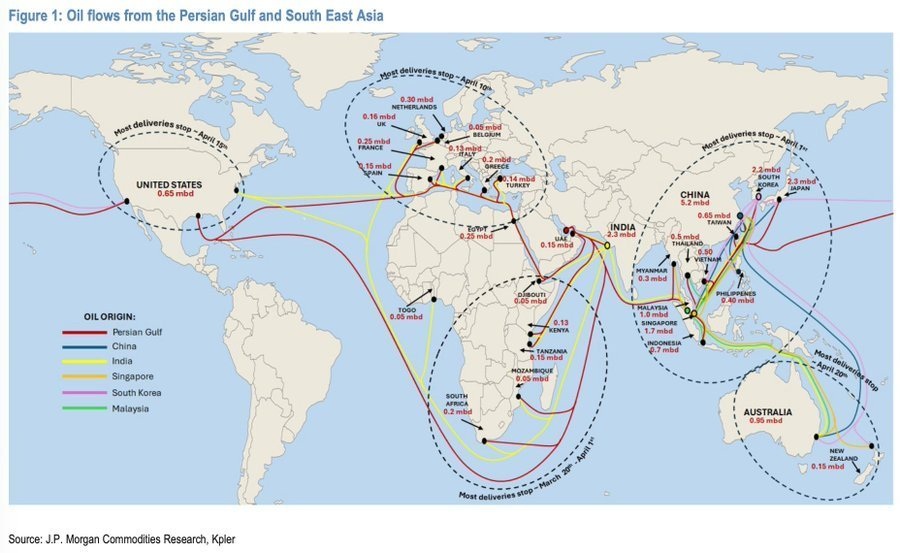
Regardless of what happens with the war, significant damage to fossil-fuel infrastructure means that the disruption is going to last a lot longer – years and years.
And the time to start dealing with it is now. Not when fuel supplies start to run out, but right now.
The good news is Auckland Council already has the blueprint to reduce our fuel use in transport. It’s called the Transport Emissions Reduction Pathway.
Because, lo and behold, it turns out what is required to rapidly reduce fossil fuel use in transport, is an exact mirror of the measures needed to rapidly reduce the emissions that cause climate change.
What is the Transport Emissions Reduction Pathway?
The Transport Emissions Reduction Pathway, or TERP, is a plan of practical steps Auckland should take to rapidly reduce emissions, and therefore reduce fuel usage, of transport in our region. It was approved by Auckland Council in 2022.
We covered it extensively here, but the thrust of the TERP is 11 key steps:
- Supercharge walking and cycling
- Massively increase public transport patronage
- Prioritise and resource sustainable transport
- Reduce travel where possible and appropriate
- Safe, low-traffic neighbourhoods for people
- Build up, not out
- Electrify private vehicles
- Enable new transport devices
- Low-emissions public transport
- Efficient freight and services
- Empower Aucklanders to make sustainable transport choices

Unfortunately, in the last few years, action on the TERP has been severely inadequate.
Sounds great. So what’s stopping us?
Leadership.
Both politically, and institutionally.
Central Government, made up of National, NZ First, and ACT, has been following Simeon Brown’s extremely ideological 2024 Government Policy Statement on Land Transport, which slashed funding for walking and cycling and reduced funding for public transport, to funnel money into a few gold-plated state highways. Basically the opposite of TERP. Despite numerous opportunities to change course, including the current crisis, they have so far refused to do so.
Auckland Council, led by Mayor Wayne Brown, has a wide spectrum of political views – some excellent, some ambivalent, and some who simply do not like the idea of prioritising walking, cycling, and public transport, even to bring them up to basic parity with the investment in driving.
Auckland Transport has suffered from institutional stagnation, where a few senior decision-makers and middle managers (aka the ‘layer of clay’) have managed to ignore and/or delay well-supported strategies and plans designed to free Aucklanders from car dependency – and fossil fuels.
The thing is, in a crisis, everything can change.
No one can now claim it is too expensive, too difficult, or a ‘nice to have’ to reduce fossil fuel use in transport. Because this fuel crisis is a burning platform, and change is coming whether we like it or not.
And people already appear to be seeking out other options, and they deserve support for doing their part.
So we’re lucky we have positive options, in the form of an approved plan that lays out the way ahead.
Now’s the time where we see the mettle of our leaders. And if they refuse to take action, then we must demand it.
What needs to happen now
Many of the larger actions are beyond the power of Council to deliver rapidly. For example, electrification of the light vehicle fleet (aka cars) – we understand the demand for EVs has been so strong, many places are sold out and now waiting deliveries from overseas. But for true change, you would need central government resources and changes, such as bringing back the Clean Car Discount scheme.
So what can we, as in Council and Auckland Transport, do urgently?
The first three actions of TERP tell us.
1. Supercharge Walking and Cycling
Auckland Council and Auckland Transport can urgently initiate the delivery of “pop-up” cycleways, to complete the strategic cycleway network.
They can do this at low cost, using the same measures as many cities around the world did directly in the early COVID response. As with 2020, the trick will be to focus on the routes that provide access for essential workers, to essential services, and that create access that doesn’t currently exist. Hospitals and medical services, the food distribution network, major factories, schools.
The legal tools are there. Reshaping Streets legislation allows for ‘trials’ to pilot street changes and /or manage traffic. With four weeks notice, AT and Council can deliver significant changes that will give people safe options for replacing car trips with walking and cycling.
A lane on the Harbour Bridge, and other motorway-adjacent access, is in the hands of Waka Kotahi/ NZTA, but is something Council can absolutely advocate for. Likewise with actions to reverse the blanket speed limit increases from Simeon Browns 2024 Speed Rule, to return to safer urban 30km/h limits.
2. Massively increase public transport patronage
Auckland’s bus network has seen enormous improvements over the last few decades. We have more than enough of a foundation to significantly ramp up the frequency of bus routes across our city, so it’s as simple to catch a bus as to jump in the car.
And not just at peak times, but all day long – giving a real alternative to driving for non-commuter trips, which make up the vast majority of trips that people currently use cars for.
We need to see the frequency ramped up as soon as possible, and services expanded where gaps are found.
Cutting the current cost of fares will increase patronage, and for certain groups where cost is a big barrier such as under 25s or Community Service Card holders, it makes sense for travel to be free. (Just as it currently is for Gold Card holders off-peak. Fair’s fair!)
Auckland Transport and Auckland Council have the ability to manage this – but central government must provide the funding and resources, as it has far more capacity and ability to do so.
3. Prioritise and resource sustainable transport
To deliver both of the programmes above, sustainable transport needs to be prioritised as well as resourced.
The quickest, cheapest, and only way to realistically deliver this stuff, is to more effectively use street space that’s currently allocated to vehicles – whether as driving lanes, or for on-street parking.
What does this mean? It means bus lanes can be rolled out on all arterials and along important bus routes, and should be 24/7 to ensure reliability of services at all times.
And it means pop-up cycleways can quickly transform kerbside space into efficient lanes that can move people safely and easily without using petrol.
(Note that police have already advised people to “park strategically“, storing their cars in driveways and garages to guard against fuel theft – so this is a logical win-win.)
Bring a vision and clarity
Underpinning all of these moves, it’s time to actively Empower Aucklanders to make sustainable transport choices. This is the time for strong, clear narratives that outline and communicate the vision and the need to do this.
Quick and creative change will be needed to deal what looks to be coming our way, and communities deserve to be on board. Just as we’ve risen to the challenge in previous emergencies, we should be actively supported to do so again.
And then, as we look further ahead to the medium-to-long term, we can keep going and implement the other actions of the TERP. Electrification of our transport system will underpin our long-term resilience against fossil fuels, reduce our emissions to combat climate change, and create neighbourhoods that support us to live healthy lives no matter the global weather.
Take Action
All of this is possible, and realistic, and doable.
And necessary.
We have the plan, the means, and the smarts to deal with the crisis ahead of us.
It just requires our leaders to have courage in this moment – and if they are slow to find their voices, we must raise ours.
Because if we don’t, we’ll get the alternative – a messy, hard, damaging and unjust transition. We will all suffer, and the most vulnerable people in our society will suffer the most.
Conversely, if together we can take the steps to get off fossil fuels, not only will we get through this shock, but we will permanently reduce the cost of living, reduce our emissions to fight climate change, and create resilience to get us through the next crisis.
If you want to help, reach out to your local MP and Councillor, and ask them to push for the urgent changes we need.
- Find out who your MP is here.
- And Councillors here.
So let’s get on with it. Because action inspires hope!
Greater Auckland’s work is made possible by generous donations from our readers and fans. We’re now a registered charity, so your donations are tax-deductible. If you’d like to support our work, you can join our circle of supporters here.

 Processing...
Great post.
Thanks Connor.
So we have a plan.
A good plan.
But we also have very entrenched vested interests.
Interests vested in maintaining the status quo as long as possible, a status quo that was increasingly becoming unsustainable, even before our most powerful world leadership went absolutely rogue, a month ago.
We now must really maximise the opportunity that November gives us to dislodge current fossil fuel based vested interests.
The track, or rather a network of gold plated motorways, and its associated fossil fuel consumption that those vested interests are intent on keeping us totally dependant on, is completely the wrong way forward.
For us, and our currently incredibly strained planet.
Nicely said Don
Excellent article, thanks Connor.
This will fail to lower Diesel consumption in a substantial way. Which is our achilles heel.
Therefore we also need to replace our diesel truck based logistics system with electric trucks. These trucks are taking off in China, the economics stacks up. The issue is the network effect which currently benefits diesel trucks. This can be overcome if the government commits resources.
A lot of our diesel consumption is from status utes, which are passenger vehicles. Almost everything in the TERP can help reduce this diesel consumption.
I should say, “which perform the function of passenger vehicles, even though they are counted as commercial vehicles”.
Now is the time to develop Kiwi Bio-Diesel !!
And heard a great interview on RNZ with our Jessie (afternoons)
Near immediate development of Natural Gas Production from already existing sources (forestry slag etc) into already existing entities, like Hospitals and GOV users..
Many solutions (locally) on many fronts..
And of course, an end to this Hyper-Masculine, Hyper-Nationalism War Mongering = PEACE
@Gregory: “biofuels” are BS. It takes way too much energy to produce them and is just a way for car manufacturers to say that they don’t need to change anything because we could “just” use different fuels.
Of course, this allows the fossil fuel industry to continue to sell fossil fuels as we still have the same old vehicles.
And yes, to your point about needing electric logistics trucks. These can be right-sized, too, for compatibility with basic safety planning.
The size of our trucks is too large for safety. This is true for each function they serve, whether on the open road, on our city arterials, or on our small streets.
Article in the Post today has the road transport lobby arguing for precisely the opposite – because we are short on fuel, and trucking costs are going up. they say that the answer is to allow bigger trucks with heavier loads, onto the roads. Hence using less diesel.
Amazing how blind they are to the destructive power of heavy trucks on our cities and people.
https://www.thepost.co.nz/business/360981056/truck-weight-limits-spotlight-diesel-costs-soar
A ‘heavy truck on a road built to take it’ is called a train…
Also this take is a version of perfectionist opposition: the improvement you are proposing doesn’t solve absolutely everything, so we should not do it.
100% – the main focus of this post was on Council ability for changes, electric trucks is well out of scope.
But also noting the increase in electric buses – so good on AT for that.
Dealing with the heavy vehicle problem is within the Council’s scope, because money they have to spend on repairing road damage can’t be spent on other infrastructure.
Anon – The post was about the Council’s ability to influence change. Electric trucks and NZ’s adoption of them to reduce NZ’s diesel reliance, is outside (in my opinion) Council’s remit.
However, yes the potential damaged caused by them is, so maybe banning heavy vehicles on certain routes is required. (which already sort of happens, so maybe a refresh there is needed).
As Heidi mentions, smaller, electric trucks / van’s are suitable for urban deliveries and shouldn’t cause road damage.
@ Greg. Impose immersions and axle weight taxes on diesels as happens in Europe (look at London, Bristol, Brighton etc) and watch our truck fleet change over night from polluting old s**t boxes to cleaner Euro 6 or electric standards.
+1
Donny said “so we should also…”. I don’t imagine he meant we shouldn’t deliver the TERP.
The economics of electric trucks is that the weight of the battery gives the vehicle a lower payload weight allowance, the payload being where freight operators make money.
Woolworths have four JAC electric trucks doing home deliveries, and Pak’n’Save have a Windross (iirc) electric semi truck hauling an electric refrigerator trailer. The government have the power to incentivise this transition, they can tweak the RUC system to compensate for the lower payload (as they did for the so-called High Efficiency overweight H trucks).
Cheaper fuel (electrons vs hydrocarbons), easily make up for money lost due to lower capacity due to battery weight.
My employer is quickly phasing out its modern post covid diesel truck, ute and panel van fleet, for this very reason and we have a fleet of 500+ vehicles.
I agree donny. While I’d like to see most of those changes, if anything they could make things worse in the short term, e.g. moving people from petrol cars to diesel buses or causing delays to trucks/cars that are burning fuel.
I kinda hope the price remains elevated for a long time, that is probably the best way to get any real progress.
Real straightforward effective actions that have benefits beyond transport and emissions.
I really think we should make some bold moves for example the NW Busway as proposed is years away, costly and specifically includes “making it easier for people in cars” – Just reallocate space for PT and save millions in emissions and dollars.
Thanks Connor, Your posts make great reading.
The change of Bus Lanes to 24 hours would inconvenience very few people as most people do not use them when they are not active.
I am so glad that I was able to take advantage of the Clean Car Discount.
Too proactive
Thanks Connor.
At the heart of all this is that the TERP shows how to reprioritise the budgets and the mix of projects (as well as how to improve the projects). Every budget since the TERP should have used this methodology. It would have saved us a lot of money. And set us up for a more affordable system.
Ignoring this budget repriorisation approach was AT’s slick technique to avoid shifting away from the planning the road lobby wants.
As an example I dug into: After the Anniversary Day Storm, the budget was reprioritised, with safety and active mode projects sacrificed in order to restore access for driving. This prevented a transformational change in the system and in people’s expectations. When I asked the Chief Financial Officer how the reprioritisation process had been developed in line with the TERP, the answer was that it hadn’t.
“The TERP is not a project guidance document, it is a pathway that sets out what would need to happen to reduce emissions by 64% by 2030.”
Without financial leadership competent in applying the TERP to reprioritisation exercises, AT’s approach is to ignore the TERP, storm after storm, in a futile attempt to keep shoring up our high-carbon, high-maintenance, unhealthy transport system.
The CFO is not the only one stuck in an old paradigm. Can anyone confirm that such AT employees will not be transferred to Council? Aucklanders should be able to expect that egregious officer behaviour will not lead to re-engagement.
But TERP was never intended as a plan of action. It was intended as a means to shut people up so that business could carry on as usual for a few more years. Eventually as people catch on they will do another “Pathway”.
Almost, miffy.
TERP was intended as a plan of action.
AT management and some politicians responded to the TERP by using it to shut people up so that business could carry on as usual for a few more years.
Don’t lump the many hard-working officers and politicians who get this in with those committed to retaining the status quo.
If the Board aren’t questioning how does xyz decision relate to the TERP, or has xyz paper for endorsing take the TERP into account, then who ever is preparing the decisions for the Board (and AT exec level) then it is way to easy to ignore.
Yes. The Board have often missed the big picture, and have demonstrated climate denial. Eg https://www.greaterauckland.org.nz/2023/06/12/pick-up-the-ball-and-run-at/
This has allowed members of the ELT (which is a mixed bag) to present papers that similarly miss the opportunities and that lead to bad decisions.
NZ has a demographic of board directors to be ashamed of. They are there to protect the status quo, not to lead the country towards a thriving future.
We need to scrutinise whatever promises the Councillors offer now.
I think you’re right in that even if the Council announce the fuel crisis means the TERP will be followed (or some aspects of it will), there’s a high likelihood that’ll be used AGAIN as a way to shut people up for a bit longer.
It is like the Harbour Bridge study. Nobody in their right mind believes there will be another crossing but they continually study it to make it look like something is happening.
Do you think they’re double crossing us?
This is why transport equity and climate action is a talkfest in auckland.
Pathway->plan->Aspiration->status quo
So now we know why, how and who.
We also have a countdown to no diesel at the pumps.
What’s going to change ?
Probably would work in 2100,but not 2020s 2030s 2040s 2050s
The future for NZ is not looking so good for me. Emissions continue to rise and the wars in Ukraine and Iran are burning fossil fuels at a fast rate. Some people are in denial.
We are having more climate events and they are repeatedly affecting most parts of the country. Nelson, East Coast, West Coast, Northland, Wellington, Christchurch, Auckland. The insurance costs are increasing and some places can not now be insured. The floods are washing away 100s of millions of tonnes of topsoil every year. NZ has a high number of slips. Erosion is a threat to farms and cities. The sea is encroaching into low lying areas. Urban sprawl is using up our precious arable land.
Many councils and individuals are building very expensive sea walls to stop the storms. Mitigation mostly means sea walls and a kilometer of a large concrete or rock wall costs $10s millions.
Floods and fires kill millions of animals. Birds, lizards, Kiwi, sheep, worms, bees etc.
In Auckland developers are building on flood planes.
Worse than that we are all going to die.
lol
Its no better anywhere else.
I travel a lot for work and can categorically tell you Italy, UK, USA, Bangladesh, Australia, Sri Lanka, and Brazil just to name a few have the exact same problems having seen all these places with my own eyes on the last couple of years.
Its nearly all tied into our enforced love affair with the automotive ICE.
In order to enable and incentivise cycling and other small wheel electric forms of mobility, at scale and pace, the action Council should take is to fully endorse the existing but largely ignored cycleway plan. Make it mandatory at any renewal or services upgrade and fund it properly.
The plan is a Minimum Viable Network for the whole city, completion of which is the key to scaling this mode. AT have been very slowly filling in bits of this map due to funding issues largely through political constraint. Here is the latest iteration from five years ago.
https://at.govt.nz/media/1985320/fc_cyclemicromobility_march21.pdf
Perhaps even the opponents of this plan within AT and AC may accept now that this is a valuable asset for any city’s resilience?
Incresing our resilience requires a decrease in our dependencies.
Our dependency on fossil fuels was never long term sustainable, given resources are finite, Depletion of our indigenous liquid, and now gaseous hydrocarbons should have been taken as significant warning, instead we have been steadily increasing fossil fuel dependency. Moar Roads.
Our dependency on car based personal transport has been increasing as micro mobility options , (cycles, scooters etc) and even just pedestrian movement, have been constantly degraded, in favour of engineering our roads to keeping bulk cars moving quickly.
In towns and cities this needs to be reversed, so that our children can once again safely walk or cycle to school as they used to. Or catch a bus without having to cross a busy road at least one way, just to get to or from the bus stop. Thus giving our children freedom to impliment their own transport solutions.
And giving them this freedom will also give us adults more transport choices and freedoms.
“Very slowly” is an understatement, the last bike lane adjacent project that I know of on the North Shore was completed in 2021, 5 years ago. It were the two pedestrian + bicycle bridges over SH1 at Northcote Road. AFAIK nothing else is even planned for the next years.
In Birkenhead, Birkenhead Avenue (the road towards Glenfield) has been bit by bit renewed (first the footpaths, then the roadway) in the past years. Maybe they will make riding bicycles on the footpath legal (or, as it is officially known, a shared path will be created).
One thing that is slightly unclear to me, is where we are at in terms of energy stored against total storage capacity (not including stock on water).
We’ve absolutely got to plan and then implement a program for saving fuel; however it looks like its also important that we don’t jump the gun by implementing drastic demand-reducing measures while our storage is still high and with more fuel incoming by ship (otherwise it will have nowhere to go on arrival).
Its so utterly typical of the politicians sponging of the Country to shut down a critical piece of infrastructure without doing anything concrete to compensate for its absence (Labour and then the National-lead Coalition’s failure to budget for increased storage).
Interested to know if you have done any work on establishing how much trucking is subsidised by motor vehicles. A truck is equivalent to about 100,000 cars or was when I did Traffic Engineering at university about 50 years ago. In a neoliberal world trucks should be paying 100,000 times the RUC cars should be charged at. If some of that subsidy for trucks was put into our rail system we could move a lot of the heavy traffic off our roads onto rail. Neil Smart Prof. Engineer (retired)
An ‘easy’ national action would be to impose national ’emergency’ speed limits based on fuel consumption optimisation. This would drastically reduce diesel consumption, though logistics trip distances would be limited for long haul. All traffic proceeding at the same economical speed would make a big difference (I leave the sums to the economists).
This should shift to supporting implementation of TERP in the longer term.
Economical speed for urban roads may take a bit more effort to work out, but not impossible.
Another easy one is to ban idling while parked.
Given the miscarriages, asthma and impacts on learning, brain development and children’s ability to regulate behaviour, that fumes cause, the practice of idling outside schools and shopping centres should have been stomped out years ago.
Just tell the pollies, no more free food or pay rises until the fuel & affordability crisis is resolved.
They’ll suddenly explode into action and have the entire thing sorted by lunchtime.
Just tell the pollies, no more free food or pay rises until the fuel & affordability crisis is resolved.
They’ll suddenly explode into action and have the entire thing sorted by lunchtime.
Nah. Take the nuclear option.
Change the pollies come November.
A much more realistic option of achieving change then expecting existing decision makers to change their decisions.
Perfect opportunity to kick in and fast track NIMT electrification and ECMT electrification. Could be done relatively quickly without needing rail rebuild etc. Gotbthe gear to do it after the recent Pukekohe extension too.
oh yeah, sure, it’s totally realistic to electrify 168km of railway and order new electric locomotives to run it in *checks notes* 50 days (/sarc)
not saying this because i’m against electrification (the opposite in fact, i’m all for it) but when it took years worth of works to electrify the NIMT in the 80s and the Auckland network, it is quite frankly delusional to think it can be done in the timescales we’re talking about with regard to the Iran war.
The railways do need track renewals, in their current condition the locomotive speeds are limited, and the risk of derailments increases as the tracks age. Best to package works together to minimise line closures in the long term.
If there was a lane on the bridge, how would bikes and pedestrians safely get there from the various directions they want to get there from?
If the lane was Curran St to Stafford Rd you have access from Herne Bay (CDB and West) and Northcote, Onewa, Takapuna (via Queen St, Lake Rd)
I wrote to S. Brown and C. Bishop today, about the incredible opportunity they have to revolutionise NZ Health, Energy, Infrastructure, and Transport…
https://www.robincapper.net/to-hon-simeon-brown-energy-minister/
Great letter Robin. I do have my doubts(!) that the likes of Simeon Brown will act upon such clearly long term beneficial suggestions but do hope other politicians seize on the moment and work to make actual change. With hope always!
I have no expectation they will take the slightest bit of notice!
One thing North Shore sorely miss is a “cycling highway” much like the one running along SH16 (why didn’t the Northern Expressway accommodate a cycle lane?!).
Having a way for cyclists to cross the bridge is incredibly helpful, but having an expressway for cycling will dramatically improve the efficiency of cycling, not to mention also being much safer. This will complement well for the bridge crossing.
Waka Kotahi (NZTA) has full plans to complete this, is/was keen to deliver them, but political decisions under this government means they remain unfunded. Parts have been delivered such as the path in recent SH1/SH18 upgrade, and the new bridges over SH1 on the Shore.
Agree strongly with this, as it is only the NW, and soon the route of the SE arterial have these critical trunk routes, so important for connecting local routes and slower roads. essential in forming a network. A southern route on the Great South Rd/SH1 axis is also missing.
I think the cycling route between Northcote Point and Smales Farm was originally meant to connect to Skypath. It is now still a useful route, but it would be great if it continues a bit further to Takapuna.